N A N O E X P R E S S
Open Access
High performance of graphene oxide-doped
silicon oxide-based resistance random access
memory
Rui Zhang
1, Kuan-Chang Chang
2, Ting-Chang Chang
3,4*, Tsung-Ming Tsai
2, Kai-Huang Chen
5, Jen-Chung Lou
1,
Jung-Hui Chen
6*, Tai-Fa Young
7, Chih-Cheng Shih
2, Ya-Liang Yang
2,7, Yin-Chih Pan
2, Tian-Jian Chu
2,
Syuan-Yong Huang
2, Chih-Hung Pan
2, Yu-Ting Su
3, Yong-En Syu
3and Simon M Sze
8Abstract
In this letter, a double active layer (Zr:SiOx/C:SiOx) resistive switching memory device with outstanding performance
is presented. Through current fitting, hopping conduction mechanism is found in both high-resistance state (HRS) and low-resistance state (LRS) of double active layer RRAM devices. By analyzing Raman and FTIR spectra, we observed that graphene oxide exists in C:SiOxlayer. Compared with single Zr:SiOxlayer structure, Zr:SiOx/C:SiOx
structure has superior performance, including low operating current, improved uniformity in both set and reset processes, and satisfactory endurance characteristics, all of which are attributed to the double-layer structure and the existence of graphene oxide flakes formed by the sputter process.
Keywords:High performance; Graphene oxide; RRAM; Hopping conduction
Background
Recently, the applications of mobile electronic products, such as combined display designs [1-9], memories [10-12], and logic ICs, have popularized considerably. With the growing demand of powerful mobile electronic products, non-volatile memory (NVM) has been widely applied due to its low power consumption requirements. To surmount the technical and physical limitation issues of conven-tional charge storage-based memories [13-17], the re-sistance random access memory (RRAM) is a kind of promising NVM due to its superior characteristics such as low cost, simple structure, high-speed operation, non-destructive readout, and the compatibility in the semicon-ductor industry [18-39].
Graphene and graphene oxide-based materials attract vast attention and have been applied into various fields [40]. Graphene oxide (GO) is a material of great interest for its special quality, and its electrical properties can be
modified by altering the attached chemical groups. It ex-hibits resistance switching behaviors by adding and re-moving oxygen-containing groups, which are quite different from common filament dominant resistance switching [41-44].
In our research, double resistive switching layer RRAM with a sandwiched structure of Pt/Zr:SiOx/C:SiOx/TiN was fabricated to investigate the switching merits by inserting C:SiOxlayer. Graphene oxide was observed in the inserted layer from the analysis of Raman and Fourier transform in-frared (FTIR) spectra. Meanwhile, single resistive switching layer devices (Pt/Zr:SiOx/TiN) were also fabricated so as to make a comparison. Through current fitting, hopping con-duction mechanism was found in both high-resistance state (HRS) and low-resistance state (LRS) of Zr:SiOx/C:SiOx RRAM devices. The resistance switching properties of gra-phene oxide was different from unstable metal filament for-mation and rupture [45,46]. The performance of RRAM devices has always been one of the targets which influence its mass production and wide application in the semicon-ductor industry. This is also the reason why the perform-ance of Zr:SiOx/GO:SiOx stacking structure is focused and analyzed in detail in this paper owing to its superior proper-ties from various aspects.
* Correspondence: [email protected]; [email protected] 3
Department of Physics, National Sun Yat-Sen University, Kaohsiung 804, Taiwan
6
Department of Chemistry, National Kaohsiung Normal University, Kaohsiung, Taiwan
Full list of author information is available at the end of the article
Methods
The experimental specimens were prepared as follows: for the single active layer specimen, the Zr:SiOxthin film
(about 20 nm) was deposited on the TiN/Ti/SiO2/Si
sub-strate by co-sputtering with the pure SiO2 and Zr
tar-gets. The active layer was deposited onto patterned TiN bottom electrode, and the sputtering power was fixed at RF power 200 and 20 W for SiO2 and Zr targets,
respectively. The co-sputtering was executed in argon ambient (Ar = 30 sccm) with a working pressure of 6 mTorr at room temperature. However, for the double resistive switching layer specimen, first a C:SiOx film
(about 6 nm) was deposited by co-sputtering with the SiO2 and C targets. The sputtering power was fixed at
RF power 200 and 5 W for SiO2and C targets,
respect-ively. The co-sputtering was also executed in argon ambient (Ar = 30 sccm) with a working pressure of 6 mTorr at room temperature. Then, the layer of Zr:SiOx
(about 14 nm) was deposited with the same RF power,
argon ambient, and working pressure as antecedent sin-gle Zr:SiOxlayer specimen.
Ultimately, the Pt top electrode of 200-nm thickness was deposited on both specimens by direct current (DC) magnetron sputtering. The entire electrical measure-ments of devices with the Pt electrode of 250-μm diam-eter were performed using Agilent B1500 semiconductor parameter analyzer (Santa Clara, CA, USA). Besides, X-ray photoelectron spectroscopy (XPS), FTIR, and Raman spectroscopy were used to analyze the mole fraction, chemical composition, and bonding of these insulator materials, respectively.
Results and discussion
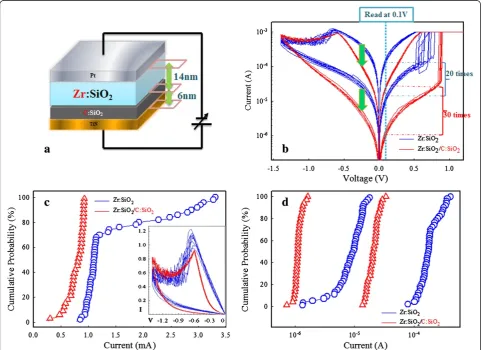
[image:2.595.57.541.334.684.2]A forming process using DC voltage sweeping with a compliance current of 10μA is required to activate all of the RRAM devices. Afterwards, the DC voltage sweeping cycling test is performed to evaluate both types of de-vices. Figure 1b shows that Zr:SiOx/C:SiOx RRAM
devices exhibit smaller working current on both LRS and HRS. It is noted that the single Zr:SiOxlayer device
shows less attractive characteristics during DC sweeping cycles, including smaller ratio between HRS and LRS, unstable set voltage, and lower degree of uniformity in reset process. If we define the read voltage 0.1 V, the on/ off ratios of single- and double-layer devices is 20 and 30, respectively. Meanwhile, from Figure 1c,d, we can see that both the reset voltage and stability between HRS and LRS of Pt/Zr:SiOx/TiN RRAM show wider
dis-tributions compared with Pt/Zr:SiOx/C:SiOx/TiN
struc-ture devices.
Through current fitting, we find that both LRS and HRS of double resistive switching layer devices have hopping conduction mechanism, owing to the introduc-tion of carbon element [43], while single resistive switch-ing layer devices exhibit Poole-Frenkel conduction in HRS and Ohmic conduction in LRS (Figure 2).
After that, we utilize material spectra analyses to find out the reason for better performance. First, XPS is applied, from which we obtain the mole fraction of each element in C:SiOxand Zr:SiOxfilms. The corresponding element ratios
in C:SiOxand Zr:SiOxare C/Si/O = 7.9:27.32:66.19 and Zr/
[image:3.595.60.539.89.276.2]Si/O = 7.49:26.32:66.19, respectively. To better understand Figure 2Current fitting of HRS and LRS of Zr:SiO2and Zr:SiO2/C:SiO2RRAM devices, respectively (a, b).The activation energy of HRS and
LRS for hopping conduction is 74.7 and 47.4 meV, respectively.
Figure 3Raman spectra of C SP2and C SP3in C:SiO
[image:3.595.57.539.479.706.2]the impact of the inserted C:SiOxlayer, it is further analyzed
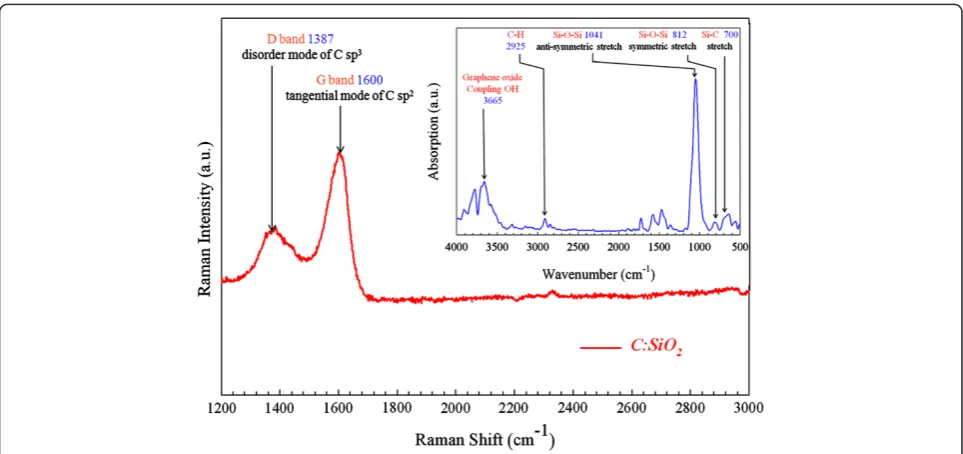
by Raman spectroscopy, from which we find typical gra-phene oxide Raman spectra which is comprised of a higher G band peak and a lower D band peak (Figure 3) [41,47]. In order to further testify the existence of graphene oxide and find its chemical bonding type, FTIR spectroscopy is used to analyze C:SiOxfilm. Graphene oxide coupling OH peak
can be observed at the wavenumber of 3,665 cm−1, as shown in the top right FTIR spectra of Figure 3.
The resistive switching mechanism in Zr:SiOx can be
explained by the stochastic formation and rupture of conduction filaments. This is also the reason why we can find Ohmic conduction mechanism in LRS and Pool-Frenkel conduction mechanism in HRS. As in LRS, electrons conduct through metal filaments from the top electrode to the bottom electrode, and in HRS, electrons conduct through shallow defects between the tip of rup-tured filament and the bottom TiN electrode. Due to the stochastic formation of conduction filament process, sin-gle active layer RRAM device exhibits less stable set voltage and lower degree of uniformity in the reset process.
Comparatively, the C:SiOx film works as the switching
layer, in which the carrier will hop through the carbon atoms within the carbocycle. If the bottom TiN electrode is applied with a negative bias, oxygen atoms are repelled to the reverse direction of TiN electrode and adsorbed by gra-phene oxide. With the adsorption of oxygen atoms, carbon-carbon bonds are stretched and carbocycle is en-larged, which results in longer hopping distance of carriers. The adsorption and desorption of oxygen-containing groups are responsible for the resistive switching in gra-phene oxide-doped silicon RRAM [41-44]. Compared with random formation of conduction filament process, adsorp-tion and desorpadsorp-tion of oxygen-containing groups are more stable, as the movement of oxygen-containing groups is much more directional (to graphene oxide). Meanwhile, conduction path always exists, and the difference is hop-ping distance variation and oxidation rate of graphene oxide. At the top Zr:SiO2layer, the metal filament serves as
the conduction way and has the ability of concentrating the electrical field, which facilitates the adsorption and desorp-tion processes of oxygen chemical groups.
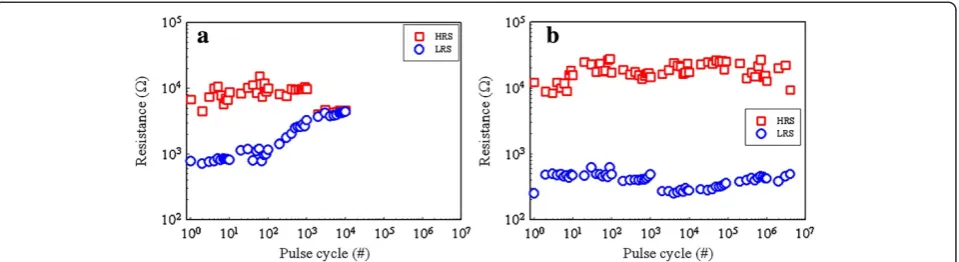
To further evaluate the memory performance, measure-ment of endurance and retention of both kinds of devices is performed. The retention properties of both types of de-vices remain stable even after 104s at 85°C, which satisfy the NVM requirements. The endurance performance is shown in Figure 4. During 104pulse cycles, the HRS and LRS of Zr:SiOxRRAM are short (Figure 4a). While in Zr:
SiOx/C:SiOxRRAM device, it exhibits stable HRS and LRS
even after more than 106pulse cycles (Figure 4b).
Conclusion
In conclusion, by co-sputtering C and Zr with SiO2,
respectively, we fabricated a double resistive switching layer RRAM, which has significantly outstanding per-formance. Both FTIR and Raman spectra confirm the existence of graphene oxide in the switching layer of double active layer RRAM devices. Compared with the stochastic formation of conducting filaments, the ad-sorption and dead-sorption of oxygen atoms from carbo-cycle work much more stable. This is also the reason why Zr:SiOx/C:SiOx structure has superior switching performance and higher stability.
Competing interests
The authors declare that they have no competing interests.
Authors' contributions
RZ and K-CC designed and set up the experimental procedure. T-CC and J-HC planned the experiments and agreed with the paper's publication. T-MT, K-HC, J-CL, and T-FY revised the manuscript critically and made some changes. C-CS fabricated the devices with the assistance of Y-LY and Y-CP. T-JC and S-YH conducted the electrical measurement of the devices. C-HP performed the XPS spectra measurement. Y-TS conducted the FTIR spectra measurement. Y-ES performed the Raman spectra measurement. SMS assisted in the data analysis. All authors read and approved the final manuscript.
Acknowledgements
[image:4.595.60.540.89.220.2]This work was performed at the National Science Council Core Facilities Laboratory for Nano-Science and Nano-Technology in the Kaohsiung-Pingtung area and was supported by the National Science Council of the
Republic of China under contract nos. NSC-102-2120-M-110-001, and NSC 101-2221-E-110-044-MY3.
Author details
1School of Software and Microelectronics, Peking University, Beijing 100871,
People's Republic of China.2Department of Materials and Optoelectronic Science, National Sun Yat-Sen University, Kaohsiung 804, Taiwan. 3
Department of Physics, National Sun Yat-Sen University, Kaohsiung 804, Taiwan.4Advanced Optoelectronics Technology Center, National Cheng Kung University, Tainan 700, Taiwan.5Department of Electronic Engineering and Computer Science, Tung-Fang Design Institute, Kaohsiung, Taiwan. 6
Department of Chemistry, National Kaohsiung Normal University, Kaohsiung, Taiwan.7Department of Mechanical and Electro-Mechanical Engineering, National Sun Yat-Sen University, Kaohsiung, Taiwan.8Department of Electronics Engineering, National Chiao Tung University, Hsinchu, Taiwan.
Received: 22 August 2013 Accepted: 11 October 2013 Published: 21 November 2013
References
1. Nomura K, Ohta H, Takagi A, Kamiya T, Hirano M, Hosono H: Room-temperature fabrication of transparent flexible thin-film transistors using amorphous oxide semiconductors.Nature2004,432:488.
2. Tsai CT, Chang TC, Chen SC, Lo I, Tsao SW, Hung MC, Chang JJ, Wu CY, Huang CY:Influence of positive bias stress on N2O plasma improved
InGaZnO thin film transistor.Appl Phys Lett2010,96:242105.
3. Chen TC, Chang TC, Tsai CT, Hsieh TY, Chen SC, Lin CS, Hung MC, Tu CH, Chang JJ, Chen PL:Behaviors of InGaZnO thin film transistor under illuminated positive gate-bias stress.Appl Phys Lett2010,97:112104. 4. Yabuta H, Sano M, Abe K, Aiba T, Den T, Kumomi H:High-mobility thin-film
transistor with amorphous InGaZnO4channel fabricated by room
temperature rf-magnetron sputtering.Appl Phys Lett2006,89:112123. 5. Chen TC, Chang TC, Hsieh TY, Lu WS, Jian FY, Tsai CT, Huang SY, Lin CS:
Investigating the degradation behavior caused by charge trapping effect under DC and AC gate-bias stress for InGaZnO thin film transistor.
Appl Phys Lett2011,99:022104.
6. Chung WF, Chang TC, Li HW, Chen SC, Chen YC, Tseng TY, Tai YH:
Environment-dependent thermal instability of sol–gel derived amorphous indium-gallium-zinc-oxide thin film transistors.Appl Phys Lett 2011,98:152109.
7. Jeong S, Ha YG, Moon J, Facchetti A, Marks TJ:Role of gallium doping in dramatically lowering amorphous-oxide processing temperatures for solution-derived indium zinc oxide thin-film transistors.Adv Mater2010,
22:1346–1350.
8. Tsao SW, Chang TC, Huang SY, Chen MC, Chen SC, Tsai CT, Kuo YJ, Chen YC, Wu WC:Hydrogen-induced improvements in electrical characteristics of a-IGZO thin-film transistors.Solid State Electron2010,54:1497–1499. 9. Chen TC, Chang TC, Hsieh TY, Tsai CT, Chen SC, Lin CS, Hung MC, Tu CH,
Chang JJ, Chen PL:Light-induced instability of an InGaZnO thin film transistor with and without SiOxpassivation layer formed by
plasma-enhanced-chemical-vapor-deposition.Appl Phys Lett2010,97:192103. 10. Chen WR, Chang TC, Yeh JL, Sze SM, Chang CY:Reliability characteristics
of NiSi nanocrystals embedded in oxide and nitride layers for nonvolatile memory application.Appl Phys Lett2008,92:152114. 11. Yeh PH, Chen LJ, Liu PT, Wang DY, Chang TC:Metal nanocrystals as
charge storage nodes for nonvolatile memory devices.Electrochim Acta 2007,52:2920–2926.
12. Jiang DD, Zhang MH, Huo ZL, Wang Q, Liu J, Yu ZA, Yang XN, Wang Y, Zhang B, Chen JN, Liu M:A study of cycling induced degradation mechanisms in Si nanocrystal memory devices.Nanotechnology2011,22:254009. 13. Pavan P, Bez R, Olivo P, Zanoni E:Flash memory cells - an overview.
Proc IEEE1997,85:8.
14. Bu J, White MH:Design considerations in scaled SONOS nonvolatile memory devices.Solid State Electron2001,45:1.
15. Chang TC, Jian FY, Chen SC, Tsai YT:Developments in nanocrystal memory.Mater Today2011,14:608.
16. Zhen L, Guan W, Shang L, Liu M, Liu G:Organic thin-film transistor memory with gold nanocrystals embedded in polyimide gate dielectric.
J Phys D Appl Phys2008,41:135111.
17. Tsai YT, Chang TC, Lin CC, Chen SC, Chen CW, Sze SM, Yeh FS, Tseng TY:
Influence of nanocrystals on resistive switching characteristic in binary
metal oxides memory devices.Electrochem Solid-State Lett2011,
14:H135–H138.
18. Guan WH, Long SB, Jia R, Liu M:Nonvolatile resistive switching memory utilizing gold nanocrystals embedded in zirconium oxide.Appl Phys Lett 2007,91:062111.
19. Liu Q, Guan WH, Long SB, Jia R, Liu M, Chen JN:Resistive switching memory effect of ZrO2films with Zr+implanted.Appl Phys Lett2008,
92:012117.
20. Syu YE, Chang TC, Tsai TM, Hung YC, Chang KC, Tsai MJ, Kao MJ, Sze SM:
Redox reaction switching mechanism in RRAM device with Pt/CoSiOX/ TiN structure.IEEE Electron Device Lett2011,32:545.
21. Tsai TM, Chang KC, Chang TC, Chang GW, Syu YE, Su YT, Liu GR, Liao KH, Chen MC, Huang HC, Tai YH, Gan DS, Sze SM:Origin of hopping conduction in Sn-doped silicon oxide RRAM with supercritical CO2fluid
treatment.IEEE Electron Device Lett2012,33:1693.
22. Tsai TM, Chang KC, Chang TC, Syu YE, Chuang SL, Chang GW, Liu GR, Chen MC, Huang HC, Liu SK, Tai YH, Gan DS, Yang YL, Young TF, Tseng BH, Chen KH, Tsai MJ, Ye C, Wang H, Sze SM:Bipolar resistive RAM characteristics induced by nickel incorporated into silicon oxide dielectrics for IC applications.IEEE Electron Device Lett2012,33:1696.
23. Chen MC, Chang TC, Tsai CT, Huang SY, Chen SC, Hu CW, Sze SM, Tsai MJ:
Influence of electrode material on the resistive memory switching property of indium gallium zinc oxide thin films.Appl Phys Lett2010,
96:262110.
24. Syu YE, Chang TC, Lou JH, Tsai TM, Chang KC, Tsai MJ, Wang YL, Liu M, Simon M, Sze SM:Atomic-level quantized reaction of HfOxmemristor.
Appl Phys Lett2013,102:172903.
25. Liu M, Abid Z, Wang W, He XL, Liu Q, Guan WH:Multilevel resistive switching with ionic and metallic filaments.Appl Phys Lett2009,
94:233106.
26. Chang KC, Tsai TM, Chang TC, Wu HH, Chen JH, Syu YE, Chang GW, Chu TJ, Liu GR, Su YT, Chen MC, Pan JH, Chen JY, Tung CW, Huang HC, Tai YH, Gan DS, Sze SM:Characteristics and mechanisms of silicon-oxide-based resistance random access memory.IEEE Electron Device Lett2013,34:399–401.
27. Li YT, Long SB, Zhang MH, Liu Q, Zhang S, Wang Y, Zuo QY, Liu S, Liu M:
Resistive switching properties of Au/ZrO2/Ag structure for low voltage
nonvolatile memory applications.IEEE Electron Device Lett2010,
31:117–119.
28. Chang KC, Pan CH, Chang TC, Tsai TM, Zhang R, Lou JC, Young TF, Chen JH, Shih CC, Chu TJ, Chen JY, Su YT, Jiang JP, Chen KH, Huang HC, Syu YE, Gan DS, Sze SM:Hopping effect of hydrogen-doped silicon oxide insert RRAM by supercritical CO2fluid treatment.IEEE Electron Device Lett2013,
34:617–619.
29. Chang KC, Tsai TM, Chang TC, Wu HH, Chen KH, Chen JH, Young TF, Chu TJ, Chen JY, Pan CH, Su YT, Syu YE, Tung CW, Chang GW, Chen MC, Huang HC, Tai YH, Gan DS, Wu JJ, Hu Y, Sze SM:Low temperature improvement method on Zn:SiOx resistive random access memory devices.
IEEE Electron Device Lett2013,34:511–513.
30. Syu YE, Chang TC, Tsai TM, Chang GW, Chang KC, Lou JH, Tai YH, Tsai MJ, Wang YL, Sze SM:Asymmetric carrier conduction mechanism by tip electric field in WSiOx resistance switching device.IEEE Electron Device Lett2012,33(3):342–344.
31. Chang KC, Tsai TM, Zhang R, Chang TC, Chen KH, Chen JH, Young TF, Lou JC, Chu TJ, Shih CC, Pan JH, Su YT, Tung CW, Chen MC, Wu JJ, Hu Y, Sze SM:
Electrical conduction mechanism of Zn:SiOxresistance random access
memory with supercritical CO2fluid process.Appl Phys Lett2013,
103:083509.
32. Chang KC, Zhang R, Chang TC, Tsai TM, Lou JC, Chen JH, Young TF, Chen MC, Yang YL, Pan YC, Chang GW, Chu TJ, Shih CC, Chen JY, Pan CH, Su YT, Syu YE, Tai YH, Sze SM:Origin of hopping conduction in graphene-oxide-doped silicon oxide resistance random access memory devices.
IEEE Electron Device Lett2013,34(5):677–679.
33. Tsai TM, Chang KC, Chang TC, Syu YE, Liao KH, Tseng BH, Sze SM:
Dehydroxyl effect of Sn-doped silicon oxide resistance random access memory with supercritical CO2fluid treatment.Appl Phys Lett2012,
101:112906.
34. Chang KC, Tsai TM, Chang TC, Syu YE, Liao KH, Chuang SL, Li CH, Gan DS, Sze SM:The effect of silicon oxide based RRAM with tin doping.
Electrochem Solid-State Lett2012,15(3):H65–H68.
resistance random access memory by supercritical CO2 fluid treatment.
Appl Phys Lett2011,99(26):263501.
36. Syu YE, Chang TC, Tsai CT, Chang GW, Tsai TM, Chang KC, Tai YH, Tsai MJ, Sze SM:Improving Resistance Switching Characteristics with SiGeOx/
SiGeON Double Layer for Nonvolatile Memory Applications.Electrochem Solid-State Lett2012,14(10):H419–H421.
37. Syu YE, Chang TC, Tsai TM , Chang GW, Chang KC, Tai YH, Tsai MJ, Wang YL, Sze SM:Silicon introduced effect on resistive switching characteristics of WOXthin films.Appl Phys Lett2012,100:022904.
38. Tsai TM, Chang KC, Zhang R, Chang TC, Lou JC, Chen JH, Young TF, Tseng BH, Shih CC, Pan YC, Chen MC, Pan JH, Syu YE, Sze SM:Performance and characteristics of double layer porous silicon oxide resistance random access memory.Appl Phys Lett2013,102(25):253509.
39. Su YT, Chang KC, Chang TC, Tsai TM, Zhang R, Lou JC, Chen JH, Young TF, Chen KH, Tseng BH, Shih CC, Yang YL Chen MC, Chu TJ, Pan CH, Syu YE, Sze SM:Characteristics of hafnium oxide resistance random access memory with different setting compliance current.Appl Phys Lett2013,
103(16):163502.
40. Geim AK, Novoselov KS:The rise of grapheme.Nature Mater2007,6:3. 41. Dreyer DR, Park S, Bielawski CW, Ruoff RS:The chemistry of graphene
oxide.Chem Soc Rev2010,39:1.
42. Zhuge F, Hu B, He C, Zhou X, Liu Z, Li R:Mechanism of nonvolatile resistive switching in graphene oxide thin films.Carbon2011,49:12. 43. Liao SH, Liu PL, Hsiao MC, Teng CC, Wang CA, Ger MD, Chiang CL:
One-step reduction and functionalization of graphene oxide with phosphorus-based compound to produce flame-retardant epoxy nanocomposite.Ind Eng Chem Res2012,51:12.
44. Jug K:A bond order approach to ring current and aromaticity.
J Org Chem1983,48:8.
45. Li Y, Long S, Hangbing L, Liu Q, Wang W, Wang Q, Huo Z, Wang Y, Zhang S, Liu S, Liu M:Reset instability in Cu/ZrO2:Cu/Pt RRAM device.
IEEE Electron Device Lett2011,32:3.
46. Guan W, Long S, Liu Q, Liu M, Wang W:Nonpolar nonvolatile resistive switching in Cu doped ZrO2.IEEE Electron Devices Lett2008,29:5.
47. Chen D, Feng H, Li J:Graphene oxide: preparation, functionalization, and electrochemical applications.Chem Rev2012,112:11.
doi:10.1186/1556-276X-8-497
Cite this article as:Zhanget al.:High performance of graphene
oxide-doped silicon oxide-based resistance random access memory.Nanoscale Research Letters20138:497.
Submit your manuscript to a
journal and benefi t from:
7Convenient online submission
7Rigorous peer review
7Immediate publication on acceptance
7Open access: articles freely available online
7High visibility within the fi eld
7Retaining the copyright to your article