depends on what you hear: temporal averaging and crossmodal integration.
Journal of Experimental Psychology: General 147 (12), pp. 1851-1864.
ISSN 0096-3445.
Downloaded from:
Usage Guidelines:
Please refer to usage guidelines at or alternatively
1
What you see depends on what you hear:
temporal averaging and crossmodal integration
Lihan Chen
1,2,3*, Xiaolin Zhou
1,2,3,4, Hermann J. Müller
5,6, Zhuanghua Shi
5*
1 Center for Brain and Cognitive Sciences and School of Psychological and Cognitive Sciences, Peking University, Beijing, 100871, China.
2 Beijing Key Laboratory of Behavior and Mental Health, Peking University, Beijing, China 3 Key Laboratory of Machine Perception (Ministry of Education), Peking University, Beijing, China 4PKU-IDG/McGovern Institute for Brain Research, Peking University, Beijing China
5 Department Psychologie, LMU Munich, Leopoldstrasse 13, 80802 Munich, Germany
6 Department of Psychological Sciences, Birkbeck College (University of London), Malet Street, London WC1E 7HX, UK
* Authors contributed equally
Running title: temporal rate averaging and crossmodal integration
Conflict of Interest: None
Corresponding author: Chen, Lihan ([email protected])
Author Note
This study was supported by grants from the Natural Science Foundation of China (31200760,
61621136008, 61527804), German DFG project SH166 3/1 and “projektbezogener
Wissenschaftleraustausch” (proWA). The data, and the source code of statistical analysis and
modeling are available at https://github.com/msenselab/temporal_averaging. Part of the study
has been presented as a talk in 17th International Multisensory Research Forum (IMRF, June
2
Abstract
In our multisensory world, we often rely more on auditory information than on visual
input for temporal processing. One typical demonstration of this is that the rate of auditory
flutter assimilates the rate of concurrent visual flicker. To date, however, this auditory
dominance effect has largely been studied using regular auditory rhythms. It thus remains
unclear whether irregular rhythms would have a similar impact on visual temporal processing;
what information is extracted from the auditory sequence that comes to influence visual
timing; and how the auditory and visual temporal rates are integrated together in quantitative
terms. We investigated these questions by assessing, and modeling, the influence of a
task-irrelevant auditory sequence on the type of ‘Ternus apparent motion’: group motion
versus element motion. The type of motion seen critically depends on the time interval
between the two Ternus display frames. We found that an irrelevant auditory sequence
preceding the Ternus display modulates the visual interval, making observers perceive either
more group motion or more element motion. This biasing effect manifests whether the
auditory sequence is regular or irregular, and it is based on a summary statistic extracted from
the sequential intervals: their geometric mean. However, the audiovisual interaction depends
on the discrepancy between the mean auditory and visual intervals: if it becomes too large, no
interaction occurs – which can be quantitatively described by a partial Bayesian integration
model. Overall, our findings reveal a crossmodal perceptual averaging principle that may
underlie complex audiovisual interactions in many everyday dynamic situations.
Keywords:Perceptual averaging; Auditory timing; Visual apparent motion; Multisensory
3
Public Significance Statement
The present study shows that auditory rhythms, regardless of their regularity, can
influence the way in which the visual system times (subsequently presented) events, thereby
altering dynamic visual (motion) perception. This audiovisual temporal interaction is based
on a summary statistic derived from the auditory sequence: the geometric mean interval,
which is then combined with the visual interval in a process of partial Bayesian integration
(where integration is unlikely to occur if the discrepancy between the auditory and visual
intervals is too large). We propose that this crossmodal perceptual averaging principle
4
Most stimuli and events in our everyday environments are multisensory. It is thus no
surprise that our brain often combines a heard sound with a seen stimulus source, even if they
are in conflict. One typical such phenomenon, in a performance we enjoy, is the ventriloquism
effect (Chen & Vroomen, 2013; Occelli, Bruns, Zampini, & Roder, 2012; Recanzone, 2009;
Slutsky & Recanzone, 2001): we perceive the ventriloquist’s voice as coming from the mouth
of a dummy as if it was the dummy that is speaking. Of note in the present context,
audiovisual integration has not only been demonstrated in spatial localization, but also in the
temporal domain. In contrast to the dominance of vision in audiovisual spatial perception,
audition dominates temporal processing, such as in rhythms and intervals. As an example,
think of how we tend to ‘auditorize’ a conductor’s arm movements coordinating a musical
passage, or Morse code flashes emanating from a naval ship. In fact, neuroscience evidence
has revealed that information for time estimation is encoded in the primary auditory cortex for
both visual and auditory events (Kanai, Lloyd, Bueti, & Walsh, 2011). This is consistent with
the proposal that the perceptual system automatically abstracts temporal structure from
rhythmic visual sequences and represents this structure using an auditory code (Guttman,
Gilroy, & Blake, 2005).
Another compelling demonstration of how auditory rhythm influences visual tempo is
known as the auditory driving effect (Boltz, 2017; Gebhard & Mowbray, 1959; Knox, 1945;
Shipley, 1964): the phenomenon that variations in auditory flutter rate may noticeably
influence the rate of perceived visual flicker. This influence, though, is dependent on the
disparity between the auditory and visual rates (Recanzone, 2003). Quantitatively, this
influence has been described by a Bayesian model of audiovisual integration (Roach, Heron,
& McGraw, 2006), which assumes that the brain takes into account prior knowledge about the
discrepancy between the auditory and visual rates in determining the degree of audiovisual
integration. Auditory driving is a robust effect that generalizes across different types of tasks,
including temporal adjustment and production (Myers, Cotton, & Hilp, 1981) and perceptual
discrimination (Welch, DuttonHurt, & Warren, 1986), and it may even be seen in the effect of
one single auditory interval on a subsequent visual interval (Burr, Della Rocca, & Morrone,
2013).
5
regular rhythms, the implicit assumption being that the mean auditory rate influences the
mean visual rate. On the other hand, studies on ensemble coding (Alvarez, 2011; Ariely,
2001) suggest that perceptual averaging can be rapidly accomplished even from a set of
variant objects or events; for example, we can quickly estimate the average size of apples in a
supermarket display, or the average tempo of a piece of music. With regard to the present
context, audiovisual integration, it remains an open question how the average tempo in
audition quantitatively influences the temporal processing of visual events – an issue that
becomes prominent as the mechanisms underlying perceptual averaging processes themselves
are still a matter of debate. There is evidence that the mental scales underlying the
representation of magnitudes (e.g., visual numerosity and temporal durations) are non-linear
rather than linear (Allan & Gibbon, 1991; Dehaene, Izard, Spelke, & Pica, 2008; Nieder &
Miller, 2003). It has also been reported that, in temporal bisection (i.e., comparing one
interval to two reference intervals), the subjective mid-point between one short and one long
reference duration is closer to their geometric, rather than their arithmetic, mean (Allan &
Gibbon, 1991). However, it remains to be established whether temporal rate averaging obeys
the principle of the arithmetic mean or the geometric mean, which might have implications
for a broad range of mechanisms coding ‘magnitude’ in perception (Walsh, 2003).
On these grounds, the aim of the present study was to quantify temporal rate averaging
in a crossmodal, audiovisual scenario using irregular auditory sequences. To this end, we
adopted and extended the Ternus temporal ventriloquism paradigm (Shi, Chen, & Müller,
2010), which we used previously to investigate crossmodal temporal integration. In the
standard Ternus temporal ventriloquism paradigm, two auditory beeps are paired with two
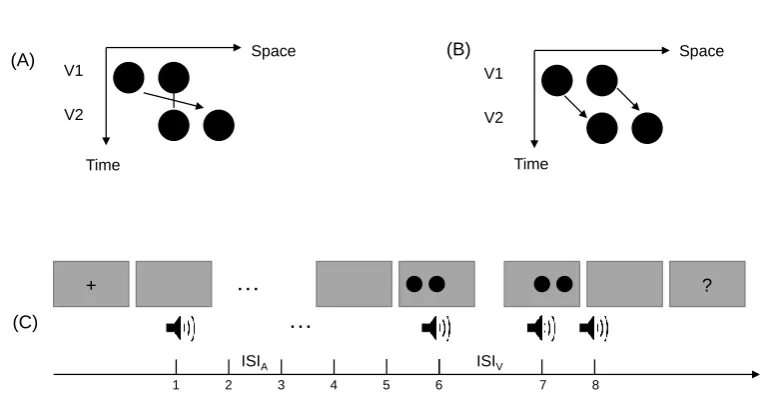
visual Ternus frames. Visual Ternus displays (see Figure 1) can elicit two distinct percepts of
visual apparent motion: element or group motion, where the type of apparent motion is
mainly determined by the visual inter-stimulus interval (ISIV) between the two display frames
(with other stimulus settings being fixed). Element motion is typically observed with short
ISIV (e.g., of 50 ms), and group motion with long ISIV (e.g., of 230 ms) (see Figure 1A, 1B).
When two beeps are presented in temporal proximity to, or synchronously with, the two
visual frames, the beeps can systematically bias the transition threshold between the two types
6
shorter than the visual interval) or towards group motion (if ISIA is longer than the visual
interval) (Shi et al., 2010). Similar temporal ventriloquism effects have also been found with
other tasks, such as temporal order judgments (for a review, see Chen & Vroomen, 2013).
Here, we extended the Ternus temporal ventriloquism paradigm by presenting a whole
sequence of beeps prior to the Ternus display frames, in addition to the two beeps paired with
Ternus frames (see Figure 1C; recall that previous studies had presented just the latter two
beeps) to examine the influence of the temporal averaging of auditory intervals on visual
apparent motion.
Experiment 1 was designed, the first instance, to demonstrate an auditory driving effect
using this new paradigm. In Experiment 2, we went on to examine whether temporal
averaging with irregular auditory sequences would have a similar impact on visual apparent
motion. In Experiment 3, we manipulated the variability of the auditory sequence to examine
for (and quantify) influences of the variability of the auditory intervals on visual apparent
motion. In Experiment 4, we further determined which types of temporal averaging statistics,
the arithmetic or the geometric mean of the auditory intervals, influences visual Ternus
apparent motion. And Experiment 5 was designed to rule out a potential confound, namely, a
‘recency’ effect – with the last auditory interval dominating the Ternus motion percept – in
the crossmodal temporal averaging. Finally, we aimed to identify the computational model
that best describes the crossmodal temporal interaction: mandatory full Bayesian integration
versus partial integration (Ernst & Banks, 2002; Roach et al., 2006).
Materials and Methods
Participants
A total of eighty-four participants (21, 22, 16, 12, 12 in Experiments 1-5; ages ranging
from 18–33 years) took part in the main experiments. All observers had normal or
corrected-to-normal vision and reported normal hearing. The experiments were performed in
compliance with the institutional guidelines set by the Academic Affairs Committee of the
Department of Psychology, Peking University (approved protocol of “#Perceptual averaging
7
institutional guidelines prior to participating and were paid for their time on a basis of 20
CNY/hour.
The number of participants recruited for Experiments 1 and 2 was based on the effect
size in our previous study of the temporal Ternus ventriloquism effect (Shi et al., 2010),
where the pairing of auditory beeps with the visual Ternus displays yielded a Cohen’s d
greater than 1 for the modulation of the Ternus motion percept. We thus used a conservative
effect size of 0.25 and a power of 0.8 for the estimation and recruited more than the estimated
sample size (of 15 participants). Given that the effects we aimed to examine turned out quite
reliable, we used a standard sample size of 12 participants in Experiments 4 and 5.
Apparatus and Stimuli
The experiments were conducted in a dimly lit (luminance: 0.09 cd/m2) cabin. Visual
stimuli were presented in the central region of a 22-inch CRT monitor (FD 225P), with a
screen resolution of 1024 x 768 pixels and a refresh rate of 100 Hz. Viewing distance was 57
cm, maintained by using a chin rest.
A visual Ternus display consisted of two stimulus frames, each containing two black
discs (l0.24 cd/m2; disc diameter and separation between discs: 1.6° and 3° of visual angle,
respectively) presented on a gray background (16.1 cd/m2). The two frames shared one
element location at the center of the monitor, while containing two other elements located at
horizontally opposite positions relative to the center (see Figure 1). Each frame was presented
for 30 ms; the inter-stimulus interval (ISIV) between the two frames was randomly selected
8
Figure 1.Ternus display and stimulus configurations. Two alternative motion percepts of the
Ternus display: (A): ‘element’ motion for short ISIs, with the middle dot perceived as
remaining static while the outer dots are perceived to move from one side to the other. (B)
‘group’ motion for long ISIs, with the two dots perceived as moving in tandem. (C) Schematic
illustration of the stimulus configurations used in the experiments. The auditory sequence
consisted of 8 to 10 beeps. Two of the beeps (the 6th and the 7th) were synchronously paired
with two visual Ternus frames which were separated by a visual ISI (ISIV(isual)) that varied
from 50 to 230 ms (for the critical beeps, ISIV(isual) = ISIA(ditory)). The other auditory ISIs
(ISIA(ditory)) were systematically manipulated such that the mean of the ISIA preceding the
visual Ternus display was 50–70 ms shorter than, equal to, or 50–70 ms longer than the
transition threshold between the element- and group-motion percepts of the visual Ternus
events. The transition threshold was first estimated individually for each observer in a
pre-test session. During the experiment, observers were simply asked to indicate the type of
visual motion (‘element’ or ‘group’) that they had perceived, while ignoring the beeps.
Mono sound beeps (1000 Hz, 65 dB, 30 ms) were generated and delivered via an
M-Audio card (Delta 1010) to a headset (Philips, SHM1900). To ensure accurate timing of
the auditory and visual stimuli, the duration of the visual stimuli and the synchronization of
the auditory and visual stimuli were controlled via the monitor’s vertical synchronization
V1
V2
Space
Time
Space
Time V1
V2
(A) (B)
(C)
+ … ?
…
1 2 3 4 5 6 7 8
9
pulses. The experimental program was written with Matlab (Mathworks Inc.) and the
Psychophysics Toolbox (Brainard, 1997).
Experimental Design
Practice
Prior to the formal experiment, participants were familiarized with visual Ternus
displays of either typical element motion (with an ISIV of 50 ms) or typical group motion
(ISIV of 260 ms) in a practice block. They were asked to discriminate the two types of
apparent motion by pressing the left or the right mouse button, respectively. The mapping
between response button and type of motion was counterbalanced across participants. During
practice, when a response was made that was inconsistent with the typical motion percept,
immediate feedback appeared on the screen showing the typical response (i.e., element or
group motion). The practice session continued until the participant reached a conformity of
95%. All participants achieved this criterion within 120 trials, given that the two extreme ISIs
used (50 and 260 ms, respectively) gave rise to non-ambiguous percepts of either element
motion or group motion.
Pre-test
For each participant, the transition threshold between element and group motion was
determined in a pre-test session. A trial began with the presentation of a central fixation cross
for 300 to 500 ms. After a blank screen of 600 ms, the two Ternus frames were presented
synchronized with two auditory tones (i.e., baseline: ISIV = ISIA); this was followed by a
blank screen of 300 to 500 ms, prior to a screen with a question mark prompting the
participant to make a two-forced-choice response indicating the type of perceived motion
(element or group motion). The ISIV between the two visual frames was randomly selected
from one of the following seven intervals: 50, 80, 110, 140, 170, 200, and 230 ms. There were
40 trials for each level of ISIV, counterbalanced with left- and rightward apparent motion. The
presentation order of the trials was randomized for each participant. Participants performed a
total of 280 trials, divided into 4 blocks of 70 trials each. After completing the pre-test, the
psychometric curve was fitted to the proportions of group motion responses across the seven
intervals (see Data Analysis and Modeling). The transition threshold, that is, the point of
10
percepts, was calculated by estimating the ISI at the point on the fitted curve that
corresponded to 50% of group motion reports. The just noticeable difference (JND), an
indicator of the sensitivity of apparent motion discrimination, was calculated as half of the
difference between the lower (25%) and upper (75%) bounds of the thresholds from the
psychometric curve.
Main Experiments
In the main experiments, the procedure of visual stimulus presentation was the same as
in the pre-test session, except that prior to the occurrence of the two Ternus display frames, an
auditory sequence consisting a variable number of 6–8 beeps was presented (see below for the
details of the onset of the Ternus display frames relative to that of the auditory sequence). As
in the pre-test, the onset of the two visual Ternus frames (each presented for 30 ms) was
accompanied by a (30-ms) auditory beep (i.e., ISIV = ISIA). A trial began with the
presentation of a central fixation marker, randomly for 300 to 500 ms. After a 600-ms blank
interval, the auditory train and the visual Ternus frames were presented (see Figure 1c),
followed sequentially by a blank screen of 300 to 500 ms and a screen with a question mark at
the screen center prompting participants to indicate the type of motion they had perceived:
element versus group motion (non-speeded response). Participants were instructed to focus on
the visual task, ignoring the sounds. After the response, the next trial started following a
random inter-trial interval of 500 to 700 ms.
In Experiment 1 (regular sound sequence), the audiovisual Ternus frames was preceded
by an auditory sequence of 6–8 beeps with a constant inter-stimulus interval (ISIA),
manipulated to be 70 ms shorter than, equal to, or 70 ms longer than the transition threshold
estimated in the pre-test. The total auditory sequence consisted of 8–10 beeps, including those
accompanying the two visual Ternus frames, with the latter being inserted mainly at the 6th–
7th positions, and followed by 0–2 beeps (number selected at random), to minimize
expectations as to the onset of the visual Ternus frames. Visual Ternus frames were presented
on 75% of all trials (504 trials in total). The remaining 25% were catch trials (168 trials) to
break up anticipatory processes. All trials were randomized and organized in 12 blocks, each
of 56 trials. The ISIV between the two visual Ternus frames was randomly selected from one
11
In Experiment 2 (irregular sound sequence), the settings were the same as in
Experiment 1, except that the auditory trains were irregular: the ISIA between adjacent beeps
in the auditory train (except the ISIA between the beeps accompanying the visual Ternus
frames) were varied ±20 ms uniformly and randomly around (i.e., they were either 20 ms
shorter or 20 ms longer than) a given mean interval (three levels: 70 ms shorter than, equal to,
or 70 ms longer than the individual transition threshold).
Experiment 3 introduced two levels of variability in the auditory-interval sequences
with 8–10 beeps: a low coefficient of variance (CV, the standard deviation divided by the
mean) of 0.1 and, respectively, a high CV of 0.3. For each CV condition, three arithmetic
mean intervals were used: 50 ms shorter than, equal to, or 50 ms longer than the estimated
transition threshold. The intervals were randomly generated from a normal distribution with a
given mean and CV. The number of the experimental trials was 1008, and the catch trials
totaled 336. All trials were randomized and organized in 24 blocks, each block containing 56
trials.
Experiment 4 used three types of auditory sequences, each consisting of 6 intervals: (i)
Baseline auditory sequence: three intervals, of 110, 140, and 170 ms, were repeated twice in
random order; in this baseline condition, the arithmetic mean (AM = 140 ms) was near-equal
to the geometric mean (GM = 138 ms). (ii) AM-deviated sequence: 6 intervals were
constructed from ISIA of 70, 140, and 280 ms, which were arranged randomly (AM = 163 ms
> GM = 140 ms); (iii) GM-deviated sequence: 6 intervals constructed from ISIA 50, 140, and
230 ms, arranged randomly (GM = 117 ms < AM = 140 ms). The audiovisual Ternus frames
were appended at the end of these sequences. The number of experimental trials was 504
(there were no catch trials), which were presented randomized and organized in 12 blocks,
each of 42 trials.
To exclude potential confounding by a recency effect, in Experiment 5, we compared
two auditory sequences: one with a geometric mean 70 ms shorter than the transition
threshold of visual Ternus motion (henceforth referred to as ‘Short’ condition), and the other
with a geometric mean 70 ms longer than the transition threshold (‘Long’ condition). Instead
of completely randomizing the five auditory intervals (excepting the final synchronous
12
the Ternus display was fixed at the transition threshold for both sequences. The remaining
four intervals were chosen randomly such that the CV of the auditory sequence was in the
range between 0.1 and 0.2. This manipulation was expected to minimize the influence of any
potential recency effect engendered by the last auditory interval. The audiovisual Ternus
frames were appended at the end of these sequences on trials (i.e., 672 out of a total of 784
trials) on which the Ternus display appeared at the end of the sound sequence (the ‘onset’ of
the first visual frame was synchronized with 6th beep). The remaining (112) trials were catch
trials, with 56 trials each on which the Ternus displays occurred at the beginning of the sound
sequence (i.e., the onset of the first visual frame was synchronized with the second beep) or,
respectively, at middle temporal locations (i.e., the onset of the first visual frame was
synchronized with the 4th beep). These catch trials were introduced to prevent participants
from consistently anticipating the visual events to occur at the end of the sound sequence. The
total 784 trials were randomized and organized in 14 blocks, each of 56 trials.
Data analysis and Modeling
We used the R package Quickpsy (Linares & López-Moliner, 2016) to fit psychometric
curves with upper and lower asymptotes, which provide better estimates of the thresholds
(Wichmann & Hill, 2001). Bayesian modeling was also conducted with R. We first calculated
the response proportions for the baseline tests with (audio-) visual Ternus apparent motion
and for the formal experiments, as well as fitting the corresponding cumulative Gaussian
psychometric functions. Based on the psychometric functions, we could then estimate the
discrimination variability of Ternus apparent motion (i.e., 𝜎𝑚) based on the standard
deviation of the cumulative Gaussian function. The parameters of the Bayesian models (see
Bayesian modeling section below) were estimated by minimizing the prediction errors using
the R optim function. Our raw data together with the source code of statistical analyses and
Bayesian modeling are available at the github repository:
https://github.com/msenselab/temporal_averaging.
13
Experiments 1 and 2: Both regular and irregular auditory intervals alter the visual
motion percept.
We manipulated the intervals between successive beeps (i.e., the ISIA prior to the Ternus
display) to be either regular or irregular, but with their arithmetic mean being either 70 ms
shorter, equal to, or 70 ms longer than the transition threshold (measured in the pre-test)
between element- and group-motion reports (for both regular and irregular ISIA). Auditory
sequences with a relatively long mean auditory interval, as compared to a short interval, were
found to elicit more reports of group motion, as indicated by the smaller PSEs (Figure 2), for
both regular intervals, F(2,40)=12.22, p<0.001, 𝜂𝑔2 = 0.112, and irregular intervals,
F(2,42)=8.25, p<0.001, 𝜂𝑔2=0.04. That is, the perceived visual interval (which determines the
ensuing motion percept) was assimilated by the average of the preceding auditory intervals,
regardless of whether the auditory intervals were regular or irregular. Post-hoc Bonferroni
comparison tests revealed that this assimilation effect was mainly driven by the short auditory
intervals in both experiments: ps were 0.001, 0.00001, and 0.57 for the comparisons -70 vs. 0
ms, -70 vs. 70 ms, and, respectively, 0 vs. 70 ms for the regular intervals; and 0.015, 0.0002,
0.77 for the comparisons of the irregular intervals (Figure 2C and 2D).
0.00 0.25 0.50 0.75 1.00
50 100 150 200
ISI (ms) P ro p . o f g ro u p m o ti o n −70 0 70 A 0.00 0.25 0.50 0.75 1.00
50 100 150 200
ISI (ms) P ro p . o f g ro u p m o ti o n −70 0 70 B * * 100 120 140 160
−70 0 70
Relative mean auditory interval (ms)
P S E s ( m s ) C * * 100 120 140 160
−70 0 70
Relative mean auditor y interval (ms)
14
Figure 2. The average means of both regular and irregular auditory sequences influence
the visual motion percept. (A) Regular auditory-sequence condition: For a typical
participant, mean proportions of group-motion responses as a function of the probe visual
interval (ISIv), and fitted psychometric curves, for auditory sequences with different
(arithmetic) mean intervals relative to the individual transition thresholds; the
relative-interval labels (-70, 0, and 70) denote the three conditions of the mean auditory
interval being 70 ms shorter than, equal to, and 70 ms longer than the pre-test transition
threshold, respectively. (B) Irregular auditory-sequence condition: for a typical participant,
mean proportions of group-motion responses and fitted psychometric curves. (C) Mean PSEs
as a function of the relative auditory interval for the regular-sequence condition; error bars
represent standard errors of the means. (D) Mean PSEs as a function of the relative auditory
interval for the irregular-sequence condition; error bars represent standard errors of the
means.
The fact that a crossmodal assimilation effect was obtained even with irregular auditory
sequences suggests that the effect is unlikely due to temporal expectation, or a general effect
of auditory entrainment (Jones, Moynihan, MacKenzie, & Puente, 2002; Large & Jones,
1999). In addition, the assimilation effect observed is unlikely due to a recency effect. To
examine for such an effect, we split the trials into two categories according to the auditory
interval that just preceded the visual Ternus interval: short and long preceding intervals with
reference to the auditory mean interval. The length of the immediately preceding interval
failed to produce any significant modulation of apparent visual motion, F(1, 22) = 2.14, p =
0.15. An account in terms of a recency effect was further ruled out by a dedicated control
experiment that directly fixed the last auditory interval (see Experiment 5 below).
Furthermore, in the regular condition, the mean JNDs (±SE) for the three ISIV conditions
[34.9 (±3.1), 30.5 (±3.4), and 28.4 (±2.9) ms for the ISIV 70 ms shorter, equal to, and,
respectively, 70 ms longer relative to the transition threshold] were larger than the JND for
the threshold (baseline) condition (18.8 (±1.2) ms; p=0.001, p=0.002, and p=0.033 for the
shorter, equal, and longer conditions vs. the 'threshold'), without differing amongst
15
p=0.001, 30.6 (±2.3), p=0.005, and 27.2 (±2.2) ms compared to the baseline 18.6 (±2.1) ms,
without differing amongst themselves (all ps>0.1). The worsened sensitivities in the three
conditions with auditory beep trains suggest that the assimilation effect observed here was not
attributable to attentional entrainment, as attentional entrainment would have been expected
to enhance the sensitivity.
Experiment 3: Variability of auditory intervals influences visual Ternus apparent
motion.
According to quantitative models of multisensory integration (Ernst & Di Luca, 2011;
Shi, Church, & Meck, 2013), the strength of the assimilation effect would be determined by
the variability of both the auditory intervals and the visual Ternus interval, assuming that
information is integrated from all intervals. According to optimal full integration, high
variance of the auditory sequence would result in a low auditory weight in audiovisual
integration, leading to a weaker assimilation effect compared to low variance. To examine for
effects of the variance of the auditory intervals on visual Ternus apparent motion, we directly
manipulated the relative standard deviation of the auditory intervals while fixing their
arithmetic mean. One key property of time perception is that it is scalar (Church, Meck, &
Gibbon, 1994; Gibbon, 1977), that is, the estimation error increases linearly as the time
interval increases, approximately following Weber’s law. Given this, we used coefficients of
variance (CVs), that is, the ratio of the standard deviation to the mean, to manipulate
standardized variability across multiple auditory intervals. Specifically, we compared a low
CV (0.1) with a high CV (0.3) condition, with an orthogonal variation of the (arithmetic)
mean auditory interval: 50 ms shorter, equal to, or 50 ms longer than the pre-determined
transition threshold.
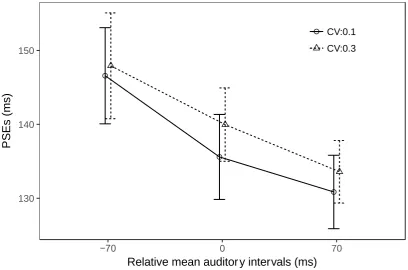
The main effect of mean interval was significant, F(2,30)=11.8, p<0.001, 𝜂𝑔2 =
0.078, with long intervals leading to more reports of group motion (i.e., lower PSEs: mean
PSE of 132±4.6 ms), short intervals to fewer reports of group motion (i.e., higher PSEs: mean
PSE of 147±6.7 ms), and equal intervals to an intermediate proportion of group-motion
reports (mean PSE of 138±5.3 ms). Post-hoc Bonferroni comparisons revealed this pattern to
16
and equal intervals (p<0.01) and the short and long intervals (p<0.001), but not between the
equal and long intervals (p = 0.49). Interestingly, the main effect of CV was significant
(though the effect size is small), F(1,15) = 5.29, p<0.05, 𝜂𝑔2 = 0.044, while the interaction
between mean interval and CV was not, F(2, 30)=0.31, p=0.73, 𝜂𝑔2 = 0.0008 (Figure 3).
Further examination for a (potentially confounding) recency effect, adopting the same
comparison as for the previous experiments, yielded no evidence that the main effects we
obtained are attributable to the length of the auditory interval immediately preceding the
visual interval, F(1,15) = 0.33, p = 0.55.
Figure 3. PSEs between element- and group-motion reports for auditory beep trains with a
low and a high coefficient of (auditory-interval) variance (CV, 0.1 or 0.3), as a function of the
(arithmetic) mean auditory interval (50 ms shorter, equal to, or 50 ms longer than the pre-test
transition threshold).
These results are interesting in two respects. First, according to mandatory, full Bayesian
integration (see Modeling section below for details), auditory-interval variability should affect
the weights of the crossmodal temporal integration (Buus, 1999; Shi et al., 2013), with greater
variance lessening the influence of the average auditory interval. Accordingly, the slopes of
130 140 150
−70 0 70
Relative mean auditor y intervals (ms)
P
S
E
s
(
m
s
)
CV:0.1
[image:17.595.94.503.288.558.2]17
the fitted lines in Figure 2 would be expected to be flatter under the high compared to the low
CV condition, yielding an interaction between mean interval and CV. The fact that this
interaction was non-significant suggests that the ensemble mean of the auditory intervals is
not fully integrated with the visual interval (we will return to this point in the next, Modeling
section). Second, the downward shift of the PSEs in the low, compared to the high, CV
condition indicates that the perceived auditory mean interval (that influences the audio-visual
integration) is actually not the arithmetic mean (‘AM’) that we manipulated. An alternative
account of this shift may derive from the fact the auditory sequences with higher CV have a
lower geometric mean (‘GM’) than the sequences with low variance, that is: the perceived
ensemble mean is likely geometrically encoded. Experiment 4 was designed to address this
(potential) confound by directly comparing the effects of ensemble coding based on the
geometric versus the arithmetic mean.
Experiment 4: Perceptual averaging of auditory intervals assimilates the visual interval
towards the geometric, rather than the arithmetic, mean.
In Experiment 4, we compared three types of auditory sequence in our audiovisual
Ternus apparent motion paradigm: a baseline sequence, an AM-deviated sequence, and a
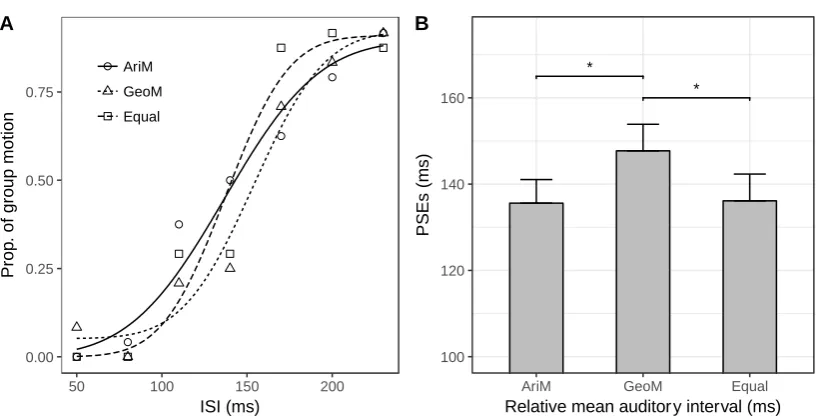
GM-deviated sequence.The PSEs were 136 (±5.46), 148 (±6.17), and 136 (±6.2) ms for the
AM-deviated (AriM), the GM-deviated (GeoM), and the baseline conditions, respectively,
F(2, 22)=8.81, p<0.05, ηg2 = 0.08 (Figure 4). Bonferroni-corrected comparisons revealed the
transition threshold to be significantly larger for the GeoM compared to the baseline
condition, p<0.01, whereas there was no difference between the AriM and the baseline
condition, p=1. This pattern indicates that ensemble coding of the auditory interval
18
Figure 4. Auditory geometric mean assimilates visual Ternus apparent motion. (A) For a
typical participant, mean proportions of group-motion responses as a function of the probe
visual interval (ISIv), and fitted psychometric curves, for the three auditory-sequence
conditions: (i) sequence of intervals with larger arithmetic mean (AriM); (ii) sequence of
intervals with smaller geometric mean (GeoM); (iii) baseline sequence with equal arithmetic
and geometric means (140 ms). (B) Mean PSEs (with error bars representing standard errors
of the means) for the three auditory-sequence conditions. Compared to the baseline sequence,
the GeoM sequence (with the smaller geometric mean) produced a significant shift of the
visual transition threshold, whereas the AriM sequence (with the larger arithmetic mean) did
not.
Experiment 5: Auditory sequences with the last interval fixed
In Experiments 1–3, we split the data according to the last interval (i.e., the interval
preceding the visual Ternus display) of the auditory sequence into two categories (short vs.
long), which failed to reveal any influence of the last interval. In Experiment 5, we formally
manipulated the last interval by fixing it at the respective transition threshold for the ‘Short’
and ‘Long’ auditory sequences (i.e., sequences with the smaller and, respectively, larger
geometric means). Figure 5 depicts the responses of a typical participant from Experiment 5.
The PSEs were 153.1 (±7.3) and, respectively, 137.9 (±9.1) for the ‘Short and ‘Long’
conditions, respectively, t(11)=3.640, p<0.01. That is, reports of element motion were more 0.00
0.25 0.50 0.75
50 100 150 200
ISI (ms) P ro p . o f g ro u p m o ti o n AriM GeoM Equal A * * 100 120 140 160
AriM GeoM Equal Relative mean auditor y interval (ms)
[image:19.595.94.503.73.283.2]19
dominant in the ‘Short’ than in the ‘Long’ condition, replicating the findings of the previous
experiments. In other words, it was the mean auditory interval, rather than the last interval
(prior to the Ternus frames), that assimilated visual Ternus apparent motion. Given this, the
[image:20.595.219.375.172.329.2]audiovisual interactions we found here are unlikely attributable to a recency effect.
Figure 5. Mean proportions of group-motion responses from a typical participant as a
function of the probe visual interval (ISIv), and fitted psychometric curves, for the two
geometric mean conditions: the ‘Short’ sequence (with the smaller geometric mean) and the
‘Long’ sequence (with the larger geometric mean).
Bayesian modeling
To account for the above findings, we implemented, and compared two variants of
Bayesian integration models: mandatory full Bayesian integration and partial Bayesian
integration. If the ensemble-coded auditory-interval mean (𝐴) and the audiovisual Ternus
display interval (𝑀) are fully integrated according to the maximum likelihood estimation
(MLE) principle (Ernst & Banks, 2002), and both are normally distributed (e.g., fluctuating
due to internal Gaussian noise) – that is: 𝐴 ∼ 𝑁(𝐼𝑎, 𝜎𝑎), 𝑀 ∼ 𝑁(𝐼𝑚, 𝜎𝑚) – the expected
optimally integrated audio-visual interval, which yields minimum variability, can be predicted
as follows:
𝐼^𝑓𝑢𝑙𝑙 = 𝑤𝐼𝑎+ (1 − 𝑤)𝐼𝑚, (1)
where 𝑤 =𝜎1 𝑎2/(
1 𝜎𝑎2+
1
𝜎𝑚2) is the weight of the averaged auditory interval, which is
proportional to its reliability. Note that full optimal integration is typically observed when the 0.00
0.25 0.50 0.75 1.00
50 100 150 200
20
two ‘cues’ are close to each other, but it breaks down when their discrepancy becomes too
large (Kording et al., 2007; Parise, Spence, & Ernst, 2012; Roach et al., 2006). In our study,
the Ternus interval and the mean auditory interval could differ substantially on some trials
(e.g., visual interval of 50 ms paired with mean auditory interval of 210 ms). Given this, a
more appropriate model would need to take a ‘discrepancy’ prior and the causal structure
(Kording et al., 2007) of audio-visual temporal integration into consideration. Thus, similar to
(Roach et al., 2006), here we assume that the probability of full integration 𝑃𝑎𝑚 depends on
the discrepancy between the mean auditory and Ternus intervals:
𝑃𝑎𝑚∼ 𝑒−(𝐼𝑎−𝐼𝑚)2/𝜎𝑎𝑚2 , (2)
where 𝜎𝑎𝑚2 is the variance of the sensory measures of the discrepancy between the ensemble
mean of the auditory intervals and the visual interval. 𝑃𝑎𝑚 will vary from trial to trial,
depending on the discrepancy between the mean auditory interval and the visual interval.
Thus, a more general, partial integration model would predict:
𝐼^𝑎𝑣 = 𝑃𝑎𝑚𝐼^𝑓𝑢𝑙𝑙+ (1 − 𝑃𝑎𝑚)𝐼𝑣. (3)
Combined with equation (1), equation (3) can be simplified as follows:
𝐼^𝑎𝑣 = (1 − 𝑤𝑃𝑎𝑚)𝐼𝑣+ 𝑤𝑃𝑎𝑚𝐼𝑎. (4)
To compare the full-integration and partial-integration models, we took into account the
data from those of our experiments that manipulated the auditory-interval regularity and
variability (Experiments 1–3; we excluded Experiments 4 and 5, as these did not include a
baseline task of Ternus apparent-motion perception; see Methods section). Given that the
baseline task provided an estimate of 𝜎𝑚, there is one parameter – 𝜎𝑎 – for the
full-integration model and two parameters – 𝜎𝑎 and 𝜎𝑎𝑚 – for the partial-integration model,
which require parameter fitting. This was carried out using the optimization algorithm
L-BFGS in R (see our source code at https://github.com/msenselab/temporal_averaging). We
assessed the goodness of the resulting fits by means of coefficients of determination (𝑅2) and
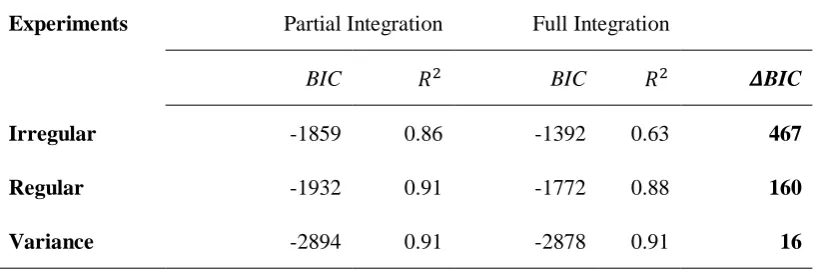
Bayesian information criteria (BIC). The BIC and 𝑅2 scores are presented in Table 1. As can
21
experiments, clearly favoring the partial-integration model (Kass & Raftery, 1995). The 𝑅2
[image:22.595.95.502.190.325.2]values also confirms this.
Table 1. Model comparison using BIC and 𝑹𝟐 for the partial- and full-integration model
Experiments Partial Integration Full Integration
BIC 𝑅2 BIC 𝑅2 𝜟BIC
Irregular -1859 0.86 -1392 0.63 467
Regular -1932 0.91 -1772 0.88 160
Variance -2894 0.91 -2878 0.91 16
Note. The differential BICs scores revealed the partial-integration model to outperform
the full-integration model across all experiments (very strong evidence in all
experiments: 𝜟BIC >10).
To visualize how well the partial-integration model predicts behavioral performance, we
calculated the predicted mean responses based on the partial-integration model for individual
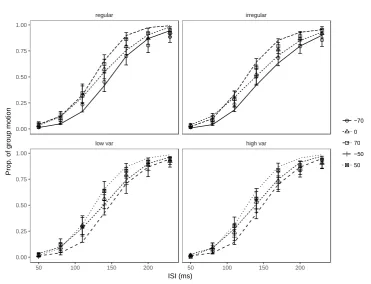
visual ISIs across all experimental conditions. Figure 6 illustrates the predictions, indicated by
curves, together with the observed mean responses, indicated by shape points. As can be seen,
the predicted mean responses are within one standard error of the observed mean responses
22
Figure 6. Mean behavioral responses (proportion of group-motion reports, indicated by
shape points) and responses predicted by the partial-integration model (indicated by curves)
as a function of the ISIV of the Ternus display, separately for auditory sequences with
different (arithmetic) mean intervals relative to the individual transition thresholds. The
relative-interval labels (-70, -50, 0, 50, and 70 [ms]) denote the magnitude of the difference
between the mean auditory interval and the transition threshold. Error bars denote standard
errors of means (±SEM).
The key difference between the full- and partial-integration models is that the latter takes
the probability of crossmodal integration into account; accordingly, the weight of the auditory
ensemble intervals (i.e., 𝑤𝑃𝑎𝑚) depends on the difference between the ensemble mean of the
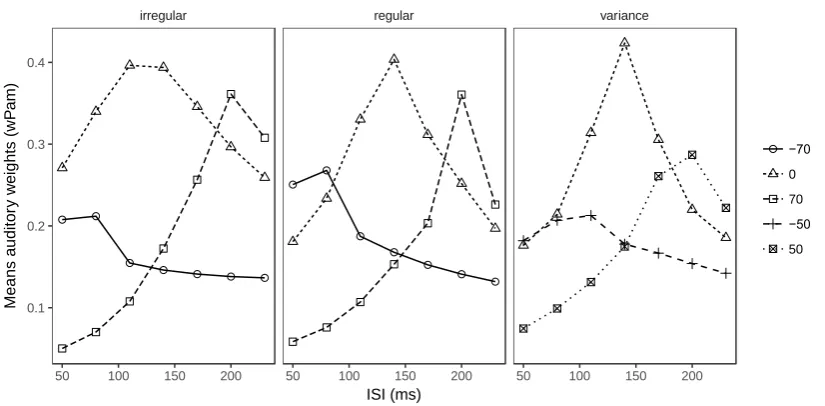
auditory intervals and the visual interval. This can be seen in Figure 7, which illustrates the
dynamic changes of the auditory weights across the various audio-visual interval discrepancy
conditions. All three experiments exhibit a similar pattern: weights are at their peak when the
visual interval and the auditory mean intervals are close to each other. For example, the peaks
for the relative intervals of 0 ms (i.e., the auditory mean intervals were set to the individual
visual thresholds) are around 140 ms, close to the mean visual transition threshold (134.6 ms
low var high var
regular irregular
50 100 150 200 50 100 150 200
[image:23.595.111.483.68.352.2]23
for regular and 135.3 ms for irregular sequences, and 139.0 ms for low and 144.8 ms for high
variance). For relative intervals of 70 ms, the peaks are shifted rightwards; and for relative
intervals of -70 ms, they are shifted leftwards.
Figure 7. Predicted weights (i.e., 𝑤𝑃𝑎𝑚, based on the partial-integration model) of the
auditory ensemble intervals as a function of the ISIV of the Ternus display, separately for
auditory sequences with different (arithmetic) mean intervals relative to the individual
transition thresholds. The relative-interval labels (-70, -50, 0, 50, and 70 ms) denote the
magnitude of the difference between the mean auditory interval and the transition threshold.
Based on the responses predicted by the partial-integration model, we further calculated
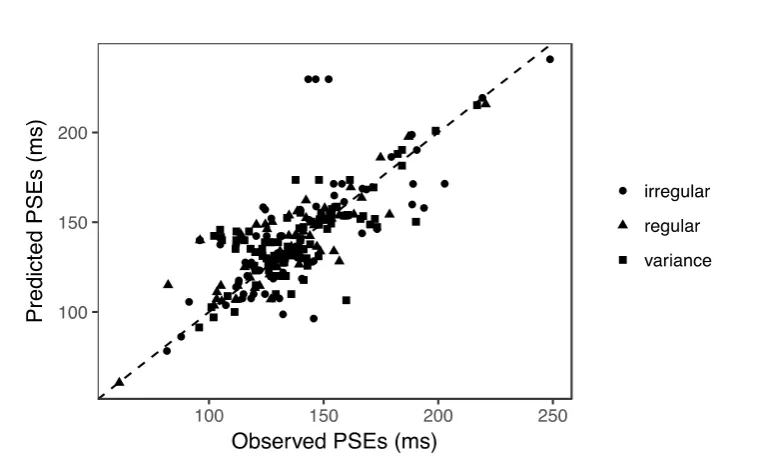
the predicted PSEs. Figure 8 shows a linear relation between the observed and predicted PSEs
for all experiments. Linear regression revealed a significant linear correlation, with a slope of
0.978 and an adjusted 𝑅2 = 0.983. The full-integration model, by contrast, produced flat
psychometric curves for 6% of the individual conditions in Experiments 1 and 2 (due to the
weight of the mean auditory interval approaching 1), which yielded unreliable estimates of
the corresponding PSEs. This led to lower predictive power compared to the
partial-integration model, as evidenced by the BIC and R2 scores (Table 1). Thus, taken
together, the partial-integration model can well explain the behavioral data that we observed.
irregular regular variance
50 100 150 200 50 100 150 200 50 100 150 200
[image:24.595.92.505.159.362.2]24
Figure 8. Predicted PSEs versus observed PSEs for all experiments. Each dot represents the
PSE of one particular observer in a given experimental condition. Shape points represent the
four auditory-sequence manipulations. Linear regression revealed a significant high
correlation (𝑅2= 0.983) and a slope of 1.008.
General Discussion
Using an audiovisual Ternus apparent motion paradigm, we conducted five experiments
on audiovisual temporal integration with regular and irregular auditory sequences presented
prior to the (audio-) visual Ternus display. We found that perceptual averaging of both regular
(Experiment 1) and irregular auditory sequences (Experiments 2 and 3) greatly influenced the
timing of the subsequent visual interval, as expressed in systematic changes of the transition
threshold in visual Ternus apparent motion: longer mean auditory intervals elicited more
reports of group motion, whereas shorter mean intervals gave rise to dominant element
motion. In Experiment 4, we further found that the geometric mean of the auditory intervals
can explain the audiovisual interaction better than the arithmetic mean. Further (post-hoc)
analyses and a purpose-designed experiment (Experiment 5) effectively ruled out an
explanation of these findings in terms of a recency effect, that is, a dominant influence of the
last interval prior to the Ternus frames. Using a Bayesian integration approach, we showed
that the behavioral responses are best predicted by partial-cue integration, rather than by full
25
a train of beeps that forms the background context of the visual task to play a critical role in
crossmodal temporal integration, even when participants are asked to ignore the auditory
stimuli.
Perceptual averaging and crossmodal temporal rate interaction
Extracting key statistical information from sets of objects or events in our environment
would provide us with a perceptual strategy to cope with limitations in attentional and
working memory capacity (Allik, Toom, Raidvee, Averin, & Kreegipuu, 2014; Chetverikov,
Campana, & Kristjansson, 2016) – given that we can have conscious access to only very few
items from the total amount of information received by our senses at any one time (e.g.,
Bundesen, Habekost, & Kyllingsbaek, 2005; Cohen, Dennett, & Kanwisher, 2016; Cowan,
2001; Marois & Ivanoff, 2005). In this situation, perceptual averaging would endow us with
an efficient and, in evolutionary terms, competitive solution to overcome bandwidth
limitations (McClelland & Bayne, 2016), thus constituting one of the underlying
computational principles for selecting appropriate actions to achieve our current behavioral
goals.Clearly, timing is fundamental for dynamic perception, and therefore unlikely to be an
exception with regard to perceptual averaging (Hardy & Buonomano, 2016; McDermott &
Simoncelli, 2011). For instance, when listening to a piece of music, we can immediately tell
the average tempo, even though the individual ‘notes’ may not be well remembered. And
when watching a field of runners in a competition, we immediately know whether it is a slow
or a fast race overall.
Research on the audiovisual interaction in (crossmodal) event timing has shown auditory
rate to have a pronounced influence on visual rate perception (Recanzone, 2003, 2009; Roach
et al., 2006; Shipley, 1964). The visual temporal rate is often assimilated to the auditory rate,
owing to the higher temporal resolution of audition compared to vision. Of note, however, the
extant studies have used only regular temporal sequences, thus leaving it an open question
whether the mechanism underlying the assimilation effect is perceptual averaging, temporal
entrainment, or a recency effect from the latest auditory interval. On this background, the
present study examined how irregular auditory sequences influence visual interval timing –
26
is the temporal averaging of the auditory sequence (regardless of its regularity) that exerted a
great influence on the visual interval.
Temporal averaging and geometric encoding
The present results indicate that the geometric mean well encapsulates the summary
statistics of the temporal structure hidden in a complex multisensory stream (Hanson, Heron,
& Whitaker, 2008; Heron, Roach, Hanson, McGraw, & Whitaker, 2012). Previous work on
numerosity had already suggested that the mental scales underlying the representation of
visual numerosity and temporal magnitudes are best characterized as being non-linear, as
opposed to linear, in nature (Dehaene, 2003; Dehaene et al., 2008; Nieder & Miller, 2003,
2004; Rips, 2013). For example, adults from the Mundurucu, an Amazonian indigenous tribe
with a limited number lexicon, map numerical quantities onto space in a logarithmic fashion
( Dehaene et al., 2008; but see Cicchini, Arrighi, Cecchetti, Giusti, & Burr, 2012). A seminal
study by Allan and Gibbon also showed that temporal bisection coincided with the geometric
mean of the two reference durations (Allan & Gibbon, 1991). Our findings reveal that
extraction of the geometric mean also underlies temporal averaging – and this might well be a
principle shared by a broad range of mechanisms coding ‘magnitude’ in perception (Walsh,
2003).
Partial integration in crossmodal temporal processing
Research on multisensory integration has shown that the ‘proximity’ and ‘similarity’ of
the spatiotemporal structure of multisensory signals – technically, their cross-correlation in
time (and space) – is critical for inferring an underlying common source to both signal
streams (Parise & Ernst, 2016; Parise et al., 2012). Accordingly, highly correlated audiovisual
events are likely perceived as arising from a single, multisensory source. Roach and
colleagues (2006) quantified this for audiovisual rate perception by introducing a disparity
prior, that is, their model assumes that the strength of crossmodal temporal integration is
dependent on the disparity between the auditory and visual temporal rates.
In the present study, by comparing two variants of Bayesian integration models, full and
27
averaging of the preceding, task-irrelevant auditory intervals assimilates the subsequent,
perceived visual interval between the Ternus display frames. The modeling results indicate
that the ensemble mean of the auditory intervals only partially integrates with the visual
interval, dependent on the time disparity between the two: when the mean of the auditory
intervals is close to the visual interval, they are optimally integrated according to the MLE
principle; in contrast, if the ensemble mean deviates grossly from the visual interval, partial
integration, based on the crossmodal disparity, provides a superior account of the behavioral
data to mandatory, full integration. However, in contrast to full integration, partial integration
requires participants to take both the mean statistics and the crossmodal disparity into
account. This is consistent with a large body of literature on temporal contextual modulation,
within the broader framework of Bayesian optimization (Jazayeri & Shadlen, 2010; Roach,
McGraw, Whitaker, & Heron, 2017; Shi et al., 2013), where prior information (e.g., history
information or a discrepancy prior) is incorporated in multisensory integration.
Perceptual averaging and temporal entrainment
One important question to be considered is whether the assimilation effect induced by
perceptual averaging can be distinguished, at root, from attentional entrainment. In the typical
auditory entrainment paradigm, the rhythm itself is irrelevant with respect to the visual target
events that are to be detected (or discriminated), though temporal expectations induced by the
rhythm influence attentional selection of the target (Lakatos, Karmos, Mehta, Ulbert, &
Schroeder, 2008). Rhythmically (i.e., with temporal attention) anticipated target events are
detected or discriminated more rapidly than early or late events that are out of phase with the
peaks of the attentional modulation induced by the entrainment (Ronconi & Melcher, 2017).
Irregular rhythms, by contrast, have been shown to disrupt temporal attention, as evidenced
by reduced benefits for responding to the target events (Miller, Carlson, & McAuley, 2013).
Importantly, in present study, both regular and irregular auditory sequences did reduce (rather
than enhance) the sensitivity of discriminating Ternus apparent (i.e., element vs. group)
motion, as evidenced by the increased JNDs. In contrast, the averaged temporal intervals,
whether these formed a regular or irregular series, were automatically integrated with the
28
motion percepts. This ‘dissociation’ implies that the assimilation effects demonstrated here
reflect a genuine, automatic perceptual averaging mechanism that operates independently of
attentional entrainment processes.
Irrelevant context in multisensory perceptual averaging
One might ask why the brain would at all take into account entirely task-irrelevant
contexts – such as, in the present study, the (mean of the) intervals of an irrelevant auditory
sequence – in multisensory integration. As revealed by our experiments, the discrimination
sensitivity for visual apparent motion became actually worse and the motion percept became
biased by including the irrelevant auditory sequence. Note however that, in the real world,
there are normally strong associations and correlations in the multisensory inputs – so that
drawing on this additional information often increases the reliability of perceptual estimates.
For example, the rhythmic sound pattern produced by a train moving along the track would
help us improve our estimation of the train’s speed, given that the tempo of the track sound is
linearly correlated with the speed of the train. Indeed, convergent evidence suggests that
multisensory integration can reduce the uncertainty of the final estimates in many situations
(Ernst & Banks, 2002; Ernst & Di Luca, 2011). However, integrating multiple sources of
information that deviates from the currently relevant information may engender unwanted
biases. Such contextual modulations have been reported in various forms. For example, when
performing a series of time estimations, observers’ judgment of a given interval is biased
toward the intervals that they just experienced (Jazayeri & Shadlen, 2010) – which is known
as a central-tendency effect (Petzschner, Glasauer, & Stephan, 2015; Shi & Burr, 2016; Shi et
al., 2013). A similar contextual modulation is also at work in the so-called time-shrinking
illusion, in which the percept of the last auditory interval is assimilated by the preceding
intervals (Nakajima, ten Hoopen, Hilkhuysen, & Sasaki, 1992; Nakajima et al., 2004), as well
as in audiovisual interval judgments when auditory and visual intervals are presented
sequentially (Burr et al., 2013). The present study demonstrated that such an audiovisual
integration still occurs even when participants are explicitly told to ignore the (task-irrelevant)
auditory sequence, suggesting that processes of top-down control cannot fully shield visual
29
Conclusion
It has long been known that auditory flutter drives visual flicker (Shipley, 1964) – a
typical phenomenon of audiovisual temporal interaction with regular auditory sequences.
Here, in five experiments, we demonstrated that irregular auditory sequences also capture
temporal processing of subsequently presented visual (target) events, measured in terms of the
biasing of Ternus apparent motion. Importantly, it is the geometric averaging of the auditory
intervals that assimilates the visual interval between the two visual Ternus display frames,
thereby influencing decisions on perceived visual motion. Further work is required to
examine whether the principles of geometric averaging and partial crossmodal integration
demonstrated here (for an audiovisual dynamic perception scenario) generalize to other
perceptual mechanisms underlying magnitude estimation in multisensory integration.
Context of the Research
Perceptual averaging of sensory properties, such as the mean number, size, and spatial
layout of objects in a scene, has been documented extensively in the visuospatial domain. It
allows us to capture our environment at a glance, in summary terms – overcoming attentional
and working-memory capacity limitations. This phenomenon prompted us to ask whether and,
if so, how processes of perceptual averaging may also be applied in the temporal domain,
specifically in (crossmodal) scenarios involving multiple interacting sensory systems. Thus,
we designed a paradigm combining a task-irrelevant temporal sequence of auditory events
with task-relevant Ternus apparent motion – a phenomenon where we see two aligned dots
either move together (e.g., to the left or right) or only one dot ‘jumping’ across the other
(apparently stationary) dot. What we see (group vs. element motion) is critically influenced
by the temporal interval between the two Ternus display frames. What we found is that the
irrelevant auditory sequence preceding the visual Ternus display alters the visual interval,
thus biasing observers to see either more group motion or more element motion, depending
the geometric mean of the preceding auditory intervals. This interaction depends on the
discrepancy between the (mean) auditory and the visual interval: if the discrepancy becomes
too large, no interaction occurs. Conceptually, the finding of temporal averaging over a
30
connection to the psychophysically well-established central-tendency effect, in which the
prior sampled distribution – here: of the auditory intervals – ‘assimilates’ the estimate – here:
the visual interval. Although we have provided a formal (partial Bayesian integration)
description of this crossmodal assimilation effect, further, purpose-designed research is
required to provide a complete picture of underlying, interacting neural mechanisms.
References
Allan, L. G., & Gibbon, J. (1991). Human Bisection at the Geometric Mean. Learning and motivation, 22, 39-58.
Allik, J., Toom, M., Raidvee, A., Averin, K., & Kreegipuu, K. (2014). Obligatory averaging in mean size perception. Vision Res, 101, 34-40. doi:10.1016/j.visres.2014.05.003
Alvarez, G. A. (2011). Representing multiple objects as an ensemble enhances visual cognition. Trends Cogn Sci, 15(3), 122-131.
Ariely, D. (2001). Seeing sets: representation by statistical properties. Psychol Sci, 12(2), 157-162. Boltz, M. G. (2017). Auditory driving in cinematic art. Music Perception, 35(1), 77-93.
Brainard, D. H. (1997). The Psychophysics Toolbox. Spat Vis, 10(4), 433-436.
Bundesen, C., Habekost, T., & Kyllingsbaek, S. (2005). A neural theory of visual attention: bridging cognition and neurophysiology. Psychol Rev, 112(2), 291-328.
doi:10.1037/0033-295X.112.2.291
Burr, D., Della Rocca, E., & Morrone, M. C. (2013). Contextual effects in interval-duration judgements in vision, audition and touch. Exp Brain Res, 230(1), 87-98. doi:10.1007/s00221-013-3632-z Buus, S. (1999). Temporal integration and multiple looks, revisited: weights as a function of time. J
Acoust Soc Am, 105(4), 2466-2475.
Chen, L., & Vroomen, J. (2013). Intersensory binding across space and time: a tutorial review. Atten Percept Psychophys, 75(5), 790-811. doi:10.3758/s13414-013-0475-4
31
Church, R. M., Meck, W. H., & Gibbon, J. (1994). Application of scalar timing theory to individual trials. J Exp Psychol Anim Behav Process, 20(2), 135-155.
Cicchini, G. M., Arrighi, R., Cecchetti, L., Giusti, M., & Burr, D. C. (2012). Optimal encoding of interval timing in expert percussionists. J Neurosci, 32(3), 1056-1060.
Cohen, M. A., Dennett, D. C., & Kanwisher, N. (2016). What is the Bandwidth of Perceptual Experience? Trends Cogn Sci, 20(5), 324-335.
Cowan, N. (2001). Metatheory of storage capacity limits. Behavioral and Brain Sciences, 24(1), 154-176.
Dehaene, S. (2003). The neural basis of the Weber-Fechner law: a logarithmic mental number line. Trends Cogn Sci, 7(4), 145-147. doi:S136466130300055X [pii]
Dehaene, S., Izard, V., Spelke, E., & Pica, P. (2008). Log or linear? Distinct intuitions of the number scale in Western and Amazonian indigene cultures. Science, 320(5880), 1217-1220. Ernst, M., & Banks, M. (2002). Humans integrate visual and haptic information in a statistically
optimal fashion. Nature, 415(6870), 429-433. doi:10.1038/415429a
Ernst, M., & Di Luca, M. (2011). Multisensory perception: from integration to remapping In: Sensory Cue Integration, (Ed) J. Trommershäuser, Oxford University Press, New York, NY, USA,
225-250.
Gebhard, J. W., & Mowbray, G. H. (1959). On discriminating the rate of visual flicker and auditory flutter. Am J Psychol, 72, 521-529.
Gibbon, J. (1977). Scalar expectancy theory and Weber’s law in animal timing. . Psychological Review, 84(3), 279–325.
Guttman, S. E., Gilroy, L. A., & Blake, R. (2005). Hearing what the eyes see: auditory encoding of visual temporal sequences. Psychol Sci, 16(3), 228-235.
doi:10.1111/j.0956-7976.2005.00808.x
Hanson, J. V., Heron, J., & Whitaker, D. (2008). Recalibration of perceived time across sensory modalities. Exp Brain Res, 185(2), 347-352. doi:10.1007/s00221-008-1282-3