© 2015, IRJET ISO 9001:2008 Certified Journal
Page 1616
Analysis of Speed Control of DC Motor –A review study
Nikhil Tripathi
1, Rameshwar Singh
2, Renu yadav
31
M.tech student, Electrical Engineering, NITM GWALIOR, MADHYA PRADESH, INDIA
1Asst prof, Electrical Engineering, NITM GWALIOR, MADHYA PRADESH, INDIA
1Asst prof, Electrical Engineering, NITM GWALIOR, MADHYA PRADESH, INDIA
---***---Abstract -
this paper presented a review study ofdifferent tuning controller for speed control of DC motor. DC motor is widely used in industries even if its maintenance cost is higher than the induction motor. Speed control of DC motor is attracted considerable research and several methods are evolved. All controllers are widely used in many different areas like process control, manufacturing, automation, aerospace, etc. The tuning of soft computing is very difficult than conventional controller for speed control of DC motor. Tuning of PID parameters is important because these parameters have a great effect on the stability and performance of the control system.
Key Words: Proportional Integral Controller, PID
Controller, Ziegler-Nichols, Neural Network Controller,
fuzzy logic controller, Linear Quadratic Regulator
(LQR) Technique.
1. INTRODUCTION
Direct current (DC) motors have variable characteristics and are used extensively in variable-speed drives. DC motor can provide a high starting torque and it is also possible to obtain speed control over wide range. Why do we need a speed motor controller? For example, if we have a DC motor in a robot and we just apply a constant power to each motor on a robot, then the poor robot will never be able to maintain a steady speed. It will go slower over carpet, faster over smooth flooring, slower up hill, faster downhill, etc. So, it is important to make a controller to control the speed of DC motor in desired speed [1]. DC motors are widely used in industrial applications, robot manipulators and home appliances, because of their high reliability, flexibility and low cost, where speed and position control of motor are required [2]. This paper deals with the performance evaluation of different types of intelligent controllers and conventional controller implemented with a clear objective to control the speed of separately excited DC motor. Its plays a significant role in modern industrial. These are several types of applications where the load on the DC motor varies over a speed range. These applications may demand high-speed control accuracy and good dynamic responses. The speed torque
characteristics of DC motors are much more superior to that of AC motors and also DC motors provide excellent control of speed for deceleration and acceleration. DC motors have a long tradition of use as adjustable speed machines and a wide range of options have evolved. In these applications, the motor should be precisely controlled to give the desired performance. The controllers of the speed that are conceived for goal to control the speed of DC motor to execute many tasks [3][4]. There are several controller types of Conventional controllers, Proportional Integral Controller, PID Controller, Ziegler-Nichols, Neural Network Controller, Fuzzy Logic Controller and Linear quadratic regulator controller. In industries 90% controllers are PID type because of its simplicity, applicability and ease of use offered by the PID controller.
2. Conventional controllers
The important issue in the modern control industries is to develop methodologies, concepts, algorithms, technologies for the design of process control systems which must be able to evolve, self develop, self organize, and self evaluate and to self improve [5][6]. Over the years, control of processes and systems in the industry is customarily done by experts through conventional proportional integral derivative (PID) controllers because of its simplicity, low cost design and robust performance in wide operating conditions. Conventional control systems suffer from transient and steady state problems like overshoot, settling time and rise time. Various technologies and modifications have been employed to overcome these difficulties, which includes auto tuning of proportional integral derivative (PID) controllers, adaptive techniques and compensation techniques. Automatic tuning procedures are required for satisfactory control of controller parameters.
2.1 Proportional Integral Controller
© 2015, IRJET ISO 9001:2008 Certified Journal
Page 1617
controller [7-8].PI Controller as long as error is presentthe controller keeps changing its output and once the error is zero or it disappears the controller does not change its output. Integration is the mode that removes the offset or the error but sometimes it may make transient response worse. In PI Controller the output of the controller is changed proportional to the integral of the error [9].
Since most of the process cannot work with an offset, they must be controlled at their set points and in order to achieve this, extra intelligence must be added to proportional controller and this is achieved by providing an integral action to the original proportional controller [10]. So the controller becomes proportional –Integral controller
Under PI Controller as long as error is present the controller keeps changing its output and once the error is zero or it disappears the controller does not change its output.
Integration is the mode that removes the offset or the error but sometimes it may make transient response worse.
In PI Controller the output of the controller is changed proportional to the integral of the error. The mathematical expression of the PI Controller is:
Where, Ki = Integral gain of the PI controller. PI Controller has the following disadvantages:
The response is sluggish at the high value of the integral time Tn.
The control loop may oscillate at the small value of integral time Tn.
2.2 PID Controller
The combination of proportional, integral and derivative control action is called PID control action. PID controllers are commonly used to regulate the time-domain behaviour of many different types of dynamic plants. These controllers are extremely popular because they can usually provide good closed-loop response characteristics. Where it can be assumed that the plant is a DC motor whose speed must be accurately regulated [11].The PID controller is placed in the forward path, so that its output becomes the voltage applied to the motor's armature the feedback signal is a velocity, measured by a tachometer .the output velocity signal C (t) is summed with a reference or command signal R (t) to form the error signal e (t). The corresponding three adjustable PID parameters are most commonly
Selected to be
Controller gain- (increased value gives more proportional action and faster control)
Integral time- (decreased value gives more integral action and faster control)
Derivative time- (increased value gives more derivative action and faster control)
Although the PID controller has only three parameters, it is not easy, without a systematic procedure, to find good values for them. In fact, a visit to a process plant will usually show that a large number of the PID controllers are poorly tuned.
PID Controller includes all the three control actions i.e. proportional, integral and derivative.
A PID controller calculates and outputs a corrective action, which corrects the error between the process output and the desired set point that adjusts the process accordingly and rapidly.
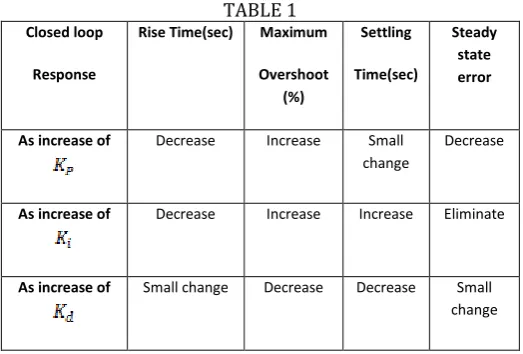
The output of the controller or the manipulated variable is obtained by adding P, I and D components and their associated coefficient. The combination of proportional, integral and derivative control action is called PID control action. PID controllers are commonly used to regulate the time-domain behavior of many different types of dynamic plants. These controllers are extremely popular because they can usually provide good closed-loop response characteristics. Consider the feedback system architecture that is shown in Fig. 1 where it can be assumed that the plant is a DC motor whose speed must be accurately regulated [12].
© 2015, IRJET ISO 9001:2008 Certified Journal
Page 1618
TABLE 1Closed loop
Response
Rise Time(sec) Maximum
Overshoot (%)
Settling
Time(sec)
Steady state error
As increase of Decrease Increase Small change
Decrease
As increase of Decrease Increase Increase Eliminate
As increase of Small change Decrease Decrease Small change
3. Ziegler-Nichols
In 1942, Ziegler-Nichols presented a tuning formula [13] , based on time response and experiences. Although it lacks selection of parameters and has an excessive overshoot in time response, still opens the way of tuning parameters. Modified Ziegler-Nichols tuning based on Chien-Hrones-Reswick (CRR) PID tuning formula for set-point regulation accommodate the response speed and d overshoot. In this paper, an optimal PID controller for DC motor speed control is developed using Ziegler-Nichols (ZN) and Modified Ziegler-Nichols .The performance measure to be minimized contains the following objectives of the PID controller that will be studied separately
Minimize the rise time, time required for system response to rise from 10% to 90% (over damped); 5% to 95%; 0% to 100% (Under damped) of the fmal steady state value of the desired response,
Minimize the maximum overshoot, Maximum overshoot is the maximum peak value of the response curve measured from the desired response of the system, and
Minimize the settling time, Time required for response to reach and stay within 2% of final value. The Zeigler Nichols Open-Loop Tuning Method is a means of relating the process parameters - delay time, process gain and time constant - to the controller parameters - controller gain and reset time [14][15]. It has been developed for use on delay-followed-by-first-order-lag processes but can also be adapted to real processes. Control theory has found several developments. Different intelligent control algorithms have been developed so far. However, the PID-type controller is still the most widely used control strategy in industries. Studies even indicate that approximately 90% of all industrial controllers are of the PID-type. In mid 1930s three mode controllers with proportional, integral, and derivative (PID) actions were commercially available and gained widespread industrial
acceptance. The PID controller tuning methods can be classified into two main categories
(1)Closed loop methods (2)Open loop methods.
In 1942, Ziegler and Nichols presented two standard methods to tune a PID-controller. These methods, due to their simplicity and practicality, are still widely used in different industrial and other tuning.
4. Neural Network Controller
A neural network comprises simple elements operating in parallel. In fact, it is a massively parallel distributed processor that stores experiential knowledge and makes it available for use when needed. In using neural networks for system identification, training data can be obtained by observing the input-output behavior of a plant. This process is called as “one step ahead prediction” and the structure is called Time Delayed Neural network. Equation (3) can be easily implemented. The proposed method can be used as adaptive or non-adaptive controller. If learning process continues, the controller will be an adaptive controller. In non-adaptive case, learning process is executed as offline or for a certain period of time. In designing and training an ANN to emulate a function, the only fixed parameters are the number of inputs and outputs of the ANN, which are based on the input/output variables of the function. The choice of the number of hidden neurons is based on experience. It is also widely accepted that maximum of two hidden layers are sufficient to learn any arbitrary non-linearity. The back-propagation training technique adjusts the weights and bias in all connecting links in the nodes so that the difference between the actual output and target output are minimized for all given training patterns [16] the time delayed neural network is a multilayer neural network and has four inputs. The MNN has one hidden layers, which consist of 2 neurons with tan sigmoid activation function. The output layer of the NN has only one neuron with pure linear activation function. Neural networks are wonderful tools, which permit the development of quantitative expressions without compromising the known complexity of the problem.
Neural networks resemble the human brain in the following two ways:
A neural network acquires knowledge through learning.
A neural network's knowledge is stored within inter-neuron connection strengths known as synaptic weights
© 2015, IRJET ISO 9001:2008 Certified Journal
Page 1619
specific problems. ANNs, like people, learn by example. AnANN is configured for a specific application, such as pattern recognition or data classification, through a learning process. Learning in biological systems involves adjustments to the synaptic connections that exist between the neurons. This is true of ANNs as well. The true power and advantage of neural networks lies in their ability to represent both linear and non-linear relationships and in their ability to learn these relationships directly from the data being modeled. Traditional linear models are simply inadequate when it comes to modelling data that contains non-linear characteristics. The neural network consists of junctions which are connected with LINKS, also called processing units. For each junction a number is ordered, this number is called weight. The weights are the tools for the long distance information storing in the neural network, the learning process occurring with the appropriate modification of weights [17]. These weights are modified so that the network input/output behaviour is in consonance with the environment, which provide the input data.
5 FUZZY LOGIC CONTROLLER
: Fuzzy logic began with the 1965 proposal of fuzzy set theory by Lotfi Al Zadeh. It has been applied to many fields, from control theory to artificial intelligence. Fuzzy logic has rapidly become one of the most successful of today's technologies for developing sophisticated control systems. Fuzzy logic control technology has been widely and successfully utilized in industrial applications. Fuzzy Logic is a multi-valued logic, that allows intermediate values to be defined between conventional evaluations like true/false, yes/no, high/low and emerged as a tool to deal with uncertain, imprecise, or qualitative decision making problems [18].
Fuzzy logic control is based on logical relationship. Fuzzy knowledge, which are used to show linguistic variables. The similarities between fuzzy logic and fuzzy set theory that is similar that of relation between Boolean logic and set theory. Fig. 2 shows a general FLC structure. FLC is processed for linguistic definitions, while other controllers work on the accuracy and parameters of system model. In the designing FLC, never need knowledge of system model, as a controller. Weather, little knowledge of control process may result unsatisfactory [19].
Fig -1: Name of the figure
A fuzzy logic model is a logical-mathematical procedure based on an “IF-THEN” rule system that mimics the human way if thinking in computational form. Generally, a fuzzy rule system categorized in four modules [20].
Fuzzification Fuzzy Inference Rule base Defuzzification
Fuzzification: The process of converting a numerical variable (real number or crisp variables) into a linguistic variable (fuzzy number) is called Fuzzification. By comparatively small number of membership functions to variable, In another manner it means the assigning of linguistic value.
Fuzzy inference: The truth value for the premise of each rule is computed under inference, and follow on the conclusion part of each rule. For each rule this results in one fuzzy subset to be assigned to each output variable. Mostly inference rules are used as MIN or PRODUCT. The output membership function is clipped off in MIN inference, at a height corresponding to the rule premise's computed degree of truth (fuzzy logic).The output membership function is scaled by the rule premise's computed degree of truth in PRODUCT inference
Rule base: For the rule bases a classic interpretation of Mamdani was used. Under rule base, outputs rules are constructed. The rules arranged in “If Then” format and formally the If side is called the conditions and the Then side is called the conclusion. A rule base controller is simply understandable and easy to maintain for a non- specialist end user and an equivalent controller could be implemented using conventional techniques.
[image:4.595.330.560.62.215.2]© 2015, IRJET ISO 9001:2008 Certified Journal
Page 1620
6. Linear Quadratic Regulator (LQR) Technique
LQR control that designed is classified as optimal control systems. This is an important function of control engineering. It has a very nice robustness property [21]. This attractive property appeals to the practicing engineers. Thus, the linear quadratic regulator theory has received considerable attention since 1950s. The liner quadratic regulator technique seeks to find the optimal controller that minimizes a given cost function (performance index). This cost function is parameterized by two matrices, Q and R, that weight the state vector and the system input respectively. These weighting matrices regulate the penalties on the excursion of state variables and control signal. One practical method is to Q and R to be diagonal matrix. The value of the elements in Q and R is related to its contribution to the cost function. To find the control law, Algebraic Riccati Equation (ARE) is first solved, and an optimal feedback gain matrix, which will lead to optimal results evaluating from the defined cost function is obtained. Linear quadratic regulator design technique is well known in modern optimal control theory and has been widely used in many applications. The standard theory of the optimal control is presented in Dissertation. Under the assumption that all state variables are available for feedback, the LQR controller design method starts with a defined set of states which are to be controlled [22]. The theory of optimal control is concerned with operating a dynamic system at minimum cost. The case where the system dynamics are described by a set of linear differential equations and the cost is described by a quadratic function is called the LQ problem. One of the main results in the theory is that the solution is provided by the linear-quadratic regulator (LQR). The performance measure is a quadratic function composed of state vector and control input. If the linear time-invariant system is controllable, the optimal control law will be obtained via solving the algebraic Riccati equation, the new LQR tuning algorithm is applied to the speed control of separately excited separately excited DC motors. The performance measure to be minimized contains output error signals and differential control energy. The Q matrix can be determined from the roots of the characteristic equation. Both computer simulations and experiment results demonstrate that the effectiveness of the optimal design of LQR Controller Linear-Quadratic Regulator (LQR) optimal control [23][24]. The function of Linear Quadratic Regulator (LQR) is to minimize the deviation of the speed of the motor. The speed of the motor is specifying that will be the input voltage of the motor and the output will be compare with the input. The output must be the same as or approximately the same as the input voltage. The advantages of used LQR are it is easy to design and increases the accuracy of the state variables by estimating the state. The nice feature of the LQR control as compared to pole placement is that instead of having to specify
where n Eigen values should be placed a set of performance weighting are specified that could have more intuitive appeal. The performance measure is a quadratic function Composed of state vector and control input.
7. CONCLUSIONS
In this paper, an attempt has been made to review various literatures for the classical controller techniques introduced by the different researchers for tuning of PID controller for speed control of DC motor to optimize the best result. This review article is also presenting the current status of tuning of PID controller for speed control of DC motor using classical controller techniques.
REFERENCES
[1] Shashi Bhushan Kumar, Mohammed Hasmat Ali*, Anshu Sinha, “Design and Simulation of Speed Control of DC Motor by Artificial Neural Network Technique” International Journal of Scientific and Research Publications, Volume 4, Issue 7, July 2014.
[2] G.SUDHA1, “Performance Based Comparison Between Various Z-N Tuninng PID And Fuzzy Logic PID Controller In Position Control System Of Dc”, International Journal on Soft Computing (IJSC) Vol.3, No.3, August 2012.
[3] Manoj Kushwah1 and Prof. Ashis Patra2, “Tuning PID Controller for Speed Control of DC Motor Using Soft Computing Techniques-A Review” Advance in Electronic and Electric Engineering, Volume 4, Number 2 (2014), pp. 141-148.
[4] J. C. Basilio and S. R. Matos, ”Design of PI and PID Controllers With Transient Performance Specification”, ,” IEEE Trans. Education, vol. 45, Issue No. 4, 2002, pp. 364-370
[5] Aditya Pratap Singh, “Speed Control of DC Motor using PID Controller Based on Matlab” International Conference on Recent Trends in Applied Sciences with Engineering Applications, Vol.4, No.6, 2013.
[6] Rahul Malhotra1, Narinder Singh2, Yaduvir Singh3, “SOFT COMPUTING TECHNIQUES FOR PROCESS CONTROL APPLICATIONS” International Journal on Soft Computing (IJSC), Vol.2, No.3, August 2011.
[7] Md Akram Ahmad, Pankaj Rai, “Speed control of a DC motor using Controllers” Automation, Control and Intelligent Systems,2014; 2(6-1): 1-9
[8] Ramesh Chandra Chourasia, Mukesh Kumar, “Speed Control of S.E.D.C. Motor by Using Pi and Fuzzy Logic Controller” International Journal of Soft Computing and Engineering (IJSCE),Volume-3, Issue-2, May 2013.
[9] J. C. Basilio and S. R. Matos, ”Design of PI and PID Controllers With Transient Performance Specification”, ,” IEEE Trans. Education, vol. 45, Issue No. 4, 2002, pp. 364-370.
© 2015, IRJET ISO 9001:2008 Certified Journal
Page 1621
DC Motor by Artificial Neural Network Technique”International Journal of Scientific and Research Publications, Volume 4, Issue 7, July 2014.
[11] Kapinjay Ucharia, Himmat Singh, “International Journal of Scientific Engineering and Technology” Volume No.3 Issue No.3, pp : 235 – 239 1 March 2014.
[12] Aditya Pratap Singh, “Speed Control of DC Motor using Pid Controller Based on Matlab” Innovative Systems Design and Engineering, Vol.4, No.6, 2013 - Selected from International Conference on Recent Trends in Applied Sciences with Engineering Applications.
[13] P. M. Meshram, Rohit G. Kanojiya “Tuning of PID Controller using Ziegler-Nichols Method for Speed Control of DC Motor” IEEE- International Conference On Advances In Engineering, Science And Management (ICAESM -2012) March 30, 31,2012 117.
[14] Bhaskar Lodh , “Simulink Based Model for Analysing the Ziegler – Nichols Tuning Algorithm as applied on Speed Control of DC Motor”, International Journal of Advanced Research in Electrical, Electronics and Instrumentation Engineering, Vol. 3, Issue 1, January 2014. [15] K.J. Astrom,T.Hagglund “Revisiting the Ziegler– Nichols step response method for PID control”, www.elsevier.com/locate/jprocont, Journal of Process Control 14 (2004) 635–650 .
[16] Neerparaj Rai#1, Bijay Rai#2, “Neural Network based Closed loop Speed Control of DC Motor using Arduino Uno.” International Journal of Engineering Trends and Technology- Volume4Issue2- 2013.
[17] Choi Y. K., Lee S. K., Kay Y.C., Design and Implementation of an Adaptive Neural Network Compensator for Control Systems, IEEE Transactions on Industrial Electronics, vol 48, April 2001.
[18] Snehashish Bhattacharjee1, Samarjeet Borah2, “A Survey on the Application of Fuzzy Logic Controller on DC Motor” International Journal of Application or Innovation in Engineering & Management (IJAIEM), Volume 2, Issue 6, June 2013
[19] Aman Kumar Singh1 , Ashis Patra2, “Speed control of a DC Motor Using PID controller, FUZZY logic controller and GA based PID Controller” International Journal of Modern Trends in Engineering and Research (IJMTER) Volume 0X, Issue 0Y, [Month – 2015]ISSN (Online):2349– 9745 ; ISSN (Print):2393-8161.
[20] Nader Jamali Sufi Amlashi “Design
andImplementation of Fuzzy Position Control System for Tracking Applications and Performance Comparisonwith Conventional PID” IAES International Journalof Artificial Intelligence (IJ-AI) Vol. 1, No. 1, March2012, pp. 31 - 44 ISSN: 2252-8938.
[21] Aamir Hashim and Obeid Ahmed, “Optimal Speed Control for Direct Current Motors Using Linear Quadratic Regulator”, Journal of Science and Technology Engineering and Computer Sciences, vol. 13, no. 2, 2012.
[22] Vinodh Kumar and Jovitha Jeromeb, “LQR Based Optimal Tuning of PID Controller for Trajectory Tracking
of Magnetic Levitation System”, Jerome / Procedia Engineering, vol. 4, no. 3, pp. 635-650, 2011.