© 2016, IRJET | Impact Factor value: 4.45 | ISO 9001:2008 Certified Journal | Page 2674
Study of seismic effect on buildings modified with shear wall
Hingkam Dada, Zuhail Bin Basheer T.P,Bullo Apo, Shaheel Ahammed
1234
B.Tech Student, Civil Engineering, Mar Athanasius college of engineeringe,kerala, India
---
Abstract
Structures undergo extensive damage and even suffer total collapse as a result of seismic activity. Normal buildings have low stiffness and strength and are very much vulnerable during the occurrence of an earthquake. Earthquake resistant building has become immensely important nowadays, especially in places prone to earthquake. However, no structure can be
fully immune to damages from earthquakes, the aim of constructing earthquake-resistant building is to erect structures that
perform better during seismic activity compared to conventional structures. Shear walls in a building are constructed to counter act the effects of lateral load coming on a structure. Buildings with shear wall design properly have shown very good performance. People usually adopt core shear wall for high rise buildings due to its ease of construction and simplicity. This study deals with the investigation of seismic effects on the buildings modified with different types of shear walls. The study also focuses on types of shear wall which perform more efficiently on rectangular building i.e structure having one dimension greater than the other.
KeyWords: Base shear, Earthquake, Shear wall, Dynamic Analysis method, Static Analysis Method, Elcentro
earthquake.
---***---1.INTRODUCTION
An earthquake is a sudden tremor of the Earth's crust, caused due to abrupt release of slowly accumulated strain that is stored in the rocks beneath the crusts surface. It is also define as an oscillatory movement resulting from the release of strain energy below or within the crust of earth surface[1,2] . It generates elastic waves or vibrations which cause movement in all direction from the point of origin and cause tremor of earth surface. No structures can remain fully free of damage during earthquake, but still all houses whether big or small can be made to withstand tremor of a particular magnitude by adopting certain structural modification and precaution. Building collapse happen because of inertia forces [3, 4]. When an earthquake occurs the lower portion of a building tends to vibrate, as it is indirect contact with the ground. However the inertia forces keeps the upper position static. Four main reason that leads to an earthquake are cited below: -1) shaking of ground 2) Failure of ground 3) fire and 4) tsunamis. In high rise buildings lateral loads are more premier that will increase rapidly with an increase in the buildings height.. Generally the requirements of strength, rigidity and stability are taken cared by designs provided. The structural system which is designed to carry vertical load may not have the capacity to resist lateral load, and even if it has, the design for lateral load will lead to increase in the structural cost substantially with an increase in stories
number. To achieve economy in high rise buildings special systems to resist lateral load have to be adopted. One of such systems to resist lateral load in tall buildings is cited below.
1.1Shear wall [5]: - A shear wall is a structural system which provides stability against earthquake, fires and blast that derives its stiffness from inherent structural forms. The shear wall starts at the foundation level and continuous throughout the height of the building. These walls can be either open sections or closed sections around elevators and stair cores or planar sections. The shear wall may be constructed using concrete or steel, that may be perforated or in solids. The shear walls act as a deep and a slender cantilevers. Structurally these walls can be classified into shear panel, coupled shear walls, shear wall frames and staggered wall into two wallsthat is coupled by beams at every floor level of the building.
1.2 Shear wall types.
Rectangular shear wall
Flanged cantilever shear walls Coupled shear walls
© 2016, IRJET | Impact Factor value: 4.45 | ISO 9001:2008 Certified Journal | Page 2675
2. LITERATURE REVIEWThere are mainly two methods of analysis to determine earthquake effects on structures
i) Static Analysis method ii) Dynamic Analysis method.
i) Static Analysis method: The seismic actions on the structures are evaluated by using equivalent Static analysiswhich is a conservative method that considers a design seismic coefficient as specified in the IS Code 1893 (2002). The design seismic coefficient include factor such as, importance factor, zone factor -Response reduction factor - soil foundation factor etc. For the simplification of analysis in order to determine earthquake effects on structures IS code has recommended seismic coefficient method. But there are anomalies associated with this method as mentionbelow. 1). the method does not consider dynamic character of ground motion and damping effects in structure. 2). Effects of higher modes are not considered 3). Soil structure interaction is not considerable.
ii) Dynamic method: These methods of analysis of structure involves free vibration analysis to determine the mode shapes and frequencies of the structure .The structure can be analyzed for seismic loading in form of response Spectrum or time history (acceleration) . The Dynamic Analysis Procedures are characterized as below:
1. Response Spectrum Analysis for Linear Structures 2. Time History Analysis for Linear and Non Linear Structure
2.1 The dynamic analysis method used in the study is the
Time History Analysis.
In this method of analysis the earthquake loading is varied upon the time. Different magnitudes of load are applied with change or increase in the time. The loading and the response history are evaluated at successive time increments, ∆t – steps. During every step the response is evaluated from the initial conditions existing at the beginning of the step i.e displacement and velocities and the loading history in the interval. The non-linear behaviour is easily considered in this method by changing the structural properties (e.g. stiffness) from one step to the next. Hence this method is one of the most effective for the solution of non-linear response,
among the many methods available.
Time-history analysis provides for linear or nonlinear evaluation of dynamic structural response under loading which may vary according to the specified time function. The time step size has to be sufficiently small for accurate analysis. However, the smaller the time step size, the higher is the “cost‟ of analysis in terms of computational for a given duration of analysis.
3. BEHAVIOUR OF SHEAR WALLS:
Many methods of shear walls have been described in several papers by numerous authors. The real behaviour of shear wall under earthquake loading is inelastic but for easiness of computations its behaviour is assumed to be elastic in most of the methods. On basis of its behaviour analysis is classified into two major categories. i.e. linear and nonlinear. The commonly used methods in linear category are finite element analysis, equivalent wide column modeling, and equivalent shear wall-frame system analysis and continuum approach. The best logical approach for the seismic design problem would be to accept the uncertainty of the seismic phenomenon and consequently to design the structure in such a manner that an adequate reserve of resistance is available to prevent failure in the case of a major earthquake, in additionthere should be little or no additional cost compared to designing the structure to resist frequent earthquake motions. Given below are some of the parameters which influences the response of a shear walls:-
Height to width ratio. Loading types
Reinforcement for flexure. Reinforcement for shear. Diagonal reinforcement.
Special transverse reinforcement. Strength of concrete.
Construction joint. Axial compressive stress. Moment to shear ratio.
In present days shear wall plays a very important role in the earthquake resisting structure. So providing different types of shear wall and finding out among them which gives the best results are being decided by us with the help of SAP2000 software. For analysis we have considered framed and unframed shear walls of rectangular and core type with equal cross sectional area in a particular building with one base dimension very much greater than other and performance of each type was compared based on storey displacement.
4. BUILDING CONFIGURATION
© 2016, IRJET | Impact Factor value: 4.45 | ISO 9001:2008 Certified Journal | Page 2676
been analyzed only for the seismic loading. The buildingconfiguration is shown table 1 below
Dead load due to slab including floor finish = 2.5 KN/m² Live load = 2 KN/m² , 3 KN/m²
Type of building = Residential Parapet wall height = 1.0 m
Density of brick masonry = 19.0 KN/m² Concrete grade = M25
Steel grade = Fe 415 Building location in zone III Zone factor = 0.16
Reduction factor = 3 Importance factor =1.0
[image:3.595.314.584.469.644.2]Table 1 Building Configuration
Fig. 1: Shear Wall
1- Rectangular shear wall
2- Core shear wall
5. OBSERVATION AND RESULT
After analyzing the building without shear wall and with rectangular and core shear walls (framed and unframed) using SAP2000, the following observations were found out:
5.1.Equivalent static method:
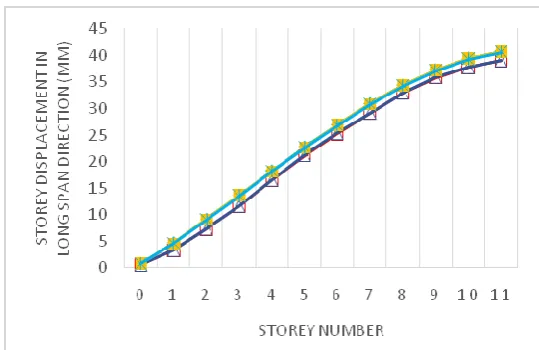
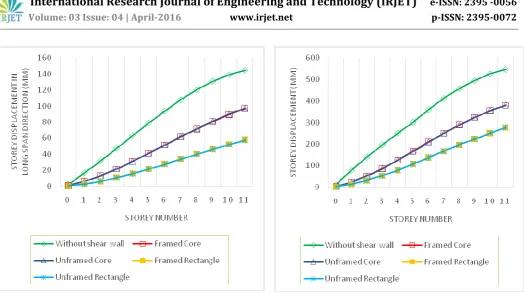
On observing the analysis result it was found that there is only slight variation in storey displacements alonglong span direction for different configurations of the building. It is because the building is stiffer in that direction. But there is a huge reduction in storey displacement along short span direction from 144.8mm for building without shear wall to 96.9mm for building with core type shear wall and 57.5 for that with rectangular shear wall o top most storey. The percentage reduction in storey displacement was found to be 33% and 60% respectively for building modified with core and rectangular shear wall. It was also observed that there is no noticeable change in displacement between the framed and unframed type of same shear wall. The rectangular shear wall gives a far better performance than core shear wall. The storey displacement along short span for top most storey in building with rectangular shear wall is found to be 41% less than that of building with core shear wall.
Foot print of
building 10.4m X 25.5m
Grid size 4m X 4m
Number of
storey G+10 storey
Height of floor 3 m
Column size 500mm X 250mm
Beam size 500mm X 250 mm
© 2016, IRJET | Impact Factor value: 4.45 | ISO 9001:2008 Certified Journal | Page 2677
Fig. 2 & Fig. 3: Storey displacement(Equivalent static method) 5.2. Time history analysis
Same trend of result as in equivalent static method is observed in time history method. The storey displacement along short span direction for topmost storey was found to be 546.8mm, 380mm (31% reduction) and 276.4mm (50% reduction) respectively for building without shear wall and with core and rectangular shear wall. The value for building with rectangular shear wall is found to be 27% less than that of building with core shear wall.
. Fig. 2 & Fig. 3: Storey displacement (Time history analysis)
6. CONCLUSION
The following conclusions can be drawn for the particular building we have selected,
1. There is only nominal change in displacement between the frame and unframed type of shear wall both in case of core type and rectangular type.
2. Displacement for rectangular type shear wall is less than that of core type shear wall in short span direction (41% in equivalent static method)
3. Displacement in short span direction is considerably higher for building without shear wall.
4. For long span direction the displacement with and without shear wall does not show much variation. This may be because of fact that stiffness in long span direction is higher as compared to that of short span direction. Therefore the influence of shear wall is not prominent in this direction.
REFERENCES
[1] Y. L. Mo and C. J. Kuo. 1998. Structural behavior of reinforced concrete frame-wall components, department of civil engineering, national Cheng kung University, Tainan, , Taiwan.
[image:4.595.41.566.54.347.2]© 2016, IRJET | Impact Factor value: 4.45 | ISO 9001:2008 Certified Journal | Page 2678
[3] Y. L. Mo and S.D. Jost .1993.Seismic response ofmultistory framed shear walls, department of Civil Engineering, National Cheng Kung University, Taiwan 70101, Taiwan.
[4] Arnaldo T. Derecho and M. Reza Kianoush, seismic Design of reinforced concrete structures, Professor, Ryerson Polytechnic University, Ontario, Canada. [5] Earthquake Analysis of Building Configuration with Different Position of Shear Wall Anuj Chandiwala1 1Adhoc Lecturer in Sarvajanik College of Engineering & Technology, Athvalines, Surat, Gujarat, India.