http://dx.doi.org/10.4236/jamp.2015.32034
How to cite this paper:Yamada, K., Sasaki, T., Nagata, T., Kanazawa, I., Suzuki, R., Ohdaira, T., Nozawa, K. and Komori, F. (2015) Solid-State Reaction and Vacancy-Type Defects in Bilayer Fe/Hf Studied by the Slow Positron Beam. Journal of Applied Mathematics and Physics, 3, 233-239. http://dx.doi.org/10.4236/jamp.2015.32034
Solid-State Reaction and Vacancy-Type
Defects in Bilayer Fe/Hf Studied by the Slow
Positron Beam
K. Yamada1, T. Sasaki1, T. Nagata1, I. Kanazawa1*, R. Suzuki2, T. Ohdaira2, K. Nozawa3,
F. Komori3
1Department of Physics, Tokyo Gakugei University, Tokyo, Japan
2The National Institute of Advanced Industrial Science and Technology (AIST), Ibaraki, Japan 3Institute of Solid State Physics, University of Tokyo, Chiba, Japan
Email: *kanazawa@ u-gakugei.ac.jp Received 12 November 2014
Abstract
The positron annihilation lifetimes and the Doppler broadening by slow positron beam are meas-ured in thin Fe films with thickness 500 nm, a thin Hf film with thickness 100 nm, and the bilayer Fe (50 nm)/Hf (50 nm) on quartz glass substrate. We have analyzed the behavior in vacancy-type defects in each layer through some deposition temperatures and annealing. It is observed that the thin Fe film, the thin Hf film, and the bilayer Fe (50 nm)/Hf (50 nm) already contain many vacan-cy-type defects. We have investigated the change of densities of the vacancy-carbon complex and the small vacancy-cluster with carbons, through solid-state amorphization of Fe (50 nm)/Hf (50 nm) bilayer.
Keywords
Metallic Films, Positron Annihilation Measurement, Solid-State Reaction, Fe Film, Diffusion, Vacancy-Type Defects
1. Introduction
Schwarz and Johnson [1] first have reported that isothermal annealing of thin film multilayers of two different crystalline metals (La and Au) can lead to the formation of an amorphous alloy. There exists a series of systems, mostly on the basis of one of the early transition metals and one of the late transition metals, in which the amorphous systems based on Hf and Zr have the advantage of a higher glass transition temperature. In addition, amorphization by mechanical alloying, a kind of solid-state amorphization, has been discovered [2].
It has been proposed that a multilayer structure, which is created in the initial stage of mechanical allying, plays an important role in amorphization [3]. The anomalously fast diffusion of one component and a large neg-ative heat of mixing in the alloy are important factors in solid-state amorphization [4].
Oguchi et al. [5] have studied the solid-state amorphization in Cu/Hf mutilayers by time different perturbed angular correlation (TDPAC). TDPAC and slow positron beam technique have shown that a strong distortion exists and many vacancy-type defects are present in the Hf layers of Cu/Hf multilayers [6] [7]. Oshima et al. [8] have studied the solid-state amorphization in Ni/Hf multilayers by slow positron beam technique. It has been shown that a high density of vacancy-type defects in Hf layers strongly induces a fast diffusion of Ni atoms, which promotes the solid-state amorphization. Fe/Hf multilayers, which have a soft magnetic property, have in-tensively been studied for high saturation magnetization and high density recording head materials [9]-[14]. A reason for the good magnetic softness is that these multilayers are in the nanocrystalline structures resulting in decreasing magnetocrystalline structure, suppressing the growth of columnar Fe grains have been required. In addition, thermal stability of these multilayers is very important, because most of magnetic heads are fabricated by glass bonding at high temperature. The growth of Fe grains and formation of amorphous-like interfacial product phase with the solid-state reaction between Fe and Hf layers are strongly related to the presence of cancy-type defects in each layer. The variable energy slow positron beams have enabled studies of atomic va-cancy-type defects at the surface, in the near surface, and in thin films [8] [15]-[19]. Especially the lifetime me-thod with slow positron beam can supply the important information, that is, what kind of vacancy-type defects is contained in the thin films [20] [21]. In this study, we have performed the lifetime and the Doppler broadening measurements with the variable energy slow positron beams for the thin Fe film (500 nm), the thin Hf film (100 nm), and the thin bilayer Fe (50 nm)/Hf (50 nm), and have investigated the nature of the vacancy-type defects in these thin films.
2. Experimental Method and Analysis
The specimens were deposited by an MBE method using two electron gun sources for Fe and Hf. The MBE chamber was brought into the 10-10 Torr range prior to deposition. Thin Fe films of thickness 500 nm were de-posited on the quartz glass substrate at room temperature and 473 K. A thin Hf film of thickness 100 nm was deposited on the quartz glass substrate at room temperature. In the case of Fe/Hf bilayers the Hf layer of thick-ness 50 nm was deposited on a quartz glass substrate at room temperature and subsequently the Fe layer of thickness 50 nm was deposited on the Hf layer at room temperature. The incident positron energy E was variable from 0 to 13 keV. The measurements of Doppler broadening spectra by slow positron beam were carried out at room temperature with a high purity germanium detector. In order to estimate the vacancy-type defects in these thin films the S-parameter was used. S was determined by the ratio of the central area over 10 channels to the total area of the positron annihilation photopeak spectrum after subtracting the background.
The positron annihilation lifetime measurements by slow positron beam were carried out at room temperature by use of the positron pulsing system with an intense slow positron beam generated by an electron linac in the National Institute of Advanced Industrial Science and Technology (AIST) LINAC facility. The lifetime spectra were obtained by measuring the time interval between the timing signal derived electrically from the pulsing system and the timing signal of an annihilation γ-ray detected with a BaF2 scintillation detector. The detailed lifetime measurement system is described elsewhere [22]. For each spectrum, at least 3.0 × 10⁵ counts were analyzed using the “RESOLUTION” routine [23] with good variance of the fits with a time resolution of about 290 ps FWHM.
In the present study, we used the scaling method [24] [25] for analyzing the positron implantation profiles in these thin films. Taking into account the diffraction effect of positron around the interfaces in multilayers, the scaling function of the positron implantation profile is represented as follows:
(
)
( )
(
)
( ) (
(
)
)
, 1 , 1
, ,
1 , ,
p i
i i i i
z E N E P E z P E z
A − E z A + E z
=
+ +
(1)
exp l m lm lm lm u u N C C =
(2)
where
(
)
( )
( )
1 1 1 1 i j j i j j d d z d uz E z E
= − − = − −
and di is the length from the surface to the ith-layer. Nim is a normalized constant, Cim, l and m are
pa-rameters which depend on the materials. z E
( )
is a mean implantation depth. The atomic number depen- dence of these parameters has already been obtained [24] [25].The parameter Np
( )
E and A are found to depend on the atomic number of the constituent elements, from Monte Carlo simulations [25]( )
(
)
(
)
(
)
, 1 , 1
0
1 , ,
d ,
i i i i
p
A E z A E z
N E
zP E z
− +
∞
+ +
≡
∫
(4)(
)
, 1 ,
i i
A − E z and Ai i, 1+
(
E z,)
are represented as follows:(
)
(
)
(
( )
1)
, 1 , 1 exp
i
i i i i
i
z d
A E z
z E
η+ η+ −
− −
−
= − −
(5)
(
)
(
)
(
)
( )
1, 1 , 1 exp
i
i i i i
i
d z
A E z
z E
η+ η+ −
+ + − = − − (6)
[
]
1 2exp 3
i b b b E
η+= − −
(7)
where b1, b2 and b3 are parameters, which are represented as function of the atomic number of materials.
3. Results and Discussions
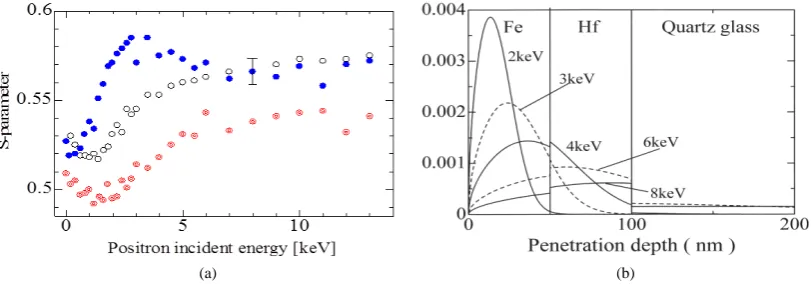
Figure 1(a) shows the measured S-parameters versus the incident positron energy for the bilayer Fe (50 nm)/Hf (50 nm) on quartz glass substrate with the bilayer thickness λ ~ 100 nm. The closed circles show the values of
S-parameter for the bilayer, which is deposited on quartz glass substrate at room temperature and subsequently the Fe layer (50 nm) is deposited on Hf layer at room temperature. The open circles show the values of S-para- meter for the bilayer annealed for 2 hours at 800 K. The double circles show the values of S-parameter for the bilayer annealed for 4 hours at 800 K.
Figure 1(b) shows the implantation profiles in the bilayer Fe (50 nm)/Hf (50 nm) on the quartz glass substrate for some incident positron energies. It is found that the values of S-parameter in the bilayer Fe (50 nm)/Hf (50 nm) annealed for 2 hours at 800 K decrease remarkably in the region of the incident energy from 2 to 3 keV, in comparison with those of as-deposited bilayer.
From the positron implantation profiles in Figure 1(b), it is seen that the S-parameter in the region from 2 to 3 keV reflects the property of the Fe layer dominantly. This means that vacancy-type defects in the Fe layer anni-hilate dominantly and vacancy-type defects in the Hf layer do not change much during annealing for 2 hours at 800 K.
[image:3.595.88.541.98.317.2] [image:3.595.208.533.161.326.2] [image:3.595.97.503.552.694.2]
(a) (b)
Furthermore, it is found that the values of S-parameter in the bilayer annealed for 4 hours at 800 K decrease much in the region of the incident energy from ~0 to ~13 keV, in comparison with those of as-deposited bilayer. This indicates that vacancy-type defects in both Fe and Hf layers annihilate much during annealing for 4 hours at 800 K. These results show that diffusion of Fe component is much faster than that of Hf component. This corresponds to one of important factors in solid-state amorphization [4].
[image:4.595.156.443.350.672.2]Figure 2 shows the positron annihilation lifetimes and those intensities in the thin Fe film of the thickness 500 nm, which is grown on the quartz glass substrate at room temperature and 473 K, and the lifetimes and in-tensities in the thin Hf film of the thickness 100 nm, which is grown on the quartz glass substrate at room tem-perature. The positron incident energies are 6 and 3 keV in the case of the Fe films and the Hf film, respectively. The lifetime, ~332 psec., in the thin Fe film of thickness 500 nm, which is grown at room temperature, corres-ponds to vacancy-clusters, which contain carbon, compose of vacancies from ~5 to ~10 numbers [26]-[30]. On the other hand, the lifetime, ~166 psec., in the thin Fe film of thickness 500 nm, which is grown at 473 K, cor-responds to the single-vacancies [26] [27], which might be trapped on carbon impurity atoms [29] [30], because single-vacancies move frequently in pure Fe at room temperature [31] [32]. The lifetime, ~232 psec., in the thin Hf film of thickness 100 nm corresponds approximately to the single-vacancy [26].
Figure 3 shows the positron annihilation lifetimes and those intensities versus the incident positron energy for the bilayer Fe (50 nm)/Hf (50 nm) after annealing for 4 hours at 800 K. The lifetimes 277 psec. (the incident po-sitron energy 2 keV) and 250 psec. (the incident popo-sitron energy 3 keV) correspond to vacancy-clusters com-posed of vacancies from 4 to 5 numbers. Now we shall consider interfacial reactions and growth of the interfa-cial product amorphous-phase. The free enthalpy, whose T is temperature, is given for the amorphous HfxFe1−x
interfacial produce phase, assuming additivity of the specific heat as follows,
Figure 2. The positron annihilation lifetimes and those intensities in the thin Fe film of the thickness 500 nm at room temperature and 473 K, and the life-times and intensities in the thin Hf film of the thickness 100 nm at room tem-perature.
Deposited temperature
In
ten
sity
[%
]
L
if
etime[
p
sec
.]
Lifetime by slow positron beam
Fe 500nm monolayer Beam energy : 6keV
Hf 100nm monolayer Beam energy : 3keV
RT 473K RT
0 50 100 500 1000
332psec.
166psec. 232psec.
87%
65% 60%
τ2
τ2
Figure 3. The positron annihilation lifetimes and those intensities vs. the in-cident positron energy for the bilayer Fe (50 nm)/Hf (50 nm) after annealing for 4 hours at 800 K.
(
)
Hf( ) (
)
Fe( )
mix mix
, 1
G x T =xG T + −x G T + ∆H − ∆T S
( )
Hf
G T and GFe
( )
T are the free enthalpies of Hf layers and Fe layers, respectively.mix H
∆ is the enthalpy of mixing.
mix S
∆ is the entropy of mixing.
The free enthalpy of the amorphous HfxFe1-x interfacial product phase is lowered due to the large negative
defects. In the case of Fe layers, taking account of the carbon-vacancy binding energy (~0.85 eV) [30], the acti-vation energy is estimated to be ~1.40 eV = ~0.85 eV + ~0.55 eV (the vacancy migration energy in Fe) [30]. This value of the activation energy is much lower than the activation energy (~2.45 eV) of the self-diffusion of Fe.
4. Conclusion
We have measured the positron annihilation Dopper broadening in the bilayer Fe (50 nm)/Hf (50 nm) by slow positron beam during the isochronal annealing at 800 K. We have analyzed the changes in density of the vacan-cy-carbon complex and the small vacancy-cluster, which might contain carbons, through solid-state amorphiza-tion of Fe (50 nm)/Hf (50 nm) with the positron annihilaamorphiza-tion lifetime by slow positron beam. We have discussed what kind of vacancy-type defects exists in Fe (500 nm) layer and Hf (100 nm), respectively.
References
[1] Schwarz, R.B. and Johnson, W.L. (1983) A Comparative Study of MR Imaging Profile of Titanium Pedicle Screws.
Phys. Rev. Lett., 51, 415. http://dx.doi.org/10.1103/PhysRevLett.51.415
[2] Koch, C.C., Calxin, O.B., McCamey, C.G. and Scarbrough, J.O. (1983) Preparation of “Amorphous” Ni60Nb40 by
Me-chanical Alloying. Appl. Phys. Lett., 43, 1017. http://dx.doi.org/10.1063/1.94213
[3] Weeber, A.W. and Bakker, H. (1988) Amorphization by Ball Milling. A Review. Physica B, 153, 93.
http://dx.doi.org/10.1016/0921-4526(88)90038-5
[4] Samwer, K. (1988) Amorphisation in Solid Metallic Systems. Phys. Rep., 161, 1.
http://dx.doi.org/10.1016/0370-1573(88)90006-3
[5] Oguchi, T., Kanazawa, I., Iwashita, T., Soe, W., Yamaguchi, A. and Yamamoto, R. (1992) Solid State Amorphization in Cu-Hf Multilayers Studied by Time-Differential Perturbed-Angular Correlation. J. Non-Cryst. Solids., 150, 448.
http://dx.doi.org/10.1016/0022-3093(92)90170-O
[6] Yamamoto, Y., Matsubara, H., Yamaguchi, M., Oguchi, T., Kanazawa, I., Iwashita, T., Ito, Y., Takamura, S., Soe, W., Yamaguchi, A. and Yamamoto,R. (1993)Cu-Hf Multilayers Studied by Slow Positron Beam and Time Differential Perturbed Angular Correlation. J. Magn. Magn. Mater., 126, 170. http://dx.doi.org/10.1016/0304-8853(93)90573-K
[7] Matsubara, H., Yamamoto, Y., Kanazawa, I., Iwashita, T., Ito, Y., Takamura, S., Soe, W. and Yamamoto, R. (1994) Studies of Multilayers of Cu-Hf with a Variable-Energy Positron Beam. Hyperfine Interaction, 84, 159.
http://dx.doi.org/10.1007/BF02060657
[8] Oshima, N., Nakajyo, T., Kanazawa, I., Iwashita, T., Ito, Y., Soe, W. and Yamamoto, R. (1995) Multilayered Ni/Hf and Solid-State Amorphization Studied Using the Slow Positron Beam Technique. Appl. Surf. Sci., 85, 329.
http://dx.doi.org/10.1016/0169-4332(94)00354-8
[9] Watanabe, Y., Oura, H. and Onozato, N. (1990) Magnetic Properties of Fe-Ta-N-O Film with High Saturation Flux Density. IEEE Trans. Magn., 26, 1500. http://dx.doi.org/10.1109/20.104429
[10] Hasegawa, N. and Saito, M. (1990) Soft Magnetic Properties of Microcrystalline Fe-M-C (M=V, Nb, Ta) Films with High Thermal Stability. J. Magn. Soc. Jpn., 14, 313. http://dx.doi.org/10.3379/jmsjmag.14.313
[11] Taneko, N., Shimada, Y., Fukamichi, K. and Miyakawa, C. (1991) Fabrication of Fe-Zr-N Films with Very Low Coer-civity. Jpn. J. Appl. Phys., 30, L195. http://dx.doi.org/10.1143/JJAP.30.L195
[12] Hasegawa, N., Kataoka, N., Fujimori, H. and Saito, M. (1991) Structural and Soft Magnetic Properties of Fe/Fe-Hf-C Multilayered Films with the High B s and Thermal Stability. J. Appl. Phys., 70, 6253.
http://dx.doi.org/10.1063/1.349983
[13] Hoffmann, H. (1964) Quantitative Calculation of the Magnetic Ripple of Uniaxial Thin Permalloy Films. J. Appl. Phys., 35, 1790. http://dx.doi.org/10.1063/1.1713743
[14] Herzer, G. (1990) Grain Size Dependence of Coercivity and Permeability in Nanocrystalline Ferromagnets. IEEE Trans. Magn., 26, 1397. http://dx.doi.org/10.1109/20.104389
[15] Schultz, P.J. and Lynn, K.G. (1988) Interaction of Positron Beams with Surfaces, Thin Films, and Interfaces. Rev. Mod. Phys, 60, 701. http://dx.doi.org/10.1103/RevModPhys.60.701
[16] Murashige, Y., Tashiro, M., Nakajyo, T., Koizumi, T., Kanazawa, I., Komori, F. and Ito, Y. (1997) The Multilayer Fe/Hf Studied with Slow Positron Beam. Appl. Surf. Sci., 113-114, 169.
http://dx.doi.org/10.1016/S0169-4332(96)00844-6
http://dx.doi.org/10.1016/S0169-4332(96)01066-5
[18] Ohtaki, H., Koizumi, T., Iwamoto, A., Kanazawa, I., Komori, F. and Ito, Y. (1998) The Study of Amorphization in Multilayer Fe/Hf with Slow Positron Beam. Appl. Surf. Sci., 130-132, 828.
http://dx.doi.org/10.1016/S0169-4332(98)00161-5
[19] Nagata, T., Ozaki, A., Terashima, Y., Kanazawa, I., Suzuki, R., Ohdaira, T., Komori, F. and Ito, Y. (2000) Solid-State Amorphization in Multilayer Fe/Hf Studied by Slow Positrons. Nucl. Instrument Method. Phys. ResearchB, 170, 240.
http://dx.doi.org/10.1016/S0168-583X(00)00162-2
[20] Takagi, K., Furukawa, N., Kanazawa, I., Suzuki, R. and Ohdaira, T. (2002) Formation of Hydrogen-Induced Vacancies during Growth of the Fe Layer Studied by Slow Positron Beam. Surf. Sci., 514, 298.
http://dx.doi.org/10.1016/S0039-6028(02)01644-8
[21] Suzuki, H., Azami, K., Komagata, S., Kanazawa, I., Suzuki, R. and Ohdaira, T. (2010) Diffusion of Positrons in Poly-mers Studied by Slow Positron Beam. J. Phys. CS, 225, 012053.
[22] Suzuki, R., Kobayashi, Y., Mikado, T., Ohgaki, H., Chiwaki, M., Yamazaki, T. and Tomimasu, T. (1991) Slow Posi-tron Pulsing System for Variable Energy PosiPosi-tron Lifetime Spectroscopy. Jpn. J. Appl. Phys., 30, L532.
http://dx.doi.org/10.1143/JJAP.30.L532
[23] Kirkegaard, P., Eldrup, M., Mogensen, O.E. and Pedersen, N.J. (1981) Program System for Analysing Positron Life-time Spectra and Angular Correlation Curves. Comput. Phys. Commun., 23, 307.
http://dx.doi.org/10.1016/0010-4655(81)90006-0
[24] Ghosh, V.J. (1995) Positron Implantation Profiles in Elemental and Multilayer Systems. Appl. Surf. Sci., 85, 187.
http://dx.doi.org/10.1016/0169-4332(94)00331-9
[25] Aers, G.C., Marshall, P.A., Leung, T.C. and Goldberg, R.D. (1995) Defect Profiling in Multilayered Systems Using Mean Depth Scaling. Appl. Surf. Sci., 85, 196. http://dx.doi.org/10.1016/0169-4332(94)00332-7
[26] Puska, M.J. and Nieminen, R.M. (1994) Theory of Positrons in Solids and on Solid Surfaces. Rev. Mod. Phys., 66, 841.
http://dx.doi.org/10.1103/RevModPhys.66.841
[27] Nieminen, M.R. and Puska, M.J. (1982) Defect Spectroscopy with Positrons: Calculations.Coleman, P.G., Sharma, S.C. and Dian, L.M., Eds., Proc. 6th Int. Conf. Positron Annihilation, North-Holland Pub, 395.
[28] Kamimura, Y., Tsutsumi, T. and Kuramoto, E. (1995) Calculations of Positron Lifetimes in a Jog and Vacancies on an Edge-Dislocation Line in Fe. Phys. Rev.B, 52, 879. http://dx.doi.org/10.1103/PhysRevB.52.879
[29] Hautojärvi, P., Johansson, J., Vehanen, A., Yli-Kauppila, J. and Moser, P.(1980) Vacancy-Carbon Interaction in Iron.
Phys. Rev. Lett., 44, 1326. http://dx.doi.org/10.1103/PhysRevLett.44.1326
[30] Vehanen, A., Hautojärvi, P., Johansson, J., Yli-Kauppila, J. and Moser, P. (1982) Vacancies and Carbon Impurities in α-Iron: Electron Irradiation. Phys. Rev.B, 25, 762. http://dx.doi.org/10.1103/PhysRevB.25.762
[31] Tanigawa, S., Hinode, K., Owada, N., Doyama, M. and Okuda, S. (1979) The Studies of Recovery of Irradiated Iron by Positron Annihilation. Hasiguchi, R.R. and Fujiwara, K., Proc. 5th Int. Conf. Positron Annihilation, Japan Institute of Metals, Sendai, 501.
[32] Hautojärvi, P., Judin, T., Vehanen, A., Yli-Kauppila, J., Johansson, J., Verdone, J. and Moser, P. (1979) Annealing of Vacancies in Electron-Irradiated α-Iron. Solid State Commun., 29, 855.
http://dx.doi.org/10.1016/0038-1098(79)90507-6
[33] Hettich, G., Mehrer, H. and Maier, K. (1977) Self-Diffusion in Ferromagnetic α-Iron. Scripta Met., 11, 795.