© 2015, IRJET ISO 9001:2008 Certified Journal Page 1126
Analysis of M35 and M40 grades of concrete by ACI and USBR methods
of mix design on replacing fine aggregates with stone dust
Satwinder Singh
1, Dr. Hemant Sood
21
M. E. Scholar, Civil Engineering, NITTTR, Chandigarh, India
2
Professor and H.O.D, Civil Engineering Department, NITTTR, Chandigarh, India
---***---
Abstract- This paper presents the results of anexperimental study conducted to compare the ACI and USBR method of concrete mix design. The M35 and M40 grades of concrete were compared for design by ACI and USBR method using stone dust as fine aggregate. The result indicates that the concrete designed with USBR method using stone dust gives maximum results in compression, flexure and split tensile strength. The results of concrete designed by DOE method by using sand are relatively higher than that of BIS method.
Key words: - crushed aggregates, compressive strength, flexural strength, split tensile strength.
1. INTRODUCTION
Concrete is a composite material composed of aggregate bonded together with fluid cement which hardens over time. Water is mixed with the dry powder/aggregate blend, which produces a semi-liquid that is shaped typically by pouring it into a form. The concrete solidifies and hardens through a chemical process called hydration. The water reacts with the cement, which bonds the other components together, creating a robust stone-like material. Chemical admixtures are added to achieve varied properties. These ingredients may accelerate or slow down the rate at which the concrete hardens, and impart many other useful properties including increased tensile strength, entrainment of air, and/or water resistance. Some of the prevalent concrete mix design methods are: a) ACI Mix Design Method, b) USBR Mix design practice, c) British Mix design Method, and d) BIS Recommended guidelines. The scope of this study is to compare DOE and BIS recommended mix design guidelines
When the stone dust was replaced with sand, the workability got reduced. A little amount of plasticizer is added to maintain workability. The objective is to compare the ACI and USBR methods of mix design with stone dust in regarding proportioning of constituents and properties of concrete in hardened state. The current paper presents a set of results from an experimental study of comparison between concrete designed by ACI and USBR method with stone dust for M35 and M40 grades.
2 . EXPERIMENTAL PROGRAM
The influence of following is studied in this experimental program
Varying ratio of aggregates on properties of concrete (compressive strength, flexural strength and split tensile strength) when designed with ACI and USBR mix methods.
Varying method for design of concrete on properties of concrete (compressive strength, flexural strength and split tensile strength) when designed with ACI and USBR mix methods using stone dust as fine aggregate.
M35 and M40 grades of concrete were designed by ACI and USBR method. In both cases cement content and water/cement ratio was fixed, it was only ratio of aggregates that was changed according to mix design methods i.e. cement content was 415 kg for M35 and 430 kg for M40 .similarly w/c ratio was 0.40 for M35 and 0.38 for M 40. The standard cubes, cylinders and beams were used to work out the properties of concrete.
The experimental program was divided into two groups. Group-1 includes the samples of M35 and M40 designed by ACI method using stone dust. The GROUP-2 includes the similar samples designed by USBR method using stone dust. The samples were cured for 7 and 28 days respectively and then subjected to standard test procedures for compression, flexure and split tensile tests for concrete. The group 1 samples are denoted with A1 and group 2 samples are denoted with vA2.
3. SPECIFICATIONS OF MATERIAL AND MIX
DESIGNS
Portland Pozolona cement (sp. Gravity = 3.0), Crushed aggregates (specific gravity = 2.72), Stone dust (specific gravity = 2.65), water and plasticizer (specific gravity = 1.1) were used to prepare the test specimens. The aggregates were free from dust particles. The grading ratio of 12.5mm and 20mm aggregates used was 40:60. Using these ingredients, M35 and M40 grades of concrete was designed by ACI and USBR methods of design mix. The proportions of mix are given in following tables
© 2015, IRJET ISO 9001:2008 Certified Journal Page 1127
TABLE 1: MIX PROPORTION BY ACI METHODConcrete
grade
Cement FA CA W/C Plasticizer
M35 1 2.31 2.16 0.40 0.8%
M40 1 2.23 2.09 0.38 1%
GROUP-2 BY USBR METHOD (A2 samples)
TABLE 2: MIX PROPORTION BY USBR METHOD
Concrete
grade
Cement FA CA W/C Plasticizer
M35 1 2.06 2.43 0.40 0.8%
M40 1 1.72 2.45 0.38 1%
3. MIXING AND CASTING OF TEST SPECIMENS
Pan mixer was used to mix the various materials. The metallic moulds were used for casting of all cubes, beams and cylinders and vibrated to eliminate voids and gain standard size of specimen. The preparation of moulds before pouring of concrete includes cleaning of moulds and application of oil on the inner surface of the moulds to avoid sticking of concrete to mould after it is set. Mixed concrete was poured into the moulds in three equal layers and the needle vibrator was used for vibration. After 1 day protection in mould the samples were demoulded and put in curing tank for respective periods of 7, 28 and 56 days. A set of 3 samples was prepared for each stage curing. The temperature of curing tank was kept at 25° ± 2° c for 56 days. The samples casted using stone dust are denoted with A1 and the samples casted with sand are denoted as A2.
4. TESTING
Cubes, beams and cylinders are tested at 3 stages of curing (after 7, 28 and 56 days) to determine the effect of change in ratio and replacement of aggregates. This part presents the details of the tests conducted and the results.
4.1 COMPRESSIVE STRENGTH
The uniaxial compression test on cube specimens was performed with reference to IS-516 (Load increasing (@ 14 MPa/min.). Compressive loading was applied to the cube specimens. Three cubes were tested at each stage of curing for each type of mix design in Group-1 and 2.
FIG – 1(a): Bar chart for Compressive Strength of M35 grade
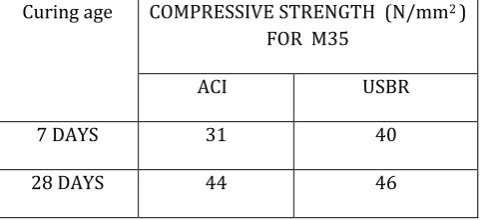
TABLE – (1a): Values of Compressive Strength of M35 grade
Curing age COMPRESSIVE STRENGTH (N/mm2 ) FOR M35
ACI USBR
7 DAYS 31 40
28 DAYS 44 46
The Fig 1(a) represents the test results for compressive strength of M35 grade of concrete designed by ACI and USBR methods using stone dust. It compares the effect of change in design method on compressive strength of concrete at 7 days and 28 days curing stage. There was about 22% increase in 7days strength and 4% increase in 28 days strength of cubes designed by USBR method as compared to strength of cubes designed by ACI method.. For M35 grade Maximum compressive strength i.e. 46
N/mm2 was achieved by concrete designed by USBR
method using stone dust.
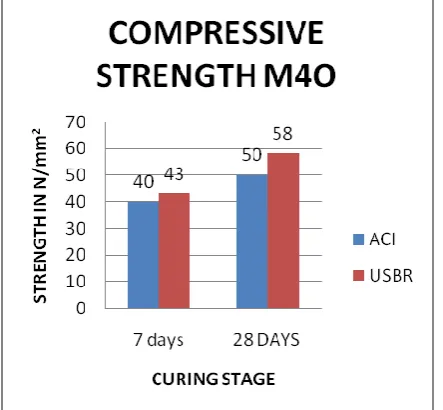
TABLE -1(b): Values for Compressive Strength of M40 grade
Curing age COMPRESSIVE STRENGTH
( N/mm2 ) FOR M40
ACI USBR
7 DAYS 40 43
28 DAYS 50 58
[image:2.595.303.546.325.435.2] [image:2.595.302.509.604.730.2]© 2015, IRJET ISO 9001:2008 Certified Journal Page 1128
USBR methods using stone dust. There was about 6%increase in 7days strength and 13% increase in 28 days strength of cubes designed by USBR as compared to strength of cubes designed by ACI method. For M40 grade Maximum compressive strength i.e. 58 N/mm2 was achieved by concrete designed by USBR method using stone dust.
Fig – 1(b): Bar chart for Compressive Strength of M40 grade
4.2 FLEXURAL STRENGTH
Beams of dimensions (10x10x50 cm) were prepared and tested under monotonic increasing loading to determine the flexural tensile strength. The rate of load application was 1.0 MPa/min in all cases. The flexural strength can be determined as PL/BD2 , where P is the maximum node applied (N), L is the span length (mm) that is the distance between the line of fracture and the nearest support measured from the center line of the tensile side of specimen, B is the width of the specimen (mm), d is the depth of specimen (mm). (When L is greater than 200mm for 150mm specimen or greater than 133mm for 100mm specimen).Three beams were tested at various stages of curing for both mix design in group-1 and 2
Fig 2(a): Bar Chart for Flexural Strength for M35
Table 2(a): Values for Flexural Strength for M35
Curing age FLEXURAL STRENGTH
( N/mm2 ) FOR M35
ACI USBR
7 DAYS 4.34 5.47
28 DAYS 5.49 8
[image:3.595.304.558.98.300.2] [image:3.595.36.258.195.400.2] [image:3.595.322.533.354.479.2]© 2015, IRJET ISO 9001:2008 Certified Journal Page 1129
Fig 2(b): Bar Chart for Flexural Strength for M40 grade
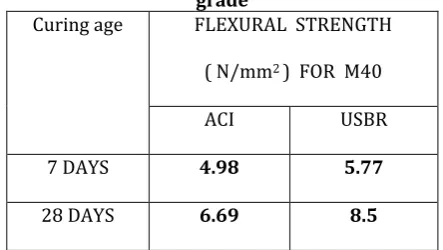
TABLE 2(b): Values for Flexural Strength for M40 grade
Curing age FLEXURAL STRENGTH
( N/mm2 ) FOR M40
ACI USBR
7 DAYS 4.98 5.77
28 DAYS 6.69 8.5
The Fig 2 (b) shows the results for the flexural strength of M40 grade of concrete. There was about 13% increase in 7days strength and 21% increase in 28 days strength of beams designed by USBR method as compared to strength of beams designed by ACI method. It was concluded that USBR method achieved greater flexural strength i.e. 8.5 N/mm2 when stone dust was used as fine aggregate.
4.3 SPLIT TENSILE STRENGTH
Cylinders of 10 cm diameter and 20 cm length were prepared and tested under increasing loading @14 MPa/min. Three cylinders were tested at each stage of curing for each type of mix design in group-1 and 2.The Split Tensile Strength is determined by 2P/πld Where P= Load at which sample fails, L= length of the specimen cylinder, D= diameter of the specimen cylinder.
Fig 3(a): Bar chart for Split tensile strength for M35 grade
Table 3(a): Values for Split tensile strength for M35 grade
Curing age SPLIT TENSILE STRENGTH ( N/mm2 ) FOR M35
ACI USBR
7 DAYS 3.18 3.18
28 DAYS 3.82 3.89
[image:4.595.66.553.45.497.2] [image:4.595.50.272.364.489.2]© 2015, IRJET ISO 9001:2008 Certified Journal Page 1130
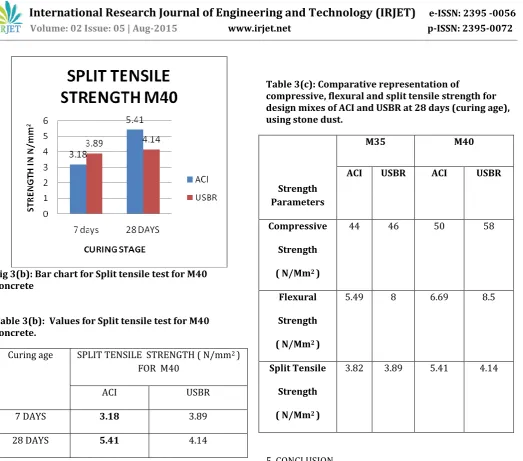
Fig 3(b): Bar chart for Split tensile test for M40concrete
Table 3(b): Values for Split tensile test for M40 concrete.
Curing age SPLIT TENSILE STRENGTH ( N/mm2 ) FOR M40
ACI USBR
7 DAYS 3.18 3.89
28 DAYS 5.41 4.14
The Fig 3 (b) shows the results for Split tensile strength of M40 grade of concrete. There was about 18% increase in 7days strength in cylinders designed with USBR method as compared to ACI method, but there was 23% increase in 28 days strength of cylinders designed by ACI method as compared to cylinders designed with USBR method. For M40 grade Maximum Split tensile strength i.e. 5.41
N/mm2 was achieved by concrete designed by ACI
method using stone dust. It concluded that greater split tensile strength was achieved by concrete designed as per ACI method using stone dust as fine aggregate.
Table 3(c): Comparative representation of
compressive, flexural and split tensile strength for design mixes of ACI and USBR at 28 days (curing age), using stone dust.
Strength Parameters
M35 M40
ACI USBR ACI USBR
Compressive
Strength
( N/Mm2 )
44 46 50 58
Flexural
Strength
( N/Mm2 )
5.49 8 6.69 8.5
Split Tensile
Strength
( N/Mm2 )
3.82 3.89 5.41 4.14
5. CONCLUSION
The experimental study was carried out to compare the ACI and USBR method of mix design using stone dust. The M35 and M40 grades of concrete were selected for comparison. While it was observed that concrete designed by both the methods achieve their target mean strength but USBR method with stone dust shows higher strength as compared to ACI method.
For M35 grade Maximum compressive strength i.e.
46 N/mm2 was achieved by concrete designed by USBR
method using stone dust. For M40 grade Maximum compressive strength i.e. 58 N/mm2 was achieved by concrete designed by USBR method using stone dust. Therefore USBR achieved better compressive strength than ACI method.
For M35 grade, Maximum flexural strength i.e. 8
N/mm2 was achieved by concrete designed by USBR
method using stone dust. For M40 grade, USBR method achieved greater flexural strength i.e. 8.5 N/mm2 when stone dust was used as fine aggregate. Therefore USBR achieved better flexural strength than ACI method.
[image:5.595.42.566.43.504.2]© 2015, IRJET ISO 9001:2008 Certified Journal Page 1131
method using stone dust. But for M40 grade MaximumSplit tensile strength i.e. 5.41 N/mm2 was achieved by concrete designed by ACI method using stone dust. The results of concrete designed by USBR method by using stone dust are relatively higher than that of ACI method. So in the construction practice, the USBR method of mix design should be used for paramount results in term of Flexure, Compression and split tensile strength of concrete.
REFERENCES
1. Amarjit Singh, Kamal Gautam, (University Of Hawaii At Manoa, USA; 30th Conference On OUR WORLD IN CONCRETE & STRUCTURES): 23 - 24 August 2005, Singapore On Comparison Of ISI And ACI Methods For Absolute Volume Concrete Mix Design
2. “Concrete Technology”, Gambhir M.L. ,Tata Mcgraw Hill,fifth Edition-2013,
3. “ Concrete Mix Proportioning As Per IS 10262:2009 – Comparison With IS 10262:1982 And ACI 211.1-91”, M.C. Nataraja And Lelin Das
4. Code Of Practice For Plain And Reinforced Concrete (Fourth Edition), IS 456:2000, Bureau Of India Standard, New Delhi.
5.C.K. Jeevendra And Mishra S.P.( IJCSEIERD,VOL. 2 ISSUE 1 March 2012 20-56) Carried Out A Comparison Between IS, BRITISH And ACI Methods Of Concrete Mix Design And Proposed A Function Equation Based Design.
6.Dr.Deepa A. Sinha(Indian Journal Of Applied Sciences Volume : 4 | Issue : 7 | July 2014) Studied The Compressive Strength Of Concrete Using Different Mix Design Methods. Http://Www.Theglobaljournals.Com/Ijar/File.Php?Val=July_2 014_1404223371__66.Pdf
7. H. S. Sureshchandra, G. Sarangapani, And B. G. Naresh Kumar ;Experimental Investigation On The Effect Of Replacement Of Sand
By Quarry Dust In Hollow Concrete Block For Different Mix Proportions ;International Journal Of Environmental Science And Development, Vol. 5, No. 1, February 2014
8. Indian Standard Concrete Mix Proportioning - Guidelines (First Revision) IS 10262:2009, Bureau Of India Standard, New Delhi, India.
9. Nataraja, M.C, Lelin Das And N. Richard Sandeep “Comparison Of Indian Standard Draft Method And ACI Method Of Concrete Mix Proportioning”, Second National Seminar On Advances In Materials And Structure, IIT, Chennai, India
10. R. Ilangovana, N. Mahendrana And K. Nagamanib (Vol. 3, No. 2, May 2014) Strength And Durability Properties Of Concrete Containing Quarry Rock Dust As Fine Aggregate
BIOGRAPHIES
Satwinder Singh Has Received His B. Tech Degree In Civil Engineering From Gurukul Vidyapeeth In 2013. At Present He Is Pursuing His ME In Construction Technology And Management From National Institute Of Technical Teacher Training And Research Chandigarh.