Volume 2012, Article ID 924921,14pages doi:10.1155/2012/924921
Research Article
Creep Modeling in a Composite Rotating Disc with
Thickness Variation in Presence of Residual Stress
Vandana Gupta and S. B. Singh
Department of Mathematics, Punjabi University, Punjab Patiala 147 002, India
Correspondence should be addressed to Vandana Gupta,[email protected]
Received 30 March 2012; Revised 4 August 2012; Accepted 5 September 2012
Academic Editor: Frank Werner
Copyrightq2012 V. Gupta and S. B. Singh. This is an open access article distributed under the Creative Commons Attribution License, which permits unrestricted use, distribution, and reproduction in any medium, provided the original work is properly cited.
Steady-state creep response in a rotating disc made of Al-SiCparticlecomposite having linearly varying thickness has been carried out using isotropic/anisotropic Hoffman yield criterion and results are compared with those using von Mises yield criterion/Hill’s criterion ignoring difference in yield stresses. The steady-state creep behavior has been described by Sherby’s creep law. The material parameters characterizing difference in yield stresses have been used from the available experimental results in literature. Stress and strain rate distributions developed due to rotation have been calculated. It is concluded that the stress and strain distributions got affected from the thermal residual stress in an isotropic/anisotropic rotating disc, although the effect of residual stress on creep behavior in an anisotropic rotating disc is observed to be lower than those observed in an isotropic disc. Thus, the presence of residual stress in composite rotating disc with varying thickness needs attention for designing a disc.
1. Introduction
out an elastic-plastic, thermal stress analyses on thermoplastic composite disc reinforced with steel fibers under uniform temperature distribution and concluded that plastic yielding expands both around inner and outer surfaces and that plastic flow is highest at the inner surface. Singh14has performed creep analysis in an anisotropic composite disc rotating at 15,000 rpm and undergoing steady-state creep at 561 K following Norton’s power law. The presence of anisotropy leads to significant reduction in the tangential and radial strain rates over the entire disc and helps in restraining creep response both in the tangential and in the radial directions. Xuan et al.15have studied the time-dependent deformation and fracture performance of multimaterial system and structures at elevated temperature. He developed a microregion deformation measuring technique which allows the direct measurement of the full creep strain fields of multimaterial system at higher temperature. Chamoli et al.16have studied the effect of anisotropy on the stress and strain rates and concluded the anisotropy of the material has a significant effect on the creep of a rotating disc. The creep behavior is described by Sherby’s law. Singh and Rattan17have investigated the stress distributions and the resulting creep deformation in isotropic rotating disc having constant thickness and made of silicon carbide particulate reinforced aluminium base composite in presence of thermal residual stress. It is concluded that the presence of the tensile residual stress affects the distribution of stresses and strain in the disc with constant thickness. Chen et al.18have investigated the effects of material gradients on the creep stress and strain of a pressurized tank, which is assumed to be made of functionally graded materials. They have concluded that the magnitude of the creep strain is influenced by the elastic modulus distribution as well as the creep property distribution inside the functionally graded materials and achieved some fundamental knowledge of the materials distribution to reduce the maximum creep stress/strain level inside the functionally graded materials tank. Gupta and Singh19have studied the effect of anisotropy on the stress and strain rates in composite disc made of anisotropic material6061Al-30% vol SiCpand concluded that the anisotropy of the material has a significant effect on the creep of a rotating disc with varying thickness.
In this paper, the steady-state creep has been investigated for composite rotating disc made of material 6061Al base alloy containing 20 vol% of SiCparticle. The analysis has been done with/without thermal residual stresses for isotropic/anisotropic disc of linearly varying thickness. The creep behavior has been described by Sherby’s constitutive model.
2. Mathematical Formulation
Consider a thin orthotropic composite disc of 6061 Al-SiCp of densityρ and rotating at a constant angular speedωradian/sec. The thickness of the disc is assumed to behandaand
bbe inner and outer radii of the disc, respectively. LetI andI0 be the moment of inertia of
the disc at inner radius aand outer radius r and b, respectively. Aand A0 are the area of
cross-section of disc at inner radiusaand outer radiusrandb, respectively. Then
I
r
a
h r2dr, I 0
b
a
h r2dr,
A
r
a
h dr, A0
b
a
h dr,
2.1
σθavg 1
A0
b
a
For the purpose of analysis of the disc the following assumptions are made.
1Material of disc is orthotropic and incompressible.
2Elastic deformations are small for the disc and therefore they can be neglected as compared to creep deformation.
3Axial stress in the disc may be assumed to be zero as thickness of disc is assumed to be very small compared to its diameter.
4The composite shows a steady-state creep behavior, which may be described by following Sherby’s law20:
˙
ε Mσ−σ0n, 2.3
whereM E−1A D
λλ3/|br|5
1/n
, where ˙ε, σ, n, σ0, A, Dλ, λ, b, Ebe the effective strain rate, effective stress, the stress exponent, threshold stress, a constant, lattice diffusivity, the subgrain size, the magnitude of burgers vector, Young’s modulus. The values of creep parameters mand σ0 are described by the following regression equations as a function of
the particle sizePand the percentage of dispersed particlesVapart from the temperature T, which extracted from the available experimental results of Panday et al.4:
me−35.38P0.2077T4.98V−0.622,
σ0−0.03507P 0.01057T 1.00536V−2.11916.
2.4
The different material combinations in the composite are conceptually replaced by an equivalent monolithic material that has the yielding and creep behavior similar to those displayed by the composite. Taking reference frame along the principal directions ofr,θ
andz, the generalized constitutive equations for an anisotropic disc under multiaxial stress condition are given as
˙
εr ˙
ε
2σ
G Hσr−Hσθ−Gσz
fc−ft
, 2.5
˙
εθ ˙
ε
2σ
H Fσθ−Fσz−Hσr
fc−ft
, 2.6
˙
εz ˙
ε
2σ
F Gσz−Gσr−Fσθ
fc−ft
, 2.7
where the effective stress,σ, is given by
σ
1
G H
Fσθ−σz2 Gσz−σr2 Hσr−σθ2
1/2
, 2.8
rate,σ is the effective stress, andfc,ftare uniaxial compression and tensile yield stresses, respectively. For biaxial state of stressσr, σθ, the effective stress is
σ
1
G H
Fσθ2 Gσr2 Hσr−σθ2
1/2
. 2.9
Using2.5and2.9,2.5can be rewritten as
˙
εr du˙r
dr
FG HG/F H/Fx− H/F fc−ft
/σθ
Mσ−σ0n
2G/F H/Fx2−2H/Fx G/F H/F1/2 .
2.10
Similarly from2.6
˙
εθ ˙
ur
r
FG H1 H/F−H/Fx fc−ft
/σθ
Mσ−σ0n
2G/F H/Fx2−2H/Fx 1 H/F1/2 . 2.11
From the material’s incompressibility assumption, it follows that
˙
εz−ε˙r ε˙θ, 2.12
wherexr σr/σθis the ratio of radial and tangential stresses and ˙ur du/dtis the radial deformation rate.
Dividing2.10by2.11
φr G/F H/Fx−H/F
fc−ft
/σθ
1 H/F−H/Fx fc−ft
/σθ
, 2.13
where
φr du˙r dr ·
˙
ur
r ⇒ du˙r
˙
ur
φr
r dr. 2.14
Integrating and taking limitatoron both sides
˙
ur u˙riexp
r
a
φr
r dr, 2.15
where ˙uri is the radial deformation rate at the inner radius. Dividing2.15byrand equated
to2.11
σ−σ0
u˙ri
1/n
where
ψr
⎧ ⎨ ⎩ 2
r ·
H/F G/Fx2−2Hx/F 1 H/F1/2
FG H1 H/F−H/Fx fc−ft
/σθ
exp·
r
a
φrdr r
⎫ ⎬ ⎭
1/n
.
2.17
Substitutingσfrom2.9to2.16, it gives
F/G FG/F H/Fx2−2H/Fx H/F 1 1/2σθ−σ0
˙
uri
1/n
M ψr
⇒σθ ˙
uri
1/n
M ψ1r ψ2r,
2.18
where
ψ1r ψr
{F/G HG/F H/Fx2−2H/Fx 1 H/F}1/2, 2.19
ψ2r σ0
{F/G HG/F H/Fx2−2H/Fx 1 H/F}1/2. 2.20
The equation of equilibrium for a rotating disc with varying thickness can be written as
d
drr hσr−hσθ ρω
2r2h0. 2.21
Integrating2.21within limitsatoband using2.1and2.2
σθavg 1
A0ρω 2I
0. 2.22
Substitutingσθfrom2.18into2.2
u˙ri
1/n
M
A0σθavg−
b
aψ2r·h dr
b
aψ1r·h dr
. 2.23
Using2.22and2.23,2.18becomes
σθ
ψ1r
ρω2I 0−
b
aψ2r·h dr
b
aψ1r·h dr
Integrating2.21within limitsatorand using2.1
σr 1
r·h
r
a
σθ·h dr−ρω2I
. 2.25
Thus the tangential stressσθand radial stressσr are determined by2.24and2.25. Then strain rates ˙εr, ˙εθand ˙εzare calculated from2.10,2.11, and2.12.
3. Solution Procedure
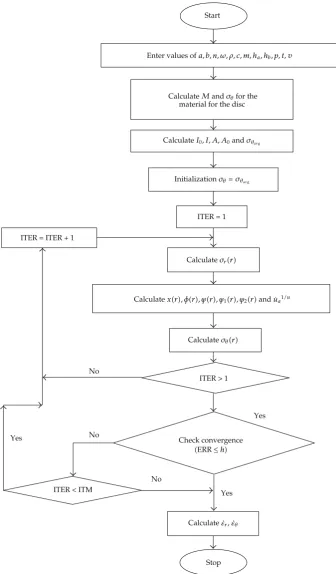
The stress distribution is evaluated from the previous analysis by iterative numerical scheme of computationFigure 1. In the first iteration, it is assumed thatσθ σθavg over the entire disc radii. Substitutingσθavgforσθin2.25the first approximation value ofσr, that is,σr1,
is obtained. The first approximation of stress ratio, that is,x1, is obtained by dividingσr1
by σθ which can be substituted in 2.13 to calculate first approximation of φr, that is, φr1. Now one carries out the numerical integration ofφr1 from limits ofator and uses this value in 2.17 to obtain first approximation of ψr, that is, ψr1. Using this ψr1 andσ0 in2.19and 2.20, respectively,ψ1r1 andψ2r1 are found, which are
used in2.18to find second approximation ofσθ, that is,σθ2. Usingσθ2forσθin2.25, second approximation ofσr, that is,σr2, is found and then the second approximation ofx,
that is,x2, is obtained. The iteration is continued till the process converges and gives the
values of stresses at different points of the radius grid.
For rapid convergence 75 percent of the value ofσθobtained in the current iteration has been mixed with 25 percent of the value ofσθobtained in the last iteration for use in the next iteration, that is,σθnext.25σθprevious .75σθcurrent.
The strain rates are then calculated from2.10,2.11, and2.12.
4. Numerical Computations and Discussions
For the sake of computation of a rotating disc made of SiCp reinforced 6061Al matrix composite Figure 2, we assume that the disc is subjected to an angular velocity of 15,000 rpm and we choose particle sizeP 1.7μm, particle contentV 20%, and temperature
T 616 K. For the anisotropic material G/F 1.34, H/F 1.64 and isotropic material
G/F 1, H/F 1, creep parameters have been carried out as reported in Gupta and Singh 19. The creep behavior of the material is described by threshold stress-based creep law by assuming a stress exponentnof 8. The inner radiiaand the outer radiibof all the discs are taken as 31.75 mm and 152.4 mm, respectively. A computer program based on the analysis presented in this paper has been developed to obtain the steady-state creep response of the composite discs with linearly varying thickness in presence of residual stress and obtained results are compared to the disc without residual stress to analyze the importance of residual stress. For the analysis, the tensile residual stressΔσyis taken as 32 MPa, as observed by
r
r
θ
b
hb ha
[image:9.600.203.395.99.286.2]ω a
Figure 2: A rotating disc of linearly varying thickness.
For the isotropic/anisotropic discs, linearly varying thickness, that is,ha 1.44,hb 0.75, has been taken, wherehis the thickness of discmmand the thicknesshis assumed to be of the formhhb 2cb−randhahb 2cb−a, wherec ha−hb/2b−ais the slope of a disc.
Using this expression for thickness,2.1becomes
A r−ahb c2b−r−a
A0 b−ahb cb−a
I hb
3
r3−a3 2c b
3
r3−a3−c
2
r4−a4
I0 hb
3
b3−a3 2c b
3
b3−a3−c
2
b4−a4.
4.1
The creep analysis in a rotating disc made of Al-SiC particle composite having linearly varying thickness has been carried using isotropic/anisotropic Hoffman yield criterion of yielding and results are compared with those using von Mises yield criterion/Hill’s criterion of yielding ignoring difference in yield stresses, that is,Δσy0.
[image:9.600.201.405.435.535.2]Disc1(isotropic disc with nonresidual stress)
Disc2(isotropic disc with residual stress)
Radial distance(mm)
20 40 60 80 100 120 140 160
Tangential stress
(
MPa
)
45 50 55 60 65
a
Radial distance(mm)
20 40 60 80 100 120 140 160
Tangential stress
(
MPa
)
45 50 55 60 65
Disc1(anisotropic disc with nonresidual stress)
Disc2(anisotropic disc with residual stress)
[image:10.600.182.416.93.392.2]b
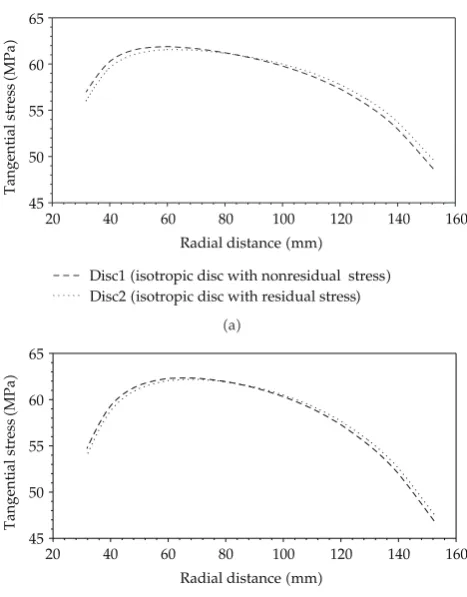
Figure 3: Variation of tangential stress along the radial distance in the isotropic/anisotropic discs rotating
with an angular velocity 15000 rpm at 616 K.
to an isotropic disc of linearly varying thickness. Also the tangential stress becomes more uniform in the presence/absence of residual stress in an anisotropic disc compared to an isotropic disc.
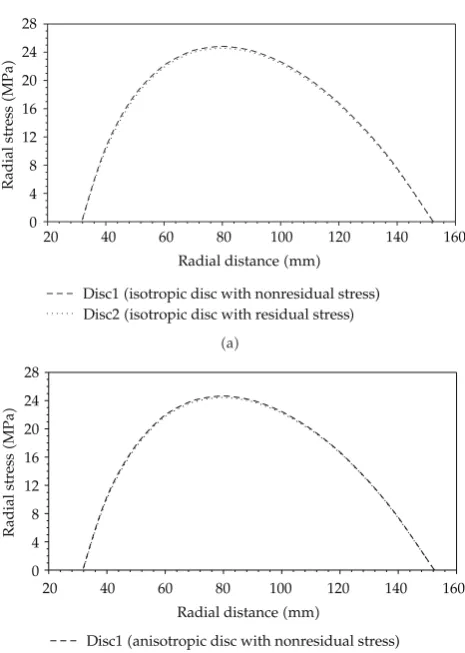
Figure 4 shows the variation of radial stresses along the radius of the isotrop-ic/anisotropic rotating disc in presence/absence of residual stress. It is observed that in presence of residual stress, the radial stress developing due to rotation is slightly lesser than the radial stress of an isotropic/anisotropic disc without residual stress, although the change in the magnitude of radial stress distribution is very small in the isotropic/anisotropic discs with linearly varying thickness due to presence of residual stress. As one moves from the inner radius to the outer radius of the disc, the radial stress increases from zero and reaches a maximum near the middle region of the disc with linearly varying thickness and then starts decreasing towards the outer region.
0 4 8 12 16 20 24 28
Disc1(isotropic disc with nonresidual stress)
Disc2(isotropic disc with residual stress)
Radial distance(mm)
20 40 60 80 100 120 140 160
Radial stress
(
MPa
)
a
Radial distance(mm)
20 40 60 80 100 120 140 160
0 4 8 12 16 20 24 28
Disc1(anisotropic disc with nonresidual stress)
Disc2(anisotropic disc with residual stress)
Radial stress
(
MPa
)
[image:11.600.183.416.90.417.2]b
Figure 4: Variation of radial stress along the radial distance in isotropic/anisotropic discs rotating with an
angular velocity 15000 rpm at 616 K.
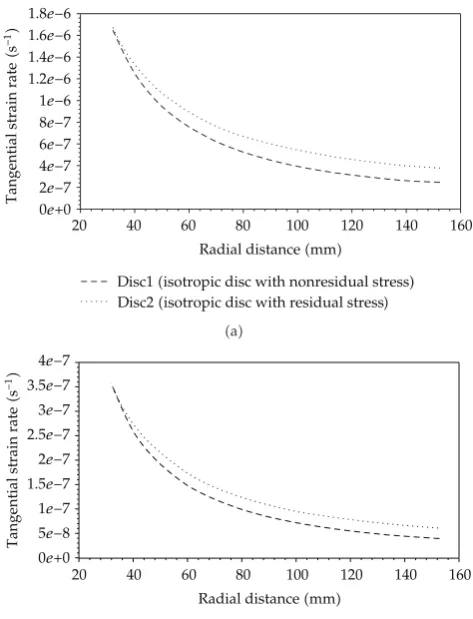
the isotropic/anisotropic discs having linearly varying thickness. Secondly, it is also noticed that variation in magnitude due to residual stress in an anisotropic disc is smaller compared to that for an isotropic disc. In an isotropic/anisotropic disc with/without residual stress, the tangential strain rates are highest at the inner radius and then decrease continuously, when one moves towards the outer radius of the disc. The trend of variation of tensile strain rate in tangential direction remains the same in an isotropic/anisotropic disc in the presence/absence of residual stress, but the magnitude can be reduced in an anisotropic disc.
0e+0
2e−7
4e−7
6e−7
8e−7
1e−6
1.2e−6
1.4e−6
1.6e−6
1.8e−6
Tangential strain rate
(
s
−
1)
Radial distance(mm)
20 40 60 80 100 120 140 160
Disc1(isotropic disc with nonresidual stress)
Disc2(isotropic disc with residual stress)
a
0e+0
5e−8
1e−7
1.5e−7
2e−7
2.5e−7
3e−7
3.5e−7
4e−7
Radial distance(mm)
20 40 60 80 100 120 140 160
Disc1(anisotropic disc with nonresidual stress)
Disc2(anisotropic disc with residual stress)
Tangential strain rate
(
s
−
1)
[image:12.600.181.418.96.406.2]b
Figure 5: Variation of tangential strain rate along the radial distance in isotropic/anisotropic discs rotating
with an angular velocity 15000 rpm at 616 K.
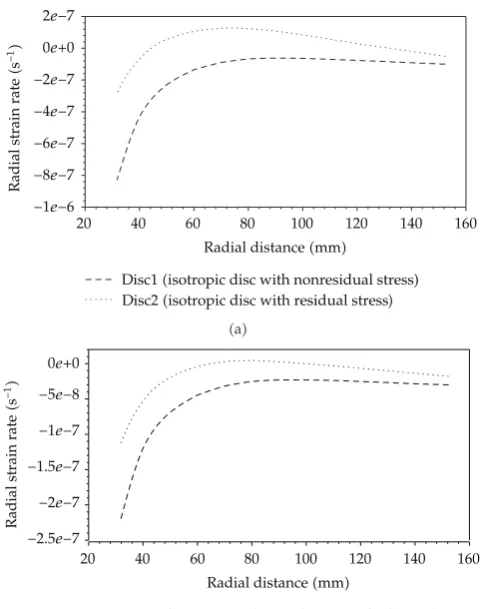
increases rapidly with radial distance and then starts decreasing. It reaches a minimum before increasing again towards the outer radius in both the isotropic/anisotropic discs with residual/without residual stress.
From previous discussion, it can be concluded that residual stress may cause signif-icant distortion in an isotropic/anisotropic rotating disc having linearly varying thickness, but the magnitude of distortion can be reduced by selecting anisotropic disc.
5. Conclusion
The previous results and discussion conclude the following.
1The presence of the thermal residual stress developing due to rotation does not significantly affect the distribution of stress in the isotropic/anisotropic disc having linearly varying thickness, but it affects the strain rates significantly.
Radial strain rate
(
s
−
1)
−1e−6
−8e−7
−6e−7
−4e−7
−2e−7
0e+0
2e−7
Radial distance(mm)
20 40 60 80 100 120 140 160
Disc1(isotropic disc with nonresidual stress)
Disc2(isotropic disc with residual stress)
a
Radial strain rate
(
s
−
1)
−2.5e−7
−2e−7
−1.5e−7
−1e−7
−5e−8
0e+0
Radial distance(mm)
20 40 60 80 100 120 140 160
Disc1(anisotropic disc with nonresidual stress)
Disc2(anisotropic disc with residual stress)
[image:13.600.179.421.95.400.2]b
Figure 6: Variation of radial strain rate along the radial distance in isotropic/anisotropic discs rotating with
an angular velocity 15000 rpm at 616 K.
3In the isotropic/anisotropic disc, the tangential strain rate is more in presence of thermal residual stress. Also, the extent of difference in creep caused due to the presence/absence of the residual stress increases as one moves towards the outer radius of the disc, although the magnitude of this difference is smaller in anisotropic disc compared to that in isotropic disc.
4In the presence of residual stress in the isotropic/anisotropic disc, the nature of radial strain rate changes from compressive to tensile, particularly in the middle region of the disc with linearly varying thickness as compared to the disc without residual stresses. Further, the magnitude of residual’s effect in the anisotropic disc is significantly lower as compared to those for the isotropic disc.
References
1 N. S. Bhatnagar, M. P. S. Kulkarni, and V. K. Arya, “Steady-state creep of orthotropic rotating disks of variable thickness,” Nuclear Engineering and Design, vol. 91, no. 2, pp. 121–141, 1986.
2 R. J. Arsenault and M. Taya, “Thermal residual stress in metal matrix composite,” Acta Metallurgica, vol. 35, no. 3, pp. 651–659, 1987.
3 R. S. Mishra and A. B. Pandey, “Some observations on the high-temperature creep behavior of 6061 Al-SiC composites,” Metallurgical Transactions A, vol. 21, no. 7, pp. 2089–2090, 1990.
4 A. B. Pandey, R. S. Mishra, and Y. R. Mahajan, “Steady state creep behaviour of silicon carbide particulate reinforced aluminium composites,” Acta Metallurgica Et Materialia, vol. 40, no. 8, pp. 2045– 2052, 1992.
5 L. C. Davis and J. E. Allison, “Residual stresses and their effects on deformation,” Metallurgical Transactions A, vol. 24, no. 11, pp. 2487–2496, 1993.
6 G. K. Hu and G. L. Huang, “Influence of residual stress on the elastic-plastic deformation of composites with two- or three-dimensional randomly oriented inclusions,” Acta Mechanica, vol. 141, no. 3, pp. 193–200, 2000.
7 H. Jahed and R. Shirazi, “Loading and unloading behaviour of a thermoplastic disc,” International Journal of Pressure Vessels and Piping, vol. 78, no. 9, pp. 637–645, 2001.
8 Y. Orcan and A. N. Eraslan, “Elastic-plastic stresses in linearly hardening rotating solid disks of variable thickness,” Mechanics Research Communications, vol. 29, no. 4, pp. 269–281, 2002.
9 S. B. Singh and S. Ray, “Newly proposed yield criterion for residual stress and steady state creep in an anisotropic composite rotating disc,” Journal of Materials Processing Technology, vol. 143-144, no. 1, pp. 623–628, 2003.
10 S. B. Singh and S. Ray, “Modeling the creep in an isotropic rotating disc of Al-SiCw composite in presence of thermal residual stress,” in Proceedings of the 3rd International Conference on Advanced Manufacturing Technology (ICAMT ’04), pp. 766–770, Kuala Lumpur, Malaysia, May 2004.
11 V. K. Gupta, S. B. Singh, H. N. Chandrawat, and S. Ray, “Steady state creep and material parameters in a rotating disc of Al-SiCP composite,” European Journal of Mechanics, A/Solids, vol. 23, no. 2, pp. 335–344, 2004.
12 H. Jahed, B. Farshi, and J. Bidabadi, “Minimum weight design of inhomogeneous rotating discs,” International Journal of Pressure Vessels and Piping, vol. 82, no. 1, pp. 35–41, 2005.
13 O. Sayman, “Stress analysis of a thermoplastic composite disc under uniform temperature distribution,” Journal of Thermoplastic Composite Materials, vol. 19, no. 1, pp. 61–77, 2006.
14 S. B. Singh, “One parameter model for creep in a whisker reinforced anisotropic rotating disc of Al-SiCw composite,” European Journal of Mechanics, A/Solids, vol. 27, no. 4, pp. 680–690, 2008.
15 F. Z. Xuan, J. J. Chen, Z. Wang, and S. T. Tu, “Time-dependent deformation and fracture of multi-material systems at high temperature,” International Journal of Pressure Vessels and Piping, vol. 86, no. 9, pp. 604–615, 2009.
16 N. Chamoli, M. Rattan, and S. B. Singh, “Effect of anisotropy on the creep of a rotating disc of Al-SiCp composite,” International Journal of Contemporary Mathematical Sciences, vol. 5, no. 11, pp. 509–516, 2010.
17 S. B. Singh and M. Rattan, “Creep analysis of an isotropic rotating Al-SiCp composite disc taking into account the phase-specific thermal residual stress,” Journal of Thermoplastic Composite Materials, vol. 23, no. 3, pp. 299–312, 2010.
18 J. J. Chen, K. B. Yoon, and S. T. Tu, “Creep behavior of pressurized tank composed of functionally graded materials,” Journal of Pressure Vessel Technology, vol. 133, no. 5, Article ID 051401, 2011.
19 V. Gupta and S. B. Singh, “Modeling anisotropy and steady state creep in a rotating disc of Al-SiCp having varying thickness,” International Journal of Scientific & Engineering Research, vol. 2, no. 10, pp. 1–12, 2011.
Submit your manuscripts at
http://www.hindawi.com
Hindawi Publishing Corporation
http://www.hindawi.com Volume 2014
Mathematics
Journal ofHindawi Publishing Corporation
http://www.hindawi.com Volume 2014
Hindawi Publishing Corporation http://www.hindawi.com
Differential Equations
International Journal of
Volume 2014
Applied MathematicsJournal of
Hindawi Publishing Corporation
http://www.hindawi.com Volume 2014
Hindawi Publishing Corporation
http://www.hindawi.com Volume 2014
Hindawi Publishing Corporation
http://www.hindawi.com Volume 2014
Mathematical PhysicsAdvances in
Complex Analysis
Journal ofHindawi Publishing Corporation
http://www.hindawi.com Volume 2014
Optimization
Journal of Hindawi Publishing Corporationhttp://www.hindawi.com Volume 2014
Combinatorics
Hindawi Publishing Corporation
http://www.hindawi.com Volume 2014
International Journal of Hindawi Publishing Corporation
http://www.hindawi.com Volume 2014
Journal of
Hindawi Publishing Corporation
http://www.hindawi.com Volume 2014
Function Spaces
Abstract and Applied Analysis
Hindawi Publishing Corporation
http://www.hindawi.com Volume 2014
International Journal of Mathematics and Mathematical Sciences
Hindawi Publishing Corporation http://www.hindawi.com Volume 2014
The Scientific
World Journal
Hindawi Publishing Corporation
http://www.hindawi.com Volume 2014
Hindawi Publishing Corporation
http://www.hindawi.com Volume 2014
Discrete Dynamics in Nature and Society
Hindawi Publishing Corporation
http://www.hindawi.com Volume 2014 Hindawi Publishing Corporation
http://www.hindawi.com Volume 2014
Discrete Mathematics
Journal ofHindawi Publishing Corporation
http://www.hindawi.com Volume 2014
Hindawi Publishing Corporation
http://www.hindawi.com Volume 2014