N o t e s f r o m m i c h i g a N L a w
In the Shadow of the Recession, p. 16
Roots of the Executive Branch, p. 29
The Father of Miranda, p. 38
Chief JustiCe Joins Celebration of 150 extraordinary years
NoN-ProfitorgaNizatioN U.S. PoStage Paid
aNN arbor, Mi PerMit #144 the UNiverSity of MichigaN
b38 hUtchiNS hall
aNN arbor, MichigaN 48109-1215 N O T E S F R O M M I C H I G A N L A W N o t e s f r o m m i c h i g a N L a w
La
w Quadrang
le
Notes from
m
ichigan Law
the regents of the university of Michigan
Julia Donovan Darlow, Laurence B. Deitch, Denise ilitch, olivia P. maynard, andrea fischer Newman, andrew c. richner, s. martin taylor, Katherine e. white, mary sue coleman, ex officio
the University of michigan, as an equal opportunity/affirmative action employer, complies with all applicable federal and state laws regarding nondiscrimination and affirmative action. the University of michigan is committed to a policy of equal opportunity for all persons and does not discriminate on the basis of race, color, national origin, age, marital status, sex, sexual orientation, gender identity, gender expression, disability, religion, height, weight, or veteran status in employment, educational programs and activities, and admissions. inquiries or complaints may be addressed to the senior Director for institutional equity, and title iX/section 504/aDa coordinator, office of institutional equity, 2072 administrative services Building, ann arbor, michigan 48109-1432, 734-763-0235, ttY 734-647-1388. for other University of michigan information call 734-764-1817. the University of michigan Law school
Volume 52, Number 2 faLL 2009
Cover photo of chief Justice John g. roberts, Jr., at the Law school’s sesquicentennial celebration by sam hollenshead.
______________________________
copyright © 2009
the regents of the University of michigan all rights reserved.
Law Quadrangle (UsPa #144) is issued by the University of michigan Law school. Postage paid at ann arbor, michigan.
Publication office: Law Quadrangle, University of michigan Law school, ann arbor, mi 48109-1215. Published two times a year.
Postmaster, send address changes to: editor, Law Quadrangle
University of michigan Law school B38 hutchins hall
ann arbor, mi 48109-1215
special Counsel for Communications: Lisa rudgers
editor: Katie Vloet
Writers: terry adams, David chambers, shannon cook, Nicole fawcett, Linda fitzgerald, rebecca freligh, sheryl James, John P. masson, clarissa sansone, James tobin, Jared wadley, Lara Zielin
assistant director for Communications: Lisa Yellin
art director: Laura Jarvis
design: martin soave, michigan marketing & Design
Photos: fred Baker, Bentley historical Library, mark Bogarin Photography, claire Duggan, gregory fox Photography, sam hollenshead Photography, Lindsay Kanter, steven simpkins, Peter smith Photography, Leisa thompson Photography, U-m Photo services (scott galvin, Lin Jones, scott soderberg, martin Vloet), Dwight Vallely, Jared wadley, Linda wan Photography illustration: carolyn reed Barritt ______________________________
if you are a Law school graduate, please send your change of address to:
Law school Development and alumni relations 109 east madison, suite 3000 ann arbor, mi 48104-2973 Phone: 734.615.4500 fax: 734.615.4539
e-mail: [email protected]
Non-alumni readers should address:
editor
Law Quadrangle B38 hutchins hall ann arbor, mi 48109-1215 fax: 734.615.4277
e-mail: for class Notes – [email protected] for other communications – [email protected]
5 Things About 1859
The year was 1859. James Buchanan lived in the White House, abolitionist John Brown led a raid on Harpers Ferry, and the seeds of the Civil War were being sown. And in Ann Arbor, Michigan, a new law department enrolled its first students.
As we celebrate the Law School’s sesquicentennial, we wondered about the world in which those first students lived. Here are a few things that occurred a century and a half ago.
1.
Charles Darwin publishes On the Origin of Species by Means of NaturalSelection, or the Preservation of Favoured Races in the Struggle for Life,
later condensed to a much shorter title: The Origin of Species. The book remains significant and controversial; indeed, New Scientist magazine recently called it “arguably the most important book ever written.” Interesting bit of trivia: It was not until the fifth edition, published 10 years later, that the phrase “survival of the fittest” was added to the book.
2.
A daredevil named Charles Blondin makes the first successful tightrope walk across Niagara Falls. He crossed several more times, including one trek on which he pushed a wheelbarrow. “The greatest feat of the Nineteenth Century,” gushed the Buffalo Republic. “That mighty cataract of the world has been crossed by a human being on a tight-rope—he has drawn up from its bosom with a rope, a bottle, and drank its contents while sitting upon it. …What will not man do next?”3.
Big Ben begins keeping time and chiming. The clock, according to the official Big Ben website, was installed in the Clock Tower in April 1859. At first, it wouldn’t work because the cast-iron minute hands were too heavy. They were replaced by lighter copper hands, and it successfully began keeping time the following month. Officially, the Clock Tower’s bell is called the Great Bell, though it is better known by its nickname—which is thought to honor either Sir Benjamin Hall, First Commissioner for Works, whose name is inscribed on the bell, or Ben Caunt, a champion heavyweight boxer of the 1850s.4.
Construction begins on the Suez Canal. The canal connects the Gulf of Suez on the Red Sea to the Mediterranean Sea, and provides a short route between Europe and Asia without circumnavigation of Africa. The canal opened in 1869, after a decade of forced labor and the death of as many as 120,000 Egyptian workers. The canal—at times called the umbilical cord to the world, the lifeline of the British Empire, and the eighth wonder of the modern world—is a passageway for some 20,000 vessels a year.5.
The most massive solar superstorm in recorded history lights up the skies with red, green, and purple auroras. The storm is believed to have been caused by a medley of solar flares, accelerated protons, intensified electrical currents, and other astro-anomalies. Thanks to the off-kilter energy, telegraph systems failed in North America and Europe, but that’s nothing compared to the chaos that such a storm would cause now. “Were it to happen today, it could severely damage satellites, disable radio communications, and cause continent-wide electrical blackouts that would require weeks or longer to recover from,” according to a 2008 article in Scientific American.[
o p e n i n g
]
t
t
Ba
ckground Pho
t
o:
g
re
gor
y Fo
x
Katie Vloet is the new editor of the LawQuadrangle. She joins the Law School after stints as a writer and public relations represen-tative at the Medical School and as editor of U-M’s faculty and staff newspaper. Prior to that, she was a newspaper reporter at the St. Petersburg (Florida) Times and the Cox Newspapers Washington Bureau. Katie is a Michigan native and a graduate of The George Washington University. She would love to hear your thoughts and ideas about the magazine, including letters to the editor for a new section in the magazine. E-mail her at [email protected].
Sheryl James is a writer in Brighton, Michigan, who won a 1991 Pulitzer Prize for feature writing for a series of articles in the St. Petersburg (Florida) Times about a mother who abandoned her newborn child. She also worked at the Detroit Free Press and Hour Detroit magazine. She freelances regularly for several magazines and teaches journalism at Eastern Michigan University.
James Tobin is a journalist and historian whose books include Ernie Pyle’s War and To Conquer the Air: the Wright Brothers and the Great Race for Flight, both of which received national awards. A former reporter for The Detroit News, he is an associate professor of journalism at Miami University in Ohio. He is working on a book about Franklin Roosevelt’s experience of disability.
John Masson is the Law School’s media relations officer and the editor of its electronic newsletter, Amicus. A long-time news-paper reporter, John won a national Emmy award—a rarity for a print journalist— for the web portion of his Detroit Free Press story about a Michigan-based unit of Marine Corps reservists deployed to Iraq. He also wrote for the Flint Journal and The Indianapolis Star. A Navy veteran of the Persian Gulf War, John continues to serve as a writer and photographer in the Coast Guard Reserve, where his only discernible duties appear to be doing all the fun stuff.
David Chambers is the Wade H. McCree Jr. Collegiate Professor Emeritus of Law. He taught family law and criminal law at the Law School from 1969 until 2003 and was the founder of the South Africa Externship Program. He also served as president of the Society of American Law Teachers and as a member of the Executive Committee of the Association of American Law Schools.
Terry K. Adams, ’72, is a senior research associate at the Law School and the Institute for Social Research at the University of Michigan. He has worked with David Chambers on the University of Michigan Law School Alumni Survey since 1980 and is a founding member of the Executive Coordinating Committee of the After the J.D. Study of the American Bar Foundation, a national study of the careers of individuals joining the bar in 2000.
C o n t r i b u t o r s
A photo in the winter issue (Vol. 52, Number 1) was identified erroneously as William W. Cook. The subject of the photo actually was Henry Wade Rogers, a former dean who went on to become president of Northwestern University and a judge on the U.S. Court of Appeals for the Second Circuit.
Note about volume number: Due to a produc-tion error, the previous issue of the magazine
was labeled Vol. 52, Number 1, rather than Vol. 51, Number 1. We will stay with the new numbering system, and Vol. 51 will not exist. We apologize for the confusion, particularly to librarians and others responsible for archiving.
Several of our keen-eyed readers pointed out that a photograph in a timeline actually de-picted World War II soldiers, not World War I.
The timeline suggested that the Michigan
Journal of International Law began in 1999.
Indeed, the Journal started in 1979 as the
Michigan Yearbook of International Legal Studies, and changed to the current title in 1989.
L a w Q u a d r a n g L e n o t e s
f a L L 2 0 0 9
0 2 A M E S S A G E F r o M D E A N C A M i N k E r 02 The worst of times, the best of times
0 4 B r i E F S
07 Branch Rickey honored at new Mets stadium
0 8 S E S Q U i C E N T E N N i A L
08 Chief Justice Roberts visits Michigan Law 11 Panel of former deans
1 6 S P E C i A L F E A T U r E S
16 IN THE SHADOW OF THE RECESSION
17 In-firm: After a tough year, what’s next? 20 Making the most of a deferral 21 Going public
22 Blue helping blue: Alumni assist with mock interviews 22 Employability: New prof lends a hand
29 THE ROOTS OF THE EXECUTIVE BRANCH Alumni rise to key posts in Obama administration: Jarrett, Salazar, Barnes, and more
38 THE FATHER OF MIRANDA
Yale Kamisar’s influence on criminal procedure
41 ANATOMY OF AN ALUMNUS
50 years after Anatomy of a Murder
44 TEACHING THE TEACHERS
Michigan Law School’s impact
2 3 FA C U LT y V i E w S
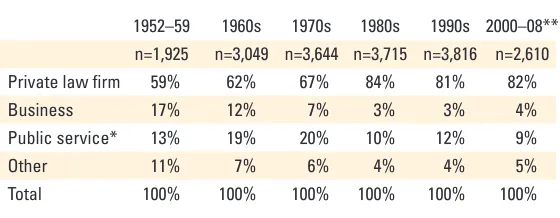
23 First jobs, through the years
4 6 G i V i N G
5 6 A L U M N i N E w S / C L A S S N o T E S
56 To catch a cheat: Alumnus-turned-poker-pro helps uncover scam 70 In Memoriam
7 2 FA C U LT y N E w S
72 New Faculty
1 6
2 9
Law Quadrangle
•
Fall 2009
2
I wish that, as we commemorate our sesquicentennial year at this great law school, the times would be all smiles and smooth sailing. But alas, just as we were in the throes of the Great Depression at our halfway point 75 years ago, so too today times are difficult and uncertain.
A few weeks ago I invited New York- and Chicago-area alumni to join me both in person and on conference calls so I could pick their brains about how best to position our current students for success in these uncertain times. Their advice was sobering, but right on target considering current market conditions. As summer associate programs narrow and new hires are deferred, students must adjust expectations, and be as strategic and proactive as possible. Alumni advised that we continue to educate students in the Michigan way; make sure students write well and com-municate well for work with discerning clients working under stressful conditions; and encourage students to be flexible in their job searches as well as the practice areas they hope to develop.
As I write this, economic indicators are showing some positive signs. And yet, though the worst of the recession is hopefully behind us, many law firm partners tell me they expect to implement continued shifts in legal recruiting and practice over the next few years. [This issue’s story about the job market (beginning on page 16) is a frank assessment of the situation. The story is in some ways a departure from previous editorial content, and the first of many topical legal issues we plan to cover.]
I believe the Law School has a special responsibility now. Our attorney-counselors are meeting one-on-one with students to explore and target their job search options. We are increasing our personal outreach to alumni and friends in both the private and public sectors. And this fall we welcomed former ABA president and alumnus Robert Hirshon as a professor from practice, who in addition to his teaching portfolio will be working with the Law School to develop new opportunities for our students in public interest and private practice (see p. 22).
a m e s s a g e f r o m d e a n C a m i n k e r
sam hollenshead
Law Quadrangle
•
Fall 2009
Chief Justice Roberts and Dean Caminker mark the end of the Conversation with Chief Justice John G. Roberts, Jr., at Hill Auditorium with a handshake.
Glorious weather accompanied the September groundbreaking ceremony for a new academic building at State and Monroe streets.
It is at times like this that we understand the true power of the international Michigan Law alumni network. At more than 20,000 strong, we have substantial alumni populations in the world’s best firms, as well as highly placed in NGOs and in the government (see page 29 for just how highly placed). Personal connections to Michigan alumni in legal and legal-related fields can be an important asset for our students, especially now as students face such extraordinary circumstances. If you know of employment opportunities or would be interested in mentoring current students as they prepare for a career in the law, I hope you will visit www. law.umich.edu/alumniandfriends/pages/alumnet.aspx to indicate your interest and area of expertise.
And yet, even as we face what alumna and assistant dean of public service MaryAnn Sarosi calls “seismic changes” in legal employment, the work of the Law School is continuing with great momentum. As the economy recovers, Michigan Law will be well-positioned to expand upon its leadership in legal education and scholarship.
This year’s incoming class is stellar, I’m pleased to report, with students from 38 states and 14 countries. We will also welcome 10 new faculty members in one of our most successful recruiting “seasons.” These faculty members are impressive in their scholarship and their breadth of academic interests—everything from antitrust to international arbitration to civil rights—and will add richness to the Law School’s distinguished faculty.
The Law School has weathered the recent financial storms with stability, in part due to the University of Michigan’s sound financial policies and management and in part due to our generous donors. Private gifts are especially important for Michigan Law; although we are a public law school, only about 2 percent of our budget is now state-supported. Gifts from you and your fellow alumni provide faculty and student support, have enabled us to keep tuition increases low, and have provided the seed funding necessary for the Law School’s new building and renovation projects.
So, we are celebrating our sesquicentennial with joy, reflection, aspiration, and with gratitude for 150 years of this remarkable Michigan Law family (see pages 8–15). The festivities included a ceremonial groundbreaking for our first academic building in 75 years, as well as a gorgeous, new glass-enclosed Commons area. Those additions will house Michigan Law’s next generation of energy and aspirations, even as we stay indelibly connected with our historic tradition.
Sincerely,
Evan Caminker
Dean and Branch Rickey Collegiate Professor of Law
s
co
tt
s
oder
B
erg, u-m
P
ho
t
o ser
b r i e f s
4
After more than a year of poring over documents, conducting long interviews, and spending late nights debating, the attorneys and students from the Law School’s Innocence Clinic secured the exonerations of Marvin Reed and his nephew DeShawn.
The Reeds had spent about nine years in prison for assault with intent to commit murder in a 2000 shooting, for which they were sentenced to 20 years. But Wayne County Circuit Court Judge Patricia Fresard ruled that they would get a new trial, and on July 31 they were embraced by family and friends after regaining their freedom when prosecutors decided not to retry them.
“I knew one of these days it was going to come to an end because I believe in the Lord. It was just a matter of time,” Marvin Reed said, and TV cameras filmed DeShawn as he cut off his prison bracelet.
The Reeds’ fortunes turned when the shooting victim, Shannon Gholston, recanted his trial testimony that had implicated them, and when the Innocence Clinic took up their cause. Other evidence that was presented this year—but was absent from the trial— showed that the police found the gun in possession of Tyrone Allen, identified by witnesses as the real shooter. Allen was shot to death by Detroit police while attempting a carjacking before the Reeds went to trial.
The Innocence Clinic represents inmates like the Reeds, whom the clinic believes to have been wrongfully convicted in cases where biological evidence like DNA does not exist. Other innocence clinics throughout the country specialize in DNA-based exonerations, notes David Moran, ’91, codirector of the clinic (pictured above).
The ruling gave the clinic its first victory since it opened in January. Recent graduate Zoe Levine—who worked on the case as a 3L— said she learned “what it means to advocate zealously on someone’s behalf, because so much is at stake.”
Bridget McCormack (pictured above), associate dean of clinical affairs and clinic codirector with Moran, noted that “there are thousands of wrongfully convicted prisoners in Michigan.”
Since last summer, the clinic has received more than 3,000 letters from convicted Michigan prisoners and their families. Each inmate must complete a 19-page questionnaire to be considered by the clinic. —JW
Innocence Clinic secures first exonerations
Pho
t
os
B
y J
ared
W
adle
y
b r i e f s
Law Quadrangle
•
Fall 2009
b r i e f s
Our Social Network:
Amicus
, Facebook,
We’ve recently begun publishing the Law Quadrangle twice yearly, rather than three times. And for those months when the magazine does not arrive in alumni mailboxes, we’ve encouraged an upstart electronic newsletter, Amicus, to fill the information gap with a selection of original stories about the Law School and Internet links to stories published elsewhere.
You’ll find stories in Amicus about Moot Court winners, the student v. faculty hoops game, and even sharks in the library. You can also read about the International Transactions Clinic, the annual Student Funded Fellowships auction, rainmaking, an alumnus’s “Courtoons,” and the Student Hurricane Network, or watch videos of the Headnotes serenading their professors.
Michigan Law has taken to the Interwebs in other ways as well: on the social net-working sites Facebook, where we’ve established an official presence, and Twitter, where we’ve been tweeting breaking news about Michigan Law and its faculty.
We’re easy to find in both places: on Facebook, search on “Michigan Law Alumni and Friends,” and on Twitter, sign up to follow “UMichLaw.” —JM
Two new experiential learning offerings will allow students and faculty to have an impact on the lives of people from as nearby as Detroit and as far away as the other side of the world.
First, with a mightily stressed child foster care system, one-third of the state’s foster kids, and fully half of the state’s permanent court wards, Wayne County’s Department of Human Services is getting help from the Law School’s Detroit Center for Family Advocacy (CFA), which opened in July.
The three-year pilot program will serve the Osborn neighborhood on Detroit’s east side, an area that carries one of Wayne County’s highest rates of children being removed from their families. Vivek Sankaran, ’01, clinical assistant professor, is directing the project, and Don Duquette, ’75, clinical professor, coordinates the careful evaluation of the project. Students in the Child Advocacy Law Clinic will help to manage cases. The CFA hopes to include faculty and students from other disciplines and volunteer attorneys in the future.
The Center is helping families with two types of cases. The first are cases in which legal assistance can help a parent, guardian, or extended family member provide a safe, stable home for a child whose family has been investigated and substantiated for possible abuse or neglect. The second are cases in which legal services to a potential permanent caregiver could help a child exit the foster care system completely. Altogether, organizers project the Center will help 600 children over the three-year course of the pilot program, which has been specially designed to be easily replicated.
Additionally, the CFA plans to offer much more than just legal counsel. A specially trained attorney will team up with a social worker and a parent advocate to help a parent or potential guardian build a plan to address safety risks while still keeping the child with the family.
The CFA is funded with grants from the Skillman Foundation, the Community Foundation for Southeast Michigan, and the McGregor Fund; a grant from retired Washington State Supreme Court Justice and CEO of the Center for Children and Youth Justice Bobbe Bridge, along with husband Jon Bridge; matching funds from the Wayne County Child Care Fund; and support from U-M.
Second, students in Bridgette Carr’s new Human Trafficking Clinic—among the first of its kind at a U.S. law school—can expect to learn a lot this fall about the world’s second-largest industry: slavery. In working directly with clients who have been victims of modern-day slavers, Carr’s students will also learn about the fear, loneliness, and frustration of captives being held far from home.
During their clinic experience, those students are likely to see victims of human trafficking from locations around the world, says Carr, ’02, adjunct clinical assistant professor.
They are children and adults, and they’re forced into jobs in cities and towns as hair braiders, landscapers, restaurant workers, farm laborers, hospitality workers, and prostitutes—“almost anyplace,” Carr said, “where people can be exploited for profit.”
Apart from the direct legal work helping to represent such victims, Carr also expects her students to conduct community education and training for local law enforcement, firefighters, EMTs, and other first responders.
In the last academic year, the Juvenile Justice Clinic, International Taxpayer Clinic, International Transactions Clinic, and Michigan Innocence Clinic all opened. In all, the Law School now offers 14 clinics, in addition to several programs and centers. —JM
b r i e f s
Law Quadrangle
•
Fall 2009
66
b r i e f s
Joshua Deahl took a road trip to the Supreme Court in 2006 to hear Professor Richard Friedman argue for the petitioner in Hammon v. Indiana. He and his classmates showed up at 5:30 a.m., and waited several hours to go inside the Corinthian-columned building.
Today, he walks into the Court every weekday without delay. As retired Justice Sandra Day O’Connor’s only clerk, Deahl, ’06, assists her with writing speeches and with her work on federal circuit courts. O’Connor also has loaned him out to Justice Anthony Kennedy. During the summer, Deahl worked on the cert pool for Kennedy—the group of clerks who work together to summarize and make recommen-dations about which petitions the Court should hear.
“It’s a tremendous experience,” he says. “Justice Kennedy is very hands-on; he talks to his clerks typically every day. I usually talk to Justice O’Connor every day if she’s in town. I’ve learned a great deal from both of them.”
Down the hall from Deahl, Hyland Hunt, ’08, is clerking for Justice John Paul Stevens. She has been writing memos about cert petitions for the justice.
“I’m getting a sense of how the Court works, how Justice Stevens views the law,” Hunt notes. “It’s pretty amazing that I can talk to him directly about his legal views.”
Next year, two more Michigan Law alumni will clerk for the Supreme Court: Sam Erman, ’07, will work for Justice Stevens, and Matt Owen, ’08, will clerk for Justice Antonin Scalia.
The clerkships highlight Michigan’s longstanding position at the forefront of public law schools in the number of Supreme Court clerkships secured by alumni, notes Joan Larsen, counsel to the associate dean for student and graduate activities.
“This is an exceptional group of young alumni,” she says. “They are all highly regarded by their professors and classmates, and I have no doubt they will represent Michigan Law very well at the Supreme Court.”—KV
Four Alumni Clerk for the High Court
Peters
mith Pho
t
ogra
P
hy
Atsushi Kinami, a visiting professor from Kyoto University, was in the Faculty Lounge earlier this year when he unearthed the diploma and thesis of Gisan (Gizo) Hashimoto, a prominent 1890 graduate who hailed from Japan. Kinami, LL.M. ’84, also found photographs and a file documenting two visits by Hashimoto’s business associates who, in the 1950s and 1960s, gave the documents to U-M.
By coincidence, Toshihiro Hashimoto—the son of Gisan Hashimoto’s nephew—traveled to Michigan Law in April with the goal of seeing mementos from the life of his ancestor. He was given copies of his relative’s dissertation and diploma, as well as photographs.
Here, the younger Hashimoto is shown with Associate Dean Mark D. West, Nippon Life Professor of Law and director of the Japanese Legal Studies Program; Margaret A. Leary, director of the Law Library; and Virginia B. Gordan, assistant dean for international affairs.
The elder Hashimoto, sometimes known by his adoptive surname of Kasuya, returned to his home country after graduating from Michigan Law to become a prefectural assembly member in 1892 and a member of the House of Representatives (lower house of the Diet) in 1898. He later was appointed vice-speaker and then was elected to preside over the House of Representatives.
Law Quadrangle
•
Fall 2009
b r i e f s
‘Giant of a man’: Professorship named
for Rickey
New York Mets principal owner Fred Wilpon, a benefactor of the Branch Rickey Collegiate Professorship, celebrated the memory of his old friend at a reception April 30 at the Mets’ new Citi Field. Rickey, ’11, was remembered as epitomizing the values for which Michigan Law stands. “Branch Rickey was a giant of a man, not in stature, but with a great intellect, creativity, and total honesty,” Wilpon noted.
As an executive with the Brooklyn Dodgers, Rickey brought Jackie Robinson onto the team 62 years ago to break the sport’s color barrier.
“He was baseball’s greatest front-office executive, and more importantly, I believe he was the greatest executive in American sports history,” Bud Selig, commissioner of Major League Baseball, said at the event.
Rachel Robinson, Jackie Robinson’s widow, shared memories of Rickey and of the early days of her husband’s signing with the Dodgers, when the two men “met, strategized, and most importantly, developed a profound and lasting relationship,” she said.
“They seemed to understand, as great soldiers do, that there was a crucial interdependence between them,” Robinson recalled. “Thanks to Fred Wilpon, we proudly salute Mr. Rickey and the University of Michigan through the establishment of the Branch Rickey Professorship.”
Rickey’s grandson Branch B. Rickey, also a baseball executive, commended Dean Evan Caminker for accepting the challenge of being the first Branch Rickey Collegiate Professor.
Professor Rich Friedman was master of ceremonies for the program, and was delighted to meet one of his heroes: Hall of Fame pitcher Sandy Koufax, a high school baseball teammate of Wilpon. (See the June issue of Amicus for Friedman’s article about meeting Koufax: www.law.umich. edu/newsandinfo/amicus/archive/ june2009/index.html.)
Rickey also is the subject of a documentary called A Matter of Fairness, which was
screened at the Sesquicentennial Celebration (see p. 8 for more about the sesquicentennial). Film producer Christopher Cook, writer and sports historian John U. Bacon, and Friedman discussed the film and Rickey’s significance. —RF
Dean Evan Caminker and Rachel Robinson, widow of Jackie Robinson, along with Branch B. Rickey (top) and Mets principal owner Fred Wilpon (middle). Below, Rich Friedman meets one of his heroes, Sandy Koufax.
a
ll
P
ho
t
os
B
y s
am
h
8
s e s Q u i C e n t e n n i a L
chief justice helps michigan law celebrate
150 world-class years
By Katie Vloet
Michael Wagner was in Joan Larsen’s seminar on presidential power when he saw some powerful-looking people in the doorway. One of those people, it turned out, was none other than the 17th Chief Justice of the United States. As part of his visit to the Law School, John G. Roberts, Jr., visited several classrooms and invited students to ask him questions.
Wagner, feeling awed by the occasion but not too overwhelmed to speak, asked Roberts whether people with non-judicial backgrounds are likely to have a place on the Supreme Court in the future. And the 2L walked away with an experience he won’t forget any time soon. “For him to take time out of his schedule to talk with our small class was a real honor,” Wagner said.
During his three-day visit for the Law School’s Sesquicentennial Celebration, Roberts dined with faculty members, helped to break ground for a new academic building, tailgated with alumni, and sat with Dean Evan Caminker in the Big House for the Michigan-Notre Dame football game.
The highlight for many was the Conversa-tion with the Chief Justice, a quesConversa-tion-and- question-and-answer session at Hill Auditorium, where a packed house heard his thoughts on his newest colleague, football, and releasing audio of cases before the end of the Supreme Court’s term. Caminker joined Roberts on stage and moderated the discussion.
Given the recent appointment and swearing-in of Associate Justice Sonia Sotomayor, it’s no surprise that several people asked about her. Roberts responded, “I think she’s going to be a delightful, wonderful colleague.”
Law Quadrangle
•
Fall 2009
s e s Q u i C e n t e n n i a L
Opposite page (top): Chief Justice Roberts enjoys the pre-game tailgate along with Professor Richard Primus and Ellen Leitch.
This page:
An image on the scoreboard honored Michigan Law’s 150 years. And have no fear; the football team came back in the second half.
3Ls Leah Litman and Andrew Fink present a memento to Chief Justice Roberts.
Chief Justice Roberts shares a meal with professors Yale Kamisar, Rebecca Eisenberg, Douglas Laycock (back to camera), and Don Herzog.
Roberts displayed a knack for comedic timing throughout his visit. Responding to a question about whether Supreme Court justices could relate to everyday folks, he tried to dispel a myth. “Not all justices went to elite institutions. Some of them went to Yale.” When the crowd’s laughter quieted, the two-time Harvard alumnus added, “I’m going to pay for that.”
Anticipating questions about which team he would cheer for in U-M’s football game against Notre Dame, Roberts—who once attended Notre Dame Elementary School in Indiana—opted not to give a direct answer. “I am an advocate of judicial restraint. I see no need to answer that question.”
When asked if he favored banishment as a legal sanction, he paused, then answered, simply, “No.”
1 0
Law Quadrangle
•
Fall 2009
s e s Q u i C e n t e n n i a L
Chief Justice Roberts (third from left) helps break ground on the new academic
build-ing at State and Monroe streets. Joining him are U-M Regent Kathy White, Campaign Chairman Bruce Bickner, ’68, U-M President Mary Sue Coleman, Dean Evan Caminker, and Andrew Richner, ’86, chairman of the U-M Board of Regents.
U-M President Mary Sue Coleman (shown here with Roberts and Campaign Chairman Bruce Bickner, ’68) said at the ceremony: “Anyone who has visited Ann Arbor has probably strolled through the Law Quad, just as Garrison Keillor did when he taped his radio show here in June 2008. He later remarked on the air, ‘You could film Romeo and Juliet there, or film scenes from Elizabethan England—it made you want to go to law school, actually.’ … I believe the new facilities will be a wonderful complement to the Law Quad and to the university.”
Breaking New Ground
The day before a “maize out” filled the seats of the Big House with bright yellow T-shirts, a smaller but no less vibrant version occurred on the site of the Law School’s new academic building.
At the groundbreaking for the School’s first new academic addition in more than 75 years, hundreds of faculty, students, alumni, and friends gathered to hear Chief Justice John G. Roberts, Jr., and other dignitaries speak. All of them were given novelty hard hats, turning the parking lot into a sea of yellow.
“We’re standing where the Law School’s past meets the Law School’s future,” Dean Evan Caminker announced.
The five-level academic building, at the southeast corner of State and Monroe streets, has been designed in a modified Collegiate Gothic style. With a stone exterior and a slate roof, it will reflect the design of the existing Law Quad buildings. The new Law School Commons will be added to previously unused space between buildings on the Quad.
“Our breaking of ground today symbolizes our movement from vision to reality,” said Bruce Bickner, ’68, chairman of the Law School’s Campaign Steering Committee. He thanked former Dean Jeffrey Lehman, ’81, who “got
the ball rolling on the building expansion,” and Caminker, who “has made this project happen.”
Roberts spoke of the three Michigan Law alumni who served as Supreme Court justices: William R. Day, 1870, Frank Murphy, 1914, and George Sutherland, who attended in 1882 and 1883.
He also referred to a letter that Justice Oliver Wendell Holmes Jr. sent to the Law School when the Law Quad buildings were dedicated in 1935. If Holmes were around today to send another letter, Roberts noted, he would be pleased by the sight of irregularly shaped pieces of stone that will form the building’s exterior.
“He might also point out that the mortar between those stones is important as well. The bond between students, professors, and alumni, between lawyers and their community, is an essential ingredient in transforming quarried rock into a great and lasting institution,” Roberts said.
Caminker predicted: “I see the Commons as the new nerve center of the Law School—an amazing space that will enhance the student experience and make our already collegial learning community even more so.” And in the big first-floor classroom of the new academic building, he envisioned this scene: “There’s a first-year student who just got called on in her Torts class, and is trying to figure out what the hell Justice Cardozo meant by ‘proximate cause’ in the Palsgraf case.
Law Quadrangle
•
Fall 2009
s e s Q u i C e n t e n n i a L
Across Five Deanships
Their priorities may have been different—dictated by the times in which they led—but for the five surviving Michigan Law deans who assembled for an extraordinary panel discussion during September’s Sesquicentennial Celebration, the pressures of leadership were always substantial.
Fortunately, the joys of the job—at least according to Lee Bollinger, now president of Columbia University and deputy chairman of the New York Fed—were, too.
“The best years of my life … have been in exactly this location, this place, and this town,” Bollinger said. “For me, this is a magical place.”
The panel, moderated by Professor Christina Whitman, ’74, included Bollinger, Ted St. Antoine, ’54, Terry Sandalow, Jeff Lehman, ’81, and current dean Evan Caminker. The participants, aided by alumni and friends seated in Honigman Auditorium, examined their deanships’ similarities and differences.
Some deans, like Sandalow, found themselves concentrating primarily on building the strongest faculty and curriculum possible. Others, like St. Antoine, Lehman, and Caminker, balanced the need to maintain those traditional strengths with overseeing fundraising for endowment growth or huge building projects, like the underground library addition and the academic building and student commons the Law School is constructing now.
“None of us is at all prepared for what our daily lives are going to be like” before taking on the job, said Lehman, who, after his deanship, was president of Cornell University and helped found China’s first American-style law school. “So much of what I did as dean was finding balance” between alumni, faculty, and students.
Finding time to address communications with the same three groups is another challenge, the deans agreed. Caminker confessed to receiving some 300 e-mails a day. Bollinger drew a laugh when he described bringing carpet samples to a faculty meeting as part of renovation planning. “You have to start somewhere,” he said.
Sandalow drew chuckles when he described his son’s attendance, during his deanship, at the Law School. The son’s advice? “Don’t go to the law school where your father is dean.” And St. Antoine got a laugh when he observed dryly that “the mathematics were that roughly half the class weren’t going to be in the top half of the class.”
The job may come with ample opportunity for frustration, but it also comes with unparalleled rewards. Caminker described getting a note from a recent graduate who wrote of a recently completed first trial as a public defender.
“I didn’t come in with the highest numbers,” the graduate wrote, “but I’m grateful that you looked past that to see the potential in me.”—JM
Law Quadrangle
•
Fall 2009
1 2
s e s Q u i C e n t e n n i a L
Eric Stein, ’42 Judge Bruno Simma
‘Bruno Unmuzzled’
Perhaps Judge Bruno Simma shared the sentiments of the alumni in attendance when he remarked, “Every time I return to Ann Arbor, it really is coming home.” The featured speaker at the Worldwide Reunion and Dinner at the U-M Museum of Art, Judge Simma forged a relationship with the Law School in 1986, but his acquaintance with the United States goes back half a century. “I came to this country as an exchange student in 1958–59,” Simma said, “and if you think Ann Arbor is the Midwest, go to East Moline, Illinois.”
Judge Simma, a William W. Cook Global Law Professor who has served on the International Court of Justice since 2003, shared his enthusiasm about the ever-varied cases he comes across at the ICJ. He also stressed his affection for the Law School, where he can remove “the muzzle you have to wear as a judge” and openly debate legal ideas in the classroom.
Dean Evan Caminker then introduced Eric Stein, ’42, the Hessel E. Yntema Professor Emeritus of Law, to offer a toast. “It was a ringing introduction, and the ringing is still in my ears,” the 96 year old quipped. “I’ve been connected with the Law School for almost half of the entire history of it,” Stein remarked. “My favorite change” in the School’s history, he said, was “the response of this institution to the globalization” of law. He ended with, “May [the Law School] live long and grow and flourish, or, as the old Romans said, ‘vivat, crescat, et floreat.’ ”
Law Quadrangle
•
Fall 2009
s e s Q u i C e n t e n n i a L
Gala Dinner
Law Quadrangle
•
Fall 2009
1 4
s e s Q u i C e n t e n n i a L
t
t
t
t
A reception hosted by the Nannes 3L Challenge Committee introduced leaders of the Law School’s more than 50 student organizations to the Challenge and its benefactor, John Nannes, ‘73 (center), shown here with Challenge cochairs Teresa Lin, 3L and Spencer Walters, 3L, along with Dean Evan Caminker.
Zdenek Kühn, LL.M. ’02, a justice of the Supreme Administrative Court of the Czech Republic, addresses a question during the panel “Civil Justice Reconsidered: Perspectives from Around the World” during Michigan Law’s Sesquicentennial weekend. Others on the panel included Michigan Law Professor Steven Croley; Wang Liming, vice president of China People’s University and former dean of the China People’s University School of Law; and Yoichiro Yamakawa, MCL ’69, senior partner of Koga and Partners in Tokyo. The moderator was Professor Phoebe Ellsworth. For more coverage of the academic panels that took place during the Sesquicentennial weekend, visit the online version of the Law Quadrangle.
Richard D. Friedman, the Ralph W. Aigler Professor of Law, asked Chief Justice Roberts to sign his dissertation, Charles Evans Hughes as Chief Justice, 1930–1941: The Complexities of Moderation. Roberts’ signature joined those of his predecessors, former Chief Justices William H. Rehnquist and Warren E. Burger.
more memories
Jurors in mock trials at the Law School will now be deliberating in the Faegre & Benson Jury Room, following a room dedication ceremony during the Sesquicentennial weekend. Dean Caminker thanked 12 Michigan Law alumni firm members at Faegre who named the room via their support and a gift from the Faegre & Benson Foundation. Pictured in the newly named room were (from left) Russell Stewart, ’84, Jim Spaanstra, ’77, Dean Caminker, Brian O’Neill, ’74, and Laura Ferrell ’09, an associate with Skadden, standing in for her father, Charlie Ferrell, ’77, also a Faegre partner.
Law Quadrangle
•
Fall
2009
s e s Q u i C e n t e n n i a L
t
t
t
t
The Honorable J. Richard Ernst, ’63, a retired judge from northern Michigan, and Julia Ernst, ’94, talk with Tracy Lin, a first-year LL.M. student from China, during the alumni-student breakfast. Julia Ernst showed Lin pictures of her daughter, who also is from China, and asked Lin about making the adjustment to studying in the United States.
To a rapt audience that included 1933 alumnus John Keusch, who remembers the Law School before the Law Quadrangle was completed, and Ann Cook (pictured here with Leary), 1945 LSA graduate and grandniece of the man who made the Law Quad possible, Law Library Director Margaret Leary delivered an engaging lunchtime talk about benefactor William Cook. Read more in the online version of the Law Quadrangle.
Historian and sports commentator John U. Bacon and film producer Christopher Cook (pictured), along with Michigan Law Professor Richard Fried-man, shared their insights on the life of 1911 Law School grad-uate Branch Rickey, who helped integrate Major League Baseball in 1947 by signing Jackie Robin-son to a contract with the Brooklyn Dodgers. A Matter of Fairness (background), an examination of Rickey’s impact on baseball, was commissioned by the Law School and has aired on sports networks around the country. Students, alumni, faculty, and friends told their stories to
StoryCorps, an independent, nonprofit oral history project. Recorded conversations will be archived at the Law School and the Library of Congress. Brad Livingston, ’79, and his daughter, Amy, a 1L, talked about the changes in the Law School between his school days and hers. Her
final question to him was this: “Are you proud of me?” He answered with an emphatic “yes.”
Read more StoryCorps
1 6
f e a t u r e
Law Quadrangle
•
Fall 2009
f e a t u r e
Layoffs. Cutbacks. Entering into redun-dancy consultations.
Whatever the terminology, there’s no way to avoid the hard truth: This has been the worst year at law
firms in recent history.
Firms have cut back on staffing, deferred new hires for a few months up to more than a year, and trimmed salaries in a quest to prevent further layoffs. The layoff tracker at lawshucks.com charts the downturn month by month and firm by firm. Stalwarts such as White & Case, Allen & Overy, and DLA Piper are near the top of the list with hundreds of attorney and staff layoffs in 2009.
“I think the big picture is, you see all the large law firms with global, diverse practices are figuring out how to deal with the decline in the demand for legal services,” says Tom Leatherbury, firm hiring partner with Vinson & Elkins in Dallas.
“That’s why you see everything from very dramatic layoffs, de-equitizing partners, and hiring freezes to
more moderate decisions such as deferring start dates by a couple of months, adjusting compensation systems, and shortening summer programs by a few weeks.”
Yet some glimmers of hope are flickering on the horizon.
A few areas of law and some regions of the globe continue to experience growth, in spite of the recession. Some midsized and boutique firms remain on stronger ground. Some see this dramatic downturn as a time to rethink the way that law firms conduct business, with the possibility that they will be more efficient and flexible in the long term. And call them heretics if you’d like, but members of a growing chorus are saying that it’s healthy for firms to cut back on lavish summer programs and the wining and dining of potential hires.
So what changes lie ahead for new graduates, associates, and partners? Which adjustments could contribute to a fundamental shift in the way Big Law firms operate? And is it really the end of the billable hour and the $160,000 starting salary?
We interviewed experts around the country for their insights into the changing landscape of the legal field. The story that follows will present some answers, predictions, and bold proposals for ways that firms can prevent such a pervasive upheaval from occurring in the future.
in-firm
A T U M U LT U O U S Y E A R C O U L D L E A D T O M A J O R
C H A N G E S I N T H E W A Y L A W F I R M S O P E R A T E
1 8
f e a t u r e
Survival tips for firms
Few, if any, firms will emerge from the downturn without at least some bumps and bruises. Many big law firms in particular have been affected in staggering ways: mergers with other firms, massive layoffs, or even closure.
It’s been an eye-opening experience for a field that had thrived in recent years. Some outside observers, as well as people within Big Law, think that the events of the past year suggest that major changes are necessary if firms hope to rise up from the current downturn. Here’s what they say:
• Reconsider the billable hour. Many have predicted that firms will make a permanent retreat from the billable hour, at least among young associates. Even if it doesn’t disappear, the billable hour may not remain the predominant method by which clients are charged.
“It’s not necessarily the end of the billable hour, but we are seeing more openness to flexible billings and portfolio pricing,” notes Hilary Worchell, a recruiter and member of Mestel & Company’s partners, groups, and mergers practice in its Los Angeles office.
• Focus more on clients’ needs. A focus on high-quality service could be one long-term outcome of the economic downturn. Firms are forced to compete harder for clients, including against foreign companies that often provide services at lower costs, but can distinguish themselves by providing the best service.
“The good news is that law firms are having to figure out how to be more flexible and how to be more in tune with their clients. Often people criticize big law firms as being an entity unto
themselves, and not in tune with their clients or the overall economy.
“The strongest law firms are the ones that are figuring out how to be flexible, to look at hiring in a new light, to be more in tune with their clients. I think introspection is always
good,” Leatherbury notes.
• Learn from smaller firms. Many midsized and small firms have been leaner than Big Law for years. For instance, while staff cuts could mean an end to the one-to-one ratio of attorneys to secretaries at larger firms, “we’ve had a three-to-one average for 20 years,” says Richard Zussman, ’80, CEO of Jaffe Raitt Heuer & Weiss in Detroit. “And I think we’re more flexible because of it.”
• Cut the size of summer programs. In the five U.S. offices of Houston-based Vinson & Elkins, 13 1Ls were employed over the summer, compared with 55 the previous year, says Leatherbury. Like many of its counterparts, the firm did not hold pricey parties for summer associates and did not conduct on-campus interviews in the spring for 1Ls. “We’ve still kept the substantive piece, but not the big receptions,” he says. “It’s sort of a reset in how we approach the summer associate program.”
Law Quadrangle
•
Fall 2009
f e a t u r e
Survival tips for individuals
New graduates entered law school with the understanding that they would have secure, high-paying jobs upon graduation. And “there are associates who worked their tails off in law school, and worked and killed themselves 16, 18 hours a day, seven days a week. The aspiration everyone had was that their compensation would be very high,” notes Jerry Kowalski, founder and senior principal of Kowalski & Associates, a law firm consulting company in New York.
“They did all the right things, and they’re the really unfortunate victims.”
So what should they do? And what about associates and partners who have been laid off or are concerned that they will be?
• Expect less compensation. The days of the $160,000 starting salary are over, according to many people in the field. Clients are becoming less inclined to pay for fresh hires to work on their cases, and because of that, some say the trimming of starting salaries was all but inevitable.
Some compare the trend to the bubble-bursting that occurs on Wall Street when stocks are viewed as overpriced. “I think we’ll continue to see a retreat from 160. It’s like a market correction,” says James Leipold, executive director of the National Association for Law Placement.
A year or two of an apprenticeship or
internship after law school might help to ease the transition to associate status, say Leipold, Kowalski, and others. That would mean a lower salary bracket for new hires, and a higher scale after employees “graduate” to the next level. Adds Kowalski: “As President Obama says, everybody’s expectations need to be lowered.”
• Consider a second degree—and not necessarily an MBA. “Something most young lawyers won’t even think about: There is currently, and there will be for the next many years, an insatiable demand for IP lawyers who have training in the hard sciences. People with master’s degrees in an advanced science, such as biotech and energy, are doing well currently and will continue to do well,” Kowalski predicts.
• Don’t stop practicing law, especially if you’re a new graduate or a young associate. “New grads especially have to be really aggressive. Even if you’re volunteering at a nonprofit every Saturday—as long as you’re doing something. Stay entrenched in the law,” says Sabrina Joshi-Eisenbrei, ’03, a recruiter and member of Mestel & Company’s partners, groups, and mergers practice in its Los Angeles office.
• Consider moving to a different practice area, a new city, or a smaller firm. In other words, go where the work is. Litigation, bankruptcy, intellectual property, regulatory, and
employ-ment law all have picked up or are expected to, while medical mal-practice, workers’ compensation, and mergers and acquisitions have stalled.
The West Coast may bounce back before other parts of the country. Several firms opened new offices in the Los Angeles area in the past year, and firms in the city are likely to pull out of the recession more quickly because it is a litigation-driven mar-ket, Joshi-Eisenbrei predicts.
In addition, some boutiques are still hiring, as are overseas offices of some U.S. firms. The second hundred biggest firms based in middle markets showed the most growth in 2008, according to a story in The American Lawyer. “Midsize law firms in the Midwest, outside the biggest cities, are hiring lawyers, opening offices, and bringing on new associates this fall as they fare better than many larger urban rivals in the face of the recession,” noted an article in The National Law Journal. One reason for this, notes Joshi-Eisenbrei, is that “midsized firms have fared better in the sense that they may not be as leveraged in the financial markets.”
• Ask yourself whether Big Law is really the direction you want to take. Deferrals may be eye-opening for young lawyers. If the economy turns around in the next couple of years, deferred associates very likely will begin the careers they had planned in the private sector.
Others, though, could learn during their deferral that they favor the public sector or public interest law. “Maybe when they look back on this, they’ll realize that it worked out for the best,” says Frank Michael D’Amore, principal, Attorney Career Catalysts.
(A)fter 17 years of steady and sometimes spectacular growth, it’s hard to find many big-firm lawyers who remember an industrywide downturn. Since 1991, when George H.W. Bush was in the White House, Barack Obama was leaving the presidency of the Harvard Law Review, and Tim Berners-Lee launched the first website, Am Law 100 firms have doubled in size and gross, while the profits of their partners have shot up by a dizzying 215 percent. The firms now sit delicately on a large and lush plateau, from which there is a long way to fall.
2 0
Law Quadrangle
•
Fall 2009
f e a t u r e
making the most of a deferral
Having accepted a deferral from Latham & Watkins in Chicago, Katie Walton, ’09, is spending her first year out of Michigan Law in the guardian ad litem program of Chicago Volunteer Legal Services Foundation (CVLS). She appears in court regularly, and is learning how to manage a caseload, talk with clients, and collaborate with other attorneys.Even though she is doing something very different from what she once planned, Walton still thinks she is very lucky.
“I really want to do litigation in the future, so it’s great to get the court experience,” she says. “This is giving me the opportunity to really hone my skills.”
The firm is paying her a stipend during the period of the deferral, which means that CVLS only has to pay for her computer and phone usage while she provides legal services for dozens of clients.
“The benefit is huge,” says CVLS Executive Director Margaret Benson. “I can’t afford to hire someone to replace a staff member who is going on maternity leave”—the staff member who typically handles the guardian ad litem cases— “so having someone coming in full time to replace her is huge to me.”
Walton’s experience at Michigan Law, in particular in the Child Advocacy Law Clinic, first piqued her interest in working in this field. Once she accepted her firm’s voluntary deferral offer, she contacted organizations and professors for ideas about where she could apply. Assistant Dean of Public Service MaryAnn Sarosi, ’87, and others told her that CVLS would be a good organization with which to work.
Walton was one of dozens of students and alumni that Sarosi’s office and the Office of Career Services have helped to find placements. “Dean Sarosi was extremely helpful after I found out that I had been deferred,” Walton
says. “I met with her several times, and she suggested employers to contact and gave me great interview tips.”
When Walton learned about CVLS, she says, “Dean Sarosi knew a lot about the organization and really encouraged me to take their offer.”
Though some nonprofits do not have the phones, computers, and space for associates who have been deferred by their firms, CVLS already had the infrastructure in place because its function is to train and support volunteer attorneys, Benson notes.
That’s good news for Walton. Just three years ago, she knew little about law firm deferrals; now that they are commonplace, she’s making the most of the situation.
“When I started Law School, I don’t think any of us would have anticipated it,” she says. “I’m sad to not be starting at Latham in the fall—I love the people there—but this is a good solution for everybody.” —KV
the job search,
with help from
michigan law
Current students, new graduates, and alumni have inundated the offices of Career Services and Public Service with calls and e-mails since the onset of the economic downturn, seeking help with finding a new job, a first job, or a summer job.
At the Office of Career Services, inquiries from alumni and recent graduates began to wane a bit after springtime—but questions from current students worried about the economy have been consistent throughout the year, Assistant Dean for Career Services Susan Guindi, ‘90, notes.
Guindi, Dean Evan Caminker, and alumni working at some Chicago and D.C. firms where students were employed for the summer held conference calls in which they discussed tips for 2Ls. The Office also coordinated an event in New York in June at which students in summer programs met with alumni at their firms.
Afterward, Guindi held conference calls for students from around the country who worked at law firms this past summer, and she relayed the tips she heard from alumni, including:
• “First and foremost, you’ve got to do your best work this summer; the quality must be impeccable. In addition, you should demon-strate initiative and be visible, and work with many attorneys at your firms.”
• Reach out to alumni at firms where you worked during the summer. “Don’t wait for them to come to you,” Guindi advised students.
• Look at smaller firms in major markets or smaller, regional markets, or both.
• “Don’t rely exclusively on on-campus interviews. You should also conduct a mailing campaign, as there are many em-ployers that offer wonderful experiences but simply don’t come to campus to recruit.” —KV
f e a t u r e
With so much turmoil in the private sector, many lawyers are setting their sights on public interest groups and government agencies. The result is more competition for these jobs than ever before, and a large, talented field from which organizations and agencies can choose. On the flip side, though, some employers are wary of using their resources to train job candidates who may be looking only for a life raft, and will return to firms as soon as the economy recovers.
At the Federal Election Commission (FEC), Deputy General Counsel Christopher Hughey has heard from many
applicants who might not have sought government work in the past, including “some who might acknowledge that they are presently out of work.”
Based on numbers alone, the interest in FEC jobs has grown dramatically, Hughey says. In 2007, for instance, one attorney position in the agency’s litigation division attracted about 80 applicants. In 2009, a
similar job drew in 271 applicants—more than three times as many as two years before.
A similar phenomenon is occurring at the U.S. Coast Guard. Lt. Cmdr. Martha Rodriguez, the Direct Commission Lawyer Program manager, spoke with some 700 people who were interested in the program—all in her first nine months after she began the job last September. And that’s for a program that is looking to fill just a dozen positions this year.
“We’re seeing people who are older, who are more established in the legal profession, who have their own businesses,” she says. “I have noticed people saying to me, ‘I thought about the service and wasn’t sure, but it seems like a good option now.’ ”
At the U.S. Department of Labor (DoL), one anecdote helps to illustrate what was happening in the early spring of 2009, when law firm layoffs were peaking. The department posted a job in March, and all of the applicants who were invited to come in for an interview were employed. Just a few weeks later, the same job was re-posted, and all of the interviewees were unemployed.
Another job posting for an attorney in DoL’s Civil Rights Division attracted 500 applicants this year; the same job would have drawn in 60 to 100 applicants in past years, a department spokesperson says. Part of the increase has occurred because the DoL is recruiting nationwide, and has made it easier to apply for jobs, the spokesperson notes—but the primary factor is the depletion of jobs in law firms.
Public interest jobs also “are now highly competitive because of how many deferred lawyers have flooded the market,” notes Frank Michael D’Amore, principal, Attorney Career Catalysts. “It is almost an embarrassment of riches for public interest organizations. The challenge for those organizations will be devoting the resources to training people who are well intentioned but will likely be gone in six months to a year.”
While some organizations are hiring attorneys, others are struggling during the recession because of the downswing in donations. At
the Heritage Foundation’s Center for Legal and Judicial Studies in Washington, D.C., Director Todd Gaziano says many more lawyers are seeking jobs, including some who might not otherwise pursue a nonprofit position.
Additional interest in these jobs, however, “doesn’t mean that we can hire any more than usual—many other nonprofits are cutting back—or that we would be prudent to hire anyone who does not fit our normal criteria,” he says. “We need to be convinced that an applicant who was previously making a lot more money has changed his or her long-term perspective and has done so for the right reasons. Otherwise, we will both regret it in a few months’ time.”
While the competition is tough among applicants, people who currently work for the government or public interest organizations are grateful for the relative durability of their jobs—and they don’t plan to leave any time soon.
“I’ve been in the public sector for my entire career. Seeing law firms completely fold— it’s shocking,” the FEC’s Hughey says. “It makes me personally quite happy to have pursued a career in public service. I didn’t go into it for that reason, but it is nice to have the stability.” —KV
going public
Lawyers seek steady ground as firms struggle
The silver lining, if there is one, is that the legal world may be inspired to draw blueprints for the 21st century. —Opinion article in TheNew York
2 2
Law Quadrangle
•
Fall 2009
f e a t u r e
blue helping blue
Alumni assist younger generation by
conducting mock interviews
Sit up straight. Make eye contact. Know the answer to questions about your favorite Law School classes, and your biggest strengths and weaknesses.
And, for goodness’ sake, don’t end your sentences with an upward inflection that suggests uncertainty and youth.
“My pet peeve is people whose voice always rises at the end of the sentence,” says Jeremy Spector, ’97, a partner with Covington & Burling in Washington, D.C. “The ‘likes’ and ‘you knows’ drive me bonkers.”
Spector lends that expertise about professional demeanor to his alma mater by conducting mock interviews of students between their 1L and 2L years. He asks them questions as if he were conducting an actual interview, then spends time providing thorough feedback.
Learning how to present themselves to potential employers, he says, gives these students an advantage over other job candidates.
“Especially in a more competitive market, it’s becoming that much more important for you to distinguish yourself from other candidates,” Spector emphasizes. “For better or worse, that may happen on the first impression. The dry run really gives them a chance to work out the kinks. They’re the kind of kinks you can’t work out when you do practice interviews with your roommate.”
Kristin Ann Meister, ’04, is another grad who volunteers her time to conduct mock interviews of students. The Alston & Bird associate meets with students in New York City, and in Ann Arbor when she visits each year in the fall.
Among her tips: Know your own resume. It sounds obvious enough, but many interviewees flounder when asked about past work or educational experiences. “Have a two- or three-minute anecdote to tell about each item on your resume,” she suggests.
She also advises the students about things to say when the interviewer asks, “Do you have any questions for me?” and “What kind of work do you want to do?”
Spector and Meister say they are happy to have the opportunity to give back to the school that launched their successful legal careers.
“I do it because I loved Michigan Law School,” Meister says. “I’m still very interested and invested in the School.”—KV
new faculty
member’s focus:
Employability of grads
Michigan Law alumni are among the most-employed in the world, and the School has no intention of losing that distinction.
To that end, the Law School has hired Robert Hirshon, ’73, a former president of the American Bar Association. He has a dual role at the School. As the inaugural Frank G. Millard Professor from Practice, he is teaching courses such as practical ethics, law and practice, and others that are designed to help ensure students develop professional virtues and strong ethical character.
Equally important will be his role as Dean Evan Caminker’s special counsel on developments in the legal profession.
Hirshon is working closely with the offices of Career Services and Public Service to open up new employment opportunities for Michigan Law students and alumni. He’ll also spearhead new Michigan Law initiatives reflecting best practices in the legal profession and examine innovative ways the School can continue maximizing employment prospects for its graduates.
“That’s what I love about this new job—there’s so much going on in the legal profession right now,” he says. “We are being buffeted by
economic forces beyond our control, but if we can better understand the environ-ment in which we’re operating, we will be able to shape that environment to make it work in the best interests of our students, our