5194
HUMAN ACTIVITIES RECOGNITION BASED ON
AUTO-ENCODER PRE-TRAINING AND BACK-PROPAGATION
ALGORITHM
1NADIA OUKRICH, 2CHERRAQI EL BOUAZZAOUI, 3ABDELILAH MAACH,
5ELGHANAMI DRISS
1,2,3,5Computer Laboratory Research and Education, Mohammed 5 University in Rabat. Morocco 4
E-mail: 1[email protected], 2[email protected]
ABSTRACT
In this paper, Auto-Encoder algorithm (AE) has been used in unsupervised feature selection, then, Back-propagation (BP) algorithm has been used to train reconstructed subsets in supervised learning; in order to recognize human activities inside smart home. Subsequently, the performances of auto-encoder have been evaluated and compared with traditional weighting technique for features selection. The experimental results demonstrate that neural network using auto-encoder achieves an average of over 91.46 % for one user and 90.62 % for two-users, relatively better than neural network using traditional weighting technique.
Keywords: Auto-Encoder Pre-Training, Deep Network, Activity Recognition, Back-Propagation Algorithm,
Smart Home.
1. INTRODUCTION
Smart homes have been a center of interest for nearly two decades now. They are characterized by ambient intelligence and automation devices/systems, which allow it to respond to residents’ needs automatically and provide them with various facilities [1]. The standard approach to build smart homes is to computerize it. A set of sensors gather different types of data, regarding the residents’ actions inside homes and its utilities consumption. Computers or devices with computing power analyze these data to identify actions of residents or events that occurred. It can respond to these actions and events by controlling certain mechanisms that are built in the home [2]. Therefore, recognize activities of humans are the first key of the smart homes. Human Activity Recognition (HAR) intends to observe human-related actions in order to obtain understanding of what type of individuals activities/routines will performed within a time interval in order to providing a useful feedback for the system [3]. Through this paper, we referred to recognition of Activities of Daily Living (ADLs). ADLs are defined as routine activities that people tend to do every day and performed to live independently [4]. ADL consist of basic activities that response to primary needs of a person, these activities are composed of only a few steps and do not require real planning, such as eating, bathing, dressing, toileting
and walking … [5]. And instrumental activities, this kind of activity needs basic planning to be performed and implies objects manipulations, like the ability to use the telephone, shopping, food preparation, housekeeping, laundry, mode of transportation, responsibility for own medication and the ability to handling finances [6]. Despite advances in recognizing ADLs, this topic remains difficult. In terms of facilitate data analysis, enhance accuracy and recognize multi-users activities, etc.
5195 features from unlabeled data and reconstruct a useful representation of features. To the best of our knowledge, this is the first work that use auto-encoder combined by back-propagation algorithm to recognize ADLs inside home.
The contributions of this paper are as follows. 1. An approach to human activities recognition
inside home using auto-encoder and back-propagation algorithm.
2. An experimental study that validate the accuracy of auto-encoder and back-propagation algorithm for single and multi-users at home.
3. Comparison of this approach with one other traditional technique widely used in literature.
The rest of this paper is organized as follows. Section 2 reviews the literature. The unsupervised auto-encoder and supervised back-propagation algorithm proposed to recognize human activities are described in Section 3. Section 4 presents the experimental results of activity recognition accuracy of the different feature datasets and the performance measures of the two algorithms: neural network using auto-encoder and BP algorithm. Finally, the main contributions are summarized in section 5.
2. RELATED WORKS
Activity recognition techniques have been widely researched. Several machine-learning techniques are used in literature [8-22]. Almost of those research activities were focused on one-user activities and use emerging sensors network technologies. Recognizing multi-user activities, studied in this paper, is challenging and least covered in literature. Activity recognition techniques can be grouped into probabilistic techniques [9], logic [10,11], and ontological methodologies [12, 13]. Researchers have commonly tested the machine learning algorithms. In [14] authors use a knowledge-driven approach (KDA) to real-time, continuous activity recognition. In [15] a novel Evolutionary Ensembles Model (EEM) based on a Genetic Algorithm (GA) are introduced [16]. To handle the non-deterministic nature of activities, authors in [17] used support vector machine (SVM), in [18] authors used Naïve Bayes (NB) classifier, hidden Markov model (HMM) in [19], and conditional random fields in (CRF) [20]. The most popular and powerful algorithms are: NB, SVM, and HMM. Although, neural networks using BP algorithm [21] has proven successful in human activity recognition in smart home environments. In
this paper [21] Fong Compare the performance measures of BP with those of NB and HMM and prove that performance measures of BP are better than those of NB and HMM. To increase efficiency and accuracy of machine learning and neural networks, researchers use many feature selection algorithms, namely, minimal-redundancy maximal-relevance criterion (mRMR) [22] feature weighting algorithms and subset search algorithms, all are based on evaluate the goodness of features individually or through feature subsets [23]. In the literature, several unsupervised feature selection methods have been proposed where various criteria have been used to obtain new structure of the original data. Some of those works are spectral feature selection (SPEC) [24], Discriminative feature selection [25], Multi Cluster Feature Selection (MCFS) [26] feature selection using oppositional-based binary Kidney inspired algorithm [27] and feature selection using trace ratio criterion [28]. In this paper, a new unsupervised feature selection method has been evolved using auto-encoder [29] since it has the capacity to learn the input features without labeled data [30], an auto-encoder is ideal for unsupervised feature selection. The aim of an auto-encoder is to reconstruct a set of data, typically for the purpose of increasing efficiently and dimensionality reduction, it learn automatically features from unlabeled data and reconstruct a useful representation of features. In this paper, we proved that auto-encoder reconstructs data better than other features selection techniques and consequently improves the processing result.
3. PROPOSED WORK
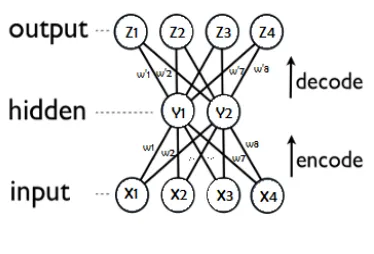
A novel method for activities recognition based on auto-encoder as unsupervised feature selection and back-propagation algorithm is explained in the following subsections. First auto-encoder algorithm is discussed in details, and then back-propagation algorithm used in supervised training is given. 3.1 Unsupervised Auto-encoder Architecture An auto-encoder [29-32] is an artificial deep neural network used in unsupervised learning for features selection. Architecturally, it is composed by an input layer, an output layer and one or more hidden layers connecting them. As in figure 1, unsupervised learning is consisting of two parts: encoder and decoder. The encoder takes an input vector x ∈ [0, 1]d, and maps it to a hidden layer y∈[0, 1]d’ through a deterministic mapping y= f
θ(x) = s(Wx
+ b), parameterized by θ = {W, b }. W is a d’×d
5196 input space z = gθ’(y) = s(W’y + b’) with θ’= {W’, b’}. The weight matrix W’ of the opposite mapping may optionally be constrained by W’= WT, in which case the auto-encoder is said to have tied weights.
y= fθ(x) = s(Wx + b), parameterized by θ = {W, b }.
W is a d’×d weight matrix and b is a bias vector. The resulting latent representation y is then mapped back to the decoder or a “reconstructed” vector z∈ [0,1]d in input space z = gθ’(y) = s(W’y + b’) with θ’= {W’, b’}. The weight matrix W’ of the opposite mapping may optionally be constrained by W’= WT, in which case the auto-encoder is said to have tied weights. Each training x(i) is thus mapped to a corresponding
y(i) and a reconstruction z(i). The parameters of this model are improved to reduce the average reconstruction error. Once we have a useful higher-level representation of the initial inputs, they are conducted to the second part: the supervised learning.
3.2 Back-Propagation Algorithm
In the supervised learning, we use back-propagation algorithms to train different labeled reconstructed input and choose the reconstructed subset with high performance. Back-propagation is a neural network based on multilayer perceptron model. Three layers compose this model: input layer, one hidden layer and output layer, all of these layers are linked by weighted connections. Back propagation algorithm attempts to associate a link between the input layer and the output layer, by computing the errors in the output layer and determine measures of hidden layer output errors. In way to adjust all weights connections (synaptic weights) of the network in iterative manner that carried on until the sum-squares-error decreases to a certain acceptance level (Error threshold). After training, neural network using BP algorithm is loaded with the testing samples with feature subsets going to input nodes. The classical error back-propagation algorithm can be summarized as
1 W k ∆W
Where W= represents a vector of neural weights, and k = {0; 1; 2; …} represents the iteration index during training. In addition, ΔW represents new weight value at the kth iteration of the training procedure, with η denoting the learning rate which should be small enough. Furthermore, e(W) represents the sum-squares-error function that is used to monitor and control BP-training process.
4. EXPERIMENTAL RESULTS
4.1 Testbed and Data Collection
Two different data sets were used in the experiments, those datasets were made by The Center for Advanced Studies in Adaptive Systems (CASAS) in [33, 34]. CASAS project is a multi-disciplinary research project at Washington State University, which focused on the creation of an intelligent home environment. Data sets are described in the table 1, the first smart apartment test bed is located in Netherlands, an adult woman performs 10 activities, and the second is located in Egypt where two married adults perform 12 activities. The two smart apartments are equipped with motion sensors distributed in different places inside homes. Sensor data is captured using a sensor network that was designed in-house and is stored in a database. The sensor events are annotated for ADLs, which are used for training and testing the activity recognition algorithms. The two datasets are represented by the same following parameters: Date, time, and the value of sensor as well as activity target output. An extract from the Aruba dataset is presented below:
Date Time Sensor ID Value Target Output
2010-11-04 00:03:50 M003 ON Sleeping begin 2010-11-04 00:03:57 M003 OFF
…………
2010-11-04 05:40:42 M007 ON
2010-11-04 05:40:43 M003 OFF Sleeping end
This example shows the sensor events correspond to the Sleeping activity. All activities are started by begin and finished by end.
The frequencies of activities vary from one to another. Two activities, Resperate in Aruba dataset and Laundry in Cairo dataset are filtered out, there are difficult to recognize these two activities because of too few instances. Activities are grouped into basic or instrumental activities to provide physical training data for neural network using BP algorithm. Table 2 detailed activities.
[image:3.612.100.287.92.219.2]Table 1. Data Sets Description Figure 1: Unsupervised Auto-encoder Learning
5197
Data
set Country Period Users instances
Aruba Netherlan ds
2010-11-04 2011-06-11
1 adult 17195 58 Cairo Egypt 2009-06-10
2009-08-05
2 adult
married 7 264
Table 2. ADLs Activities of Two Data Sets Activity
type Activity name description Activity instances
Aruba: Basic ADL
Activity_0 Sleeping 385 Activity_3 Work 133 Activity_4 Relax 1095 Activity_6 Bed_to_Toilet 155 Activity_7 Enter_Home 431 Activity_8 Leave_Home 431
Aruba : Instrume ntal ADL
Activity_1 Meal_Preparation 1034 Activity_2 Eating 238 Activity_5 Wash_Dishes 66 Activity_9 Housekeeping 34
Cairo: Basic ADL
Activity_0 Bed_to_toilet 25 Activity_2 R1_sleep 55 Activity_3 R1_wake 58 Activity_4 R1_work_in_office 46 Activity_6 Leave_home 59 Activity_9 R2_sleep 58 Activity_11 R2_wake 64
Cairo: Instrume
ntal ADL
Activity_1 Breakfast 49 Activity_5 Dinner 42 Activity_7 Lunch 37 Activity_8 Night_wandering 47 Activity_10 R2_take_medicine 44
4.2 Features Listing
In the experimental part, we have two different datasets with different number and names of actvities to be recognized, in this section we tried to select all significant features which characterizes most all daily life activities of the two data sets, each activity has thirteen features of the sensor events which characterize the activities:
1- ∑
Si is the mean of Sensors ID of activity i, ni
is the number of motion sensors noted in the dataset between the beginning and end of the activity, and Sik is the state (on or
off) of the kth Sensor ID.
2- The logical value of the first Sensor ID triggered in the beginning of the current activity;
3- The logical value of the second Sensor ID triggered in the beginning of the current activity;
4- The logical value of the last Sensor ID triggered in the end of current activity;
5- The logical value of before the last Sensor ID triggered in the end of the current activity;
6- The variance of all Sensor IDs triggered by the current activity:
∑
7- Time recorded in the beginning of the current activity;
8- Time recorded in the end of the current activity;
9- Time duration of the current activity; 10- Day of week, which is converted into a value
in the range of 0 to 6;
11- Previous activity, which represents the activity that occurred before the beginning of the current activity;
12- Activity length, which is the number of instances between the beginning and the end of current activity;
13- The season of the year.
4.3 Auto-Encoder and BP Algorithm Parameters for Activity Recognition
5198
Table 3. Parameters of Neural Network Using BP Algorithm
Learning rate η
Number of iteration
Error threshold
0.01 40 000 0.01
Figure 2. Number of Iterations Depends On the Gradient Error
4.4 Results
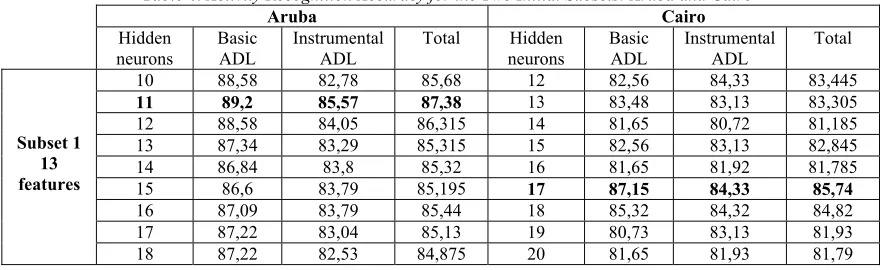
[image:5.612.82.526.342.477.2]First, we report on the first results of total activity recognition accuracy for the two initial subsets Cairo and Aruba. Thirteen features described in table 2 compose those two data sets. Table 4 show accuracy results of the two initial subsets Cairo and Aruba. Those results are presented before any data manipulation. It can be seen that the highest average of recognition accuracy performance of neural network using BP algorithm for the initial Cairo and Aruba subsets, are 85.74% and 87.38% respectively. In the majority of cases, the accuracy of basic activities is higher than instrumental ones, since basic activities are simple and require one or two sensors to be detected. Otherwise, the instrumental activity is more complex and requires a series of sensors to detect it.
Table 4. Activity Recognition Accuracy for the Two Initial Subsets: Aruba and Cairo
Aruba Cairo
Hidden
neurons Basic ADL Instrumental ADL Total neurons Hidden Basic ADL Instrumental ADL Total
Subset 1 13 features
10 88,58 82,78 85,68 12 82,56 84,33 83,445
11 89,2 85,57 87,38 13 83,48 83,13 83,305
12 88,58 84,05 86,315 14 81,65 80,72 81,185 13 87,34 83,29 85,315 15 82,56 83,13 82,845 14 86,84 83,8 85,32 16 81,65 81,92 81,785 15 86,6 83,79 85,195 17 87,15 84,33 85,74
16 87,09 83,79 85,44 18 85,32 84,32 84,82 17 87,22 83,04 85,13 19 80,73 83,13 81,93 18 87,22 82,53 84,875 20 81,65 81,93 81,79
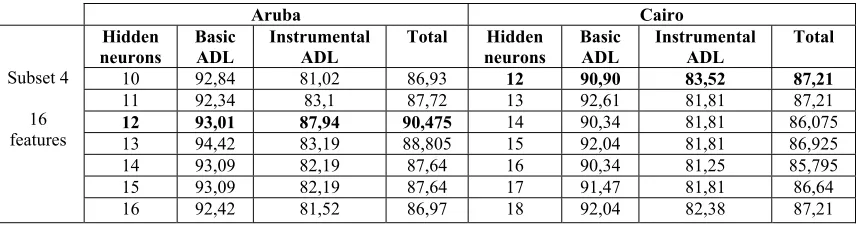
After creating subsets with reconstructed features using auto-encoder. We presents only the results of subset 1 that consists of 12 features, subset 2 that consist of 14 features, subset 3 that consist of 16 features, subset 4 that consist of 18 features, and subset 5 that consist of 20 features. The results, in tables 5–9, reveal that the highest average accuracy of BP algorithm using auto-encoder is 91.46% for Aruba dataset and 90.62% for Cairo dataset. Tables 5–9 show the comparison results of recognition accuracy performance of neural network using BP algorithm for the five feature reconstructed subsets with different numbers of neurons of hidden layer. Activity recognition accuracy is lower for Subset 2 and Subset 3. It also can be found that for Subset 5, activity recognition accuracy is better than those previous subsets. Subset 6 presents the relatively
5199
Table 5. Accuracy of Different Hidden Neurons of Subset 2
[image:6.612.94.523.393.506.2]Table 6. Accuracy of Different Hidden Neurons of Subset 3
Table 7. Accuracy of Different Hidden Neurons of Subset 4
Aruba Cairo
Subset 4
16 features
Hidden neurons
Basic ADL
Instrumental ADL
Total Hidden neurons
Basic ADL
Instrumental ADL
Total
10 92,84 81,02 86,93 12 90,90 83,52 87,21
11 92,34 83,1 87,72 13 92,61 81,81 87,21
12 93,01 87,94 90,475 14 90,34 81,81 86,075
13 94,42 83,19 88,805 15 92,04 81,81 86,925 14 93,09 82,19 87,64 16 90,34 81,25 85,795 15 93,09 82,19 87,64 17 91,47 81,81 86,64 16 92,42 81,52 86,97 18 92,04 82,38 87,21
Table 8. Accuracy of Different Hidden Neurons of Subset 5
Aruba Cairo
Subset 5
18 features
Hidden
neurons Basic ADL Instrumental ADL Total neurons Hidden Basic ADL Instrumental ADL Total
10 92,25 76,52 84,385 12 90,34 88,06 89,2 11 92,34 75,94 84,14 13 92,04 83,52 87,78 12 92,59 78,94 85,765 14 91,47 84,09 87,78 13 97,17 83,69 90,43 15 92,61 82,38 87,495 14 95,25 79,85 87,55 16 90,90 82,95 86,925 15 92,59 76,35 84,47 17 92,04 83,52 87,78 16 93,42 76,19 84,805 18 92,04 82,95 87,495 17 93,25 76,19 84,72 19 90,90 82,38 86,64
Aruba Cairo
Subset 2 12 features
Hidden neurons
Basic ADL
Instrumental ADL
Total Hidden neurons
Basic ADL
Instrumental ADL
Total
10 93,42 76,27 84,845 12 88,2 79,52 83,86
11 90,75 76,35 83,55 13 88,2 77,81 83,005 12 90,42 76,77 83,595 14 91,04 78,38 84,71
13 90,5 76,19 83,345 15 89,34 79,52 84,43 14 90,5 75,94 83,22 16 89,34 79,52 84,43
Aruba Cairo
Subset 3
14 features
Hidden neurons
Basic ADL
Instrumental ADL
Total Hidden neurons
Basic ADL
Instrumental ADL
Total
10 92,09 76,27 84,18 12 89,77 84,09 86,93 11 91,67 76,02 83,845 13 90,34 84,09 87,215
12 91,75 76,02 83,885 14 90,34 82,95 86,645
13 92,5 75,94 84,22 15 89,77 84,65 87,21
5200
Table 9. Accuracy of Different Hidden Neurons of Subset 6
Aruba Cairo
Hidden
neurons Basic ADL Instrumental ADL Total neurons Hidden Basic ADL Instrumental ADL Total
Subset 6
20 features
10 91,09 78,1 84,595 12 89,20 86,36 87,78 11 91,75 77,1 84,425 13 91,47 84,65 88,06 12 92,51 79,61 86,06 14 92,61 88,06 90,335 13 93,09 79,09 86,09 15 90,90 86,93 88,915 14 93,75 81,44 87,595 16 92,04 85,79 88,915 15 92,42 88,1 90,26 17 90,90 89,77 90,335
16 94,33 88,59 91,46 18 90,90 84,09 87,495
17 90,76 80,27 85,515 19 92,04 89,20 90,62
18 90,84 78,77 84,805 20 92,61 87,5 90,05 19 90,92 77,69 84,305 21 92,61 84,65 88,63 20 89,84 75,77 82,805 22 90,90 84,09 87,495
4.5 Comparison Results
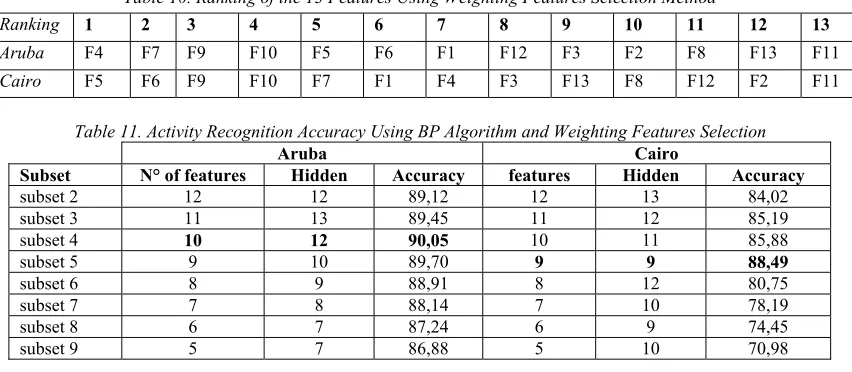
In this subsection, the influence of unsupervised pre-training on the recognition accuracy is evaluated by comparison with BP algorithm using traditional weighting features selection method. Table 10
[image:7.612.96.522.366.552.2]presents ranking of the 13 features using weighting features selection method of Cairo and Aruba datasets. Table 11 shows, that the using of features selection reach the higher accuracy of 90.05% for Aruba dataset and 88.49% for Cairo dataset, and l
Table 10. Ranking of the 13 Features Using Weighting Features Selection Method
Table 11. Activity Recognition Accuracy Using BP Algorithm and Weighting Features Selection
Aruba Cairo
Subset N° of features Hidden Accuracy features Hidden Accuracy
subset 2 12 12 89,12 12 13 84,02
subset 3 11 13 89,45 11 12 85,19
subset 4 10 12 90,05 10 11 85,88
subset 5 9 10 89,70 9 9 88,49
subset 6 8 9 88,91 8 12 80,75
subset 7 7 8 88,14 7 10 78,19
subset 8 6 7 87,24 6 9 74,45
subset 9 5 7 86,88 5 10 70,98
than BP algorithm using auto-encoder. It shows that neural network using BP algorithm performs relatively better than HMM and NB even with small number of instances. The reason is that HMM and NB algorithms evaluate human activities based on the probabilities greatly related to the finite instances. Comparison results of activity recognition accuracy rate for the four algorithms is presented in table 13. It can be concluded that the human activity recognition performances of neural network using auto-encoder pre-training and BP algorithm are better than neural network using BP algorithm and weighting features selection. The main reasons are first, that neural network using BP algorithm repeats a two-phase cycle, propagation and weight update
since it uses gradient descent to tune network weights to best fit a training set of input–output pairs. Second, auto-encoder can select features that are more interesting and reconstruct new powerful and useful representations of features. Finally, different feature sets generate different human activity recognition accuracy, and the selection of suitable feature sets increases the human activity recognition accuracy.
5. CONCLUSION
This paper applies back-propagation algorithm with auto-encoder pre-training to represent and recognize human activities based on observed sensor events. From the results, it can be concluded that the
Ranking 1 2 3 4 5 6 7 8 9 10 11 12 13
Aruba F4 F7 F9 F10 F5 F6 F1 F12 F3 F2 F8 F13 F11
5201 human activity recognition performances of neural network using auto-encoder is better than neural network using classical method of features selection. The main reasons are that neural network using BP algorithm is immune to errors in training data since it uses gradient descent to tune network weights to best fi t a training set of input/output pairs and has strong ability in learning to interpret complex sensor events in smart home environments. Furthermore, different feature sets generate different human activity recognition accuracy, therefore, the suitable feature set must be selected in advance, and the selection of unsuitable feature sets increases the computational complexity and degrades the human activity recognition accuracy. To improve human activity recognition accuracy, an effective approach is to properly select the feature subsets.
However, there is still a lot of room for development: future works will include venturing out on more complex human activities to recognize. Furthermore, experimenting this method in real time is another subject to explore. Also, the use of smartphone platform as neural networks inputs are a few of the topics for future research.
REFRENCES:
[1] Michiel Brink, Ignacio González Alonso and Johanna E.M.H. van Bronswijk, “Assessing Smart-Home Platforms for Ambient Assisted Living (AAL)”,
International Journal of Ambient Computing and Intelligence (IJACI), 2013.
[2] Sulong, Ghazali Et Mohammedali, Ammar. Recognition Of Human Activities From Still Image Using Novel Classifier. Journal Of Theoretical & Applied Information Technology, 2015, Vol. 71, No 1.
[3] Ozgur Yurur, Chi Harold Liu, and Wilfrido Moreno, “A Survey of Context-Aware Middleware Designs for Human Activity Recognition”. IEEE Communications Magazine, 2014, pp 24-31. [4] Mehdi Najjar, François Courtemanche, Habib
Hamam and Alexandre Dion, “Intelligent Recognition of Activities of Daily Living for Assisting Memory and/or Cognitively Impaired Elders in Smart Homes”, International Journal of Ambient Computing and Intelligence (IJACI), 2009. [5] Sidney Katz, MD, Amasa B. Ford, MD, Roland W.
Moskowitz, MD, Beverly A. Jackson, BS, and Marjorie W. Jaffe, MA, Cleveland, “Studies of Illness in the Aged The Index of ADL, A Standardized Measure of Biological and Psychosocial Function”. 1963, JAMA.
[6] M. Powell Lawton, PhD, and Elaine M. Brody, ACSW, “Assessment of Older People: Self-Maintaining and Instrumental Activities of Daily Living”. 1969.
[7] Isabelle Guyon and Andr´e Elisseef, chapter: An Introduction to Feature Extraction. Volume 207 of the series Studies in Fuzziness and Soft Computing, 2006, pp 1-25.
[8] L. Chen, C. D. Nugent and H. Wang, “A Knowledge-Driven Approach to Activity Recognition in Smart Homes”. In: IEEE Transactions on Knowledge and Data Engineering, 2012.
[9] E. M. Tapia, S. S. Intille and L. Kent, “Activity Recognition in the Home Using Simple and Ubiquitous Sensors”. In: Pervasive Computing, 2004, pp. 158-175.
[10]Zack Zhu, Ulf Blanke, Gerhard Tröster, “Recognizing composite daily activities from crowd-labelled social media data”, Pervasive and Mobile Computing, 2016, pp.103–120.
[11]H. A. Kautz, “A Formal Theory of Plan Recognition and its Implementation”, In: Reasoning about plans, (San Francisco, CA, USA), Morgan Kaufmann Publishers Inc; 1991, pp. 69-124.
[12]A. N. Tuan, R. Andrea and A. Marco, “Ontology-based office activity recognition with applications for energy savings”. Journal of Ambient Intelligence and Humanized Computing; vol. 5, no. 5, 2014. pp. 667-681.
[13]L. Stankovic, V. Stankovic, J. Liao, C. Wilson, “Measuring the energy intensity of domestic activities from smart meter data”. Applied Energy, Volume 183, 2016. pp. 1565-1580.
[14]Chen L, Nugent C, Wang H, “A knowledge-driven approach to activity recognition in smart homes”.
IEEE Trans Knowl Data Eng; 2012. pp. 961 –741. [15]Fahim M, Fatima I, Lee S, Lee Y. EEM,
“evolutionary ensembles model for activity recognition in smart homes” Appl Intell, 2013. pp. 88–98.
[16]Yongchao Xue, Linsong Cheng, Jianye Mou, Wenqi Zhao, “A new fracture prediction method by combining genetic algorithm with neural network in low-permeability reservoirs”. Journal of Petroleum Science and Engineering 2014.
[17]Labiba Gillani Fahad, Muttukrishnan Rajarajan, “Integration of discriminative and generative models for activity recognition in smart homes”. Applied Soft Computing, article in press. 2015.
5202 [19]Crandall, A., D. Cook: Using a hidden Markov model
for resident identification. In: Proceedings of the 6th international conference on intelligent environments
(Kuala Lumpur), Malaysia; 2010. pp. 74–9. [20]Kai Zhan, Steven Faux, Fabio Ramos, “Multi-scale
Conditional Random Fields for first-person activity recognition on elders and disabled patients”.
Pervasive and Mobile Computing, Pages 251 -267, 2015.
[21]Hongqing Fang, Lei He, Hao Si, Peng Liu, Xiaolei Xie, “Human activity recognition based on feature selection in smart home using backpropagation algorithm”. ISA Transactions53, 2014.
[22]Hanchuan Peng, Fuhui Long, and Chris Ding ” Feature selection based on mutual information: criteria of max-dependency, max-relevance, and min-redundancy”. IEEE Transactions on Pattern Analysis and Machine Intelligence, Vol. 27, No. 8, pp.1226-1238, 2005.
[23]Lei Yu , Huan Liu, “Feature Selection for High-Dimensional Data: A Fast Correlation-Based Filter Solution”. Proceedings of the Twentieth International Conference on Machine Learning
(ICML-2003), Washington DC, 2003.
[24]Zhao, Zheng, and Huan Liu. "Spectral feature selection for supervised and unsupervised learning."
Proceedings of the 24th international conference on Machine learning. ACM, 2007.
[25]Yang, Yi, et al. "12, I-Norm Regularized Discriminative Feature Selection for Unsupervised Learning". lJCAI Proceedings International Joint Conference on Artificial Intelligence. Vol. 22. No. I. 2011.
[26]Cai, Deng, Chiyuan Zhang, and Xiaofei He. "Unsupervised feature selection for multi-cluster data." Proceedings of the 16th ACM SIGKDD international conference on Knowledge discovery and data mining. ACM, 2010.
[27]Taqi, Mustafa Kadhim ET Ali, Rosmah. Obka-Fs: An Oppositional-Based Binary Kidneyinspired Search Algorithm for Feature Selection. Journal Of Theoretical And Applied Information Technology, 2017, Vol. 95, No 1, P. 9.
[28]NIE, Feiping, XIANG, Shiming, JIA, Yangqing, et al. Trace Ratio Criterion for Feature Selection. In : AAAI. 2008. pp. 671-676.
[29]Li Xia, P. Shum, “Design of novel DS-OCDMA encoders/decoders using phase sampled long period grating”. Optics Communications, 2008, pp 4317– 4320.
[30]CHANDRA, B. et SHARMA, Rajesh K. “Exploring autoencoders for unsupervised feature selection. In : Neural Networks (IJCNN)”, 2015 International Joint Conference on. IEEE, 2015. p. 1-6.
[31]Dumitru Erhan, Yoshua Bengio, Aaron Courville, Pierre-Antoine Manzagol, Pascal Vincent, “Why Does Unsupervised Pre-training Help Deep Learning?”, Journal of Machine Learning Research
11, 2010. pp. 625-660.
[32]Shoumi, Milyun Ni' Et Fanany, Mohamad Ivan. A Sparse Encoding Symmetric Machines Pre-Training For Temporal Deep Belief Networks For Motion Analysis And Synthesis. Journal Of Theoretical & Applied Information Technology, 2015, Vol. 72, No 1.
[33]The WSU CASAS smart home project.D. Cook, “Learning setting-generalized activity mdoels for smart spaces”. IEEE Intelligent Systems, 2011. [34] WSU CASAS smart home project. D. Cook and M.