6056
PERFORMANCE ENHANCEMENT OF BLIND ALGORITHMS
BASED ON MAXIMUM ZERO ERROR PROBABILITY
1NAMYONG KIM, 2KIHYEON KWON
1Division of Electronic Information and Communication Eng., Kangwon National Univ. Korea
2Division of Electronic Information and Communication Eng., Kangwon National Univ. Korea
E-mail: 1[email protected], 2kweon@kangwon.ac.kr
ABSTRACT
In this paper, the error-Gaussian-kernelled input of the algorithm developed by maximization of zero-error probability of constant modulus error (MZEP-CME) is studied for developing a method to reduce the weight perturbation of the MZEP-CME under impulsive noise. The proposed method is to normalize the input of MZEP-CME with the norm of the error-Gaussian-kernelled input (EGKI) in order to reduce weight perturbation. Then the denominator of the step size can make the algorithm unstable when it has a very small value or wide fluctuations. To prevent these incidents, a balanced power of EGKI between the current power and the past one is employed. This normalization with balance power provides an additional function for reducing further the weight perturbation in impulsive noise environment. Simulation results show that the weight fluctuation after convergence of the proposed algorithm is below half of that of the MZEP-CME. Also compared with the MZEP-CME, the proposed approach lowers the steady state MSE (mean squared error) by about 1 dB under impulsive noise. 2)
Keywords: Impulsive Noise, Maximization Of Zero-Error Probability, Constant Modulus,
Error-Gaussian-Kernelled Input, Weight Perturbation
1. INTRODUCTION
Communication systems suffer from Gaussian noise as well as impulsive noise generated from various impulsive noise sources [1][2]. To deal with such harsh problems, new performance criteria and signal processing methods have been introduced. As information theory-based criteria designed by using a combination of a nonparametric probability density function (PDF) estimator and a procedure to compute entropy, error entropy (EE) for supervised learning based on Gaussian noise environment and correntropy for blind learning in situations with impulsive noise problem have been introduced and experimented in the work [3] and [4], respectively. Minimization of EE (MEE) as an alternative to the mean squared error (MSE) criterion has shown superior performance in supervised channel equalization applications [5].
For unsupervised or blind equalization, the constant modulus algorithm (CMA) is widely used [6][7]. It minimizes the averaged power of constant modulus error (CME) defined as the difference between an instant output power and a constant modulus. As another information theory-based criterion, zero-error probability (ZEP) has been
proposed and further developed to employ CME for blind learning which will be referred to in this paper as ZEP-CME [8].
In the work [9] theoretical and simulation analysis of maximization of ZEP-CME (MZEP-CME) have been studied. The MZEP-CME method initially proposed for Gaussian noise environments produces acceptable performance in impulsive noise environment as well. Gaussian kernel of MZEP-CME has an effect of making the system insensitive to the large differences between the power of impulse-infected outputs and the constant modulus.
On the other hand, correntropy blind method introduced for impulsive-noise resistance has shown acceptable but not very satisfying against impulsive noise in modulation schemes with independent source symbols. Not to mention, it is known that constant modulus algorithms based on MSE fails to converge in impulsive noise environment [9].
6057 on weight adjustment process. This effect allows the DF structure to be equipped so that the residual ISI cancellation can be carried out effectively.
The MZEP-CME type blind algorithms have some computational burden in its gradient calculations. For reducing this heavy computational complexity, a recursive approach to the estimation of the ZEP of CME and its gradient has been introduced in [11].
The problem in this MZEP-CME algorithm is that the factors or properties that play the key role of making the algorithm immune to impulsive noise have not been investigated enough, which leads researchers to be difficult to find some ways to improve its performance in any impulsive noise environments. In this situation, further improvement of the performance of the algorithm may require research in-depth and the improved performance resulted from the research can bring significant breakthrough to wireless channel equalization fields under severe channel environments with strong impulsive noise and multipath distortions inflicted by heavy intersymbol interference.
The research questions we may raise can be what we should look at in order to find out the key factors which are linked to the algorithm’s immunity against impulsive noise. The possible answers to this question may be the Gaussian kernel for the constant modulus error and input signal multiplied by this kernel. Another question can be how we improve the performance of the algorithm by exploiting the factors found from the research. One of the answers to this question can be the normalization approach which has been successfully employed in the normalized least mean square (NLMS) algorithm [12].
Associated another difficulties are the instability that can be occurred when the input power at an instant has a very low value or heavy fluctuations. This difficulty is also presented in this paper and some strategies to cope with it by employing balancing the past power and the current power are discussed.
In this study, it is analyzed that the error-Gaussian-kernelled input (EGKI) of MZEP-CME algorithm plays the role of keeping the algorithm undisturbed from impulsive noise. Based on the analysis of the role of EGKI against impulsive noise, a method of performance enhancement of the MZEP-CME algorithm is proposed. When compared with the conventional MZEP-CME algorithm, the proposed method has different properties of normalizing the step size by the averaged power of EGKI. So the fact that the information of input
statistics is effectively utilized can be a core property that the proposed algorithm owns. Other properties that can be strengths of the proposed algorithm may be that the minimum MSE of the proposed method can be lowered in any severe impulsive noise conditions.
One of limitations of the proposed algorithm may be that the convergence speed is still not faster than the original MZEP –CME algorithm. Further study is needed to investigate other factors related with its convergence rate and find effective methods to enhance the rate for higher data rates of wireless communications under impulsive noise.
2. BLINDIMPULSIVE NOISE MODEL
In common communication channels with impulsive-noise, the noise is usually composed of the background Gaussian noise (GN) and impulse noise (IN) together [1][4]. The IN occurs according to a Poisson process and the average number of impulse occurrences per information symbol duration is defined as
. The IN has a Gaussian distribution with variance
IN2 . The distribution function of IN is expressed as)
(
)
1
(
)
(
k kIN
n
n
f
]
2
exp[
2
22
IN k
IN
n
(1)The background noise is white and has a Gaussian distribution with variance
GN2 as]
2
exp[
2
1
)
(
22
GN k
GN k
GN
n
n
f
(2)Taking the convolution of (1) and (2) yields the distribution of total noise (a sum of the two random processes) defined as
f
NOISE(
n
k)
.
]
2
exp[
2
1
)
(
21 2
1
kk NOISE
n
n
f
]
2
exp[
2
222
2
n
k6058 where
1
,
2
GN2
IN2 ,
1
GN ,and
12
22.This impulsive noise model is known to be widely used [1][4].
3. BLIND ALGORITHMS BASED ON MSE CRITERION
Figures For a tapped delay line (TDL) equalizer with weight vector
W
ofL
elements in training-aided equalization, error samplee
k at timek
between the desired training symbold
k and outputy
kare produced byk k
d
e
T kk k k
d
y
W
X
( )where the equalizer input vector is
T L k k
k k
k
[
x
,
x
1,
x
2,...,
x
1]
X
.Based on mean squared error (MSE) criterion
E
[
e
k2]
whereE
[
]
denotes statistical expectation, the least mean squared (LMS) algorithm in (4) has been developed and widely used in supervised learning [12].k k LMS k
k
W
e
X
W
1
2
(4)For unsupervised learning, many of channel equalization methods without the aid of a training sequence
d
k (referred to as blind equalization) employ nonlinearity at the equalizer outputy
k to generate the error signal. In most CMA-type algorithms, the errore
CMEis defined as2 2
,
y
R
e
CMEk
k
( )where the constant modulus
R
2 of the modulation scheme is]
[
/
]
[
4 2 2E
d
kE
d
kR
( )The CMA has been developed based on the following cost function
E
[
e
CME,k2]
[6][12].]
)
[(
]
[
22 2 2
,
E
y
R
e
E
CMEk
k
( )Minimization of the cost function
E
[
e
CME2]
yields
k k k CME CMA k
k
W
e
y
X
W
1
2
,
(5)Comparing the LMS algorithm (4) and CMA (5),
we may regard
y
kX
kas a modified inputX
k scaled by the scalar outputy
k.k k k
y
X
X
(6)Then the CMA can be expressed as
k
CMA CMEk
kk
W
e
X
W
12
, (7)When we define the weight perturbation as
2
1 k
k
W
W
, we may observe from (7) that the weight perturbation becomes zero only when the errore
CME,kis zero. This indicates that a single large impulsive noise sample can generate a big error so that the weight update process (7) becomes unstable under impulsive noise.4. BLIND ALGORITHMS BASED ON GAUSSIAN KERNEL
6059 The correntropy function
V
X[
m
]
is a similarity function measuring kernel-difference between two random processesX
k andX
kmdefined as)]
(
[
]
[
k k mX
m
E
G
X
X
V
(8)where
G
(
)
is a zero-mean Gaussian kernel with standard deviation
as]
2
exp[
2
1
)
(
2 2
x
x
G
(9)Then (8) can be estimated through the sample mean with a sample size
N
as
N m k m k kX
G
X
X
m
N
m
V
(
)
1
1
]
[
(10)The researchers in [4] proposed the cost function
M m m SY CEe
P
1 2, where
e
SY,mis correntropy errordefined as
e
SY,m
V
S[
m
]
V
Y[
m
]
between thesource correntropy
V
S[
m
]
and the output correntropyV
Y[
m
]
andM
is the number of lags. Minimization ofP
CE by using a gradient descent method with a step size
CEyields the correntropy blind algorithm described in (11).
M m k m N k i SYm CEk
k
N
m
e
1 ,
2
1
(
1
)
1
W
W
)
)(
(
)
(
y
iy
imy
iy
im i imG
X
X
(11)As in (6), we may regard
)
)(
(
y
i
y
imX
i
X
im as a modified input
m i,
X
scaled by the scalar output difference)
(
y
i
y
im .)
)(
(
,m i i m i i m
i
y
y
X
X
X
(12)Then correntropy algorithm becomes
M m k m N k i SYm CEk
k
e
m
N
2 1 ,1
)
1
(
1
W
W
G
(
y
iy
im)
X
i,m (13)In (13), the weight perturbation
W
k1
W
kbecomes zero when the error
e
SY,m is zero or)
(
y
iy
imG
is zero. This means that the weight perturbation becomes small when the output differencey
i
y
im is large, i.e.,G
(
y
i
y
im)
is very small. This incident can be observed when the input is inflicted with impulsive noise. This may explain why the correntropy algorithm is robust against impulsive noise.When we define the output-difference-Gaussian-kernelled input (ODGKI)
X
ODGKIk,m as
k k m km ODGKIm
k,
G
(
y
y
)
X
,X
(14)Then we can express (13) as
M m k m N k i m SY CE k ke
m
N
1 , 2 1)
1
(
1
W
W
ODGKI m k,X
(15)The other criterion that is dealt with in this paper is Zero-Error Probability that can control the concentration of error samples around zero [8]. Using the kernel density estimation method in [13] based on Gaussian kernel and
N
error samples, we have the error distributionf
E(
e
)
as
Ni i
E
G
e
e
N
e
f
1)
(
1
)
(
(16)Inserting
e
0
, the ZEPf
E(
0
)
reduces to
Ni i
E
G
e
N
f
1)
(
1
)
0
(
(17)By replacing
e
iin (17) with constant modulus6060 constant modulus error samples
e
CME,kN1,
e
CME,kN2,...,
e
CME,k
.
kN k i
i CME
CME
G
e
N
f
1
,
)
(
1
)
0
(
(18)Through the maximization of
f
CME(
0
)
in (18), we obtain the following MZEP-CME algorithm [8].
k
N k i CMEi MZEPCME
k
k
N
e
1 , 2
1
2
W
W
G
(
e
CME,i)
X
i (19)In (19), the weight perturbation
W
k1
W
k 2 becomes zero when the errore
CME,k is zero or)
(
e
CME,kG
is zero. Even when a single large impulsive noise sample creates a big error, the weight perturbation becomes very small due to the decaying property of Gaussian kernelG
(
e
CME,k)
. We can notice that the weight update process (19) has a function of dual check control of errors that can be very large under impulsive noise.On the other hand, the term
k k CME
e
G
(
,)
X
in(19) may be regarded as dual-controlled input by
output-scaling in
X
k
y
kX
k
firstly and then error-Gaussian kernelling by
G
(
e
CME,k)
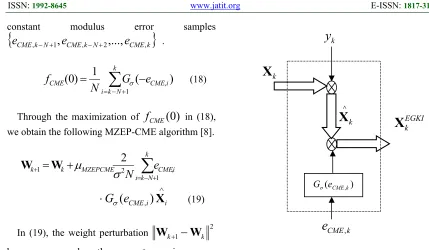
as depicted in Figure 1. In this respect, defining the error-Gaussian-kernelled input (EGKI),X
EGKIk as∧
k k CME
σ
EGKI
k
G
e
X
X
=
(
,)
(20)Then (19) can be expressed as
EGKI i k
N k i
i CME MZEPCME
k
k
e
N
X
W
W
1 , 2
1
2
[image:5.612.83.512.73.323.2]
(21)Figure 1: Generation Of Error-Gaussian-Kernelled Input.
Then the modified input (MI),
X
k of CMA in (6) may be interpreted as scaled only by the output sampley
k . The output-difference-Gaussian-kernelled input in the correntropy algorithm (15),ODGKI m k,
X
can be interpreted as scaled by)
(
y
ky
k mG
andoutput-difference
(
y
k
y
km)
. Similarly, the error-Gaussian-kernelled input,X
kEGKI in the MZEP-CME (21) may be interpreted as scaled by error-Gaussian kernelG
(
e
CME,k)
and output sampley
k.5. PROPOSED ALGORITHM BASED ON MZEP-CME CRITERION
As mentioned in the previous section, due to the decaying property of Gaussian kernel
G
(
e
CME,k)
against large errors, the error-Gaussian-kernelled input of MZEP-CME algorithm (21) plays the core role of keeping the algorithm less disturbed from impulsive noise. Utilizing this role of EGKI against impulsive noise, a method for enhancing performance of the MZEP-CME algorithm is proposed in this section.
k CME
e
,k
X
) ( CME,k
σ e G
EGKI k
X
k
y
∧
k
6061 For the purpose of reducing the weight perturbation
W
k1
W
k 2
2
LMSe
k
X
k 2 ofLMS algorithm, the NLMS has been introduced by normalizing the step-size with its power [13].
1 0 2 2 L m m k k T kk
X
X
x
X
( )Applying this approach to MZEP-CME with the elements of error-Gaussian-kernelled input vector
X
EGKIk
EGKI
Tk EGKI N k EGKI N
k
x
x
x
1,
2,...,
, we propose to normalize
MZEPCME with
N i EGKI i N kx
0 2)
(
for the purpose of further reducing theweight perturbation. EGKI i k N k i i CME N i EGKI i N k MZEPCME k k
e
x
N
X
W
W
1 , 0 2 2 1)
(
2
(22)As discussed in the NLMS in [13], the denominator makes the algorithm sensitive or unstable when it has a very small value or wide fluctuations. To prevent these incidents, we employ a balanced power of EGKI
Power
(
k
)
between the current power and the past one as
N i EGKI i N kx
k
Power
0 2)
(
)
(
)
1
(
)
1
(
Power
k
(23)Then the proposed algorithm (22) can be rewritten as
)
(
2
2
1 k
N
Power
MZEPCMEk
k
W
W
iEGKI k N k i i CMEe
X
1, (24)
The weight perturbation of the proposed algorithm can then be expressed as
2
1 k
k
W
W
2
1 ,
2
(
)
2
k
Power
e
N
EGKI i k N k i i CME MZEPCME
X
(25)On the other hand, the weight perturbation of MZEP-CME is
2
1 k
k
W
W
2 1 , 2
2
EGKI i k N k i i CME MZEPCMEe
N
X
(26)
Comparing (25) and (26) reveals that the input of the proposed algorithm becomes normalized by its power whereas the conventional algorithm does not. In Gaussian noise environment, this may not have a significant effect on the weight perturbation by employing a small value of the step size. In impulsive noise situations, the input power can change hugely from moment to moment and become important information to be exploited. In this respect, the proposed algorithm can be viewed as having an additional function for reducing further the weight perturbation in severe environments like impulsive noise afflicted ones.
6. RESULTS AND DISCUSSION
6062
Figure 2; Base Band Communication System Model.
unity and the rest to zero. The step-size for CMA is
00001
.
0
CMA
. The MZEP-CME and theproposed algorithm have common parameter values as
MZEPCME
0
.
02
,N
20
, and
6
.
0
. The impulsive noisen
k is generated according to the Gaussian mixture model as in (3) with001
.
0
2 2
1
GN
and
22
GN2
IN2001
.
50
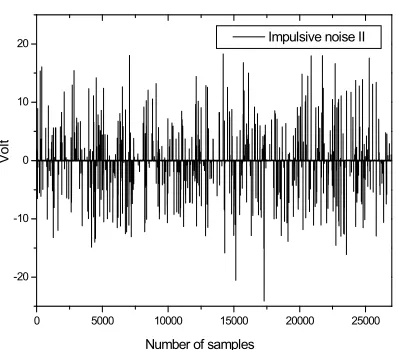
. One sample of the impulsive noise used in this simulation is described in Figure 3 with01
.
0
(noise I) and Figure 4 with
0
.
03
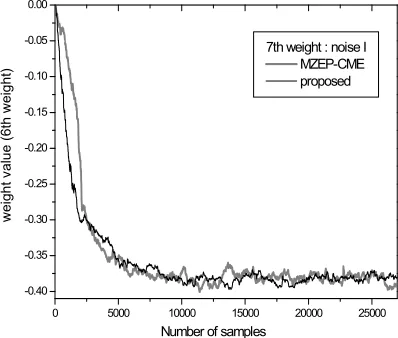
(noise II).Firstly we investigate the results of weight perturbation after convergence for the case of noise I. In Figure 5, the variation difference of the center weight (6th weight) between the two algorithms can be noticed. The proposed algorithm keeps its center weight within the width of about 0.016 (1.262~1.278) while the MZEP-CME has weight fluctuations over 0.021 (1.251~1.272). For the 7th weight depicted in Figure 6, we have acquired similar results that the fluctuation of the weight of the proposed algorithm is kept within about 0.024
0 5000 10000 15000 20000 25000
-20 -15 -10 -5 0 5 10 15
Vo
lt
Number of samples
[image:7.612.327.522.86.295.2]Impulsive noise I
Figure 3: Noise Sample Used In The Simulation
With Noise I.
0 5000 10000 15000 20000 25000
-20 -10 0 10 20
Vo
lt
Number of samples
Impulsive noise II
Figure 4: Noise Sample Used In The Simulation
With Noise II.
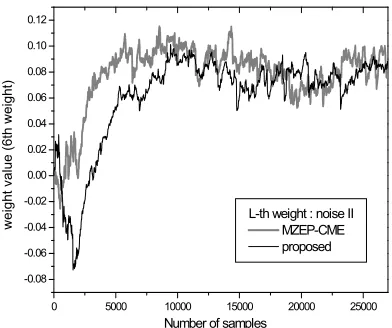
(-0.396~-0.372) whereas the one of the MZEP-CME is over 0.042 (-0.402~-0.360). Also in the case of the final weight (11th weight) an even bigger difference of weight perturbation is observed in Figure 7 as 0.03 (-0.098~-0.128) for the proposed algorithm and 0.04 (-0.090~-0.130) for the MZEP-CME.
Data source
Output
y
kInput
kx
Impulsive
noise
n
k2
R
CME
k CME
e
,Algorithms
k
d
Channel
i iz
h
z
H
(
)
Equalizer
k T k k
y
W
X
k
W
W
k1Transmitter
[image:7.612.330.528.393.568.2]6063
0 5000 10000 15000 20000 25000
1.16 1.18 1.20 1.22 1.24 1.26 1.28 1.30 1.32 1.34 1.36 1.38 1.40
we
ight
va
lue (5th weig
ht
)
Number of samples
6th weight : noise I MZEP-CME proposed
Figure 5: Trace Of 6th Weight Under Noise I.
0 5000 10000 15000 20000 25000
-0.40 -0.35 -0.30 -0.25 -0.20 -0.15 -0.10 -0.05 0.00
7th weight : noise I MZEP-CME proposed
w
ei
gh
t v
alu
e
(
6th w
eig
ht)
[image:8.612.103.306.113.290.2]Number of samples
Figure 6: Trace Of 7th Weight Under Noise I.
Secondly, for the noise II which is even more severe case we investigate the results of weight perturbation. The variation difference of the center weight (6th weight) after convergence between the two algorithms can be noticed in Figure 8. The proposed algorithm keeps the width of center weight fluctuation within about 0.034 (1.224~1.258) while the MZEP-CME has weight fluctuations over 0.045 (1.220~1.265). For the 7th weight depicted in Figure 9, we have acquired
0 5000 10000 15000 20000 25000
-0.08 -0.06 -0.04 -0.02 0.00 0.02 0.04 0.06 0.08 0.10 0.12 0.14
L-th weight : noise I MZEP-CME proposed
we
ig
h
t v
a
lue
(
L
-th
w
e
igh
t)
[image:8.612.327.521.118.287.2]Number of samples
Figure 7: Trace Of Lth Weight Under Noise I.
0 5000 10000 15000 20000 25000
1.1 1.2 1.3 1.4
wei
ght v
a
lue
(
5
th we
igh
t)
Number of samples
[image:8.612.103.302.360.529.2]6th weight : noise II MZEP-CME proposed
Figure 8: Trace Of 6th Weight Under Noise II.
[image:8.612.322.524.366.534.2]6064
0 5000 10000 15000 20000 25000
-0.40 -0.35 -0.30 -0.25 -0.20 -0.15 -0.10
7th weight : noise II MZEP-CME proposed
weig
ht
v
al
ue
(
6t
h
weig
ht
)
[image:9.612.101.298.114.277.2]Number of samples
Figure 9: Trace Of 7th Weight Under Noise II.
0 5000 10000 15000 20000 25000
-0.08 -0.06 -0.04 -0.02 0.00 0.02 0.04 0.06 0.08 0.10 0.12
weigh
t v
alue
(6
th
w
eigh
t)
Number of samples
[image:9.612.324.529.115.278.2]L-th weight : noise II MZEP-CME proposed
Figure 10: Trace Of Lth Weight Under Noise II.
Figure 11 shows the MSE learning curves in the case of noise I for CMA, MZEP-CME and the proposed algorithm. As discussed in section 3, the CMA diverges after a short period of starting convergence. On the other hand, the MZEP-CME type algorithms show rapid and stable convergence. While the two algorithms show similar convergence speed of convergence, they have different steady state MSE after convergence as the MZEP-CME have bigger steady state MSE than the proposed algorithm by about 1 dB. The performance enhancement of the proposed
0 200 400 600 800 1000 1200 1400
-30 -25 -20 -15 -10 -5 0 5
10
lo
g of
M
SE
Number of samples (x10) Noise I
[image:9.612.102.298.360.524.2]CMA MZEP-CME proposed
Figure 11: MSE Convergence Performance Under Noise I For The Impulse Occurrence Rate Of 0.01.
-0.4 -0.2 0.0 0.2 0.4
0 5 10 15 20 25 30 35 40 45
P
ro
babili
ty
(
/2
000)
Error value Noise I
CMA MZEP-CME proposed
Figure 12: Error Distribution Under Noise I For The Impulse Occurrence Rate Of 0.01.
algorithm is more clearly verified in the comparison of error distribution as shown in Figure 12. The proposed algorithm yields much narrower error distribution than the conventional MZEP-CME.
[image:9.612.323.528.381.555.2]6065
0 200 400 600 800 1000 1200 1400
-24 -22 -20 -18 -16 -14 -12 -10 -8 -6 -4 -2 0 2
10 log
of M
SE
Number of samples (x10) Noise II
[image:10.612.101.303.105.284.2]CMA MZEP-CME proposed
Figure 13: MSE Convergence Performance Under Noise II For The Impulse Occurrence Rate Of 0.03.
-0.4 -0.2 0.0 0.2 0.4
0 5 10 15 20 25
Noise II CMA MZEP-CME proposed
P
ro
ba
bilit
y
(/
20
00
)
Error value
Figure 14: Error Distribution Under Noise II For The Impulse Occurrence Rate Of 0.03.
sample number 300. On the other hand, the MZEP-CME and the proposed algorithm show stable convergence in even more severe noise environment. Similarly the two algorithms MZEP-CME and the proposed algorithm show similar convergence speed but different steady state MSE.
The MZEP-CME has -20.6 dB of the steady state MSE and the proposed one shows -21.8 dB, which indicates that the proposed algorithm yields better performance by about 1.2 dB. In the comparison of error distribution as shown in Figure 14, the proposed algorithm yields 0.01215 (24.3/2000) at zero of error value while the MZEP-CME shows 0.0106 (21.2/2000).
From these results, we may identify problems of the previous algorithm MZEP-CME as having higher minimum MSE and lower system error concentration on zero due to no exploitation of input power information. Therefore the significance of these results can be recognized that the utilization of the input power information, more accurately, the time varying power of error-Gaussian-kernelled input (EGKI).
7. DIFFERENCE FROM THE PRIOR WORK AND IMPROVEMENT
From the results of weight perturbation under the noise model I and II after convergence, we have found that the variation differences between the two algorithms of MZEP-CME and the proposed algorithm for 3 weights sampled from L=11 weights are varied but in large part consistent. The width of fluctuation for the center weight is about 0.016 for the proposed algorithm and 0.021 for the MZEP-CME, respectively. This indicates that the proposed algorithm lowers the weight perturbation by about 1.3 times for the center weight.
For the other two weights the fluctuation of the weight of the proposed algorithm is about 0.024 and 0.03 while the MZEP-CME gives over 0.042 and 0.04. This shows that the proposed algorithm produces weight perturbation performance 1.3~1.8 times better than that of the MZEP-CME.
In the more severe case of noise II, weight perturbation. The variation width of the center weight is 0.034 for the proposed and 0.045 for the MZEP-CME. This means the proposed method yields 1.3 times better performance than the MZEP- CME. For the other two weights in the noise case II, we acquired similar results. The weight fluctuation of the proposed algorithm is about 0.034 and 0.037 while the MZEP-CME gives over 0.045 and 0.078. This means that the weight perturbation performance of the proposed algorithm yields 1.3~2.1 times better than that of the MZEP-CME.
[image:10.612.102.302.395.570.2]6066 proposed algorithm yields is 1.55~1.7 times, that is 1.63 times. These results agree with the purpose of the proposed method that is designed to reduce the weight perturbation in impulsive noise environment. In the results of learning speed, the MZEP-CME and the proposed algorithm shows the same convergence speed while the well-known CMA diverges due to the lack of cutting outliers. This indicates the Gaussian kernel of the ZEP-CME based algorithms exerts robustness against impulsive noise in some degree. It is reasonable that the robustness obtained from its outlier-cutting ability produces stable convergence.
Though the two algorithms have similar convergence rate, different performance of minimum MSE after convergence is observed. The performance enhancement of the proposed algorithm is more than 1.2 dB in the comparison of minimum MSE in both noise situations.
In the comparison of error rate at zero of error value for both noise cases, the proposed algorithm yields higher error rates by 1.15 times than the MZEP-CME.
All these results confirm that the performance enhancement of the proposed algorithm can be clearly achieved in various noise environments.
8. CONCLUSION
This paper presents that the role of the error-Gaussian-kernelled input of MZEP-CME algorithm is to keep the algorithm undisturbed from impulsive noise and based on the role, a method of reducing the weight perturbation of the MZEP-CME under impulsive noise. The proposed method is to normalize the step size with the norm of the error-Gaussian-kernelled input. To prevent the denominator from getting the algorithm sensitive, a balanced power of the error-Gaussian-kernelled input between the current power and the past one is employed.
The analysis reveals that the input of the proposed algorithm becomes normalized by its power through exploiting information on the input power that may change hugely in impulsive noise situations.
Simulation results show that the weight fluctuation after convergence of the proposed algorithm is below half of that of the MZEP-CME. The analysis and its corresponding results lead us to conclude that the proposed approach can improve convergence performance by significantly lowering the weight perturbation under impulsive noise.
Therefore one of the strengths of the proposed algorithm compared with the conventional MZEP-CME algorithm can be the property of step size normalization by the averaged power of EGKI containing the information of input statistics. Another strength that can be pointed out is the minimum MSE. This lowered minimum MSE indicates more accurate recovery of transmitted data in any severe impulsive noise conditions.
However the fact that the convergence speed is still not faster than the original MZEP–CME algorithm can be one of the limitations of the proposed algorithm. This leaves researchers to investigate properties related with convergence rate and find effective methods.
REFRENCES:
[1] K. Koike and H. Ogiwara, “Application of Turbo TCM codes for impulsive noise channel”, IEICE Trans. Fundamentals, Vol. E81-A, Oct. 1998, pp. 2032-2039.
[2] S. Unawong, S. Miyamoto, and N. Morinaga, “A novel receiver design for DS-CDMA systems under impulsive radio noise environments”, IEICE Trans. Comm., Vol. E82-B, June 1999, pp. 936 -943.
[3] D. Erdogmus, and J. Principe, “An Entropy Minimization algorithm for Supervised Training of Nonlinear Systems”, IEEE Trans. Signal Processing, Vol. 50, July, 2002, pp. 1780-1786.
[4] I. Santamaria, P. Pokharel, and J. Principe, “Generalized correlation function: Definition, properties, and application to blind equalization”, IEEE Trans. Signal Processing, Vol. 54, June 2006, pp. 2187-2197.
[5] I. Santamaria, D. Erdogmus, and J. Principe, “Entropy Minimization for Supervised Digital Communications Channel Equalization”, IEEE Trans. Signal Processing, Vol. 50, May, 2002, pp. 1184-1192.
[6] J. Treichler and B. Agee, “A new approach to multipath correction of constant modulus signals”, IEEE Trans. Acoust., Speech, Signal Process. Vol. ASSP-31, Nov. 1983, pp. 349-372.
[7] S. Lim, “Performance Improvement of MCMA Equalization Algorithm Using Adaptive Modulus”, JIIBC, Vol. 3, June 2014, pp. 57-62. [8] N. Kim, K. Jung, and L. Yang, “Maximization
6067 [9] N. Kim, “Performance Analysis of Maximum
Zero-Error Probability Algorithm for Blind Equalization in Impulsive Noise Channels”, Journal of Internet Computing and Services, Vol. 11, Oct. 2010, pp.1-8.
[10] N. Kim, “Blind Algorithms with Decision Feedback based on Zero-Error Probability for Constant Modulus Errors”, J-KICS, Vol. 36, 2011, pp.753-758.
[11] N. Kim, “Estimation of Zero-Error Probability of Constant Modulus Errors for Blind Equalization”, Journal of Internet Computing and Services, Vol. 15, Oct. 2014, pp.17-24. [12] S. Haykin, Adaptive Filter Theory, Prentice
Hall, Upper Saddle River, 4th edition, 2001. [13] E. Parzen, “On the Estimation of a Probability