Available online on www.ijpsr.com 1176 IJPSR (2011), Vol. 2, Issue 5 (Research Article)
Received on 27 December, 2011; received in revised form 10 February, 2011; accepted 24 April, 2011
COMPATIBILITY AND STABILITY STUDIES OF AMPICILLIN TRIHYDRATE AND PIPERINE MIXTURE
K. Janakiraman* and R. Manavalan
Department of Pharmacy, Annamalai University, Annamalainagar, Tamil Nadu, India
ABSTRACT
Ampicillin is used to treat variety of Bacterial infections in Humans. Piperine, an alkaloid from Piper species is reported to enhance oral bioavailability of co-administered drugs. The present study was aimed to include to Piperine (bioenhancer) as a formulation additive in oral formulations of Ampicillin Trihydrate. So, a Physical mixture of Ampicillin Trihydrate and Piperine (1:1) was tested for their compatibility by DSC, TLC and FT-IR techniques. Stability of the mixture was assessed by the use of ICH guidelines. The above studies have proved that Piperine can be used as a formulation additive (bioenhancer), in oral formulations of Ampicillin Trihydrate.
Keywords:
Ampicillin, Piperine, Bioenhancer, Compatibility studies,
Stability studies
Correspondence to Author:
K. Janakiraman
Available online on www.ijpsr.com 1177 INTRODUCTION: Piperine (1-piperoyl piperdine) is a
major component of the Piper species. This species has been used widely as spices and in various systems of Indian medicine 1. Piperine has been shown to enhance the bioavailability of drugs like Vascicine, Curcumin, Barbiturate, Oxyphenyl- butazone, Propranalol, Theophylline and Ampicillin 1-7. Ampicillin is extensively used in various bacterial infections 8. The present study was aimed to develop a new concept of inclusion of bioenhancer as a formulation additive by conducting compatibility and stability studies of Ampicillin Trihydrate and Piperine (1:1) mixture. MATERIALS AND METHODS: Piperine sample was received from M/s Sami labs, Bangalore. The Ampicillin trihydrate was purchased from M/s. MMC Laboratories, Chennai and the sample was found to comply with specifications as per Indian Pharmacopoeia 9. The test microorganism; Bacillus subtilis (ATCC 6633) was obtained from National Chemical Laboratories (NCL), Pune. The Culture and Assay Media were supplied by M/S Hi-Media Ltd., Mumbai. Differential Scanning Calorimeter (Model DSC 60) was purchased from M/S Shimadzu, Japan. The Fourier Transform-Infra Red Spectrometer (Model: Spectrum One) was purchased from M/S Perkin Elmer, USA. Compatibility studies of Ampicillin Trihydrate Piperine physical mixture (1:1) was carried out using Differential Scanning Calorimetry (DSC), Thin Layer Chroatography (TLC) and Fourier Transform Infra Red (FT-IR) Spectroscopy. The same mixture was used for stability studies and the studies were carried out in Stability Study Chamber (Model: Ketan), manufactured by M/s. Shivani Scientific Industries (P) Ltd., Mumbai. The Potency of Ampicillin (for stability studies) was determined microbiologically (Filter paper disc- diffusion assay) using Bacillus subtitlis (ATCC 6633) as test organism 10.
Experimental Design:
Compatibility studies: Compatibility studies are an important step in pre formulation studies for
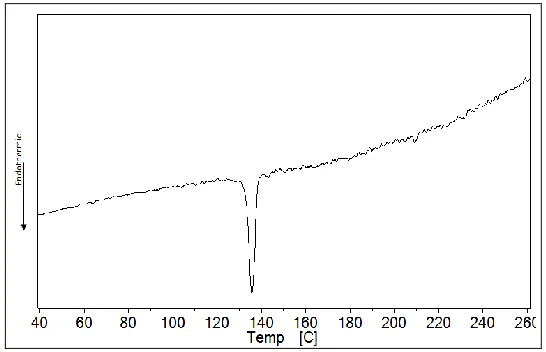
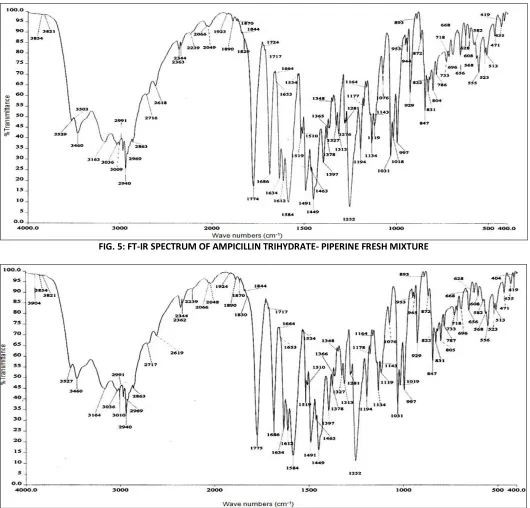
developing a dosage form. The Ampicillin Trihydrate-Piperine physical mixture (1:1) was stored in High Density Poly ethylene (HDPE) containers sealed with Teflon. The mixture was subjected to Differential Scanning Calorimetry (DSC) studies [scanning temperature range 35˚C- 275˚C with (10˚C/min. raise)], Thin Layer Chromatography (TLC) studies for Ampicillin 9 and Fourier Transform - Infra Red (FT-IR) studies (scanning between 400 cm-1 and 4000 cm-1) at zero time and one month after storing at 50˚C in an oven 11. The results of the TLC studies are given in Table 1 and the results of DSC and Fourier Transform- Infra Red (FT-IR) studies are presented as figures. (For DSC studies Fig. 1 & 2 and for FT-IR studies Fig. 3 to 6). Stability studies: Stability studies are also an important part of pre formulation studies. The stability of the drug substance depends upon the container and conditions in which it is stored and other excipients present with the drug. Since the storage temperature for Ampicillin trihydrate, as recommended by many Pharmacopoeias is around 25˚C, the stability studies for Ampicillin Trihydrate-Piperine physical mixture (1:1), was carried out as per ICH guidelines for General cases of drugs 12.
The mixture was encapsulated in hard gelatin capsule shells, the capsules were then transferred to High Density Poly Ethylene (HDPE) bottles. The mouth of the bottles were then covered with aluminium foil and then closed with a closure. The study was carried out as accelerated study (for 6 months) by storing at 40˚C±2˚C, 75±5% RH (sampling at 0, 1, 2, 3, 6 months) and as long term study (for 1 year) by storing at 25˚C±2˚C, 60±5% RH sampling was done at 0, 3, 6, 9, 12 months .
Available online on www.ijpsr.com 1178 potency of the said antibiotic. The mixture was also
observed for changes in physical characters such as color, odor and taste during accelerated and long term stability studies. The results for long term stability studies of the mixtures are given in Table 2 and the results for Accelerated stability studies are given in Table 3. The degradation rate constants were calculated from stability profiles (% potency retained vs. time) and the results are given in Table 4.
RESULTS AND DISCUSSION: Compatibility studies: DSC Studies:
[image:3.612.32.304.261.446.2]FIG.1: DSC THERMOGRAMS OF AMPICILLIN TRIHYDRATE PIPERINE SYSTEM; (A) Ampicillin trihydrate, (B) Ampicillin trihydrate-Piperine fresh mixture and (C) Stored mixture
FIG. 2: DSC THERMOGRAM OF PIPERINE
From the thermograms (Fig. 1 & 2), one can infer that there is no interaction between Ampicillin trihydrate and Piperine in fresh as well as in stored mixture. Since Ampicillin was used as trihydrate, it was not giving a sharp endothermic peak corresponding to its decomposing temperature of 202˚C 13. The endothermic peak found in fresh as well as in stored mixture corresponds to the melting range of Piperine (128˚ to 129˚C) 13. So it indicates that Ampicillin and Piperine do not interact immediately upon mixing and even after storage of mixture.
[image:3.612.316.578.359.458.2]TLC studies: The results of TLC studies (Table 1) show no change in the Rf values of Ampicillin Trihydrate in combination with Piperine in fresh as well as in stored conditions. This indicates that no interaction takes place between Ampicillin Trihydrate and Piperine in fresh as well as stored conditions.
TABLE 1: RESULTS OF TLC STUDIES
[image:3.612.29.302.492.668.2]Combination Rf Value
(mean±S.D)*
Ampicillin Trihydrate 0.67 ± 0.21
Ampicillin Trihydrate + Piperine (Fresh
Mixture) 0.67 ± 0.22
Ampicillin Trihydrate + Piperine (Stored
Mixture) 0.67 ± 0.11
*n=6, P < 0.01
Available online on www.ijpsr.com 1179 FIG. 3: FT-IR SPECTRUM OF PIPERINE
Available online on www.ijpsr.com 1180
FIG. 5: FT-IR SPECTRUM OF AMPICILLIN TRIHYDRATE- PIPERINE FRESH MIXTURE
FIG. 6: FT-IR SPECTRUM OF AMPICILLIN TRIHYDRATE –PIPERINE STORED MIXTURE
Stability studies: The results of stability studies (presented as tables 2, 3 & 4) show that the mixtures of Ampicillin trihydrate and Piperine are stable during long term study (storage at 25˚C±2˚C, 60±5% RH) and even at accelerated conditions (storage at 40˚C±2˚C, 75±5% RH). The degradation (indicated by decrease in % potency of antibiotics)
Available online on www.ijpsr.com 1181
TABLE 2: RESULTS OF LONG TERM STABILITY STUDIES OF AMPICILLIN TRIHYDRATE PIPERINE MIXTURE
Frequency of Testing (Months) Color of the mixture Odor & Taste of the mixture % Potency retained*
Initial colorless Slightly Pungent 100
3 colorless Slightly Pungent 99.1±0.78
6 colorless Slightly Pungent 98.2±0.56
9 colorless Slightly Pungent 97.2±0.68
[image:6.612.45.551.201.276.2]12 colorless Slightly Pungent 96.0±0.56 (*n=3, mean ± S.D, P<0.05)
TABLE 3: RESULTS OF ACCELERATED STABILITY STUDIES OF AMPICILLIN TRIHYDRATE PIPERINE MIXTURE
Frequency of Testing (Months) Color of the mixture Odor & Taste of the mixture % Potency retained*
Initial colorless Slightly Pungent 100
1 colorless Slightly Pungent 98.8±0.87
2 colorless Slightly Pungent 97.6±0.54
3 colorless Slightly Pungent 96.4±0.45
6 colorless Slightly Pungent 95.6±0.53
(*n=3, mean ± S.D, P<0.05)
TABLE 4: ZERO ORDER DEGRADATION RATE CONSTANTS FOR AMPICILLIN TRIHYDRATE PIPERINE MIXTURE
Name of the mixture Zero order rate constant/month*
40˚C±2˚C, 75±5% RH (Accelerated Condition) 25˚C±2˚C, 60±5% RH (Long Term) Ampicillin Trihydrate & Piperine 1.2± 0.34 0.3 ± 0.54
(*n=3, mean ± S.D, P<0.05)
CONCLUSION: From the above studies it can be concluded that Piperine can be used as a formulation additive (Bioenhancer) in oral solid dosage forms of Ampicillin Trihydrate. The inclusion of Piperine as a bioenhancer will result in better oral absorption of Ampicillin and reduction its oral dose. The reduction in oral dose will result in minimal side effects, reduced cost of treatment and improved patient compliance.
REFERENCES
1. Atal C K, Zutshi U & Rao P G, Scientific evidence on the role of Ayurvedic herbals on Bioavailability of drug, J.Ethanopharmacol. 1981; 4: 117.
2. Majumdar A, M, Dhuley J N, Deshmukh V K, Raman P H & Naik S R, Anti-inflammatory activity of Piperine, Japan J. Med Sc Biol, 1990; 43:95.
3. Shobha G, Joseph T, Majeed M, Rajendran R & Srinivas P S S R, Influence of Piperine on the pharmacokinetics of curcumin in animals and human volunteers, Plant Med, 1998; 64: 353.
4. Majumdar A M, Dhuley J N, Deshmukh VK, Raman P H, Tharat S L and Naik S R. Effect of Piperine on Pentobarbitore induced hypnosis in rats,Indian J Exp Biol, 1990; 28: 486.
5. Majumdar A M, Dhuley J N, Deshmukh VK and Naik S R, Effect of Piperine Bioavailability of Oxyphenylbutazone in rats, Indian Drugs, 1999; 36:123.
6. Bano G, Raina RK, and Zutshi U, “Effect of Piperine on Bioavailability and Pharmacokinetics of Propanolol and Theophylline in healthy volunteers”.Eur J Clin Pharmacol. 1991; 41: 615- 617.
7. Janakiraman K and Manavalan R Effect of Piperine on oral Bioavailability of Ampicillin and Norfloxacin Afr. J. Trad. CAM2008; 5 (3): 257 – 262.
8. Sweetman, S. C. Martindale, The Complete drug reference, The Pharmaceutical Press London, Edition 33, 2002;150– 51 9. Pharmacopoeia of India, The Controller of Publication, New
Delhi,. Edition.4, Vol. 1, 1996; 57 – 8.
10. Pharmacopoeia of India, the Controller of Publication, New Delhi. Edition 3, Vol. 2, 1985; A92
11. Fiese, E.F. Hagen, T.A., Pre-formulation studies in Lachman, L, Liberman, H and Kanig, J (Eds). Theory and Practice of Industrial Pharmacy Varghese Publishing Company, Mumbai, Edition.3, 1986; 193-.194.
12. International Committee on Harmonization (ICH) Topic Q1A (R2) Stability testing of new drug substances and Products available on-line at www.ich.org