ORIGINALRESEARCHARTICLE
IMPROVING MANUFACTURING PERFORMANCE THROUGH IMPLEMENTING CYCLE-TIME
REDUCTION: A STUDY OF LEAN PLASTIC BAGS ENTERPRISE
*Tareq N. Issa
Department of Mechanical and Industrial Engineering Applied Science Private University, Jordan Road,
Shefa Badran, Amman, Jordan
ARTICLEINFO ABSTRACT
Lean manufacturing is concerned with the implementation of several tools and methodologies that aim for the continuous elimination of waste throughout manufacturing process flow in the production system. Lean manufacturing also focuses on company’s goals of improving quality, reducing inventory and becoming more competitive. This research addresses the implementation of lean principles and tools in a small-medium size plastic industry, and focuses on a manufacturing enterprise producing “Fused” plastic bags products. In this production operation, the major types of waste to eliminate include material waiting, processing-time and setup wastes. The primary goal is to identify and implement selected lean strategies to eliminate waste in the plastic bags manufacturing operationunder study. A systematic approach was used for the implementation of lean principles and techniques, through the application of Value Stream Mapping analysis. The current state value stream map was constructed to improve the plastic bags manufacturing process through identifying opportunities to eliminate waste and its sources. Also, the future-state value stream map was developed describing improvements in the overall manufacturing process resulting from eliminating wastes. The implementation of VSM, 5S, Visual Control, Kaizen, and Reduced lot size methods have provided significant benefits and results. Productivity has increased to 95.5%, Manufacturing Lead Time reduced by 10.4% and The Cycle Time for the "Cutting/Packaging" process was reduced by 35% to about 30 minutes.
Copyright © 2018, Tareq N. Issa. This is an open access article distributed under the Creative Commons Attribution License, which permits unrestricted use, distribution, and reproduction in any medium, provided the original work is properly cited.
INTRODUCTION
The goal of Lean manufacturing is to producing quality products, reducing waste and implementing improved process and maximizing material flow. “Lean thinking” was adopted by the automobile industry business processes and operations, as articulated by Womack (1990). It has been recognized as one of the key approaches in enhancing the productivity and hence the competitiveness of an organization. Application of lean manufacturing includes different tools and techniques like Value stream mapping, Kanban, Kaizen, Supermarket and Wastes. Value Stream Mapping is a method of describing material and process flow from costumer order receipt to delivery. In recent years, lean manufacturing has been widely adopted by manufacturing firms and other sectors as a continuous improvement program.
*Corresponding author: Tareq N. Issa
Department of Mechanical & Industrial Engineering Applied Science Private University, Jordan Road, Shefa Badran, Amman, Jordan
This study addresses the implementation of relevant lean principles and tools in a Small-Medium Scale “Fused” plastic bags manufacturing firm (the case company). The term “plastic Fusion” refers to the heated plastic entering the blowing machine to fuse and create sheets of plastics that are turned into rolls of connected plastic bags. The main target is to develop and asses several strategies to eliminate waste on the shop floor. A systematic approach was used for implementing the Value stream mapping technique and selecting the appropriate lean principles and tools for waste reduction. The current and future states value stream maps (VSM) were constructed to identify opportunities to eliminate wastes and propose relevant changes/improvement in the “Fused” plastic bags manufacturing operation under study. Based on the information gathered, the company will utilize the results as a plan to map the future state and implement lean manufacturing tools for process performance improvement, example implementations were described in related studies by Melton (2005) and Alvarez, et al. (2009). In section 2 of this
ISSN: 2230-9926
International Journal of Development Research
Vol. 08, Issue, 10, pp.23248-23255, October,2018
Article History:
Received 22nd July, 2018
Received in revised form 10th August, 2018
Accepted 17th September, 2018
Published online 29th October,2018 Key Words:
Process Flow; Cycle-Time Reduction; Plastic bags Industry;
Value stream map.
Citation: Tareq N. Issa, 2018. “Improving manufacturing performance through implementing cycle-time reduction: a study of lean plastic bags enterprise”,
Internationa lJournal of Development Research, 8,(10), 23248-23255.
paper, a review of the literature related to lean manufacturing implementations is presented. The subsequent sections provide a profile of the case manufacturing firm, the lean methodology applied, the “current state” map and its analysis, as well as the development of the “future state” map for the production operation under study. In the last two sections, analysis of the “future state” map and recommendations for further research are presented.
Review of Literature
Lean manufacturing originates its name from the
manufacturing systems and processes of the Toyota production system. These systems are highly flexible, responsive to customer requirements and effective in producing goods at low cost with shorter cycle times. As presented and discussed by Singh et al. (2010). A study emphasized that Leanis a manufacturing concept to reduce waste and also reviewed the methodologies used in measuring the level of leanness achieved in an Indian manufacturing industries. Lean manufacturing is a set of principles and techniques that leads to continuous process improvement through elimination of non-value added activities, as described by Sahoo et al., (2008). As stated by Rosnah and Othman (2012) The main objective of lean production is to develop appropriate strategies to eliminate waste in areas relating to work-in progress (WIP), motion time, set-up time, lead time and defects while considering the economic needs of the problem. Also, the study described the implementation of lean principles and tools in a small and medium scale industry focusing on the Plastic Injection molding operation demonstrated that the use of VSM, 5S, SMED and Kanban have shown very encouraging results. Productivity has increased to 94.1%, Delivery attainment increased to 100%, and Changeover time was reduced to 38.5 minutes from 3 hours. Khedkar et al. (2012) showed that 5S is a basic technique for improving the foundation of Lean manufacturing systems. Their research effort dealt with the implementation of 5S methodology in the plastic Molding industry. Significant improvements in productivity, safety, efficiency, and maintaining an orderly workplace were accomplished. Chaple et al. (2014)emphasized that Lean manufacturing is a key approach to enhance the productivity and competitiveness of an organization. The paper presented a review of Lean principles and practices in the Indian manufacturing industries. The study also, identified enablers and barriers in implementing the lean principles and practices in a wide range of the Indian industries.
A large FDI-based plastic bag manufacturing company located in Bangladesh had focused on approaching lean manufacturing in achieving “near perfection”. This was done by creating the current state and future state VSM and by identifying and reducing various sources of wastes. The research was done for 16 products for a semi-automated production line and yielded 4-6% increase of value added time and 4-6% decrease of non-value added time for each product, as presented and discussed by Yesmin et al. (2011). In the study presented by Sundar et al. (2014), there was an emphasis that in order to have a successful implementation of lean manufacturing, the organizations had to focus on all aspects such as Value stream mapping, Kanban, line balancing, inventory control, pull system and SMED. The study also presented an attempt to develop a route map for the organizations to implement lean
manufacturing systems. Choomlucksana et al. (2015)
described how lean manufacturing can help improve work
efficiency in a case study of the manufacturing metal sheet stamping operation. The study showed that the Deburring and Polishing processes relatively involved the most non-value added activities. Using visual controls and 5S lean techniques, the case company achieved waste reduction and efficiency improvement. These improvements include a 62.5% reduction in cycle time and 67.53% in reducing non-value adding activities for the Polishing stage. Singh et al. (2010) explained how value stream mapping (VSM) is helpful in lean implementation and to develop the road map to tackle improvement areas to bridge the gap between the existing state and the proposed state of a manufacturing firm. This paper is a real case study showing VSM applications for lean implementation of Current state and future state for manufacturing of a firm are compared and demonstrated: 92.58% reduction in lead time, 2.17% percent reduction in processing time, 97.1% percent reduction in WIP and 26% percent reduction in manpower requirement. Kumar et al. (2018) have presented a road map to implement Lean-Kaizen concept using value stream mapping (VSM) to identify hidden continuous improvement opportunities in Indian small and medium-sized enterprises. Using Lean-Kaizen, findings of the study included eliminated rework time, reduced inventory level and reduced lead time and C/T leading to improved productivity. The studies conducted by Abdulmalek and Rajgopal, (2007) and Lian, Landeghem, (2002) demonstrated the use of simulation analysis for describing the benefits of lean manufacturing and value stream mapping applications to achieve waste reduction and productivity improvement.
Profile of Manufacturing firm
The case company in this study was established in Jordan as Orient Plastic Company (OPC) in 1958. Now OPC is one of the largest plastic bags production companies in Jordan and the Middle East. The OPC company which is located in Amman, the capital city of Jordan, produces a variety of plastic bags products with a work force totaling 142 employees. These plastic bags products are produced in several product families in order to meet various markets and customer requirements. The market demand consists of various customer orders received from apparel, retail, and supermarket industries.
LEAN METHODOLOGY
GeneralApproach
The case company has implemented several manufacturing processes to produce different plastic families. This study deals with performance analysis of manufacturing processes in this production company. In this study, the selected manufacturing process flow (production line) is concerned with the production of 30x45cm (5 to 10micron thickness, low-density) “Nylon” plastic bags product. This product and its manufacturing process flow is considered the case-study production line, and involves several processes including: Chemical Material Preparation, Loading/Mixing (feeding), Heating (in throat) and Blowing, Connecting and Roll Formation, Materials Handling (Weighting), Loading and Connecting, and Rolls Cutting/Packaging. This study focuses on identifying the types and sources of waste in the above-described manufacturing processes including: Materials preparation and mixing loss, connecting and roll formation set-up time, and cutting and packaging delays.
The analysis of this manufacturing process flow shows that the problems in the above stated processes include the following:
The chemical materials preparation and pigments
mixing involves a raw material (loss) and processing time waste.
The furnace-heating (in throat) process may involve a delay of production flow due to having insufficient materials in the throat. That may cause little waste in this process cycle time leading to (set
subsequent processes.
Heating (Throat) and Blowing process involve a setup delay associated with the presence of impurities inside the head of the blowing machine, that will cause extended set-up activity for this process.
The packaging process may provide some plastic bag bundles with a weight lower than requirement due to insignificant raw material loss as well as worker inadequate packaging skills. This may lead to a loss in the produced quantity of bundles per manufacturing cycle. This process involves Cycle-Time waste.
The current (achieved) 86.7%
considered lower than the desired (target) productivity of 95.5%. This is equivalent to an achieved production quantity of 13 plastic bag rolls as compared to a future targeted (improved) production quantity of 17 plastic bundles.
In this study, and through the implementation of the lean methodology and Value Stream Mapping technique, the lean principles and techniques related to set-up time reduction, elimination of non-value adding activities and lead time improvements will be considered. Therefore, the above The analysis of this manufacturing process flow shows that the problems in the above stated processes include the following:
The chemical materials preparation and pigments mixing involves a raw material (loss) and processing
heating (in throat) process may involve a delay of production flow due to having insufficient materials in the throat. That may cause little waste in this process cycle time leading to (set-up delays) in the
ing process involve a setup delay associated with the presence of impurities inside the head of the blowing machine, that will cause
up activity for this process.
The packaging process may provide some plastic bag han requirement due to insignificant raw material loss as well as worker inadequate packaging skills. This may lead to a loss in the produced quantity of bundles per manufacturing
Time waste.
The current (achieved) 86.7% productivity is considered lower than the desired (target) productivity of 95.5%. This is equivalent to an achieved production quantity of 13 plastic bag rolls as compared to a future targeted (improved) production quantity of 17 plastic
study, and through the implementation of the lean methodology and Value Stream Mapping technique, the lean up time reduction, value adding activities and lead time Therefore, the
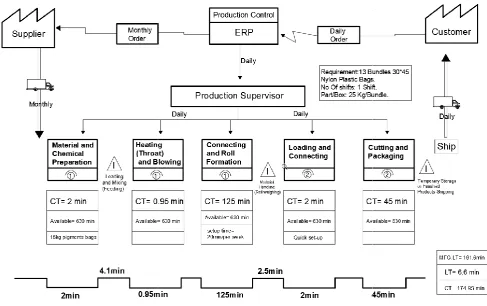
above-described problem areas are illustrated in the current value stream map (VSM) for the 30x45cm plastic bag
manufacturing operation under study, as provided in Figure (1) of Section (5) in this paper. The main goal is to apply relevant combinations of lean tools to analyze the previously described sources of waste in the “current state” map, and then develop the “future state” value stream map for the manufacturing process under study. The purpose is to
process flow resulting in an improved manufacturing performance productivity and shorter lead time.
Product Selection: The selection of the product family is considered the first and important step in the implementation of the lean methodology. The case company in this study is Orient Fused Plastic (OPC) manufacturing firm, and the selected product in this study is
bags product family.
Current State Value Stream Map
developed and analyzed after collecting the relevant manufacturing process data for the selected plastic bag batch production operation. This operation consists of two machine based processes grouped into two operational stages. The machine processes in the first stage
machine processes in the second stage is called
In the first manufacturing stage, processes include
Process 1 -Materials and Chemical Preparation:
[image:3.595.57.545.60.366.2]process involves preparation of chemicals/pigments raw materials plastic pigments. This includes ten bags low density (LD) and five bags linear low density (LLD) pigments that will be used for producing 325kgs (15 bags of pigments) by the operator. This activity requires 2minutes cycle time to complete.
Figure 1. Current State Value Stream Map
described problem areas are illustrated in the current-state value stream map (VSM) for the 30x45cm plastic bag
manufacturing operation under study, as provided in Figure (1) The main goal is to apply relevant combinations of lean tools to analyze the previously described sources of waste in the “current state” map, and then develop the “future state” value stream map for the manufacturing process under study. The purpose is to achieve a more efficient process flow resulting in an improved manufacturing performance productivity and shorter lead time.
The selection of the product family is considered the first and important step in the implementation an methodology. The case company in this study is Orient Fused Plastic (OPC) manufacturing firm, and the selected product in this study is the 30x45cm “Nylon” plastic
alue Stream Map: The Current state map analyzed after collecting the relevant manufacturing process data for the selected plastic bag batch production operation. This operation consists of two machine-based processes grouped into two operational stages. The machine processes in the first stage is called Pandara, and the machine processes in the second stage is called Elpa.
turing stage, processes include
Process/activity 2 -Loading and Mixing (Feeding): This activity involves mixing the 325kgs of plastic and pigments raw materials in a tub by the activity worker. This activity requires 4.1minutes cycle time to complete.
Process 3 - Heating (Throat) and Blowing: This process involves the following two steps:
The first step of this process involves Feeding 100kg (per 3-hour run) from the 325kg material mix of pigments into the Throat (Heater). Using a deep tray with the supervision of a worker. This step is completed in 35 seconds (0.5 min).The second step of this process involves pulling heated/melted material from the heating machine by a screw which is located inside the metal tunnel (throat). The throat uses a heater for melting materials then fusing plastics using a blower. The second step of this process provides the entire melted plastics through “Plastic Fusion” mechanism at the blowing machine. Also, at this step there is an air flow used for cooling the melted plastics which is referred to as “thin film production”. Finally, the resulting plastic sheets are used to form plastic-roll products. This process is maintained until the entire mixed raw material is processed through the metal tunnel. This process requires up to 0.95 minutes to complete.
Process 4 -Connecting and Roll Formation: This process involves connecting the starting edge of the plastic roll between the rolling cylinders until it completes forming a roll. In this stage, the goal of roll connecting is to provide full cooling for the plastics so that it produces “Nylon” plastic rolls. This activity takes about 31.2 minutes to complete starting when the edge of roll appears from the head of the machine until a roll is completed. Thus, this activity requires 125 minutes to complete the formation of 4 rolls (per 3-hours run in 11-hours daily shift) that are generated from The Heating (throat) and Blowing Process. This process cycle time is relatively long due to the 31 minutes significant per roll formation time.
Process 5 -Material Handling (Roll weighing): In this process the worker wraps and unloads each produced roll from the connecting machine and then, the total weight for 4rolls is evaluated and often found slightly below 100kg. The loss in rolls weight is the result of a 1% estimated material loss (waste) occurring in the “material mixing and feeding” process. This step is completed in 1.5 minutes. The process also includes plastic rolls handling that involves worker transporting the plastic rolls to a stacking area until the rolls are loaded to the next stage, with 1 minute required time to complete. This Material handling and Logistics activity involves transportation by the operator for the plastic roll to the next stage using stacker. Before starting the next stage, we have a waiting time until loading the roll “WIP” at the second machine.
For the second manufacturing stage: The following presents the second stage manufacturing processes that are described as implemented in the current state for plastic bags production line understudy. This stage requires two operators (workers) to ensure high-performance manufacturing processes.
And this stage processes include
Process 6 –Loading and Connecting: This process involves loading each roll in to the machine by the two operators
available for this process, then connecting the plastic material between machine cylinders. This process may involve simple and quick set-ups and takes 2 minutes to complete.
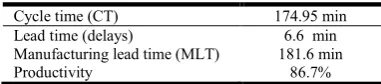
[image:4.595.337.528.338.380.2]Process 7 –Cutting and Packaging: This process involves automatic cutting and welding the plastic roll into bags using a cutting tool, and finally packaging the produced plastic bags. This activity involves packaging each 25 kg quantity of plastic bags into a one bundle. And, consequently, 4 bundles per run of plastic bags product are produced, this process requires 45minutes cycle time to complete. The above described two main stages and their manufacturing processes will be implemented each daily shift to achieve the production of 13 plastic bundles as the equivalent of 325kg plastic material per 11-hours daily shift. Thus, the manufacturing Lead time for the current state of the selected plastic bags production operation is estimated as 3.1 hours per production run in 11-hours daily shift. In addition, the material loss rate in this production line is about 1% which is negligibly in significant. The performance metrics or measures achieved for the current state of the selected plastic bags production operation are as shown in Table 1.
Table 1. Current/Achieved performance measures
Cycle time (CT) 174.95 min Lead time (delays) 6.6 min Manufacturing lead time (MLT) 181.6 min
Productivity 86.7%
Analysis of Current State Map
Data Sampling on Waste
Waste/Loss in Productivity: For the plastic bags production
operation under study, the productivity target is determined at the level of 17 Bundles per 11hour daily shift. Therefore, assuming 7 working days per week, the desired productivity target is estimated as 119 bundles per week. Data samples (sets)for weekly number of bundles produced were collected for 12 weeks (3 months). Total number of bundles produced was determined for each week, and thus, the weekly production of bundles is presented in the chart provided in (Figure 2):
Figure 2. Productivity Frequency Chart
According to the current performance of data in figure (2), the number of plastic bundles produces daily is about 13 bundles. Therefore, the most frequent (average) weekly production is about 90 bundles.
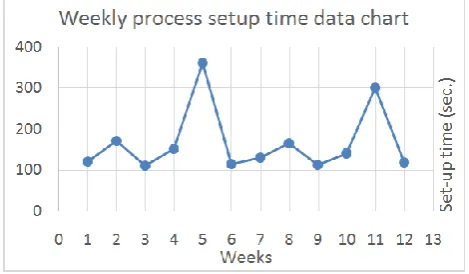
[image:4.595.309.561.571.731.2]Waste in Process Setup: Data samples (sets) for process setup time were weekly collected. Average daily setup time was determined for each week; the average daily process setup time per week is in the chart provided in (Figure 3).
Figure 3. Set-up Time Frequency Chart
According to the data presented in Figure (3), the process daily setup time per week varies from 2 minutes (120 sec.) to 6 minutes (360 sec.). This variation in setup time can be explained by the occurrence of machine breakdown, absence of worker and maintenance requirements.
Areas of Waste Analysis: Based on the analysis of areas of waste and related data samples for the current manufacturing process flow understudy, the possible types/areas of waste that were identified, include the following:
The Loading and Mixing (Feeding) involves some
material loss (waste), causing the feed of smaller quantity of raw material into the Heating-Throat process 3. It was identified that this material waste is the result of inadequate worker skills.
The Heating (Furnace)/Material Melting process: may involve a delay of production flow due to having insufficient materials in the throat. That may cause little waste in this process cycle time leading to (set-up delays) in the subsequent processes. As a result, the cycle time of this process may exceed 0.95 minutes in some production runs during daily shifts whenever the process is not fully attended/supervised by the worker. Heating (Throat) and Blowing process involve a setup
delay associated with the presence of impurities inside the head of the blowing machine, that will cause extended set-up activity to remove impurities and thus, extending setup time (waste) for the entire process flow understudy.
As explained in section 7.1.2 (Figure 3). If impurities in the Blower Machine are not removed, the plastics quality will be adversely impacted resulting in defective material waste.
In the cutting and packaging process, the packaging stage of plastic bags rolls involves occurrences of non-compliance in the weight of certain bundles to the 25 Kg-weight requirements. This contribute to reducing the total weight of the shipped quantity of bundles.
Based on the analysis of the above-stated areas of waste in the current state of the manufacturing process flow, as shown in Figure (1), the major sources of waste that were identified include raw material loss, mixed material waiting-time, cycle
time waste and setup time delay. The appropriate lean tools and techniques will be selected and used for current state improvements through the reduction/elimination of these areas of wastes. This to be performed by evaluating the benefits of several combinations for improvement using a simulation approach for value stream mapping analysis, as presented by Abdulmalek and Rajgopal (2007).
Future State Value Stream Map
Objectives / Approach
An efficient production system can be achieved using a comprehensive and effective approach in order to minimize wastes and improve productivity. This includes eliminating over production, excess in material transportation, waiting times, cycle time waste and set-up delays, and non-value added activities. The primary goals of this study are to develop “future state” Value stream map for the plastic bags production operation understudy (production line), by identifying areas of waste and/or opportunities for process improvements, and finally to adopt and analyze appropriate lean manufacturing tools and methods to eliminate waste. To accomplish these goals, the current state VSM for the plastic bags production operation understudy, as presented in section 6, will be analyzed for potential manufacturing process performance improvement. Considering the current state design for the manufacturing process flow under study, the changes to be recommended include related improvements that are needed to develop the “future state” design leading to reduced cycle time as well as manufacturing lead time for the process flow understudy (Manufacturing operation).
Development of Future State Map: Material delays, process set-up and manufacturing lead time are viewed as critical factors that must be considered to ensure that manufacturers are able to fulfill customer’s demand for plastic bags product. The main goal is to meet customer requirements with the desired quality, quantity, on time delivery, and competitive pricing within the shortest lead time to market. For the future state design, the implemented improvements concerning the physical changes and performance characteristics in the manufacturing processes involved:
Loading and Mixing “Feeding” was essential due to unskilled labor performance in this process. Therefore, it was suggested that replacing the worker by an automatic mixing machine is economically justifiable. This change which requires only minimum worker supervision, has eliminated material loss and reduced the cycle time for this process thus, has resulted in Feeding the required quantity of raw materials into the Heating Throat.
Heating (Throat) and Blowing process
possible setup delay associated with the presence of impurities inside the head of the blowing machine.
Implementing the “Kaizen” Process improvement
technique, the root causes of the impurities problem are identified to include inadequate preventive maintenance activity and lack of inspections. That will cause extended set-up activity to remove impurities and thus, extending setup time (waste) for the entire process flow unders Therefore, as part of the “Kaizen” process, it is suggested that performing periodic inspection as well as preventive
maintenance to detect impurities presence and
“consequently”, maintaining simple and quick setup for this stage.
For The Cutting and Packaging process,
occurrences of non-compliance to the 25kg requirement in certain plastic bundles, it was suggested that the “5S” Lean technique be implemented. Therefore, the use of this technique will identify and eliminate any no value adding under-performed steps in the cutting stage thatwould result in loss of some plastic bags in the produced bundles.
Additionally, the value adding steps in the
cutting/packaging process are then determined and established, and thus providing a more standardized process. As a result, the performance of operators in this process is improved and the cycle time required for this process is significantly reduced.
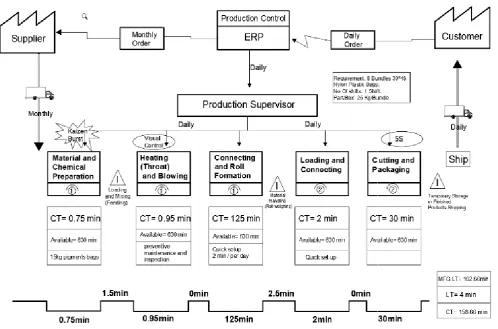
[image:6.595.52.551.56.385.2]The above described proposed changes/improvements current state of the manufacturing process flow under study These represent most suitable combination of changes/ improvements that are implemented as shown in the
Figure
23253 Tareq N. Issa, Improving manufacturing performance through implementing cycle
Heating (Throat) and Blowing process may involve a possible setup delay associated with the presence of impurities inside the head of the blowing machine.
Implementing the “Kaizen” Process improvement
of the impurities problem are identified to include inadequate preventive maintenance activity and lack of inspections. That will cause extended up activity to remove impurities and thus, extending setup time (waste) for the entire process flow understudy. Therefore, as part of the “Kaizen” process, it is suggested that performing periodic inspection as well as preventive
maintenance to detect impurities presence and
“consequently”, maintaining simple and quick setup for
Packaging process, to reduce the compliance to the 25kg-weight requirement in certain plastic bundles, it was suggested that the “5S” Lean technique be implemented. Therefore, the use of this technique will identify and eliminate any
non-performed steps in the cutting stage thatwould result in loss of some plastic bags in the
Additionally, the value adding steps in the
cutting/packaging process are then determined and more standardized process. As a result, the performance of operators in this process is improved and the cycle time required for this
changes/improvements the ng process flow under study. represent most suitable combination of changes/ improvements that are implemented as shown in the
“Future State Design” provided in Figure (4). As a result of these implementations, the manufacturing lead time was reduced, while the overall productivity was improved. performance improvements have been verified through analysis and evaluation of the manufacturing processes involved using related actual data.
Analysis of future state value stream map
Based on the above-stated analysis of the future state value stream map for the manufacturing operation understudy, the suggested changes and the selected lean tools/techniques, have been documented and implemented after the approval of manufacturing/production management team at the orient plastic company. The implementations of these changes are
expected to provide the anticipated performance
improvements. These changes are reflected in the “future st VSM” as shown in Figure (4)
tools/techniques requires changes in the selected
manufacturing operation (production line) that resulted in reducing process cycle times, and these have contributed to reducing the total manufacturing lead time. Additionally, t overall productivity of the manufacturing operation has also considerably improved. These cycle
as follows:
For the “Material Preparation”
reduced from 2 minutes to 0.75 minutes. Also, the
and Feeding” process (WIP material) cycle time was reduced from 4.1 minutes to 1.5 minutes. Concerning the
(Throat) and Blowing” process, the performance of periodic inspection as well as preventive maintenance allows for an early detection of the presence of impurities. Consequently,
Figure 4. Future State Value Stream Map
Improving manufacturing performance through implementing cycle-time reduction: a study of lean plastic bags enterprise
“Future State Design” provided in Figure (4). As a result of manufacturing lead time was reduced, while the overall productivity was improved. These performance improvements have been verified through analysis and evaluation of the manufacturing processes involved using related actual data.
value stream map
stated analysis of the future state value stream map for the manufacturing operation understudy, the suggested changes and the selected lean tools/techniques, have been documented and implemented after the approval of the manufacturing/production management team at the orient plastic company. The implementations of these changes are
expected to provide the anticipated performance
improvements. These changes are reflected in the “future state (4). The implementation of lean
tools/techniques requires changes in the selected
manufacturing operation (production line) that resulted in reducing process cycle times, and these have contributed to reducing the total manufacturing lead time. Additionally, the overall productivity of the manufacturing operation has also These cycle-time reductions are stated
this improvement ensures maintaining simple and quick setup as well as meeting the 0.95 minutes’ cycle time requirements for this process. For the “Connecting and Roll Formation” process, the setup time of 20 minutes per week (3 min per daily shift/ 0.9 min per run) is considered insignificant and has no direct impact on the entire manufacturing process lead time since the setup is performed prior to shift start. Additionally, this process cycle time requirement of 125 minutes to complete the formation of 4 rolls (per 3-hours run in 11-hours daily shift) is relatively long due to the 31 minutes significant per roll formation time. This cycle time is an actual processing time that does not involve a direct time waste, and can only be reduced if the replacement of the currently used machine technology can economically be considered. Finally, the “Cutting and Packaging” process cycle time was reduced from 45 minutes to 30 minutes. Therefore, the above-stated lean implementations or improvements, have resulted in reducing total cycle time from 174.9 min to 158.66 min as well as, reducing the manufacturing lead time from 181.6 minutes to 162.66 minutes, for the entire manufacturing operation understudy. In addition, these improvements have positively
impacted manufacturing process performance, and
[image:7.595.43.279.397.440.2]consequently,contributedto increasingtheweeklyproductivity from 86.7% to 95.5%. These improved performance results are indicated as “The Future State Target Performance Measures”, and these are summarized in Table (2).
Table 2. Performance Measure for the Manufacturing Operation Future State
Cycle time (CT) 158.66 min
Lead time (LT) 4 min
Manufacturing lead time (MLT) 162.66 min Productivity (Improved) 95.5%
Conclusion
This research study is concerned with lean manufacturing implementation in the plastic bags industry. The aims of this study were to achieve, lower process cycle time, lower manufacturing lead time and higher productivity for the selected production operation in the case-study manufacturing firm. In the current-state analysis for the manufacturing process flow under study, the types/sources of waste related to time and material were identified as the major sources of waste. The systematic approach adopted in this study involved the implementation of lean methodology which has proven to be effective for eliminating these areas of waste. This is accomplished through the identification/selection of the appropriate Lean Tools and techniques including Value Stream Mapping, Kaizen Method, Visual Controls and 5S Technique. Based on the analysis of areas of waste in the current state of the manufacturing process flow, the major sources of waste that were identified include raw material loss, mixed material waiting-time, production delay time and setup time waste (delay). The selected lean tools and techniques in this study were used for current state improvements through the reduction/elimination of these areas of wastes. This was achieved through the implementation of the most suitable combination of improvements in the manufacturing process flow. These improvements were implemented to achieve the Future State design for the manufacturing process understudy. The results achieved in this study showed significant improvements in lead time and productivity performances for the plastic bags manufacturing operation.
Recommendations for Further Research
An important recommendation is to encourage the case company/firm to apply the lean manufacturing tools necessary for continued process improvement and sustained elimination of time and material waste. This effort is to be carried out through identification of new areas for improvement that would contribute to achievinghigher lean-performance level for the plastic bags production operation under study.
Through this additional research effort for further optimization of the manufacturing process flow, the impact of potential improvements pertinent to cycle times, lead time, and productivity are to be assessed. It is also recommended that improving the setup procedure and the cycle time for the “Connecting and Roll Formation” process is an important area for further research and analysis. This may require considering alternate machine technology, the redesign of setup procedure, and standardization as well as the reduction of cycle time for this process. The investigation of these areas requires that additional be gathered, and further research and analysis be carried out in order to make relevant and effective decisions concerning these areas of the process.
REFERENCES
Abdulmalek, F.A. and Rajgopal, J. 2007. Analyzing the benefits of lean manufacturing and value stream mapping via simulation: a process sector case study. Int. J. Prod.
Econ., 107(1): 223–236.
Alvarez, R., Calvo, R., Pena, M.M. and Domingo, R.2009. “Redesigning an assembly line through lean manufacturing tools.” International Journal of Advanced Manufacturing
Technology 43: 949-58.
Chaple, A.P., Narkhede, B.E. and Akarte, M.M. 2014.“Status of implementation of Lean manufacturing principles in the
context of Indian industry: Literature review” 5th
International &26th all India manufacturing technology, design and research conference. December 12-142014. IIT Guwahati, Assam, India. (567-1-567-6).
Choomlucksanaa, J. and M. Ongsaranakorna, P. Suksabaia. 2015. “Improving the productivity of sheet metal stamping subassembly area using the application of lean manufacturing principles.” 2nd International Materials, Industrial, and Manufacturing Engineering Conference, MIMEC2015, 4-6 February 2015, Bali Indonesia.
Khedkar. S. B. and Prof. R. D. Thakre, Prof. Y. V.Mahantare, Mr. Ravi Gondne.2012. “Studying Implementing 5S Techniques in Plastic Moulding.” International Journal of
Modern Engineering Research (IJMER) Vol.2, Issue.5,
Sep,-Oct.2012 pp.3653-3656.
Kumar S., Dhingra A., Singh B. 2018. "Lean-Kaizen implementation: A roadmap for identifying continuous improvement opportunities in Indian small and medium sized enterprise", Journal of Engineering, Design and
Technology, Vol. 16 Issue: 1, pp.143-160.
Lian, Y.H. and Landeghem, V., “An Application of Simulation and Value Stream Mapping In Lean Manufacturing”, Proceedings 14th European Simulation Symposium, 2002 Melton, T. 2005. “The Benefits of Lean Manufacturing What
Lean Thinking has to Offer the process Industries.”
Chemical Engineering Research and Design, 38(A6):
Rosnah, M.Y. and Othman, A. 2012. “Lean ManufacturingImplementation in a Plastic Molding Industry”. AIJSTPME 5(4): 43-52
Sahoo, A.K., N. K. Singh and R. Shankar. M. K. Tiwari. 2018. “Lean philosophy: implementation in a forging company.”
Int J Adv Manuf Technol.,36:451–462.
Seth, D. and Gupta, V. 2005. “Application of valuestream mapping for lean operations and cycle time reduction: An
Indian case study.” Production Planning and Control
16(1): 44-59.
Singh, B., Garg, S.K. and Sharma, S.K. 2010. “Value stream mapping: literature review and implications for Indian industry.” Int J Adv Manuf Technol DOI 10.1007/s00170-010-2860-7.
Singh, B.J. and Khanduja, D. 2010. “SMED: for quick changeovers in foundry SMEs”. International Journal of
Productivity and Performance Management 59(1): 98-116.
Sundar, R., Balaji, A.N., SatheeshKumar, R.M. 2014. “Areview on Lean Manufacturing Implementation
Techniques” (12th Global Congress On Manufacturing and
Management), Procedia Engineering vol. 97 (2014)
1875-1885.
Vinodh, S., Arvind, K.R. and Somanaathan, M. 2010. “Application of value stream mapping in an Indian
camshaft manufacturing organization.” Journal of
Manufacturing Technology Management 21(7): 888-900.
Womack, J., Jones, D.T. and Roos, D. 1990. “The machine that changed the world.” Rawson Associates, New York, NY.
Womack, J.P. and Jones, D.T. 1996. “Beyond Toyota:how to root out waste and pursue perfection.” Harvard Business Review 74(5): 140-58.
Yesmin, T. Masuduzzaman, MD. A. Zaheer. 2011. “Productivity Improvement in Plastic Bag Manufacturing Through Lean Manufacturing Concepts: A Case Study.”
Applied Mechanics and Materials. ISSN: 1662-7482, Vols.
110-116, pp 1975-1982.