UNIVERSITI TEKNIKAL MALAYSIA MELAKA
DESIGN OF CHILLED FLOOR SYSTEM FOR COOLING
IN MALAYSIA
This report submitted in accordance with requirement of the Universiti Teknikal Malaysia Melaka (UTeM) for the Bachelor of Mechanical Engineering Technology
(Refrigeration & Air-Conditioning Systems) (Hons.)
by
MUHAMMAD NAJIB BIN AZIZ B071210417
901113146196
UNIVERSITI TEKNIKAL MALAYSIA MELAKA
BORANG PENGESAHAN STATUS LAPORAN PROJEK SARJANA MUDA
TAJUK: Design of Chilled Floor System for Cooling in Malaysia
SESI PENGAJIAN:2015/16 Semester 1
Saya MUHAMMAD NAJIB BIN AZIZ
mengaku membenarkan Laporan PSM ini disimpan di Perpustakaan Universiti Teknikal Malaysia Melaka (UTeM) dengan syarat-syarat kegunaan seperti berikut: 1. Laporan PSM adalah hak milik Universiti Teknikal Malaysia Melaka dan penulis. 2. Perpustakaan Universiti Teknikal Malaysia Melaka dibenarkan membuat salinan
untuk tujuan pengajian sahaja dengan izin penulis.
3. Perpustakaan dibenarkan membuat salinan laporan PSM ini sebagai bahan pertukaran antara institusi pengajian tinggi.
4. **Sila tandakan ( )
SULIT
TERHAD
TIDAK TERHAD
(Mengandungi maklumat yang berdarjah keselamatan atau kepentingan Malaysia sebagaimana yang termaktub dalam AKTA RAHSIA RASMI 1972)
(Mengandungi maklumat TERHAD yang telah ditentukan oleh organisasi/badan di mana penyelidikan dijalankan)
Alamat Tetap:
NO. 52 JALAN INDAH 3/4 TAMAN AMPANG INDAH 68000 AMPANG, SELANGOR
Tarikh: ________________________
Disahkan oleh:
Cop Rasmi:
Tarikh: _______________________
FAKULTI TEKNOLOGI KEJURUTERAAN Tel : +606 331 6019 | Faks : +606 331 6431/6411
Rujukan Kami (Our Ref) : Rujukan Tuan (Your Ref) :
25 JAN 2016 Pustakawan
Perpustakaan UTeM
Universiti Teknikal Malaysia Melaka Hang Tuah Jaya,
76100 Durian Tunggal, Melaka.
Tuan/Puan,
PENGKELASAN LAPORAN PSM SEBAGAI SULIT/TERHAD LAPORAN PROJEK SARJANA MUDA TEKNOLOGI KEJURUTERAAN MEKANIKAL (SISTEM
PENYAMANAN UDARA DAN PENYEJUKBEKUAN): MUHAMMAD NAJIB BIN AZIZ
Sukacita dimaklumkan bahawa Laporan PSM yang tersebut di atas bertajuk
“Design of Chilled Floor System for Cooling in Malaysia” mohon dikelaskan sebagai *SULIT / TERHAD untuk tempoh LIMA (5) tahun dari tarikh surat ini.
2. Hal ini adalah kerana IANYA MERUPAKAN PROJEK YANG DITAJA OLEH SYARIKAT LUAR DAN HASIL KAJIANNYA ADALAH SULIT.
Sekian dimaklumkan. Terima kasih.
Yang benar,
________________
DECLARATION
I hereby, declared this report entitled “Design of Chilled Floor System for Cooling in Malaysia” is the results of my own research except as cited in references.
Signature : ……….
Author’s Name : Muhammad Najib bin Aziz
APPROVAL
This report is submitted to the Faculty of Engineering Technology of UTeM as a partial fulfillment of the requirements for the degree of Bachelor of Mechanical Engineering Technology (Refrigeration & Air-Conditioning Systems) (Hons.). The member of the supervisory is as follow:
………
ABSTRACT
This project is based on one of the Hydronic Radiant Cooling (HRC) type systems that are Chilled Floor System. This project basically based on the limitation occurring of using the conventional air conditioning such as high utility bills and damage environment. Therefore, by applying Hydronic Radiant Cooling System, the limitation that occurs from conventional air conditional can be dealt. Overall of this project are focusing on measuring the room temperature and humidity inside the environmental chamber. The varied number of copper tube is installed to extend the height of cooling inside the environmental chamber. In additional, by closed the entire ventilation hole on the environmental chamber has been done to keep the heat inside, and small fan been installed at the floor of the chamber to extend the cooling height. The copper tube for chilled floor panel is covered with aluminium sheet during this experiment to increase cooling capacity and silica gel is placed at the air supply entrance to absorb the air moisture from outside before entering the chamber. Chilled water from mini chiller are pumped and circulated inside chilled floor panel through copper tubes. The temperatures in the mini chiller are considered by mixing of water, ice, sodium chloride (salt) and propylene glycol (C3H8O2) with different
ratio. The main purpose of this project is to consider of using Chilled Floor as
ABSTRAK
Projek ini adalah salah satu daripada sistem Penyejukan Kitaran Hydro (HRC)’ iaitu
sistem lantai sejuk. Secara amnya Projek ini berdasarkan kekurangan yang berlaku jika menggunakan penyaman udara konvensional antaranya ialan bil utiliti yang tinggi dan merosakkan alam sekitar. Oleh itu, dengan mengaplikasi system Penyejukan Kitaran Hydro, kekurangan yang berlaku daripada penyaman udara konvensional dapat ditangani. Secara keseluruhan, projek ini memfokuskan pengukuran suhu bilik dan kelembapan di dalam ruangan kerja. Bilangan tiub kuprum yang di pasang di dalam ruangan kerja akan diubah ubah untuk meningkatkan had ketingggian suhu. Sebagai tambahan, semua salur udara yang terdapat pada ruangan kerja ditutup bagi menyimpan suhu sejuk, dan kipas dipasang pada lantai ruangan kerja bagi menolak udara sejuk ke atas. Panel lantai sejuk di liputi dengan aluminium semasa eksperimen bagi meningkatkan kemampuan penyejukan dan gel silika ditempatkan di saluran masuk udara untuk memerangkap kelembapan udara dari luar daripada masuk ke dalam ruangan. Air sejuk daripada chiller mini akan dipam dan disebarkan ke panel lantai sejuk melalui tiub kuprum. Suhu chiller mini adalah dengan campuran air, ais, sodium klorida (garam) dan propelina glikol(C3H8O2) dengan nisbah yang berlainan. Tujuan utama projek ini
DEDICATION
I dedicate this project to my beloved parents, Aziz bin Ariffin and Hafizah binti Hussin and also to my siblings and my fiancé who always love me, support and prayed for my success. I also dedicate all my hard work and effort for this project to my supervisor Dr. Ahmed Salem Saeed Bin Ghooth for supporting me throughout
this project.
ACKNOWLEDGEMENT
Alhamdulillah thanks to Allah S.W.T for the blessings favors and gifts, finally can prepared a full complete report for Final Year Project (FYP). In preparing this report, too many trials and challenges had to overcome, but all that used as a teaching and a very valuable experience for my hard work finally paid off when this report was successfully completed properly.
The special thank goes to my helpful supervisor, Dr. Ahmed Salem Saeed Bin Ghooth. The supervision and support that he gave truly help the progression and smoothness of this project. The co-operation is much indeed
appreciated.
TABLE OF CONTENT
Abstract i
Abstrak ii
Dedication iii
Acknowledgement iv
Table of Content v
List of Figures ix
List of Tables xi
List Abbreviations, Symbols and Nomenclatures xiii
CHAPTER 1: INTRODUCTION
1.1 Project Background 1
1.2 Problem Statement 3
1.3 Project Objective 3
1.4 Project Scope 4
1.5 Thesis Outline 4
CHAPTER 2: LITERATURE REVIEW
2.1 Introduction 5
2.2 Conventional air-conditioning system 6
2.3.1 Preserving (Drying and Freezing) 8
2.3.2 Preserving Temperature 9
2.4 Hydronic Radiant Cooling System 11
2.4.1 Chilled Floor System 12
2.4.2 Copper tubes 13
2.4.3 Aluminum sheet 14
2.4.4 Cooling power 15
2.5 Thermal comfort 16
2.5.1 Dehumidification 17
2.5.2 Silica Gel 17
2.6 Ventilation 18
CHAPTER 3: METHODOLOGY
3.1 Introduction 20
3.2 Flow chart 20
3.3 Design and preparation of prototype 22
3.3.1 Materials and Equipment. 22
3.3.2 Prototype preparation 24
3.3.3 Environmental chamber preparation 24
3.3.4 Chiller preparation 28
3.3.5 Chilled floor system preparation 29
3.4 Experimental work 31
3.4.2 Exp2: Measure environmental chamber temperature 33 with different distance
3.4.3 Exp3: Checking with varied number of cooper tubes 34 for minimum temperature and maximum height
3.4.4 Exp4: Closed all air inlet and outlet of environmental 35 chamber
CHAPTER 4: RESULT & DISCUSSION
4.1 Introduction 37
4.2 Experiment 1 - Mini chiller water 37
4.2.1 Chilled Water (H2O + Ice) 38
4.2.2 Salted Chilled Water (H2O + NaCl) 39
4.2.3 Propylene Glycol Salted Chilled Water 41 (C3H8O2 + Ws)
4.2.4 Propylene Glycol Chilled Water 43
(C3H8O2 + H2O)
4.3 Experiment 2 - Environmental chamber temperature 45 with different height
4.4 Experiment 3 - Environmental chamber temperature 48 with additional number of copper tubes
4.5 Experiment 4 - Closed all air inlet and outlet of 51 environmental chamber
CHAPTER 5: CONCLUSION & FUTURE WORK
5.2 Summary of research 55
5.3 Achievement Of Research Objectives 56
5.4 Significant Of Research 56
5.5 Problem Faced During Research 57
5.6 Suggestion For Future Work 57
APPENDICES
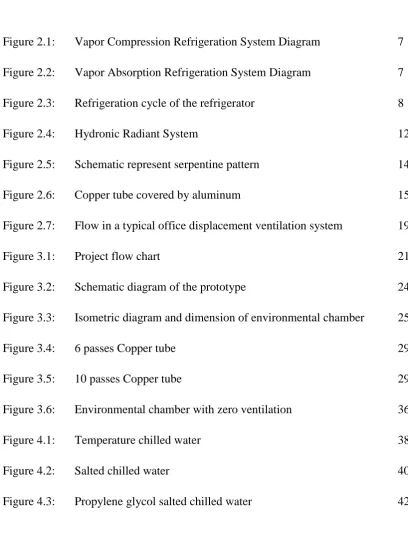
58LIST OF FIGURES
Figure 2.1: Vapor Compression Refrigeration System Diagram 7
Figure 2.2: Vapor Absorption Refrigeration System Diagram 7
Figure 2.3: Refrigeration cycle of the refrigerator 8
Figure 2.4: Hydronic Radiant System 12
Figure 2.5: Schematic represent serpentine pattern 14
Figure 2.6: Copper tube covered by aluminum 15
Figure 2.7: Flow in a typical office displacement ventilation system 19
Figure 3.1: Project flow chart 21
Figure 3.2: Schematic diagram of the prototype 24
Figure 3.3: Isometric diagram and dimension of environmental chamber 25
Figure 3.4: 6 passes Copper tube 29
Figure 3.5: 10 passes Copper tube 29
Figure 3.6: Environmental chamber with zero ventilation 36
[image:14.595.111.520.227.777.2]Figure 4.1: Temperature chilled water 38
Figure 4.2: Salted chilled water 40
Figure 4.4: Propylene glycol chilled water 44
Figure 4.5: 6 passes copper tube temperature 47
Figure 4.6: 10 passes copper tube temperature 50
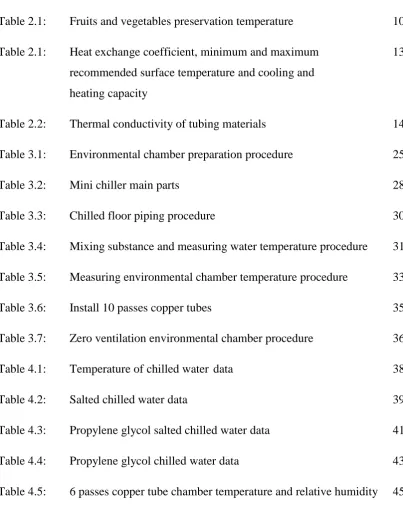
LIST OF TABLE
Table 2.1: Fruits and vegetables preservation temperature 10
Table 2.1: Heat exchange coefficient, minimum and maximum 13 recommended surface temperature and cooling and
heating capacity
Table 2.2: Thermal conductivity of tubing materials 14
Table 3.1: Environmental chamber preparation procedure 25
Table 3.2: Mini chiller main parts 28
Table 3.3: Chilled floor piping procedure 30
Table 3.4: Mixing substance and measuring water temperature procedure 31
Table 3.5: Measuring environmental chamber temperature procedure 33
Table 3.6: Install 10 passes copper tubes 35
Table 3.7: Zero ventilation environmental chamber procedure 36
Table 4.1: Temperature of chilled water data 38
Table 4.2: Salted chilled water data 39
Table 4.3: Propylene glycol salted chilled water data 41
Table 4.4: Propylene glycol chilled water data 43
Table 4.6: 6 passes copper tube temperature data 46
Table 4.7: 10 passes copper tube chamber temperature and relative humidity 48
Table 4.8: 10 passes copper tube temperature data 48
Table 4.9: 10 passes copper tube with zero ventilation chamber 51 temperatures and RH
Table 4.10: 10 passes copper tube and zero ventilation temperature data 52
LIST OF ABBREVIATIONS, SYMBOLS AND
NOMENCLATURE
- Heat transfer by convection (W/m 2)
- Convective coefficient (W/m 2 K)
- Room air temperature (°C)
- Surface temperature (°C)
- Heat transfer by radiation (W/m 2)
, - Stephan-Bolzmann constant (W/m 2 K 4)
- Mean radiant temperature of an unconditioned surface (K)
- Mean radiant temperature of a cooled surface (K)
- Configuration factor (-)
- Emissivity factor (-)
In this chapter, introduction of the most important topics that involve background, problems statement, objectives, scope of the project are provided and the thesis organization of overall chapters is provided within the chapter as well.
1.1 Project Background
Air-conditioning is the process of treating the temperature, relative humidity, cleanliness and distribution of air to the conditioned space. Many years ago, some ancient architectural already practiced cooling techniques for controlling building temperature to local climate condition such as high thermal wall, high room ceilings and shading. The primary modern air-conditioning system was developed in 1902 by a young electrical engineer named Willis Carrier.
Now a day’s use of conventional air conditioning becomes very important,it has been used in many aspects of the life over the world such as for residential, industrial and commercial. The main purpose of this system is to provide thermal comfort and improving indoor air quality (IAQ) for occupants. Significantly, the application of air-conditioning in daily live allows people to feel comfortable especially in Malaysia that is known as a hot and humid zone due to achievement the thermal comfort for human body, via lowering the occupied zoned temperature by commonly vapour compression system.
Normally, people are spending 90% of their days indoors (inside the office or house). That shows the acceptable and appropriate temperature is very important for occupants to get better thermal comfort. Ventilation is also improves indoor air quality. Although air conditioning is very convenient, some limitations are associated, such as high utility bills cause of using a compressor, the refrigerant also contains chemicals cause to damage the environment and ozone layer, the air circulation can transmit infectious bacteria and allergic reactions cause by airborne dust and fungi that only circulating inside the zone, too long spent time in conditioned space will result skin drought cause by humidity decreases, and the temperature provided is only for human comfort does not suitable for preserving fresh food.
In point of fact, a practical system that creates a more comfortable thermal environment than conventional all-air systems with low energy consumption would
be built in the line with current modern technology. An alternative system names a Hydronic radiant cooling (HRC) system which is using water as the transport medium becomes one of the significant solutions since it is able to reduce the amount of air distribute through the buildings, as 100% ventilation is provided by outside air system without recirculating air fraction. HRC is divided into 3 types, which are chilled ceiling, chilled wall and chilled floor system. Unlike the conventional air conditioning, Hydronic Radiant Cooling (HRC) system does not us a vapour compression cycle that consume 70% of the total electrical consumption in the world, as using water to replace refrigerant gas as a cooling medium that is unlimited source, cheap and also environmental friendly. The natural cooling provided by HRC is more acceptable range for thermal comfort.
examine to be forced in order to raise an extended the height of cooling zone by using either exhaust or supply fan. In order to control the humidity and dry air temperature, Silica Gel material is placed at the entrance of the environmental chamber where the air inlet is supplied. Therefore, the experimental work is carried out to confirm the suitability of this application in Malaysia.
1.2 Problem Statement
Based on the limitation of the conventional air conditioning stated above such as high utility bills and damage environment, there are several alternative ways has been proposed, and one of the ideas is replace the conventional air conditioning system with HRC system. In this project, the major idea is to design of the floor chilled system to provide certain cooling for preserving some fresh fruits and flowers with extend distance for cooling from the floor is a challenge in case of using chilled floor system with appropriate number of tubes and ventilation.
1.3 Project Objective
In order to say the project is successful done, the objectives have been declared, and must be achieved in completing the project. The most important objectives of the current project are
to:-1. Consider the possibility of accepting chilled floor system as an alternative cooling system for Malaysia.
1.4 Project Scope
In this project, the area of consideration is environmental chamber. Temperature and relative humidity will be measured inside the environmental chamber. Temperature will be measured and recorded in several positions or height to achieve human thermal comfort temperature based on the ASHRAE guideline recommended which is 23°C to 26°C for room temperature (TR) and 30% to 60% for relative humidity (RH) by varying the number of the cooper tubes, varying the configuration of air inlet and air outlet to achieve appropriate extend distance. The fabrication of the prototype made of plywood as the environmental chamber. The silica gel is place at the air entrance inside of the environmental chamber. For the chilled floor panel, the copper tube is covered with Aluminium sheet during this experiment to increase cooling capacity. Water temperature in the mini chiller will be considered by mixing the water with ice and glycol.
1.5 Thesis Outline
The review in this chapter focuses on a specific survey related to brief introduction, conventional air-conditioning system, refrigerator and preserving process, hydronic radiant cooling system, thermal comfort, and ventilation. Additionally, the current study intends to investigate the possibility of using the HRC system in Malaysia.
2.1 Introduction
Hydronic Radiant Cooling (HRC) system is a new system compared to the conventional air conditioning due to HRC system does not rely on the vapor compression cycle to generate cooling effect (Lawrence Berkeley, 2004). Nowadays it can be said there are three major types of HRC system commonly used for cooling purpose such as chilled radiant ceiling, chilled radiant floor and chilled radiant wall systems. Malaysia is classified as a hot-humid zone due to the location, that is encourages us to investigate an alternative cooling system (ANSI/ASHRAE/IESNA Standard 90.1-2007). The theories and findings associated with the previous studies are reviewed and described to gain the highlight knowledge associated with the proposed current study.
2.2 Conventional Air-Conditioning System