ISSN: www.jatit.org E-ISSN:
A TDMA-BASED SMART CLUSTERING TECHNIQUE
FOR VANETS
1Mr. J.JAYAVEL, 2Dr. R.VENKATESAN, 3Mr. S. PONMUDI
1
Teaching Assistant, Department of IT, Anna University Regional Centre Coimbatore
2
Professor and Head, Department of CSE, P.S.G College of Technology, Peelamedu, Coimbatore
3
Student, Department of IT, Anna University Regional Centre Coimbatore
E-mail: [email protected] , 2 [email protected] , [email protected]
ABSTRACT
A vehicle’s on-road time since the last pit stop has to be taken into account while forming clusters using Vehicular Ad-hoc Networks (VANET). This is important so as to keep the vehicles at optimum driving conditions and to provide rest to the driver at regular intervals. To the best of our knowledge, no clustering scheme has considered this important practical issue while designing a routing protocol for VANET. In this paper, we present a dynamic and stable cluster-based MAC protocol with a more realistic selection metric that includes the vehicle's on-road time and position messages like relative speed, direction and connectivity among neighboring vehicles while giving priority to vehicles joining a cluster. Our proposed Travel Time Based Clustering Approach (TTCA) is based on a TDMA-based MAC scheme and has been simulated using OMNET++ and SUMO. The results express a significant improvement in terms of cluster stability and throughput against existing approaches.
Keywords: Vehicular Ad hoc networks, Cluster, TDMA, OMNET++, SUMO
1. INTRODUCTION
Among the various application areas of Mobile Ad hoc Networks (MANET), Vehicular Ad hoc Networks (VANET) looks as the most promising area to be actively implemented in the near future. VANET has caught the attention of the academic community, government and the auto industry and is well positioned to play a major role in the realization of Intelligent Transport Systems (ITS) [1]. ITS have two main functionalities, namely to increase road safety and increase commercial purposes. Road safety can be increased by letting vehicular users to communicate among themselves about road conditions. This communication is further classified into critical messages like accidents or landslides and non critical information like parking lot information and road congestion notification. Since a car user may spend up to two hours a day while travelling, ITS can be made to provide infotainment services like email, newscasts and access to social networking media. Towards these ends, VANET enables the possibility of Vehicle-to-Vehicle (V2V) as well as Vehicle-to-Infrastructure (V2I) communications
through a Dedicated Short Range Communication (DSRC) spectrum.
ISSN: www.jatit.org E-ISSN:
Figure 1: Division of time into CCH intervals and SCH intervals, IEEE 1609.4 standard
All these applications that are used for safety purposes in a vehicular environment must be designed with stringent reliability and delay considerations. Safety messages are based on broadcast transmission and the existing IEEE 1609.4 trial standard for WAVE [5] allows a single DSRC radio [6] for both safety and non-safety applications. Figure 1 shows the division of time into control channels(CCH) and service channels(SCH) along with a guard interval of 4 msec. In the US, the Federal Communications Centre (FCC) allocated 75 MHz of spectrum for dedicated short-range vehicular communications. In the UK and across the EU, 30 MHz of spectrum has been set aside for vehicular networks. However, it has been found in [7] that at high traffic densities, DSRC based up onCarrier Sense Multiple Access with Collision Avoidance(CSMA/CA) mechanism cannot provide high reliability. An alternative mechanism in such scenarios would be to opt for a more reliable TDMA scheme.
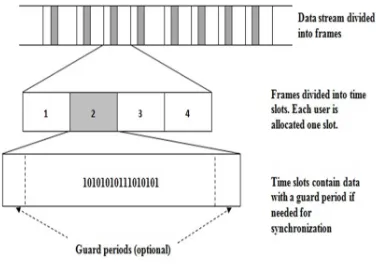
Time Division Multiple Access (TDMA) is a channel access mechanism where the available bandwidth is slotted into time divisions and each division is used only by a single sender, thereby avoiding packet collisions. However, TDMA need modifications to be used in ad-hoc networks due to the lack of centralized control and high slot allocation complexity. Conflict-free scheduling mechanisms need to be introduced to ensure slot synchronization and to reduce overhead messages [8]. Clustering is a natural phenomenon that has been found to occur in highways as vehicle exhibit platoon behavior and tend to travel in groups. Researchers have tried to address the challenges faced by TDMA using various clustering algorithms. We have adopted the dynamic TDMA slot reservation technique followed in TC-MAC[9] where the transmission time is partitioned into consecutive non-overlapping TDMA frames as shown in Figure 2. The SCH and CCH are divided into k equal sized time slots for transferring control and status messages. Each vehicle is assigned a local-id and are said to be aligned. The basic idea is that in each logical frame a vehicle listens to its assigned time slot for status and control messages and sets the corresponding byte in. The number of vehicles (N) may change dynamically and the ClusterHead(CH) is responsible for updating the value of N and is responsible for informing all the vehicles in the cluster about the new value. Cluster stability is an important criterion by which the performance of a clustering algorithm can be
[image:2.595.313.501.236.368.2]measured. Stability has been found to dramatically improve the performance of communication layers by allowing for spatial reuse of resources, simplifying routing and prolonging the link life-time between nodes. In this paper, cluster stability is improved by focusing on carefully selecting the nodes based on a weightage scheme at the time of cluster formation.
Figure 1: TDMA Time Slot Format
The objective of this paper is to improve cluster stability by proposing a novel TDMA based clustering mechanism based on a vehicle’s on-road time and other positional parameters such as network connectivity, inter-vehicular distance and average relative speed of the candidate node and its cluster members. We have compared the new scheme with the existing Stability Based Clustering Algorithm SBCA [21] clustering algorithm designed for stable clusters. The rest of this paper is organized as follows; In Section II, we present the related works. Section III describes in detail about our proposed approach. Section IV provides the simulation setup, Section V presents the results and its analysis, and in section VI, we present the conclusion and future work that can be done.
2. RELATED WORK
ISSN: www.jatit.org E-ISSN: to reduce the overhead introduced during the
election of a CH and maintaining node membership in a highly dynamic and fast changing topology such as in VANET. Almalag et al. [16], have selected a cluster-head among the cluster members based on the lane where most of the traffic flows. Each vehicle is capable of computing its ClusterHeadLevel(CHL) based on its network connectivity level, average velocity level and average distance level. Lane weight is determined based in the total number of lanes on the roadway and the number of lanes for each traffic flow.
In [17], the authors proposed a node precedence algorithm and adaptively identify the 1-hop neighbors and selects optimal CHs based on relative node mobility metrics such as speed, location and direction of travel. It also introduces the zone of interest concept that reflects the frequent changes on the network and provides prior knowledge about the neighbors as they travel into new neighborhood locations.
In [18], the authors have proposed a distributed and mobility aware Cluster based MAC protocol that integrates OFDMA with the contention-based DCF algorithm in IEEE 802.11p. It can also predict the future speed and position of all cluster members. This feature helps a ClusterHead (CH) to decide on changing the used communication range based on the traffic conditions. Cluster members are elected based on the weighted stabilization factor, which is a function of change in its relative speed and direction.CH has two levels of power. The first power level Pt is used to communicate with cluster
members and the second power level is used to reach a distance of 2R to communicate with its neighboring CH. Also by using the OFDMA technique, the hidden terminal problem has been addressed.
The authors in [19] present a Hierarchical Clustering Algorithm (HCA) that creates a fast randomized hierarchical cluster with a diameter of at most four hops, without the use of GPS. The above algorithm, during the maintenance phase creates hierarchical clusters in which the maximal distance between a CH vehicle and any other vehicle in the cluster is two hops. The algorithm is considered highly robust, because it does not rely on localization systems like GPS, but by inferring connectivity from sent messages.
The authors in [20] have utilized fixed infrastructure like road-side units to gather information from cluster heads and to fill the communication gap that may occur when any data packet is lost. The RSU units are given the role of selecting the CH according to the environment. The above protocol aims to improve communication between Cluster heads and between neighboring clusters.
The authors in [21] propose a protocol which focuses on reducing the communication overhead by formation and maintenance of clusters. The overall cluster architecture has been based on the idea that the mobile node should be associated with the cluster and not to a cluster head. The protocol has two phases, the cluster setup phase and maintenance phase. In the setup phase, nodes with close proximity to each other are formed into a cluster and during the cluster maintenance stage; a Primary ClusterHead (PCH) and a Secondary ClusterHead(SCH) are selected. Whenever the PCH leaves the cluster, the SCH takes over. This arrangement greatly increases the cluster life time and reduces the overhead involved in selecting a new cluster.
Hassan et al in [22] have proposed a multichannel MAC scheme that focuses on transmitting high priority messages without delay. The scheme also focuses on addressing the problem related to transmission collisions caused by node mobility. It reduces the collision probability by assigning disjoint sets of time slots to vehicle moving in opposite directions and to road side units. This technique helps each node to access the control channel once per frame, thus providing them an opportunity to transmit high priority messages without delay. One drawback of the scheme is that the parameter for decreasing merging and access collision rates needs to be calculated theoretically and needs to be tested under realistic mobility models.
ISSN: www.jatit.org E-ISSN: demerits. All the above approaches tend to focus on
just the positional information of vehicles and do not take into consideration the temporal aspects of clustering. In our proposed protocol, we take this often neglected aspect in allowing a vehicle to become a cluster member as well as to function as a CH for longer periods of time. Our proposed protocol has been found to increase cluster stability compared to the existing TDMA based approaches.
3. OUR APPROACH
3.1 Key Assumptions
We clarify on the assumptions that we have made for each vehicle travelling independently or with a group of vehicles. Each vehicle has its unique identifier and is equipped with a Global Positioning System (GPS) or Differential Global Position System (DGPS) receiver to obtain its geographical position and to ensure that vehicles have synchronized clocks. A digital map is provided to recognize which lane it is in. Each vehicle is fitted with a wireless transceiver for directly communicating with nodes that are within its communication range and indirectly (i.e. through inter-mediate nodes) with nodes that are not within its communication range. As recommended by DSRC, the transmission range of safety related vehicle-to-vehicle messages is assumed to be 300 meters, and channel contention is resolved using a TDMA based slot allocation mechanism as proposed in [9]. The clustering scheme we are using in our proposed protocol is clusterhead (CH) based, where the cluster decisions is dictated by the CH. Our protocol is based on the multi-channel DSRC layout, with 1 CCH and 6 SCHs.We have considered a highway scenario in the design of our proposed approach. As per [10], ‘daily time’ refers to the total driving time accumulated between the end of one daily rest period and the beginning of the following daily rest period or between a daily rest period and a weekly rest period. The maximum allowable daily driving time for a vehicle is fixed to nine hours. Thus a vehicle’s on-road time needs to be continuously monitored and is achieved by means of a digital tachograph attached to a vehicle’s on-board sensor. In 2006, EU has made digital tachograph to be fitted into vehicles as mandatory for monitoring driving times and rest periods.
In our proposed Travel Time based Clustering Approach (TTCA), a weight-based node election system has been developed for allowing a vehicle to be part of a cluster and also to be elected as a CH. This approach is similar to that of the Utility
Function [24] and TC-MAC [9], but with a different set of parameters. We have considered the effect of a vehicle’s continuous travel time, network connectivity, average inter-vehicular distance, and average velocity for calculating node weight Nw based on which a stable cluster is
formed. The higher the value of Nw, the better is the
probability for a node to be selected as a clusterhead as well as to be part of any new cluster. The node weight is defined as
Nw = (NCi+ αi + A.S) * ωi (1)
Where,
Nw = Node weight
NCi = Network Connectivity Level of
vehicle i.
αi = Average Intervehicle distance level
between any two vehicles
A.S = Average Speed of vehicles ωi = Travel time Weightage for vehicle i.
3.2 Continuous Travel Time:
The main aspect of our approach is to give a weightage level for the continuous time travelled by a vehicle, since the last pit stop. The weightage level
ω
i is set at the upper limit when the vehicle begins its journey and is inversely proportional to the time travelled Τi. Thus the valueof
ω
i reduce as the vehicle travels over a period oftime.
ω
i α
(2)
3.3 Network Connectivity Value
The network connectivity value Nc refers to the maximum number of vehicles that are within the direct communication range of vehicle i and is defined as
Nc
i(t) = ∑
jA(i,j,t)
(3)Where j is a probable neighboring vehicle A(i,j,t) =1 if i and j are connected and is equal to 0, if there is no connection.
Average Intervehicle distance level
∑ ౠ
మ
ౠమ ౠ
ISSN: www.jatit.org E-ISSN: Where (x,y) are the coordinates of any two
vehicles and NV is the total number of vehicles that are connected to vehicle i in any lane.
Average Speed:
It refers to the difference between the average speeds of all vehicles in range of clusterheadvehicle i and the potential neighboring vehicle. It is calculated as
Average Speed A. S ∑ (5)
where j is a potential neighboring vehicle and i is clusterheadvehicle.
4. SIMULATION SETUP
We have chosen OMNET++/INET [25] as the wireless network simulator since that it implements the IEEE 802.11p standard at both the physical and the MAC layers. We have used the SUMO traffic simulator [26], [27], which is a C++-based open-source space continuous microscopic simulator for vehicular traffic. We use TRACI interface [28] to connect the discrete-event simulator OMNET++/INET with the continuous simulator SUMO. TRACI uses a client/server architecture, where SUMO is configured as a server and OMNET++is configured as a client. The client sends request commands to SUMO to perform the simulation run or for accessing environmental details. SUMO responds with a status response to each command and a traffic trace is generated after each action. Both the requests to the SUMO and the traffic traces from SUMO are transported using TCP/IP written in INET. The TCP segment consists of a small header that gives the overall message size and a set of commands or traffic traces contained in the segment. Each vehicle in SUMO is mapped to a mobile node in OMNET++. We have extended OMNET++ with a module that allows us to define the specification of a single vehicle node which is created in SUMO. However, the calculation for node’s travel time and deleting it once it reaches a threshold is performed in OMNET++. SUMO executes in discrete time steps, and the trace generated by SUMO is parsed by a manager module in OMNET++. The manager module then monitors the traffic trace to the nodes. The length of the road is set to 10kms. We
have tested our scheme in a highway scenario with only sedan type of vehicle in our simulation. The clusterhead that is selected is mainly positioned in the middle of the cluster so that the number of links it maintains with its neighbors is high. It essentially continues moving in the same direction as the majority of the traffic flow.
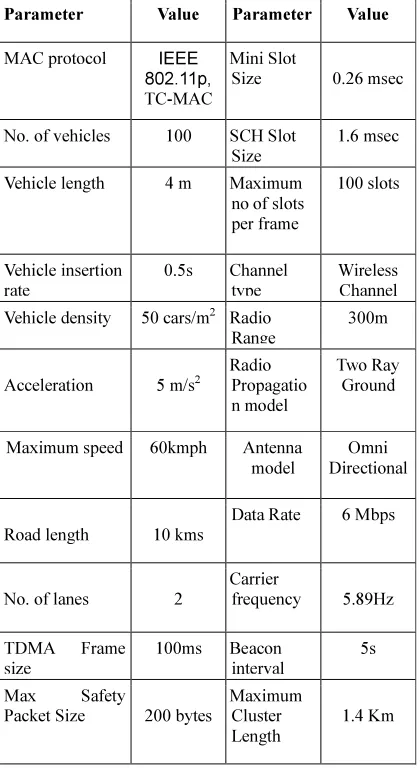
[image:5.595.303.513.339.725.2]Each simulation ran for 9 hours, however only the last 6 hours were used for performance metric calculations. This was to ensure that sufficient numbers of vehicles are injected into the scenario and clusters are formed with minimum of 30vehicles per km and has an elected cluster head before measuring its performance. Table I shows the simulation parameters that were used to compare the two approaches.
Table 1: Simulation Parameters.
Parameter Value Parameter Value
MAC protocol IEEE 802.11p, TC-MAC
Mini Slot
Size 0.26 msec
No. of vehicles 100 SCH Slot Size
1.6 msec
Vehicle length 4 m Maximum no of slots per frame
100 slots
Vehicle insertion rate
0.5s Channel type
Wireless Channel Vehicle density 50 cars/m2 Radio
Range
300m
Acceleration 5 m/s2
Radio Propagatio n model
Two Ray Ground
Maximum speed 60kmph Antenna model
Omni Directional
Road length 10 kms
Data Rate 6 Mbps
No. of lanes 2
Carrier
frequency 5.89Hz
TDMA Frame size
100ms Beacon interval
5s
Max Safety
Packet Size 200 bytes
Maximum Cluster Length
ISSN: www.jatit.org E-ISSN: Max Non-Safety
Packet Size 1200 bytes Inter vehicular spacing
10m
5. RESULTS
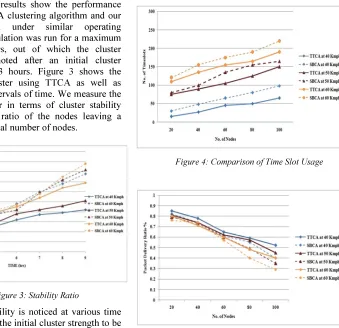
[image:6.595.82.521.68.583.2]The simulation results show the performance of the existing SBCA clustering algorithm and our proposed approach under similar operating conditions. The simulation was run for a maximum duration of 9 hours, out of which the cluster performance was noted after an initial cluster formation time of 3 hours. Figure 3 shows the stability of the cluster using TTCA as well as SBCA at various intervals of time. We measure the stability of a cluster in terms of cluster stability ratio, which is the ratio of the nodes leaving a cluster and the original number of nodes.
Figure 3: Stability Ratio
The cluster stability is noticed at various time intervals by keeping the initial cluster strength to be constant at 30 nodes and at different average cluster speeds of 40kmph, 50kmph and 60kmph. We have identified a moving cluster to be either in stable region (stability ratio 0.0 to 0.5) or in an unstable region (stability ratio 0.6 to 1.0). Our proposed approach allows a cluster to remain in the stable region for a longer duration than SBCA even at varying travelling speeds. This is because, the nodes of our cluster are selected based on the minimum on-road travel time. This factor allows the nodes following TTCA to remain in a cluster for a longer duration than SBCA. From the simulation result as shown in Figure 4, our TDMA based TTCA scheme consumes fewer time slots than 802.11p based SBCA algorithm. This is because TTCA efficiently utilizes pre-scheduled time slots to transmit data, while the backoff algorithm in 802.11p increases the waiting time,
[image:6.595.170.509.213.541.2]when the number of node increases. In Figure 5, we compare the two techniques based on packet delivery ratio. Results show that compared to SBCA, TTCA has better packet delivery ratio due to less number of packet losses. This is achieved due to better cluster stability.
Figure 4: Comparison of Time Slot Usage
Figure 5: Packet Delivery Ratio
6. CONCLUSION
ISSN: www.jatit.org E-ISSN: inter-cluster communications. A mathematical
model can be formulated to support our simulation results and an algorithm can be developed for a node to join and leave a cluster.
REFRENCES:
[1] Intelligent Transport Systems (ITS); Vehicular Communications; Basic Set of Applications; Definitions, ETSI TR 102 638, V1.1.1, Jun. 2009.
[2] Kandarpa R 2009 Final Report: Vehicle Infrastructure Integration (VII) Proof of Concept (POC) Test – Executive Summary. [3] Shladover S, Desoer C, Hedrick J, Tomizuka M,
Walrand J, Zhang WB, McMahon D, Peng H, Sheikholeslam S and McKeown N “Automated vehicle control developments in the PATH program.”, IEEE Transactions on Vehicular Technology 40(1), 114–130. 1991
[4] X.Yang, "A Vehicle-to-Vehicle Communication Protocol for Cooperative Collision Warning", MOBIQUITOUS 2004, pp.114 -123 2004
[5] IEEE 802.11P/D5.0, “Draft Amendment for Wireless Access in Vehicular Environments (WAVE)”, 2008
[6] Bilstrup, K.S, Uhlemann, E; Strom, E. G, “Scalability Issues of the MAC Methods STDMA and CSMA of IEEE 802.11p When Used in VANETs”, 2010 IEEE International Conference on Communications Workshops, 2010, pp. 1 – 5
[7] Zhe Wang and Mahbub Hassan, "How Much of DSRC is Available for Non-Safety Use?" 5th ACM International Workshop on Vehicular Internetworking (VANET'08 in conjunction with ACM MOBICOM'08), San Francisco, 15 September 2008.
[8] Theodoros Salonidis, Leandros Tassiulas, “Asynchronous TDMA adhoc networks: Scheduling and Performance” In: Proceedings of European Transactions in Telecommunications (ETT), 2004.
[9] Almalag, M.S.; Olariu, S.; Weigle, M.C., "TDMA cluster-based MAC for VANETs (TC-MAC)," World of Wireless, Mobile and Multimedia Networks (WoWMoM), 2012 IEEE International Symposium on a , vol., no., pp.1,6, 25-28 June 2012 doi:10.1109/WoWMoM.2012. 6263796
[10] Regulation (Ec) No 561/2006 Of The European Parliament And Of The Councilof 15 March 2006
[11] Y. Gunter, B. Wiegel, and H. P. Grossmann, “Medium access concept for VANETs based on clustering,” in Proc. 2007 IEEE Vehicular Technology Conference, pp. 2189–2193. [12] P. Fan, P. Sistla, and P. Nelson, “Theoretical
analysis of a directional stability-based clustering algorithm for VANETs,” 2008 ACM International Workshop on Vehicular Ad Hoc Networks, pp. 80–81.
[13] H. Su and X. Zhang, “Clustering-based multichannel MAC protocols for QoSprovisionings over vehicular ad hoc networks,” IEEE Trans. Veh. Technol., vol. 56, no. 6, pp. 3309–3323, Nov. 2007.
[14] L. Bononi and M. Di Felice, “DBA-MAC: dynamic backbone-assisted medium access control protocol for efficient broadcast in VANETs,” J.Interconnection Networks, vol. 10, no. 4, pp. 321–344, Oct. 2009.
[15] R. Aquino-Santos, V. Rangel-Licea, M. A. Garcia-Ruiz, A. Gonzalez- Potes, O. Alvarez-Cardenas, A. Edwards, M. G. Mayoral-Baldivia, and S. Sandoval-Carrillo, “Inter-vehicular communications using wireless ad hoc networks,” a book chapter in Automotive Informatics and Communicative Systems: Principles in Vehicular Networks and Data Exchange. IGI Global, May 2009.
[16] Almalag, M.S.; Olariu, S.; Weigle, M.C., "TDMA cluster-based MAC for VANETs (TC-MAC)," World of Wireless, Mobile and Multimedia Networks (WoWMoM), 2012 IEEE International Symposium on a , vol., no., pp.1,6, 25-28 June 2012
[17] R. T. Goonewardene , F. H. Ali and E. Stipidis "Robust mobility adaptive clustering scheme with support for geographic routing for vehicular ad hoc networks", IET Intell. Transp. Syst., vol. 3, no. 2, pp.148 -158 2009
[18] Hafeez, K.A.; Lian Zhao; Zaiyi Liao; Ma, B.N., "A novel medium access control (MAC) protocol for VANETs," Communications and Networking in China (CHINACOM), 2011 6th International ICST Conference on , vol., no., pp.685,690, 17-19 Aug. 2011
ISSN: www.jatit.org E-ISSN: [20] Lin Sun; Ying Wu; JingdongXu; YuweiXu, "An
RSU-assisted Cluster Head Selection and Backup Protocol," Advanced Information Networking and Applications Workshops (WAINA), 2012 26th International Conference on , vol., no., pp.581,587, 26-29 March 2012 [21] Ahizoune, A.; Hafid, A., "A new stability based
clustering algorithm (SBCA) for VANETs," Local Computer Networks Workshops (LCN Workshops), 2012 IEEE 37th Conference on , vol., no., pp.843,847, 22-25 Oct. 2012
[22] Omar, H.A.; Weihua Zhuang; Li Li, "VeMAC: A novel multichannel MAC protocol for vehicular ad hoc networks," Computer Communications Workshops (INFOCOM WKSHPS), 2011 IEEE Conference on , vol., no., pp.413,418, 10-15 April 2011
[23] Shea, C.; Hassanabadi, Behnam; Valaee, S., "Mobility-Based Clustering in VANETs Using Affinity Propagation," Global Telecommunications Conference, 2009. GLOBECOM 2009.IEEE , vol., no., pp.1,6, Nov. 30 2009-Dec. 4 2009
[24] P. Fan, J. G. Haran, J. F. Dillenburg, and P. C. Nelson. Cluster-basedframework in vehicular ad-hoc networks. In ADHOC-NOW, pages 32– 42, 2005.
[25] The wireless simulation framework. [Online]. Available: http://www.omnetpp.org/
[26] The vehicular traffic simulator. [Online]. Available: http://sumo.sourceforge.net/
[27] The German Aerospace Research Laboratory. [Online]. Available: www.dlr.de/en/