INVESTIGATING BIOGEOGRAPHY-BASED OPTIMISATION
FOR PATIENT ADMISSION SCHEDULING PROBLEMS
1ABDELAZIZ I. HAMMOURI, 2BASEM ALRIFAI
1Data Mining and Optimisation Research Group, Centre for Artificial Intelligence Technology,
Universiti Kebangsaan Malaysia, 43600 Bangi, Selangor, Malaysia
1Department of Computer Information System, Al-Balqa Applied University, 19117, Al-Salt, Jordan
2Department of Software Engineering, Al-Balqa Applied University, 19117, Al-Salt, Jordan
E-mail: [email protected], [email protected]
ABSTRACT
This paper derives its work from an interest in the development of an automated approach to tackle highly constrained patient admission scheduling problems (PASP). It is concerned with an assignment of patients to bed in an appropriate department in such a way it can maximise medical treatment effectiveness and patients’ comfort. In this paper too, we have investigate a newly created meta-heuristic optimisation algorithm, called Biogeography Based Optimization (BBO) based on the idea of migration of species between different habitats. To evaluate the performance of the proposed method, six instances of PASP data sets were used. The performance of the BBO algorithm was compared with other approaches that in the literature. Experimental results show that, the BBO needs more investigation for improving the obtained results.
Keywords: Meta-Heuristic. Evolutionary Algorithms. Biogeography-Based Optimization. Patient Admission scheduling. Healthcare.
1. INTRODUCTION
The central admission unit in health-care organizations is responsible for the process of allocating hospital beds to the patients waiting in the system. This unit is responsible for maximising the resource usage and at the same time minimise the duration of each patient stay [1, 2]. However, there are different types of patients that arrive at the hospital. Some of them are in a critical condition, and may need immediate attention. While adding others to a waiting list until, a suitable and empty bed found. The occupying of beds operation is subjected to some constraints concerning to the medical equipment in the room, the medical skills of the department staff and the patient's room preference [3]. Thus making the task of assigning patients to bed very difficult and in need of a good knowledge and experience [4], otherwise it will lead to inefficiencies of the social benefits and/or monetary gains.
Numerous meta-heuristics approaches have been applied to solve PAS problems. The complexity of the PAS problem and the need for an optimisation algorithm to assistance the admission scheduler in making fast decisions motivate researches for tackling this problem. Moreover, Vancroonenburg categorised the problem as NP complete [5], which means that it cannot be solved in polynomial time.
Consequently, an alternative algorithm (i.e., the BBO algorithm in this paper) is investigated for tackling the PAS problem. BBO is a newly created population based meta-heuristic algorithm, based on the idea of the migration of species between different islands. To our knowledge, this is the first time where the application of BBO to the patient admission problem is attempted. The BBO is an attractive algorithm because of its low dependence on parameter tuning as well as BBO has features in common with other biology-based optimization methods, such as GA[6, 7] and PSO[8, 9]. This makes BBO applicable to many of the same types of problems that GA and PSO are used for, namely, high-dimension problems with multiple local optima [10]. On the other hand, BBO have some unique features. First, as it have been noted previously mentioned, BBO is a population-based heuristic algorithm, BBO does not involve in reproducing or regenerating of the population not like the reproduction strategies in GA. BBO differs from ACO [11], ACO generates a new set of solutions with each iteration. While BBO maintains its own population from the first iteration to the last one, relying on migration operation to gradually adapt population.
the patient admission-scheduling problem. Section III presents the description of the basic BBO, while Section IV presents the proposed method. Section V describes the experimental results obtained, and followed next by concluding remarks in Section VI.
2. PATIENT ADMISSION SCHEDULING
Patient admission scheduling problems deal with an assignment of patients to bed in an appropriate room/department in such a way it can maximise medical treatment effectiveness and patients’ comfort [3]. The problem consists of set of hard and soft constraints. The feasible solution achieved once all the hard constraints are satisfied, and the soft constraints are minimised as much as possible by the objective function. The set of hard and soft constraints imposed to this problem are listed as below [3]:
• Hard constraints
i. A maximum number of one patient per bed for
each time slot (night).
ii. The number of patient must not exceed the
room capacity for each night.
iii. The admission and discharge dates are fixed.
iv. The length-of-stay for each patient must be
contiguous.
v. For each time slot (night) during the
length-of-stay of a patient, s/he must be assigned to a bed.
• Soft constraints
i. The number of room transfers should be
minimised, where the room transfer is moving a patient from one room to another during his/her length of stay (we will tackle/deal with this constraint as a hard constraint).
ii. Patients in the same room-time slot should
have the same gender unless the room characteristics allow for mixing genders. The room genders are Male (M), Female (F), Mix (M) or Depend (D) on the first patient that enters the room at each night.
iii. The department should be suitable for the
patient’s age.
iv. The specialism of the department should
satisfy the specialism of the patient hosted in any room of this department.
v. The specialism of the room should satisfy the
specialism of the patient assigned to it.
vi. The room should have the mandatory
requirements of the patient pathology assigned to it.
vii. The room preferred should have the preferred
requirements of the patient pathology assigned to it.
viii. The room preference of the patient should be
satisfied.
To increase the complexity of the problem, we changed the first soft constraint to be an additional hard constraint. In this case the problem is treated as in [12, 13]. It makes the search space smaller. However, [14-17] maintained the hard and soft constraints as in the original problem.
In this research, we used the original published dataset [17] which consists of 6 instances. The mathematical formulations for PASP and the features of the datasets can be found in [17]. Note that, the patients that have the same admission and discharge date and the patients admitted after the planning horizon are not included in this problem.
3. BIOGEOGRAPHY-BASED OPTIMISATION
Biogeography is natural method in distribution species, where different geographical areas are consider as good habitat if they have high "Habitat Suitability Indexes" (HSI). These areas are characterised by number of independent variables (features) like temperature, rainfall, diversity of topographic features and diversity of vegetation, known as "Suitability Index Variables" (SIVs). The habitat suitability index (HSI) meanwhile is a dependent variable.
BBO was first introduced by Simon [10] in which species move from one island to another looking for a good habitat. In BBO, the habitat suitability index (HSI) shows the degree of its goodness of the solutions; where the high HSI habitat represents a good solution, and the low HSI habitat, represent a poor solution. Poor solutions accept many changes by inheriting the good features from good solutions. This operation known as migration operation can improves the quality of the poor solution as much as possible. In addition, BBO has other operation known as the mutation operation that can modify one or more solution feature(s) randomly based on the pre-calculated probability value, increasing the diversity between the solutions in the population.
on 14 benchmark functions. The comparisons with other algorithms have shown an outstanding performance of BBO over the other algorithms in both experiments (real life problem and benchmark functions). Other applications of BBO can be found in as sensor selection [10], scheduling problem [18, 19], data clustering [20], image segmentation [21, 22], satellite image classification [23], feature extraction [24], optimal meter placement [25], ground water detection [26], parameter estimation [27] and power system optimisation [28-30]. To our knowledge, this will be the first time that BBO algorithm used on the patient admission-scheduling problem.
4. PROPOSED METHOD
Our proposed method starts with the feasible “initial solutions”, and then having those solutions improved by BBO algorithm. The initial solutions generated are as follow: randomly assigning the patients to the available beds, and then adding or removing operators until a feasible solution found. The details of the proposed method are as presented and outlined in the next subsections.
4.1. Solution representation
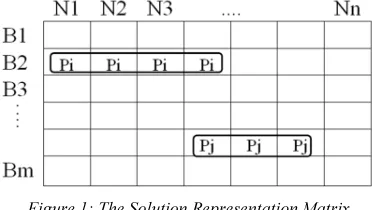
[image:3.595.94.283.567.672.2]The solution is represented as a two dimensional matrix where the number of columns is equal to the planning horizon, and the number of rows is equal to the number of beds in all departments (as shown in Figure 1). The rows represent the beds and the columns represent the nights. The entries of the matrix represent the patient ID. This representation helps in not violating two of the five hard constraints i.e., (i) maximum one patient per bedtime slot (HD1), and (ii) the number of patients per night in the room cannot exceed its capacity (HD2).
Figure 1: The Solution Representation Matrix.
4.2. Neighbourhood Structure
In this work, we use three neighbourhood structures as follows:
• Nbs1 (move): move one patient is selected at
random and move to a new bed randomly,
• Nbs2 (swap): choose two patients and swap
the beds, and
• Nbs3 (swap and move): as in Nbs2, but if the
suitable length of stay cannot be found from the swap operation, patient will then moved to other new random bed.
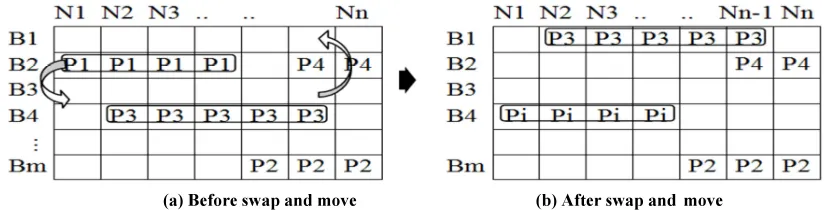
Note that, the neighbourhood structures are applied during the mutation operation and repair mechanism. The details of each neighbourhood structures are as follows:
Nbs1: Move operation
Assume that we want to move patient P1 from bed B2 to a new bed select at random. In this case, move the patient P1 with 4 nights stay to a new bed that can cover all stays (B3 in this example). If bed B3 already has occupied patient, then release the patient in B3 and move P1 to B3. Later, find a new bed for the patient that earlier bedded in B3. Figure 2 illustrates the previous example.
Nbs2: Swap operation
Two patients are selected at random (assume P2 and P3), and the stay period of the two patients must have at least one intersection. Swap the beds accordingly i.e., P2 (from the last bed Bm) is moved to bed B4, and P3 from B4 is moved to the last bed. Figure 3 illustrates the previous example.
Nbs3: Swap and move operations
Two patients are selected at random (assume P1 and P3) and swap the beds. In this case, P1 is now in B4, but P3 cannot be in B2 because it will violate the hard constraint (i.e., two patients in one bed) where P3 and P4 will be together in B2 at night Nn-1. Thus, P3 needs to be moved to other available bed at random i.e., B1 in this example, instead of B2 in order to obtain a feasible schedule. Figure 4 illustrates the previous example.
4.3. The algorithm
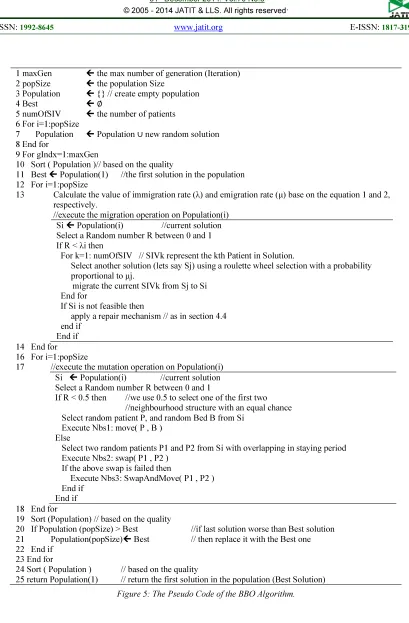
Figure 5 represents the pseudo code of the BBO algorithm. Also shown in Figure 5 is how the algorithm randomly initialises the population. The solutions then sorted in ascending order (With respect to the quality of the solution). After that, the immigration rate (λ) and emigration rate (μ) are calculated based on the following two equations [10]:
λ 1
(1)
μ
(2)
Where n is the population size, and Ki is the rank
and has the lowest rank), I and E are the maximum immigration rate and the maximum emigration rate respectively, where the default value for them is 1 (one). The migration operation then performed in order to improve the quality of the solutions. The migration operation used to migrate solution’s features (SIV) from the good solutions (high HSI) to the poor ones (low HSI). In the case of an unfeasible solution, a repair function will be performed (see Section 4.4) to bring the unfeasible solution back to feasibility. All the solutions in the population will have the mutation operation performed on them, where one of the first two neighbourhood structures (Nbs1 or Nbs2) will be randomly selected for each solution, and if the second neighbourhood structure (Nbs2) failed, then the third neighbourhood structure (Nbs3) is chosen. The population is finally, updated by replacing the worst solution with the best found.
4.4. Repair mechanism
A repair mechanism employed to ensure the feasibility of the solutions after the migration operation, where the migration operation leads in some cases to unfeasibility. The repair mechanism works by reassigning the patients that violate the hard constraints to a new bed that satisfies all the hard constraints. This process is repeated until the feasible solution is found (satisfies all the hard constraints for all patients).
5. EXPERIMENTAL RESULTS
The proposed algorithm was implemented using Java and simulations were performed on Intel® Core™ i3-4130 (CPU 3.4 GHz) PC with 4 GB RAM. We executed the experiments for 10 independent runs. The termination criterion is set as the maximum number of iterations, which is equal to 2000 that caused the running time from 593 to 946 seconds. Note that, in the problem definition, the maximum running time is set to 3000 seconds. Based on our preliminary experiments, our algorithm reached the stagnant state after 200 iterations, which need about 150-250 seconds in most of the cases. Thus, it is of no significance to prolong the search to 3000 seconds. Table I shows the parameter setting for the proposed algorithm, which were determined after some preliminary experiments.
Table I: Parameter Settings of the Proposed Algorithm.
We compare the results that obtained from BBO with other available approaches in the literature as shown in
Table II. The algorithms in comparison are Bilgin
et al. (2008) and Ceschia and Schaerf (2011). Again, the best results are in bold.
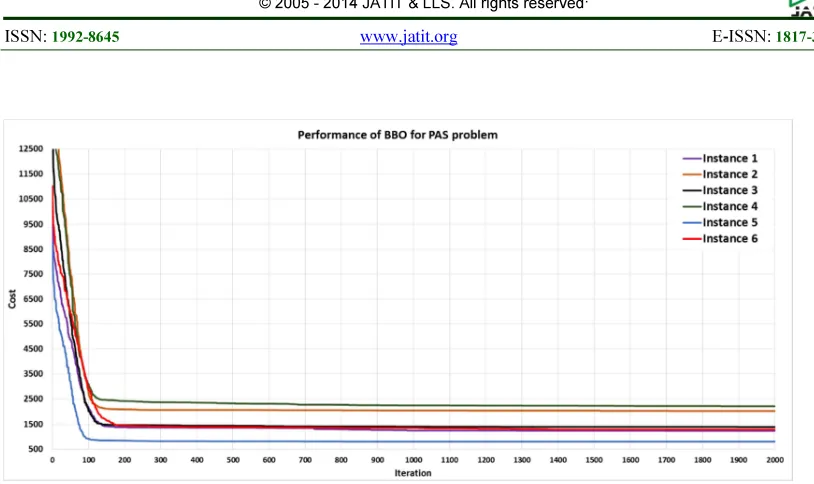
The best results highlighted in bold. We can clearly see that Ceschia and Schaerf (2011) outperformed the other approaches in comparisons. We believed that Ceschia and Schaerf (2011) can achieved better solutions, since their approach allows the flexibility of jumping from unfeasible to feasible regions during the search processes. Our approaches however, only deal with feasible solution that limits the search in search space. Figure 6 shows the performance of the BBO for each datasets, as show in this figure, BBO reach to stagnant state at earlier time of the search, since it cannot achieve significant improvements after the first 200 iterations for the six instances of PASP.
6. CONCLUSION AND FUTURE WORK
In this paper, we have presented a search methodology that combines the principle of the
geography theories i.e., Biogeography-based
Optimisation. The performance of the approach
tested on the original dataset of PASP.
Experimental results show that BBO is not able to produce favourable results in comparison with state-of-the-art. The proposed approach shows that it reached to the stagnant state at the early of the search. We believed that BBO needs further
investigations and improvements, such as,
hybridising the BBO with other meta-heuristic algorithms in order to create a balance between the exploration and exploitation capability that offered by BBO. This will be the subject of our future work.
REFRENCES:
[1] J.M.H. Vissers, I.J.B.F. Adan, and N.P.
Dellaert, "Developing a platform for
comparison of hospital admission systems: An
illustration", European Journal of Operational
Research, 180 (2007) 1290-1301.
[2] P. Gemmel and R. Van Dierdonck, "Admission scheduling in acute care hospitals: does the practice fit with the theory?", International
Parameter Value
Population size 50
Journal of Operations & Production
Management, 19 (1999) 863-878.
[3] P. Demeester, M. Misir, B. Bilgin, K. Verbeeck, P. De Causmaecker, and G. Vanden Berghe, "A hyper-heuristic approach to the patient admission scheduling problem", in, 2009, pp. 65-65.
[4] N. Ayvaz and W.T. Huh, "Allocation of hospital capacity to multiple types of patients",
Journal of Revenue & Pricing Management, 9
(2010) 386-398.
[5] W. Vancroonenburg, D. Goossens, and F.C.
Spieksma, "Technical report: On the
complexity of the patient assignment
problem", (2011).
[6] N. Chen, Z. Zhan, J. Zhang, O. Liu, and H. Liu, "A genetic algorithm for the optimization of admission scheduling strategy in hospitals",
in, IEEE, 2010, pp. 1-5.
[7] H. He and Y. Tan, "A two-stage genetic
algorithm for automatic clustering",
Neurocomputing, 81 (2012) 49-59.
[8] B. Alrifai, H. Al-Hiary, and A. I Hammouri, "An Adaptive Color Night Vision Scheme
Tuned Enhanced Particle Swarm
Optimization", International Journal of
Computer Applications, 87 (2014) 9-14.
[9] A.I. Hammouri, B. Alrifai, and H. Al-Hiary, "An Intelligent Watermarking Approach Based Particle Swarm Optimization in
Discrete Wavelet Domain", International
Journal of Computer Science Issues (IJCSI),
10 (2013).
[10] D. Simon, "Biogeography-based
optimization", IEEE Transactions on
Evolutionary Computation, 12 (2008)
702-713.
[11] G. Zhe, L. Dan, A. Baoyu, O. Yangxi, C. Wei, N. Xinxin, and X. Yang, "An Analysis of Ant
Colony Clustering Methods: Models,
Algorithms and Applications", International
Journal of Advancements in Computing
Technology, 3 (2011).
[12] S. Ceschia and A. Schaerf, "Local search and lower bounds for the patient admission
scheduling problem", Computers &
Operations Research, (2011).
[13] S. Ceschia and A. Schaerf, "Multi-neighborhood Local Search for the Patient
Admission Problem", Hybrid Metaheuristics,
(2009) 156-170.
[14] B. Bilgin, P. Demeester, M. Misir, W. Vancroonenburg, and G. Vanden Berghe,
"One hyperheuristic approach to two
timetabling problems in health care", Journal
of Heuristics, (2012).
[15] P. Demeester, W. Souffriau, P. De Causmaecker, and G. Vanden Berghe, "A hybrid tabu search algorithm for automatically
assigning patients to beds", Artificial
Intelligence in Medicine, 48 (2010) 61-70.
[16] P. Demeester, "Patient admission scheduling website",
"http://allserv.kahosl.be/~peter/pas/" viewed
in July 12, 2014, (2009).
[17] B. Bilgin, P. Demeester, and G. Vanden Berghe, "A hyperheuristic approach to the
patient admission scheduling problem",
Techical Report, KaHo Sint-Lieven, Gent,
(2008).
[18] S.H.A. Rahmati and M. Zandieh, "A new
biogeography-based optimization (BBO)
algorithm for the flexible job shop scheduling
problem", The International Journal of
Advanced Manufacturing Technology, (2012)
1-15.
[19] M. Yin and X. Li, "A hybrid bio-geography based optimization for permutation flow shop
scheduling", Scientific Research and Essays, 6
(2011) 2078-2100.
[20] A.I. Hammouri and S. Abdullah,
"Biogeography-Based Optimisation For Data Clustering", in: H. Fujita, A. Selamat, H.
Haron (Eds.) New Trends in Software
Methodologies, Tools and Techniques -
Proceedings of the Thirteenth SoMeT '14, IOS
Press, Langkawi, Malaysia, 2014, pp.
951-963.
[21] A. Chatterjee, P. Siarry, A. Nakib, and R. Blanc, "An improved biogeography based optimization approach for segmentation of human head CT-scan images employing fuzzy
entropy", Engineering Applications of
Artificial Intelligence, (2012).
[22] S. Gupta, K. Bhuchar, and P.S. Sandhu, "Implementing Color Image Segmentation Using Biogeography Based Optimization", in, 2011.
[23] V.K. Panchal, P. Singh, N. Kaur, and H. Kundra, "Biogeography based Satellite Image
Classification", International Journal of
Computer Science and Information Security, 6
(2009) 269-274.
[24] V. Panchal, S. Goel, and M. Bhatnagar, "Biogeography based land cover feature
extraction", in, IEEE, 2009, pp. 1588-1591.
[25] K. Jamuna and K. Swarup, "Biogeography
based optimization for optimal meter
estimation", Swarm and Evolutionary
Computation, (2011).
[26] V. Panchal, H. Kundra, and A. Kaur, "An integrated approach to biogeography based optimization with case based reasoning for retrieving groundwater possibility", (2009). [27] Y. Xu and L. Wang, "An effective hybrid
biogeography-based optimization algorithm for parameter estimation of chaotic systems",
Expert Systems with Applications, (2011).
[28] R. Rarick, D. Simon, F.E. Villaseca, and B.
Vyakaranam, "Biogeography-based
optimization and the solution of the power
flow problem", in, IEEE, 2009, pp.
1003-1008.
[29] P. Roy, S. Ghoshal, and S. Thakur,
"Biogeography-based optimization for
economic load dispatch problems", Electric
Power Components and Systems, 38 (2009)
166-181.
[30] A. Bhattacharya and P. Chattopadhyay,
"Hybrid differential evolution with
biogeography-based optimization algorithm for solution of economic emission load
dispatch problems", Expert Systems with
(a) Before move (b) After move
Figure 2: The Neighbourhood Structure - Nbs1.
[image:7.595.88.494.282.375.2](a) Before swap (b) After swap
Figure 3: The Neighbourhood Structure - Nbs2.
(a) Before swap and move (b) After swap andmove
[image:7.595.89.501.425.530.2]1 maxGen the max number of generation (Iteration) 2 popSize the population Size
3 Population {} // create empty population 4 Best ∅
5 numOfSIV the number of patients 6 For i=1:popSize
7 Population Population ∪ new random solution 8 End for
9 For gIndx=1:maxGen
10 Sort ( Population )// based on the quality
11 Best Population(1) //the first solution in the population 12 For i=1:popSize
13 Calculate the value of immigration rate (λ) and emigration rate (μ) base on the equation 1 and 2, respectively.
//execute the migration operation on Population(i) Si Population(i) //current solution Select a Random number R between 0 and 1 If R < λi then
For k=1: numOfSIV // SIVk represent the kth Patient in Solution.
Select another solution (lets say Sj) using a roulette wheel selection with a probability proportional to μj.
migrate the current SIVk from Sj to Si End for
If Si is not feasible then
apply a repair mechanism // as in section 4.4 end if
End if 14 End for 16 For i=1:popSize
17 //execute the mutation operation on Population(i) Si Population(i) //current solution Select a Random number R between 0 and 1
If R < 0.5 then //we use 0.5 to select one of the first two //neighbourhood structure with an equal chance
Select random patient P, and random Bed B from Si Execute Nbs1: move( P , B )
Else
Select two random patients P1 and P2 from Si with overlapping in staying period Execute Nbs2: swap( P1 , P2 )
If the above swap is failed then
Execute Nbs3: SwapAndMove( P1 , P2 ) End if
End if 18 End for
19 Sort (Population) // based on the quality
20 If Population (popSize) > Best //if last solution worse than Best solution 21 Population(popSize) Best // then replace it with the Best one 22 End if
23 End for
24 Sort ( Population ) // based on the quality
[image:8.595.92.501.81.704.2]25 return Population(1) // return the first solution in the population (Best Solution)
Figure 6: The Best Solution Found in Each Iteration of BBO (for Instances from 1 to 6).
Table II. Comparisons with State-Of-The-Art.
Instance No.
BBO Bilgin et al. (2008) Ceschia and Schaerf (2011)
Min Avg. Std. Avg. Time Avg. Std. Min Avg. Std.
[image:9.595.105.492.391.489.2]