A PIXEL INTERPOLATION TECHNIQUE FOR CURVED HAIR
REMOVAL IN SKIN IMAGES TO SUPPORT MELANOMA
DETECTION
1T Y SATHEESHA 2D SATYANARAYANA 3M N GIRIPRASAD
1
Dept. of ECE, Nagarjuna College of Engineering and Technology, Bangalore – 562 110, Karnataka, India
2Dept. of ECE, Rageev Gandhi Memorial College of Engineering and Technology, Nandyala – 515 000,
Andrapradesh, India
3,1
Dept. of ECE, Jawaharlal Nehru Technological University Anantapur, Anantapuramu – 515 002,
Andrapradesh, India.E-mail:
1[email protected] , 2[email protected] , 3[email protected]ABSTRACT
Melanoma Insitu is one of the most earliest perilous forms of skin cancer. These cancerous growths develop when unrepaired DNA damage to skin cells (most often caused by ultraviolet radiation) triggers mutations (genetic defects) that lead the skin cells to multiply rapidly and form malignant tumors. As there is no effective treatment for advanced melanoma, recognizing the lesion at an early stage is crucial for successful treatment. This lead to the development of several computer-aided methods to assist dermatologists. While diagnosing, hair occlusion caused algorithms to fail to identify the correct lesion in skin, and caused errors in the results. Removing hairs without altering the lesion in skin images is important to effectively apply detection algorithms.
The challenge is to develop fast, precise and robust algorithms for the removal of hairs without altering the lesion in skin images. Hence, it leads to the techniques of image processing by identifying hair pixels within a binary image mask using the Pixel Interpolation Technique. The Pixel Interpolation Technique was adapted to find a quadratic curve which detects curved hairs in the image mask for removal and replacement through pixel interpolation. MATLAB [12] gives the platform to perform tests rapidly on both simulated and actual images for implementing this. Overall the quadratic Radon formula for Pixel Interpolation works nicely in being able to detect curves in the image and ignore the majority of image spots which are considered noise.
Keywords: Median filter, Pixel Interpolation Techniques, Melanocyte
1. INTRODUCTION
Skin cancer[1] is the most commonly diagnosed type of cancer in all people, regardless of age, gender, or race. It is mainly diagnosed in Europe, North America[2] and Australia every year. There are currently more than 3.5 million recognized types of skin cancers, but the most three recognized types of skin cancersare basal cell carcinoma
(BCC), squamous cell carcinoma (SCC), and malignant melanoma. The most serious form of skin cancer is melanoma which is a dangerous proliferation of melanocytes. First, fashion over the past few decades has changed to favor greater levels of skin exposure. Combined with a trend of increased tanning outdoors and indoors (in tanning beds), leaves the skin vulnerable and more susceptible to ultraviolet (UV) rays, and as a
result skin cancer[8].In 2013, 200 thousand new cases of Melanoma of the skin were diagnosed worldwide[9] and accounted for 4% of all cancer cases. Even though, accounting for less than 5 percent of cases, it causes a vast majority of skin cancer related deaths.
The combination of developments in these algorithms has maximized the developments in the field of image processing. Using these algorithms as guidelines for image processing programs to aid in the diagnosis of malignancy in skin lesions has grown. Since early detection of malignancy is so important, many software approaches focus on aiding dermatologists in early recognition. With the assistance of these programs dermatologists can increase their effectiveness at early diagnosis. Because of the usefulness of varying imaging techniques to clearly show pigmentation patterns in skin lesions, dermoscopy images have become an indispensable tool for such imaging programs. In many automation programs there is lots of discussion and adaptation referring to the mapping, segmentation, classification and diagnosis of skin lesion. However, not much research has focused has been done on the subject of hair removal. Human hair covers the entire body and has a range of different colors, textures, and orientations. As a result, images and lesions can be blocked by these hairs and can disrupt the algorithms which are being used for lesion detection. Therefore hair can cause major informational corruptions when working with a skin lesion image.
Two main methods expanded on this addresses this issue directly but approach the problem differently. The DullRazor[5] and E-Shaver[6] methods elaborate on their process and results. Thus, effective for the removal and replacement of hairs within images. Despite this success both programs have their limitations as well. In this thesis hair detection and removal is addressed through the use of the Pixel Interpolation Technique. A generalized quadratic Radon Method[7] is developed for the purpose of detecting a broader class of hairs for removal. Though the Pixel Interpolation Technique is most commonly recognized for its use in Computer Axial Tomography (CAT) scans, in this thesis an extended form of the Radon transform is an essential part of curved hair detection. The curved hair detection is required, because the Pixel Interpolation Technique works by taking line integrals through an object in various directions. The transformation of the line into a quadratic was essential for the detection.
The Pixel Interpolation Technique has the capability to map two-dimensional images containing lines (or curves) into a Radon
transform domain of line/curve parameters. An image containing straight lines can be mapped to a Radon domain of line parameters where the lines in the image produce peaks in the Radon domain positioned at the corresponding line parameters. In this thesis a quadratic Pixel Interpolation Technique was developed to detect and locate curvatures in an image. Once an initial hair masking of the image was done to differentiate the hairs from lesion and skin the quadratic Pixel Interpolation Technique was used to classify whether a pixel is part of a hair or not. Using a peak detector and an interpolation method the peaks in the Radon domain, relating to the detection of a curve in the image domain, were used to attempt "shaving" the hair from the image.
2. RELATED WORKS
Melanoma develops in the melanocytes. Melanocytes are located in the base of the epidermis. The melanin produced in these cells protects the deeper layers of the skin from sun and UV exposure[10]. When detected early, melanomas have a 95-100 percent successful treatment. However, due to the rapid rate of spreading and its ability to invade the lymph system and internal organs they can be extremely deadly if not treated quickly. Once melanomas spread, their prognosis for successful treatment drops precipitously.
There are many different algorithms that are used for detecting and diagnosing skin cancer, the most of which are the Menzies method, the 7-point checklist, and the CASH algorithm. The most commonly used algorithm for diagnosing malignant melanomas is the ABCD method.
Some melanomas can appear as color streaks under finger nails or toe nails and some appear as bruises which will not heal.Although the ABCD diagnosis method does not cover all melanoma symptoms and appearances it is the most commonly used algorithm. The early detection of malignant melanomas and proving its usefulness as a whole can increase when used in conjunction with computer algorithms such as
Menzies Method of Detection 7-Point Checklist
All refer to the mapping, segmentation, and classification of skin lesions as malignant melanomas. However, none address an important and common problem which arise major errors in results. Human hair covers the entire body and has a range of different colors, textures and orientations. Images of skin lesions always have the possibility of being obscured by hair. So, when working with a skin lesion image, hair can cause major information corruption. Therefore, the publication of DullRazor[5] in 1997 was launched for image processing in dermatological applications.
A few solutions existed before DullRazor, which could be used to remedy this problem. The simplest of these is, to remove all images obscured by hair from the data set. It would obviously reduce the universal usage of the algorithm by eliminating a majority of usable images. Another common solution is to simply shave the hair, but shaving can be a dangerous and painful process that can cause bleeding, skin or tissue damage, and even compromise the features of the lesion causing errors in detection and diagnosis. Another is slow, time consuming and costly, which is to manually go through each image and detect each border (hair and lesion). Thick hair was left behind, when used a low-pass filter to average the Visual scene to remove thin narrow hairs from the image. Hence, DullRazor[5] coded specifically as a preprocessing tool for the removal of dark hairs from the lesion image.
DullRazor is focused on removing only thick dark hairs it consists of three basic parts: (1) identify the dark hair locations; (2) replace the hair pixels by the nearby non-hair pixels; and (3) smooth the final result. The resulting image has dull traces of the faded removed hairs, but overall the process works effectively enough to produce satisfactory results when doing segmentation of the lesion. The DullRazor code satisfactorily executes the task of removing obscuring hairs from the images.
However, there are shortcomings. Firstly, the continued obstruction of the image caused by the
presence of thin light colored hairs is not targeted by the DullRazor. Since it only targets dark thick hairs, the program ignores the removal of thin and lighter hairs leaving them behind to occlude the image and corrupt its features. The second disadvantage is that hair-like structures which possess similar coloring as the lesion can be left behind and negatively affect the results of the lesion diagnosis. Finally, though the traces of these hairs could possibly be removed, this would occur at the excessive cost of fine detail in the image.
DullRazor noticed these short comings as well as the speed of the program and presented another algorithm called E-Shaver[6] designed to remove both dark and light hairs as well as reduce white spots produced by reflections of light due to perspiration or oil on the skin. The E-Shaver method has the following three steps: (1) detecting hair pixels; (2) replacing the detected hair pixels with non-hair pixels; and (3) smoothing.
To detect hairs, the E-Shaver[6] program first identifies thin structures using edge detection. The Prewitt filter was selected for use due to its higher value Signal to Noise Ratio (SNR) indicating a higher performance for hair detection. Using 3x3 and 5X3 Prewitt filters as horizontal edge detectors, and their transposes for vertical edge detectors, these filters can be used to detect hairs in the images. In order to decrease computation, dominant orientations of hairs in the images were determined using the Radon formula. Because it has the capability to detect linear trends in images. This program incorporated it to determine if a vertical, horizontal, or combination filters should be used based on the predominate trend of the hairs. Each hair pixel is then averaged with itself as well as its immediate neighbors. Masking is run three times to pull out all hairs and then the hairs replaced by averaging.
than DullRazor this code can also leave behind hairs and artifacts. In this thesis hair detection and removal is done through the use of the generalized Radon transform to allow for a broader class of hairs that can be detected and removed.
3. PROPOSED WORK
The proposed method called the Pixel Interpolation Technique is introduced which allows detection and removal of a broader class of hairs. Radon published the Quadratic formula [9] for reconstructing a function by taking line integrals through an object in various directions.
The Pixel Interpolation Technique has become very popular and indispensable tool in data processing, image processing, tomography, etc., since the time it developed. The Pixel Interpolation Technique is most commonly recognized for its use in the inverse Radon transform in Computer Axial Tomography (CAT) scans, also known as Computed Tomography scans (CT scan)[10]. A CAT scan is a medical imaging method which generates a two-dimensional image of the inside of a sliced section of an object, most often used in imaging portions of a human body. When performing multiple consecutive scans while moving down the scanned object, it produces a detailed three-dimensional image of that object. Because the formula is so versatile, it can be defined in many different ways.
For line detection applications in image processing, Pixel Interpolation Technique is most commonly used. It has the capability to map two-dimensional images containing lines into a transform domain of possible line parameters [11]. An image containing straight lines maps each line in the image to a peak positioned at the corresponding line parameters in the transform domain. This can be an extremely useful tool in image processing because it is helpful for the detection and removal of lines in an image such as when hairs might need to be removed in a skin image.
A frequent and popular problem in image processing revolves around the identification of curves in an image. With the Pixel Interpolation Technique this issue can be considerably simplified due to its ability of mapping lines in the image domain to a parameter domain. Through an extension of the Radon transform, it can be made to deal with curve detection where the extended Radon transform’s parameter domain can be used to characterize detected curves. Thus through the use of an extended Radon transform a difficult curve detection issue in the image domain can become a simple local peak detection in the parameter domain.
In order to remove curved hairs in an image, a quadratic formula was developed to detect and locate curvature in an image. Initial hair masking of the image was done to differentiate the hairs from lesion and skin. This process transforms an image into a binary hair mask containing hair lines and noise. The quadratic Radon formula is then used across the image to separate hairs from noise pixels. By detecting peaks in the Radon domain, pixels can then be classified as hair or noise. If a pixel is classified as part of a hair an interpolation method is used to replace it, effectively “shaving” the hair from the image.
When implementing the quadratic formula it was essential to optimize the code for fast processing. In order to do this a vectorization of the algorithm was necessary to improved computational speed. As the transform allows for a multitude of parallel computations it was possible to improve the computational speed considerably through preprocessing, calculations, and vectorization of variables.
Inputs for the formula include a binary image
containing curves (hairs), a scalar (normally equal to 1 because it refers to the step of the
pixels in the x direction), a vector of values to
be run, and a vector of values. In the Radon function the process of rotational transformation
performed through a series of vectorized steps to decrease computational time. Essentially the rotational transformation matrix is applied to the quadratic equation. The curved hair detection technique is only applied to pixels that could possibly be hairs, i.e., those pixels having a masked value of 1.
Due to the nature of the quadratic method, when a quadratic curve is detected a peak is created at the corresponding parameter location in the Radon domain. In order to automatically remove the hair, the detection of a curve is not sufficient, but the actual location of the peak in the Radon domain must also be determined before removal can occur. To do this a peak detection algorithm needs to be used to automatically to determine the presence of a quadratic peak.
Once peaks are detected and a pixel is determined to be part of a hair, the next step is to replace the value of the pixel with a value that is closely related to those skin pixels values surrounding it. In order to do this, an interpolation method was selected and the value of the hair pixel is replaced with the value determined from the interpolated value. This was done solely to demonstrate that the proper pixels were being selected for removal.
4. RESULTS AND DISCUSSION
[image:5.595.311.507.85.318.2]The images are recorded with the size 256x256 pixels .The depth is 8 bit per pixel. The images are stored in the digital PNG. Converting to the often used format jpg gave poorer results. Not surprisingly, since jpg is a compressed format and therefore some of the information is lost. This is shown in figure (1).
Figure 1: Input Image
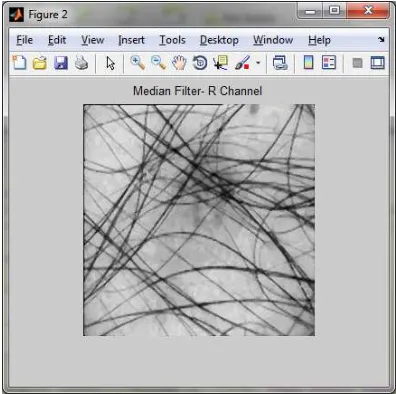
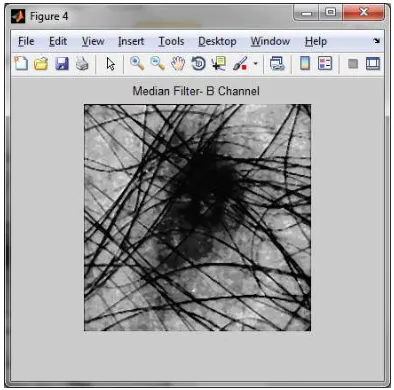
The color space used is the RGB (red, green, blue) color space. The three perpendicular axes represent the intensities of the three primary colors separating image into RGB layers (addition of median filter for better hair masking). This is shown in figure (2 to 4) the 3 separate median filter output for R, G and B channels
[image:5.595.311.509.444.641.2]Figure 3: Median Filtering on G Channel of the image
Figure 4: Median Filtering on B Channel of the image
A median filter smoothens the image by utilizing the median of the neighborhood. Median filter perform the following tasks to find each pixel value in the processed image:
1. All pixels in neighborhood of the pixel in the original image which are identified by the mask are sorted in the ascending or descending order.
2. The median of the sorted value is computed and is chosen as the pixel value for the processed image
[image:6.595.310.509.340.540.2]When median filters are applied to an image, the pixel values which are very different from their neighboring pixels will be eliminated. By eliminating the effect of such odd pixels, the values are assigned to the pixels that are representative of the values of the typical neighboring pixels in the original images. When we take the median vector, the pixel values which are very different from their neighboring pixels are replaced by a value equal to the neighboring pixel value. Because of this, median filtering is very widely used in digital image processing. Finally median filtered output is shown in figure (5).
[image:6.595.87.284.367.562.2]Figure 6: Final Morphological Image
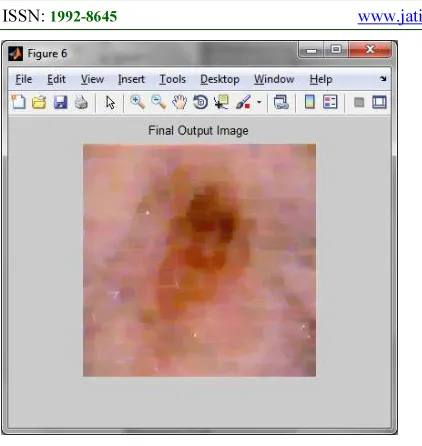
To get a morphological image strel is function used here. It creates a flat linear structuring element that is symmetric with respect to the neighborhood center. Finally we are performing morphological closing on the gray scale or binary image IM with the structuring element SE (strel). Final resultant preprocessed output is shown in figure (6)
5. CONCLUSION
Pixel Interpolation Techniques the efficient method which is used for a detection and removal of broader class of hairs as compared to other methods and process. Though it worked effectively on general quadratic curves and when used for detection and location of hairs in actual hair images the results of the final images were below Excellency. The main part of this is due to the fact that the image masking that was used is not effective enough to allow the full detection of hairs in the image. Parts of hairs are left out of the initial hair mask and this error permeates throughout the rest of the program.
The actual quadratic Radon formula is fast and efficient. It is believed that if this function could be incorporated into a more effective and faster algorithm for peak detection and hair removal it would be an effective tool for hair removal in skin lesion images. As the primary focus of this thesis, was on the development and use of the quadratic
radon method. There are several areas of the thesis that could be expanded and improved.
In conclusion the implemented algorithm meets the expectations and thus, satisfies. The results of the preliminary tests show that Pixel Interpolation Technique has the potential of better evaluation of changes.
REFERENCES:
[1] The Skin Cancer Foundation, “Skin Cancer Information," Skin Cancer Foundation. [2] American Academy of Dermatology (AAD),
"Skin Cancer Net," American Academy of Dermatology (AAD),
[3] American Cancer Society, "Skin Cancer Facts," American Cancer Society, [Online].
[4] National Geographic, "Ozone Depletion," National Geographic, [Online].
[5] World Cancer Research Fund International, "Cancer Statistics”, World Cancer Research Fund International,2008.
[6] R. Garnavi, Thesis: Computer-aided Diagnosis of Melanoma, Australia: Department of Electrical and Electronic Engineering,The University of Melbourne Australia, 2011. [7] T. Lee, V. Ng, R. Gallager, A. Coldman and D.
McLean, "DullRazor: A Software Approach to Hair Removal from Images," PubMed: Computers in Biology and Medicine, vol. 6, no. Nov, pp. 533-43, 1997.
[8] K. Kiani and A. R. Sharafat, "E-Shaver: An Improved DullRazor(R) for Digitally Removing Dark and Light-Colored Hairs in Dermoscopic Images," Computers in Biology and Medicine, vol. 41, pp. 139-145, 2011. [9]E. W. Weisstein, "'Radon Transform',"
MathWorld- A Wolfram Web Resource [10]C. Nordqvist, "Medical News Today: What Is
a CT scan? What Is a CAT Scan?," MediLexicon International, 10 June 2009. [11]S. Tomatis, M. Carrara, A. Bono, C. Bartoli,
M. Lualdi, G. Tragni, A. Colombo and R. Marchesini, "Automated melanoma detection with a novel multispectral imaging system: results of a prospective Study," Phys. Med. Biol. , vol. 50, pp. 1675-1687, 2005.