FACIAL DIMENSIONS DRIVEN DESIGN AND
OPTIMIZATION TECHNIQUES FOR SPECTACLES
1XIAOJIAN LIU, 1JIANFENG WU,2XIAODONG HE, 2HAIYING LI
1Industrial Design Institute, Zhejiang University of Technology, Hangzhou 310023, Zhejiang, China
2
Wenzhou Institute of Industry & Science, Wenzhou, 325000, Zhejiang, China
ABSTRACT
The styling design of spectacles is affected by several facial dimensions, and also has many requirements related with user’s personal preference. So the design process is rather complicated. Based on the dimension data of human face collected from Chinese people, the authors built a 3D parametric head modeling system driven by facial dimensions, and a head model-driven spectacle design mechanism, which realized rapid designing and adjustment of spectacles. For the convenience of designer’s regulation work, the glass outline shapes are defined and coded as three basic styles, which are 2-points, 3-points and 4-points style, based on which the parametric design method is established. The paper also discussed the further optimizing techniques with interactive genetic algorithms (IGA) on the basis of the spectacle code. A prototype system is programmed on a 3D parametric platform and examples are demonstrated to verify the effects of the design method proposed.
Keywords: Ergonomics, Facial Dimensions, Parameter Driven, Spectacles, Industrial Design
1. INTRODUCTION
Influenced by multiple facial man-machine size, glasses comfort is a key ergonomic performance. Parameter driven design techniques in the field of ergonomic design has more contents than the geometric model parameter driven in the general case, because the body has quite a lot size, there complex function relationship between each other; a product often subject to the impact of a number of different body sizes, in addition, it is not deterministic mapping relationship between all body size s and product sizes sometimes [1]. These factors have increased the complexity of parameter driven technology applications in ergonomic design.
C. Lu proposed product design idea of using 3D human model as the drive parameter carrier in his doctoral thesis, established three human models, structure, size and surface, carrying different types of body size [1]. Based on the hand 3D model, L. Luo achieved the design of appearance and morphology and design of key position arrangement of the model-driven phone product [2-3]. For optimization design needs of the chairs seat morphology, X. Liu explored carrying out curved surface driven design application with the use of man-machine contact pressure distribution data [4], design effect of various different drive function are
tested to make up for oversimplifying of the traditional complex surface design, thus to achieve better design results. C. Lu made an in-depth exploration about the technique of mapping function between the seat curved surface morphology and the contact pressure obtained through the experimental method from the perspective of a reasonable mapping relationship, established data mapping model, and provided reference for complex multi-parameter driven model in product design [5]. The above practice research has proved the feasibility of parametric human body model driven product design, such parameter driven technique embedded man-machine design knowledge in the human model or drive mechanism to ensure the correct implementation of the ergonomic design principles reduce the requirements on the designer’s knowledge structure.
morphology design of the glasses lens [6], based on interactive genetic algorithm, optimize lens contours morphology of up to 14 parameters and discussed dimensionality reduction techniques, and achieved satisfactory results.
2. SECONDARY DRIVE DESIGN
PRINCIPLES OF GLASSES PRODUCT
Secondary drive method was used in this paper to
implement parameter-driven design of glasses products, as shown in Figure 1.
He ad an d face param e tri c m ode l
m ode l in g
Collection of meas urement data
De sign m e asure me nt parame te rs
Statistics and fitting
Percentile index
Calculation of parameter value
Driving parameters
He ad an d face param e te r mode l
i nstance
Drive: base surface Drive: lens contour
Glasses structure Appearance
design interface
Non-e rgonom ics de si gn param e te rs
Optimization algorithm interface
Parameter optimization drive 2
[image:2.612.93.290.223.417.2]drive 1
Figure 1: Mechanism Of The Secondary Drive
To realize the secondary drive, design measurement parameter sequence is firstly needed: measuring the sample groups, statistically fitting to its distribution curve, to get body size calculation function with percentile as index variable based on the integral function of the distribution curve, thus calculate body sizes under different percentiles, as the drive variables of three-dimensional parametric head and face model. Parametric head and face model is used as a drive source in the secondary drive for the design of driving base curved surface and the contour of the lens. Base curved surface is to abstract glasses products (including lenses, frames, etc.) to a curved surface, and then carry out design the curved surface. Base curved surface is established around the head and face three-dimensional model, to make the designed glassed products comply with the relevant ergonomic rules by maintaining the correct relationship between it and head and face model.
Lens contour morphology design focuses on aesthetics and visual effects, its ergonomic design requirements are generally the positional relationship between the contour morphology and eye pupil, the design requirements need to be
achieved by defining the geometric elements of the contour curve and the geometric relationship of the pupil positions (eg. to ensure coverage of the lens).
3. IMPLEMENTATION TECHNIQUES OF
DRIVEN DESIGN
Based on parametric design platform Solidworks, the author obtained the above drive design process; a brief description about the implementation technique of the four key aspects will be made in this section.
3.1 Head And Face Measurement Data And Its Statistical Analysis
Data about the sizes of Chinese head and face are outdated and simple, which cannot meet the design requirements of complex products. To this end, the author carried out a large amount of data collection. Common needs for head and face products (not only glasses) are designed, and 24 critical dimensions are identified. 24 data adopt two kinds of measuring methods: First is to make three-dimensional scanning about the head of the examinee, and then use the software technology to measure the distance between standard measuring points; second is to use the tools for manual measurement. Figure 2 - Figure 3 are scanning equipment and measure point.
[image:2.612.331.508.447.584.2]Figure 3: Measuring Points In The Face
Percentile is generally taken as the basis for determining the size of the human body in products ergonomic design. Percentile of the size refers to the size values of the crowd in this percentile are located below a certain level, the calculation function of the percentile is the integral function of size probability density curve.
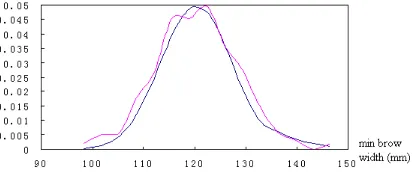
290 samples of Wenzhou region were measured in the survey work. For each size, the distribution range of the measurement value is divided into 15 equi-segmentations, make statistics about the number of samples within each segment, on such basis, obtain distribution curve of the size. According to the previous measurement experience, it is assumed that all dimensions are in line with the normal distribution, and normal distribution function can be reached after fitting. Figure 4 is distribution curve and the normal distribution fitting curve of minimum frontal width, it can be seen, the assumption of normal distribution is a reasonable. The method of calculating the head and face size in percentile is to use the inverse function of the integral function of the size normal distribution curve, as shown in Figure 5.
[image:3.612.316.519.413.529.2]Figure 4: Normal Distribution Fitting Of One Of The Parameters
Figure 5: Integral Curve Of The Normal Distribution Curve
3.2 Three -dimensional parametric model of the head and face
For the construction of three-dimensional parametric model of the head and face, firstly, establish the parametric model by hand, and then define the head and face size parameters as the key parameters of the model, and establish driven relationship between size and model morphology. The structural framework definitions of the head and face model and curved surface morphology are shown in Figure 6. To reduce surfaces malformations, a certain degree of simplification has been carried out about the facial detail that does not affect the human-machine nature and visual effects.
Figure 6: Parametric Model Of Face
[image:3.612.94.300.550.639.2]Figure 7: Driving Parameters Of Spectacle
Figure 8: Two Face Models Under Different Driving Parameters
3.3 Base curved surface of glasses design
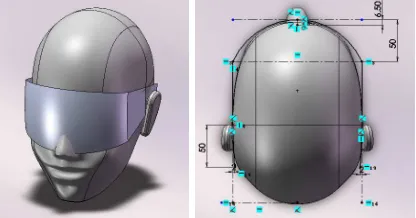
As mentioned earlier, the base curved surface is used for auxiliary curved surface of 3D glasses design. Base curved surface can be constructed through a variety of ways, and user-defined template can also be created; the author uses one of the most common base curved surface morphology, generated by the rotational scanning of the contour, Figure 9 is the definition of base curved surface and its contour line.
Figure 9: Definition Of Base Curved Surface
The definition of base curved surface make it has drive relationship with parametric model of the head and face in two aspects:
1) distance between curved surface and face: by setting the distance parameter to ensure (dimensioning 6.50 in Figure 9), this parameter
affect the optical function effects of the glasses, the size value depends on the calculation of the correlation analysis, it can be read from external data document;
2) Fit relationship between curved surface and the temple of head: by setting the constraint relation make relevant measuring points go through scanning contour.
Arc height of base curved surface at the front part (dimensioning 50 of Figure 9) is corresponding to different types of glasses products, for example, the front of optical glasses is a little bit flat, arc height parameters is relatively small, the fitness of sunglasses and face is relatively high, arc parameter is relatively high. The arc height and distance parameters could be adjusted according to the needs of the actual design.
[image:4.612.314.524.337.466.2]Figure 10 shows the application mode of base curved surface in design.
Figure 10: Application Of Base Curved Surface
The contours of lenses, frames and legs the leg can be designed respectively in the corresponding design base surface, and then projected onto the base curved surface for shearing, thickening and further design.
[image:4.612.91.299.528.637.2]further effect of performances. The technology of this paper is its reverse process, the principle is similar, and they are the reconstruction based on the output parameter data.
3.4 Parametric lens contour morphology
The lens contour morphology is the main visual feature of glasses, especially sunglasses, the lenses contour morphology design is the main content of the glasses product design. Although the lens morphology is ever-changing, there are still certain rules could be followed. Through the researches on the lens morphology of a large number of glasses products, this paper abstracts the contour of the mainstream dual-lens glasses into three parametric form: two-point contour, three-point contour and four-point contour, respectively using two, three, four control points to define basic contour characteristics of the lens, supplemented with adjustment parameter of a series of corresponding local morphology, to accurately represent the most of lens contour morphology as a group of real numbers parameter sequence.
The design of the lens contour is carried out on the lens design base surface (as shown in Figure 10), three kinds of parametric lens contours are shown in Figure 11 here below.
A. 2-Points Shape
B. 3-Point Shape
C. 4-Point Shape [image:5.612.118.270.425.718.2]
D. Base Surface For Glass Shape Design
Figure 11: Parametric Templates Of Glass Shapes
Three contour morphologies are all constituted by several segments tangent arcs, among them, two-point contour is four arcs, three-point contour is six arcs, and four-point contour is 8 arcs. Take three-point contour as an example: with the use of two measuring points, inner and outer corner of the eye (as shown in the circle of Figure 11c)define control points of three contour feature, which is shown in the circle of Figure 11b. The three control points are connected into a triangle (called “control triangle”), taking its three sides as the strings to build three arcs, arc height will be determined by a circumscribed similar triangle. Lastly, connect the filleted corner between three arcs to make the contour line into a smooth, coherent closed curve. According to this definition, three-point lens contours morphologies contain a total of eleven parameters, including five control point location parameters, three arc height parameters and three connecting radius parameters. Definition method of two-point lens is similar to four-point lens; the numbers of parameters are respectively 5 and 15.
All parameters are set by centering around two eye measuring points, thus the relationship between the designed lens contour morphology and the eye can be guaranteed. The design of parameters take the designer’s operating habits about the morphology into considerations, such as designer’s requirement about adjusting partial curve, “slightly convex”, “slightly flat”, “slightly sharp”, as well as the adjustments about overall morphology can be completed conveniently, and the adjustable performance of the morphology is much better than the traditional spline curve.
which will be further elaborated in Section 5.
4. APPLICATION VERIFICATION OF
DESIGN EXAMPLE
Based on the parametric design platform software Solidworks, this paper established prototype system. 24 parameters’ measurement data of the head and face and their statistical treatment results are stored in an external Excel document. The measurement data is not cured within the program which could facilitate the application of the latest statistics measurement results at any time, or could be used for local user group-oriented design. The three lenses contour has been defined as the template and stored in the system file, and all the parameters are defined. The user can also define and save your own design template according to their own needs based on the measurement parameters.
In the prototype system, the parameters are divided into two groups: 9 are used for drive modeling and 15 are used for query. Each size can be obtained by clicking “update data” button according to the selected data file and the given percentile index; a new configuration of head model can be generated in Solidworks scene by clicking “drive modeling” button based on the value of nine drive size, which can be taken as the basis for the subsequent design work, the base curved surface of the model will also change along with the head model.
Figure 12 is the final design result of the optical glasses shown in Figure 10, with the use of a four-point contour template. Figure 13 is the design effect sketch of sunglasses, with the use of three- point contour template.
Figure 123: Optical Spectacles Design Effects
Figure 13: Sun Glasses Design Effects
5. APPLICATION INTERFACE OF DESIGN
OPTIMIZATION TECHNIQUES
Through the methods above, most key design elements of spectacles such as ergonomics dimensions or shape dimensions can realize parametric driving design. The design of graphic effects is also considered and is realized through an interface to 2D applications. The techniques provide much aid for designers, but there is till difficulties, i.e. the comprehensive optimization of mass parameters. The sum of spectacles parameters is usually more than 10, some types’ parameters exceed 20. So it’s a hard labor for designers to regulate them one by one manually, even if with the help of driving design techniques. The shape of glasses needs more subtle regulation work, for the esthetic effects of glassed are generated from the overall matching of all parameters. In such case, manual combination work suffers from low efficiency and is likely to miss good design.
Integral optimization needs to work on parameters’ code, i.e. to code the spectacles as a group of parameters. The authors’ previous work provides access for this [6], which is realized on the basis of Interactive Genetic Algorithms.
multi designs generated by the program.
Figure 14: Automatically Generated 3D Glasses Designs Based On 4-Points Shape Template
As the design parameters can be output from the models and kept in exterior Excel data files, so the results data of optimization program can be easily exchanged for all kinds of optimization strategies, such as better design of evaluation methods [8, 9], or quantified creativity calculation[10], etc.
6. CONCLUSION
For several key aspects in the design of glasses products, this paper carried out the study about assistive technique. Studies have shown that directly using anthropometric parameters to ergonomic design of drive related products is feasible. In the man-machine design of glasses, combining application of different mapping laws has greater technical space, for example, there are more flexible ways that can be tapped in combination application rule of “pass-type” man-machine size and “optimal-type” man-man-machine-size rules there. Further in-depth study about the setting of conditional probability relations between multi human-machine sizes also need to be done for providing basis for batch (not personalized) custom made frames. In addition to assisting ergonomic design, parameter-driven method could also provide convenience for the overall optimization of multi-parameters.
ACKNOWLEDGEMENTS
The paper is sponsored by Chinese National Natural Science Fund (No.60975048 & 61103100), National Torch Project (No.2011GH551158), Zhejiang Natural Science Fund (No.Y1111111) and Wenzhou Science & Technology Program (No.G20100195), many thanks to Chinese government’s generosity to our interesting research work.
REFERENCES
[1] C. Lu, G. Li, X. Jian. Ergonomic Product Design Driven by Parametric Manikin.
Packaging Engineering, Vol.30, No.5, 2005,
pp.207-209
[2] L. Luo, K. Wang, C. Lu. Study of P roductFam ily Shape Design and System Construction. Mechanical Science and Technology, Vol.25, No.7, 2006, 802-805
[3] X. Liu, S. Sun, L. Luo, G. Li.. Mobile product ergonomics design driven by interactive operations. Computer Integrated Manufacturing Systems. Vol.14, No.2, 2008,
pp.215-220.
[4] X. Liu, Z. Dong, J. Wu, S. Sun. Human-product interface shape design method based on interface pressure data. Computer Integrated Manufacturing Systems. Vol.14,
No.4, 2008, pp.644-649.
[5] C. Lu, X. Liu, G. L, S. Sun. Data mapping model of the design of human-product contacting interface. Computer Integrated
Manufacturing Systems. Vol.15, No.5, 2009,
pp.900-904.
[6] X. Liu, S. Sun, G. Li. A Downsizing Method of Solution Space for Product Shape Design with Complex Parameters. Journal of
Computer-Aided Design & Computer
Graphics. Vol.19, No.12, 2007, pp.1604-1609.
[7] Y. Sun, X. Liu, W. Wang. User Innovation Method Considering Creativity and Satisfaction Criteria and Its Application in Product Styling Optimization. Journal of
Computer-Aided Design & Computer
Graphics, Vol.24, No.8, 2012, pp.954-960.
[8] Y. Sun, W. Wang, Y. Zhao, X. Liu. User image oriented interactive genetic algorithm evaluation mode in product development.
Computer Integrated Manufacturing Systems,
Vol.18, No.2, 2012, pp.276-281.
[9] Y. Sun, W. Wang. An Experimental Study on the User Evaluation Accuracy of Interactive Genetic Algorithms. Journal of Convergence
Information Technology, Vol.7, No.1, 2012,
pp.457-467.
[10] Y. Sun, X. Liu, X. He. Boolean evaluation for interactive genetic algorithms and its fatigue-reduction effects in product optimization task.