S T U D Y P R O T O C O L
Open Access
Outcomes of Usual Chiropractic, Harm & efficacy,
the OUCH study: study protocol for a randomized
controlled trial
Bruce F Walker
1, Barrett Losco
1, Brenton R Clarke
2, Jeff Hebert
1, Simon French
3,4and Norman J Stomski
1*Abstract
Background:Previous studies have demonstrated that adverse events occur during chiropractic treatment. However, because of these studies design we do not know the frequency and extent of these events when compared to sham treatment. The principal aims of this study are to establish the frequency and severity of adverse effects from short term usual chiropractic treatment of the spine when compared to a sham treatment group. The secondary aim of this study is to establish the efficacy of usual short term chiropractic care for spinal pain when compared to a sham intervention.
Methods:One hundred and eighty participants will be randomly allocated to either usual chiropractic care or a sham intervention group. To be considered for inclusion the participants must have experienced non-specific spinal pain for at least one week. The study will be conducted at the clinics of registered chiropractors in Western Australia. Participants in each group will receive two treatments at intervals no less than one week. For the usual chiropractic care group, the selection of therapeutic techniques will be left to the chiropractors’discretion. For the sham intervention group, de-tuned ultrasound and de-tuned activator treatment will be applied by the
chiropractors to the regions where spinal pain is experienced. Adverse events will be assessed two days after each appointment using a questionnaire developed for this study. The efficacy of short term chiropractic care for spinal pain will be examined at two week follow-up by assessing pain, physical function, minimum acceptable outcome, and satisfaction with care, with the use of the following outcome measures: Numerical Rating Scale, Functional Rating Index, Neck Disability Index, Minimum Acceptable Outcome Questionnaire, Oswestry Disability Index, and a global measure of treatment satisfaction. The statistician, outcome assessor, and participants will be blinded to treatment allocation.
Trial registration:Australia and New Zealand Clinical Trials Register (ANZCTR): ACTRN12611000542998
Background
The success of any therapy is often based on the ques-tions“Is it safe? Is it effective?”. For chiropractic therapy there has been some research to ascertain effectiveness [1] and also for spinal manipulation [2] but there has been very little to document its safety. The safety profile of any therapy is a cornerstone of modern practice as it provides protection for the public and informs the con-sumer consent process. Trials of chiropractic therapy have shown mixed results which, together with its
current use for multiple indications, make research into aspects of its safety important.
There are several published reports about the safety of chiropractic treatment. A single arm study conducted by Senstad et al in 1996 [3] reviewed the type, frequency, and characteristics of unpleasant side effects after spinal manipulation. About half of the patients reported at least one adverse event some time during the course of a maximum of six treatments. Of these, the most com-mon adverse events were local discomfort (53%), head-ache (12%), tiredness (11%), or radiating discomfort (10%). Adverse events were mild or moderate in 85% of patients. Limitations of this study included that the chir-opractors gathered their own data; responders could not * Correspondence: [email protected]
1
School of Chiropractic and Sports Science, Murdoch University, Perth, Australia
Full list of author information is available at the end of the article
be compared with non-responders; and reports could not be obtained from patients who attended one treat-ment only. It is possible that some opted out because of unpleasant reactions, potentially making the results an underestimate.
Hurwitz et al compared the rate of adverse events between two randomly allocated groups of neck patients who received either manipulation or mobilisation from chiropractors [4]. About a third of all participants reported at least one adverse event. The most common adverse events were increased pain (27%), headache (15%), tiredness (12%), radiating pain (6%), and dizziness (4%). Participants who received manipulation were more likely to experience an adverse event than participants who received mobilisation.
A prospective survey of chiropractors in the United Kingdom examined adverse events following manipula-tion of the neck [5]. No serious adverse events were reported. Of the adverse events reported, the most nota-ble were increased neck pain (7%) and increased shoulder/arm pain (4%), muscle stiffness and headache (4%). A potential limitation of this study was that data were collected by the chiropractors administering the intervention, which may have led to an underestimation of adverse events.
The fourth study was a prospective study of patients who received chiropractic care for neck pain [6]. Just over half of the participants experienced at least one adverse event following any of the three treatments, and 13% of the adverse events were severe in intensity. About 75% of all reported adverse events were muscu-loskeletal or pain related. Other less common adverse events included tiredness, dizziness, nausea, or ringing in the ears.
The main limitation associated with these four studies above [3-6] was that three of the studies were uncon-trolled. These uncontrolled studies may have overesti-mated the frequency of adverse events because the reported events may be associated with either natural history [6] or a placebo response [7].
Another limitation concerns the involvement of chiro-practors in collecting information about adverse events directly from the participants in two of the studies [3,5]. The involvement of chiropractors may have led to an underestimation of adverse events as the patients may have been reluctant to disclose the events they experienced.
Given the limitations associated with previous studies of adverse events during chiropractic care [3-6], it is evi-dent that controlled studies are warranted to develop a better understanding of the rate of adverse events in chiropractic care. This proposition reflects the findings of a recent systematic review [8] that concluded there were no robust data concerning rate of adverse events
after chiropractic treatment and recommended urgent investigations to provide definitive conclusions as to its safety profile.
In summary, the literature reveals that adverse events do happen from chiropractic therapies. However, pre-vious studies have limitations and therefore we do not know the frequency and extent of these events particu-larly when compared to sham treatment.
Aims
1. To establish the frequency and severity of adverse events from usual short term chiropractic treatment of the spine when compared to a sham treatment.
2. To establish the efficacy of usual short term chiro-practic care for spinal pain when compared to a sham intervention.
Materials and methods
This study will be a randomised, placebo-controlled trial comparing usual short term chiropractic care and a sham intervention of no known benefit for participants with non-specific spinal pain of more than one week in duration. The inclusion of a placebo group will allow for a comparison of adverse events between active chiro-practic care and those that are a manifestation of either
“sham” treatment or natural history. Participants will be randomly allocated to receive usual chiropractic care or a sham intervention consisting of non-functional thera-peutic ultrasound and a de-tuned Activator®instrument [9]. The reporting of the results of this trial will accord with both the extended CONSORT statement for Ran-domized Trials of Nonpharmacologic Treatment [10] and the CONSORT extension for Better Reporting of Harms in Randomized Trials [11].
Study Sample and Participant Enrolment
Participants will be recruited in Perth, Western Australia by the use of newspaper advertisements. Any person who responds to the advertisement by phone will be considered a potential candidate and will receive through the mail the following documents:
•an information letter;
•a pain diagram to assess symptom location and distribution;
•the Numerical Rating Scale (NRS) [12] on which the patients will score their current overall level of spinal pain;
•Functional Rating Index (FRI) [13];
• a questionnaire enquiring about the minimum amount of change in pain levels that potential parti-cipants would consider to be an acceptable outcome [14];
These documents will be returned in a reply paid envelope and the information will be used to determine eligibility. To be considered for inclusion, potential par-ticipants must be adults (18 years or older), literate in English, and have had spinal pain (neck pain, mid-back pain, or low back pain) for more than 1 week. In addi-tion, potential participants must score at least 3 on the NRS and 12 on the FRI as this allows measurement of a minimal clinically important difference in the improve-ment direction [15].
Potential participants will be excluded if they:
• have been previously unable to tolerate common chiropractic treatments, for example: manipulation; mobilisation; Activator®; flexion distraction therapy; traction; soft tissue massage; trigger point therapy; sacro-occipital technique; ultrasound; interferential therapy; and Transcutaneous Electrical Nerve Stimu-lation (TENS).
• have any of the following conditions: spinal pain related to cancer or infection; clinically important fracture of the spine; spondyloarthropathy; known osteoporosis; progressive upper or lower limb weak-ness; symptoms of cauda equina syndrome or other important neurological condition; recent disc hernia-tion; cardiovascular disease likely to be a contraindi-cation to spinal manipulation; uncontrolled hypertension; cognitive impairment; blood coagula-tion disorder; spinal surgery in the last year; previous history of stroke or transient ischaemic attacks; have a pacemaker or other electrical device implanted; are currently pregnant;
•have a current compensation claim;
•have a substance abuse problem;
•cannot commit to study protocol.
Potential participants who satisfy the inclusion criteria will be sent a more detailed information letter. Two days later, they will be contacted by phone to determine if they are interested in participating, and if so an appoint-ment will be made to attend Murdoch University.
Chiropractor Participants
The study interventions will be administered at the clinics of registered chiropractors in Perth, Western Australia. Recruitment of about 12 chiropractors will be by way of open advertisement to the profession using contact details in the public domain or from the online Register of Chiropractors. To be eligible, chiropractors must have had at least two years of clinical experience and regularly use spinal manipulation in the mix of their therapy modalities. Chiropractors who administer the sham intervention must have both ultrasound and Activator®instruments available.
Treatment allocation
When participants visit Murdoch University and after baseline measures and consent have been obtained, one of the research staff, excluding the research assistant (RA) and statistician, will randomly allocate the partici-pants to one of the two groups using a 1:1 allocation. A statistician will generate a permuted block randomiza-tion sequence allocating persons to either chiropractic care or the sham group. The group assignment will be written on small cards and placed in opaque envelopes.
For ethical reasons, participants in the sham group will be offered two treatments of usual chiropractic care two weeks after receiving the last sham treatment and following receipt of their final outcome measures by the RA. Any participant who discontinues treatment will be followed-up to determine the reason for discontinuation.
Pilot Study
A pilot study, using the first five participants recruited, will be undertaken to evaluate process and resource issues. In particular, we will examine whether the parti-cipants were able to complete the questionnaires in full without difficulty and the length of time required. All research team members involved with baseline assess-ments and randomisation will meet after the first five participants have been randomised to reach a consensus decision on the feasibility of administering the question-naires. In the absence of explicit recommendations about the required sample size to examine feasibility issues, we determined that five participants would be sufficient [16].
Intervention/treatment
Chiropractors will be asked to deliver one of the two study interventions. The study interventions are as follows:
1. Short term usual chiropractic care: a series of two chiropractic treatments to the spine as deemed suitable by a registered chiropractor. Treatments include one or more of the following: spinal manipulation, mobilisation, drop piece, traction, electro- therapies, ultrasound, Acti-vator®, soft tissue techniques and other manual techni-ques offered by the chiropractor. This treatment approach replicates a common pragmatic approach in the field [1].
depressor at random locations in the spine near the areas of concern. The dimensions of the depressor are 19 mm wide and 150 mm long, although on average only 600 mm of the length will be in contact with the skin. This means a surface area of 1140 mm2. We mea-sured the force this will provide to the skin using a force transducer. The mean of 5 measured attempts was a very low 3.7 kPa. To increase the perceived “hands on”credibility, the chiropractor will be trained to gently place one hand on an area adjacent to the participant’s spine while delivering the ultrasound and Activator® therapies. The four chiropractors recruited to deliver the sham treatment will be asked to administer the sham interventions as they normally use Activator® tools and ultrasound and with the same enthusiasm they would use for all other therapies.
Withdrawing Participants from this Study
A stopping rule was defined for withdrawing partici-pants from this study in accordance with recommenda-tions in the CONSORT extension for Better Reporting of Harms [11]. If a participant reports to their chiro-practor or research staff a severe adverse event they will be withdrawn from the study and referred to their local doctor or hospital emergency department depending on the nature of the event. Each participant will complete an adverse event questionnaire two days after each chir-opractic appointment and asked to then return it in a reply paid envelope. Any adverse event will be classified as severe if it is thought to be an emergency situation e. g. stroke or the associated pain intensity is rated above 8/10 on an 11 point NRS, which accords with the defini-tion for a serious adverse event by Rubinstein et al [6].
Ethical Clearance
All participants (chiropractors and patients’with spinal pain) will provide voluntary written informed consent with a full understanding of what study participation entails and the potential risks. Ethics approval has been obtained from Murdoch University’s Human Research Ethics Committee (Reference number 2011/109).
Demographic Material and Assessment of Outcomes
1. Chiropractor Demographics and Usual Chiropractic Care Characteristics
For the participating chiropractors, the following demo-graphic characteristics will be collected: age, years in practice, institution from which qualifications were obtained, and speciality certification or additional quali-fications. A treatment checklist will be used to collect information about the types of treatments used in each usual chiropractic care appointment. Collection of the demographic and treatment information accords with the CONSORT Recommendations for the Reporting of
Nonpharmacologic Trials [10]. Information about the types of treatment used will also be used for later analy-sis and correlation with adverse events.
2. Baseline Assessment
The following questionnaires will be administered at baseline: demographic questionnaire; NRS [12]; FRI [13]; Fear-Avoidance Behaviour Questionnaire (FABQ) [19]; SF-36 [20]; STarT Back Musculoskeletal Screening Tool [21]; and the Pain Catstrophising Scale (PCS) [22]. Also, the primary area of concern for each participant will be identified and one of the following questionnaires speci-fic to that area will be administered: the modified Oswestry Disability Index (ODI) [23]; or Neck Disability Index (NDI)[24].
Descriptive statistics from the baseline measures including the SF-36, STarT Back Musculoskeletal Screening Tool, and demographic questionnaire will be examined to determine if clinically important differences are evident between the usual chiropractic group and sham group at baseline. The SF-36 is a well validated and extensively used measure of general health status [25]. The STarT Back Musculoskeletal Screening Tool is brief validated instrument that has been developed to identify people with chronic pain who are more likely to experience persistent symptoms [21]. The demographic questionnaire enquires about age, sex, race/ethnicity, education, household income, marital status, employ-ment status, smoking, and alcohol and legal drug con-sumption. These items were derived from classifications used by the Australian Bureau of Statistics [26].
A baseline symptom checklist will be administered to examine whether the adverse events that participants reported after each chiropractic treatment were actually an adverse event or the persistence of a presenting com-plaint. This will be achieved through comparing data from the symptom checklist taken at baseline to data from the adverse event checklist collected after each chiropractic treatment.
The NRS contains an 11-point scale varying from 0 (no pain) to 10 (worst pain imaginable) [12]. It is a valid, reliable and responsive measure of pain intensity [27]. Participants will be asked to use the scale to rate: their worst level of pain in the last two days; average pain level in the last two days; best pain level in the last two days; and current pain.
The FRI contains 10 questions which enquire about the impact of neck and back pain on physical function. It was designed to assess conditions where more than one area of the spine is involved and is valid, reliable and responsive [13].
The modified ODI is a region-specific outcome mea-sure that has been shown to have high levels of reliabil-ity, validity and responsiveness in patients with low back pain [23]. It assesses impact of low back pain on physi-cal function and activities of daily living.
The FABQ will be used to assess participant’s beliefs about the relationships between back pain, work, and physical activity. The FABQ has good test-retest reliabil-ity [19], and predictive validreliabil-ity for future episodes of LBP [23] and clinical outcome [15].
Catastrophising will be assessed with the PCS [22]. The PCS assesses different dimensions of negative thoughts related to pain: rumination, magnification, and helplessness. It contains 13 items scored on a 5-point Likert-type scale varying from 0 ("not at all”) to 4 ("all the time”). The PCS has been shown to be a reliable and valid measure which predicts postoperative pain intensity following lumbar spine surgery [28].
3. Assessment of Adverse Event Events
To accord with the CONSORT extension for Better Reporting of Harms [11], it is necessary to a priori define anticipated and unanticipated adverse events and explicitly state these definitions in reporting the meth-ods for this study. Anticipated adverse events for this study are defined as the adverse events listed in the questionnaire developed for this study and any of the other adverse events reported in the studies conducted by Senstad et al. [3], Hurwitz et al. [4], Rubinstein et al. [6], and Theil et al. [5]. Unanticipated adverse events will be defined as stroke, fracture, dislocation, or disc injury.
Information about adverse events will be collected after each chiropractic appointment. Participants will be asked to complete the questionnaire two days after each appointment as adverse events typically manifest within two days of chiropractic treatment [3,4,6].
The adverse events questionnaire [Additional file 1] was derived from a checklist used by Cagnie et al. [29]; open-ended questions from Senstad et al. [3] and Hur-witz et al. [4]; adverse events reported in RCT’s [4,6,29-32]; and two surveys [5,33]. It consists of items which enquire about the onset and severity of adverse events, and items about the impact of adverse events on activities of daily living. We decided to use a question-naire which consisted largely of predefined response options as previous studies have demonstrated that the use of predefined response options results in more com-prehensive reporting of adverse events [34].
4. Assessment at Two Week Follow-Up
We will administer at two week follow-up the NRS [12], FRI [13], and the area specific instruments modified ODI [23] or NDI [24]. These questionnaires will be used to establish the short term efficacy of brief chiropractic care for spinal pain. The FABQ [19] and PCS [22] will
also be administered to examine whether cognitive aspects related to the experience of pain influence pain severity, physical function and adverse events.
Also, a global measure of treatment satisfaction [27] and global measure of perceived change [35] will be administered at two week follow-up. The global measure of treatment satisfaction [27] will be used to examine the association between adverse events and treatment satisfaction. It will be measured on a five point categori-cal scategori-cale (very dissatisfied = 0; dissatisfied = 1; no pre-ference = 2; satisfied = 3; very satisfied = 4). The global measure of perceived change [35] will be used to exam-ine the association between adverse events and overall perceived change in the main complaint. It will be mea-sured on an 11 point continuous scale varying from -5 to +5 (-5 = much worse, 0 = unchanged, +5 much better).
Blinding will be assessed at two weeks with a ques-tionnaire [36] that asks the participants if they were in the real treatment group or the sham treatment group. The possible responses are: real treatment group; sham group; or don’t know.
Blinding
Practitioners are unable to be blinded with respect to the participants’treatment group allocation. The statisti-cian and research assistant will remain blind to treat-ment allocation. We aim to blind participants to the assigned treatment throughout the trial.
Sample Size
The sample size was based on the number needed to detect a significant difference in the primary outcome (adverse event: yes/no) between groups. We make the assumption that in the usual chiropractic group 45% of patients will experience an adverse event and that the rate in the sham group will be 25%. We believe this is a very conservative estimate given that a) the participants in the Senstad et al. study [3] had 6 treatments and there was a rate of 55% adverse events and b) that for the sham treatment previous studies have shown a mild adverse event rate of 7% [37] using the same de-tuned ultrasound method. Therefore, using a 2-sided test and alpha level of 0.05, recruiting 90 participants in each group (180 total) will provide 80% power to detect a dif-ference this large or larger. G*Power 3.1.3 was used to calculate the sample size [38].
Statistical Methods
and the types of treatments used. The measurements taken at baseline for the participants will be compared to establish whether the groups are similar.
Analysis of Adverse Events
The primary outcome (adverse event; yes/no) will be compared between groups. The severity and frequency of adverse events will be reported descriptively. Logistic regression will be used to examine associations between adverse events and several factors. Factors which have been significantly associated with adverse events in pre-vious studies will be selected for this study. These
factors comprise treatment satisfaction [4], manipula-tion/mobilisation [4], global improvement [4], GP visit in last six months [6], duration of neck/back pain [6], medication use [29], gender [29], and age [29]. The rela-tive risk [39] will be calculated using a two by two con-tingency table and 95% confidence intervals. The number needed to harm [40] will be calculated with 95% confidence intervals to identify the number of indi-viduals needed to be exposed to a risk factor (chiroprac-tic treatment) over a specific period to cause harm (adverse outcome) in one patient that would not
1
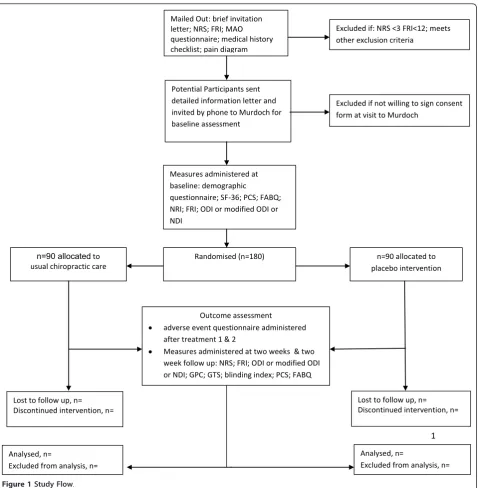
Mailed Out: brief invitation letter; NRS; FRI; MAO questionnaire; medical history checklist; pain diagram
Excluded if: NRS <3 FRI<12; meets other exclusion criteria
Potential Participants sent detailed information letter and invited by phone to Murdoch for baseline assessment
Excluded if not willing to sign consent form at visit to Murdoch
Measures administered at baseline: demographic
questionnaire; SF-36; PCS; FABQ; NRI; FRI; ODI or modified ODI or NDI
Randomised (n=180)
n=90 allocated to usual chiropractic care
n=90 allocated to placebo intervention
Outcome assessment
adverse event questionnaire administered after treatment 1 & 2
Measures administered at two weeks & two week follow up: NRS; FRI; ODI or modified ODI or NDI; GPC; GTS; blinding index; PCS; FABQ
Lost to follow up, n= Discontinued intervention, n=
Lost to follow up, n= Discontinued intervention, n=
Analysed, n=
Excluded from analysis, n=
Analysed, n=
[image:6.595.61.540.86.575.2]Excluded from analysis, n=
otherwise have been harmed. Data will be assessed by using per protocol analysis. In addition, an intention to treat analysis will be undertaken by using sequential regression multiple imputation [41].
Analysis of Secondary Outcomes
The efficacy of short term usual chiropractic care will assessed in two ways. First, for the repeated measures ANOVA will be used to compare differences between groups for the pain and physical function measures. Sec-ond, the minimum acceptable outcome [14], which involves establishing what participants consider to be a
“minimum acceptable outcome” for which they would undertake a procedure. The proportion of participants meeting this target in each group will be reported descriptively and the groups will be compared by using a chi-squared test [14].
Blinding to treatment allocation will be assessed by using the Bang Index (BI) [36] which will allow us to determine if a significant proportion of participants guessed that they were in opposite treatment group. A BI value of < -0.2 indicates that significant proportion guessed wrongly, BI between 0.2 and -0.2 indicates par-ticipants guessed randomly, and BI > 0.2 indicates that the study was unblinded.
Study Flow
A flow chart of the study is seen in Figure 1.
Discussion
To our knowledge, this is the first study to use a sham-controlled arm to examine the rate of adverse events during chiropractic care. It also appears to be the first controlled study to investigate how often adverse events occur during chiropractic care for spinal pain, as the only other controlled chiropractic study examined adverse events for chiropractic treatment of neck pain. The findings of this study will build on the limited num-ber of previous studies conducted to examine adverse events during chiropractic care and contribute towards a more robust understanding of the safety profile of chiropractic care. In particular, the inclusion of a sham arm will enable us to better discern the rate of actual adverse events by comparing the frequency of adverse events that occurred in the usual chiropractic care group to those in the sham controlled group. This study will also provide additional evidence about the efficacy of short term usual chiropractic care for spinal pain.
There are three main limitations associated with the conduct of this study. First, we will only be able to pro-vide two treatment sessions to each participant due to funding constraints. Consequently, in all likelihood our study will only capture the most common adverse events of chiropractic care. Second, the internal validity of this trial would have been enhanced by having the
same chiropractors provide both interventions. However, we decided to use a different group of chiropractors to provide each intervention as we anticipated difficulty in recruiting sufficient chiropractors with access to both ultrasound and Activator® instruments, both of which are required to administer the sham intervention. Third, the extent to which we can accurately determine the relative risk of usual chiropractic care depends on how well we are able to maintain blinding to treatment allo-cation. We acknowledge that it may be difficult to blind the participants with spinal pain to the assigned treat-ment throughout the trial and accordingly will examine blinding through administering a questionnaire. How-ever, our findings about the success of blinding should be viewed cautiously as the questionnaire we will use to assess blinding has not been formally validated.
Additional material
Additional File 1: Adverse Events in Chiropractic Care
Questionnaire. Survey instrument developed for this study to gather information about adverse events.
Abbreviations
BI: Bang Index; CONSORT: Consolidated Standards of Reporting Trials; FABQ: Fear-Avoidance Behaviour Questionnaire; FRI: Functional Rating Index; NDI: Neck Disability Index; NRS: Numerical Rating Scale; ODI: Oswestry Disability Index; PCS: Pain Catastrophising Scale; TENS: Transcutaneous Nerve Stimulation.
Acknowledgements
The authors gratefully acknowledge the assistance of the Victorian Chiropractors Registration Board for providing the funding for this project.
Author details
1School of Chiropractic and Sports Science, Murdoch University, Perth,
Australia.2School of Chemical and Mathematics and Sciences, Murdoch University, Perth, Australia.3Primary Care Research Unit, Melbourne University, Melbourne, Victoria, Australia.4School of Public Health and Preventive Medicine, Monash University, Melbourne, Victoria, Australia.
Authors’contributions
BFW was involved in the conceptualisation of the project, the design and drafting the manuscript. JH was involved in the conceptualisation of the project, the design and drafting the manuscript. SF was involved in the conceptualisation of the project, the design and drafting the manuscript. BRC was involved with the design and statistics and manuscript drafting. BL was involved in the conceptualisation of the project and the design. NJS was involved in the design and drafting of the manuscript. All authors have read and approved the final version of the manuscript.
Competing interests
The authors declare that they have no competing interests.
Received: 27 June 2011 Accepted: 31 October 2011 Published: 31 October 2011
References
2. Rubinstein SM, van Middelkoop M, Assendelft WJ, de Boer MR, van Tulder MW:Spinal manipulative therapy for chronic low-back pain.
Cochrane Database Syst Rev2011,2:CD008112.
3. Senstad O, Leboeuf-Yde C, Borchgrevink C:Frequency and Characteristics of Side Effects of Spinal Manipulative Therapy.Spine1996,22:435-440. 4. Hurwitz EL, Morgenstern H, Vassilaki M, Chiang LM:Adverse Reactions to
Chiropractic Treatment and Their Effects on Satisfaction and Clinical Outcomes among Patients Enrolled In UCLA Neck Pain Study.J Manipulative Physiol Ther2004,27:16-25.
5. Thiel HW, Bolton JE, Docherty S, Portlock JC:Safety of Chiropractic Manipulation of the Cervical Spine: A Prospective National Survey.Spine
2007,32(21):2375-2378.
6. Rubinstein SM, Leboeuf-Yde C, Knol DL, de Koekkoek TE, Pfeifle CE, van Tulder MW:Predictors of Adverse Events Following Chiropractic Care for Patients with Neck Pain.J Manipulative Physiol Ther2008,31(2):94-103. 7. Thomson R:Side Effects and Placebo amplification.Br J Psychiatry1982,
1:64-68.
8. Gouveia LO, Castanho P, Ferreira JJ:Safety of chiropractic interventions: a systematic review.Spine2009,34:E405-13.
9. Activator Methods. [http://activator.com/activator-methods-an-update-and-review-part-one-of-two-2/], Last Accessed: 26 May 2011.
10. Boutron I, Moher D, Altman DG, Schulz KF, Ravaud P:Extending the CONSORT statement to randomized trials of nonpharmacologic treatment: explanation and elaboration.Ann Intern Med2008,
148:295-309.
11. Ioannidis JP, Evans SJ, Gøtzsche PC, O’Neill RT, Altman DG, Schulz K, Moher D:Better reporting of harms in randomized trials: an extension of the CONSORT statement.Ann Intern Med2004,141:781-8.
12. Katz J, Melzack R:Measurement of pain.Surg Clin North Am2010,
79:231-52.
13. Feise R:Functional Rating Index: A New Valid and Reliable Instrument to Measure the Magnitude of Clinical Change in Spinal Conditions.Spine
2001,26:78-97.
14. Carragee EJ, Cheng I:Minimum Acceptable Outcome after Lumbar spinal Fusion.Spine J2010,10:313-320.
15. Childs JS, Piva SR:Responsiveness of the Numeric Pain Rating Scale in Patients with Low back Pain.Spine2005,30:1331-1334.
16. Lehana Thabane, Jinhui Ma, Rong Chu, Ji Cheng, Afisi Ismaila, Rios PLorena, Reid Robson, Marroon Thaban, Lora Giangregorio, Goldsmith HCharles:A tutorial on pilot studies: the what, why and how.BMC Med Res Methodol
2010,10:1.
17. Koes BW, Bouter LM, van Mameren H, Essers AH, Verstegen GJ, Hofhuizen DM, Houben JP, Knipschild PG:Randomised clinical trial of manipulative therapy and physiotherapy for persistant back and neck pain complaints: results of one year follow up.BMJ1992,304:601-605. 18. Pengel L:Outcomes of recent onset of low back pain (PhD thesis).
PhysiotherapySydney, The University of Sydney; 2004.
19. Waddell G, Newton M, Henderson I, Somerville D, Main CJ:Fear Avoidance Beliefs Questionnaire (FABQ) and the role of fear-avoidance beliefs in chronic low back pain and disability.Pain1993,52:157-168. 20. Ware JE Jr, Sherbourne CD:The MOS 36-item short-form health survey
(SF-36). Conceptual framework and item selection.Med Care1992,
30:473-483.
21. Hill JC, Dunn KM, Lewis M, Mullis R, Main CJ, Foster NE, Hay EM:A primary care back pain screening tool: identifying patient subgroups for initial treatment.Arthritis Rheum2008,59:5:632-41.
22. Sullivan MJL, Bishop SR, Pivik J:The pain catastrophizing scale: development and validation.Psychol Assess1995,7:524-532. 23. Fritz J, Irrgang J:A comparison of a modified Oswestry Low Back Pain
Disability Questionnaire and the Quebec Back Pain Disability Scale.Phys Ther2001,81:776-788.
24. Vernon H, Mior S:The Neck Disability Index: A study of reliability and validity.J Manipulative Physiol Ther1991,14:409-15.
25. Garratt AM, Ruta DA, Abdalla MI, Buckingham JK, Russell IT:The SF36 health survey questionnaire: an outcome measure suitable for routine use within the NHS?BMJ306:1440-1444.
26. Australian Bureau of Statistics:1291.0 - A Guide to Major ABS Classifications
[http://www.abs.gov.au/ausstats/[email protected]/DirClassManualsbyTopic/ F19DB188D50D978ACA2570B30006A35D?OpenDocument], Last Accessed 19 April 2011.
27. Dworkin RH, Turk DC, McDermott MP, Peirce-Sandner S, Burke LB, Cowan P, Farrar JT, Hertz S, Raja SN, Rappaport BA, Rauschkolb C, Sampaio C:
Interpreting the Clinical Importance of Treatment Outcomes in Chronic Pain Clinical Trials: IMMPACT Recommendations.J Pain2005,9:105-121. 28. D’Eon JL, Harris CA, Ellis JA:Testing factorial validity and gender
invariance of the pain catastrophizing scale.J Behav Med2004,27:361-72. 29. Cagnie B, Vinck E, Beernaert A, Cambier D:How common are side effects
of spinal manipulation and can these side effects be predicted?Man Ther2004,9:151-156.
30. Gemmell H, Miller P:Relative effectiveness and adverse effects of cervical manipulation, mobilisation and the activator instrument in patients with sub-acute non-specific neck pain: results from a stopped randomised trial.Chiropr Osteopat2010,18:20.
31. Hondras MA, Long CR, Cao Y, Rowell RM, Meeker WC:A Randomized Controlled Trial Comparing Two Types of Spinal Manipulation and Minimal Conservative Medical Care for Adults 55 Years and Older with Subacute or Chronic Low Back Pain.J Manipulative Physiol Ther2009,
32:330-43.
32. Santilli V, Beghi E, Finucci S:Chiropractic manipulation in the treatment of acute back pain and sciatica with disc protrusion: a randomized double-blind clinical trial of active and simulated spinal manipulations.Spine J
2006,6:131-7.
33. Xue CC, Zhang AL, Lin V, Myers R, Polus B, Story DF:Acupuncture, chiropractic and osteopathy use in Australia: a national population survey.BMC Public Health2008,8:105.
34. Bent S, Padula A, Avins AL:Brief Communication: Better ways to question patients about adverse medical events: a randomized, controlled trial.
Ann Intern Med2006,144:4:257-61.
35. Kamper SJ, Maher CG, Mackay G:Global rating of change scales: a review of strengths and weaknesses and considerations for design.J Man Manip Ther2009,17(3):163-70.
36. Bang NL, Ni L, Davis CE:Assessment of Blinding in Clinical Trials.Control Clin Trials2004,25(2):143-56.
37. Costa LO, Maher CG, Latimer J, Hodges PW, Herbert RD, Refshauge KM, McAuley JH, Jennings MD:Motor Control Exercise for Chronic Low Back Pain: A Randomized Placebo-Controlled Trial.Phys Ther2009,
89(12):1275-86.
38. Faul F, Erdfelder E, Lang AG, Buchner A:G*Power 3: A flexible statistical power analysis for the social, behavioral, and biomedical sciences.Behav Res Method2007,39:175-191.
39. Sistrom CL, Garvan CW:Proportions, odds, and risk.Radiology2004,
230:12-9.
40. Strauss SE, Glasziou P, Richardson SW, Haynes RB:Evidence-Based Medicine: how to practice & teach EBM.Churchill Livingstone, London;, 4 2011.
41. He Y:Missing Data Analysis Using Multiple Imputation: Getting to the Heart of the Matter.Circ Cardiovasc Qual Outcomes2010,3:98-105.
doi:10.1186/1745-6215-12-235
Cite this article as:Walkeret al.:Outcomes of Usual Chiropractic, Harm & efficacy, the OUCH study: study protocol for a randomized controlled trial.Trials201112:235.
Submit your next manuscript to BioMed Central and take full advantage of:
• Convenient online submission
• Thorough peer review
• No space constraints or color figure charges
• Immediate publication on acceptance
• Inclusion in PubMed, CAS, Scopus and Google Scholar
• Research which is freely available for redistribution