Online ISSN 2278-8808, SJIF 2016 = 6.17, www.srjis.com UGC Approved Sr. No.49366, JAN-FEB 2018, VOL- 5/43 https://doi.org/10.21922/srjis.v5i43.11233
Copyright © 2017, Scholarly Research Journal for Interdisciplinary Studies A COMPARATIVE STUDY OF EFFECTIVENESS OF MODULAR AND
E-LECTURE APPROACHES FOR LEARNING EDUCATIONAL RESEARCH
CONCEPTS BY P.G. AND POST P.G. STUDENTS IN THE CONTEXT OF LOCUS
OF CONTROL
Sultan Mudasir1 & Tyagi S.K.2
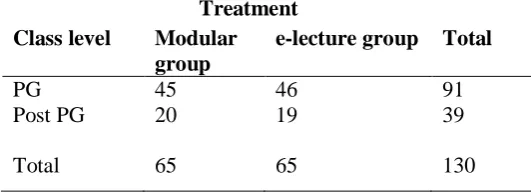
The purpose was to study the effect of Treatment, Locus of Control and their interaction on Achievement of Research Comprehension, Achievement of Research Skill and Overall Research Achievement in Educational Research when groups were equated on Pre-Achievement of Research Comprehension, Pre-Achievement of Research Skill and Overall Pre-Research Achievement in Educational Research respectively. The present study was Quasi- experimental in nature, designed on the lines of Non-Equivalent Control Group Design by Campbell and Stanley. The sample comprised of 130 students, out of these 91 were P.G. students and 39 were post P.G. students studying in different Institutions of Jammu and Kashmir. Out of 130 students, 45 P.G. students and 20 Post P.G. students constituted the Modular group while as 46 P.G. students and 19 Post P.G. students constituted the e-lecture group. Some common topics were taught to both the groups using different strategies of teaching viz., module and e-lecture. The Achievement of Research Comprehension and Research Skill of P.G. and Post P.G. students was assessed with the help of (i) Achievement of Research Comprehension Test and Research Skill Test in Educational Research developed by the researcher. The data related to Locus of Control was collected with the help of standardized tool Locus of Control developed by Roma pal. The data were analysed with the help of Two Way ANCOVA. The findings of the study were: (i) Modular Approach was found to be effective in terms of Achievement of Research Comprehension, Research Skill and Overall Research Skill in Educational Research as compared to e-lecture approach when groups were equated on Pre-Achievement of Research Comprehension, Pre-Achievement of Research Skill and Overall Pre-Research Achievement in Educational Research respectively. (ii) Locus of Control and its interaction with Treatment was found to have no significant influence on Achievement of Research Comprehension, Achievement of Research Skill and Overall Research Achievement in Educational Research when groups were equated on Pre-Achievement of Research Comprehension, Pre-Achievement of Research Skill and Overall Pre-Research Achievement in Educational Research respectively.
1. Doctoral Research Scholar, School of Education, DAVV, Indore, M.P. 2. Former, Professor, Head and Dean, School of Education, Indore, M.P.
1.0 Rationale of the Study
Since the principle of individualized instruction evolved, a number of attempts were made to find the effectiveness of various methods of instructions in context to support the
(Pg. 9301-9317)
Copyright © 2017, Scholarly Research Journal for Interdisciplinary Studies
individualized learning to overcome the individual differences. Module is one of the most popular forms of self instructional material. Many researches have been conducted abroad as well as in India which were developmental and experimental in nature. Researches conducted abroad as well as in India are stated under the captions given below:
Effectiveness of module
Effectiveness of other forms of self instructional material
Studies related to effectiveness of module which were conducted abroad as well as in India are given below:
Sharma (1982); Mollykutty (1991); Joshi (1999); Ahuja (2002); Chopra (2002); Shetty (2004); Londhey (2007); Maharana (2011)
All the above researches found modular approach of learning more effective than traditional mode of learning. Some researchers compared modular approach with other instructional mode and found as an effective mode of instruction than other mode of learning.
Studies related to effectiveness of other forms of instructional material:
Studies related to effectiveness of other forms of instructional material which were conducted abroad as well as in India are as follows:
Manocha (1990;) Mahapatra (1993); Prabhakar (1995); Moghe (1996); Ojha (1996); Danikhel (1997); Joshi (1997); Nath (1998); Antonisamy (1999); Kohal (1999); Zyoud (1999); Singh (2001); Thaker (2001); Mukherjee (2001); Shinde (2002); Dubey (2004); Das (2005); Kohli (2005); Rupsingh (2006); Tourani (2006); Asthana (2007); Parashar (2007); Shinde (2007); Gupta (2008); Lulla (2008); Gopal (2009); Sharma (2009); Tiwari (2012). All the above studies provided the findings that the learning instructional material was found superior to traditional method of learning.
(Pg. 9301-9317)
Copyright © 2017, Scholarly Research Journal for Interdisciplinary Studies
adopted self learning mode many years ago. These countries are well developed in the field of education. They have very flexible system of education. With the development of distance education and open learning system concepts, requirement of structured learning material increased. Open University like IGNOU (Indra Gandhi National Open University) developed material on different subjects but they were not research based. To get best results and make distance education more feasible it is necessary to develop research based module.
All these facts motivated the researcher to develop a module on fundamentals of Research Methodology and Statistics for research students in social science (including education) and study of its effectiveness in terms of achievement with selected variables.
2.0 OBJECTIVES
The objectives of the study were:
1. To study the effect of Treatment, Locus of Control and their interaction on Achievement of Research Comprehension in Educational Research by taking Pre-Achievement of Research Comprehension in Educational Research as Covariate. 2. To study the effect of Treatment, Locus of Control and their interaction on
Achievement of Research Skill in Educational Research by taking Pre-Achievement of Research Skill in Educational Research as Covariate.
3. To study the effect of Treatment, Locus of Control and their interaction on Overall Research Achievement in Educational Research by taking Overall Pre-Research Achievement in Educational Research as Covariate.
3.0 HYPOTHESES
Hypotheses of the study were:
1. There is no significant effect of Treatment, Locus of Control and their interaction on Achievement of Research Comprehension in Educational Research by taking Pre-Achievement of Research Comprehension in Educational Research as Covariate. 2. There is no significant effect of Treatment, Locus of Control and their interaction on
Achievement of Research Skill in Educational Research by taking Pre-Achievement of Research Skill in Educational Research as Covariate.
(Pg. 9301-9317)
Copyright © 2017, Scholarly Research Journal for Interdisciplinary Studies 4.0 Delimitations of the study
1. Module was developed in English language only.
2. The study was limited only to students of Education and social science disciplines. 3. The module was developed on some common selected topics prescribed in PG/Post
PG Students syllabi of Research Methodology and Statistics. 4. Research Concepts were limited to selected concepts such as:
Hypothesis testing
Parametric and Non-Parametric tests
Scales of Measurement
Tests of difference between means of two /k samples test
Paired samples and two Independent samples test
Non-Parametric counterpart of Independent and Correlated t-tests. 5.0 RESEARCH DESIGN
The present study being experimental in nature was designed on the lines of non equivalent control group design. Following was the layout of the design (Symbolic representation).
O X1 O
---
O X2 O
Where, X1 and X2 denote Modular and e-lectures Treatments respectively. O before X1 (Modular Treatment) and X2 (e-lecture Treatment) denotes pretest and O after X1 (Modular Treatment) and X2 (e-lecture Treatment) denotes post test. The dotted line denotes the two groups were not made equivalent before the experimentation. Before beginning the experiment, the Achievement Test I and Achievement Test II on Educational Research Concepts developed by the investigator was administered to the students of both groups i.e., Modular group as well as e-lectures group. Both the Modular and e-lecture groups were also administered Locus of Control tool in between. At the end of the experiment, the Achievement Test I and Achievement Test II were again administered on both Modular and e-lecture groups.
6.0 SAMPLE
(Pg. 9301-9317)
Copyright © 2017, Scholarly Research Journal for Interdisciplinary Studies
[image:5.595.164.430.314.411.2]of Kashmir, Central University of Kashmir, Nowgam Bypass Srinagar, Main Campus, University of Kashmir, Hazratbal Srinagar. The Universities were selected purposively. Then two groups were formed, namely, Modular group and e-lecture group on the basis of random assignment of Treatments to the half of the students of each Institute. The subjects of both PG and Post PG Course constituted the Modular group as well as the e-lecture group. The sample comprised of 130 students, out of these 91 were PG students and 39 were post PG students. Out of 130 students, 45 PG students and 20 Post PG students constituted the Modular group while as 46 PG students and 19 Post PG students constituted the e-lecture group. Both males and females were the part of the sample. The medium of the instruction was English only. The details of the sample are given in table 1.1 which is given below:
Table 1.1: Treatment/Group wise and class level wise distribution of sample:
Treatment
Class level Modular
group
e-lecture group Total
PG Post PG
45 20
46 19
91 39
Total 65 65 130
7.0 TOOL
7.1 Achievement of Research Comprehension Test in Educational Research (ARCTER):
Achievement of Research Comprehension Test in Educational Research comprised of 31 questions to assess the Achievement of Research Comprehension in Educational Research of subjects appropriately related to selected topics for the Module/e-lectures. The test was developed and standardized by the researcher. The questions were multiple-choice with each question having four alternatives to choose from. The language of the test was English only. The students were given 35 minutes to complete the Test. 1 marks was given for each correct answer of the question. The total weightage of the Test was 31 marks. There were no negative marking.
7.2 Achievement of Research Skills Test in Educational Research (ARSTER):
(Pg. 9301-9317)
Copyright © 2017, Scholarly Research Journal for Interdisciplinary Studies
Skill of the subjects of present study. The Test comprised of 10 questions/tasks on the basis of Research Skills listed below:
Formulation of Research Objective, Null Hypothesis and Directional Hypothesis.
Data entry
Testing assumptions underlying Statistical test
Running a statistical test
Editing the output
Interpreting the output
The Achievement of Research Skill of students was assessed on the basis of these tasks. Each task was carrying 5 marks. All questions carried equal marks. There was no negative marking. The language of the test was English only.
7.3 Locus of Control
A standardized Locus of control (Internal-External) Scale developed by Roma Pal was used for the assessment of locus of control of students. This scale is applicable for adolescents and adults. The scale consists of 35 pairs of items (statements) related to internal and external control of the student’s personality. The students were asked to go through the instructions carefully. The students were given 30-40 minutes to complete the test. The statements related to internal control were awarded one marks and the statements related to external control were awarded two marks. The students were asked not to leave any item unattempted. The language of the test was English only. The test-retest reliability of the scale has been reported to be 0.78 and the validity to be 0.77.
8.0 Procedure of the study
(Pg. 9301-9317)
Copyright © 2017, Scholarly Research Journal for Interdisciplinary Studies
and females were the part of the sample. The medium of the instruction was English only. The permission of the concerned Heads of above stated teaching departments was obtained before starting the experiment. At the beginning students were oriented about the experimentation with the objective of establishing rapport with them. The students of experimental group first and experimental group second were provided orientation about Modular approach and e-lectures approach respectively. Moreover, proper instructions were given to them to learn effectively.
8.1 Pretesting
Two tests were performed on both the groups and both tests were performed on the same day. I. Achievement of Research Comprehension Test in Educational Research was administered on the experimental groups first as well as on the experimental group second. There were 31 questions in the Achievement of Research Comprehension Test in Educational Research and the duration of the Test was 35 minutes.
II. Achievement of Research Skills Test in Educational Research was administered on the experimental group first as well as on the experimental group second. There were 10 questions in the Achievement of Research Skills Test in Educational Research where each question 5 marks and the duration of the Test was 60 minutes.
8.2 Treatment
After pretesting, the Treatment was given to the students of both experimental groups. Students of experimental group first were told about Modular approach while as Students of experimental group second were told about the e-lectures approach in Educational Research, which they were supposed to watch during the Treatment process.
(Pg. 9301-9317)
Copyright © 2017, Scholarly Research Journal for Interdisciplinary Studies
The students of second experimental group were allowed to watch e-lectures on selected topics one by one. They were also permitted to discuss and ask questions during the e-lectures. They were permitted to stop the e-lectures at any point of time they liked and if needed, they were allowed to repeat any portion of e-lectures as many times as they wished. All the students were provided a notebook and a ball point pen for jot down the important points during the e-lectures. The Treatment was given per day depending upon the duration of e-lecture. The Treatment process was continued for 20 days. After the completion of part of Treatment in class, each student of the experimental group second was asked to view of e-lecture on the different topics in Educational Research for the next six days. Thus each cycle was completed for a topic, the entire process taking up about 20 days excluding pre and post testing, holidays, revision days and administration of other tools.
Furthermore, both treatments were given per day. Modular Treatment was given in Ist half of the day while as e-lecture Treatment was given in IInd half. Same procedure was followed at other two experimental places. Thus, the complete process of experiment took 60 days. 8.3 Post-testing
After the completion of experimental process, Achievement of Research Comprehension Test in Educational Research and Achievement of Research Skills Test in Educational Research were administered on Modular group and e-lecture group. The Items in both the Tests were same as in Pretest and both the Tests were administered on the same day. In addition to Achievement of Research Comprehension Test and Achievement of Research Skills Test in Educational Research, a standardized Tool Locus of Control was administered on the students of both groups in between the experimental process. The scoring of the tools were done as per the scoring guide developed by the researcher for Achievement of Research Comprehension Test and Achievement of Research Skills Test in Educational Research while as scoring of tool Locus of Control was done as per the respective manual.
9.0 Data Analysis
The data was analysed objective wise by using Two Way Analysis Covariance (ANCOVA) for all the objectives.
10.0 Results and Interpretation
10.1 Effect of Treatment, Locus of Control and their Interaction on Achievement of
Research Comprehension in Educational Research by taking Pre-Achievement of
(Pg. 9301-9317)
Copyright © 2017, Scholarly Research Journal for Interdisciplinary Studies
The fourth objective was to study the effect of Treatment, Locus of Control and their Interaction on Achievement of Research Comprehension in Educational Research by taking Pre- Achievement of Research Comprehension in Educational Research as Covariate. There were two levels of Treatment, namely, Modular Group and e-lecture Group. Similarly, there were two levels of Locus of Control, namely, Internal Locus of Control and External Locus of Control. The data were analyzed with the help of 2×2 Factorial Design ANCOVA with unequal cells size. The results obtained are given in table 1.2 below:
Table 1.2: Summary of 2×2 Factorial Design ANCOVA with Unequal Cells Size of
Achievement of Research Comprehension in Educational Research by Taking
Pre-Achievement of Research Comprehension in Educational Research as Covariate
Source of
variation
df SS y.x
MSS y.x F y.x Sig.
Treatment 1 1722.22 1722.22 113.39 .000
Locus of Control 1 51.19 51.19 3.37 .069
Treatment× Locus of Control
1 7.68 7.68 .51 .478
Error 125 1898.43 15.19
Total 128
From the above table, it is evident that the adjusted value of F for Treatment on Achievement of Research Comprehension in Educational Research is 113.39 with df = (1, 127), whose p-value is less than 0.01. Therefore, it is significant at 0.01 level of significance. In this context, the null hypothesis that “there is no significant effect of Treatment on Achievement of Research Comprehension in Educational Research by taking Pre-Achievement of Research Comprehension in Educational Research as Covariate” is rejected. Thus the Modular group and the e-lecture group differ in their mean scores of Achievement of Research Comprehension in Educational Research when pre- Achievement of Research Comprehension in Educational Research was taken as Covariate.
In order to find out which group students have performed significantly better, the adjusted means of Modular Group and e-lecture Group were compared, which are given in table 1.3 below:
Table 1.3: Summary of Adjusted Means of Achievement of Research Comprehension in
Educational Research of Modular Group and the e-lecture Group
Treatment Adjusted Mean
Modular Group 22.10
(Pg. 9301-9317)
Copyright © 2017, Scholarly Research Journal for Interdisciplinary Studies
From the above table, it is evident that the adjusted mean score of Achievement of Research Comprehension in Educational Research Modular group is 22.10 which is significantly higher than that of the e-lecture Group whose mean score is 14.73. It, may, therefore be concluded that the adjusted mean score of Achievement of Research Comprehension in Educational Research of Modular group is significantly higher than that of e-lecture Group. Hence, Modular Approach has been effective in terms of Achievement of Research Comprehension in Educational Research as compared to e-lecture approach when Pre-Achievement of Research Comprehension in Educational Research was taken as covariate. From the above table, it is evident that adjusted F value for Locus of Control on Achievement of Research Comprehension in Educational Research by taking Pre- Achievement of Research Comprehension in Educational Research as Covariate is 3.37 with df = (1, 125), whose p-value is .069 which is greater than 0.05. Therefore, it is not significant at 0.05 level of significance. In the light of this the null hypothesis that “there is no significant effect of Locus of Control on Achievement of Research Comprehension in Educational research by taking pre-Achievement of Research Comprehension in Educational Research as Covariate” is not rejected. It reflects that mean scores of Achievement of Research Comprehension in Educational Research of Internal and External Locus of Control students by taking pre-Achievement of Research Comprehension in Educational Research as Covariate do not differ significantly. It may, therefore, be concluded that Locus of Control was found to have no significant influence on Achievement of Research Comprehension in Educational Research when Pre-Achievement of Research Comprehension was taken as Covariate.
(Pg. 9301-9317)
Copyright © 2017, Scholarly Research Journal for Interdisciplinary Studies
Achievement of Research Comprehension in Educational Research as Covariate do not differ significantly. It may, therefore, be concluded that Locus of Control was found to have no significant influence on Achievement of Research Comprehension in Educational Research when Pre-Achievement of Research Comprehension was taken as Covariate.
10.2: Effect of Treatment, Locus of Control and their interaction on Achievement of
Research Skill in Educational Research by taking Pre- Achievement of Research Skill in
Educational Research as Covariate.
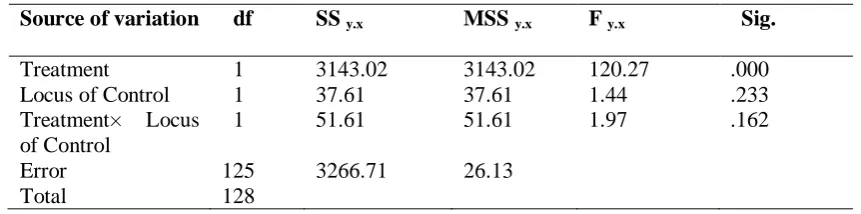
[image:11.595.82.513.454.561.2]The fifth objective was to study the effect of Treatment, Locus of Control and their Interaction on Achievement of Research Skill in Educational Research by taking Pre-Achievement of Research Skill in Educational Research as Covariate. There were two levels of Treatment, namely, Modular Group and e-lecture Group. Similarly, there were two levels of Locus of Control, namely, Internal Locus of Control and External Locus of Control. The data were analyzed with the help of 2×2 Factorial Design ANCOVA with unequal cells size. The results obtained are given in table 1.4 below:
Table 1.4: Summary of 2×2 Factorial Design ANCOVA with Unequal Cells Size of
Achievement of Research Skill in Educational Research by Taking Pre-Achievement of
Research Skill in Educational Research as Covariate
Source of variation df SS y.x
MSS y.x F y.x Sig.
Treatment 1 3143.02 3143.02 120.27 .000
Locus of Control 1 37.61 37.61 1.44 .233
Treatment× Locus of Control
1 51.61 51.61 1.97 .162
Error 125 3266.71 26.13
Total 128
From the above table, it is evident that the adjusted value of F for Treatment on
(Pg. 9301-9317)
Copyright © 2017, Scholarly Research Journal for Interdisciplinary Studies
In order to find out which group students have performed significantly better, the adjusted means of Modular Group and e-lecture Group were compared, which are given in table 1.5 below:
Table 1.5: Summary of Adjusted Means of Achievement of Research Skill in
Educational Research of Modular Group and the e-lecture Group
Treatment Adjusted Mean
Modular Group 32.00
e-lecture Group 21.19
From the above table, it is evident that the adjusted mean score of Achievement of Research Skill in Educational Research Modular group is 32.00 which is significantly higher than that of the e-lecture Group whose mean score is 21.19. It, may, therefore be concluded that the adjusted mean score of Achievement of Research Skill in Educational Research of Modular group is significantly higher than that of e-lecture Group. Hence, Modular Approach has been effective in terms of Achievement of Research Skill in Educational Research as compared to e-lecture approach when Pre-Achievement of Research Skill in Educational Research was taken as Covariate.
(Pg. 9301-9317)
Copyright © 2017, Scholarly Research Journal for Interdisciplinary Studies
0.05 level of significance. In the light of this the null hypothesis that “there is no significant effect of Interaction between Treatment and Locus of Control on Achievement of Research Skill in Educational research by taking Pre-Achievement of Research Skill in Educational Research as Covariate” is not rejected. It reflects that mean scores of Achievement of Research Skill in Educational Research of Internal and External Locus of Control students by taking pre-Achievement of Research Skill in Educational Research as Covariate do not differ significantly. It may, therefore, be concluded that Locus of Control was found to have no significant influence on Achievement of Research Skill in Educational Research when Pre-Achievement of Research Skill was taken as Covariate.
10.3: Effect of Treatment, Locus of Control and their interaction on Overall Research
Achievement in Educational Research by taking Overall Pre-Research Achievement in
Educational Research as covariate.
The sixth objective was to study the effect of Treatment, Locus of Control and their interaction on Overall Research Achievement in Educational Research by taking Overall Pre-Research Achievement in Educational Pre-Research as covariate. There were two levels of Treatment, namely, Modular Group and e-lecture Group. Similarly, there were two levels of Locus of Control, namely, internal and External Locus of Control students. The data were analyzed with the help of 2×2 Factorial Design ANCOVA with unequal cells size. The results obtained are given in table 1.6 below:
Table 1.6: Summary of 2×2 Factorial Design ANCOVA with Unequal Cells Size of
Overall Research Achievement in Educational Research by Taking Overall
Pre-Research Achievement in Educational Pre-Research as Covariate
Source of variation df SS y.x
MSS y.x F y.x Sig.
Treatment 1 9374.55 9374.55 197.13 .000
Locus of Control 1 3.01 3.01 .06 .802
Treatment× Locus
of Control
1 11.07 11.07 .23 .630
Error 125 5944.33 47.56
Total 128
From the above table, it is evident that the adjusted value of F for Overall Research
(Pg. 9301-9317)
Copyright © 2017, Scholarly Research Journal for Interdisciplinary Studies
Research as Covariate” is rejected. Thus the Modular group and the e-lecture group differ in their mean scores of Overall Research Achievement in Educational Research when Overall Pre- Research Achievement in Educational Research was taken as covariate.
In order to find out which group students have performed significantly better, the adjusted means of Modular Group and e-lecture Group were compared, which are given in table 1.7 below:
Table 1.7: Summary of Adjusted Means of Overall Research Achievement in
Educational Research of Modular Group and the e-lecture Group
Treatment Adjusted Mean
Modular Group 54.06
e-lecture Group 35.97
From the above table, it is evident that the adjusted mean score of Overall Research Achievement in Educational Research of Modular group is 54.06 which is significantly higher than that of the e-lecture Group whose mean score is 35.97. It, may, therefore be concluded that the adjusted mean score of Overall Research Achievement in Educational Research of Modular group is significantly higher than that of e-lecture Group. Hence, Treatment (Modular Approach) has been effective in terms of Overall Research Achievement in Educational Research when Overall Pre-Research Achievement in Educational Research was taken as Covariate.
(Pg. 9301-9317)
Copyright © 2017, Scholarly Research Journal for Interdisciplinary Studies
From the above table, it is evident that adjusted F value for the Interaction between Treatment and Locus of Control on Overall Research Achievement in Educational Research by taking Overall Pre-Research Achievement of in Educational Research as Covariate is .23 with df = (1, 125), whose p-value is .630 which is greater than 0.05. Therefore, it is not significant at 0.05 level of significance. In the light of this the null hypothesis that “there is no significant effect of Interaction between Treatment and Locus of Control on Overall Research Achievement in Educational research by taking Overall Pre-Research Achievement in Educational Research as Covariate” is not rejected. It reflects that mean scores of Overall Research Achievement in Educational Research of Internal and External Locus of Control students by taking Overall Pre-Research Achievement in Educational Research as Covariate do not differ significantly. It may, therefore, be concluded that Locus of Control was found to have no significant influence on Overall Research Achievement in Educational Research when Overall Pre-Research Achievement in Educational Research was taken as Covariate. 11.0 Findings and Discussion
The findings obtained from the interpretation of results above are as follows:
1. Modular Approach was found to be effective in terms of Achievement of Research Comprehension, Research Skill and Overall Research Skill in Educational Research as compared to e-lecture approach when groups were equated on Pre-Achievement of Research Comprehension, Pre-Achievement of Research Skill and Overall Pre-Research Achievement in Educational Research respectively.
2. Locus of Control and its interaction with Treatment was found to have no significant influence on Achievement of Research Comprehension in Educational Research when groups were equated on Pre-Achievement of Research Comprehension in Educational Research.
3. Locus of Control and its interaction with Treatment was found to have no significant influence on Achievement of Research Skill in Educational Research when groups were equated on Pre-Achievement of Research Skill in Educational.
4. Locus of Control and its interaction with Treatment was found to have no significant influence on Overall Research Achievement of in Educational Research when groups were equated on Overall Pre-Research Achievement in Educational Research.
(Pg. 9301-9317)
Copyright © 2017, Scholarly Research Journal for Interdisciplinary Studies
who found learning through Module was significantly effective than learning through traditional method. The students who were exposed to Modular Approach on Educational Research Concepts (Statistical Concepts) in Educational Research have performed better than the students who were exposed to e-lectures. The students studying the subject Research Methodology and Statistics at their own pace because they were free to raise any point at any point of time. They had an opportunity to discuss among themselves as well as with the teacher and researcher. The researcher clarifies the doubts of the students. The students of Modular group have enough opportunity to actively practice as they were supposed to carry out the different tasks / activities related objective writing, hypothesis framing, writing interpretation and writing suitable output while as this opportunity was not with the students of e-lecture group. Students showed more interest in solving the practice examples as they could know the answers which were given in the end of every capsule of the module. So there was more possibility that students studied through Modular Approach may have enhanced their Overall Research Achievement in Educational Research because in the present study the Overall Research Achievement in Educational Research was treated as the sum total of Achievement of Research Comprehension and Research Skill in Educational Research. Moreover, the module was written in very simple and lucid language. Most of the times the students of e-lecture group had no opportunity to get clarification regarding all the subject matter while as this opportunity was clearly with the students of Modular group. Some of the students of e-lecture group experience difficulty in following the accent of the speaker and even the language which is not the case with module. The above differences in learning with two different strategies might have been responsible for the present finding.
(Pg. 9301-9317)
Copyright © 2017, Scholarly Research Journal for Interdisciplinary Studies
Overall Research Achievement in Educational Research of Internal Locus of Control and External Locus of Control students. The findings indicate that the Locus of Control may not be kept in mind while preparing the Module on Educational Research Concepts (Statistical Concepts) in Educational Research. This might be due to the fact that Module on Educational Research Concepts (Statistical Concepts) in Educational Research was same for both Internal Locus of Control and External Locus of Control students in respect of contents and examples etc. Further, the freedom of learning through Module on Educational Research Concepts (Statistical Concepts) in Educational Research was same for both Internal Locus of Control and External Locus of Control students. These days due to competition both Internal Locus of Control and External Locus of Control students become conscious of their self development. So they do not miss any opportunity to develop their Overall Research concepts through Modular Approach. Even parents and teachers encourage both Internal Locus of Control and External Locus of Control students to do as best as possible. The peer group pressure and decision also contributes in taking maximum benefit from such a new innovative type of treatment. Some of above observations might be responsible for the present findings.
12.0 References:
Agrawal, R. (1995). A Comparative study of Conceptual Understanding by programmed instruction and Computer Assisted Instruction. Doctoral thesis, VI Survey of Educational Research. Ahuja, P. (2002). Effect of Self Learning Modules on Achievement in Environmental Education in
relation to altruism and emotional intelligence. Doctoral thesis, Punjab University.
Chopra, N. (2002). Development of Self Instructional Module to enhence communication skills of collage principles. Unpublished Ph.D. thesis, M.S. University, Ahmedabad.
Das, S. (2005). A study of effectiveness of Educational Television (ETV) in teaching of Mathematics in schools of Delhi. Doctoral thesis, Vishva-Bharti.
Dubey, C. (2004). Study of effectiveness of Educational Material related to Indian National Heritage for the students of class VIII. Doctoral thesis, University of Lukhnow.
Gopal, P. (2009). Effectiveness of Computer Assisted Instructional Material in English grammer for secondary school students on the basis of Achievement in English and written expression power in English. Unpublished Ph.D. thesis, D.A.V.V., Indore.
Gupta, C. (2008). Effectiveness of Video Instructional Material for the development of Social values amongst undergraduate students. Unpublished Ph.D. thesis, D.A.V.V., Indore.
Joshi, K. (1999). Development of Module on Educational Technology, its Effectiveness and Comparison with Traditional Method in terms of Scholastic Achievement at B.ED level. Unpublished Ph.D. thesis, D.A.V.V., Indore.
(Pg. 9301-9317)
Copyright © 2017, Scholarly Research Journal for Interdisciplinary Studies
Joshi, V.K. (1995). A comparative study of effectiveness of Audio-Visual stimuli in context of science technology. Doctoral thesis, VI Survey of Educational Research.
Kohal, V. (1999). Effectiveness of self learning modules on Achievement in Geography in relation to Mastery and Non-Mastery teaching strategies, Intelligence and study habits. Unpublished Ph.D. thesis, Punjab University.
Londhey, U. (2007). A study of effectiveness of Modular Approach for teaching Science to class IX students in terms of their Achievement and Reactions towards Modular Approach. Unpublished Ph.D. thesis, D.A.V.V., Indore.
Mahaparta, B.C. (1993). Development of Software Package for Teaching Chemistry to class IX students of M.P.State. Unpublished Ph.D. thesis, D.A.V.V., Indore.
Maharana, N. (2011). Comparative effectiveness of with and without Jerk Technology Module on Environmental Education in terms of Achievement in Environmental Education on B.Ed. trainees. Unpublished Ph.D. thesis, D.A.V.V., Indore.
Mullykutty, T.M. (1991). Effectiveness of Modular Approach in teaching education and requisites for implementation. Unpublished Ph.D. thesis, University of Kerala.
Sharma, J.P. (1987). Developing Instructional Material in Civics at 10+2 level for Pre-service and in-service teacher’s. Unpublished Ph.D. thesis, D.A.V.V., Indore.
Sharma, U. (2015). Effectiveness of Instructional Material based on Thinking Skill of identifying the pros/cons in terms of student’s Cognitive and Affective Domain related variables at secondary school level. The sample comprised of 82 class IX students. Unpublished Ph.D. Thesis, D.A.V.V., Indore.
Sharma, Y. (2009). Developing Strategy for Fostering Mathematical Creativity among class IX students. Unpublished Ph.D. Thesis, D.A.V.V., Indore.
Shinde, J. (2002). Effectiveness of Multimedia CAI Package with reference to levels of interactivity and Learning Styles. Ph.D. thesis, VI Survey of Educational Research.
Shinde, L. (2007). Effectiveness of Video Instructional Material on Research Methodology and Statistics in terms of Achievement and Reaction towards Video Instructional Material on Research Methodology and Statistics. Unpublished Ph.D. thesis, D.A.V.V., Indore.
Shetty, A.D. (2004). Development of Self Instructional Module on Staff Development for the Secondary School Principals. Ph.D. thesis, M.S. University, Ahmedabad.
Thakod, J.A. (1998). A comparative study of the teaching of English in the high and low achieving secondary schools of Gujarat. Doctoral thesis, VI Survey of Educational Research.
Tiwari, K. (2012). Effectiveness of development web based Instruction on Reasoning in terms of Reasoning and Reaction towards developed Web Based Instruction on Reasoning of learners. Unpublished Ph.D. thesis, D.A.V.V., Indore.
Prabhakar, S. (1995). Development of software for computer aided instruction and its comparison with traditional method for teaching physics at plus II level. Unpublished Ph.D. thesis, D.A.V.V, Indore.