Middle and Secondary Education Dissertations Department of Middle and Secondary Education
1-8-2016
Take Me Out to the Ballgame: Adolescents' Insights
About Engagement with Sports Texts in a
Voluntary Sports Reading Club
Kevin J. Powell
Follow this and additional works at:https://scholarworks.gsu.edu/mse_diss
This Dissertation is brought to you for free and open access by the Department of Middle and Secondary Education at ScholarWorks @ Georgia State University. It has been accepted for inclusion in Middle and Secondary Education Dissertations by an authorized administrator of ScholarWorks @ Georgia State University. For more information, please [email protected].
Recommended Citation
Powell, Kevin J., "Take Me Out to the Ballgame: Adolescents' Insights About Engagement with Sports Texts in a Voluntary Sports Reading Club." Dissertation, Georgia State University, 2016.
This dissertation, TAKE ME OUT TO THE BALLGAME: ADOLESCENTS’ INSIGHTS
ABOUT ENGAGEMENT WITH SPORTS TEXTS IN A VOLUNTARY SPORTS READING
CLUB, by KEVIN POWELL, was prepared under the direction of the candidate’s Dissertation
Advisory Committee. It is accepted by the committee members in partial fulfillment of the
requirements for the degree, Doctor of Philosophy, in the College of Education and Human
Development, Georgia State University.
The Dissertation Advisory Committee and the student’s Department Chairperson, as
representatives of the faculty, certify that this dissertation has met all standards of excellence and
scholarship as determined by the faculty.
_________________________________
Ewa McGrail, Ph.D.
Committee Chair
____________________________________ _________________________________
Peggy Albers, Ph.D. Michelle Zoss, Ph.D.
Committee Member Committee Member
____________________________________
Gabriel Kuperminc, Ph.D.
Committee Member
____________________________________
Date
_________________________________
Gertrude Tinker Sachs, Ph.D.
Chairperson, Department of Middle and Secondary Education
_________________________________
By presenting this dissertation as a partial fulfillment of the requirements for the advanced degree
from Georgia State University, I agree that the library of Georgia State University shall make it
available for inspection and circulation in accordance with its regulations governing materials of
this type. I agree that permission to quote, to copy from, or to publish this dissertation may be
granted by the professor under whose direction it was written, by the College of Education and
Human Development’s Director of Graduate Studies, or by me. Such quoting, copying, or
publishing must be solely for scholarly purposes and will not involve potential financial gain. It is
understood that any copying from or publication of this dissertation which involves potential
financial gain will not be allowed without my written permission.
All dissertations deposited in the Georgia State University library must be used in
accordance with the stipulations prescribed by the author in the preceding statement. The author
of this dissertation is:
Kevin J. Powell
544 E. Ponce de Leon Avenue Decatur, GA 30030
The director of this dissertation is:
Ewa McGrail, Ph.D.
Department of Middle and Secondary Education College of Education and Human Development
Kevin Josef Powell
ADDRESS 544 E. Ponce de Leon Avenue Decatur, Georgia 30030
EDUCATION
PROFESSIONAL EXPERIENCE
2011-2013 Teaching Assistant Georgia State University
2004-2011 Teacher Librarian
DeKalb County School System
2003-2004 Language Arts Teacher
Gwinnett County School System
PUBLICATIONS
Powell, K.J. (2015). Understanding adolescents’ interest in sports texts. Manuscript submitted for publication.
McGrail, E. & Powell, K.J. (2014). Curation of digitized artifacts in the study of historical fiction. Teacher Librarian, 41(4), 37-41.
Powell, K.J. & McGrail, E. (2013). Using artifacts to study historical and realistic children’s and adolescent fiction in the classroom. Language Arts Journal of Michigan, 28(2), 41-46.
Ph.D. 2015 Georgia State University Language and Literacy
M.Ed. 2003 University of Georgia Instructional Technology
A.B.
B.S.Ed.
2002
2000
University of Georgia English
University of Georgia
PRESENTATIONS
Powell, K.J. (2013, November). Exploring open source software for visual communication at Annual Convention of National Council of Teachers of English, Boston, MA.
Powell, K.J. (2013, March). Using sport texts to explore difficult topics with upper elementary and middle school boys at Georgia Conference on Children’s Literature, Athens, GA.
Powell, K.J. (2012, November). Exploring online primary sources in literature instruction at Annual Convention of National Council of Teachers of English, Las Vegas, NV.
McGrail, E., & Powell, K.J. (2012, March). Teaching literature with artifacts using social bookmarking services: Encouraging exchange of information and communities of support at Georgia International Conference on Information Literacy, Savannah, GA.
Powell, K.J., & McGrail, E. (2012, March). Using artifacts to connect students to the literature they study at Annual Conference on Literature for Children and Young Adults, Kennesaw, GA.
Powell, K.J. (2009, October). Using Apple’s iMovie and Garage Band to improve student writing and speaking skills at Georgia Council of Media Organizations Annual Conference, Columbus, GA.
PROFESSIONAL SERVICE
Member: National Council of Teachers of English, International Reading Association, and American Association of School Librarians
2014 Reviewer, Journal of Adolescent and Adult Literacy
2012-2013 Editorial Assistant, New Methods of Literacy Research eds. Albers & Flint
ENGAGEMENT WITH SPORTS TEXTS IN A VOLUNTARY SPORTS READING CLUB
by
KEVIN POWELL
Under the Direction of Ewa McGrail, Ph.D.
ABSTRACT
Adolescent disengagement in school and school-related activities continues to be a
national problem (Christenson, Reschly, & Wylie, 2012; Center for Evaluation and Education
Policy, 2009). Recent research has shown that allowing choice in what adolescents read in school
and school-related activities strengthens student engagement (Kittle, 2013; Lee, 2011; Miller,
2009). Much of this literature, however, does not adequately explore the potential of sports texts
to foster engaged reading by exploring the cognitive, behavioral, emotional, and agentic
components of engagement (Finn, 2012; Yin & Moore, 2004). In addition, researchers have yet to
emphasize adolescent voices via qualitative inquiry to add to the knowledge base of student
engagement with sports texts (Fredricks, 2004; Ivey & Johnston, 2013). Therefore, educators,
teacher educators, administrators, and policymakers need an understanding of the potential to
generate interest in adolescents’ engagement with sports texts.
Framed by Rosenblatt's (1994) transactional theory of reading, this qualitative case study
(1) What were the indicators of engagement when selected adolescents interacted with sports
texts? (2) What contextual factors brought about the features of student engagement when
adolescents explored sports texts?
Participants in this study included three adolescent sports enthusiasts, and data collection
occurred November-December 2014 during the 2014-2015 school year. Data sources included
semi-structured interviews, participant observation during club meetings, session observation
using audio and video recording, and participant journals. Using an evaluative approach to text
analysis that involved assessing, categorizing, and evaluating content (Kuckartz, 2014), I found
the participants’ engagement with sports texts was varied based on their thinking, emotions,
behavior, and sense of agency communicated in the program. Findings suggest that adolescent
sports enthusiasts may benefit from opportunities to use sports texts to show their engagement in
semi-structured reading and discussion programs through the connections and responses to the
texts they read. Findings also suggest that maintaining engagement over a six-week program is a
difficult endeavor. Providing almost all-out choice, a casual space to talk and discuss texts, and
acknowledging the social dynamics of the group may strengthen engagement in school,
afterschool, and community small group reading programs. Finally, the study emphasized the
important role that teachers and other adults can play in providing an environment for rich
discussion and response by focusing on the features of student engagement.
TAKE ME OUT TO THE BALLGAME: ADOLESCENTS’ INSIGHTS ABOUT
ENGAGEMENT WITH SPORTS TEXTS IN A VOLUNTARY SPORTS READING CLUB
by
KEVIN POWELL
A Dissertation
Presented in Partial Fulfillment of Requirements for the
Degree of
Doctor of Philosophy
in
Teaching and Learning
in
The Department of Middle and Secondary Education
in
the College of Education and Human Development
Georgia State University
Copyright by Kevin J. Powell
ACKNOWLEDGMENTS
To the members of my committee, especially Dr. Ewa McGrail, for their tremendously
thoughtful feedback and for helping me develop my thinking about literacy and engagement.
To my colleagues, especially Tara Campbell, for being there to share ideas and to share
what to expect next in the dissertation process. It has been great to meet so many thoughtful and
passionate classmates and friends throughout my time as a doctoral student.
To my participants, for their love of sports and willingness to share their time, thoughts,
and conversations with me.
To Elliot and Corinne, for their abundant supply of smiles and giggles.
TABLE OF CONTENTS
LIST OF TABLES……….……...V LIST OF FIGURES………... VI
1 INTRODUCTION ...1
Problem ...4
Theoretical Framework ...10
Purpose of the Study…...13
Research Questions………...14
Overview of the Study….. ...14
Definition of Terms………...15
2 REVIEW OF THE LITERATURE ...17
What is Student Engagement? ... 18
Engaged Reading ... 31
Sports Texts and Engaged Reading ... 40
Context in Student Engagement Research ... 44
3 METHODOLOGY ...48
Research Setting ...50
Participant Selection ...52
Data Collection...61
Data Analysis...81
Role of the Researcher ... 89
Ethical Considerations…...90
4 FINDINGS ...97
Profile of Cameron ... 98
Profile of Joshua ... 120
Profile of Khalil ... 140
Cross Case Analysis ... 157
Chapter Summary ... 184
5 DISCUSSION ...185
Conclusions...186
Implications for Practice...210
Implications for Further Research...220
REFERENCES...227
LIST OF TABLES
1 Components of Engagement………..………19
2 Data Sources………..………61
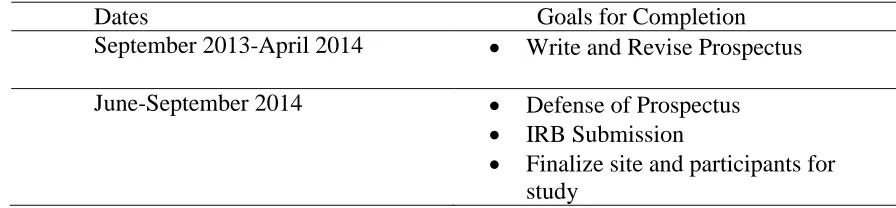
3 Timeline for Study………..…………...95
4 Cameron’s Engagement Moments Inventory………..…………101
5 Joshua’s Engagement Moments Inventory………..………123
6 Khalil’s Engagement Moments Inventory………..……….144
7 Overview of Participants………...………...156
8 Total Engagement Numbers for the Three Focal Participants………..………...158
LIST OF FIGURES
1 Guide Notes……….………..55
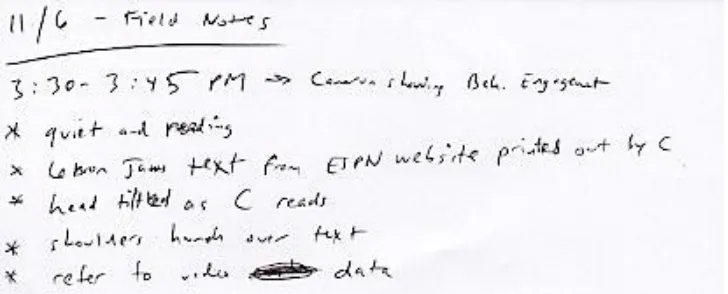
2 Example of Field notes for Cameron………...………..71
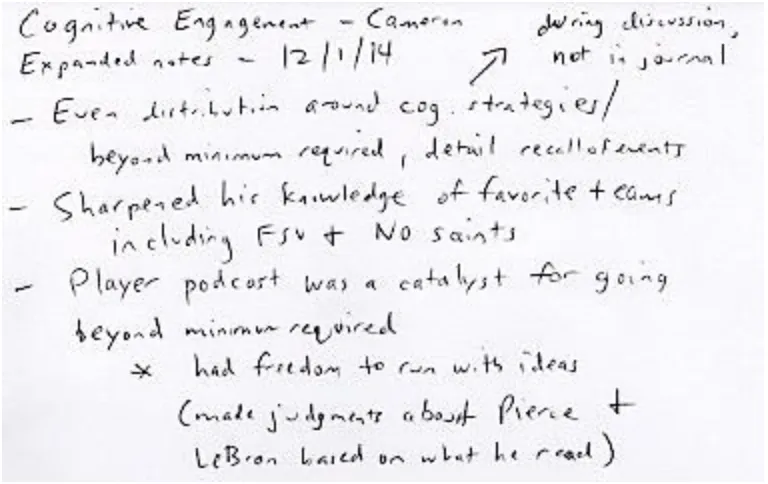
3 Example of Expanded Observation Notes of Cameron….………72
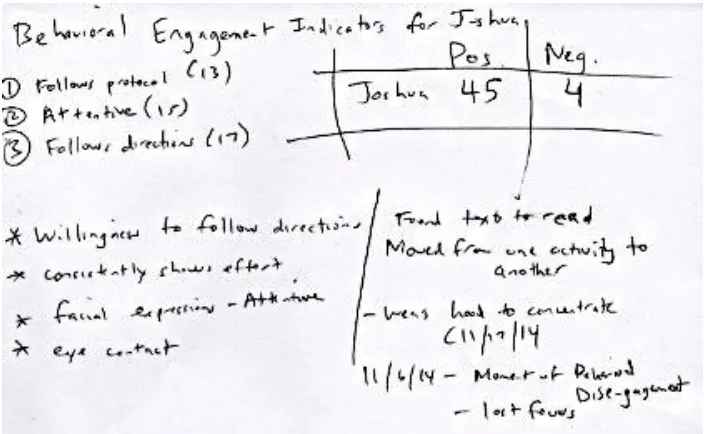
4 Observational Notes for Joshua’s Indicators of Behavioral Engagement……….………76
5 Joshua’s Reaction Journal Entry………..……...………...79
6 Khalil’s Illustration in Reaction Journal………...…………..………...80
7 First Cycle Coding Example………...…..……….82
8 Second Cycle Coding and Evaluative Analysis of Data………...……….83
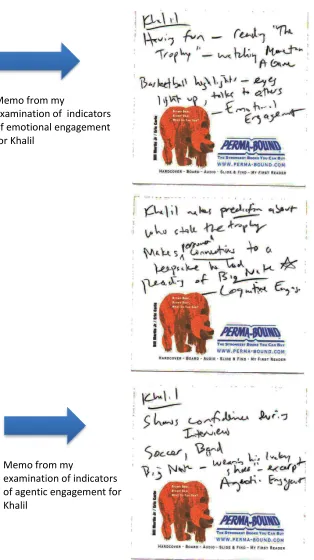
9 Examples of Memos from Data Analysis……….………..………...86
10 Cameron Showing Behavioral Engagement During Reading Time………..……..……112
11 Cameron Showing Behavioral Engagement During Discussion…...……...…...…....113
12 Joshua’s Digital Presentation of Kevin Durant………...………..………...126
13 Joshua Showing Behavioral Engagement During the Club……….……..…...…...131
14 Joshua and Cameron Showing Behavioral Engagement During Discussion Time...132
15 Joshua and Khalil Reading During the Club……….……..…….133
16 Khalil Showing Behavioral Engagement During Reading Time………….………...….151
1 INTRODUCTION TO THE STUDY
Adolescent disengagement in school and school-related activities continues to be a
national problem (Center for Evaluation & Education Policy, 2009; Christenson, Reschly, &
Wylie, 2012). In a study conducted by the Center for Evaluation and Education Policy at Indiana
University, 66% of students reported being bored at school a minimum of one or more times
every day, and 17% reported being bored in every class (2009). Adolescents often find the
curriculum taught in school uninteresting, and they often have negative views of school and their
teachers (Christenson, Reschly, & Wylie, 2012; Flutter & Rudduck, 2004; Intrator & Kunzman,
2009). In the most serious cases of student disengagement, students simply give up and drop out
of school (Center for Evaluation & Education Policy, 2009). Over 3 million students in the
United States drop out of school each year, and those who drop out earn up to 41 percent less
than people who have graduated from high school or earned a GED (U.S. Census Bureau,
American Community Survey, 2009).
Therefore, researchers have pointed to the concept of student engagement as a possible
focus for strategies to reduce student disengagement and reduce the dropout rate in the United
States (Christensen, 2008; Christenson, Reschly, & Wylie, 2012). Researchers have found
significant correlations between students’ reported levels of engagement and their risk of
dropping out of school (Center for Evaluation & Education Policy, 2009; Skinner & Furrer,
2008). In a report by the Center for Evaluation and Education Policy at Indiana University
(2009), researchers asked 81,499 students in 110 schools a variety of questions about
engagement in school. Of the students surveyed, 22% considered dropping out of high school.
Among those students, a large majority of students considered dropping out because they did not
did at school (60%); more considered dropping out for those reasons than because of family
concerns (42%) or needing money (35%). Researchers have found that student disengagement
often has cascading effects over years of schooling as students’ grades, attendance, and reading
scores suffer (Ripski & Gregory, 2009; Roby, 2004). When students’ grades and attendance
suffer, disengagement increases, and a recent national study found that student disengagement
increases by 10% from 8th grade to 10th grade alone (Kelly & Price, 2014).
Understanding the construct of student engagement is not only important to dropout
prevention, but it is also essential to understanding what students learn (Appleton, Christenson,
& Furlong, 2008). Measuring student engagement is a multifaceted construct that has been
referred to as an alternative to top down test-driven reform measures such as No Child Left
Behind (2001) and Race to the Top (2008). Researchers have argued that measuring student
engagement instead of relying on standardized test scores may better show the full scope of what
and how students learn (Finn & Zimmer, 2012; Ivey & Johnston, 2013). When educators,
administrators, and policymakers focus on test scores, researchers have found that they do not
give enough attention to the multifaceted qualities of engagement (Shernoff, 2010).
Within the literature on student engagement, researchers have also found that allowing
adolescents to choose what they read has a dramatic effect on deepening engagement (Beers,
2001; Ivey & Johnston, 2013; Kittle, 2013; Miller, 2009). The current body of research on
student engagement with texts provides a rich basis for the many ways engaged reading occurs
when adolescents have opportunities to explore texts of their choosing (Christenson, Reschly, &
Wylie, 2012; Intrator & Kunzman, 2009). When students choose their own texts, they are more
likely to show interest in the text at hand, to show changes in their identities, and to gain a
2008). For example, Lee (2011) evaluated the impact of an independent reading program on
students’ attitudes and practices. She found that five factors influenced student engagement as
adolescents participated in a sustained silent reading (SSR) program: distributed time, conducive
environment, appeal, access, encouragement, and non-accountability. Lee concluded that SSR is
often criticized, but also found that if teachers focus more on implementation, SSR can be
beneficial. Developing an effective independent reading program takes preparation, time, and
patience. For independent reading time to be successful, she found that teachers should
encourage independent practice, read aloud to students, and provide meaningful feedback. Lee,
however, took an instructional approach to her research; the research was designed as a case
study to examine instructional practices surrounding SSR, not as an analysis of adolescent voices
in a sports reading club. Additionally, Lee did not conduct an in-depth analysis of what happens
within the multifaceted components of engagement when adolescents have the opportunity to
read texts of their choosing. Intrator and Kunzman (2009) offered that researchers often fail to
address that adolescents are “self-conscious, observant, critical consumers of educational
experience” (p. 29). They have unique, often untapped perspectives on what is happening in
today’s schools.
Ivey and Johnston (2013) found that changes in student engagement occurred when
teachers gave students opportunities to read young adult titles of their own choosing at their own
pace, especially with regard to students’ sense of agency and identity formation. In addition, Ivey
and Johnston (2013) voiced concern about the traditional approaches to reading instruction,
especially when students and teachers all read the same book at the same time. They found
mixed results with this whole class approach: a number of students in the study showed
about the construct of adolescents’ engagement with texts including the effect adolescents’
independent reading has on agency and identity, and found that when adolescents read the same
book at the same time it may inhibit engaged reading. Importantly, Ivey and Johnston’s (2013)
research was limited to students choosing texts with subject matter they were not excited about.
However, providing opportunities for sports enthusiasts to choose sports texts creates a built-in
sense of interest. Additionally, Ivey and Johnston (2013) did not explore what researchers still
need to know about student engagement as it applies to sports enthusiasts’ engagement with
sports texts. In addition to Lee (2011) and Ivey and Johnston (2013), other researchers have
come to similar conclusions about the effectiveness of choice on strengthening engaged reading
(Beach, Campano, & Edmiston, 2010; Groenke & Scherff, 2010; Kittle, 2013). The consensus
from the research findings is that choice is an essential component to fostering engaged reading,
while providing time to read, meaningful feedback, modeling, clear goals, a sense of autonomy,
and other variables were also important components for eliciting engagement with reading. Yet,
these studies often did not adequately seek adolescent voices in the analysis of student
engagement, especially as it applied to adolescents’ engaged reading of sports texts.
Problem
When I was an adolescent, sports played a pivotal role in my life. I played sports every
day after school. I also played hours of sports video games, collected and traded baseball cards,
watched sports-themed movies, and read innumerable books about sports. Unfortunately, as an
adolescent I did not have opportunities to read and talk about sports and sports texts in school
and school-related activities. As such, I believe there is an avenue of research unexplored on
adolescents’ engagement in reading and responding to sports texts. A growing number of
school-related activities by acknowledging adolescents’ interest in sports texts (Alvermann,
2004; Baker, 2007; Crowe, 2001; Dannen, 2012). Engagement with sports texts can promote
“buy in” for adolescent sports enthusiasts, it can offer exposure to a number of themes of the
human condition, and it can offer opportunities to explore difficult issues (Alvermann,
Huddleston, & Hagood, 2004; Crowe, 2004; Dannen, 2012; Schneider, 2011). For example,
Dannen (2012) took a critical thinking approach by using her students’ conversations about
popular sports media texts to teach argumentation skills. Baker (2007) took a holistic approach to
using sports texts by exploring the three pedagogical discourses he worked within at school: the
poetry club he sponsored, the basketball team he coached, and the English language arts class he
taught. He found the melding of these discourses made him a better teacher and athletics coach.
The existing research on adolescents and sports texts, however, is primarily focused on
instructional practices (Beach, Campano, & Edmiston, 2010; Harvey & Daniels, 2009; Kittle,
2013; Kuhn & Crowell, 2011) as they applied to using sports texts in the classroom; it is not
focused on listening to adolescents to understand the extent to which they are engaged by
reading of sports texts. By emphasizing adolescent voices through observation, interviews, and
discussions in small groups, and analyzing adolescents’ engaged reading of sports texts with
existing research on engaged reading of texts, the present study added to our understanding of
adolescent sports enthusiasts’ engagement with sports texts. For example, a number of recent
studies on engagement with texts focused primarily on one of the cornerstones (cognitive,
behavioral, emotional, and agentic) of engagement (Blackwell, Trzesniewski, & Dweck,
2007; Guthrie, Wigfield, & You 2012; Voekl, 2012). Instead, this study focused on the
interaction that happens in the following four areas within the field of student engagement: (a)
engaged reading of sports texts, (c) engaged reading of sports texts, and (c) the contextual factors
that influenced student engagement. As I analyzed the interactions of three adolescent sports
enthusiasts, I examined in depth what happened with all of these aspects of student engagement.
In sum, a number of possibilities emerge when educators and researchers think about and
connect sports texts with student engagement. Researchers need to learn more about adolescents’
engaged reading of sports texts. In fact, recent researchers have argued that examining students’
responses to sports and sports-related texts is a form of engagement research in need of further
exploration, especially for students who are at risk of dropping out of school (Finn & Zimmer,
2012; Yin & Moore, 2004). In addition, Finn and Zimmer (2012) offered that studies of student
engagement with sports and sports-related activities could be important to testing hypotheses of
the significance of student engagement with sports, especially using qualitative inquiry.
As discussed above, there were several compelling reasons to study the problem of
student disengagement in school and school-related activities as it related to student interactions
with sports texts. First, in the literature review, I analyzed existing research on the multifaceted
components of student engagement. Researchers often describe three dimensions of student
engagement, cognitive, emotional, and behavioral, and discuss how these dimensions helped to
explain the complexities of student engagement (Christenson, Reschly, & Wylie, 2012; Finn &
Zimmer, 2012; McClelland & Cameron, 2011). In particular, this literature review of the
construct of engagement examined how these components applied to adolescents’ engagement
with reading. Additionally, I explored recent research on agency as a possible fourth dimension
of student engagement (Reeve, 2013). I concluded this section by addressing the current
methodological challenges in the research on student engagement by reviewing the effectiveness
of student engagement are quantitative, through the use of large-scale surveys and questionnaires
(Fredricks, Blumenfeld, & Paris 2004; Ivey & Johnston, 2013). These measures may narrow the
potential of our learning about indicators of engagement, and how context plays a role in student
engagement. A growing number of researchers have called for qualitative studies of student
engagement to augment existing surveys and paint a more comprehensive picture of adolescents’
engaged reading experiences (Fredricks, Blumenfeld, & Paris 2004; Ivey & Johnston, 2013).
Including adolescents’ individual perspectives via qualitative, inductive means may potentially
add another layer of understanding to the dimensions of engagement.
Second, I addressed the construct of adolescents’ engaged reading of texts to lay the
groundwork for the potential of sports texts to support adolescents’ engaged reading. I began
with a review of the instructional factors that influence engaged reading and what researchers
currently know about adolescents’ engaged reading. Several key themes from the research on
engaged reading emerged, including an acknowledgement that reading is a social act in which
readers make meaning through transactional means (Rosenblatt 1994; Langer, 2000), the use of
strategy instruction, and the impact that exposure to a variety of texts has on engaged reading
(Guthrie, Wigfield, & You 2012; Zelazo & Carlson, 2012). Although instructional practices that
influence engaged reading have been well documented in the current literature, further
exploration of the definition of engaged reading is needed to ensure that the voices and
perspectives of adolescents are heard and included (Intrator & Kunzman, 2009; Ivey & Johnston,
2012). I concluded my discussion of engaged reading by reviewing the research on sharpening
the definition of engaged reading by seeking out adolescents’ points of view (Intrator &
Third, in the literature review, I addressed recent research on the potential of sports texts
to foster engaged reading. In recent years, researchers have directed their focus on how
adolescents read and respond to a variety of texts, including comic books, blogs, and multimedia
(Alvermann, 2011; Beach, Campano, Edmiston, & Borgmann, 2010; Groenke & Scherff, 2010;
New London Group, 2000). As a result of adolescents’ reading of a variety of texts, recognition
of the richness of texts outside the traditional language arts curriculum has developed. Hypertext
poetry, podcast, graphic novels, video, blogs, websites, and other new media, have gained
popularity inside and outside of the classroom. However, researchers have yet to adequately
explore the potential of sports texts to foster engaged reading by exploring the cognitive,
behavioral, emotional, and agentic components of engagement (Finn, 2012; Yin & Moore,
2004).
I also reviewed the potential of sports texts to support adolescent sports enthusiasts’
engaged reading, beginning with a definition of sports texts and describing how the use of sports
texts in school and school-related activities has evolved in the last two decades. The existing
literature on the potential of non-canonical texts to foster engaged reading (Alvermann, 2006;
New London Group, 2000; Sabeti, 2012) often does not address the effects that sports texts have
on adolescent sports enthusiasts’ engaged reading. Yet, as early as the 1970s, a small number of
educators and researchers had examined the value of sports texts (Baker, 2007; Boston, 1975;
Guttmann, 1978; Schneider, 2011). They often explored the benefits of adolescents’ reading of a
variety of sports texts from game action to social issues to sports reporting. Other researchers
have explored how adolescents approach difficult topics addressed in sports texts (Alvermann,
Huddleston, & Hagood, 2004; Crowe, 2004). There, however, has been little known research on
choosing. The research that has been done has examined the value of sport texts and the
instructional approaches to using sports texts in the classroom, but the researchers have not
discussed specific indicators of engagement as students explored sports texts.
The literature review concludes with a discussion of the contextual factors that influence
student engagement and a review of reading club models, since the context and social nature of
reading played critical roles in adolescents’ engaged reading of sports texts in the present study
(Alexander & Fox, 2011). The context in which adolescents interacted with sport texts, in this
case in a voluntary sports reading club, played an important role in their engagement with sports
texts. A great deal of research has focused on how adolescents participate in reading clubs in
school and school-related activities (Casey, 2009; Daniels, 2002; Faust et al., 2005; Harvey &
Daniels, 2009; Thein, Guise, & Sloane, 2011).
A number of themes emerged from my review of the literature on reading clubs,
including reading group frameworks that tend to take a predominantly cognitive approach, a
critical approach, or a constructivist approach. In a cognitive approach, adolescents practice
reasoning, questioning and communication skills, and sustaining talk (Clarke & Holwadel, 2007;
Kuhn & Crowell, 2011; Lin et al., 2011; Maloch, 2002). Adolescents often do not delve as
deeply into topics such as the knowledge they bring to the learning situation, nor do they discuss
macro issues of culture such as race, class, and gender. In a critical approach, adolescents move
the reading from a personal response to a personal and social response that questions the status
quo and underlying hegemonic structures of schooling and literacy (Faust et al., 2005; McCall,
2010; Thein, Guise, & Sloane, 2011; Young, 2000). In the constructivist approach, adolescents
focus on the construction of meaning-making as crucial to interpreting the individual and culture
chapter three, I describe my own reading club model, which is based on the literature review and
which fits the goals of my research study (i.e. acknowledging what participants bring to the
reading situation, while also challenging them to think in a critical manner). The participants in
this study were invited to consider issues through discussion that gave them the space to
critically analyze text without judgment.
Theoretical Framework
This study used Rosenblatt’s (1994) transactional theory of reading to inform the research
on students’ engaged reading of sports texts. The transactional theory of reading formed the
foundation of this study in the sense that it shaped data collection, development of research
questions, and data analysis. Rosenblatt’s transactional theory of reading is a departure from
New Critical Theory, which grew from an increased academic focus on literary studies in the
second half of the 20th century (Urban & Wagoner, 2009). New Critical Theory continues to be
influential today, especially in secondary literature settings, in which educators focus on close
reading to discuss the literary elements of a text (Beach & Swiss, 2011). In such settings,
students learn to analyze texts using terms like symbolism, metaphor, irony, and other elements
of figurative language, and students often demonstrate their understanding of these literary terms
in structured essay writing activities.
As New Critical approaches to teaching literature gained popularity, Rosenblatt
(1938/1996) disrupted the notion that readers are strictly consumers of information. Rosenblatt’s
transactional theory offered that “reader” and “text” combine to form a “poem” that goes beyond
what reader or text can be on its own (Rosenblatt, 1994, p. 34). Three tenets of Rosenblatt’s
transactional theory of reading were relevant to the study. First, the role of the reader does not
Instead, the individual reader brings personal experience to the text, creating a dynamic
exchange, or “transaction” in Rosenblatt’s (1994) terms, between text and reader (p. 34). Second,
the same text may be read efferently or aesthetically. In aesthetic reading, according to
Rosenblatt, “The reader’s attention is centered directly on what he is living through during his
relationship with that particular text” (Rosenblatt, 1994, p. 25). The reader considers personal
and emotional connections to a text. During strictly efferent reading, Rosenblatt stated, “The
reader disengages as much as possible from the personal and qualitative elements in his response
to the verbal symbols” (Rosenblatt, 1994, p. 27). The reader primarily seeks to gain information
from the text. Engaged readers make choices on an efferent and aesthetic continuum when they
read. Third, transactional theory offers reading as process in which the goal is a state of
“evocation” (p. 15). Rosenblatt (1994) stated, “Both text and reader are essential aspects or
components of that which is manifested in each reading as a poem” (p. 15). These are the
moments when readers feel a personal and critical connection to what they read as they have the
dual potential of increasing an individual’s self-awareness and aiding one in acknowledging
other points of view. These tenets connected to my study by helping me explore the insights of a
small group of adolescent readers of sports texts, and the ways adolescent sports enthusiasts
created meaning through a complex transaction between text and author to form a “poem” that
goes beyond what a text could be on its own, acknowledging the agentic nature of reading texts
(Rosenblatt, 1994, p. 25).
Recent research has built upon Rosenblatt’s transactional theory of reading. For example,
Wilhelm and Novak (2011) used the transactional theory of reading to investigate what happens
when adolescents in English language arts classrooms move beyond the traditional school of
with texts on a cognitive level, but they also brought their individual identities and cultural
knowledge to their experiences with texts (Smith & Wilhelm, 2002; Wilhelm & Novak, 2011).
Noted theorists including Fish (1982), Iser (1980), and Probst (2004) have also influenced our
understanding of Rosenblatt’s transactional theory of reading. Fish (1982) questioned the
traditional belief that a text can be approached in a universal manner. He argued, instead, that
reading communities drive interpretations of texts. Probst (2004) used the theoretical lens of the
transactional theory of reading to uncover that adolescents grow into active readers when they
drive response and analysis of literature.
In addition, Langer (2000) built upon Rosenblatt’s transactional theory of reading with
her theory of envisionment building. Langer (2000) conducted a five-year study of secondary
literature discussions in which she examined students’ response and developing understandings
of texts. She explored, for example, discussions that were controlled by the teacher and were
focused on traditional, close reading of the text, as well as other discussions that showed how
discussion can be used to propel student thinking, and to explore a host of cognitive and
emotional possibilities through what she called “envisionment building” (Langer, 2000, p. 10).
Langer (2011) defined envisionment as a “function of one’s personal and cultural experiences,
one’s relationship to the current experience, what one knows, how one feels, and what one is
after” (p. 10). In Langer’s theory, readers develop new thoughts through a constant transaction
with the text. They step in and step out of envisionments as they gain ideas through non-linear
stances with the text. Langer describes four relationships readers have to text: (a) being out and
stepping into an envisionment (first interactions with text when they ask questions and may be
confounded by texts), (b) being in and moving through an envisionment (make connections to
knows (rethink their perspectives based on their interactions with text), and (d) stepping out and
objectifying the experience (they have opportunities to analyze and assess the text).
These four stances readers take toward texts, supplemented by Rosenblatt’s theory of
transactional reading, form the basis for my analysis of the participants’ interaction with sports
texts in the present study. Nevertheless, these theorists who employed the transactional theory of
reading have not addressed what happens when adolescents participate in a sports reading club,
especially with regard to their engagement with text. Within the context of the transactional
theory of reading, readers’ personal experiences are legitimate topics of interest to researchers.
Transaction took place in my study through examination of the personal experiences of sports
enthusiasts in small group reading and discussion, exploration of the participants’ aesthetic and
efferent responses to sports texts, and examination of the potential of sports texts as a means for
personal and critical connections in the texts the participants read.
Purpose of the Study
The possibility that sports texts may be able to offer something that other text types
cannot or have not been able to accomplish sparked my own passion and desire in the present
study to understand what factors influenced adolescents’ engagement with sports texts
(Schneider, 2011). While much of the research on students’ use of sports texts in school and
school-related activities is directed on instructional practices as they applied to using sports texts
in the classroom (Beach, Campano, & Edmiston, 2010; Harvey & Daniels, 2009; Kittle, 2013;
Kuhn & Crowell, 2011), my focus in this study was on seeking the individual points-of-view and
voices of adolescent readers who enjoyed reading and discussing sports texts (Baker, 2007;
Guttmann, 1978; Schneider, 2011); this focus on adolescent voices contributed to understanding
cognitive, behavioral, emotional, and agentic factors that contributed to engagement when three
adolescents explored sports texts in a voluntary sports reading club. I followed the agentic
approach described in previous research (Reeve, 2013) as I looked for factors that contribute to
adolescent reading engagement. The study provided material for the reader to learn about the
multifaceted components of student engagement, qualitative inquiry of student engagement, and
the use of reading clubs as they applied to adolescents’ reading and discussion of sports texts.
Research Questions
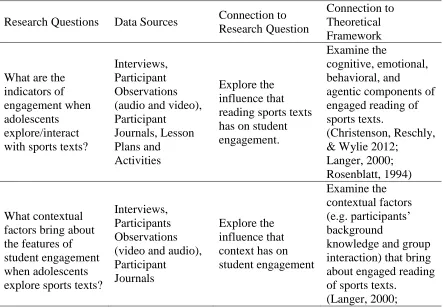
Two questions guided my research: (1) What were the indicators of engagement when
selected adolescents interacted with sports texts? (2) What contextual factors brought about the
features of student engagement when adolescents explored sports texts?
Overview of the Study
This case study included three sports enthusiasts in a middle school in the southeastern
United States. I live in an urban area in the southeast and I have teaching experience there as
well. Approximately a month before the sports reading club began, I posted flyers throughout the
school and included announcements on the morning student newscast to gather participants. I
also worked closely with the school’s afterschool coordinator to spread the word about the club.
The sports reading club met twice a week for approximately one hour each session, with each
session devoted to reading and discussion of sports texts. There were pre- and post-interviews
and questionnaires to determine focal participants for the study. In these study instruments, I
learned about students’ interest in sports texts, the participants’ background, their reading
practices, and their level of engagement in school and school-related activities.
The study was rooted in qualitative case study research. Research in qualitative case
meaning, and the importance of rendering complexity of a situation” (Creswell, 2008, p. 4).
Stake (1995) outlined four requirements of case study, triangulation (ability to thoroughly
triangulate data), experiential knowledge (ability to demonstrate knowledge gained through
experience), context (how experiential knowledge influences context in which it resides), and
activities (pays close attention to the minute details of the case activities). These are the essential
responsibilities of case study research when researchers use Stake’s model. I followed these five
requirements to ensure reliability and validity in the study I conducted.
In sum, for this study, I used Rosenblatt’s (1978) transactional theory of reading to
investigate what happened to student engagement when adolescents explored sports texts of their
choosing in a voluntary sports reading club. I analyzed the multifaceted components of
engagement as well as aspects of students’ engaged reading of sports texts. This approach
provided an open-ended scope for analysis of the research questions. This chapter focused on
statement of problem, rationale for the study, theoretical perspective, and the purpose of the
study. The following two chapters will provide a literature review and the design and procedures
I used in the study.
Definitions of Terms
Adolescence – A time of rich cognitive, emotional, and social development in the second decade of life, approximately between the ages of 10 and 20 (Lerner & Steinberg, 2009). Adolescence
involves “reorganization with the aim of adapting to cultural expectations of becoming an adult”
(Lerner & Steinberg, 2009, p. 15).
Student Engagement – Engagement has cognitive (invest cognitive effort in learning), behavioral (participation in school and related activities), emotional (attitudes and feelings
components (Christenson, Reschly, & Wylie, 2012). Again, I followed the agentic approach
described in previous research (Reeve, 2013) as I looked for factors that contributed to
adolescent reading engagement in the study. When adolescents are interested, having fun, and
concentrating, they are fully engaged.
Reading Clubs – Less formal than versions of reading clubs often found in classroom instruction (Atwell, 1998; Daniels, 2002; Raphael & McMahon, 1997), reading clubs in this
study involved a small group of adolescents reading and discussing a variety of texts of their
choosing in a voluntary setting.
Texts – Used in a broad sense, text includes print based materials such as books, short stories, and poetry as well as non-print based materials such as video, documentaries, websites,
hypermedia, blogs, and other multimedia.
Sports Texts – Bound by a focus on sports, sports texts involve a variety of themes and uses. Print based as well as non-print based sports texts usually fall into four general categories, game
action (fantasy sports, learning about, and appreciating the game included here), sports reporting,
character-driven, and social issues.
Sports Enthusiasts – People who have a passionate interest in sports. Sports affect multiple aspects of their lives as they enjoy watching, playing, reading, and seeking out new information
2 REVIEW OF THE LITERATURE
The purpose of this study was to (a) investigate cognitive, behavioral, emotional, and
agentic factors that contributed to student engagement when three adolescents explored sports
texts in a voluntary sports reading club, (b) to provide material for the reader to learn about the
multifaceted components of student engagement, and (c) to explore the use of reading clubs as
they apply to adolescents’ reading and discussion of sports texts. Two questions guided my
research: (1) What were the indicators of engagement when selected adolescents interacted with
sports texts? (2) What contextual factors brought about the features of student engagement when
adolescents explored sports texts?
A literature review may have two purposes, comprehensive or directed (Boote & Beile,
2005; Maxwell, 2006). I took the directed approach. The goal in a directed approach to a review
of literature is to create “a model of phenomena that informs and supports the research”
(Maxwell, p. 30). By taking a directed approach, the literature review more closely reflected the
purpose and research questions of the study. In this manner, since a case study on adolescents’
interactions with sports texts in a voluntary sports reading club involved a number of dimensions,
I narrowed my focus to four areas of interest (the construct of student engagement, instructional
factors that influence engaged reading, engaged reading of sports texts, and contextual factors that
influence student engagement) in the review of literature. These four areas served as the lenses
through which I examined the research questions and collected and analyzed data. I begin with a
review of the construct of student engagement through the research that explores the multifaceted
components of student engagement. In this section, I also address the current methodological
concerns in the research on student engagement by reviewing the effectiveness of existing models
factors that influence engaged reading and what researchers currently know about the construct of
adolescents’ engaged reading. Third, I explore sports texts as a possible means to support
adolescent sports enthusiasts’ engaged reading, including a definition of sports texts and describe
how the use of sports texts has evolved in the last two decades. I conclude the literature review
with a discussion of the environmental factors that affect engagement and an overview of reading
clubs, since the context and social nature of reading play critical roles in adolescents’ engaged
reading (Shernoff, 2013). Through the review of these four elements, this literature review
allowed me to develop a system of indicators to observe what happened to student engagement in
a voluntary sports reading club.
What is Student Engagement?
Student engagement is a popular but ambiguous area of research. According to some
educators and researchers, engagement has been discussed as a potential way to reduce boredom
and reduce the number of students who drop out of school (Christenson, Reschly, & Wylie, 2012;
Intrator & Kunzman, 2009). Research in engagement also persists because educators and
researchers see it as a malleable construct essential to understanding what students learn
(Appleton, Christenson, & Furlong, 2008). In opposition to recent reform measures such as No
Child Left Behind (2001) and Race to the Top (2008), researchers have argued that measuring
student engagement instead of relying on standardized test scores may better show the full scope
of what and how students learn (Finn & Zimmer, 2012; Ivey & Johnson, 2013). McClelland and
Cameron (2011) define student engagement as thoughts about school and willingness to invest
cognitive effort in learning (cognitive engagement), attitudes and feelings toward learning
(emotional engagement), and participation in school and related activities, including completion
(behavioral, cognitive, and emotional engagement) make up the cornerstones of most discussions
of the construct of engagement (Christenson, Reschly, & Wylie, 2012). These three facets have
been researched separately and collectively. In addition, researchers have pointed to an additional
component of engagement, which they refer to as agentic engagement (Ivey & Johnston, 2012;
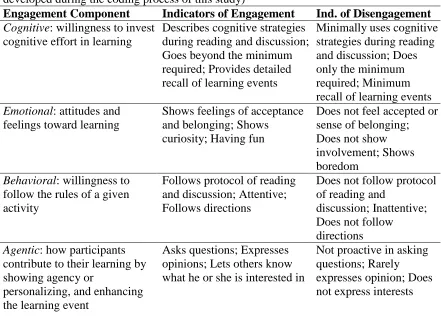
Reeve & Tseng, 2011). In Figure 1, I provide an overview of each component of engagement. In
the following sections, I review the research that explores student engagement through each
[image:34.612.69.510.317.634.2]element of the construct (Appleton, Christenson, Furlong, 2008; Ivey & Johnson, 2013).
Table 1.
Components of Engagement (Based on McClelland & Cameron, 2011, Reeve, 2013 and developed during the coding process of this study)
Engagement Component Indicators of Engagement Ind. of Disengagement
Cognitive: willingness to invest cognitive effort in learning
Describes cognitive strategies during reading and discussion; Goes beyond the minimum required; Provides detailed recall of learning events
Minimally uses cognitive strategies during reading and discussion; Does only the minimum required; Minimum recall of learning events Emotional: attitudes and
feelings toward learning
Shows feelings of acceptance and belonging; Shows
curiosity; Having fun
Does not feel accepted or sense of belonging; Does not show involvement; Shows boredom
Behavioral: willingness to follow the rules of a given activity
Follows protocol of reading and discussion; Attentive; Follows directions
Does not follow protocol of reading and
discussion; Inattentive; Does not follow
directions Agentic: how participants
contribute to their learning by showing agency or
personalizing, and enhancing the learning event
Asks questions; Expresses opinions; Lets others know what he or she is interested in
Cognitive engagement. Researchers have explored a number of ways that cognitive engagement plays an essential role in adolescent reading practices (Guthrie, Wigfield, & You
2012; Kuhn, 2008; Zelazo & Carlson, 2012). Cognition in reading refers to how readers bring
along knowledge structures in their interactions with texts. These knowledge structures have
cognitive (how adolescents think) and metacognitive (how adolescents think about thinking)
aspects. According to Zelazo and Carlson (2012), adolescents’ executive function, or a complex
combination of working memory, flexible attention, and reasoning and problem solving affect
their cognitive engagement.
According to Reyna, Chapman, Dougherty, and Confrey (2011), as children progress into
adolescence, their metacognitive skills become more and more important --they must begin to
make sense of complex information and exhibit sound reasoning. When reading, discussing, and
writing about what they read, they practice making causal judgments and predictions, increase
meta-strategic skills, and sharpen executive control (Diamond, 2013). Adolescents prepare for the
rigors of reading difficult texts in varying disciplines. Many researchers have examined this
transition from concrete operations to formal operations and the ability to use abstract thinking
(Inhelder & Piaget, 1958; Keating, 2004; Kuhn & Pease, 2006).
Kuhn (2008) offered alternative ways on how the formal operations stage develops
differently from earlier stages. She found that a hallmark of cognitive engagement in adolescence
is the ability to move beyond transfer, a quality that is discernable in childhood development, to
transition and transformation in adolescence. She acknowledged that not all adolescents and
adults are adept at metacognition, or formal operations (Kuhn, 2008). As in earlier stages of
development, according to Kuhn (2008), people do not learn to think metacognitively simply as a
understanding cognitive engagement as it applies to adolescents. Exploring cognitive engagement
may help researchers better understand adolescents’ movement beyond transfer to transition and
transformation. Kuhn (2008) introduced the importance of this sensitive period for adolescents to
foster metacognition, but she did not seek adolescent voices to get a better understanding of the
multifaceted components of cognitive engagement.
Researchers have pointed to adolescent intellectual development as a double-edged sword
(Kuhn, 2008; Lerner, 2002). On the one hand, adolescents have the freedom to explore on their
own and further their intellectual enrichment independently. Shernoff (2013) examined
adolescents’ burgeoning independent learning abilities through the theoretical lens of flow theory
in private Montessori schools and other alternative public and private schools. He found that the
extent to which an individual believed he or she could control the events that affect them had a
dramatic effect on cognitive engagement. On the other hand, adolescents have the choice to
continue on a comfortable, un-intellectually stimulating path. Unfortunately, recent statistics show
that adolescents are often bored in school. In a study conducted by the Center for Evaluation and
Education Policy at Indiana University (2009), 66% of students reported being bored at school a
minimum of one time or more every day, and 17% reported being bored in every class. As Lerner
(2002) stated, individuals during adolescence become “producers of their own development” (p.
11). Therefore, this burgeoning independence that adolescents have aligns with adolescence as a
critical period for fostering the multifaceted components of engagement. By studying adolescents’
engaged reading of sports texts, this study sought to uncover the complexities of adolescents as
“producers of their own development” (Lerner, 2002, p. 11). I was interested in understanding
whether adolescents’ interpretation of sports texts had similarities to the traditional notions of
they normally engaged with texts in the English language arts classroom. These wonderings drove
my thinking in the present study.
Miller (2009) provided convincing evidence that giving adolescents the time to read in
school and choice in texts may also lead to improved cognitive engagement. Miller used
instructional activities including self-reflections (personal reflections regarding the strengths and
weaknesses a student has with reading), I-read reflections (reading journals where students record
connections, thoughts, predictions, and vocabulary), and strategic goal setting (setting goals for
students’ reading for the year) to emphasize the importance of reading a variety of texts. She
found that changing students’ attitudes toward reading by allowing choice and regarding reading
as a fun, worthwhile endeavor dramatically improved student engagement. As a result of her case
study, she showed how student voice and opinion are crucial to deepening students’ cognitive
engagement with reading. In the present study, I was interested in examining whether tapping into
adolescents’ interest in sports texts had a similar positive effect on cognitive engagement. When
the participants in my study read and discussed texts of their choosing at their own pace, I had
opportunities to witness cognitive engagement.
Other researchers have explained additional underlying cognitive mechanisms that
enhance or diminish adolescents’ cognitive engagement with reading (Blackwell, Trzesniewski,
& Dweck, 2007; Dweck, 2007; Tough, 2013). Blackwell, Trzesniewski, and Dweck (2007)
divided implicit theories of intelligence into growth-oriented and fixed-oriented; adolescents who
take a fixed perspective of intelligence focus on performance and innate ability, whereas
adolescents who take a growth mindset acknowledge that intelligence is malleable and that
According to Blackwell, Trzesniewski, and Dweck (2007), adolescents do well when they
consider that intelligence can be developed.
Blackwell, Trzesniewski, and Dweck (2007) conducted two studies on growth-oriented
and fixed-oriented implicit theories of intelligence. In study 1, they examined students’ theory of
intelligence (fixed or growth mindset) and whether or not it connected to lasting achievement
trajectory. The study consisted of 373 middle school students who varied in ethnicity,
achievement, and socioeconomic status. For those students who saw cognitive ability as
malleable, grades improved. For those students who saw cognitive ability as fixed, grades
predicted a flat trajectory. The researchers replicated this study of the meditational model on a
lower-achieving sample, as well. In study 2, (2007) the researchers took an intervention approach
to determine whether or not teaching children to think their cognitive ability is malleable will
display more positive engagement and motivation in the classroom. The study consisted of 99
low-achieving seventh-graders (with “low-achieving” defined as the 35th percentile or lower on
an achievement test). The middle school students participated in eight, 25-minute periods led by
undergraduate students who were trained to teach sessions on growth mindset. The results of the
experimental study showed that teaching growth mindset produced no decline in achievement.
Before the intervention, there was decline and continued decline was found in the control group.
The most promising finding was that the single intervention in one semester halted the decline in
achievement. Study 2 (2007) showed the relationship between theory of intelligence (growth
mindset and fixed mindset) and engagement and motivation in a longitudinal, real-world setting.
The researchers found that diverging achievement scores emerge only during challenging
studies showed that diverging achievement scores were less likely in a supportive, less
failure-prone environment such as elementary school (Blackwell, Trzesniewski, & Dweck, 2007).
Yet Graham and Werner (2012) uncovered in their research that students’ implicit of
theories may not be domain general; for instance, adolescents may take a growth mindset in
music lessons, whereas they take a fixed mindset in geometry lessons. This finding led me to
consider what effect the use of sports texts in a voluntary sports reading club had on adolescents’
mindsets. Would the participants carry the same mindset in the traditional English language arts
class as they did in a voluntary sports reading club? Would the mindset in a voluntary sports
reading club transfer to traditional contexts for learning in schools? I addressed these questions in
my study. I was interested in the possibility that a student’s mindset may affect how they
approached reading of traditional canonical texts versus reading of sports texts. Graham and
Werner (2012) also noted that performance can be a positive motivator; in other words, if a
person is approaching the performance in a positive manner, performance may have the capacity
to act as a catalyst for growth mindset. Will participants who regularly perform on the athletic
field reflect a similar mindset in a voluntary sports reading club as they do on the field? How does
this mindset in the club compare to the participants’ mindset in a traditional English language arts
classroom? The questions surrounding growth and fixed mindset served as an intriguing
open-ended lens to explore the students’ cognitive engagement in the sports reading club.
To summarize, researchers who have studied cognitive engagement have detected that
opportunities for adolescents to independently read books of their choosing, opportunities for
adolescents to focus on meta-strategic skills, and recognition of implicit theories of intelligence,
all affected student cognitive engagement (Blackwell, Trzesniewski, & Dweck, 2007;
to explore how these factors in cognitive engagement affected students’ engaged reading of sports
texts. The knowledge structures adolescents brought to the voluntary sports reading club played
intriguing roles in their cognitive engagement with the texts.
Emotional engagement. Researchers have found that emotional factors also play important roles when adolescents measure student engagement (Finn & Zimmer, 2012;
Ostermann, 2000; Voekl, 2012). Adolescence is a rich time of emotional development (Lerner &
Steinberg, 2009; Prencipe et al., 2011). Adolescents are making sense of the world, fostering
close friendships, and experiencing biological and social changes (Lerner & Steinberg, 2009).
Adolescents are honing their sense of self and their influence on their families, friends, and
society (Intrator & Kunzman, 2009). As a result, adolescents “yearn for opportunities to explore
and express their distinctive voices” (Intrator & Kunzman, 2009, p. 29). This exploration of
distinctive voices may be a primary place for exploration in fostering emotional engagement. To
highlight adolescents’ distinctive voices, learner expectations are driven by mental baggage a
learner brings to an instructional event (Prencipe et al., 2011). Motivation, biases, expertise,
varying degrees of self-regulation, and executive function all affect learner expectations (Finn &
Zimmer, 2012). A learner may have a range of desires and intentions going into an instructional
event that fall on a continuum of extrinsic to intrinsic motivation (Cameron, Pierce, Banko, &
Gear, 2005; Wigfield & Guthrie, 2000).
Motivation helps to fuel emotional engagement (Eccles & Wang, 2012; Wigfield, Guthrie,
& You, 2012; Wigfield & Guthrie, 2000). In recent years, researchers have increasingly directed
their focus on the relationship between motivation and engagement (Appleton, Christenson, &
Furlong, 2008; Martin, 2012). Motivation can manifest itself as short-term motivation,
the reasons why a child reads. A person reads a text not only because of his or her capacity to
read, but because he or she is motivated to read. Traditionally, theorists have divided motivation
into two categories, extrinsic and intrinsic motivation (Deci & Ryan, 2000). Extrinsic motivation
takes into account factors outside of the reader, such as gold stars, grades, and pizza parties. The
primary focus in this study is on intrinsic motivation, or reading as an internal source of
enjoyment and enrichment. The following section addresses students’ motivation to read as an
example of the variety of ways motivation and engagement comingle.
Fostering readers’ intrinsic motivation has been a concern of reading researchers for
decades. In a seminal study, Oldfather and Dahl (1994) examined intrinsic motivation from a
social constructivist standpoint, highlighting the significance of following children’s interests as
they constructed their schemas on reading. Guthrie and Alao (1997) extended the ideas of
intrinsic motivation to divide the characteristics of intrinsic motivation into three categories:
curiosity, involvement, and preference for challenge (p. 407). Readers can ebb and flow by being
high in one aspect and low in another, while still maintaining intrinsic motivation to read. These
aspects do not have to work in tandem to increase intrinsic motivation, but with higher levels of
each aspect comes increased intrinsic motivation. Unfortunately, Guthrie and Alao (1997) found
that intrinsic motivation for reading in children decreased as the students moved from elementary
school into middle and high school. Kelly and Rice (2014) also detected a substantial increase in
student disengagement with reading in the middle school years. These researchers, however, did
not explore what happens to engagement when sports enthusiasts are able to read texts of their
choosing at their own pace in a sports reading club. Studies of what happens to intrinsic
may shed light on possible ways to curb the cascading effects of disengagement with reading in
school and school-related activities in the middle school years.
Guthrie, Klauda, and Ho (2013) studied the connections between reading instruction,
motivation, engagement, and achievement for 1,159 seventh graders. The researchers examined
two contexts, one in which all the students in the study were taught in a traditional English
language arts context and one an experimental group in which 854 of the students participated in
Concept-Oriented Reading Instruction (CORI), a reading engagement and motivation
intervention. In the traditional English language arts model, motivation was positively correlated
to achievement through engagement. In the intervention model, positive changes in motivation,
engagement, and achievement occurred stronger than in the traditional English language arts
instruction. Guthrie, Klauda, and Ho (2013) found that engagement increased through an
intervention approach, whereas the present study was designed to seek adolescent voices through
qualitatively means to highlight the indicators of student engagement. Guthrie, Klauda, and Ho’s
(2013) study, however, does point to the differences in levels of engagement in traditional English
language arts classes versus alternative means of literacy learning such as in a book club.
Behavioral engagement. Behavioral engagement refers to adolescents’ willingness to follow the rules of school or a given activity. For example, when students consistently show effort
at school, but they still struggle with schoolwork, they may be behaviorally engaged, but they
may not be cognitively engaged. Researchers in this field of student engagement focus on the
degree to which a student shows effort in his or her work and in their willingness to comply with
school or activity structure (Christenson, Reschly, & Wylie, 2012; Guthrie, Wigfield, and You,
2012). Guthrie, Wigfield, and You (2012) examined the relationship between behavioral
motivation also showed high levels of behavioral engagement. They also found, when they
controlled for past achievement, self-efficacy, and socio-economic status, that behavioral
engagement was correlated with reading comprehension scores. They, however, did not examine
these indicators of behavioral engagement in a qualitative study through interview and
observation. Rather, they conducted a large-scale study using self-report surveys. Guthrie,
Klauda, et al. (2012) found that middle school students’ disregard for information texts was a
leading factor in behavioral disengagement. In their study, Guthrie, Klauda, et al. (2012),
however, focused primarily on traditional informational texts such as textbooks in middle school
and secondary school. The researchers did not explore how allowing students choice to read
information texts that aligned with their interests in sports may affect their levels of behavioral
engagement.
Behavioral engagement was particularly compelling in this study for a number of other
reasons, as well. There was a melding of out of school and in school structure in the sports
reading club that affected the participants’ level of behavioral engagement; as further discussed in
the chapter three, there was a defined structure to the activities in the sports reading club, while
students had freedom to read and discuss what they wanted as it pertained to sports. I provided
text suggestions and direction in group discussions, which was interpreted and accepted in various
ways by the participants of the study. The goals and structure I set up for the voluntary sports
reading group affected the participants’ behavioral engagement. I was interested in understanding
what the students brought to the reading club from their in school and out of school literacies, and
how the knowledge structures the participants brought to the study affected whether or not they