Application of ACO to Disentangle Max-Min MDVRP
Using Clustering Technique
Mandeep Kaur
*, Shanky Goyal
***
Assistant Professor, Guru Kashi University, Talwandi Sabo, Punjab, India **
Technical Consultant, Hewlett Packard, Banglor
Abstract- In this paper the ACO (Ant colony optimization)
technique of Swarm Intelligence has been used to solve an interesting class of problem. This is an optimization technique which is used to solve max-min MDVRP. Unlike the traditional MDVRP which focuses on minimizing the distance travelled by the vehicle, this technique focuses on minimizing the maximum distance travelled by the vehicle. To achieve this level of optimization 2-opt technique has been used.
Index Terms- Input Image for15 cities, 18 cities and 30 cities,
Clustering and Swarm Intelligence.
I. INTRODUCTION
ehicle routing problem (VRP) is a combinatorial optimization problem delving to serve geographically dispersed customers with a fleet of vehicles. This came into existence in 1959. VRP is exercised in transportation, tourism, logistics, school bus path optimization etc. There is one central depot which takes order from the customers and then finally supplies them the goods. VRP is closely related to TSP as it consists of many TSPs with common start and end cities. Probably, the basic inducement is to minimize the cost by minimizing the total distance travelled by the vehicles. Other name for VRP is Single Depot Vehicle Routing Problem
(SDVRP).
An extension of this algorithm is Multi Depot Vehicle
Routing Problem (MDVRP) which implicates number of
depots instead of only one. In most of the real-life VRPs, demands at the customer nodes vary due to various factors, such as location and temporal seasonal factors [3]. A network routing topology generated by solving min-max MDVRP results in a set of daisy-chain network configurations that minimize the maximum latency between a server and client. This can be advantageous in situations in which the server-client connection cost is high but the client-client connection cost is low [20].Vehicles should start from the depot and then return back to the depot after serving an ample amount of customers. Every customer has a demand which varies stochastically. Vehicles are assigned to the customers and one customer is served by only one vehicle. There are few considerations which should be kept in mind while implementing MDVRP.
1) Vehicle should start and end its route at the depot.
2) A customer is visited exactly once by the vehicle in each cluster.
3) Total cost to traverse the customers is minimized.
1.1 Nearest neighbor function
a) Each customer/city is assigned to the nearest depot.
b) Routes are made by traversing the vehicles over the cities( initial solution is made).
c) Local improvement method is applied to the routes initially formed in order to get better results.
Constraints are imposed on the vehicles:
a) Capacity constraint: includes that a vehicle can carry a
certain amount of goods.
b) Distance constraint: includes that a vehicle can travel a
certain amount of distance.
1.2 Ant Colony Optimization
The technique that is used to solve the problem is Ant Colony Optimization (ACO). ACO is a probabilistic technique for solving computational problems which are used to find optimum path, based upon the behavior of the ant seeking a path between the food source and their colony. ACO algorithms are population-based, in that a collection of agents “collaborates” to find an optimal (or even satisfactory) solution. Such approaches are naturally suited to parallel processing, but their success strongly depends on both the nature of the particular problem and the underlying hardware (12). Initial these ants wander randomly; they find the food source they keep on laying the pheromone trail which acts as a communication medium for the ants. Pheromone evaporates over the period of time.
Minor changes can be done in order to get improved results of Ant system
1) Transition rule
Relation between the pheromone trail laid done and the exploration of path done.
2) Pheromone trail update
Increasing the probability of the city been chosen by updating the value of the pheromone laid.
3) Local trail updates
Evaporation of the pheromone laid down thus the solution does not stuck in local minima.
4) Candidate lists (of cities)
The one that is closer and has more probability is chosen as the next city.
II. IMAGECLASSIFICATION
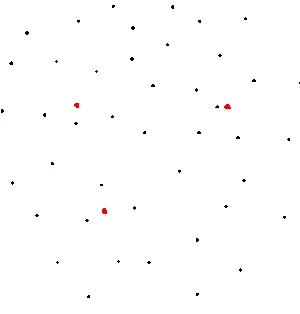
In the fig below cities and depots are randomly distributed over the planar region. Black nodes are the cities/ customers and
the red nodes represent the depots. There are 50 cities/customers and 3 depots. On each depot there are 2 vehicles each. Fig 1.6 represents how the cities /customers are assigned to the depots. Finally in Fig 1.7 represents how these assignments are given route. The assignment of routes should be such that the vehicle routes do not intersect which means that the perturbation is applied.
[image:2.612.82.244.353.682.2]Fig 1: Random distribution of cities and depots
Fig 2: Assignment of cities to depots
Fig 3: Routes formed
III. PROPOSEDWORK
Here broader area of research is swarm intelligence under which ACO has been chosen. Various problems are encountered when it comes to transportation of goods like how to decrease the cost in terms of distance travelled, fuel consumption etc. Thus for further exploration vehicle routing problems are chosen, under which this paper will be extending SDVRP to MDVRP. Here MDVRP is solved using ACO technique. In traditional MDVRP attempt was made to reduce the total distance travelled whereas in this case attempt is being made to reduce the maximum distance travelled by the vehicle. This is done by first making clusters based upon the distance of cluster from the depot. Number of routes should be equal to or less than the number of depots. More number of routes increase the number of vehicles required thus reducing the quality of solution. Customers are assigned to different routes. The distance is computed according to the following rule:
- If D(ci,A) < D(ci,B), then customer ci is assigned to depot A
- If D(ci,A) > D(ci,B), then customer ci is assigned to depot B
- If D(ci,A) = D(ci,B), then customer ci is assigned to a depot
chosen arbitrarily between A and B. In the above cases,
d = represents the distance between customer ci and depot k. Finally
each cluster is treated as an individual SDVRP in which ACO is used to find the shortest path such that the distance and the capacity constraints of the vehicle are not violated. In ACO artificial ants simulate the behavior of artificial ants. The objective function corresponds to the quality of food sources and an adaptive memory corresponds to the pheromone trails [5]. Ants are provided with local heuristic function and global function which represent the greedy approach and desirability of a solution respectively. To appropriately guide the search process using the local and global information, ant colony algorithms typically use some parameters that include heuristic desirability, pheromone updating rule, and probabilistic transition rule [5]. 2-opt-heuristic, a local search that involves replacing two edges is used in order to embellish the accuracy. Firstly the heuristic desirability of visiting one city after other is calculated
i.e. when we move from city i to j . Desirability and distance are inversely proportional to each other. ; the probability of visiting the city is calculated
Once desirability value is calculated for each city moving to the other one, now probability value can be calculated using the desirability as one of the parameter. Probability is denoted by
pij which tells the probability of visiting the next city which
where τij represents the concentration of the pheromone on the
path from city i to city j, α and β represents the biases for pheromone trail and visibility respectively, and they represent parameters to weigh pheromone concentration (which represents learnt knowledge for more global solution) with respect to visibility (which represents local heuristic desirability) in the transition rule (4).
This is done in order to find the shortest path possible. The value of the pheromone is updated whenever a new city is chosen. Finally the moment the distance or the capacity constraints are violated then the depot is chosen as the next city to be visited. Whenever the vehicle exceeds the vehicle distance constraint L then the depot is chosen as the next city and a new tour is commenced for a new vehicle. Thus L is a critical parameter for calculating the distance for the proposed algorithm.
L is the maximum distance that a vehicle can travel while our approach tries to find out the minimum of L i.e. L* in each cluster.
IV. SIMULATIONRESEARCH
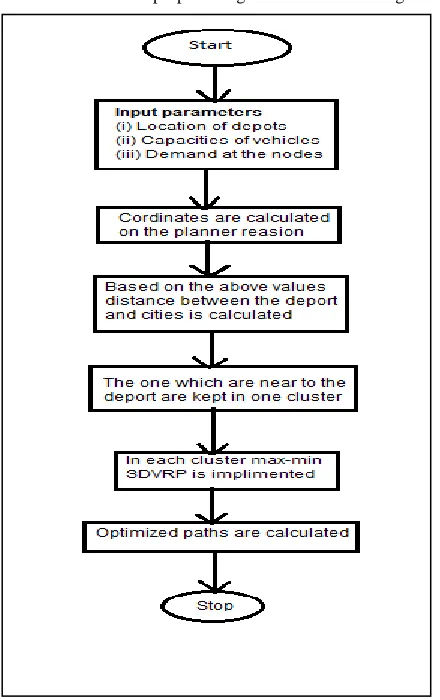
[image:3.612.308.560.81.694.2]The flowchart of the proposed algorithm is shown in figure 4.
Fig 4: Flow Chart
The pseudo-code of the proposed algorithm is given in figure 5.
Fig 5: Pseudo-code: Implementation of algorithm Procedure MDVRPusingACO
InitializeDataValues ClusteringTechnique While( ! numberofclusters) do
SDVRPforeachCluster While( ! nodeleft) do ACOforeachVehicle End-while End-while End-procedure
Procedure InitializeDataValues Variables
InterpretData CalculateDistances CalculateNearestNeighbourList IntializeMatrix InitializeAnts
InitailizethePositonofAnts
InitializeParameter End-Procedure Procedure ClusteringTechnique
For m = 1 to noofdepos do For n =1 noofcities do D[m][n] = End End For n=1 to noofcities do For m = 1 to noofdepos do A[x] = D[m][n] End
T[n] = sort(a, noofdepos) End End-procedure Procedure ACOfor1vehicle While (!maximumdistance) do
RouteConstruction LocalSearchProcedure UpdateStatistics PheromoneUpdate End-while End-procedure Procedure RouteConstruction for a = 1 to m do
for c = 1 to n do
ant[a].city[c ] = 0 End-for End-for counter ← 1
for a = 1 to m do
r ← random {1; . . . ; p} ant[a].tour[counter]← r ant[a].city[r] ← 1 End-for
while (counter < p ) do counter = counter + 1 for a = 1 to m do
FormulationRule(a, counter) End-for End-while
for a = 1 to m do
ant[a] . tour[ p + 1 ] ← ant[ a ] . tour[1] ant[ a ] . tour_length ← CalculateTourLength(k) End-for
[image:3.612.58.278.369.719.2]V. RESULT
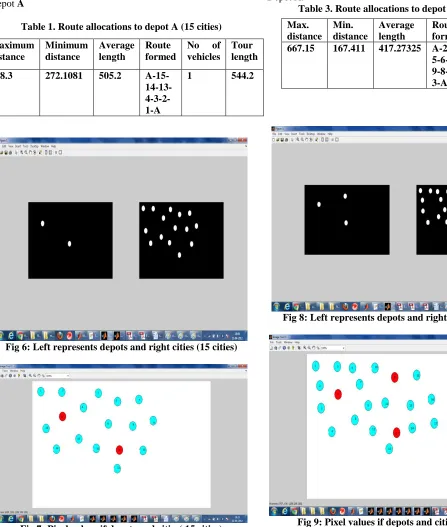
Here we have made the input image on the 900*600 pixel we assume that two pixels represents 1 km on the ground. For example suppose XY city is 150 km apart from the depot which is considered as the origin. Now when we draw the similar image according to pixels then we will say that city XY is 300 pixels apart from the depot. Here we have two options one is we can draw the position of the depots and the city and the other one is we can give as input the coordinates of the point. Here we will be using the first scenario i.e. giving the image as the input.
5.1 Results for 15 cities
[image:4.612.322.578.192.689.2]Depot A
Table 1. Route allocations to depot A (15 cities)
Fig 6: Left represents depots and right cities (15 cities)
Fig 7: Pixel values if depots and cities( 15 cities)
Depot B:
Table 2. Route allocation to depot B(15 cities)
5.2 Result for 18 cities
Depot A:
[image:4.612.46.493.202.729.2]Table 3. Route allocations to depot A (18 cities)
Fig 8: Left represents depots and right cities (18 cities)
Fig 9: Pixel values if depots and cities (18 cities) Max.
distance Min. distance
Average length
Route formed
No of
vehicles Tour length
772.85 276.994 524.75
B-11- 12-6-3- 7-9-8-10-B
1 554
Maximum distance
Minimum distance
Average length
Route formed
No of
vehicles Tour length
738.3 272.1081 505.2
A-15- 14-13- 4-3-2-1-A
1 544.2
Max. distance
Min. distance
Average length
Route formed
No of
vehicles Tour length
667.15 167.411 417.27325
A-2-1- 5-6-7- 9-8-4-3-A
[image:4.612.315.575.534.718.2]Depot B:
Table 4. Route allocation to depot B (18 cities)
Depot C:
Table 5. Route allocation to depot C (18 cities)
5.3 Result of 30 Cities
Fig 10: Left represents depots and right cities (30 cities)
Fig 11: Pixel values if depots and cities (30 cities)
Depot A:
Table 6. Route allocations to depot A (30 cities)
Depot B:
Table 7. Route allocations to depot B (30 cities)
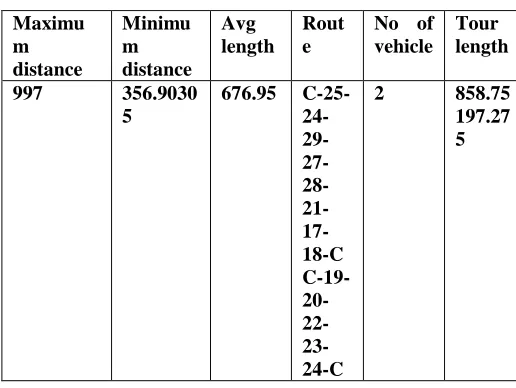
[image:5.612.323.581.343.537.2]Depot C:
Table 8. Route allocations to depot C (30 cities)
VI. CONCLUSIONANDFUTUREWORK
Ant colony optimization technique has been used to solve an interesting class of problem. This is an optimization technique which is used to solve max-min MDVRP. Unlike the traditional MDVRP which focuses on minimizing the distance travelled by the vehicle, this technique focuses on minimizing the maximum distance travelled by the vehicle. To achieve this level of optimization 2-opt technique has been used. Various time critical problem fall in this category so this system can be used to meet the constraints of the problem. Here distance constraints have been used such that there is a limit to which the vehicle can travel. Results have been verified for a various test cases and have been compared to max-min SDVRP and MDVRP using GA. The results are better than both of them using the proposed
Max. distance Min. distance Average length Route formed
No of
vehicles Tour length
416.75 37.081 226.9155
B-10- 12-18-16-B
1 111.25
Max. distance Min. distance Average length Route formed
No of
vehicles Tour length
704.15 194.97855 449.5642
C-11- 13-14- 15-17-C
1 584.95
Max. distance Min. distance Average length Route formed
No of
vehicles Tour length
882.35 220.57665 551.45
A-3-2- 1-30- 11-13- 4-6-5-A
1 661.75
Max. distance Min. distance Average length Route formed
No of
vehicles Tour length
665.25 174.93225 420.1
B-9- 10-12- 14-15- 16-8-7-B
1 524.8
Maximu m distance Minimu m distance Avg length Rout e
No of vehicle
Tour length
997 356.9030
5
676.95
C-25- 24- 29- 27- 28- 21- 17-18-C C-19- 20- 22- 23-24-C
2 858.75
[image:5.612.40.296.529.696.2]Ant Colony Optimization Technique. Future work includes using the concept of time windows using ACO. Other future work can be using3-opt to solve the problem and get more optimized result.
Table 9. Comparative analysis:
REFERENCES
[1] Aziz Ezzatneshan, Department of Computer Engineering, Amirkabir University of Technology, Tehran, Iran, “A algorithm for the Vehicle Problem” , 2010
[2] Yu-Hsuan Huang Chuan-KangTing Dept. of Comput. Sci. & Inf. Eng., Nat. Chung Cheng Univ., Chiayi, Taiwan,” Ant Colony Optimization for the Single Vehicle Pickup and Delivery Problem with Time Window”, 18-20 Nov. 2010 , 537 - 543
[3] Thiemo Krink, EVALife Group, Dept. of Computer Science, University of Aarhus, “Swarm Intelligence -Introduction”, krink_01_7
[4] Koushik S Venkata Narasimha, Manish Kumar, Member, “Ant Colony Optimization Technique to Solve the Min-Max Single Depot Vehicle Routing Problem” ASME, (2011), 2011 American Control Conference on O'Farrell Street, San Francisco, CA, USA
[5] Vittorio Maniezzo, Luca Maria Gambardella, Fabio de Luigi, “Ant Colony Optimization”.
[6] Yu Bin a,*, Yang Zhong-Zhen a, Yao Baozhen b, “An improved ant colony optimization for vehicle routing problem”, European Journal of Operational Research 196 (2009) 171–176
[7] Surekha P* , Research Scholar, Department of EEE PSG College of Technology , Coimbatore, India Dr.S.Sumathi, Associate Professor, Department of EEE PSG College of Technology, Coimbatore, India, “Solution To Multi-Depot Vehicle Routing Problem Using Genetic Algorithms”, World Applied Programming, Vol (1), No (3), August 2011. 118-131 (2011) WAP journal
[8] Michael Brand, Michael Masuda, Nicole Wehner, Xiao-Hua Yu, “Ant Colony Optimization Algorithm for Robot Path Planning”, 2010 International Conference On Computer Design And Applications, Volume 3 436-440
[9] Kiran Khurshid, Safwat Irteza, Adnan Ahmed Khan, “Application of Ant Colony Optimization based algorithm in MIMO Detection ”, 978-1-4244-8126-2/10/ ©2010 IEEE
[10] Alaa Aljanaby, Alaa Aljanaby and Norita Md. Norwawi, “An Exploration Technique for the Interacted Multiple Ant Colonies Optimization Framework ”, 978-0-7695-3973-7/10 © 2010 IEEE DOI 10.1109/ISMS.2010.28
[11] Sutapa Samanta, Maryland State Highway Administration, USA, Manoj K. Jha, Morgan State University, USA, “Multi Depot Probabilistic Vehicle Routing Problems with a Time Window: Theory, Solution and Application”, 40 International Journal of Operations Research and Information Systems, 2(2), 40-64, April-June 2011
[12] Jos´e M. Cecilia, Jos´e M. Garc´ıa, Manuel Ujald´on, Andy Nisbet, Martyn Amos, “Parallelization Strategies for Ant Colony Optimisation on GPUs”, [13] John Carlssony; Dongdong Gez; Arjun Subramaniamx; Amy Wu{; and
Yinyu Yek, “Solving Min-Max Multi-Depot Vehicle Routing Problem”, Stanford University, Stanford, CA 94305, USA, 1st May 2007
AUTHORS
First Author – Mandeep Kaur, Assistant Professor, Guru Kashi
University, Talwandi Sabo, Punjab, India, Email: [email protected]
Second Author – Shanky Goyal, Technical Consultant, Hewlett
Packard, Banglor, Email: [email protected]
S no. Cities Results
(MDVRP)
Results(SDVRP)
1 15
cities
544.2 323.59
2 18
cities
111.25 135
3 30
cities