Georgia State University
ScholarWorks @ Georgia State University
Middle and Secondary Education Dissertations Department of Middle and Secondary Education
Spring 5-13-2016
A case study exploring the effects of using an
integrative STEM curriculum on eighth grade
students’ performance and engagement in the
mathematics classroom
Norman Robinson
Follow this and additional works at:https://scholarworks.gsu.edu/mse_diss
This Dissertation is brought to you for free and open access by the Department of Middle and Secondary Education at ScholarWorks @ Georgia State University. It has been accepted for inclusion in Middle and Secondary Education Dissertations by an authorized administrator of ScholarWorks @ Georgia State University. For more information, please [email protected].
Recommended Citation
Robinson, Norman, "A case study exploring the effects of using an integrative STEM curriculum on eighth grade students’ performance and engagement in the mathematics classroom." Dissertation, Georgia State University, 2016.
ACCEPTANCE
This dissertation, A CASE STUDY EXPLORING THE EFFECTS OF USING AN
INTEGRATIVE STEM CURRICULUM ON EIGHTH GRADE STUDENTS’
PERFORMANCE AND ENGAGEMENT IN THE MATHEMATICS CLASSROOM, by
NORMAN F. ROBINSON III, was prepared under the direction of the candidate’s Dissertation
Advisory Committee. It is accepted by the committee members in partial fulfillment of the
requirements for the degree, Doctor of Philosophy, in the College of Education and Human
Development, Georgia State University.
The Dissertation Advisory Committee and the student’s Department Chairperson, as
representa-tives of the faculty, certify that this dissertation has met all standards of excellence and
scholar-ship as determined by the faculty.
_______________________________ _______________________________ Iman Chahine, Ph.D. Audrey Leroux, Ph.D.
Committee Member Committee Chair
_______________________________ _____________________________________ Patrick Enderle, Ph.D. Donna Whiting, Ph.D.
Committee Member Committee Member
_______________________________ Date
_______________________________ Gertrude Tinker Sachs, Ph.D.
Chairperson, Department of Middle and Secondary Education
_______________________________ Paul Alberto, Ph.D.
Dean
AUTHOR’S STATEMENT
By presenting this dissertation as a partial fulfillment of the requirements for the advanced
degree from Georgia State University, I agree that the library of Georgia State University shall
make it available for inspection and circulation in accordance with its regulations governing
materials of this type. I agree that permission to quote, copy from, or to publish this dissertation
may be granted by professor under whose direction it was written, by the College of Education
and Human Development’s Director of Graduate Studies, or by me. Such quoting, copying, or
publishing must be solely for scholarly purposes and will to involve potential financial gain. It is
understood that any copying from or publication of this dissertation which involves potential
financial gain will not be allowed without my written permission.
NOTICE TO BORROWERS
All dissertations deposited in the Georgia State University Library must be used in
Accordance with the stipulations prescribed by the author in the preceding statement. The author
of this dissertation is:
Norman F. Robinson III 4574 Pamela Place Lithonia, GA 30038
The director of this dissertation is:
Dr. Iman Chahine, Ph.D. Middle and Secondary Education
College of Education and Human Development Georgia State University
CURRICULUM VITAE
Norman F. Robinson III
ADDRESS: 4574 Pamela Place Lithonia, GA 30038
EDUCATION:
ACADEMIC BACKGROUND
Doctor of Philosophy in Teaching and Learning/Mathematics Education May 2016
Georgia State University-Atlanta, Georgia
Dissertation: A case study exploring the effects of using an integrative STEM curriculum
on 8th grade students’ performance and engagement in the mathematics classroom
Master of Science in Natural and Applied Sciences July 2007
Oklahoma State University-Stillwater, Oklahoma
Bachelor of Science in Mathematics May 1995
Tennessee Technological University- Cookeville, Tennessee
PROFFESIONAL EXPERIENCE:
Center for Education Integrating Science, Mathematics and Computing (CEISMC) Georgia Institute of Technology
Atlanta, Georgia June 2014 – Present Program Director-STEM Education
Center for Education Integrating Science, Mathematics and Computing (CEISMC) Georgia Institute of Technology
Atlanta, Georgia June 2011 – June 2014 Education Outreach Manager for Engineering and Robotics
Marietta City Schools-Marietta Middle STEM Magnet School
Marietta, Georgia August 2009 – May 2011
Mathematics Teacher
National Aeronautics and Space Administration (NASA)
National Institute of Aerospace
Hampton, Virginia June 2007 – June 2008 Education Specialist
Hampton University
Hampton, Virginia September 2007 – May 2008
Adjunct Instructor
National Aeronautics and Space Administration (NASA) Aerospace Education Services Project
Oklahoma State University, Stillwater Oklahoma September 2002 – June 2007
Aerospace Education Specialist
Riverside High School, The School District of Greenville County
Greer, South Carolina September 2000 – August 2002
Mathematics Educator
Berea Middle School, The School District of Greenville County
Greenville, South Carolina January 1999 – June 1999
Administrative Assistant / Assistant Principal
Tanglewood Middle School, The School District of Greenville County
Greenville, South Carolina August 1995 – August 2000
Mathematics Educator
RESEARCH AND GRANTS:
Teacher Quality Grant: Optimizing Mathematics and Science Learning for Middle Level Students Using Robotics and Engineering Design Inquiries.
Co-Investigator, Georgia State University. Atlanta GA 2015
PAPERS AND PUBLICATIONS:
Robinson, Usselman & Lingle (2014). Integrative STEM: Design and
implementation of an 8th grade technology curriculum. Paper presented at the ASEE Annual Conference and Exposition, Indianapolis, IN.
CURRICULUM DEVELOPED:
Robotics and Engineering Design Curriculum Math and Science @Work AP Calculus
Space Shuttle Ascent, Next Generation Spacecraft, Ascending from the Moon
Math and Science @Work AP Physics
Lunar Surface Instrumentation Part II, Lunar Landing Weightless Wonder – Reduced Gravity Flight
Exploring Space Through Algebra
A case study exploring the effects of using an integrative STEM curriculum on eighth grade
students’ performance and engagement in the mathematics classroom
by
Norman F. Robinson III
Under the Direction of Dr. Iman Chahine
ABSTRACT
To address the need to improve student achievement in STEM disciplines, effort has been
made to develop a new of tools for STEM education (Bybee, 2013). The Robotics and
Engineering Design Curriculum (REDC) provides students an opportunity to develop systems
thinking abilities while integrating science and mathematics concepts. Using an exploratory case
study approach within a situated cognition framework, this study examines the effects of using
REDC on 54 eighth grade students’ performance and engagement during 5-week integrative
STEM instruction in the mathematics and science class. Situational factors that contribute to
students’ success in learning STEM concepts are also examined.
This study employed mixed-methods techniques. The quantitative data collected
surveys. Quantitative data analysis included reliability analyses and paired sample t-tests. The
results of the reliability analyses for the achievement test and MES survey report acceptable
Cronbach’s alpha (.843 and .787, respectively). Qualitative data collected included
semi-structured interviews, field notes and student artifacts (engineering notebook and printed
prototypes). Qualitative data analysis used coding procedures suggested by Saldana (2012)
where patterns were identified and grouped to allow the emergence of themes. Collectively, the
data was triangulated to support six emerging themes. The emerging themes regarding the effect
of using the curriculum are as follows: (1) the developing anthropomorphic relationship with the
robot enhances engagement, (2) engagement is impacted by purposeful and intentional physical
action, and (3) purposeful collaboration promotes engagement through the construction of
meaning and interaction. Three themes emerged identifying factors that contribute to success:
(1) learning environment must have transformative learning potential, (2) learning experiences
underpinned by design thinking contribute to success and (3) contextual relevance is enhanced
when students have the freedom to their design learning journey. This study addresses the need
for research into the implementation of 3-D design and manufacturing in the middle school
classroom.
Bybee, R. W. (2013). The case for STEM education: Challenges and opportunities. National
Science Teachers Association.
Saldaña, J. (2012). The coding manual for qualitative researchers (No. 14). Los Angeles, Ca:
Sage.
A case study exploring the effects of using an integrative STEM curriculum on eighth grade
students’ performance and engagement in the mathematics classroom
by
Norman F. Robinson III
A Dissertation
Presented in Partial Fulfillment of Requirements for the
Degree of
Doctor of Philosophy
In
Teaching and Learning
Mathematics Education
In
the College of Education and Human Development
Georgia State University
Copyright by Norman F. Robinson III
DEDICATION
This work is dedicated to my mother, Gloria Scott Robinson and my grandmother, Doretha S.
Lee. Thank you for believing in me, pushing me, supporting me and loving me. I pray you are
ACKNOWLEDGEMENT
To my wife, thank you for your unwavering understanding and support in helping me achieve
this dream. This could not have happened without you, and I wouldn’t want it to anyway! You
are truly my answer from God. I love you!
To my father, without you this day would not have happened. You placed the fire inside of me
to do what I said I was going to do….and I have done it. To my children, Jacquelyne and
Joshua, thanks for your support and love through this journey. Most of all, I thank you for
making me a better father. To my sister, Lori Robinson, you have always looked up to me when
I was actually looking up to you. Thank you for your support and love. I love you!
To my sister, Dianna Fauntleroy, thank you for setting the standard. To my
cousin-sisters/brothers, Glenn Jones, Ralph Williams, Camilla Jones, Robyn Jones and Hilliard
Robinson. You help make me the man I am today. I love you!
To my Aunt Yvonne Jones, thank you for your support and love. I love you!
Thanks to my committee chair, Dr. Iman Chahine for your pushing, patience and guidance.
Thanks to my committee members Dr. Patrick Enderle and Dr. Audrey Leroux.
TABLE OF CONTENTS
LIST OF TABLES ... ix
LIST OF FIGURES ... x
CHAPTER 1 ... 1
Introduction ... 1
Statement of the Problem ... 2
Need for STEM Literacy ... 2
Lack of Defined Focus ... 4
Student Engagement and Performance ... 5
Purpose and Research Questions ... 6
Significance of the Study ... 6
Theoretical Framework ... 7
Situated Cognition Defined ... 10
Community of Practice ... 13
Legitimate Peripheral Participation ... 15
Cognitive Apprenticeship ... 16
Basic Tenets of Situated Cognition ... 18
Historical Development ... 19
Ontological Underpinnings ... 22
Epistemological Underpinnings ... 24
Situated Cognition in STEM Learning ... 27
A Review of the Literature ... 29
Development of STEM ... 31
The Need for STEM ... 31
Historical Context ... 31
Integration to Integrative STEM ... 33
Instructional Practices ... 37
Pedagogical Approach ... 37
Innovative Instructional Technology ... 40
Related Studies ... 42
Literature Gaps ... 47
CHAPTER 3 ... 50
Methodology ... 50
Research Design ... 50
Research Setting ... 53
Sampling Techniques and Participation ... 54
Integrative STEM Curriculum ... 55
Data Collection ... 61
Procedure ... 67
Data Management Plan ... 69
Data Analysis ... 69
Qualitative Data Analysis ... 70
Quantitative Data Analysis ... 72
Qualitative Data ... 73
Quantitative Data ... 74
Confidentiality and Ethics ... 74
Limitations of the Study ... 75
CHAPTER 4 ... 77
Data Analysis and Results ... 77
Quantitative Data Analysis ... 78
Analysis Techniques ... 78
Achievement ... 78
Engagement ... 80
Qualitative Data Analysis ... 83
Method of Analysis: Coding ... 83
Emerging Findings ... 87
Effects on student engagement ... 88
STEM-situational factors contributing to students’ success ... 101
Summary of the Results... 111
Chapter 5 ... 115
Discussions ... 115
Discussion of Research Findings... 115
Connections to Literature ... 116
Implications for Practice ... 124
REFERENCES ... 129
Appendix A: Biomechanics Standard and Activity Matrix ... 149
Appendix A: Biomechanics Standard and Activity Matrix cont. ... 150
Appendix A: Biomechanics Standard and Activity Matrix cont. ... 151
Appendix A: Biomechanics Standard and Activity Matrix cont. ... 152
Appendix A: Biomechanics Standard and Activity Matrix cont. ... 153
Appendix A: Biomechanics Standard and Activity Matrix cont. ... 154
Appendix A: Biomechanics Standard and Activity Matrix cont. ... 155
Appendix B: Interview protocol (Sample) ... 156
Appendix B: Interview protocol (Sample) cont. ... 157
Appendix B: Interview protocol (Sample) cont. ... 158
Appendix C: Observation protocol (Sample) ... 159
Appendix C: Observation protocol (Sample) cont. ... 160
Appendix C: Observation protocol (Sample) cont. ... 161
LIST OF TABLES
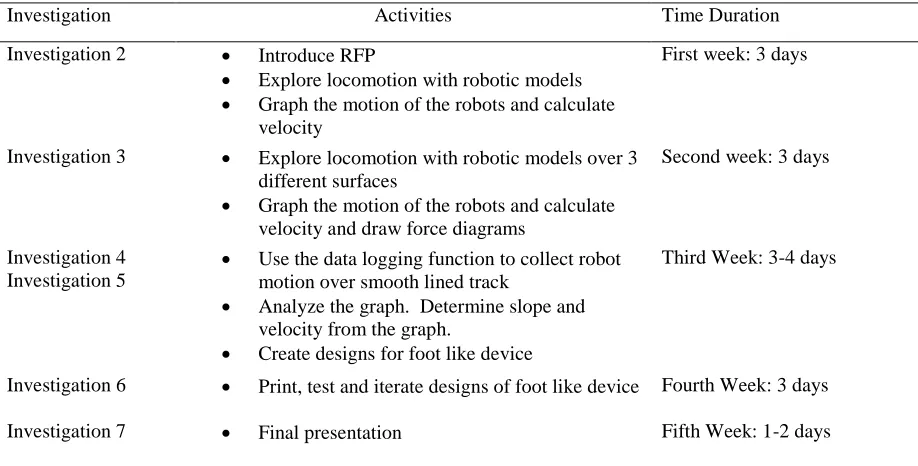
Table 1: Instructional time of activities per Investigation………60
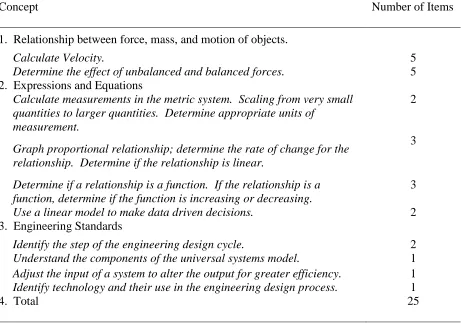
Table 2: Pre/Post Test Concepts and Number of Items Per Concept………65
Table 3: Skewness and Kurtosis Statistics for the Achievement Pre/Posttest….………..79
Table 4: Skewness and Kurtosis Statistics for the MES Survey Subscales……… ……..81
LIST OF FIGURES
Figure 1. Situated Cognition Theoretical Framework……….……….11
Figure 2. Situated Cognition Concept Map………..13
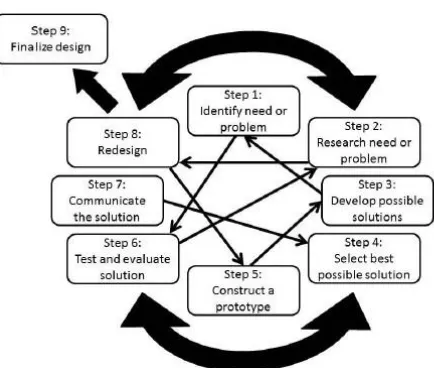
Figure 3. The Engineering Design Model………57
Figure 4. Concept Map Linking Study Design to Situated Cognition Framework ………….…70
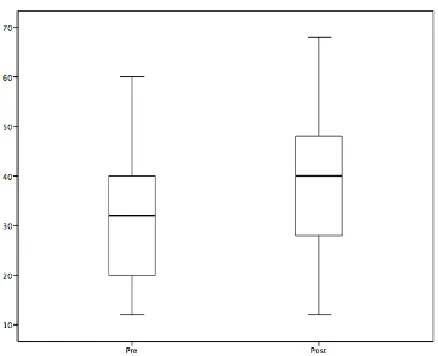
Figure 5. Pre/Post Test Concepts and Number of Items per Concept………..79
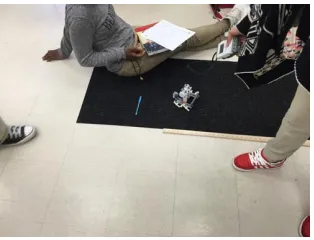
Figure 6. Students in Close Proximity to the Robot During Testing..………..90
Figure 7. Student #2 Engineering Notebook Entry Foot Friction Experiment……….…………92
Figure 8. Student #6 Engineering Notebook Entry Foot Friction Experiment……...………...92
Figure 9. Student #1 Testing the Robot Operating on a Vinyl Surface………..93
Figure 10. Student #7 Testing the Robot Operating on a Tile Surface……….94
Figure 11. Screenshot NXT Data Logging In Student #3’s Engineering Notebook .…………..94
Figure 12. Screenshot NXT Data Logging In Student #3’s Engineering Notebook …………...95
Figure 13. Screenshot NXT Data Logging in Student #5’s Engineering Notebook …………...96
Figure 14. Student #6 Printed Feet…….……….……...97
Figure 15. Student #5 Testing Printed Feet……….….…97
Figure 16. Student #1 Bumpy Foot Design and Spike Foot Design ………98
Figure 17. Student #4 Engineering Notebook Entry Foot-Like Device Ideas ………..…....99
Figure 18. Data Logging Graph from the Engineering Notebook Book…..……...100
Figure 19. The Engineering Design Model ……….104
Figure 20. Student #5’s Path Graph Observation Entry Engineering Notebook ………105
Figure 21. Student #4’s Path Graph Observation Entry Engineering Notebook……….105
Figure 23. Student #7’s Foot Design Draft and The Corresponding Printed Feet.………….…107
Figure 24. Student #1’s Foot Design Draft and the Corresponding Printed Feet …………..…107
Figure 25. Student #6 Manufactured Foot Prototype ……….…109
Figure 26. Student #4 Manufactured Foot Prototype ……….…109
CHAPTER 1 Introduction
Global positioning has become an increasing concern in the United States. The country
that holds the position of leadership globally influences world economy and motivates policy
(Williams, 2011). During most of the time since the industrial age, the United States has held
this position of leadership and has been a major competitor in the worldwide arena. With the
turn of the new century, this position has slowly become tenuous and the ranking is in a period of
decline (Atkinson, 2010). The urgency is magnified by the emergence of other countries
advancing in innovation and manufacturing. These advancements provide fuel for economic
growth and global position. With science, technology, engineering and mathematics driving a
major portion of technological innovation, the nation’s focus has shifted to policies that address
this matter.
Wissehr, Concannon and Barrow (2011) define the period during the 1950’s to 1970’s as
the Sputnik Era. The Russian launch of the Sputnik satellite inspired America to engage in the
movement of developing a mathematical and scientific literate society. This movement was in
response to Russia’s perceived leapfrog advancement over the United States. This era served as
a trumpet call to educate citizens with the intent of maintaining technological superiority.
Technology advancements motivate a healthy and growing economy. Innovation inspires the
improvement or the creation of new products, processes and services. Atkinson (2010) claims
that it is these technological innovations that are driving forces behind economic growth and
competitiveness. Since this era, the prevalent perception is that the country is in decline
maintain economic stability and develop the 21st century workforce. Zhao (2010) states that the
risk of losing the highly regarded leadership position is due in part to the poor workforce
development. A properly trained workforce is integral to grow and sustain an economy driven
by technology and innovation. These factors have motivated many to ask if we are currently in
this generation’s Sputnik Era.
During this time, students have become disengaged in the mathematics and science
classrooms. Balfanz, Herzog and Iver (2007) assert that middle school students in the United
States are falling behind especially in urban communities. Many factors have attributed to
student disengagement and performance decline in the middle schools. Kieffer, Marinell and
Neugebauer (2014) cite curricular demands and changing school environment as being some of
the factors for the decline. With the deterioration evident, the call for reform addressing student
performance and engagement has been made (PCAST, 2010).
Statement of the Problem
The problem addressed in this study examined the need for middle school students to
become STEM (Science, Technology, Engineering and Mathematics) literate, the lack of defined
focus for STEM integration, and the decline of student performance and engagement in the
mathematics classroom. Following is a discussion of each aspect of the problem.
Need for STEM Literacy
Bybee (2013) states that many of the jobs and careers needed to support innovation are
currently and will be rooted in STEM disciplines. The President’s Council of Advisors on
Science and Technology, PCAST (2010), states that the workforce produced in the current
education system has had their creativity dulled and stifled. At the same time, students have not
internationally, United States 15-year-old students are ranked below average on the Programme
for International Student Assessment (PISA) given in 2012. The assessment measured the
acquired skills and knowledge that are essential for participation in modern technological
societies. Students in America showed weaknesses in performing higher-level cognitive tasks
such as real world problem solving. As a result, the students are inadequately prepared for
success and prosperity in the workforce. Atkinson (2010) states that the number of STEM
degrees earned has been outpaced and at times doubled by Non-STEM degrees. He also
maintains that the low number of American students going into to STEM fields poses risks to the
economy growth.
PCAST (2010) claims that STEM job and career growth will outpace the number of
educated and trained professionals needed for these occupations. Roberts (2012) claims that the
United States is ranked 18th among industrialized nations of students graduating and the country
is falling in graduation rates. Bybee (2013) asserts that for the United States to maintain global
competitiveness a greater effort must be made to produce STEM literate students to form a 21st
century workforce. These students will be equipped with fundamental concepts and knowledge
in the areas of STEM. Along with being STEM literate, the students will have critical
problem-framing and solving skills. However, Roberts (2012) states that today’s educational system will
not meet the demands to produce STEM literate members of the society thus causing a shortage
of workers to regain the leadership position globally. Even though there has been an increase in
graduation rates as reported by the Department of Education as reported by Camera (2015), the
celebration has been subdued with the evidence of misreporting and the fact that students’
mathematics and science scores dropped for the first time during the past decade. Under the
With innovation and creativity being influential skills overlooked in the classroom today, we are
manifesting a generation of students that have a strong disinterest in STEM related fields and
disciplines.
Lack of Defined Focus
STEM education is seen as a vehicle in which the U.S. can educate and train a 21st
century workforce. Bybee (2010) describes that there still exists a wide gap of misunderstanding
of STEM education. STEM education from the onset of its inception was considered a basic
label for anything that related to science, technology, engineering and mathematics. Although,
the focus was heavily placed on science and mathematics, the manner of instruction varied.
Presently, Brown, Brown, Reardon, and Merrill (2011) state that there has been a lack of
understanding of what STEM education is in schools today.
Bybee (2013) claims that many perspectives of STEM pervade the educational landscape.
The absence of focus has created many definitions. For example, he describes the idea of STEM
education starting with instruction facilitated in separated discipline silos. This approach has a
focus on either mathematics or science. This approach is characterized by an emphasis on both
subjects but still contained in their separate silo. Another approach shows that STEM could
possibly mean the incorporation of two or more subjects anchored by one subject. For example,
science teachers incorporate technology and engineering in lessons such as egg drop or drag
racing car activities. Another example highlights the efforts of mathematics teachers using
biology and art to describe characteristics of nature through sequences.
Another perception of STEM education is the combination of two or more disciplines
into one instructional course. This combination is currently present in engineering and
version of STEM education has all of the disciplines combined to form a stand-alone course.
With many forms and perceptions of STEM education, there is a need for forming a foundation
that is present in the described characterizations. Bybee (2010) claims that STEM education
should be the place where students solve problems in context using non-routine problem solving
skills, self management, and self development. He describes an environment where a student
participates socially developing complex communication to use systems thinking to solve real
world challenges. At all school levels, with an emphasis on middle school, the need to bring
STEM into focus is evident. Saxton, Burns, Holveck, Kelley, Prince, Rigelman and Skinner
(2014) contend that a focused perspective of STEM aids the design of instruction and
assessment.
Student Engagement and Performance
Students in the United States have lost interest in science and mathematics. Chen (2015)
claims that this problem has plagued education for generations. Many reasons have been
attributed to the disengagement of students. For example, the use of lecturing as a primary mode
of instruction to a teacher’s inability to include all students in the instructional activities have
been identified as reasons why students disconnect from the learning process. Another glaring
reason for student disengagement is the continued teaching of skills and practices that do not
translate to relevant material for the 21st century workplace (Atkinson, 2010). As we move
towards a more technologically advanced world, we are slow to educate and develop skills
needed for the 21st century workplace.
Bybee (2013) also informs that after a decade of education reform, we still have a
situation where students in the United States are below average proficiency. There is a
they receive. With a consistent call for students to perform with abilities that are characterized
by innovation and higher order problem solving, there is a place to incorporate activities that
include design thinking and engineering. Design thinking develops creative confidence through
hands on projects and engineering allows for students to use the creativity to solve real life
problems (Kwek, 2011).
Purpose and Research Questions
The purpose of this study was to investigate and describe the effects of using
project-based integrative STEM modules on eighth grade students’ performance and engagement in a
unit on functions in Algebra. The study was guided by the following research questions:
1. What is the effect of using project-based, integrative STEM modules on 8th grade student
performance and engagement in learning a unit on linear functions? More specifically, to
what extent are grade 8 students able to make connections between linear functions and
its applications?
2. What STEM-related situational factors contribute to 8th grade students’ success in
learning using project based, integrative STEM modules?
Significance of the Study
The study is significant for many reasons. First, there is a need to develop STEM literate
students entering the workforce. Secondly, there is a demand for the identification of strategies
and practices that narrow the definition of integrative STEM education. Lastly, there is a lack of
reporting and communication of the effects of student participation in integrative STEM
activities on their performance and engagement.
The call for a STEM proficient and prepared society requires the improvement of STEM
environment, there is a question of determining viable processes to investigate, study and
communicate the integrative STEM teaching and learning experience present in the model.
Honey (2014) reports the recommendation posed by the National Academy of Sciences, which
calls for the exploration of the curriculum and pedagogical interventions in detail with attention
focused on the nature of integration and how it is supported.
This study examined how the integrative nature of the learning experiences support the
development of knowledge and practices that form the foundation of 21st century workplace
skills. By exploring the factors that lead to performance and engagement, instructional practices
are identified and highlighted for use in other areas of instruction. Aspects of the learning
environment can be replicated to motivate the development of critical thinking skills.
Ultimately, strategies are identified that promote student interest and proficiency in STEM with
the purpose of guiding them to become STEM literate.
Theoretically, the study examined the social nature of learning in the context of real
world situations. Honey (2014) asserts that the design of integrative STEM should be based in
the interactions of students, teachers and the community. This study was built upon the social
nature of learning foundation and provided a blueprint to how one engages in integrative STEM
problem solving. By exploring the framework of situatedness, examples were given to show
how students engage in activities where core discipline content is applied and transferred to
similar situations.
Theoretical Framework
Xaviers’s School for Gifted Youngsters is a fictional school for Marvel’s X-Men. Along
with teaching subjects like English and math, Professor Charles Xavier primarily trains the
fostering a friendly human-mutant relationship. Professor X recognizes their gifts and talents
and wants to take them to higher measures of success and performance. He uses various
instructional strategies and lessons to facilitate the growth of each young mutant’s unique gift.
The professor created a school to prepare them for life and the challenges they will have to
endure. He realized that their development would be benefited from learning as a team and not
individually. Thus he tailored their learning experiences to be done collaboratively. Their
primary classroom was a place called the Danger Room. Here he designed simulations that
replicated situations they would face as members of this unique team. The simulations were
intricate and detailed. They resembled the ill structured problems and situations they would face
in the real world. Thus, the situation represented the actual problem in context, authenticity and
danger. The journey of solving these challenges could only be done as a team. Only as a team,
could they succeed and prepare themselves for other challenges that would come before them as
they protected earth against enemies here and beyond.
The above-mentioned description is from The Uncanny X-men comic from 1981. The
main learning environment that is described is called the Danger Room (Trushell, 2004). The
room is designed to present the situations of rescue and combat to a team of young mutants in
preparation for their journey as superheroes. Professor X guides them through exercises from
the control room located at the top of the room. Extensive modeling programs allow for training
in realistic and authentic environments from outer space to the depths of an ocean. Projectiles
are hurled at them to sharpen skills and techniques. The team of mutants collaborate and
negotiate with themselves in the best manner to overcome each challenge presented to them in
community to achieve success and develop lifesaving skills for preservation and protection of
Earth. Learning by doing in context is an overarching theme present in the Danger Room.
The description for the Danger Room in the above paragraphs could also be painting a
picture of a middle school classroom. The students in the classroom can be immersed in an
authentic real world challenge, for example developing exoskeleton robotic prosthesis to aid
diabetic patients with the amputation of a limb. As often displayed in the real world of science
and engineering, the students would collaborate in design teams to find solutions. These students
would use relevant tools that are used by those in industry in the same manner as those would in
professional settings. Just as Professor X deems to immerse his young mutant learners in
activities that foster the development of useful knowledge, the middle school classroom can be
designed to afford relevant tasks that are interestingly meaningful and promote learning of the
concepts involved. Professor X believed that with the help and the aid of others in their group,
they are able to utilize and develop the tools needed to achieve a successful mission. Stein
(1998) describes a classroom where students work together with experts to novices to develop
meaning and solve problems. Even though students come with different unique talents and
abilities, when they are joined together to solve the problems of the class, they can develop skills
that go beyond and be successful throughout life. Both of the examples, Professor X’s Danger
Room and the middle school classroom, are spaces that demonstrate the tenets of situated
cognition.
This examination of the theoretical framework is divided into four parts. In part 1, I will
discuss and examine the definition of situated cognition theory. The learning processes that
cognitive apprenticeship, will be discussed. An analysis of the basic tenets of situated cognition
will solidify the theoretical framework developed.
In part 2, I will explore the historical development of situated cognition. A review of the
precedents from which the development of situated cognition originated. Some of the pioneers
and their theories will be inspected to discuss their influence on the framework. The foundation
of “situatedness” will be explored.
Part 3 will focus on the ontological and epistemological underpinnings. This section will
discuss the definition of what knowledge is in relation to situated cognition to understand how
attaining knowledge takes place. Finally, part 4 will investigate situated cognition in the
instruction of STEM education. The process of designing learning experiences on the foundation
of investigating the world in an authentic manner through real world problem solving will be
discussed. Investigating the learning processes of situated cognition will provide insight to how
engagement and proficiency is impacted.
Situated Cognition Defined
Lave (1988) states that situated cognition is a theory where an individual’s cognitive
activity cannot be isolated from the social context from which it occurs. Brown, Collins, and
Duguid (1989) further develops Lave’s definition of situated cognition as the presupposition that
learning and knowledge acquisition is embedded in an authentic context and activity within the
culture it resides. Lave (1988) defines authentic activities as purposeful, meaningful actions but
ordinary to the practices of the culture. Lave and Wenger (1991) believe that learning is situated
in the activity in which it is taking place and is integral to a culture’s generative social practices.
From this definition the notion of learning can be understood to be done by all in the community
that the process of learning occurs as a result of relationships established between the learners,
the activities and the social organization of the communities involved. Brown et al. (1989) state
that the knowledge acquired as a result of these relationships and the associated concepts are like
tools and resources of the culture. These tools and resources can only be understood through
expert guidance and use. The conceptual knowledge acquired is no longer seen as a standalone
acquisition of facts. Knowledge becomes a tool that is applicable, useful and robust. Through
active use of the tools, participants will deepen their understanding. Utilization of the tool will
be developed much further than any abstract or explicit rules that may accompany the tool. The
use of the tool will aid in the development of its understanding. The understanding will change
and grow as expertise is developed. Just as the understanding of the tools change, the
participants’ roles in this process will develop and change over time (Brown et al., 1989).
Participants will be afforded the opportunity to develop and adapt. As Brown et al. (1989)
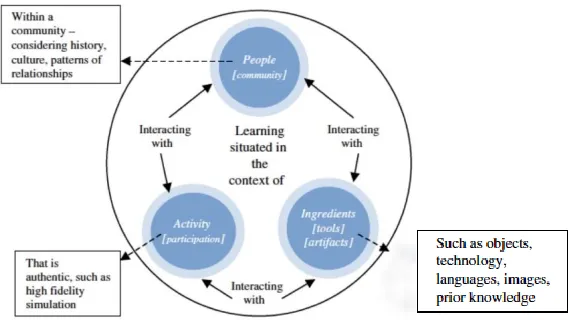
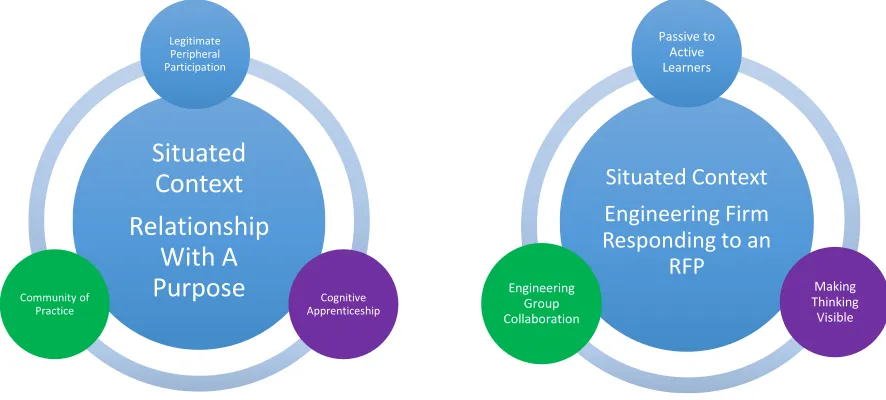
asserts, participants become enculturated in the social structure of the situation. Figure 1 below
[image:30.612.84.376.473.633.2]is a depiction of the interaction with the contexts that have been previously characterized.
Figure 1. Situated Cognition Theoretical Framework. Adapted from “Situated cognition: A
Varela, Thompson, and Rosch (1991) extend the theory stating that being situated lends
to an understanding that cognition depends on bodily experience with its environment. This
perspective brings into view that cognition requires the immersion of the body’s sensorimotor
capabilities. The connection between mind and body is characterized as the embodiment of the
mind. Robbins (2009) claims that the embodiment of the mind allows for sensory perception of
the environment as inputs and motor activity as outputs. Varela et al. (1991) further describe this
relationship as physical, temporal and functional. As a result of the characterization of the
relationship, the learner interacts with its environment to form reality and develop reason. From
this claim, Robbins (2009) concludes that thought is empty without the embodiment of the mind.
Wilson (2002) further describes the embodiment of the mind as being on-line or off-line.
On-line embodiment involves the body in a literal sense. Robbins (2009) describes the on-On-line
interaction between the mind and body as a dynamic relationship involving motor nerves, sense
organs and limbs. Wilson (2002) describes off-line embodiment as the condition where
cognition occurs through memory and mental imagery.
All of the characterizations of situated cognition lead to a focus on the social structures
and learning processes in the environment. The social structures and learning processes are
communities of practice, legitimate peripheral participation and cognitive apprenticeship. Figure
2 below depicts their relationship with each other. At the center is the situated context. Lave
and Wenger (1991) describe learning as being situated in a community of practice and represents
development from peripheral activity to more expert participation where learning can be seen as
a form of apprenticeship. Students immersed in the situated context enter in as a newcomer to a
community. As the community engages in the context they are enabled to acquire, develop and
social construction of knowledge. Community of practice, legitimate peripheral participation
and cognitive apprenticeship will be a described to give further insight to the theory of situated
cognition.
Figure 2. Situated Cognition Concept Map.
Community of Practice
According to Lave and Wenger (1991), a community of practice is a group of people who
share skills, inquiries, set of problems, or interests individually and as a group. In the
community, Hung (2001) argues that the members are connected socially by beliefs and ways of
thinking. As newcomers become engaged, they enter with little knowledge of the norms and
practices of the community. Learners begin to move from one level to another engaging in a
process of collective learning in a shared space where the problem or challenge is presented.
The members develop shared resources and tools that will aid them in problem solving. Lave
and Wenger (1991) inform us that this results in the formation of shared practices. These shared
practices can be communicated explicitly or not depending on the level they are used and
communicated. For example, in programming the code for a robot to perform a series of tasks,
certain strategies may be assumed and communicated as standard. Programming the motion of a
robot to move linearly is an example where strategies can be assumed. It may be assumed, Situated
Context Relationship
With A Purpose
Legitimate Peripheral Participation
Cognitive Apprenticehip Community of
depending on the engineering of the robot, that motion will incorporate the use of two motors or
one depending on design. Another example where other strategies are constructed explicitly
would be the determination of the best path to find a location for the deployment of solar stations
for energy storage and consumption. Brown et al. (1989) argue that these characteristics of
domain, membership and practice form the foundation of a community of practice. The domain
refers to the commonality of interest amongst the community or membership. The practice is the
set of resources, experiences and tools that the membership uses for problem-solving.
Winbourne (2010) further characterizes a community of practice as participation in
identity formation. Identity is formed in a community of practice by creating an
apprentice/master scale structure. The learner, by identifying their place on this scale, is
informed of their manner of discourse and behavior. A community of practice, as argued by
Winbourne (2010), is described as all of the participants actively engaging in the activity of the
practice that is constituted by the participants. Wenger (1998) provided the foundation declaring
that learning is central to the human identity. The construction of identity through the social
practices contributes to the learning process. The individuals in this process participate to form
the community’s shared identity.
Aspects of interest to a community include the manner of how people are connected to
the situation or context in which they are connected. Wenger (1998) classifies this interaction as
a relationship with a purpose (Figure 2). This relationship distinguishes itself from other
relationships that are created for reasons outside of a shared purpose. Carlisle (2002) expounds
on another aspect of interest, which is the use of the community’s tools that are used to stimulate
of the community allows for a pathway to shared understanding and discarding of knowledge
that is not used.
Legitimate Peripheral Participation
Legitimate peripheral participation, as coined by Lave and Wenger (1991), describes how
newcomers move from a beginner to an experienced member and from experienced member to a
veteran in a community of practice. Legitimate peripheral participation is characterized by the
relationship between the beginners and the veterans with regards to the activities, discourse and
products of the culture. Hudson (2010) extends the premise that the process of co-participation
is integral to learning, as opposed to learning within the heads of individuals. Lave and Wenger
(1998) further state that novices enter this process by doing “peripheral” activity. They describe
peripheral activity as engagement at the lowest level or residing on the fringe with the least
amount of participation. As students progress through the processes, they may assume more than
one role. For example, in some engineering learning experiences students may come with
limited knowledge of designing and manufacturing prototypes, but have developed problem
solving skills. Students may engage by observing or offering comments from the “outskirts” of
the process. Over time the students will take on more central responsibilities. This can be seen
in the example of the student using 3-D design software then moving to a place where the
designs are used to manufacture prototypes for testing and data collection. This process is
tailored towards the student’s inquiry and ability. The student can be an expert at a lower level
but a novice at a higher level. The student moves though this progression at different stages and
times during their membership in the community. The student is motivated to learn due to their
need to gain more knowledge. The movement continues until the student performs at their
Cognitive Apprenticeship
Brown et al. (1989) developed the model of cognitive apprenticeship which emerged
from the theory of situated cognition. Collins, Brown and Holum (1991) state that cognitive
apprenticeship is a theory that assumes learning is done socially between learners/experts
through observation, modeling and imitation. Learning is a process that is done through
experience and facilitated by an expert. As stated earlier, the learning is tied to an activity and
context which a novice joins in a community of practice from the periphery. The novice learns
in context and culture as an apprentice as they move though the process of legitimate peripheral
participation. Thus, Brown et al. (1989) claim that cognitive apprenticeship supports the learner
through the acquisition, development and use of cognitive tools during the authentic learning
activity.
Collins et al. (1991) describe the traditional model of apprenticeship as the expert
showing an apprentice how a task is done. After observations, the apprentice practices certain
aspects of the task under the facilitation of the expert. As the apprentice gains proficiency doing
the task, the expert turns over more responsibility of the task until he feels that the apprentice has
gained the proper skill to complete the task on their own. The traditional model is highlighted by
four aspects of learning: modeling, scaffolding, guided practice and coaching.
The bridge from traditional apprenticeship to cognitive apprenticeship involves
transitioning methods used that would relate to a classroom learning experience. In a traditional
apprenticeship the skills needed to learn a specific task are easily observable. Collins et al.
(1991) claim that the students’ thinking and problem solving skills need to be made visible so
that the teacher can guide and facilitate their development. This action is promoted by
arise out of real world situations. To bridge this idea, Polo (2015) states that cognitive
apprenticeship emphasizes that learning should be done in context embedded in real world
problems. Finally, traditional apprentices learn skills which are inherent to the task. Schooling
expects students to transfer knowledge to different tasks. To bridge this idea to cognitive
apprenticeship, diverse situations should be presented that show the common use of skills
learned.
Lave and Wenger (1991) further developed the social nature of cognitive apprenticeship
describing how learning occurs in partnership with others. Learners develop cognitive processes
while interacting within a social context of a community. Hung (2001) points to Vygotskian
thought that individuals can learn more through interacting with others than they could do
independently. Brown et al. (1989) support the importance of social interaction stating that the
learner’s engagement with a culture’s practices affords them the ability to adapt and assimilate
these norms. Smith (2004) shows how this premise forms the foundation of the work in artificial
intelligence (AI). The study of how robots are programmed to interact and behave in certain
communities to acquire knowledge is an area of interest in this field. The robots are
programmed with the ability to assimilate itself into a membership by observing the members’
behaviors and practices and adopting them for the purpose of engagement. Cognition moves
from being rich with representations and symbols to a self-organizing system with its
environment. The robot becomes a socially active component of the community and participates
with the formation of resources that are used and are relevant to the context of interest. Smith
(2004) claims that knowledge and understanding is distributed socially. Socially shared
Basic Tenets of Situated Cognition
Lave and Wenger (1988) proposed four basic tenets of situated cognition as a theoretical
framework: (1) learning is grounded in the actions of everyday situations, (2) knowledge is
acquired “situationally” and transfers only to similar circumstances, (3) social processes
influence the way people think, interact and solve problems to attain knowledge, and (4)
meaning is made socially and is a product of learning. Brown et al. (1989) argue that the four
basic tenets underpin the assumption that learners are participating in actual experiences that are
relevant to the content learned. First, learning is a function of the activity, context and culture in
which it occurs. It is further explained that the activities involved must represent the same that
are peculiar to the culture where meaning and purpose is socially negotiated. For example, the
ruler used by a community of newspaper editors to measure copy layout would be different for a
community of engineers using a ruler to measure proper placement of support joists. The
authenticity of the context, as claimed by Herrington (1995), reflects how the knowledge will be
used in real life without fragmenting the problem and counting for real world complexity.
Secondly, Choi (1995) claims that the transfer of knowledge is influenced by situational factors
and is successful when cognition is anchored in realistic contexts. Real life problem solving is
where transfer is most likely to happen. For example, the Boy Scout transferring knowledge of
knot tying to storing food tied to a tree out of the reach of animals. The Boy Scout uses his
knowledge of knots to make it easy to retrieve the stored food while at the same time keeping it
secure. Thirdly, Brown et al. (1998) explain that learners are continuously interacting with the
cultural values and norms in the process’s context. As learners engage in authentic contexts,
they are applying the process as a means of participating in this social structure. Finally, as a
Historical Development
Situated cognition has its beginnings in psychology, anthropology, sociology and
cognitive science (Gallagher, 2009). The question that drives interest in the phenomenon of
learning is how does cognitive development take place and what is its role in learning? Young
(2003) states that the emerging perspectives carry the beliefs that the constructivist platform
directs the act of meaning making. These emerging perspectives provide the nutrients where the
roots of situated cognition are fortified and developed. Several theories provide the path to
situated cognition, Lev Vygotsky and John Dewey socio-cultural theory, ecological psychology,
everyday cognition and critical theory.
Lev Vygotsky’s view of cognitive development differs from the work of Piaget and
provides foundation on which situated cognition is constructed. At the heart of his view is the
premise that learning is a social experience. This is a key difference between his view and
Piaget’s view. Piaget believed that development must precede learning. Vygotsky believed that
“social learning is likely to precede development (Yilmaz, 2011, p. 207).” Knowledge is an
internalization of social activity. Yilmaz (2011) claims that Vygotsky argues that culture plays a
key role in cognitive development. The people are important players just as the cultural artifacts
and practices. Learners actively engage in all of the interactions between these players to
construct knowledge and skill. Subsequently, learning is viewed as the relationship and
connection between the individual and the society. This relationship promotes, dictates and
regulates the development of cognition. Thus the social experience is bounded by the culture in
which it inhabits.
Hung (2001) claims the importance of learning and characterizes it as a social act. The
People assemble in a community of practice where they develop the rules and structures that
support the community. Freeman (2008) argues that the co-creation of knowledge among the
peers promotes active learning. Lehman (2014) claims that working from this perspective,
individuals can be seen as meaning makers of the experiences and situations around them. It is
from this community that members are engaged in collaboration and problem solving that leads
to adaptation, growth and change.
Lave (1991) states that Vygotsky mentioned how the analysis of child’s psychological
development is centered around two basic tasks, the analysis of the social situation and the
analysis of the psychological structures that develop in the social situation. These ideas underpin
the concept of Zone Proximal Development (ZPD). Hung (2001) describes Vygotsky’s ZPD as
the area or distance between what the learner can do by himself with assistance to what the
learner can do unaided. The intent is for the educator to provide experiences that are within this
zone to enhance and promote learning. As mentioned before, the focus is not only on the end
result but also on the process to arriving the end result. Learning in this zone can be scaffolded
through the guidance of an expert or in collaboration with other learners. The formation of a
community of learners could be created where novices and those who are more developed can
interact. During this process the teaching and instruction can be tailored to the individual based
on the needs within the culture.
Bredo (1994) argues that John Dewey’s assertion that there is no separation between
mind and body is another point of foundation for social cognition. Much of the teaching and
learning through lecture promotes the idea that learning is done mostly without an interaction
between the body and the environment. The situated shift calls for a description of the
interaction between oneself and its surroundings. The action is described as orchestrated or
composed. Therefore, this relationship results in meaningful experiences that are part of the
learning process. Bredo (1994) explains how Dewey describes a transactional system that
emphasizes the mutual development across abilities. He characterizes it as the space where
understanding is obtained through doing. Meaning is co-constructed between the learner and the
culture. The community’s environment is the place where the development occurs.
Gallagher (2009) says that the systemic view of cognition, which is described as the
philosophical, psychological and social development, is influenced by theories and designs from
Dewey. Dewey’s school explored how learners are able to construct meaning using physical
models and representations. The underlying thought is that the facilitation of learning abstract
and general concepts can be done through the manipulation of models. Wenger (2014) states
that these ideas are found in the theory of constructivism and discussed in the response to
Artificial Intelligence’s model of knowledge acquisition. The model stated that learning is an
active process. Comprehension requires some prior knowledge or experience. A recurring
theme is that conceptual understanding is gained by doing. Bredo (1994) contends that Dewey
argued against the idea that thinking is a separate activity between perception and action. Dewey
states that actively moving and manipulating things shape perception. From this perspective,
there is no distinction between mind and body. The moving involved is part of the
understanding and meaning making aspect of the process.
The ecological platform of situation cognition gives the foundation of “situatedness.”
The relationship of the subject and the environment aids in the process of understanding and
meaning making. Pick (1992) states that Eleanor Gibson classified affordance as active
based on what is in the environment. Thus, sense is made based on the context of the
environment.
Everyday cognition solidifies the framework for situated cognition. Born from the field
of cognitive science, the area of investigating every day learning strategies of a certain field is of
interest. Henning (2004) espouses that everyday cognitive activity uses the relevant and
situational resources and tools, which have been provided, to produce and construct new
knowledge. Here the priority is taking a contrived, concerted and sterile experience to a real
world authentic study. The real world authentic study is outside of the formal environment and
can be viewed as everyday activities. Everyday cognition views of learning of an everyday
activity is characterized as developing everyday strategies which are not necessarily taught in a
classroom but taught in the environment of the situation. This ideology provides the groundwork
for activity being situated. Situatedness is very specific to the activity and authentic in the
workings and design of the function.
Ontological Underpinnings
The ontological question aims at addressing the philosophical ideologies of reality in
regards to situated cognition. Ontologically, situated cognition does not accept that there is one
truth. Stead (2004) argues that there are many truths present based on how it is perceived and
situated in relationships. The implications of this assumption reach far and deep in integrative
STEM education. The role of the teacher is reshaped from the traditional sage or expert that
provides the answer or ultimate truth. The instructor’s role moves from providing and
structuring information to the position of guide and co-learner. The teacher now engages as part
The view of many truths also leads to the idea that the construction of knowledge is done
socially through the interaction and relationships between actors and tools of the community.
Scotland (2012) claims that this regard of knowledge construction is done in various ways, but
the truth is a consensus formed by the participants in the community. Social construction can
include an array of different perspectives. The array includes perspectives from the
acknowledgement of how social factors shape interpretations to views on how processes shape
the meaning making. The appearance of the interpretations leads to a thorough description that
gives insight and depth.
Richards (2001) claims a further assumption that learning is based on context. Human
thought and action have a strong relationship to context and are affected by the external
characteristics of the contextual surroundings. Cobb (1999) argues that the situated context is
traced to the notion of physical location and explains how this view is apparent in example
investigations where comparisons are made between learning mathematics in a mathematics
class and learning mathematics in a technology class. During the mathematics class, the
practices and skills learned may develop a different form of mathematical reasoning than what is
used in the technology class. Lave and Wenger (1991) attribute this to the social nature of
engaging in the practice in a particular space.
Yilmaz (2011) states that when context is investigated in respect to the learning
environment it is assumed the environment uses relevant and authentic tools and resources in the
designed environment. It is important to provide situations that utilize skills taught and
developed as the learners use them. Lave (1988) states the range of use can be from everyday
use by “just plain folks” to those identified as experts. As mentioned before, Yilmaz (2011)
with the process of learning rather than the instruction of specific skills. Through cognitive
development, understanding and knowledge is constructed using the community crafted tools
and resources.
Theories of situated cognition argue that the learning space is a complex system and can
be viewed from many perspectives. Based on the foundation of theory, an allowance is made to
view the world from many historical and cultural contexts. Peters-Burton (2014) argues that an
assumption of the integrative STEM approach is that complex critical thinking and problem
solving skills are instructed as well as academic knowledge from specific subjects. Thus, there
are multiple perspectives that the integrative STEM approach can provide. These multiple
perspectives allow for the development of more than discipline content knowledge.
Development of critical thinking skills, problem-solving techniques and other soft skills are also
addressed in integrative STEM education.
Epistemological Underpinnings
The roots of situated cognition are anchored with social constructivism. Young (2004) contends that “Social constructivist, such as Bruner and Vygotsky, recognize that influences on
individual construction are derived from and preceded by social relationships” (p.376). Brown et
al. (1989) claim that the community and culture craft and develop the tools used in practice by
the input made by the individual members of the community. The tools are constructed that
resemble the belief structure and values that permeate the culture of the activity. This learning
follows a path where the culture influences thinking. As learning progresses, changes in the
individual occur in relation to the community or culture. The change is part of the process where
An important aspect to constructivism is that the world and the culture are present from
birth. Crotty (1998) argues that there is a pre-existing system in place from birth. There are
beliefs and values that have been agreed upon and the acquisition of new knowledge is bound by
this system and structure.
With foundations formed in constructivism, situated cognition formed out of behavioral
and cognitive science. From the ideology of systems thinking, symbol manipulation enables
individuals to describe, express, and create ideas of the environment around them. Seel (2001)
holds that situated cognition fundamentally gives the frame that provides meaning making by
extracting and organizing information from a given environment. The process gives insight to
the relationship and interaction between the individual and the environment. The interaction is
defined by the cognitive processes, such as activity, characterized by the interaction between
mind, body and the environment.
Now that it is established that the relationship between the individual and the
environment produces knowledge, Stead (2004) avows that it is important to establish that
knowledge is culturally and socially constructed through discourse. He contributes this to the
social nature of knowledge. Learning is done through enculturation. Brown et al. (1989) argue
that either consciously or unconsciously humans from an early age assimilate behavior and
beliefs systems of social groups. By practicing the culture norms and beliefs, meaning is made
by observation or active involvement. Through this involvement, individuals have the chance to
develop a base of knowledge and determine relevancy with regards to the construction of
meaning. Practicing also gives opportunity to strengthen their culture’s membership. By the
immersion of culture, individuals are given access to the conceptual tools and resources used in
Zheng (2010) claims that the research in situated cognition shows that individuals
participating in valued social practices through the immersion in authentic activities promote
knowledge acquisition. Marra (2014) states, “Knowledge that is anchored, or “situated” in
specific contexts is more meaningful, more integrated, better retained and more transferable” (p.
226). Authentic contexts promote engagement from the community and the individuals in the
community. Seel (2001) declares that situated, however, differs in understanding among
cognitive and educational psychologists. Seel (2001) agrees that the semantics of being situated
is thought to be a “product of the internal operations which occur when a learner interacts with a
physical and social situation” (p. 406). The learner interacts with the situation by making mental
models to simulate the situation in order to make meaning of the situation. A model-based
reasoning is promoted where cognitive operations simulate what is happening in real life. As the
learner engages cognitively with the environment, the learner develops knowledge. This
knowledge is not a separate entity but is in concert with the surroundings it was derived from.
Due to the social nature of knowledge and the process embedded in real authentic
contexts, issues of power have to be considered critically. James (2012) declares that knowledge
is not only constructed socially but it is subject to the influence of the power structures within the
society. Investigation into the power structure seeks to uncover issues of social justice and
marginalization. The acquisition of knowledge will be a function of emancipation from a power
structure or the modification of how knowledge is acquired. Critical ideology seeks to place
value on the making of knowledge. The critical perspective places judgment on reality and
Situated Cognition in STEM Learning
Historically STEM educators have discussed and debated the intention and motivation of
various models of integration of the four disciplines. From a positivist’s point of view, the
integration of the four disciplines would not be necessary. James (2012) contends that a
positivist epistemological aim is to obtain knowledge that is descriptive and factual. This
knowledge has an independent existence without influence from the environment or the person
researching it. From the view of situated cognition, the effectiveness of discipline integration
can be explained through the lens of obtaining knowledge by doing and investigating the culture
where it is occurring. Moye (2014) explains that as STEM education has developed, integration
has been unclear and void of a consensus form. The disciplines were taught separately.
Instruction was described by the formation of silos where learning experiences that were not
connected. It has been recognized that integrative instruction promotes the retention of facts and
abstract concepts as well as an understanding of how to apply knowledge and information gained
(Wirth, 2008). The application of STEM concepts in one setting is the intent of integrative
STEM.
Gomez (2013) affirms the description of integrative STEM as learning concepts using
critical thinking and applying problem solving skills. The motivation is to gain understanding
how to apply concepts, processes and design thinking in an authentic context. The view of
situated cognition provides a lens to understand the intended purpose of STEM education.
Learners can obtain an understanding of how things work in the world and how things are
interconnected. Moye (2014) maintains that STEM education can enable students to be critical
of the world and find answers to solve issues present in society. Peters-Burton (2014) holds that