SRJIS/BIMONTHLY/ FARHEEN & PROF. KARUNESH SAXENA (4138-4155)
OCT-NOV, 2016, VOL. 3/18 www.srjis.com Page 4138 EFFECT OF DEMOGRAPHIC FACTORS OF MANAGERS ON CRM PRACTICES IN SELECTED HOTELS OF SOUTHERN RAJASTHAN
Farheen1 & Prof. Karunesh Saxena2 1
Research scholar, Faculty of Management Studies, MLS University, Udaipur 2
Director & Chairman, Faculty of Management Studies; Director IQAC, MLS University, Udaipur
Service industry is becoming very vast and big and hospitality industry earns the most amongst all service sectors. The Hospitality industry offers a huge potential for Social CRM. The Hospitality industry thrives on two basic factors- Segmentation & Uniqueness. Apart from the regular promises of customer satisfaction, it is the Identity or rather the personality of the hotel that really matters. And not to forget the Stand-out factor, that every hotel has on offering, as compared to its competitors. All these factors contribute towards the building of trust and customer loyalty, and eventually prolonged profitability. Customer relationship management (CRM) has a growing popularity and is becoming one of the hottest academic and practical topics in the business field. In fact, due to the competitive environment, CRM is crucial and has become a niche for firm performance. Southern Rajasthan covers many well renowned hotels which bears importance at international level too. However, there is limited research that reveals the relationship between demographic variables and CRM practices followed by the hotels of Southern Rajasthan .This study is an attempt to excogitate the importance of CRM in hotels of Southern Rajasthan with regards to the opinion of hotel managers.
Keywords: CRM, Service Sector, Hospitality Industry, Hotels
Introduction
Every economy consists of three sectors. These are primary sector (extraction such as
mining, agriculture and fishing), secondary sector (manufacturing) and the tertiary
sector (service sector). Economies tend to follow a developmental progression that
brings them from a heavy reliance on primary, toward the development of Scholarly Research Journal's is licensed Based on a work at www.srjis.com
SRJIS/BIMONTHLY/ FARHEEN & PROF. KARUNESH SAXENA (4138-4155)
OCT-NOV, 2016, VOL. 3/18 www.srjis.com Page 4139 manufacturing and finally toward a more service based structure. The service sector
consists of the soft parts of the economy such as insurance, government, tourism,
hospitality, banking, retail, education, and social services. Service industry involves
the provision of services to businesses as well as final consumers. Today Indian
Service Sector accounts for more than half of country’s GDP. The major sectors that
combine together to constitute service industry in India are listed below:
Information Technology
Education
Financial services
Media
Hospitality, accommodation and food services
Entertainment, culture and recreation
CRM is a concept that has developed from marketing theory. During the latter half of
the last century a major shift in thinking occurred based on evidence that it is more
profitable to retain a customer than to acquire a new one. Consequently, relationship
marketing theory suggests that companies change their focus from pursuing the aim of
selling to the maximum number of people to concentrating on developing relationships
with their existing customers. The main focus of CRM is the formation of relationships
with customers with the intention of improving customer satisfaction and maximizing
profits. Lee (2002) in a study of 400 CRM implementations worldwide concluded that
25 % of the explained variation between successful and un-successful CRM initiatives
is due to variations in line-level training and support.It is a proven fact that the multi-
dimensions concept of CRM can be considered relatively new, because of the only few
studies, which are made on the CRM dimensions of some service sectors such as
banking (Akroush et al., 2011; Sadek et al., 2011; Sin et al., 2005; Yim, Anderson,
and Swaminathan, 2005) and contact centers(Abdullateef et al., 2010), thus the range of information on this concept is quite limited. To drive the point home, it can be
SRJIS/BIMONTHLY/ FARHEEN & PROF. KARUNESH SAXENA (4138-4155)
OCT-NOV, 2016, VOL. 3/18 www.srjis.com Page 4140 al., 2005). With the development of technology, many IT systems have been developed to assist the aim of customer relationship. These systems range from contact
databases to campaign management software. All of these systems, which can
assistimproving the efficiency of CRM, have been grouped together and are now
generically known as CRM software. To quote Rohhrbacher (2002), “The internet
isn’t a revolution; it simply revolutionizes the way we send and receive information.
People now focus more on the information on the internet than information about the
internet’’.
According to Payne (2009), “the emergence of CRM as a management approach is a
consequence of a number of important trends. These are described as follows: The
shift in business focus from transactional marketing to relationship marketing - The
realization that customers are a business asset and not simply a commercial audience. -
The transition in structuring organizations, on a strategic basis, from functions to
processes - The recognition of the benefits of using information proactively rather than
solely reactively - The greater utilization of technology in managing and maximizing
the value of information - The acceptance of the need for trade-off between delivering
and extracting a value for a customer - The development of one-to-one marketing
approaches”.
Furthermore, several studies, made about the impact of information technology on
organization performance report similar findings about the positive role of information
technology in CRM strategy. In other words, these studies revealed that many
customer-centric strategies cannot achieve their goals, without the help of information
technology (Abdullateef et al., 2010; Eid, 2007; Ozgener and Iraz, 2006; Sigala,
2005; Sin et al., 2005; Yeh et al., 2010). Consequently, CRM based technology enables organizations to plan and implement successful marketing actions for retaining
customers long-last and making them more profitable , because of the customer
database and other information-storing systems (Roberts, Liu, and Hazard, 2005).
SRJIS/BIMONTHLY/ FARHEEN & PROF. KARUNESH SAXENA (4138-4155)
OCT-NOV, 2016, VOL. 3/18 www.srjis.com Page 4141 improves marketing capabilities by providing valuable information about customers,
which, in turn, will help both managers and employees to achieve specific marketing
goals much more effectively
Review of Related Literature
To gain the in- depth knowledge about the topic he researcher has reviewed many
national and internal journals. The related review of literature has been collected from
several online sources and libraries. This part of the research plays a vital role in
understanding the research gap and it provides a route map to research on the
untouched areas of the concerned topic.
According toTepeci (1999) hospitality companies can increase their market share and
growth rates by increasing their brand loyal customers. This is a more profitable
approach than other marketing activities, such as price cuts or promotional programs.
As a mature industry, the hospitality business must pursue market-share gains, rather
than market-growth gains. Acquiring new customers is expensive because of
advertising, promotion, and start-up operating expenses. Besides, it is cheaper to serve
current customers.
“Customer Satisfaction has converted into a critical issue which decides the success of
any organization. It is one of the major factors which have to be taken into
consideration. It is the demand of market to find out a way to make and feel your
customer satisfy. The Concept of Customer Relationship Management (CRM) has
emerged as magic stick and it describes the way to reach “Customer delightness”. CRM includes basically understanding the customer’s need and requirement and the
essence of CRM is Customer Retention. The Application of CRM in Hospitality
Industry is required to increase the satisfaction level of customer and resulting in
maintaining long term relations, helping the Social Recognition and developing
Customer loyalty too.Singh & Rajput (2011)
SRJIS/BIMONTHLY/ FARHEEN & PROF. KARUNESH SAXENA (4138-4155)
OCT-NOV, 2016, VOL. 3/18 www.srjis.com Page 4142 financial issues that hoteliers are currently facing and to introduce the theme issue.
According to them some of the key emerging areas are risk management, cost
management, land management and policies, revenue management, growth challenges
and innovative practices arising from an extended inflationary period. The paper draws
facts and emerging trends from various official reports and collates key issues as
highlighted by the theme issue contributors.
In the opinion ofM. Graf et al. (2013) a conceptual model based on transaction costs
economics (TCE), tests it with a cross-industry sample of managers, and draws out the
implications for theory and practice. TCE-based antecedents explain most, but not all,
CRM outsourcing decisions, with the resource-based value of the firm (RBV) and real
options theory offering potential explanations for relationship between CRM
outsourcing and technical uncertainty. A survey of managers responsible for CRM
sourcing decisions was used to test the research hypotheses, along with in-depth field
interviews.
Yin Chu (2014) identified current research trends and clarified the changing direction of studies on luxury hotels. The luxury hotel researches that were identified were
categorized into nine groups by research themes: marketing, human resources (HR),
finance, strategic management, technology, service quality, food science, tourism and
others, with marketing, HR and technology being the most popular research themes.
Analysis of methodological trends in luxury hotel research indicated that the majority
of the researchers utilized quantitative methods employing various statistical analysis
techniques. Overall, luxury hotel research is still limited in the number of publications
and diversity of research topics.
In the opinion of Arman (2014) companies that used social networks got a huge return
on that investment in 2010. This study also revealed that, 72% respondents plan on
linking data from social networks to their CRM software within next year. Integration
of Social Media (SM) and Customer Relationship Management (CRM) is imperative
SRJIS/BIMONTHLY/ FARHEEN & PROF. KARUNESH SAXENA (4138-4155)
OCT-NOV, 2016, VOL. 3/18 www.srjis.com Page 4143 business, but, as the implemented firm’s growing market share and improving
performance creates it as a lucrative business strategy.
Saini& Kumar (2015) identified the effect of e-CRM strategies on customer satisfaction in context of online shopping. This study is based on 150 respondents and
analysis confirms the conceptual model that convenience, trust and security have
significant effect on customer satisfaction. This study enables managers and marketers
to implement the e-CRM in the best shape and match it with current needs and
requirements of consumers. The conclusions suggest that if organizations want to get
the most from their e-CRM implementations they need to revisit the general principles
of usability and resistance which should be applied thoroughly and consistently.
Research Methodology
For the present study exploratory and descriptive research design was used. The
research was conducted with the help of a structured questionnaire measuring the
factors of CRM. 200 respondents (managers) were selected for filling the
questionnaire.For collecting data from respondent’s convenience sampling is used.The
questionnaire was divided into 5 partsand contains both close and open ended
questions. One part of the questionnaire is designed on
the 5 point likert scale. The researcher has applied ANOVA and Leven’s test for the
analysis of the data collected from the questionnaire.
Analysis and Interpretations
The analysis has done to analyse the relationship between various demographic
variables such as age, gender and qualification with dependent variablesi.e. CRM
factors such as perception, Customer Relationship, Customer Service Quality and
Customer Retention
1. Effect of Age of Managers on Factors of CRM
For the purpose of the study the researcher has made several hypotheses to evaluate the
SRJIS/BIMONTHLY/ FARHEEN & PROF. KARUNESH SAXENA (4138-4155)
OCT-NOV, 2016, VOL. 3/18 www.srjis.com Page 4144 hypotheses were analysed with the help of statistical tools. The analysis of the data was
done with the help of Levene’s test and ANOVA.
H01: There is no significant difference between various age groups of managers with
respect to their perception about the CRM.
H11: There is significant difference between various age groups of managers with
respect to their perception about the CRM.
H02: There is no significant difference between various age groups of managers with
respect to Customer Relationship.
H12: There is significant difference between various age groups of managers with
respect to Customer Relationship.
H03: There is no significant difference between various age groups of managers with
respect to Customer Service Quality.
H13: There is significant difference between various age groups of managers with
respect to Customer Service Quality.
H04: There is no significant difference between various age groups of managers with
respect to Customer Retention.
H14: There is significant difference between various age groups of managers with
[image:7.595.86.516.483.704.2]respect to Customer Retention.
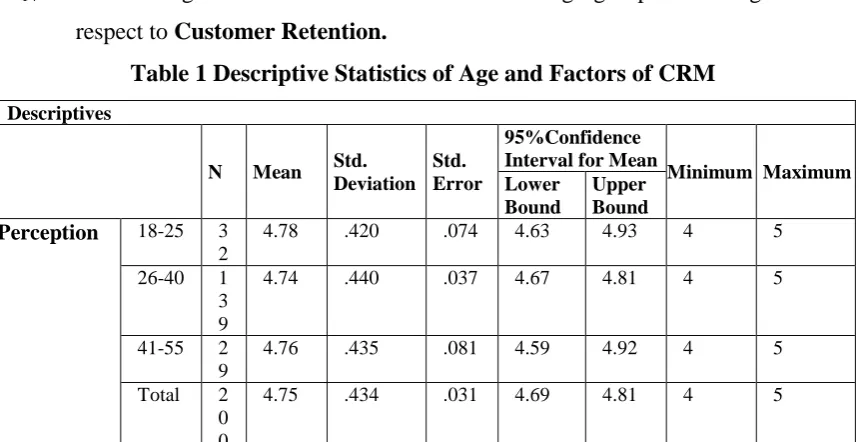
Table 1 Descriptive Statistics of Age and Factors of CRM Descriptives
N Mean Std.
Deviation Std. Error
95%Confidence Interval for Mean
Minimum Maximum Lower
Bound
Upper Bound
Perception 18-25 3
2
4.78 .420 .074 4.63 4.93 4 5
26-40 1 3 9
4.74 .440 .037 4.67 4.81 4 5
41-55 2 9
4.76 .435 .081 4.59 4.92 4 5
Total 2 0 0
SRJIS/BIMONTHLY/ FARHEEN & PROF. KARUNESH SAXENA (4138-4155)
OCT-NOV, 2016, VOL. 3/18 www.srjis.com Page 4145
Customer Relationship
18-25 3 2
4.56 .504 .089 4.38 4.74 4 5
26-40 1 3 9
4.55 .500 .042 4.46 4.63 4 5
41-55 2 9
4.69 .471 .087 4.51 4.87 4 5
Total 2 0 0
4.57 .496 .035 4.50 4.64 4 5
Customer Service Quality
18-25 3 2
4.56 .504 .089 4.38 4.74 4 5
26-40 1 3 9
4.68 .467 .040 4.61 4.76 4 5
41-55 2 9
4.86 .351 .065 4.73 5.00 4 5
Total 2 0 0
4.69 .464 .033 4.63 4.75 4 5
Customer Retention
18-25 3 2
4.69 .471 .083 4.52 4.86 4 5
26-40 1 3 9
4.72 .451 .038 4.64 4.80 4 5
41-55 2 9
4.83 .384 .071 4.68 4.97 4 5
Total 2 0 0
4.73 .445 .031 4.67 4.79 4 5
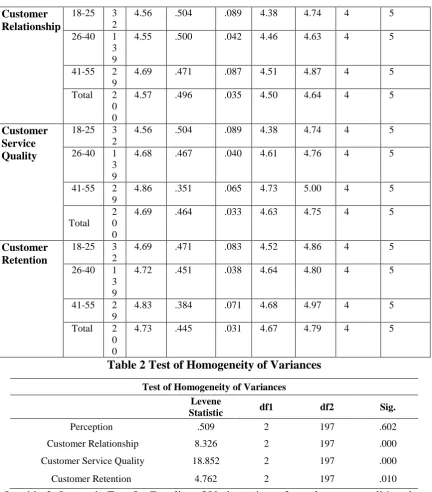
Table 2 Test of Homogeneity of Variances Test of Homogeneity of Variances
Levene
Statistic df1 df2 Sig.
Perception .509 2 197 .602
Customer Relationship 8.326 2 197 .000
Customer Service Quality 18.852 2 197 .000
Customer Retention 4.762 2 197 .010
In table 2, Levene’s Test for Equality of Variance is performed to test condition that
the variances of both samples are equal or not. A high value results normally in a
[image:8.595.83.516.133.626.2]significant difference and a low value results normally in a non- significant difference.
SRJIS/BIMONTHLY/ FARHEEN & PROF. KARUNESH SAXENA (4138-4155)
[image:9.595.94.502.169.421.2]OCT-NOV, 2016, VOL. 3/18 www.srjis.com Page 4146 relationship (.000), Customer service quality (.000) and Customer Retention (0.010) has low value which could be interpreted as variances are equal.
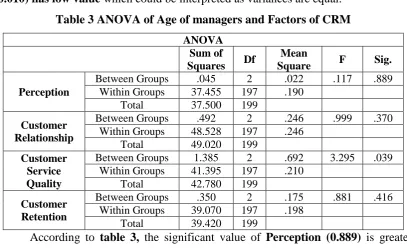
Table 3 ANOVA of Age of managers and Factors of CRM
ANOVA Sum of
Squares Df
Mean
Square F Sig.
Perception
Between Groups .045 2 .022 .117 .889
Within Groups 37.455 197 .190
Total 37.500 199
Customer Relationship
Between Groups .492 2 .246 .999 .370
Within Groups 48.528 197 .246
Total 49.020 199
Customer Service Quality
Between Groups 1.385 2 .692 3.295 .039
Within Groups 41.395 197 .210
Total 42.780 199
Customer Retention
Between Groups .350 2 .175 .881 .416
Within Groups 39.070 197 .198
Total 39.420 199
According to table 3, the significant value of Perception (0.889) is greater
than 00.05 so the null hypothesis is accepted that there is no significant difference
between various age groups of managers with respect to their perception about the CRM. This could be interpreted as all the age groups discovered have same perception towards CRM.
The significant value of Customer Relationship (0.370) is greater than 00.05
so the null hypothesis is accepted that there is no significant difference between
various age groups of managers with respect to Customer Relationship. This could be interpreted as all the age group agrees over the importance of customer relationship
as an important factor of CRM.
The significant value of Customer Service Quality (0.039) is less than 00.05
so the null hypothesis is rejected and accepting the alternate which states there is
SRJIS/BIMONTHLY/ FARHEEN & PROF. KARUNESH SAXENA (4138-4155)
OCT-NOV, 2016, VOL. 3/18 www.srjis.com Page 4147
The significant value of Customer Retention (0.416) is greater than 0.05 so
the null hypothesis is accepted that there is no significant difference between
various age groups of managers with respect to Customer Retention. Thus it can be inferred that managers of all age groups have common thinking of customer
retention as an important factor of CRM.
2 Effect of Gender of Managers on Factors of CRM
Everybody has different opinion and different perception to look at the things and for
fulfilling the same condition the researcher has taken gender to evaluate its effect on
factors of CRM. The opinions of male and female mangers were taken with the help of
questionnaire and then the evaluation was done with the help of Leven’s test and
ANOVA. Following hypotheses were framed to analyse the relationship between
gender and factors of CRM :
H05: There is no significant difference between male and female managers towards
their perception about the CRM.
H15: There is significant difference between male and female managers towards
their perception about the CRM.
H06: There is no significant difference between male and female managers towards
Customer Relationship.
H16: There is significant difference between male and female managers towards
Customer Relationship.
H07: There is no significant difference between male and female managers towards
Customer Service Quality.
H17: There is significant difference between male and female managers towards
Customer Service Quality.
H08: There is no significant difference between male and female managers towards
Customer Retention.
H18: There is significant difference between male and female managers towards
SRJIS/BIMONTHLY/ FARHEEN & PROF. KARUNESH SAXENA (4138-4155)
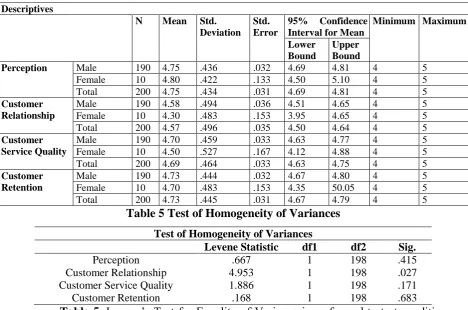
[image:11.595.64.533.158.468.2]OCT-NOV, 2016, VOL. 3/18 www.srjis.com Page 4148 Table 4 Descriptive statistics of Gender and Factors of CRM
Descriptives
N Mean Std.
Deviation Std. Error
95% Confidence Interval for Mean
Minimum Maximum
Lower Bound
Upper Bound
Perception Male 190 4.75 .436 .032 4.69 4.81 4 5
Female 10 4.80 .422 .133 4.50 5.10 4 5
Total 200 4.75 .434 .031 4.69 4.81 4 5
Customer Relationship
Male 190 4.58 .494 .036 4.51 4.65 4 5
Female 10 4.30 .483 .153 3.95 4.65 4 5
Total 200 4.57 .496 .035 4.50 4.64 4 5
Customer Service Quality
Male 190 4.70 .459 .033 4.63 4.77 4 5
Female 10 4.50 .527 .167 4.12 4.88 4 5
Total 200 4.69 .464 .033 4.63 4.75 4 5
Customer Retention
Male 190 4.73 .444 .032 4.67 4.80 4 5
Female 10 4.70 .483 .153 4.35 50.05 4 5
Total 200 4.73 .445 .031 4.67 4.79 4 5
Table 5 Test of Homogeneity of Variances
Test of Homogeneity of Variances
Levene Statistic df1 df2 Sig.
Perception .667 1 198 .415
Customer Relationship 4.953 1 198 .027
Customer Service Quality 1.886 1 198 .171
Customer Retention .168 1 198 .683
Table 5, Levene’s Test for Equality of Variance is performed to test condition that the variances of both samples are equal or not. A high value results normally in a
significant difference and a low value results normally in a non- significant. Table 5.25
SRJIS/BIMONTHLY/ FARHEEN & PROF. KARUNESH SAXENA (4138-4155)
[image:12.595.100.500.148.359.2]OCT-NOV, 2016, VOL. 3/18 www.srjis.com Page 4149 Table 6 ANOVA of Gender of Managers and Factors of CRM
ANOVA Sum of
Squares Df
Mean
Square F Sig.
Perception
Between Groups .026 1 .026 .139 .710
Within Groups 37.474 198 .189
Total 37.500 199
Customer Relationship
Between Groups .767 1 .767 3.149 .078
Within Groups 48.253 198 .244
Total 49.020 199
Customer Service Quality
Between Groups .380 1 .380 1.775 .184
Within Groups 42.400 198 .214
Total 42.780 199
Customer Retention
Between Groups .009 1 .009 .048 .828
Within Groups 39.411 198 .199
Total 39.420 199
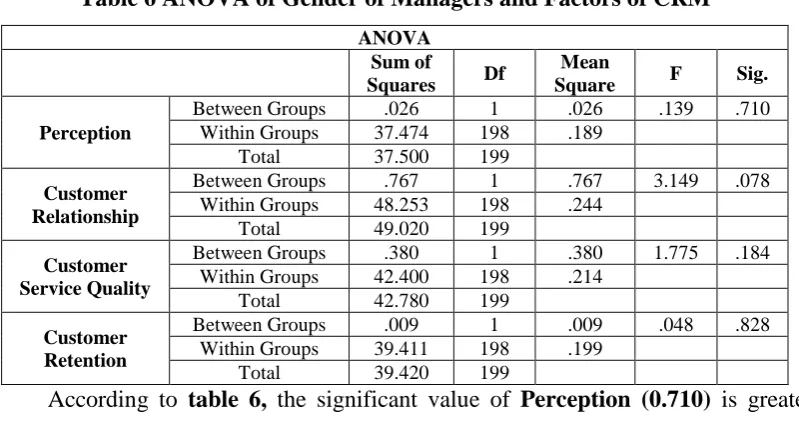
According to table 6, the significant value of Perception (0.710) is greater
than 00.05 so the null hypothesis is accepted that there is no significant difference
between male and female managers and their perception about the CRM. This could be interpreted as both the genders male and female have same perception
towards factors of CRM.
The significant value of Customer Relationship (0.078) is greater than 00.05
so the null hypothesis is accepted that there is no significant difference between
male and female managers towards customer relationship. This could be interpreted as both the gender agrees over the importance of customer relationship as
an important factor of CRM.
The significant value of Customer Service Quality (0.184) is greater than
00.05 so the null hypothesis is accepted that there is no significant difference
between male andfemale managers towards customer service quality. Thus it can be concluded that both male and female accept customer service quality as an
important factor of CRM.
The significant value of Customer Retention (0.828) is greater than 00.05 so
the null hypothesis is accepted that there is no significant difference between male
SRJIS/BIMONTHLY/ FARHEEN & PROF. KARUNESH SAXENA (4138-4155)
OCT-NOV, 2016, VOL. 3/18 www.srjis.com Page 4150 the genders male and female have common thinking of customer retention as an
important factor of CRM.
3 Effect of Qualification of Managers on Factors of CRM
For the purpose of the research study effect of educational level was also evaluated
against factors of CRM. Several hypotheses were framed to analyse the relationship
between the qualification of managers and factors of CRM. The collected data then
analysed with the help of statistical tools like Levene;s test and ANOVA.
H09: Managers of different education levels do not differ significantly with regards
to Perception.
H19: Managers of different education levels differ significantly with regards to
Perception.
H010: Managers of different education levels do not differ significantly with regards
to Customer Relationship.
H110: Managers of different education levels differ significantly with regards to
Customer Relationship.
H011: Managers of different education levels do not differ significantly with regards
to Customer Service Quality.
H111: Managers of different education levels differ significantly with regards to
Customer Service Quality.
H012: Managers of different education levels do not differ significantly with regards
to Customer Retention.
H112: Managers of different education levels differ significantly with regards to
SRJIS/BIMONTHLY/ FARHEEN & PROF. KARUNESH SAXENA (4138-4155)
[image:14.595.63.535.173.703.2]OCT-NOV, 2016, VOL. 3/18 www.srjis.com Page 4151 Table 7 Descriptive statistics of Qualification and Factors of CRM
Descriptives
N Mean Std.
Deviation Std. Error
95% Confidence Interval for Mean
Minimum Maximum Lower
Bound
Upper Bound
Perception
Certificate 1 4.00 . . . . 4 4
Diploma 1 5.00 . . . . 5 5
Under Graduate 55 4.80 .404 0.054 4.69 4.91 4 5
Masters 143 4.73 .443 .037 4.66 4.81 4 5
Total 200 4.75 .434 .031 4.69 4.81 4 5
Customer Relationship
Certificate 1 4.00 . . . . 4 4
Diploma 1 5.00 . . . . 5 5
Under Graduate 55 4.62 .490 .066 4.49 4.75 4 5
Masters 143 4.55 .499 .042 4.47 4.63 4 5
Total 200 4.57 .496 .035 4.50 4.64 4 5
Customer Service Quality
Certificate 1 5.00 . . . . 5 5
Diploma 1 4.00 . . . . 4 4
Under Graduate 55 4.76 .429 0.058 4.65 4.88 4 5
Masters 143 4.66 .474 .040 4.59 4.74 4 5
Total 200 4.69 .464 .033 4.63 4.75 4 5
Customer Retention
Certificate 1 4.00 . . . . 4 4
Diploma 1 5.00 . . . . 5 5
Under Graduate 55 4.75 .440 0.059 4.63 4.86 4 5
Masters 143 4.73 .447 .037 4.65 4.80 4 5
Total 200 4.73 .445 .031 4.67 4.79 4 5
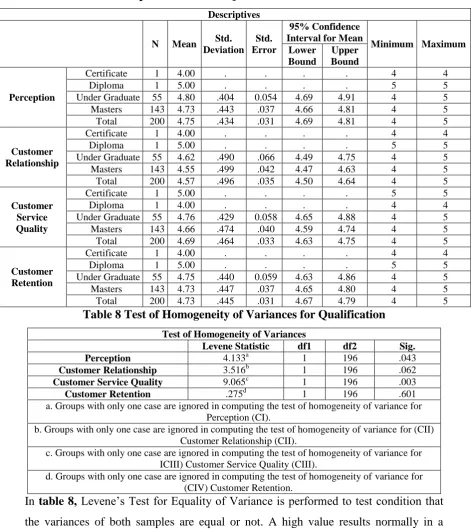
Table 8 Test of Homogeneity of Variances for Qualification Test of Homogeneity of Variances
Levene Statistic df1 df2 Sig.
Perception 4.133a 1 196 .043
Customer Relationship 3.516b 1 196 .062
Customer Service Quality 9.065c 1 196 .003
Customer Retention .275d 1 196 .601
a. Groups with only one case are ignored in computing the test of homogeneity of variance for Perception (CI).
b. Groups with only one case are ignored in computing the test of homogeneity of variance for (CII) Customer Relationship (CII).
c. Groups with only one case are ignored in computing the test of homogeneity of variance for ICIII) Customer Service Quality (CIII).
d. Groups with only one case are ignored in computing the test of homogeneity of variance for (CIV) Customer Retention.
SRJIS/BIMONTHLY/ FARHEEN & PROF. KARUNESH SAXENA (4138-4155)
OCT-NOV, 2016, VOL. 3/18 www.srjis.com Page 4152
significant difference and a low value results normally in a non-significant. Table 5.28
[image:15.595.91.506.237.434.2]presents that Perception (.043), Customer Relationship (0.062), Customer service quality (.003) has low value whereasCustomer retention (.601) has high value which could be interpreted as the variances are not equal.
Table 9 ANOVA of qualification and factors of CRM ANOVA
Sum of
Squares df
Mean
Square F Sig.
Perception
Between Groups .798 3 .266 1.420 .238
Within Groups 36.702 196 .187
Total 37.500 199
Customer Relationship
Between Groups .682 3 .227 .921 .432
Within Groups 48.338 196 .247
Total 49.020 199
Customer Service Quality
Between Groups .965 3 .322 1.507 .214
Within Groups 41.815 196 .213
Total 42.780 199
Customer Retention
Between Groups .620 3 .207 1.044 .374
Within Groups 38.800 196 .198
Total 39.420 199
According to table 9, the significant value of Perception (0.238) is greater
than 00.05 so the null hypothesis is accepted that managers of different education
levels do not differ significantly with regards to Perception. This could interpret that all the qualification groups have same perception towards factors of CRM.
The significant value of Customer Relationship (0.432) is greater than 00.05
so the null hypothesis is accepted that managers of different education levels do not
differ significantly with regards to Customer Relationship. This could be interpreted as all the qualification groups agree over the importance of customer
relationship as an important factor of CRM.
The significant value of Customer Service Quality (0.214) is greater than
00.05 so the null hypothesis is accepted that managers of different education levels
do not differ significantly with regards to Customer Service Quality. Thus it can be concluded that all the qualification groups accept customer service quality as an
SRJIS/BIMONTHLY/ FARHEEN & PROF. KARUNESH SAXENA (4138-4155)
OCT-NOV, 2016, VOL. 3/18 www.srjis.com Page 4153
The significant value of Customer Retention (0.374) is greater than 00.05 so
the null hypothesis is accepted that managers of different education levels do not
differ significantly with regards to Customer Retention. Thus it can be inferred that all the qualification groups have common thinking of customer retention as an
important factor of CRM.
Suggestions
From the above review on the concerned topic and the analysis done following
suggestions are given to the hotel managers to improve the quality of their services by
using better CRM practices.
1. Top management should be serious about CRM practices, to improve the profit of
the organisation.
2. Managers should improve the CRM practices to cater to the needs of customers.
3. Managers should frequently determine and supervise customer satisfaction, loyalty
and commitment in order to build sound customer relationships.
4. Budget allocation should be proper and according to the need of the hotel to
improve the level of performance.
5. Managers should improve customer segmentation, technological advancement and
communicational aspects in CRM practices.
From the present study it is concluded that all the respondents (hotel managers) of
all age groups, gender and qualification are of the opinion that CRM is an important
variable for building strong relationship with the customers and it is the only way to
increase profitability in this competitive world. The concept of traditional selling is
now converted into modern marketing concept which incorporated customer
relationship management as the major variable for growth and profitability. CRM is
mostly used in service sector and from the present study it is clear that hotels are using
it to the fullest to attract the customers and for this reason many hotels give attractive
SRJIS/BIMONTHLY/ FARHEEN & PROF. KARUNESH SAXENA (4138-4155)
OCT-NOV, 2016, VOL. 3/18 www.srjis.com Page 4154 It is worth mentioning that this paper will also raise awareness among hotel
managers to paymore attention to CRM dimensions, marketing capabilities, and assist
them in improving hotelperformance and competitiveness. However, the fact remains
that this study has its limitations. First,because it is confined to Southern Rajasthan
only and hence it is very important to study about CRM in different parts of the
country. Second, the model is morefocused on the hotel industry and therefore, there is
a need to test it in different sectors such as the financial sector.
References
Abdullateef, A.O., Mokhtar, S.S., Yusoff, R.Z. (2010), The impact of CRM Dimensions on Call Center Performance. International Journal of Computer Science and Network Security, 10(12), 184-195.
Akroush, N.M., Dahiyat, E.S., Gharaibeh, S.H., Abu-Lail, N.B. (2011), Customer relationship management implementation.An investigation of a scale’s generalizability and its relationship with business performance in a developing country context. International Journal of Commerce and Management, 21(2), 158-191.
Arman, S. (2014).Integrated Model of Social Media and Customer Relationship Management: A Literature Review, International Journal of Information, Business and Management, 6(3), 118-130.
Chang, W., Park, E.J., Chaiy, S. (2010), How does CRM technology transform into organizational performance? A mediating role of marketing capability. Journal of Business Research, 63, 849-855.
Eid, R. (2007), Towards a Successful CRM Implementation in Banks: An Integrated Model. The Service Industries Journal, 27(8), 1021–1039.
Graf, M. et.al. (2013). Outsourcing of Customer Relationship Management: Implications for Customer Satisfaction, Journal of Strategic Marketing, 21(1), 68-81
Lee,.D. (2002), “Getting a Duh’,’’ Customer Relationship Mangement,pp. 28
Ozgener, S., Iraz, R. (2006), Customer relationship management in small – medium enterprises: The case of Turkish tourism industry. Tourism Management, 27(6), 1356-1363.
Payne, A. (2009). Handbook of CRM: Achieving Excellence in Customer Management. s.l.:Elsevier. Roberts, M., Liu, R., Hazard, K. (2005), Strategy, technology and organizational alignment:
keycomponents of CRM success. Journal of Database Marketing and Customer StrategyManagement, 12(4), 315-326
Rohhbracher,.B.(2002), “As Users Get Smarter, Marketers Must Kep Up”,clickz.com, pp.1
Sadek, H., Yousef, A., Ghoneim, A., Tantawi, P. (2011), Measuring the effect of customer relationship management (CRM) components on the non-financial performance of commercial bank: Egypt
case. European, Mediterranean and Middle Eastern Conference on
InformationSystem(EMCIS2011),May3031.Athens,Greece.Retrievedfrom.http://www.iseing.org /emcis/EMCISWebsite/EMCIS2011%20Proceedings/SCI10.pdf
Saini& Kumar (2015).The Effect of e-CRM on Customer Satisfaction: An Empirical Study of Online Shopping”, Journal of Management and Science, 5(2), 31-41.
SRJIS/BIMONTHLY/ FARHEEN & PROF. KARUNESH SAXENA (4138-4155)
OCT-NOV, 2016, VOL. 3/18 www.srjis.com Page 4155 Sigala, M. (2005), Integrating customer relationship management in hotel operations: Managerial and
operational implications. International Journal of Hospitality Management, 24(3), 391-413. Sin L.Y.M., Tse A.C.B., Yim F.H.K. (2005), CRM: conceptualization and scale development. European
Journal of Marketing, 39(11/12), 1264-1290.
Singh & Rajput (2011).
http://pioneerjournal.in/conferences/tech-knowledge/9th-national- conference/3545-importance-of-crm-in-hospitality-services-and-its-impact-on-customer-satisfaction-a-study-of-hotels-in-indore.html
Tepeci, Mustafa. (1999). Increasing brand loyalty in the hospitality industry, International Journal of Contemporary Hospitality Management, 11(5), pp. 223 – 230.
Yueh, C.L., Lee, Y., Barnes, F.B, (2010), The effects of leadership styles on knowledge-based customer relationship management implementation. International Journal of Management and Marketing Research, 3(1), 1-19.
Yim, F.H., Anderson, R.E., Swaminathan, S. (2005), Customer Relationship Management: Its Dimensions and Effect on Customer Outcomes. Journal of Personal Selling and Sales Management, 24(4), 265- 280