The Implementation of Cooperative Learning Make a
Match to improve Social science learning activities
and learning outcomes
Mukhammad Alfan Khakima*, Maria Veronica Roesminingsihb, Agus Suprijonoc, Waspodo Tjipto Subrotod
a Postgraduate Student in Elementary program, State university of Surabaya Jl. Ketintang No.30, Surabaya, 60231 Indonesia
b,Lecturers of Elementary Program, State University of Surabaya, Indonesia
dDepartment of Economics Education Faculty of Economics Universitas Negeri Surabaya Indonesia aEmail: [email protected]
bEmail: [email protected] cEmail: [email protected] dEmail: [email protected]
DOI: 10.29322/IJSRP.9.03.2019.p8750
http://dx.doi.org/10.29322/IJSRP.9.03.2019.p8750
Abstrak: This study aims to describe the students’ activities and learning outcomes to enhanced the cooperative learning
models make a match on social science subjects in 5th grade of Jajartunggal III state elementary school, Surabaya. This
research is an action research which carried out in three cycles. The subjects in this study were fifth grade students of Jajartunggal III state elementary school, Surabaya in Academic Year of 2018/2019, they are 36 students. The data collection technique used observation, learning outcomes tests and documentation. The students’ activities in cycle I was 69.86% and increased to 78.80% in cycle II, and 85.82% in cycle III. The students’ learning outcomes in the first cycle showed an average value of 73.36 with a percentage of classical completeness of 71.82%. It increased to 76.22 in the second cycle with a percentage of classical completeness of 78.86%. Cycle III showed the average score of students is 81.68 with a percentage of classical completeness of 88.28%. Based on the results of the study, it can be concluded that the implementation of
cooperative learning make a match can improve the social science learning activities and learning outcomes in 5th grade of
Jajartunggal III state elementary school, Surabaya.
Kata Kunci: Cooperative learning Make A Match, Learning activities and learning outcomes.
1. Introduction
Teaching and Learning process is a dynamic process to achieve a predetermined goal (Sujana,
2011: 30). Social Science is formally defined as an integrated study of social science and humanities in
order to develop the competence of citizens (Nasution, 2015: 3). Social science is a learning program
that aims to help and train students to be able to have the ability to recognize and analyze a problem
from various perspectives in a comprehensive manner (Supardan, 2015: 17).
Based on the observation result which is conducted in Jajartunggal III state elementary school,
Surabaya, it created several problems in social science which were identified as follows: (1) using
students’ participation, and (4) low learning outcomes of the students. It is proved by the results in the
end of the first final examination in 36 students, it is only 38.9% of students were able to reach the
completeness of minimum criteria. The average learning outcome is 61, it is from the completeness of
minimum criteria in social science, which is arranged to 75. The low activity and learning outcomes are
caused by monotonous and meaningless learning model.
Cooperative learning make a match is one of learning constructivist-based understanding
(Suprijono, 2016: 196). Constructivist approaches emphasize on the students who are able to construct
knowledge by transforming, organizing, reorganizing knowledge and information before, so this is
considered as a realization of the goals in social science. Activity is an activity to change somene's
behavior in teaching and learning interactions (Sardiman, 2014: 95).
Based on the research questions, the objectives of this study are as follows: (1) describing students
activities when implemented cooperative learning make a match on social science in fifth grade of
Jajartunggal III state elementary school, Surabaya, (2) describing teacher activities when implemented
cooperative learning make a match on social science in fifth grade of Jajartunggal III state elementary
school, Surabaya, and (3) describing the improvement of students learning outcomes through
cooperative learning make a match on social science in fifth grade of Jajartunggal III state elementary
school, Surabaya.
In this study, the results of previous studies which are conducted by researchers as follows: The
first study by Fitriani (2017), The Implementation of Cooperative Models Make a Match Improved
Social Skills and Social Science Learning Outcomes on the Fourth Grade Students of Surau Gadang 13
state elementary school, Padang. The results of this study show that the cooperative learning model
make a match can improve social science learning activities and outcomes in fourth grade students of
Surau Gadang 13 state elementary school, Padang. The second study by Faniandari (2016), Application
of Cooperative Learning to Make a Match on Light Material and Development of Blind Card Learning
Media. The results of his research prove that make a match can optimize the interaction between all
elements in learning, such as teachers, students, and media, as like all five senses, tastes, and intentions
that make learning meaningful.
The gap of this research is the researchers conduct he research in different location. The location
in this study was Jajartunggal III state elementary school, Surabaya. Another difference is seen from the
this study the subjects are students who learn social science in analyzing human interaction with the
environment.
This study wants to examine about the students’ activities and learning outcome while learning
social science with cooperative learning model make a match. By using the implementation of
cooperative learning make a match is expected to be able to improve the activities and results of social
science of fifth grade students of Jajartunggal III state elementary school, Surabaya.
2. Method
The design and methods in this research are classroom action research. Hopkins interpreted
classroom action research as a combination of research with substantive action, which is carried out in
inquiry or an effort of someone's understanding of what happened in this case (Hopkin, 1993: 43). The
design of this study use Kemmis & Taggart (1988) model which consists of several cycles, each cycle
consisting of four stages: 1) planning, 2) action, 3) observation, 4) reflection.
The subjects in this study were 36 fifth grade students of Jajartunggal III state elementary school,
Surabaya in academic year 2018/2019. They are 16 girls and 20 boys. The material of this study was to
analyze human interaction with the environment.
Data collection techniques in this study include: observation, test and documentation. Data
analysis was quantitative with percentages. In observation, there are two kinds of observation, those are
observation for teacher activities and observation on student activity. Data analysis in observation was
obtained by giving scores on every aspect which is observed during the learning process in each cycle.
The Analysis of teachers’ activities and students’ activities use the following formula.
𝑃𝑃= 𝑓𝑓𝑁𝑁× 100%
Notes:
P = the frequency of occurance presentage
f = the appearance number of teachers and students’ activities
N = total activities
Students learning outcomes in each cycle were analyzed individually and classically.
completeness minimum criteria of social science, is 75. Furthermore, classical learning completeness
was achieved if ≥ 80% of all students in the class were thoroughly studied.
To determine the students’ test scores in learning outcomes, use the following equation.
𝑉𝑉𝑉𝑉𝑉𝑉𝑉𝑉𝑉𝑉= 𝑚𝑚𝑇𝑇𝑚𝑚𝑚𝑚𝑚𝑚𝑚𝑚𝑚𝑚𝑇𝑇𝑇𝑇𝑇𝑇𝑇𝑇𝑇𝑇𝑠𝑠𝑠𝑠𝑇𝑇𝑠𝑠𝑠𝑠𝑠𝑠𝑠𝑠𝑇𝑇𝑠𝑠𝑠𝑠𝑥𝑥100
After calculating the value of learning outcomes and the average learning outcomes of social
science in the class, the next step find the percentage of classical completeness of students in the
learning process. The analysis of students’classical completeness towards the learning process expressed
in the percentage with the equation as follows.
𝑃𝑃= ∑ 𝑠𝑠𝑇𝑇𝑚𝑚𝑠𝑠𝑠𝑠𝑠𝑠𝑇𝑇𝑠𝑠𝑤𝑤ℎ𝑇𝑇∑ 𝑠𝑠𝑇𝑇𝑚𝑚𝑠𝑠𝑠𝑠𝑠𝑠𝑇𝑇𝑠𝑠𝑚𝑚𝑠𝑠𝑠𝑠𝑇𝑇𝑚𝑚𝑐𝑐𝑇𝑇𝑠𝑠𝑇𝑇𝑠𝑠𝑇𝑇ℎ𝑠𝑠𝑇𝑇𝑠𝑠𝑇𝑇𝑠𝑠𝑠𝑠𝑚𝑚𝑠𝑠𝑙𝑙𝑥𝑥100%
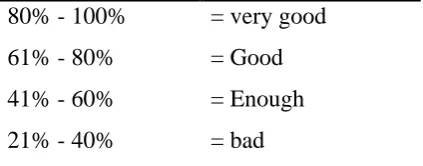
For making easier in knowing the level of its success, it is created a range of assessment criteria
[image:4.612.191.403.407.490.2]for teachers’ activities, students’ activities and students classical learning outcomes as follows:
Tabel 2: criteria of students activities and learning outcomes (Arikunto, 2008: 128)
80% - 100% = very good
61% - 80% = Good
41% - 60% = Enough
21% - 40% = bad
The success indicator of this study are: (1) this study is called as successful research if the students
activities achieve success criteria of ≥ 80% from all aspects. (2) this study is called as successful
research if the students activities achieve success criteria of ≥ 80% from all aspects, and (3) the study is
successful if 80% of the students have learning outcomes with a minimum score of 75. This value is
accordance with Minimum Completion Criteria determined in social science at Jajartunggal III state
elementary school, Surabaya.
3. Result and Discussion
In this section, the results of the study show the implementation of cooperative learning make a
interaction with environment. This classroom action research is carried out in 3 cycles with an allocation
of 3x35 minutes per meeting.
The first cycle was held on January 3 2019, the second cycle was on January 10, 2019, and the
third cycle was on January 17, 2019. Cooperative learning make a match carried out in five phases. The
first phase provides problem orientation to students. The teacher displays information about recognizing
economic activities related to natural resources. The second phase organizes the students to do
observation. The students are grouped into 2 groups, the first group becomes an assessment group and
the second group is divided into three groups, they are the question card group, the answer card group
and the picture card group. The third phase sets the position of the group in a square shape. The teacher
blew the whistle as a sign that all the groups were looking for an appropriate partner and students start to
discuss. The fourth phase sounds is playing soft instrumental music and control the discussion process.
The fifth phase facilitates the discussion to provide an opportunity for all students to explain/confirm the
things that have been done while concluding.
[image:5.612.101.514.402.508.2]Observations are carried out when learning activities take place with the following data.
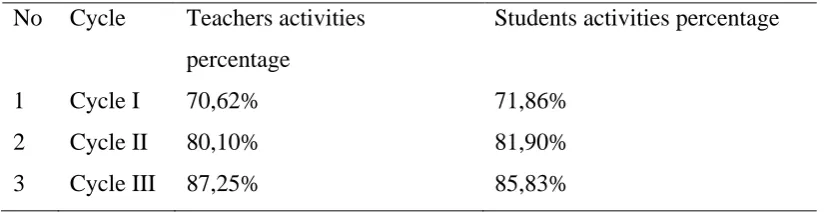
Tabel 3. Recapitulation of Observation Results from Teachers and students Activities
No Cycle Teachers activities
percentage
Students activities percentage
1 Cycle I 70,62% 71,86%
2 Cycle II 80,10% 81,90%
3 Cycle III 87,25% 85,83%
From the results of observations in the first cycle, the percentage of implementation of teacher
activities was obtained by 72.76%, so it needs to be continued in the next cycle. In the second cycle
obtained a percentage of 79.45%. It indicates that an increase of 6.69% from the first cycle. In the third
cycle the percentage of 86.50% increased to 7.05%. This percentage has reached the indicator of success
in the study which is determined by 80%.
From table 3, it is known that in the first cycle the achievement of student activities was 69.86%.
This percentage has not yet reached the success indicator determined in this study which is 80%. This is
first cycle to 78.80% with the criteria of "good" in the second cycle. The percentage of success achieved
in the second cycle which has reached the success of indicator. It determined in this study which is equal
to 80%. However, there is one aspect that has a low value, such as the aspect of asking questions. In the
third cycle, the percentage of classical activities of students was 82.83%, an increase of 2.83% from the
second cycle. The percentage of student activities reached the success indicators which set out in this
study so that this research is done in cycle III.
The learning outcomes test in this study is a test of the cognitive learning outcomes of students who
is conducted by giving a test in the end of each lesson. The recapitulation of student learning outcomes
[image:6.612.109.503.299.406.2]from cycle I-III can be seen in the following table.
Tabel 4. Recapitulation of students’ learning outcome in cycle I-III
No Cycle The average learning
outcomes
Classical completeness
percentage
1 Cycle I 74,63 69,44%
2 Cycle II 80,48 77,78%
3 Cycle III 82,63 83,33%
Based on Table 4 it is known that in the first cycle, 25 from 36 students are completed the
learning model and 11 students did not complete the learning model. The percentage of classical
completeness and the average value in the first cycle has not reached the success criteria which is
determined in this study is equal to 80%, so this research is continued in cycle II. One of the factors
affected the low achievement of minimum complexion criteria is in the low level of the concept of
learning material. so that students are still having difficulty in conducting presentation and doing
assignment.
In the second cycle 28 students from 36 students completed learning model and 8 students did not
complete in learning model. The average learning outcomes in the second cycle is amounted to 80.48
with a percentage of classical completeness of 77.78%. The average value of learning outcomes
obtained in the second cycle which has been able to reach the minimum completeness criteria. It is equal
to 75 but the percentage of classical completeness obtained in the second cycle, it also still does not
achieve the indicators of success which is determined in this study. So this research continues in cycle
Cycle III 30 students completed in learning and 6 students did not complete in learning. The
average student learning outcomes is amounted to 82.63 with the percentage of classical completeness
of 83.33% and indicating that the indicator of success had been reached in the third cycle, because it had
achieved the success indicators which is determined in this study, is ≥ 80%, and the average learning
process is higher than the minimum completeness criteria. Based on the results of this research and the
description above, it can be said that the implementation of the cooperative learning make a match can
improve social science learning outcomes of the fifth grade students of Jajartunggal III state elementary
school, Surabaya.
4. Conclusion
Based on data analysis, the results of the study of the implementation of cooperative learning make
a match can improve social studies learning outcomes of fifth grade students of Jajartunggal III state
elementary school, Surabaya and the conclusions are as follows: 1) the percentage of implementation of
teacher activities in the cycle in the first cycle of 70.62% in the category "good", increased to 80.10% in
the second cycle and 87.25% in the third cycle with the category "very good ", 2) student learning
activities in the first cycle got a percentage of 71.86% in" good "activities increased to 81.90% in the
second cycle and 85.83% in the third cycle in the category of" very good ", 3) students’ learning
outcomes students in the first cycle obtained an average value of 74.63 with a percentage of
completeness of 69.44%. In the second cycle student learning outcomes obtain an average value of
80.48 with a percentage of completeness of 77.78%. The third cycle of student learning outcomes
obtained an average value of 82.63 with a completeness percentage of 83.33%. 4) Cooperative learning
make a match is student-centered learning that can improve social science activities and learning
outcomes.
Referensi
Anni, Catharina Tri dan Achmad Rifa’i. (2011). Psikologi Pendidikan. Semarang: UNNES Press.
Arikunto, Suharsimi. (2008). Dasar-dasar Evaluasi Pendidikan. Jakarta: Prestasi Pustaka.
Ekawarna. (2013). Penelitian Tindakan Kelas. Jakarta: Referensi GP Press Group
Hamalik, Oemar (2009). Proses Belajar Mengajar. Bandung: BumiAksara.
Hopkin, David. (1993). A Teacher Guide To Classroom Research, 2nd. Phila delpia: Open University
Kusmarni, Y., Winarti, M., & Kurniawati,Y. (2016). The Development of Edutainment Learning Model
in Social Science Education/IPS Research and Development Study on IPS education at
elementary level in Bandung and Cimahi. International Journal Pedagogy Of Social Studies,
1(2), 8661-18293
Nasution, S. (2015). Sosiologi Pendidikan. Jakarta. Bumi Aksara.
Purba, G. I. D., Surya, E. Manullang, M., Asmin. (2018). The Effect of Students’ Worksheet in the
Model of Discovery Learning Against the Students’ Ability of Reasoning and Mathematical
Communication in the Faculty of Mathematics and Natural Science of State University of
Medan. International Journal of Sciences: Basic and Applied Research (IJSBAR). 37(3),
70-82.
Sardiman AM, (2014). Interaksi dan Motivasi Belajar Mengajar. Jakarta: Raja Grafindo Persada.
Simamora, R., E. Sidabutar, D. R., & Surya, E. (2017). Improving Learning Activity and Students’
Problem Solving Skill through Problem Based Learning (PBL) in Junior High School.
International Journal of Sciences: Basic and Applied Research (IJSBAR) 33(2), 321-331.
Somantri, Nu’man. (2001). Menggagas Pembaharuan IPS. Bandung: PT Rodakarya
Sudjana, Nana. (2011).Penilaian Hasil Proses Belajar Mengajar. Bandung: Remaja Rodakarya
Supardan, Dadang. (2015). Pembelajaran Ilmu Pengetahuan Sosial Perspektif Filosofi dan Kurikulum.
Jakarta: Bumi Aksara.
Suprijono, Agus. (2017). Cooperative Learning . Yogyakarta: Pustaka Pelajar