S T U D Y P R O T O C O L
Open Access
Evaluation of short message service and
peer navigation to improve engagement in
HIV care in South Africa: study protocol for
a three-arm cluster randomized controlled
trial
Sheri A. Lippman
1*, Starley B. Shade
1, Jeri Sumitani
2, Julia DeKadt
2, Jennifer M. Gilvydis
3, Mary Jane Ratlhagana
2,
Jessica Grignon
2,3, John Tumbo
4, Hailey Gilmore
1, Emily Agnew
1, Parya Saberi
1, Scott Barnhart
5and Wayne T. Steward
1Abstract
Background:In countries with a high burden of HIV, such as South Africa, where the epidemic remains the world’s largest, improving early uptake of and consistent adherence to antiretroviral therapy could bring substantial HIV prevention gains. However, patients are not linked to or retained in care at rates needed to curtail the epidemic. Two strategies that have demonstrated a potential to stem losses along the HIV care cascade in the sub-Saharan African context are use of text messaging or short message service (SMS) and peer-navigation services.
Methods/Design:We designed a cluster randomized trial to assess the efficacy of an SMS intervention and a peer-navigation intervention to improve retention in care and treatment, timely linkage to care and treatment, medication adherence, and prevention behaviors in South Africa. Eighteen primary and community healthcare clinics in Rustenburg and Moses Kotane Sub-districts in the North West Province were randomized to one of three conditions: SMS intervention (n = 7), peer navigation intervention (n = 7), or standard of care (n = 4). Approximately 42 participants are being recruited at each clinic, which will result in a target of 750 participants. Eligible
participants include patients accessing HIV testing or care in a study clinic, recently diagnosed with HIV, aged 18 years or older, and with access to a cellular telephone where they are willing to receive automated SMS with HIV-related messaging. Data collection includes extraction of visit information from clinical files and participant surveys at baseline, 6 months, and 12 months. Intent-to-treat (ITT) analysis will explore differences between randomization arms and the primary outcome of patient retention in care at 12 months following enrollment. We will also explore secondary outcomes including participants’a) timely linkage to care (within 3 months of HIV diagnosis), b) adherence to treatment based on self-report and clinic’s medication dispensation dates, and c) condom-use behaviors.
Discussion:The findings will allow us to compare the efficacy of two complementary interventions, one that requires fewer resources to implement (SMS) and one (peer navigation) that offers more flexibility in terms of the patient barriers to care that it can address.
(Continued on next page)
* Correspondence:[email protected]
1Center for AIDS Prevention Studies, Department of Medicine, University of
California, San Francisco, UCSF Box 0886, 550 16th Street, 3rd Floor, San Francisco, CA 94143, USA
Full list of author information is available at the end of the article
(Continued from previous page)
Trial registration:NCT02417233, registered 12 December 2014.
Keywords:Cluster randomized trial, South Africa, HIV, Adherence, Engagement in care, Retention, SMS, Peer navigation
Background
The success of“treatment-as-prevention”trials has ush-ered in a new era in worldwide HIV prevention efforts [1]. Antiretroviral therapy (ART) suppresses viral repli-cation, effectively forestalling disease progression and re-ducing the likelihood of viral transmission [2–6]. The landmark HPTN 052 trial among HIV sero-discordant couples found that early ART initiation (when CD4+ cell count is between 350 and 500 cells/μL) can reduce HIV transmission to uninfected partners by 96 % [2]. In countries with a high burden of disease, such as South Africa, where the epidemic remains the world’s largest with an estimated 6.4 million people living with HIV (PLHIV) [7], improving early uptake of and adherence to ART could bring substantial gains in HIV prevention. Modeling suggests that annual HIV testing with the im-mediate initiation of ART (at any CD4 count) in South Africa could reduce HIV incidence and mortality to less than one case per 1000 people per year by 2016 [8]. Additionally, South Africans residing in communities with greater ART coverage have a lower risk of HIV ac-quisition [9]. While instituting universal ART coverage will be challenging to implement in resource-constrained settings, important gains can be attained by ensuring that infected individuals are identified early in their HIV disease, enter into care rapidly, and remain in care and adherent to their regimens following the initi-ation of treatment. Unfortunately, in sub-Saharan Africa, some 40 % of individuals who test positive are not suc-cessfully linked to care, and only 50 % of those who are not yet ART-eligible are retained in HIV care [10], lead-ing to a “cascade”of losses at each stage along the care continuum [11].
In South Africa, the government continues to sponsor national HIV testing campaigns and has expanded ART eligibility, first to those with a CD4+ cell count of 350 cells/μL or less and recently to those with a CD4+ cell count of 500 cells/μL or less [12, 13]. Although treat-ment expansion is critical, current losses along the HIV care cascade are impeding HIV prevention gains. Na-tional data from 2012 indicated that 65 % of the popula-tion had been tested for HIV; however, only 37.8 % of HIV-positive men and 55 % of HIV positive women were aware of their HIV status [7]. Additionally, once diag-nosed, many do not initiate care or treatment. A study in Cape Town found that only 62.5 % of recently
diagnosed patients received a CD4+ test result within 6 months; 66.7 % of those that were eligible for ART ini-tiated treatment; and only 46.3 % of those not ART eli-gible returned for a subsequent CD4+ test [14]. In a study in rural Kwa-Zulu Natal, only 44.9 % of the HIV-positive patients not yet ART eligible returned for subse-quent CD4+ tests within 13 months [15]. To summarize, whereas South Africa has the largest antiretroviral pro-gram in the world [16], only 52 % of patients eligible for ART are estimated to currently receive treatment [17]. These failures to engage patients in care are exacerbated by further considering loss to follow-up after ART initi-ation, which has long-lasting implications, worsening outcomes for PLHIV, even if they return to care [18].
Interventions that link and retain patients in HIV care, promote ART adherence, and encourage risk-reduction behaviors in resource-limited settings are essential and could substantially improve survival and prevent new HIV infections [2, 19, 20]. We sought to identify strat-egies that do not require extensive resources and could realistically be implemented and supported by health departments in sub-Saharan Africa. Among feasible strategies that have the potential to improve care en-gagement outcomes, particularly retention and adher-ence, text messaging or short message service (SMS) and personal support have both demonstrated promise and could be economically feasible [20–22]. SMS cost 1 to 2 cents to send in bulk and are free for clients to receive. Systematic reviews and meta-analyses have demon-strated that the use of SMS for appointment reminders have improved clinic attendance [23–25]. Additionally, SMS interventions that included appointment re-minders, laboratory result notifications, and medication reminders have demonstrated promise in improving ART initiation and retention in care, as well as ART ad-herence in African settings [26–29]. One randomized trial also demonstrated improved rates of viral suppres-sion among those receiving weekly SMS [30].
counseling, or who had home visits [31]. Research in Uganda suggests that care outcomes for those initiating ART and those still pre-ART can be improved when pa-tients receive treatment support [32, 33]. Furthermore, recommendations from an international expert physician panel now call for systematic monitoring of linkage and retention in care, including the potential use of peer or paraprofessional patient navigators to assist patients in obtaining the care that they need [34]. Furthermore, peer navigators are less costly than professional personnel and may be more feasible to support in a resource-constrained setting.
Given the promise of these intervention options, we designed a cluster randomized trial to assess the efficacy of an SMS intervention and a peer navigation interven-tion to improve reteninterven-tion in care, timely linkage to care and treatment, ART adherence, and prevention behav-iors in South African primary health clinics in the North West Province.
Methods/Design
Study design
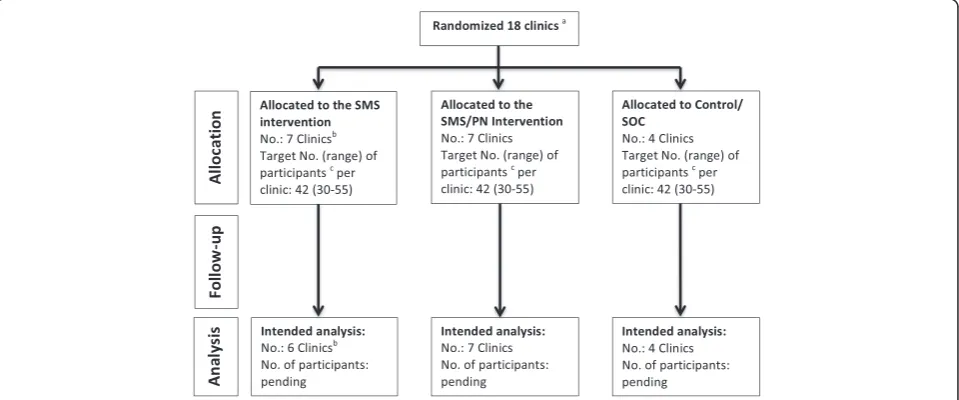
Using a cluster randomized trial at the level of the clinic, we will evaluate the efficacy of employing two strategies for enhancing linkage to and retention in clinical care, ART adherence, and HIV preventive behaviors. A target of 750 participants will be enrolled across 18 clinics in the Moses Kotane and Rustenburg Sub-districts, Boja-nala Platinum District, South Africa (Fig. 1). Clinics have been randomized to one of three conditions: an SMS
intervention arm, a peer navigation (PN) arm that also includes SMS, and a control condition. Clinics have been randomized instead of individuals to avoid contamin-ation of intervention across individuals within clinics and to facilitate cooperation with clinic staff. Participant outcomes will be monitored using both clinical record extraction to document HIV care visits and services and a series of interviewer-administered surveys at enroll-ment (baseline assessenroll-ment), 6 months after baseline, and 12 months after baseline.
Study setting
The North West Province has a population of just over 3.5 million people. The province is disproportionately young, with 60 % of the population under the age of 34 years, with high rates of unemployment, poverty, and low levels of educational attainment. Over 46 % of the population is living in poverty compared to 39.9 % of the national average [35]. The province has the fourth highest HIV prevalence in the country: 13.3 % among the general population [7] and 29.7 % among women in antenatal services [36]. Within North West Province, the Bojanala Platinum District, representing 37 % of the overall provincial population, has an HIV prevalence of 35.0 % in the antenatal clinics [36], making it more heav-ily affected than most other districts. Care in Bojanala Platinum is provided by one provincial hospital, four dis-trict hospitals, 13 community health centers, 104 pri-mary health clinics, and numerous mobile health points. Our study area was limited to two sub-districts, Moses
[image:3.595.59.539.465.665.2]Kotane and Rustenburg, and facilities included commu-nity health centers and primary health clinics only.
Clinic selection and randomization
The 18 study clinics were selected from among 61 ART-initiating clinics within the two study sub-districts. To be eligible, a clinic could not be one of the four that had participated in a pilot test of the interventions, had to have a catchment area of 6,000 or more inhabitants, and have adequate patient load to ensure recruitment targets (defined as having 40 new individuals added to HIV pa-tient care registers in the first 4 months of 2014). From among the 24 clinics meeting these criteria, we excluded one clinic that primarily served the mobile mining work-force (estimated at over 90 % of their patient load), and therefore was unlikely to retain patients. We also ex-cluded one clinic that was not using patient registers, which precluded establishing eligibility; one clinic that was scheduled to close; and three clinics that were dis-tant from study offices, complicating access and supervision.
The 18 remaining clinics were randomized to one of the three study arms, including seven to each interven-tion condiinterven-tion and four to standard of care (Fig. 1). The decision to randomize more clinics to intervention con-ditions was based on agreements with the local govern-ment partners at the district of health. We randomized sites using methods described by Hayes [37]. We strati-fied by sub-district and employed balanced (restricted) randomization based on number of total monthly clinic visits, number of HIV tests conducted in the previous four months, number of patients on ART, and the func-tionality of the monitoring and evaluation systems (in-cluding record-keeping and supply chain management) to ensure balance across the study arms.
Participant eligibility and recruitment
We will be enrolling 750 participants, with a target of 42 (range = 30-55) participants at each facility. All partici-pants must be diagnosed with HIV within 1 year preced-ing their enrollment. Participants must also be 18 years or older, have access to a cellular telephone where they are willing to receive automated text messages with HIV-related content, and be willing and able to give in-formed consent (not under the influence of illicit sub-stances, or seemingly emotionally unstable at the time of recruitment and enrollment). Written informed consent will be obtained from all participants prior to enrollment in the study.
We aim to recruit an equivalent number of men and women and ensure that the sample has substantial rep-resentation (minimum of 30 %) of clients who do not yet quality for ART in order to assess the linkage and re-tention for both clients who initiate ART and those who
do not. To accomplish this balance, recruitment will be completed using two strategies. The first strategy in-cludes recruiting clients who present at the clinic for HIV testing and receive a positive diagnosis for the first time, or those who are returning to collect their initial CD4+ test results. Recruitment will be systematic: all of those presenting for an HIV test or for an initial CD4+ test result will be approached by clinic staff about their interest in participating in the study. We initially esti-mated that between 50 % and 60 % of those recruited during HIV testing would have an ART-qualifying CD4+ cell count at the time of recruitment [38]. Because the national guidelines have recently changed to increase qualifying CD4+ to 500 or less, it is more likely that 70 to 80 % of the individuals newly diagnosed after January 2015 will qualify for ART.
The second recruitment strategy includes identifying patients from recent entries in the HIV care registers at the clinic sites. This selection will also be systematic: we will enumerate every male and female in the HIV care registers and then systematically select men and women at pre-determined intervals. The selection interval (for example, every fourth woman listed) will differ by clinic depending on the total number of male and female adult registry entries. Because clinic registers are more complete for ART patients than for pre-ART patients (those not yet eligible for ART), we assume that the large majority of patients recruited from the registers (upwards of 90 %) will have qualified for ART. There-fore, we aim to recruit 75 % of our participants through the first strategy and 25 % of participants through the second strategy to ensure that non ART-qualifying par-ticipants are included.
Intervention
Two intervention strategies to increase retention in care (primary outcome), as well as linkage to care, ART ad-herence, and prevention behaviors (secondary outcomes) will be compared to local standard of care (SOC). The two intervention strategies that participants will receive for the duration of 1 year are as follows: 1) an automated SMS and 2) a peer-navigator (PN) model that also in-cludes some automated SMS.
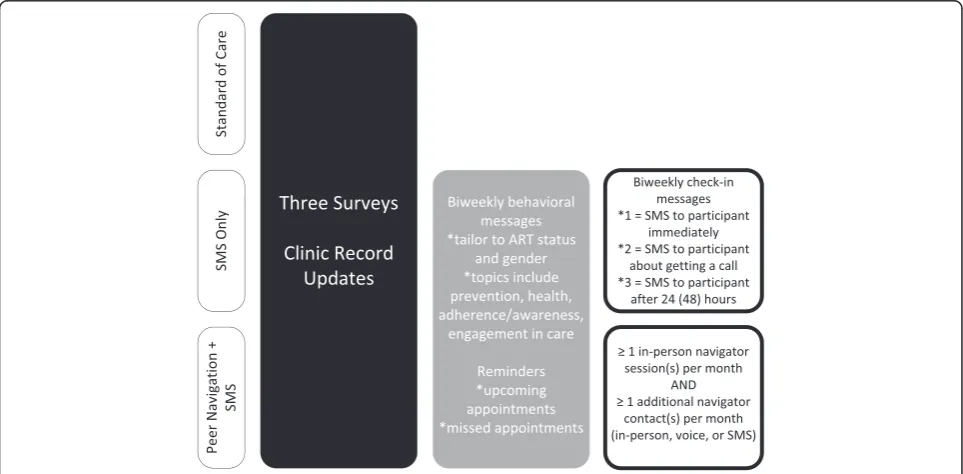
The first strategy includes three types of messages to be sent to participants that will be delivered automatic-ally from a central system based on their gender and clinical/ART status recorded on registration and enroll-ment forms and updated through clinical record extrac-tion (Fig. 2). These three message types include the following:
messages are designed to address four themes: HIV prevention (some of these messages are gender-specific); engagement in care; medication adherence (for those on ART) or awareness (for those not yet eligible for treatment); and healthy living, which includes messaging concerning alcohol/drug use, social support and safe disclosure, and health/ nutrition.
2. Care Reminder Messages: Participants are sent a message 3 days before any scheduled clinic visits, whether for ART refills, CD4+ or HIV viral load testing, or other routine care. Participants also receive a reminder message if they have missed a clinic visit by over 2 weeks, in line with South
African guidelines [13]. Patients receive up to 6
messages (bi-weekly) following a missed
appointment to encourage them to return to the clinic. Additionally, when a client has failed to present for a visit for 3 months, the study staff will alert the clinic that a client has been lost to follow-up.
3. Two-way Messages: These are automated biweekly
“check-in”messages that are sent from a central
system; they also record participant responses and send a system alert to the team if a follow-up call to the participant is needed. Two-way messaging serves to maintain contact with the participant, provides a means of retention in the study and in care, and also is a probe to ensure that the participant is not defaulting on care and treatment or experiencing any difficulties that need to be addressed. The
participant receives a request to“reply 1 if you’re
good or 2 if you have a problem and need to talk.”If
the participant responds“2,”project staff will receive
an alert to call the client within the first business day after receiving the notification. If the participant does not respond to the check-in message within 24 hours, the participant receives the message a second time. If the participant has not replied to either message after 48 hours, the study staff will receive an alert to call the client. When staff call for
either a“2”response or a non-response, they follow
a protocol for referrals and are trained not to offer advice and counseling. Responding to two-way messages is free of cost for participants.
The automated messaging system provides scheduled delivery of messages via the CommConnect online plat-form, part of the CommCare system developed by Dimagi, Inc. The particular behavioral messages that a participant receives are determined by gender and ART status, as captured by study staff during enrollment. The ART status classification is also linked to ongoing clinic record extraction, so that if the ART status changes, so does the message tree. Reminder messages are triggered by a“date of next appointment” field, which is updated during weekly chart extraction by study staff. If chart ex-traction indicates that a participant has missed a visit by over 2 weeks, a reminder is also sent. The CommCon-nect system sends and receives messages free of cost to participants. Even so, the study provides each participant with 50 to 60 Rand of airtime on the participant’s cell
[image:5.595.57.539.468.705.2]phone carrier of choice at enrollment and again at the 6-month follow-up visit to ensure that participants are comfortable using their phones for responding to study check-in messages.
The second intervention strategy is predicated on rela-tionship building and support with fellow patients. Spe-cifically, the strategy makes use of peer navigators, who work with participants to assess their barriers to reten-tion in HIV care, ART adherence, and prevenreten-tion of fur-ther HIV transmission, and then aids participants in developing plans and strategies for overcoming these barriers. To be eligible to serve as a peer navigator, a person must be HIV-positive, receiving care at a government-run primary healthcare facility, and have demonstrated commitment to adhering to medications and clinical monitoring. Each navigator will assist ap-proximately 10 participants (no more than 12) during the study. Following an initial visit, navigators aim to have at least one in-person meeting and one check-in by SMS or phone with each participant each month (that is, a minimum of two contacts per month for 12 months). This standardized contact schedule is intended to serve as a minimum threshold. A navigator’s work with a participant will often involve additional con-tacts in the course of a month, such as offering to ac-company a participant to their appointments (with participant consent), assisting a participant with disclos-ure of his or her HIV status to a family member or friend, or conducting additional meetings by phone or in-person to discuss emerging challenges and strategize solutions.
Participants in the peer navigator condition will also receive biweekly behavioral messages and appointment reminders, which will be sent via the CommConnect system according to the same schedule as used in the SMS-only strategy. Following the pilot of these strategies in four clinics, the study team resolved to include auto-mated reminders and behavioral messages instead of personalized reminders and behavioral messages sent by the navigators to clients in the peer navigation arm. This decision ensures better consistency of messaging be-cause navigators in the pilot phase struggled to personalize the sequencing of the various behavioral messages while still adhering to standardized scripts for each message. Additionally, investigators felt that auto-mating the messages for clients in the PN arm would fa-cilitate exploration of incremental effectiveness of the two study interventions, with one (PN) building on the other (SMS).
Peer navigators will meet weekly with their direct su-pervisors and biweekly with the larger study team to dis-cuss challenges being observed among participants, and to develop potential approaches to overcome the ob-served challenges. In addition, the supervisory team
meets weekly with study investigators to identify emer-ging complex challenges with particular participants or navigators, and to strategize solutions. Navigators also have access to a “clinic liaison” at each clinic site. This individual, usually one of the nurse providers, serves as a primary point of contact between the study team and clinic staff at a site. Navigators can refer their partici-pants to the clinic liaison when, for example, they feel that a participant has a problem that requires medical attention or a referral for other medical or social services.
Data collection procedures
Regardless of the intervention assignment, all partici-pants, including those receiving services in the SOC clinics, are asked to complete a baseline survey assess-ment and provide contact information on the day that enrollment occurs. Participants will be reassessed via surveys during the 6-month and 12-month follow-ups. Both baseline and follow-up assessments will capture in-formation about (1) access to clinics and HIV care ser-vices received in the 6 months preceding each assessment, (2) self-reported assessments of ART adher-ence (for participants on ART), and (3) self-reported HIV risk behaviors and risk reduction practices (condom use or partner reduction). The follow-up surveys also capture (4) self-reported receipt of the intervention components (for participants in the intervention arms) and (5) self-reported satisfaction with SMS and peer navigator services. We will also capture data related to demographics, disclosure, anticipated stigma [39], alco-hol use (AUDIT-C) [40, 41], and mental health (CESD-10) [41, 42].
Data regarding clinical visits and care received will be extracted from clinical files. Record extraction will occur weekly for participants on ART, and every 2 weeks for those not on ART, who are seen less frequently than the ART patients. Study staff will capture details regarding any visit that occurred since the last extraction, includ-ing the visit date, HIV-related services received (for ex-ample, medications), and any related CD4+ or HIV viral load test results. All data collection forms and proce-dures have been reviewed and approved by the Commit-tee for Human Research at the University of California, San Francisco (UCSF), the Human Subjects Division at University of Washington, and the Human Sciences Re-search Council (HSRC) ReRe-search Ethics Committee in South Africa. The Policy, Planning, Research, Monitor-ing and Evaluation Committee for the North West Pro-vincial Department of Health also reviewed and approved the protocol.
(including fringe benefits), 2) recurring supplies and ser-vices, 3) capital and equipment (for example, furniture and computers), and 4) facility space. Intervention costs will be assessed using a uniform cost data-collection protocol to quantify resources used and associated costs in each of the study arms. Data will be obtained through administrative record reviews and administrative and program staff interviews, supplemented by a staff time study in order to distinguish pre-implementation and implementation activities. Pre-implementation in-cludes hiring, procurement, intervention development/ modification and training. Implementation includes recruitment, intervention activities and supervision. Nonresearch program management costs will be allo-cated based on the period in which they occurred (pre-implementation versus implementation).
Measures
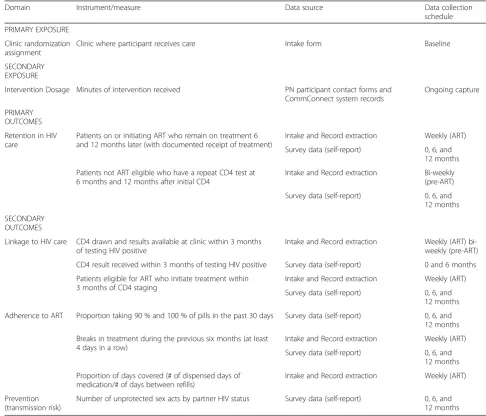
[image:7.595.52.539.316.732.2]Primary and secondary exposure and outcome measures are included in Table 1. Primary exposure for the intent-to-treat analysis is classified as the clinic randomization arm: SMS intervention, PN intervention, and SOC. The primary study outcome is retention in care, which is de-fined for patients on ART as the proportion of patients who have initiated ART who remain on treatment at 6 and 12 months and for patients who are not yet eligible as the proportion of patients who undergo a repeat CD4 test at 6 months and 12 months after the initial CD4. The secondary outcome of linkage to care is defined as a patient undergoing CD4 staging or being assessed for ART eligibility within 3 months of a positive diagnosis. We will also monitor whether the participants are linked to ART – that is, whether eligible participants receive
Table 1Measures, data sources, and data collection schedules for protocol exposures and outcomes
Domain Instrument/measure Data source Data collection
schedule PRIMARY EXPOSURE
Clinic randomization assignment
Clinic where participant receives care Intake form Baseline
SECONDARY EXPOSURE
Intervention Dosage Minutes of intervention received PN participant contact forms and CommConnect system records
Ongoing capture
PRIMARY OUTCOMES Retention in HIV care
Patients on or initiating ART who remain on treatment 6 and 12 months later (with documented receipt of treatment)
Intake and Record extraction Weekly (ART) Survey data (self-report) 0, 6, and
12 months Patients not ART eligible who have a repeat CD4 test at
6 months and 12 months after initial CD4
Intake and Record extraction Bi-weekly (pre-ART) Survey data (self-report) 0, 6, and
12 months SECONDARY
OUTCOMES
Linkage to HIV care CD4 drawn and results available at clinic within 3 months of testing HIV positive
Intake and Record extraction Weekly (ART) bi-weekly (pre-ART) CD4 result received within 3 months of testing HIV positive Survey data (self-report) 0 and 6 months Patients eligible for ART who initiate treatment within
3 months of CD4 staging
Intake and Record extraction Weekly (ART) Survey data (self-report) 0, 6, and
12 months Adherence to ART Proportion taking 90 % and 100 % of pills in the past 30 days Survey data (self-report) 0, 6, and
12 months Breaks in treatment during the previous six months (at least
4 days in a row)
Intake and Record extraction Weekly (ART) Survey data (self-report) 0, 6, and
12 months Proportion of days covered (# of dispensed days of
medication/# of days between refills)
Intake and Record extraction Weekly (ART)
Prevention (transmission risk)
ART within 3 months of CD4 staging. The secondary outcome of adherence is being assessed in three ways: as a report of taking 90 % of the prescribed medication, as no report or clinical record indicating gaps in treatment of 4 or more days, and collection of the proportion of days covered by medication dispensed. Finally, preven-tion behavior is defined as the number of unprotected sex acts by HIV partner status. All outcomes will be measured using both clinical record extraction and self-report; these two means of data collection will be com-pared for accuracy (using clinical record extraction as the gold standard).
Because the volume and intensity of the intervention might vary, particularly in the PN arm, we will also cap-ture intervention exposure or dosage as a secondary ex-posure measure. Dose (minutes) of intervention received will be used for per protocol analyses. In the PN arm, this will include recording client data on frequency and duration of in-person meetings and phone communica-tions with the navigator. Delivery and response to SMS messages for both intervention arms will be recorded with a standard duration of exposure (for example, 30 seconds) for each message, including two-way messa-ging. Any phone or in-person follow-up to SMS mes-sages will be recorded separately. Secondary outcomes include linkage to HIV care, adherence to medications, and transmission risk behavior, as described in Table 1.
Analysis
Our preliminary analysis will include presentation of participant demographic characteristics, service usage, acceptability of intervention approaches and self-reported sexual behavior within each of the three study arms using descriptive statistics (one-way and cross-tabular frequency tables and, for continuous variables, measures of central tendency). Measures of variability will account for repeated measures (multiple patients) and consequent correlation of variables (clustering) within each health facility. We will employ multiple im-putation (MI) using chained equations to account for missing data. This procedure assumes that incomplete data arise from a missing-at-random (MAR) process, under which missingness is random conditional on ob-served covariables and obob-served outcomes rather than a missing-completely-at-random (MCAR) mechanism [43], thus making fewer assumptions about the nature of the missing data. We will conduct sensitivity analysis using weighted MI to evaluate the robustness of the MAR assumption [44].
Our primary analyses will employ an intention-to-treat (ITT) approach. We will employ logistic generalized esti-mating equations (GEE) to compare patient retention between intervention arms. We will also evaluate
secondary outcomes (linkage, adherence and prevention behaviors) using an ITT analysis, as described above. We will employ GEE rather than mixed effects models as this approach allows us to estimate the effect of the intervention at the level of the population, rather than at the level of the individual. As our interventions will be implemented at the level of the health system, it is im-portant to estimate the effect of the intervention at the level it is implemented [45]. Further, previous research has suggested that adjustment for confounding can im-prove the efficiency of estimates in the context of ran-domized trials [46]. We will thus conduct sensitivity analyses employing causal inference methods to account for any imbalance in distribution of site- and individual-level co-variables across study clinics. We will employ targeted maximum likelihood estimation [47], which allows estimation of both site- and individual-level co-variables, to minimize bias and improve efficiency of estimates of effect in the context of small sample sizes [48].
Our secondary analyses will employ a per-protocol ap-proach to evaluate differences in primary and secondary outcomes. These analyses will resemble the intent-to-treat analyses described above, with the difference that individuals will be evaluated based on the number of mi-nutes of intervention exposure they receive. As above, these analyses will account for the clustering of results within sites and include use of causal inference methods to adjust for potential confounding. These analyses will allow us to determine whether an observed effect of the intervention is limited due to inadequate implementa-tion and whether there is a needed dosage for the inter-ventions to successfully impact outcomes. This will also permit any accounting for contamination should an SOC participant also receive services at an intervention clinic (their intervention dosage can be included), though we do not believe this will be common based on distance between study clinics and experiences during the pilot study. Our primary and secondary analyses will employ robust standard errors as these are unbiased in a setting where the coefficient of variation is less than 0.20 [49]. Our sensitivity analyses will include computation of confidence intervals using bias-corrected sandwich esti-mators [49–51]. Stata, version 13, will be used to man-age data and conduct the primary and secondary analyses; more complex sensitivity analyses will be con-ducted using R.
costs associated with intervention scale-up (each add-itional clinic added or individual enrolled). Efficiency will be measured as the cost per additional person retained in care for each arm of the study.
Sample size estimation
We aim to enroll 750 patients across the 18 participating clinics, with the goal of ensuring that each of the 18 clinics has at least 30 participants, and no site more than 55 to guarantee a well-balanced sample and minimize variability. We anticipate that approximately 20 % of the sample will discontinue study participation, largely due to extensive migration in the area. This estimate of attri-tion is grounded in on our pilot experience, during which 10 % of participants moved out of the area during a 3-month observation period. We therefore anticipate an evaluable sample of 600 participants over 1 year. Under the assumption that only 50 % of participants in the SOC clinics will remain in care [10, 38], this sample size will provide 80 % power to observe a 20 % to 23 % difference in patient retention at 12 months between the PN and SOC or SMS and SOC arms and a 17 % to 20 % difference between the PN and SMS arms. These esti-mates assume a two-sided alpha of 0.05 and a coefficient of variation of 0.15 to 0.20 or an intra-cluster correlation of 0.0225 to 0.04 based on a review of the recent litera-ture around sample size estimation in large cluster ran-domized trials [52, 53].
Discussion
This trial will determine whether the use of SMS and peer-navigation interventions in rural and peri-urban clinics can improve engagement in HIV care and preven-tion in South Africa, where scalable intervenpreven-tions are sorely needed to improve current HIV outcomes. Both interventions being explored were pilot tested and dem-onstrated to be feasible to implement in similar low re-source clinics in one of the study sub-districts (Moses Kotane) prior to beginning the trial.
The SMS approach is now being used broadly for health promotion given the ubiquitous presence of mobile phones in South Africa and other sub-Saharan African countries. Strategies utilizing cellular phones and other mobile technologies to improve HIV outcomes in sub-Saharan Africa are growing in number, particularly for ad-herence reminders [21, 54]. Additionally, the South African Government recently launched“MomConnect”, a national initiative for pregnant women that aims to improve access to maternal child health services by pro-viding stage-based appointment reminders and well-baby information SMS messaging [55], demonstrating both na-tional interest and support for this approach to engage-ment in care. The use of mHealth, particularly text messaging technologies, does bring with it potential
challenges. In the pilot phase, participants were hesitant to reply to messages from our service for fear of airtime charge, despite assurances that all messaging to the pro-ject was free. A number of participants reported either losing their phone or having a break in coverage, necessi-tating constant phone number confirmation and updating. Finally, extensive efforts were needed to include all local carriers on the messaging service free of charge to the users, which required additional system programming. In summary, whereas the promise of mobile phones for im-proving HIV-related care outcomes is great, the need ex-ists for additional research findings – showing not just that reminders can improve retention in care, but that the improved visit adherence will result in improved health [23].
The peer-navigation approach has also gained traction in recent years [21]. Though a peer-navigation interven-tion equivalent to this protocol has not yet been explored in South Africa to our knowledge, other treat-ment supporter interventions have demonstrated poten-tial, pointing to the need for support that goes beyond mediation assistance to include emotional support and encouragement [56]. A community-based PN model may also be adapted to fit into the current policy climate in South Africa. The government is currently rolling out a new primary healthcare (PHC) re-engineering model, which includes the deployment of a cadre of community health workers to homes in their communities to moni-tor health. These ward-based outreach teams (WBOTs) are integrated into primary care facilities and support priority clinic services in the community, including HIV testing and HIV/TB care. Our team is exploring the pos-sibility of integrating aspects of the peer navigation strat-egy within the WBOT model, pending trial findings. Another integration challenge that merits exploration in optimizing any community-based health model is how to incorporate the community-based work with services located at the clinic. We found in our pilot phase that integrating the peer navigators with clinical nursing and counseling staff was not easy, despite the fact that the clinic staff was pleased to have navigators working with the clinic patients. Other challenges include intensive training and supervision required to deploy and monitor navigators, who need ongoing mentoring and debriefing, particularly as they begin to traverse difficult barriers to care with their clients, such as alcohol dependence or food insecurity.
patient load to warrant inclusion. As a result, findings may not be generalizable to clients attending private clinics, to residents of other provinces, or to residents of large metropolitan centers or very rural areas where clinics have limited HIV patient load. Additionally, while trial participants are being systematically invited to par-ticipate and should represent the current patients under-going HIV testing and receiving services at the clinics, the study population is not representative of the large number of residents who do not present for testing, which comprise approximately 35 % of the national adult population [57].
Results will provide crucial information regarding the efficacy of two complementary intervention strategies, with the recognition that one intervention (SMS) is less resource intensive but also less flexible in terms of the patient barriers to care that it can address. This trial is powered to compare retention outcomes at 12 months between the SOC and both the SMS and the PN inter-vention. This is an opportunity to estimate not only intervention efficacy but also incremental efficacy from the base SMS model to an enhanced peer navigation model with patient reminders (which could be generated either from an automated SMS system or directly from a peer navigator). In the future, an exploration of targeted interventions, or whether a more intensive intervention (PN) could be targeted to the clients with more personal barriers who require additional support, is needed. In addition, knowledge of whether the less intensive model of SMS would be sufficient for those who need re-minders but do not experience major barriers, such as fear of disclosure or substance use, is also needed.
Trial status
The trial began recruitment in one of two study districts on 20 October 2014 and in the second sub-district on 26 January 2015. We aim to complete recruit-ment by 5 January 2015.
Abbreviations
ART:antiretroviral therapy; DoH: Department of Health; GEE: generalized estimating equations; HIV: human immunodeficiency virus; ITT: intent to treat; PHC: primary health clinic; PN: peer navigation; SMS: short messaging service; SOC: standard of care.
Competing interests
The authors declare that they have no competing interests.
Authors’contributions
SL is the principal investigator and conceived the study with WS, JMG, SS, JT, PS, and SB. SL, WS, JMG, and PS led the development of the study protocols. JD, JS, EA, and HG finalized the data collection instruments and field work SOPs. SL led development of the manuscript. WS and SS wrote portions of the manuscript. All other authors contributed to manuscript editing and review. MJR and JS supervised the pilot testing of the study interventions and data collection procedures and contributed to development of the final protocol. MJR, JD, JS, HG, and JG are supervising the implementation of the cluster randomized trial. All authors have contributed to the intellectual
content of the manuscript, to the development of the trial protocol, and have read and approved the final manuscript.
Acknowledgements
We thank Jessica Morris and Erushka Pillay for supporting data collection systems in preparation of the study. We thank Elsie Raphela for her work supporting community entry, Ndangano Makongoza for study coordination in Moses Kotane, and Michael Reyes for mentorship and guidance. We thank the North West Provincial Department of Health, the Bojanala Platinum District Department of Health, and the Provincial Research Committee for ongoing support of this project. We acknowledge and thank the four pilot health facilities for allowing us to pilot test technology and protocol in advance of this study. We thank Chester Kwak and the team at Dimagi for assistance in setting up the messaging and data systems. This project was funded by the Cooperative Agreement U91HA06801 from the US Department of Health and Human Services, Health Resources and Services Administration (HRSA) in support of the President’s Emergency Plan for AIDS Relief (PEPFAR). The contents of this paper are solely the responsibility of the authors and do not necessarily represent the views of HRSA or the U.S. Government.
Author details
1
Center for AIDS Prevention Studies, Department of Medicine, University of California, San Francisco, UCSF Box 0886, 550 16th Street, 3rd Floor, San Francisco, CA 94143, USA.2International Training and Education Center for
Health South Africa, University of Washington, 232 Bronkhorst Street, Pretoria, Republic of South Africa.3Department of Global Health, University of Washington, Seattle, USA.4Department of Family Medicine and Primary
Health Care, University of Limpopo - Medical University of Southern Africa campus, Pretoria, South Africa.5Departments of Medicine and Global Health,
University of Washington, Seattle, WA, USA.
Received: 25 April 2015 Accepted: 21 January 2016
References
1. Padian NS, McCoy SI, Karim SS, Hasen N, Kim J, Bartos M, et al. HIV prevention transformed: the new prevention research agenda. Lancet. 2011;378:269–78.
2. Cohen MS, Chen YQ, McCauley M, Gamble T, Hosseinipour MC, Kumarasamy N, et al. Prevention of HIV-1 infection with early antiretroviral therapy. N Engl J Med. 2011;365:493–505.
3. Collier AC, Coombs RW, Schoenfeld DA, Bassett RL, Timpone J, Baruch A, et al. Treatment of human immunodeficiency virus infection with saquinavir, zidovudine, and zalcitabine. AIDS Clinical Trials Group. N Engl J Med. 1996;334:1011–7.
4. Deeks SG, Smith M, Holodniy M, Kahn JO. HIV-1 protease inhibitors. A review for clinicians. JAMA. 1997;277:145–53.
5. McDonald CK, Kuritzkes DR. Human immunodeficiency virus type 1 protease inhibitors. Arch Intern Med. 1997;157:951–9.
6. Quinn TC, Wawer MJ, Sewankambo N, Serwadda D, Li C, Wabwire-Mangen F, et al. Viral load and heterosexual transmission of human
immunodeficiency virus type 1. Rakai Project Study Group. N Engl J Med. 2000;342:921–9.
7. Shisana ORT, Simbayi LC, Zuma K, Jooste S, Zungu N, Labadarios D, et al. South African National HIV prevalence, incidence and behaviour survey, 2012. Pretoria: HSRC Press; 2014.
8. Granich RM, Gilks CF, Dye C, De Cock KM, Williams BG. Universal voluntary HIV testing with immediate antiretroviral therapy as a strategy for elimination of HIV transmission: a mathematical model. Lancet. 2009;373:48–57.
9. Tanser F, Barnighausen T, Grapsa E, Zaidi J, Newell ML. High coverage of ART associated with decline in risk of HIV acquisition in rural KwaZulu-Natal. South Afr Sci. 2013;339:966–71.
10. Rosen S, Fox MP. Retention in HIV care between testing and treatment in sub-Saharan Africa: a systematic review. PLoS Med. 2011;8:e1001056. 11. Cheever LW. Engaging HIV-infected patients in care: their lives depend on
it. Clin Infect Dis. 2007;44:1500–2.
13. National Consolidated Guidelines for the Prevention of Mother-to-Child Transmission of HIV (PMTCT) and the Management of HIV in Children, Adolescents and Adults. Pretoria: Department of Health, Republic of South Africa; 2014. at: http://www.sahivsoc.org/upload/documents/
HIV%20guidelines%20_Jan%202015.pdf. Accessed January 30, 2016. 14. Kranzer K, Zeinecker J, Ginsberg P, Orrell C, Kalawe NN, Lawn SD, et al.
Linkage to HIV care and antiretroviral therapy in Cape Town, South Africa. PLoS One. 2010;5:e13801.
15. Lessells RJ, Mutevedzi PC, Cooke GS, Newell ML. Retention in HIV care for individuals not yet eligible for antiretroviral therapy: rural KwaZulu-Natal, South Africa. J Acquir Immune Defic Syndr. 2011;56:e79–86.
16. UNAIDS. Global Report: UNAIDS Report on the Global AIDS Epidemic. Geneva; 2010
17. Johnson LF. Access to antiretroviral treatment in South Africa, 2004–2011. S Afr J HIV Med. 2012;13:1.
18. Ndiaye B, Ould-Kaci K, Salleron J, Bataille P, Bonnevie F, Cochonat K, et al. Characteristics of and outcomes in HIV-infected patients who return to care after loss to follow-up. AIDS. 2009;23:1786–9.
19. Eaton JW, Johnson LF, Salomon JA, Barnighausen T, Bendavid E, Bershteyn A, et al. HIV treatment as prevention: systematic comparison of mathematical models of the potential impact of antiretroviral therapy on HIV incidence in South Africa. PLoS Med. 2012;9:e1001245.
20. Govindasamy D, Meghij J, Negussi E, Baggaley R, Ford N, Kranzer K. Interventions to improve or facilitate linkage to or retention in pre-ART (HIV) care and initiation of ART in low- and middle-income settings–a systematic review. J Int AIDS Soc. 2014;17:19032.
21. Chaiyachati KH, Ogbuoji O, Price M, Suthar AB, Negussie EK, Barnighausen T. Interventions to improve adherence to antiretroviral therapy: a rapid systematic review. AIDS. 2014;28 Suppl 2:S187–204.
22. Barnighausen T, Chaiyachati K, Chimbindi N, Peoples A, Haberer J, Newell ML. Interventions to increase antiretroviral adherence in sub-Saharan Africa: a systematic review of evaluation studies. Lancet Infect Dis. 2011;11:942–51. 23. Gurol-Urganci I, de Jongh T, Vodopivec-Jamsek V, Atun R, Car J. Mobile
phone messaging reminders for attendance at healthcare appointments. Cochrane Database Syst Rev. 2013;12:CD007458.
24. Guy R, Hocking J, Wand H, Stott S, Ali H, Kaldor J. How effective are short message service reminders at increasing clinic attendance? A meta-analysis and systematic review. Health Serv Res. 2012;47:614–32.
25. Free C, Phillips G, Watson L, Galli L, Felix L, Edwards P, et al. The effectiveness of mobile-health technologies to improve health care service delivery processes: a systematic review and meta-analysis. PLoS Med. 2013;10:e1001363.
26. Kunutsor S, Walley J, Katabira E, Muchuro S, Balidawa H, Namagala E, et al. Using mobile phones to improve clinic attendance amongst an antiretroviral treatment cohort in rural Uganda: a cross-sectional and prospective study. AIDS Behav. 2010;14:1347–52.
27. Finocchario-Kessler S, Gautney BJ, Khamadi S, Okoth V, Goggin K, Spinler JK, et al. If you text them, they will come: using the HIV infant tracking system to improve early infant diagnosis quality and retention in Kenya. AIDS. 2014;28 Suppl 3:S313–21.
28. Pop-Eleches C, Thirumurthy H, Habyarimana JP, Zivin JG, Goldstein MP, de Walque D, et al. Mobile phone technologies improve adherence to antiretroviral treatment in a resource-limited setting: a randomized controlled trial of text message reminders. AIDS. 2011;25:825–34. 29. Mbuagbaw L, van der Kop ML, Lester RT, Thirumurthy H, Pop-Eleches C,
Ye C, et al. Mobile phone text messages for improving adherence to antiretroviral therapy (ART): an individual patient data meta-analysis of randomised trials. BMJ Open. 2013;3:e003950.
30. Lester RT, Ritvo P, Mills EJ, Kariri A, Karanja S, Chung MH, et al. Effects of a mobile phone short message service on antiretroviral treatment adherence in Kenya (WelTel Kenya1): a randomised trial. Lancet. 2010;376:1838–45. 31. Achieng L, Musangi H, Ong’uti S, Ombegoh E, Bryant L, Mwiindi J, et al. An
observational cohort comparison of facilitators of retention in care and adherence to anti-retroviral therapy at an HIV treatment center in Kenya. PLoS One. 2012;7:e32727.
32. Kunutsor S, Walley J, Katabira E, Muchuro S, Balidawa H, Namagala E, et al. Improving clinic attendance and adherence to antiretroviral therapy through a treatment supporter intervention in Uganda: a randomized controlled trial. AIDS Behav. 2011;15:1795–802.
33. Muhamadi L, Tumwesigye NM, Kadobera D, Marrone G, Wabwire-Mangen F, Pariyo G, et al. A single-blind randomized controlled trial to evaluate the
effect of extended counseling on uptake of pre-antiretroviral care in Eastern Uganda. Trials. 2011;12:184.
34. Thompson MA, Mugavero MJ, Amico KR, Cargill VA, Chang LW, Gross R, et al. Guidelines for improving entry into and retention in care and antiretroviral adherence for persons with HIV: evidence-based
recommendations from an international association of physicians in AIDS care panel. Ann Intern Med. 2012;156:817–33.
35. Provincial Development Plan. North West Province, South Africa: North West Planning Commission; 2013. at: http://premier.nwpg.gov.za/sites/default/ files/vacancies/North%20West%20Provincial%20Development%20Plan.pdf. Accessed January 30, 2016.
36. National Department of Health. The National Antenatal Sentinel HIV and Syphilis Prevalence Survey, South Africa, 2011. Pretoria; 2012
37. Hayes R, Moulton L. Cluster Randomised Trials. Boca Raton: Chapman & Hall/CRC; 2009.
38. Kranzer K, Govindasamy D, Ford N, Johnston V, Lawn SD. Quantifying and addressing losses along the continuum of care for people living with HIV infection in sub-Saharan Africa: a systematic review. J Int AIDS Soc. 2012;15:17383.
39. Genberg BL, Hlavka Z, Konda KA, Maman S, Chariyalertsak S, Chingono A, et al. A comparison of HIV/AIDS-related stigma in four countries: negative attitudes and perceived acts of discrimination towards people living with HIV/AIDS. Soc Sci Med. 2009;68:2279–87.
40. Peltzer K, Simbayi L, Kalichman S, Jooste S, Cloete A, Mbelle N. Alcohol Use in three different inner cities in South Africa: AUDIT-C and CAGE. J Psychol Afr. 2007;17:95.
41. Peltzer K, Friend-du Preez N, Ramlagan S, Anderson J. Antiretroviral treatment adherence among HIV patients in KwaZulu-Natal, South Africa. BMC Public Health. 2010;10:111.
42. Andresen E, Malmgren J, Carter W, Patrick D. Screening for depression in well older adults: evaluation of a short form of the CES-D (Center for Epidemiologic Studies Depression Scale). Am J Prev Med. 1994;10:77–84. 43. Little RJA, Rubin DB. Statistical analysis with missing data. NY: John Wiley &
Sons; 2002.
44. Carpenter JR, Kenward MG, White IR. Sensitivity analysis after multiple imputation under missing at random: a weighting approach. Stat Methods Med Res. 2007;16:259–75.
45. Hubbard AE, Ahern J, Fleischer NL, Van der Laan M, Lippman SA, Jewell N, et al. To GEE or not to GEE: comparing population average and mixed models for estimating the associations between neighborhood risk factors and health. Epidemiology. 2010;21:467–74.
46. Moore KL, van der Laan MJ. Covariate adjustment in randomized trials with binary outcomes: targeted maximum likelihood estimation. Stat Med. 2009; 28:39–64.
47. van der Laan, M and Gruber S. Collaborative double robust targeted maximum likelihood estimation. Int J Biostat. 2010; 6(1): Article 17. doi:10.2202/1557-4679.1181.
48. Stephens AJ, Tchetgen EJ, De Gruttola V. Augmented generalized estimating equations for improving efficiency and validity of estimation in cluster randomized trials by leveraging cluster-and individual-level covariates. Stat Med. 2012;31:915.
49. Li P, Redden DT. Small sample performance of bias-corrected sandwich estimators for cluster-randomized trials with binary outcomes. Stat Med. 2015;34:281–96.
50. Mancl LA, DeRouen TA. A covariance estimator for GEE with improved small-sample properties. Biometrics. 2001;57:126–34.
51. Morel JG, Bokossa MC, Neerchal NK. Small sample correction for the variance of GEE estimators. Biom J. 2003;45:395–409.
52. Hayes R, Ayles H, Beyers N, Sabapathy K, Floyd S, Shanaube K, et al. HPTN 071 (PopART): rationale and design of a cluster-randomised trial of the population impact of an HIV combination prevention intervention including universal testing and treatment - a study protocol for a cluster randomised trial. Trials. 2014;15:57.
53. Pagel C, Prost A, Lewycka S, Das S, Colbourn T, Mahapatra R, et al. Intracluster correlation coefficients and coefficients of variation for perinatal outcomes from five cluster-randomised controlled trials in low and middle-income countries: results and methodological implications. Trials. 2011;12:151.
55. MomConnect. Reducing Maternal and Child Mortality Through Strenthening Primary Healthcare in South Africa. http://www.rmchsa.org/momconnect/. Accessed January 30, 2016.
56. Duwell MM, Knowlton AR, Nachega JB, Efron A, Goliath R, Morroni C, et al. Patient-nominated, community-based HIV treatment supporters: patient perspectives, feasibility, challenges, and factors for success in HIV-infected South African adults. AIDS Patient Care STDS. 2013;27:96–102.
57. Shisana O, Rehle T, Simbayi LC, Zuma K, Jooste S, Zungu N, et al. South African National HIV Prevalence, Incidence and Behaviour Survey, 2012. Cape Town: HSRC Press; 2014.
• We accept pre-submission inquiries
• Our selector tool helps you to find the most relevant journal • We provide round the clock customer support
• Convenient online submission • Thorough peer review
• Inclusion in PubMed and all major indexing services • Maximum visibility for your research
Submit your manuscript at www.biomedcentral.com/submit