TOWARDS GENERATING AMBISONICS USING AUDIO-VISUAL CUE FOR
VIRTUAL REALITY
Aakanksha Rana
∗, Cagri Ozcinar
∗, and Aljosa Smolic
V-SENSE, School of Computer Science and Statistics, Trinity College Dublin, Ireland.
ABSTRACT
Ambisonicsi.e., a full-sphere surround sound, is quintessential with 360◦visual content to provide a realistic virtual reality (VR) experi-ence. While360◦visual content capture gained a tremendous boost recently, the estimation of corresponding spatial sound is still chal-lenging due to the required sound-field microphones or information about the sound-source locations. In this paper, we introduce a novel problem of generating Ambisonics in360◦videos using the audio-visual cue. With this aim, firstly, a novel360◦audio-visual video dataset of 265 videos is introduced with annotated sound-source lo-cations. Secondly, a pipeline is designed for an automatic Ambisonic estimation problem. Benefiting from the deep learning based audio-visual feature-embedding and prediction modules, our pipeline esti-mates the 3D sound-source locations and further use such locations to encode to the B-format. To benchmark our dataset and pipeline, we additionally propose evaluation criteria to investigate the per-formance using different360◦ input representations. Our results demonstrate the efficacy of the proposed pipeline and open up a new area of research in360◦audio-visual analysis for future investiga-tions.
Index Terms— Virtual Reality,360◦video, Spatial sound, Am-bisonics, Multi-model, Deep learning.
1. INTRODUCTION
Recent advancements in virtual reality (VR) technologies have paved the way of capturing and sharing omnidirectional videos (ODVs) over social media. ODV, also known as360◦ video, provides the visual representation of the360◦surrounding of the captured scene. This emerging representation can be navigated with three degrees of freedom by rotating and changing the viewing direction of VR devices (e.g., tablet, laptop, head-mounted display). Users can nowadays, easily capture the360◦content with the help of afford-able360◦cameras available in the market (e.g., Ricoh Theta [1] and Samsung Gear 360 [2]) and share their ODVs over social networks to engage viewers deeply.
Essentially, creating realistic VR experiences requires the ODVs to be captured with their spatial audios. The spatial aspect of sound plays a significant role in informing the viewers about the location of objects in the360◦environment, providing an immersive multime-dia experience. In practice, however, existing affordable360◦ cam-eras can capture the visual scene either with mono or stereo audio signals. As a consequence, such audio-visual content is incapable of creating a magical sense of “being there” in the VR environment.
Recent user studies have amplified the need for spatial audio to achieve presence in VR films [3–5]. A spatial audio signal (also re-ferred to as 3D audio or 360 audio) is considered as a powerful way
*These authors contributed equally to this work.
of directing viewers’ attention [6, 7], however, requiring expensive sound-field microphones, professional sound recording and produc-tion tools [8, 9].
The lack of spatial audio captured by affordable360◦cameras poses an interesting alternative audio-visual research topic in multi-media signal processing community –given ODV with a mono/stereo audio signal, can we create the spatial audio to be used for VR video applications?.
In this work, we introduce a novel problem of generating Am-bisonics from the mono/stereo audio signal based on the audio-visual cue. Ambisonics is an effective way of representing the spatial audio and providing 3D sound for VR applications [10]. The Ambisonic technology is based on the spherical harmonic decomposition of the sound field and can encode the wave equation in the spherical coordinate system (r, Φ, θ). In this context,r is the distance to the source point from the center of coordinates,Φ ∈ (−π, π]and
θ ∈[−π/2, π/2]. This direction of the sound can be encoded into four different channels (W,X,Y,Z) of the B-format [11], which is the basis for the first order Ambisonics. Hence, the location of a sound source on the sphere is required to be known to generate Ambisonics.
To tackle this problem, in this paper, we establish a well-annotated dataset and design a 4-stage pipeline to estimate the locations of sound sources. The dataset contains 265 ODVs with different audio-visual scenarios, such as round-table discussions, presentations, meetings, documentaries. In addition, we design a 4-stage pipeline to estimate the locations of sound sources on the sphere to generate the Ambisonics, where the 4-stages are namely, representation, feature embedding, prediction, and encoding. Our proposed pipeline adopts the deep learning based audio-visual fea-ture embeddings and prediction techniques to facilitate the 3D localization of sound source using different ODV input represen-tations. Also, we benchmark our dataset by proposing evaluation criteria to investigate the performance of our pipeline.
In a nutshell, the main contributions of this paper are threefold. First, we address the problem of automatic spatial audio estimation based on audio-visual cue as a first work. Second, we establish the first360◦Audio-Visual Dataset (360AVD) which contains 265 video clips with a well-annotated ground-truth providing the sound direc-tion and locadirec-tion. Third, we propose evaluadirec-tion criteria and perform preliminary quantitative and qualitative analysis using two widely used ODV projection techniques and state-of-the-art feature embed-ding and prediction algorithms to estimate the location of the sound source. We expect that releasing this dataset and addressing this novel research question will foster further research in multimedia signal processing area.
Video Signal
B format
(I) (II) (III) (IV)
360° Video Capturing
Audio Signal
Fig. 1: Generation of a full-sphere surround sound environment in ODVs using audio-visual embeddings. The four modules of the pipeline are (I) Representation, (II) Feature embedding, (III) Prediction and (IV) Ambisonics encoding.
experiments with the used metrics. Our conclusions are drawn in Section 6.
2. RELATED WORK
Recent works showed that the location of a sound source could be estimated based on audio-visual signals. For instance, Owens et al. [12] modeled the visual and auditory signals and predicted the sound source pixel location on a given traditional 2D video. Simi-larly, Tianet al. [13] proposed audio-guided visual attention mecha-nism to explore audio-visual correlation with a target to predict event localization in traditional 2D videos. Also, Ephratet al. [14] pre-sented a deep network-based model that incorporate audio-visual cue to extract each speaker sound from a mixture of sounds. Audio-visual salient event detection was studied in [15] based on Audio-visual, audio and text modalities. The work showed that the performance of visual saliency estimation could be improved by incorporating audio and text. Colemanet al. [16] showed that an object-based au-dio capturing could achieve a convincing 3D auau-dio experience over headphones. Furthermore, in [17], source separation system was presented for high order Ambisonics recording. A multi-channel spatial filter was derived based on the long short-term memory re-current neural network with an assumption of known the directions of arrival of the directional sound sources.
However, to the best of our knowledge, no research on Am-bisonics generation based on the audio-visual cue of ODV content currently exists.
3. DATASET
Dataset is fundamental in predicting the sound location on ODV. However, to the best of our knowledge, there is no publicly avail-able dataset suitavail-able for our objective. To this end, we present the first 360AVD which contains 265 video clips with a well-annotated ground-truth providing the sound direction and location. The dataset has been prepared using publicly available YouTube360◦unlabeled videos. Each clip in the dataset is of10seconds where all the dio sources are manually annotated per second. To annotate the au-dio source locations, we used Microsoft’s visual object tagging tool1
which supports labeling of multiple pixel locations for each second of a given video content. The dataset contains a different range of categories: presentation, documentary, debates and casual discus-sions. Sample scenes from the proposed dataset are presented in
1Visual Object Tagging Tool: An electron app for building end to end
[image:2.612.92.523.73.181.2]Object Detection Models from Images and Videos: https://github. com/Microsoft/VoTT
Figure 2. Our proposed dataset with our source codes are available athttps://github.com/V-Sense/360AudioVisual.
Presentation
Documentary
Discussions
Debates
Fig. 2: Sample scenes from the proposed 360AVD.
4. PROPOSED SYSTEM
Figure 1 illustrates the proposed pipeline for the generation of a full-sphere surround sound environment in ODV. The proposed system consists of four main modules, namely (I) input representations, (II) feature embedding, (III) prediction models, and (IV) Ambisonics en-coding. At the first module, our aim is to investigate the impact of different sphere-to-planar projections for ODV. At the second mod-ule, we jointly estimate features for audio and video signals. Then, the combined information from the video and audio signals is fed into the prediction module to predict the 3D sound source location of a given ODV. Finally, we generate first-order Ambisonics by in-cluding the direction of the sound and encoding the estimated multi-channel audio based on the B-format.
[image:2.612.314.552.265.510.2]4.1. Input Representations
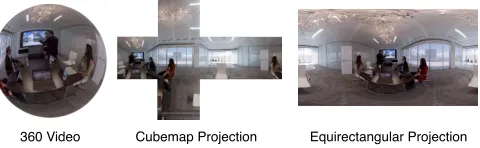
Equirectangular Projection 360 Video Cubemap Projection
Fig. 3: Visual representation of equirectangular and cubemap pro-jections for the captured360◦video.
We investigate the performance of two widely used ODV rep-resentations, equirectangular and cubemap (or cubical), as shown in Figure 3. The first, an equirectangular projection, is the most straightforward format that represents a spherical object on a 2D planar surface. The second, a cubic projection, is a collection of six cube faces which are utilized to fill the whole sphere around the viewer. The first projection, however, contains less geometrical dis-tortions than the second one.
4.2. Feature Embedding
Combining visual [18] and audio embedding using deep learning techniques have been recently studied in the literature [12, 13] for several end-to-end application-based scenarios such as source sepa-ration, action recognition, and audio-visual alignment. Most of the works are designed for traditional 2D video with a mono/stereo au-dio signal. However, such models combining the visual and sound information have not been studied for360◦video content.
Motivated from [12, 13], we formulate the feature embedding and prediction modules of the proposed Ambisonics generation pipeline. For the feature embedding module, we firstly employ the pre-trained VGG-19 [19] network to compute the visual features using the selected360◦visual representationi.e., equirectangular or cubical projections. For each second, similar to [13], we compute the feature maps from15frames and average them to obtain one feature map,v, of the dimension of7×7×512. For each second of audio signal, we simultaneously extract the128dimensional audio representation,a, using a pre-trained VGG-like network [20]. Then, we finally feed the extracted feature embedding to the following prediction module to obtain the sound source probability maps, as shown in Figure 1.
4.3. Prediction Module
To predict the location of the sound source, we first adopt the sub-networks of the proposed deep sub-networks, Tianet al. [13] and Owenset al. [12], originally designed for traditional 2D videos. We then alter them for our task at handi.e., to predict the 3D volumetric maps. Both models are recently published and their models are publicly available. We used the middle-layers from these pre-trained models to obtain the sound source location maps. The two predic-tion modules of our pipeline are named as a self-supervised module (SsM) and attention module (Att).
SsM module: It is an adaptation of the fusion sub-network pro-posed in [12] with three convolutional layers. To predict the sound localization mapSSsM
p , we concatenate the feature embedding and
feed it to the convolutional layers, and finally apply the spherical mapping functionfover the probability estimation map given as:
SpSsM=f(σ(L T
convl)), (1)
whereσis the sigmoid function,Lis the affine layer,convlis the
last convolutional layer and functionfmaps(x, y)→(θ, φ) coor-dinates.
Att module: It is inspired from attention mechanism detailed in [13], adaptively learns to locate the visible regions in each second of the video from where the sound originates. To predict 3D sound for each second, localization mapsSAttp is mathematically defined
as:
SpAtt=f(sof tmax(ω·ρ(lv) +la)), (2)
where theρris a hyperbolic tangent function,ωis a weighting
pa-rameter andla and lv are the audio-visual transformation layers.
Altogether, the attention weight vector computed using the multi-layer perception (MLP) like formulation as detailed in [13], is finally transformed by applying functionf.
4.4. Ambisonics Encoding
After the sound localization mapsSis estimated, we encode local-ized sound sources to the B-format. For this, the location of thei-th sound source is first estimated as follows:
˜
Φi,θ˜i=C (3)
whereC is the set of a sound source location based on 3D coordi-nates,{C}N
i=1,Nis the number of sound sources,Φ˜iandθ˜iare the
predicted spherical locations of thei-th sound source. The center of sound sourceCiis the mean location of distribution of 3D point
in thei-th sound source probability volumesS. The spherical vol-umesSare obtained by an absolute threshold,i.e., for all coordinates whereS(x, y, z) ≤ , values are equated to0. Hence, we encode the B-format as follows:
W(t) =
N X
i si(t)/
√
2,
X(t) =
N X
i
si(t)cosΦ˜icosθ˜i,
Y(t) =
N X
i
si(t)sinΦ˜icosθ˜i,
Z(t) =
N X
i
si(t)sinθ˜i,
(4)
wheresi(t)is thei-th sound signal of a given ODV, and the set of
four audio channels(W, X, Y, Z)form the estimated Ambisonics. The non-directional sound pressure level is represented asW, and three other channels,(X, Y, Z), are described as the position of the sound: front-to-back (X), side-to-side (Y), and up-to-down (Z).
5. EXPERIMENTS
This section describes the proposed metrics and preliminary results obtained from our proposed pipeline for Ambisonics generation.
5.1. Metrics
[image:3.612.58.298.107.181.2]Models 360-SSD 360-OvErr
=0.6 0.5 0.4 0.6 0.5 0.4
[image:4.612.111.501.70.137.2]SsM-Cubical 0.71±0.04 0.72±0.08 0.74±0.06 0.71±0.06 0.77±0.05 0.82±0.04 SsM-EquiR 0.75±0.06 0.77±0.09 0.79±0.07 0.78±0.07 0.84±0.06 0.88±0.08 Att-Cubical 0.72±0.05 0.73±0.05 0.74±0.04 0.72±0.05 0.74±0.08 0.78±0.08 Att-EquiR 0.76±0.04 0.77±0.08 0.78±0.06 0.84±0.06 0.85±0.06 0.86±0.06
Table 1:Quantitative Results on 360AVD Dataset. The scores are averaged on 265 ODVs for all models.
360-SSD:It estimates the Euclidean distance between the cen-tre of the predictedi-th sound source,Cip(x, y, z), and the centre of
ground truthi-th sound source,Cig(x, y, z), in the Cartesian coor-dinate systemi.e.,||Cgi −Cip||. The center of sound sourceCiis
defined in Section 4.3. For 360-SSD, all distances are normalized and the probability spheres have radius 0.5.
360-OvErr:This metric is based on the ratio of an intersection of the predicted and ground truth probability volumes to the union and, mathematically given as1−Sp∩Sg
Sg∪Sp, whereSpis the predicted
probability volumes andSg belongs to the ground truth. This
mea-sure can be seen as a 3D variant of single object localization error proposed in [21].
5.2. Implementation
Feature embedding and prediction.We base on the VGG-19 [19] and VGG-like [20] network for feature embedding module and com-puting audio and visual features are trained on Imagnet [19] and Au-dioset [22] dataset. For our SsM module, we adopt the convolutional layers from [12] which are trained large scale dataset of 750,000 videos. Similarly, we adopt the transformation layerslaandlvin
Eq. 2 from the model proposed in [13] trained on a large-scale AVE dataset. The followed training paradigm is similar to [12, 13]. Ambisonic encoding. To encode Ambisonics, we used the Face-book 360 encoder tool from the FaceFace-book Spatial Workstation [23]. Each predicted location for each sound was added to the location channels of B-format. Afterward, the MP4Box [24] was used to wrap the ODV and multi-channel audio together within an MP4 header file.
5.3. Results
In this section, we carried out the performance evaluation study of the proposed Ambisonics generation pipeline using both well-known representations and state-of-the-art prediction models over the pro-posed 360AVD dataset.
We first evaluated the performance of the predicted probability volumes, quantitatively, by using the proposed metrics: 360-SSD and 360-OvErr. For both metrics, less score stands for better perfor-mance. In Table 1, we present the results averaged over 265 ODVs with cubical and equirectangular formats and different settings of. Using both the metrics, we observe that SsM model-based prediction module with cubical ODV input representation performs the best in terms of localizing the exact sound source 3D location as well as the region. Att model-based prediction module competes closely with the former for localizing the 3D sound source.
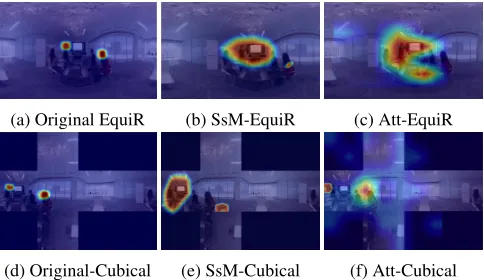
For both models, we observe that cubical ODV representation provides better localization than the equirectangular format. This partly accounts to less distortions present in the cubical format, which in turn is favorable for distinctive feature embedding and prediction. On the other hand, the overall higher 360-OvErr with equirectangular format demonstrate the influence of the distortions where it leads to larger detected regions. This can be additionally seen in Fig. 4 where the qualitative performance of both models are
illustrated with cubical and equirectangular representation. Addi-tional results,e.g., ODV with generated Ambisonics, are available on our Github page.
(a) Original EquiR (b) SsM-EquiR (c) Att-EquiR
(d) Original-Cubical (e) SsM-Cubical (f) Att-Cubical
Fig. 4: Qualitative Results: Row I shows the original360◦ video frame with (a) overlay-ed ground truth, predicted results from (b) SsM and (c) Att modules in equirectangular representation. Row II shows the same frame with (d) overlay-ed ground truth, predicted results from (e) SsM and (f) Att modules in cubical representation.
6. CONCLUSION
This paper introduces a novel research problem of automatic Am-bisonics generation from the mono/stereo audio signal based on audio-visual cue. For this aim, we propose a pipeline to predict the sound source location in a 3D space and time. The proposed pipeline contains four stages, representation, feature embedding, prediction, and Ambisonics encoding. To investigate the perfor-mance of each module, we introduce the first audio-visual dataset of 265 omnidirectional videos consisting of various single to multiple speech scenarios and evaluation metrics. Our initial analysis shows that the cubical representation of omnidirectional video with the self-supervised deep learning prediction algorithm performs better performance. All obtained results suggest that the problem of ac-curate sound source location estimation using audio-visual cue for Ambisonics remains open with a quite large room of improvement. The future work will consider developing optimal modules for our end-to-end pipeline for Ambisonics generations.
Acknowledgements
[image:4.612.316.558.207.347.2]References
[1] “RICOH THETA,” https://theta360.com/en/, Accessed: 2018-10-27.
[2] “Samsung Gear 360,” https://www.samsung.com/global/ galaxy/gear-360/, Accessed: 2018-10-27.
[3] C. O Fearghail, C. Ozcinar, S. Knorr, and A. Smolic, “Director’s cut - analysis of aspects of interactive storytelling for vr films,” in Inter-national Conference for Interactive Digital Storytelling (ICIDS) 2018, 2018.
[4] S. Knorr, C. Ozcinar, C. O Fearghail, and A. Smolic, “Director’s cut - a combined dataset for visual attention analysis in cinematic vr content,” inThe 15th ACM SIGGRAPH European Conference on Visual Media Production (CVMP), 2018.
[5] C. Ozcinar and A. Smolic, “Visual attention in omnidirectional video for virtual reality applications,” in10th International Conference on Quality of Multimedia Experience (QoMEX), 2018.
[6] N. O’Dwyer, N. Johnson, R. Pag´es, J. Ondˇrej, K. Amplianitis, E. Bates, D. Monaghan, and A. Smoli´c, “Beckett in vr: Exploring narrative using free viewpoint video,” inACM SIGGRAPH 2018 Posters, New York, NY, USA, 2018, SIGGRAPH ’18, pp. 2:1–2:2, ACM.
[7] V. Sitzmann, A. Serrano, A. Pavel, M. Agrawala, D. Gutierrez, B. Ma-sia, and G. Wetzstein, “Saliency in vr: How do people explore virtual environments?,” IEEE Transactions on Visualization and Computer Graphics, vol. 24, no. 4, pp. 1633–1642, April 2018.
[8] M. Frank, F. Zotter, and A. Sontacchi, “Producing 3d audio in ambison-ics,” inAudio Engineering Society Conference: 57th International Conference: The Future of Audio Entertainment Technology–Cinema, Television and the Internet. Audio Engineering Society, 2015.
[9] H. Lim, C. Ozcinar, A. P. Hill, and A. Kondoz, “Sound localisation for 3d multimedia streaming,” inProceedings of the 12th Western Pacific Acoustics Conference (WESPAC), 2015.
[10] E. Bates, “Comparing ambisonic microphones [blog],”
https://endabates.wordpress.com/2017/06/19/
comparing-ambisonic-microphones/, Accessed:
2018-10-27.
[11] M. A. Gerzon, “Ambisonics in multichannel broadcasting and video,”
Journal of the Audio Engineering Society. Audio Engineering Society, vol. 33, no. 11, pp. 859–871, 1985.
[12] A. Owens and A. A. Efros, “Audio-visual scene analysis with self-supervised multisensory features,”European Conference on Computer Vision (ECCV), 2018.
[13] T. Yapeng, S. Jing, Bochen L., D. Zhiyao, and X. Chenliang, “Audio-visual event localization in unconstrained videos,” inThe European Conference on Computer Vision (ECCV), September 2018.
[14] A. Ephrat, I. Mosseri, O. Lang, T. Dekel, K. Wilson, A. Hassidim, W. T. Freeman, and M. Rubinstein, “Looking to listen at the cocktail party: A speaker-independent audio-visual model for speech separation,”ACM Transactions on Graphics, July 2018.
[15] P. Koutras, A. Zlatintsi, E. Iosif, A. Katsamanis, P. Maragos, and A. Potamianos, “Predicting audio-visual salient events based on vi-sual, audio and text modalities for movie summarization,” inIEEE International Conference on Image Processing (ICIP), Sept 2015, pp. 4361–4365.
[16] P. Coleman, A. Franck, J Francombe, Q Liu, T. de Campos, R. J. Hughes, D. Menzies, M F S G´alvez, Y. Tang, J. Woodcock, P. J. B. Jackson, F. Melchior, C. Pike, F. M. Fazi, T. J. Cox, and A. Hilton, “An Audio-Visual system for Object-Based audio: From recording to listen-ing,”IEEE Transactions on Multimedia, vol. 20, no. 8, pp. 1919–1931, Aug. 2018.
[17] L. Perotin, R. Serizel, E. Vincent, and A. Gurin, “Multichannel speech separation with recurrent neural networks from high-order ambisonics recordings,” inIEEE International Conference on Acoustics, Speech and Signal Processing (ICASSP), April 2018, pp. 36–40.
[18] A. Rana, J. Zepeda, and P. P´erez, “Feature Learning for the Image Retrieval Task,” inComputer Vision - FSLCV, ACCV 2014 - Singapore, November 1-2, 2014, 2014, pp. 152–165.
[19] K. Simonyan and A. Zisserman, “Very deep convolutional networks for large-scale image recognition,” inInternational Conference on Ma-chine Learning, 2015.
[20] S. Hershey, S. Chaudhuri, D. P. W. Ellis, J. F. Gemmeke, A. Jansen, R. Channing Moore, M. Plakal, D. Platt, R. A. Saurous, B. Seybold, M. Slaney, R. J. Weiss, and K. W. Wilson, “CNN architectures for large-scale audio classification,”CoRR, vol. abs/1609.09430, 2016.
[21] O. Russakovsky, J. Deng, H. Su, J. Krause, S. Satheesh, S. Ma, Z. Huang, A. Karpathy, A. Khosla, M. Bernstein, A. C. Berg, and L. Fei-Fei, “Imagenet large scale visual recognition challenge,” In-ternational Journal of Computer Vision, vol. 115, no. 3, Dec. 2015.
[22] Jort F. Gemmeke, Daniel P. W. Ellis, Dylan Freedman, Aren Jansen, Wade Lawrence, R. Channing Moore, Manoj Plakal, and Marvin Ritter, “Audio set: An ontology and human-labeled dataset for audio events,” inIEEE International Conference on Acoustics, Speech and Signal Pro-cessing (ICASSP), New Orleans, LA, 2017.
[23] “The Facebook 360 Spatial Workstation,” https://
facebook360.fb.com/spatial-workstation/, Accessed:
2018-10-27.