Theme: An Approach for Aspect-Oriented Analysis and Design
Elisa Baniassad and Siobh´an Clarke
Department of Computer Science
Trinity College, Dublin 2, Ireland
{
Elisa.Baniassad, Siobhan.Clarke
}
@cs.tcd.ie
Abstract
Aspects are behaviours that are tangled and scattered across a system. In requirements documentation, aspects manifest themselves as descriptions of behaviours that are intertwined, and woven throughout. Some aspects may be obvious, as specifications of typical crosscutting behaviour. Others may be more subtle, making them hard to identify. In either case, it is difficult to analyse requirements to locate all points in the system where aspects should be applied. These issues lead to problems achieving traceability of pects throughout the development lifecycle. To identify as-pects early in the software lifecycle, and establish sufficient traceability, developers need support for aspect identifica-tion and analysis in requirements documentaidentifica-tion. To ad-dress this, we have devised the Theme approach for viewing the relationships between behaviours in a requirements doc-ument, identifying and isolating aspects in the requirements, and modelling those aspects using a design language. This paper describes the approach, and illustrates it with a case study and analysis.
1. Introduction
The intent of aspect-orientation is to allow developers to encapsulate system behaviour that does not fit cleanly into the particular programming model in use; it is aimed at breaking the hegemony of the dominant decomposition.
Behaviour that cannot be encapsulated because of its impact across the whole system is called crosscutting be-haviour. Before encapsulating crosscutting behaviour into an aspect, the developer must first identify it in the require-ments. This is difficult, because, by their nature, aspects are tangled with other behaviours, and are likely to be described in multiple parts of the requirements document. Using intu-ition or even domain knowledge is not necessarily sufficient for identifying the potentially broad range of aspects within a reasonable amount of time. For example, it required sig-nificant effort to identify and characterise that prefetching
could be modeled as an aspect in the FreeBSD operating system [7].
When identifying aspects early in the lifecycle, devel-opers can currently apply three approaches. The common approach for aspect-identification is to look for the objects in a system first, and then attempt to spot the tangled and scattered behaviour as it becomes evident. This is an ad-hoc approach that is likely to necessitate re-design as as-pects are discovered late in the design process. Alterna-tively, before the design process starts, developers might scan requirements for mentions of typical aspect-style be-haviour, such as logging, tracing, or debugging functional-ity. This only covers a narrow range of potential aspects; it does not help with identifying crosscutting behaviour that does not fall into these categories, or that might be domain specific. To address this need, a developer might start by applying an aspect-oriented requirements engineering tech-nology, and target non-functional requirements as an initial set of aspects [13, 11, 16]. However, there are likely to be many functional requirements in the system that probably break down into complicated and interrelated behaviours. Would any of those be aspects? Where would they crosscut the system?
We believe that in order to identify and model a broad range of aspects early in the lifecycle, and assess where they crosscut the system, developers need support for anal-ysis of the relationships between all behaviours described in requirements documentation. They also need support for translation of the results of the analysis into design models which can then be implemented in code.
register
unregister
logged
flagged
give
student can for a course
student can for a course
when a student then it must be in their record when a student it must be
professors can student
when professor a student it must be
when professor a student it must be as special professor can marks for courses
[image:2.612.53.287.72.262.2]when a professor a mark this must be in the record
Figure 1. Action View of CMS Requirements
and where in the system it crosscuts. We also claim that the Theme approach assists with maintaining traceability from requirements to design, since requirements map directly to Theme/Doc views which map directly to Theme/UML models. This traceability also provides cues about require-ments coverage in the design.
In this paper we present the approach by means of a small example (Section 2), and provide a case study to as-sess its effectiveness at aspect identification, the provision of traceability and coverage cues, and scalability of the ap-proach (Section 3). We then discuss other issues and make observations about the approach (Section 4), review related work (Section 5), and conclude (Section 6).
2. Theme
In the Theme approach, a theme is an element of design: a collection of structures and behaviours that represent one feature. Multiple themes can be combined or integrated to form a system [17]. Themes were introduced at the design-level in [4]. The Theme model has two kinds of themes:
base themes, which may share some structure and behaviour with other base themes, while modelling these from their own perspective, andcrosscutting themes which have be-haviour that overlays the functionality of the base themes. Crosscutting themes areaspects[6].
The Theme approach is divided into two segments: Theme/Doc and Theme/UML. These both operate on and refer to the same themes, but depict them at different phases of the lifecycle. Theme/Doc provides views1 and func-tional support for identification and depiction at the analysis
1All Theme/Doc views are generated automatically in dot [12] format
given the text of the requirements document, a list of key entities, and a
phase, whereas Theme/UML allows standard UML model-ing of relevant structure and behaviour for each theme at the design phase.2
In this section we work through a small example to il-lustrate the basic points of how to use Theme/Doc and Theme/UML to support the identification, design, and de-sign checking of aspects in a set of requirements.
2.1. Course Management System
The Course Management System (CMS) is a very small system, with nine requirements:
• R1. Students can register for courses. • R2. Students can unregister for courses.
• R3. When a student registers then it must be logged in their record.
• R4. When a student unregisters it must also be logged. • R5. Professors can unregister students.
• R6. When a professor unregisters a student it must be logged. • R7 When a professor unregisters a student it must be flagged
as special.
• R8. Professors can give marks for courses.
• R9. When a professor gives a mark this must be logged in the record.
2.2. Identifying Aspects Using Action Views
Using the Theme/Doc tool, a developer can view the relation-ship between behaviours described in requirements documenta-tion, and determine which behaviours are base, and which are crosscutting.
To help identify crosscutting behaviours we use theaction view
of the requirements document. Two inputs are needed to create the action view: a list of key actions identified by the developer by looking at the requirements document and picking out sensible verbs, and the requirements as written in the original document. Theme/Doc then performs lexical analysis of the text and gener-ates the action view.3
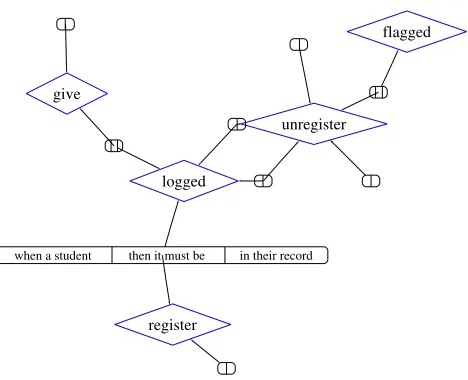
Each action is potentially a theme to be designed separately in Theme/UML. For the CMS, we have identified five actions: regis-ter, unregisregis-ter, logged, flagged, and give. Figure 1 shows the ac-tion view created by the Theme/Doc tool for the CMS. In the view we see the five actions as diamonds. The requirements from the text are shown as rounded boxes (sentence records) which contain
list of key actions. The dotty graph visualization package is used for the layout and display of the views.
2Theme/UML designs are created by a developer using an appropriate
UML editor. In Theme/UML all classes and behaviour related to a par-ticular theme are placed together in one package-style structure. These are then integrated with other themes using composition semantics such as merge and override. This is described in more detail in [4].
3Due to the lexical nature of the tool, any block of text could be defined
register unregister
logged
give flagged
student can for a course student can for a course
when a student then it must be in their record when a student it must be
professors can student
when professor a student it must be
when professor a student it must be as special professor can marks for courses
when a professor a mark this must be in the record
Figure 2. Clipped Action View
the words from the original sentence. If the requirement sentence contains a key action, it will be linked to the sentence record. The intent of the action view is to highlight relationships between ac-tions; the text of the individual requirements themselves is not the point at this stage, and so is not intended to be legible. Of course, a user may choose to enlarge any requirement for their information. In this view we have chosen to enlarge R3, which reads “when a student registers then it must be logged in their record”.
As we might expect, none of the actions in the requirements is isolated from the rest. They all relate in some way to the rest of the actions. The fact that they are linked shows us that there is crosscutting and tangling of behaviours within the requirements. For instance, we can see from this figure that thelogged action is mentioned in four requirements, and that theregisteraction is mentioned in two requirements.
Requirements often refer to more than one action. For instance, R3 refers to both theregisterandloggedactions. We identify as-pects by examining these shared requirements. Our aim is to sep-arate and isolate groups of actions and requirements in the action view, arriving at two kinds of action/requirement groupings. The first are self-contained and have no requirements that refer to ac-tion in other groups, which we determine to be “base”. The second kind are crosscutting and have requirements referring to actions in other groups.
We use the clippingfunctionality of the tool to achieve this separation and isolation. First, we examine each shared require-ment to see which action it is more appropriately coupled with. If the requirement is too ambiguous to associate with one action or the other, we must resolve the ambiguity, either by re-writing, splitting, or refining the requirement. The requirement that links
loggedtoregisteris R3, which describes logged behaviour that is added to registration behaviour. We intuit that logging is the pri-mary behaviour of this requirement, and hence that R3 should be coupled with theloggedtheme. In deciding this, we have deter-mined thatloggingis crosscutting andregisteris base. Second, we clip the arrow from R3 toregisterso that it is only linked to
logging. That arrow is replaced by a grey arrow with a dot at its head which points fromloggedtoregister, indicating thatlogged
crosscutsregister.
We then visit each requirement thatlogged shares with other actions, to determine whether they belong withloggedor the other action. Since we have determined thatloggedcrosscutsregister
it is likely that it also crosscuts the other actions with which it is linked. We continue to snip the links between the shared re-quirements and the base actions, and leave them with thelogged
action. Finally, we arrive at our goal as shown in theclipped action viewdisplayed in Figure 2: four actions with requirements that
re-Legend
student can
for
course
register Entity requirement phrase 1
[image:3.612.309.543.79.131.2]requirement phrase 2 Action
Figure 3. Theme/Doc Theme view: register
fer only to themselves and are therefore base, and one action that mentions others and is therefore crosscutting. In clipped action views, crosscutting themes are placed above the themes that they crosscut. The grey arrows indicating crosscutting in the clipped view (Figure 2) will help guide the configuration of aspect-base relationships at design.
We now make one final observation from the action groupings. In this view we see that theflaggedaction is linked to the unreg-ister action. We examine the requirement they share and make the decision that the flagging functionality should be included in the professor’s behaviour in theunregistertheme. An alternative might have been to consider that flagging behaviour crosscut un-registering behaviour. Now, each grouping becomes a theme we wish to model using Theme/UML.
2.3. Planning for Design Using the Theme View
Theme/Doc’stheme viewis used to plan the design and mod-elling of the themes identified in the previous step. Theme views differ from action views in that they do not only show require-ments and actions, but also show key elerequire-ments of the system that will need to be considered for each theme design in Theme/UML. To construct a theme view, a developer must supply an additional set of keywords: key entities. Like the action view, the theme view is created through lexical analysis of the text of the requirements document.
Figure 3 shows the theme view of theregistertheme clipped of crosscutting behaviour. We can see that it has only one require-ment, which mentions nothing other than registration behaviour. When reading sentences in Theme/Doc, first read the element that points into the sentence record, then read the first phrase in the record, and then read the element pointed to by that phrase. If the phrase is empty, it just means there was only a space between the first and second element, with no connecting phrase. Then read the subsequent connecting phrase, and then the element to which it points. Continue back and forth between the record and its at-tached elements until the record ends. To read a sentence, do not read more than one element out from the sentence record. This sentence reads “Student(s) can Register for Course(s)”.
Course
+courseCode : int
+addStudent(Student)
Student
+name : String +ID : String
+register(Course) 1..*
«theme» Register
:Student :Course
addStudent(self) register(course)
Figure 4. Theme/UML:register
logged
record student
it must be
then it must be in their
professor
a it must be
a this must be
in the
mark unregister
register
give
Figure 5. Theme/Doc Theme View: logged
When modelling a crosscutting theme we want to model the crosscutting behaviour in an abstract and potentially re-usable way. We do not want explicit references to any base actions or entities. The theme view for crosscutting themes helps with identi-fication of such elements by greying out actions and entities found in other themes. The remaining white actions and entities can then be used to guide the design of the abstract crosscutting behaviour. The grey actions are also used to determine the joining, or binding of the crosscutting behaviour to the greyed-out base.
An example of this is shown in Figure 5. We can see that only elements that are unique to the logged theme areloggedand record. We can now model the abstract behaviour for logging records without refering directly to registration, unregistration, students, professors or giving marks. The model for thelogged
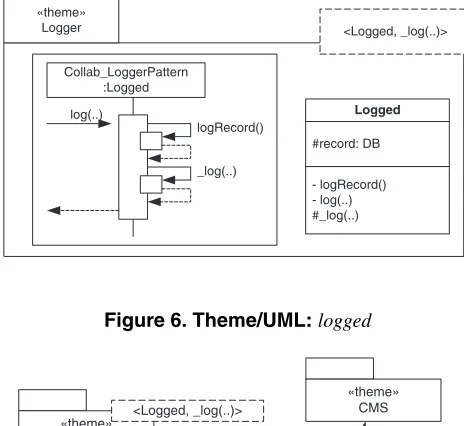
theme is shown in Figure 6 in which we can see that therecord element of theloggedtheme has become a database in this design, and that theloggedaction has been loosely translated into the logRecordmethod. Theme/UML allows reasoning about ele-ments from a base by using templates that will be bound to real base elements at a later stage.
To determine how the crosscutting theme should hook into the base features, we look back at the theme view forlogged (Fig-ure 5). All of the grey actions are behaviours that are crosscut by theloggedbehaviour. The Theme/UML forloggedprovides the log()template method as the handle method for the base
be-«theme»
Logger <Logged, _log(..)>
Collab_LoggerPattern :Logged
log(..)
logRecord()
_log(..)
Logged
#record: DB
[image:4.612.308.540.79.292.2]- logRecord() - log(..) #_log(..)
Figure 6. Theme/UML:logged
bind[<{Person, Student, Professor} ,
{Student.register(), Person.unregister(), Professor.giveMark()}>]
«theme» Logger
«theme» CMS <Logged, _log(..)>
Figure 7. Composition of logged and other
themes
haviour. To resolve which method the log()method actually is, we use thebind feature of Theme/UML to bind it to a con-crete method from another feature of the system. So, we bind the log method to the grey actions in thelogged theme view: register, unregister, and give(mark). To determine the classes to which methods belong, we can look at Figure 5 and the relevant Theme/UML models for each action. We see that theregister method is associated with theStudentclass (also illustrated in Figure 4) and thegiveMarkmethod belongs to theProfessor class. Both theStudentandProfessorclasses are linked to theunregistermethod, so we use their parent class,Person, specified in a Theme/UML model not shown here, for the binding. Figure 7 depicts the bind statement to integrate theLoggertheme into theCMStheme, which is a product of a previous merging of all other base themes.
2.4. Re-checking Themes Using the Augmented
Theme View
student
register has
can for a
name has
ID has
course
addStudent
has
courseCode has
[image:5.612.311.542.83.185.2]calls
Figure 8. Augmented View: register
is shown with a dashed arrow. We’ve added a method to the view, which is shown as an action, and also a class, which is shown as an entity. To distinguish these as augmentations, the corners are marked. These augmentations are specified by the user and fed into the Theme/Doc tool which generates the augmented graph.
By looking at Figure 8, we can see that the Theme/UML de-sign seems to align with the requirement shown in Theme/Doc. If there were other design elements (other classes or methods) in-cluded in the Theme/UML design, we would see them here, and would be able to assess their correctness with a view to the re-quirements. This view is not intended to provide any formal ba-sis for analyba-sis; there will not necessarily be a 1-1 mapping be-tween requirements-level actions/entities and design-level opera-tions/structures. Rather, it is intended to place, in the context of the requirements, the design decisions that were made. This context then gives the developer a view for verifying the design decisions themselves.
Since the Theme/UML for a crosscutting theme only includes information about the abstract crosscutting behaviour, only the structures related to the behaviour are added to the theme view. This view is shown in Figure 9, in which all augmented elements are enlarged. As before, all elements not unique to the crosscutting behaviour are shown in grey. This view has two relationships the
registeraugmented view did not: “is-a” relationships, shown with a bi-directional arrow, and “bound” relationships which are shown with bi-directional dashed arrows, as they are in the Theme/UML bind notation. Elements that are involved in the binding but that are not shown in the view are also added. For instance, the action giveMarkis in grey because it is not in the Theme/UML for the
loggedtheme, but is included because thegiveMarkmethod is bound to thelogRecordmethod. To assess the completeness of the design decisions for this theme we look at whether all the greyed actions are bound to the action representing the crosscut-ting behaviour. We also scan to see that all the structures men-tioned are dealt with in some way. We can see that mark, for instance, is included in the crosscutting behaviour because it is used by thegiveMarkmethod which is bound tologRecord.
3. Case Study
The goals of this case study were to test the Theme approach on a larger example, and perform preliminary assessment of it in terms of effectiveness for finding aspects, support for assessment
logged is logRecord
record
uses
student it must be
then it must be in their
professor
a
it must be
a
this must be in the
mark
giveMark
uses
unregister bound
register bound
[image:5.612.55.286.87.186.2]give is bound
Figure 9. Augmented View: logged
of requirements coverage, facilitation of requirements traceability, and scalability. We will first give a general description of the lo-cation aware game that was the basis for the case study, and then provide results and analysis.
3.1. Location Aware Game
The set of requirements used in this case study are those for a location aware game called the Crystal Game, which was devel-oped in an independent research project. The game has 89 require-ments, so is roughly ten times larger than the example provided in Section 2. The game involves any number of human players, each of whom is provided hand-held devices. The game can be set in any location, as long as the location has the necessary in-frastructure. The object of the game is to collect crystals that are deposited throughout the location. As a player moves around the game space, their hand-held device will alert them when they have encountered a crystal. Computer-generated characters also take part in the game. When a player encounters one of them, they will interact, and perhaps duel. When a player encounters another player, they will duel, and the loser of the duel will turn all of their crystals over to the winner. The game ends after a specified time period. The winner is decided by how many crystals each player has. There are other constraints and requirements in this game which will be of interest and will be described in later sections.
3.2. Results
In this section we review the steps we took to apply the Theme approach to the Crystal Game requirements.
accumulate
give track-energy crystal collect by discover a crystal when in world or by receive a crystal
enter-location
player can enter a location from any direction player enter location by walk into location on map player enter location character present character set player task discover crystal in location and no character or other player then pick-up crystal a player may meet another player in a location when they enter it
set-task assign-location
location are random assign to player location are random assign to character game will random distibute crystal throughout world
create-new
game player should choose begin_new from the option_menu
declare-winner
player with most crystal in throne_room at end of game is declare winner winner crown king of realm player with equal number of crystal at end must duel in order to declare winner
display
explore_mode map zoom out show entire world
end-game
game end when timer elapse all player should be in throne_room game can end for a player by leave game or winner declare player forfeit game if doesn’t return to throne_room before time limit elapse
sage ask player a question about the world or ask riddle wizard task is to send player to run an errand for them usually to bring them magical item warrior challenge player to physical_feet if character has no crystal player then they can not challenge or duel playermeet another then automatically challenge them to duel duel consists of play game of rock paper scissors winner of duel take both crystal player challenge another, each wager one crystal on the outcome of a duel outcome is fail or succeed
join-game
member player computer will send up-to-date game_state to new player new player choose join_existing from the option_menu
leave_game
room_mode player start game gain 10 unit of energy player fail at a they lose 2 unit energy player succeed at a they gain 3 unit energy player may possess 10 unit maximum player lose 1 unit of energy for every 5 minute in player lose 2 unit of energy for every 5 minute in player fail challenge to player lose 5 unit of energy player succeed in challenge energy gain to maximum player lose energy player sends audio signal in form of buzzer and reason why is show on screen of wearable computer player gain energy player gets audio signal in form of ding and reason why is shown on screen of wearable computer
new-game prompt player chosen to game
when a player enter a location a description of the room is in the message board at the bottom left of the screen
player is in while explore world player has wearable computer contain led which light-up while playermeet with other player in they must duel when a player an outside location they go into
loser of duelthe wager crystal wizardplayer a crystal when they complete their player meet with character that is same type then that character player crystal toplayer must be in contact with a player already a member of game
player should select the option from the option_menu to leave a game player drop all crystal in location they are in and
small map of world in upper left-hand corner of gui smaller scale map in main part of gui shows data about world and character or player in vicinity of player mapon gui player explore world in main map follow and change view when player in map shows room zoomed in
playera crystal gain 2 unit of energy playerto input a port number for the game to take place on
playerto choose a time limit and name for the
player wants to to input the machine name or ip address of the other player and port number on which the game is being playwhen player to input their name and choose character_type from character_list
[image:6.612.57.293.128.440.2]while player in a yellow_light will light on wearable computer when a player a room the player goes into
Figure 11. Clipped Action View of Major Game Actions
Figure 10. Game Action View: All Actions
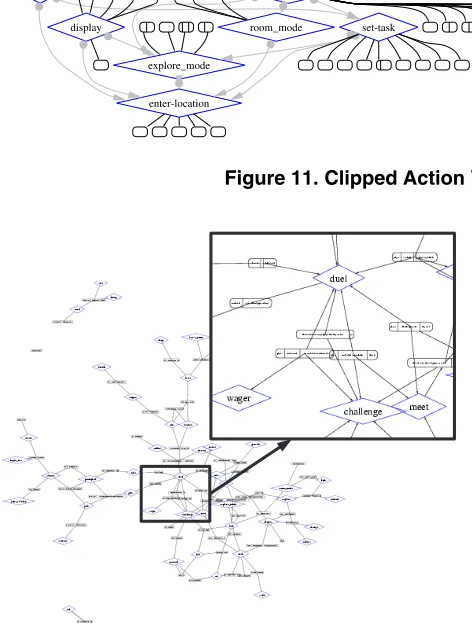
We used the view shown in Figure 10 to perform such an as-sessment. This figure shows the initial action view for the game, with the centre portion of the view enlarged. The enlarged view shows four actions,duel, wager, challengeandmeet. We exam-ined the requirements they shared, considered the meaning of the actions, and determined thatduel, wager, andchallengeshould all be grouped under the general heading ofduel, since players chal-lenge one another to duel, and wager crystals on the outcome of a duel. In that case, we classifiedduelas being more major than wa-gerandchallenge, which we saw as sub-actions ofduel. Themeet
action was connected toduelbecause when players encounter one another they duel. We examined requirements shared bymeeting
andduellingand determined that since they were not synonymous, they should not be grouped into one theme. Later, we determined thatduel and its sub-actions should be grouped under the more major action,set-task. In the end, we arrived at the view shown in Figure 11, which displays the 16 major actions which became our themes. Of those actions, five are independent, while others share requirements, and hence crosscut one another in some way.
The clipping functionality of the tool helped us investigate the
major action view to determine which themes are crosscutting and which are base. In the case of theprompttheme this was straight-forward. The prompt theme (shown to the right of Figure 11) shared requirements with two other themes,new-gameand join-game. By examining the shared requirements it could be seen that the prompting behaviour crosscut these two themes.
As is visible on the left side of Figure 11, there are several re-lated themes. To determine which of those was crosscutting, we began by assessing the requirements between theexplore-mode
and enter-location themes. We determined that explore-mode
crosscut enter-location. By continuing to examine themes that shared requirements with enter-location we further determined that room-modewas crosscutting, as was give, accumulate, set-task, anddisplay. We then examined the remaining shared re-quirements, and encountered themes that crosscut other crosscut-ting themes. For instance, thetrack-energytheme was determined to crosscut set-task, room-modeand explore-mode, all of which crosscutenter-location. There are five themes that crosscut other crosscutting themes: display, set-task, give, track-energyand ac-cumulate.4
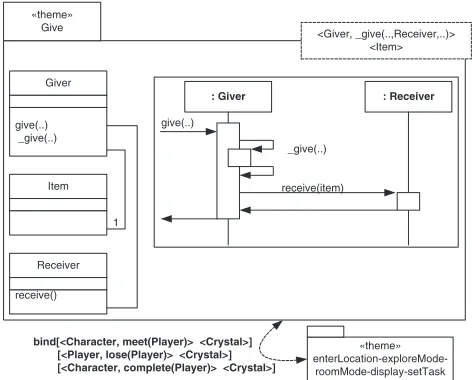
3.2.2. Modelling and Composing ThemesThe theme view was used to drive the modelling and composition semantics for design of the game using Theme/UML. Figure 12 shows the Theme/UML for thegivetheme. Thegivetheme handles the situation in which a player or a character gives a crystal to another player. This happens in three situations: when a player meets a character, the character gives them a crystal; when a player loses to another player, the loser gives the winner a crystal; and when a player completes a task for a character, the character gives the player a crystal.
To ensure that the developer carefully considers the order in which crosscutting themes are composed with base themes, Theme/UML allows only one crosscutting theme per composition. We therefore needed to inspect the crosscutting relationships to determine the order of binding. For this we used the clipped ac-tion view shown in Figure 11. In this view, the themes are posi-tioned hierarchically, based on whether they crosscut one another. The grey arrows indicate which themes crosscut other themes. We can see, for instance, that there are no grey arrows extending from
4AspectJ [1], allows specification of join-points in aspect code as well
enter-location, which indicates that it is base functionality. This is also suggested by the fact thatenter-locationis positioned low-est in the graph. To determine the binding order, we begin with the lowest themes, and work to the highest, incrementally binding in one crosscutting theme at a time. To determine what is first in the binding we identify the themes that crosscut only that theme (room-modeand explore-mode), and placed those first, and sec-ond in the binding order. The final bindings were done with the “more” crosscutting themes: display, giveandtrack-energy. The very last binding is ofaccumulate, since it crosscuts thegiveand
track-energythemes.
Thegivetheme bindings are also shown in Figure 12. Give
is bound fifth in the general order, and is bound to an al-ready composed theme, enterLocation-exploreMode-roomMode-display-setTask. As the name suggests, the composed theme is the product of bindingenter-locationto its closest four crosscutting themes.
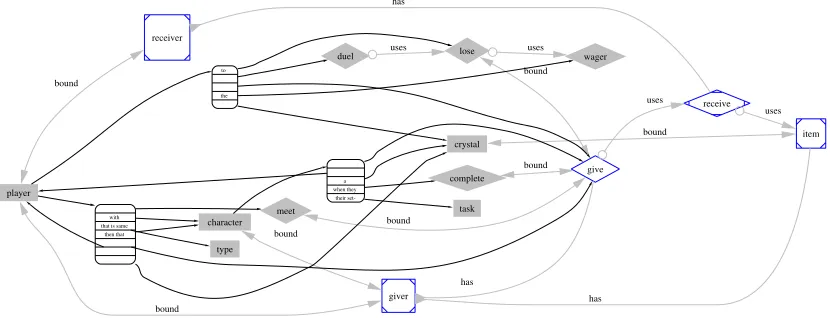
3.2.3. Checking Theme/UML Finally, we used the augmented theme view to check the validity of the design choices we made. An example of this is shown in Figure 13. In this figure we can see that four elements have been added to the view: giver, receiver, receive, anditem. The relationships from the Theme/UML are also shown. We can see that all the grey actions have been bound togive, except forwagerandduel, which are drawn in through lose. We can see that both players and characters aregivers, but only a player is bound toreceiver.
3.3. Analysis
In this section we discuss how the results of the application of the Theme approach reflect on the four areas of interest: effective-ness at support for aspect identification, requirements coverage, traceability, and scalability.
3.3.1. Effectiveness of Support for Aspect Identification Through the application of the Theme approach, we were able to identify eight aspects: explore-mode, room-mode, accumulate, track-energy, give, set-task, displayandprompt. Had we carefully read the requirements document we may have identified seven of these behaviours as aspect behaviours since they provide track-ing or loggtrack-ing style functionality. However, it is unlikely that we would have identified thegivefunctionality as an aspect because mentions of thegiveaction are spread throughout the document, and it might have been difficult to recall that the same abstract behaviour is occurring with relation to different system features. Also, since in the document text it is described as a consequence of other actions, such as meeting, and duelling, it is possible that we would have automatically thought ofgiveas a method in those actions. It wouldn’t have been until we were modelling or im-plementing it that we would have noticed its crosscutting nature. We can see from Figure 12 that the givefunctionality works as an aspect, as it can be expressed in an abstract way, and can be overlayed on the appropriate behaviour through bindings.
We also found our approach effective support for determining the binding order for multiple crosscutting themes. This may be otherwise difficult to determine.
«theme»
Give <Giver, _give(..,Receiver,..)>
<Item>
give(..) _give(..)
Giver
receive() Receiver
Item
1
: Giver : Receiver
give(..)
receive(item) _give(..)
bind[<Character, meet(Player)> <Crystal>] [<Player, lose(Player)> <Crystal>] [<Character, complete(Player)> <Crystal>]
[image:7.612.308.544.76.266.2]«theme» enterLocation-exploreMode-roomMode-display-setTask
Figure 12. Theme/UML:give
3.3.2. Requirements CoverageWe were initially concerned that it may also be difficult to assess whether all the requirements have been associated with a theme. We noted that the action view can be used to monitor requirements coverage, because if a require-ment is not associated with a theme it is orphaned in the view. By orphaned, we mean that only the sentence record for the re-quirement appears, without being linked to a diamond-shaped ac-tion. We found that a requirement could be orphaned in two ways. Orphans can appear in the initial action view if the requirement contains no key actions. This may happen if it refers to another action, but does not mention it explicitly. By inspecting the re-quirement we can identify the rere-quirement’s original location in the text, and can read the requirement in context to determine to which action it refers. The other way orphans can appear is when forming the major action view. As major actions are identified, they are added to a new list of keywords. The minor actions that have been grouped under the major action will be annotated so that they will be linked to the major action in the view. Minor actions that are not grouped with major actions will disapear, and their requirements will appear to be orphaned. We systematically vis-ited the orphaned requirements to determine whether any of their minor actions should be promoted to major, or whether to group those requirements under other major actions.
lose
give bound
wager uses
crystal
item bound
character
a when they
their
set-giver bound
type
duel uses
complete bound
receive uses
meet
bound player
to the
with that is same
then that
bound receiver
bound
task
uses
has
[image:8.612.90.505.79.238.2]has has
Figure 13. Augmented View: give
can examine any Theme artifact and view backward and forward traceability links. For instance, when looking at a theme view we obtain backwards mappings by inspecting the sentences displayed to find their location in the original text, and by observing which actions were deemed to be minor. We can also obtain forward mappings identifying the Theme/UML that models the view based on their common name.
For example, in Figure 13 we see the augmented view for the
give theme. If we inspect the sentences shown in this view we would find that they are sentences 4, 18 and 69 from the orig-inal text. We can see that actions duel, lose, wager, meet, and
completeare all contained in other themes. By visiting the action view we can infer that they were deemed minor actions since there is no major theme named after any of them, and that three were grouped under theset-tasktheme, and one was grouped under the
enter-locationtheme. This is further confirmed by viewing the
giveTheme/UML shown in Figure 12.
3.3.4. Scalability of Action Views In the small CMS example, almost every action became a theme. This allowed for easy asso-ciation of requirements with themes, and for easy viewing. How-ever, in the larger game example, we classified actions into two types: major and minor. Major actions became themes, while mi-nor actions were slotted to become methods within a theme. When forming the action views for this larger example, we chose only to use the major actions to form the view, rather than viewing all the major and minor actions. This allowed us to determine and assess the relationships between themes without the added “noise” of the minor actions.
Were we to scale the requirements further, it would be neces-sary to apply other approaches, since it would not be feasible to fit an entire action view for a very large system onto a screen or a page. In this case, query functionality, provided by the Theme/Doc tool, is needed to form sub-views that could be examined sepa-rately from the entire action view.
The current approach has essentially provided two “zoom-levels” of action view; a developer can zoom-in to see all the ac-tions, or can zoom-out and just see the major actions. It would likely be useful, in a larger system, to provide more degrees of
zooming so at some level the entirety of the system could be seen in one view.
4. Discussion
In this section, we provide further discussion of issues we noted while evaluating the Theme approach.
4.1. Synonyms
Synonyms are handled through a synonym dictionary which, for the sake of the action view, automatically augments the re-quirements text so that the correct associations will be made. This is more complicated when two words are the same but have dif-ferent meanings in terms of the system. For instance, the term
givewas used in the Crystal Game not only for giving crystals, but also for giving audio and visual signals to players. The action view helped identify instances where this occured, because the common action brought together other actions which, upon analysis, should not be linked. For instance, the common termgivebrought closer togetheraccumulateandprompt. We could intuit from having read the requirements document that these two actions should be unre-lated. When inspecting the relationships around thegiveaction, it was clear that the term was being used in different senses. We then used the annotation feature of the tool to replace the audio sense with the termgive-audio. These annotations are not shown in the theme view.
4.2. Scattered Requirements
When analyzing the requirements for the context aware game, we found that not only did behaviours crosscut other behaviours (such as give crossutting the meet action in the enter-location
orga-nize the document in terms of the features as they saw them. This scattering was also true of the other crosscutting themes, with the exception ofroom-modeandexplore-modewhich were described in their own sections.
4.3. Ambiguities Found in Requirements
We found that the Theme approach helped us identify ambi-guities in the original requirements specification. While refining the 59 actions into the 16 themes we found that there were subtle ambiguities in the initial requirements document. For instance, we found that it was not explicitly mentioned how crystals were col-lected by a player, unless the crystal was actually given to them by another player or a game character. One requirement men-tioned picking up crystals (“a player explores the world and picks up crystals”), and another mentioned the accumulation of crystals (“a player collects crystals by discovery in a location, or when a player or character gives one to them.”) Though it was implied, there was no specific description of a player actually picking up a crystal when they discover it in a location. This subtle ambigu-ity was discovered when we saw that thepick-upaction, and the
collectaction were not located close to one another in the view shown in Figure 10, though we knew intuitively that they should be related. This was highlighted because thecollectaction was closely placed to thegiveaction.
4.4. Evolution of Requirements
There are two situations in which requirements can change: during the requirements gathering and analysis stage, or after mod-eling has begun. In either situation, the evolution can be handled by re-generating the views for the set of requirements, and decid-ing under which themes the new requirements should fall. A de-veloper would follow the same process as outlined for the original requirements set for the new or changed set of requirements.
5. Related Work
The intent of this work is to support analysis of requirements documents for identification of aspects, and traceability of those aspects to (and from) the design. For this reason, our related work primarily describes work on identification of aspects from require-ments; we do not focus on standalone aspect-oriented design ap-proaches. Previous publications on Theme/UML [4, 6, 5] describe other work on design.
5.1. Aspect-Oriented Requirements Engineering
There have been several efforts in capturing and relating aspect-oriented requirements [16, 18, 8, 13, 11, 10, 3]. Here we consider the two which relate most closely to the Theme approach. Rashid et al [13] provide the AORE (Aspect-Oriented Require-ments Engineering) model and ARCaDe (Aspectual RequireRequire-ments Composition and Decision support) approach and tool for de-scribing components and requirements-level aspects. Examples of these aspects are compatibility, availability, or security. This
work builds on the ViewPoints model [9], which is intended to support the integration of heterogeneous requirements specified from multiple perspectives. An early stage in the AORE model is the identification and specification of concerns. The approach to this differs from the Theme approach to concern identification in that it relies on the domain knowledge of the developer to iden-tify possible non-functional requirements to be taken into account when implementing a particular requirement. Those concerns are not explicitly mentioned in the requirements specification; it is up to the developer to ascertain their relevance on their own. We see this as a complemetary approach to our own. Such domain knowledge will always play a large part in system design. The Theme/Doc approach aims to support the analysis of relationships between behaviours described in requirements specifications. It is possible that the Theme/Doc approach to aspect identification could be used during the concern identification phase of AORE, or could support AORE’s extension to include functional as well as non-functional requirements.
Katera and Katz [11] propose architectural views of aspects as a means for reasoning about the relationships among aspects in a system. They describe aspects as crosscutting augmentations to an existing design. In particular, they allow for specification of the overlap between aspects through the concept of asub-aspect
that provides the overlapping functionality, and they make rela-tionships between aspects explicit. A UML approach is given to support these views which differs from the Theme/UML approach: it provides additional architectural support for aspect modelling to that provided by Theme/UML, and it uses aspect mappings rather than multi-dimensional composition style semantics. Theme/Doc could be integrated into this approach since the relationships ex-posed between behaviours in a set of requirements could be used to establish the behaviours between aspects and sub-aspects in this approach, as well as support the identification of functionality shared between components.
5.2. Concept Graphing
The graphical approach employed by Theme/Doc is similar in spirit to conceptual graphs (CGs), as introduced by Sowa [14]. These are visual systems of logic that are readable by humans. CGs provide a formal graphical representation of concepts and the relationships between concepts. CGs have been used for au-tomating consistency checking in multiple-perspective software specifications [15]. This work differs from the approach used in Theme/Doc in that it is concerned with the integration of het-erogeneous requirements, whereas we are focused on providing views which expose relationships between functions and entities described in requirements. More investigation would be needed to see whether the formalisms employed by these techniques could be integrated into the Theme/Doc approach as a way to blend it with aspect-oriented requirements engineering approaches.
level graph of a DPRG is intended to assist a developer in under-standing an existing design by decomposing its textual description and relating it to design and implementation. Theme/Doc pro-vides visual cues for requirements analysis, and aspect identifica-tion, composiidentifica-tion, and design. As such, the views presented in this paper are designed to map directly to Theme/UML, and to ex-pose relationships in requirements text to facilitate identification of aspects.
6. Conclusions
In order to identify aspects in a set of requirements and map them to design, we need to see how behaviours described in the requirements relate to one another. In this paper we have pre-sented the Theme approach, which provides a model and tool sup-port for identification of aspects in requirements specifications, de-sign level modelling of aspects and their composition, and check-ing design decisions in the context of the requirements. The Theme approach is based on Theme/UML which is augmented by the Theme/Doc process presented here. Theme/Doc provides four views of a requirements specification: the action view; the clipped action view, which clusters requirements with particular behaviour, and shows which actions were chosen to crosscut oth-ers; the theme view, which depicts the entities and actions of a cluster from the clipped view; and the augmented theme view, which places design decisions into the context of the requirements. Our case study showed that this approach is effective in helping to identify aspects in requirements specifications. In addition, these views provide traceability links from the requirements to the de-sign as modeled in Theme/UML. We also found that the approach could be used to check coverage of requirements in design, and we identified functionality that would enhance the scalability of the approach.
7. Acknowledgements
We would like to thank Conor Ryan, Alan Gray, David McKit-terick, Karl Quinn and Tonya McMorrow from the original Crys-tal Game development team, on which our case study was based. Also thanks to Mary Lee for early work applying the Theme ap-proach, and to Cormac Driver and Ryan van Roode for comments on earlier drafts of this paper. We would also like to thank the anonymous reviewers for their comments and insight.
References
[1] Aspectj home page, Xerox PARC, USA, http://aspectj.org/. [2] E. Baniassad, G. Murphy, and C. Schwanninger. Design
pat-tern rationale graphs: Linking design to source. In Proceed-ings of the International Conference on Software Engineer-ing, pages 352–362, 2003.
[3] J. Castro, M. Kolp, and J. Mylopoulos. Towards
requirements-driven information systems engineering: The tropos project, 2002.
[4] S. Clarke. Extending standard uml with model composition semantics. Science of Computer Programming, 44(1):71– 100, July 2002.
[5] S. Clarke and R. Walker. Towards a standard design language for AOSD. InProceedings of the International Conference on Aspect-Oriented Software Development, pages 113–119. ACM Press, 2002.
[6] S. Clarke and R. J. Walker. Composition patterns: An ap-proach to designing reusable aspects. InInternational Con-ference on Software Engineering, pages 5–14, 2001. [7] Y. Coady and G. Kiczales. Back to the future: A retroactive
study of aspect evolution in operating system code. In Pro-ceedings of the International Conference on Aspect-oriented Software Development, pages 50–59, 2003.
[8] R. Darimont and A. van Lamsweerde. Formal refinement patterns for goal-driven requirements elaboration. In Foun-dations of Software Engineering, pages 179–190, 1996. [9] A. Finkelstein. The viewpoints faq. BCS/IEE Software
En-gineering Journal, 11(1), 1996.
[10] J. Grundy. Aspect-oriented requirements engineering for component based software systems. In4th IEEE Interna-tional Symposium on Requirements Engineering, pages 84– 91.
[11] M. Katera and S. Katz. Architectural views of aspects. InProceedings of the International Conference on Aspect-oriented Software Development, pages 1–10, 2003.
[12] E. Koutsofios and S. North.Drawing graphs with dot. Mur-ray Hill, NJ.
[13] A. Rashid, A. Moreira, and J. Araujo. Modularisation and composition of aspectual requirements. InProceedings of the International Conference on Aspect-oriented Software De-velopment, pages 11–20, 2003.
[14] F. Sowa. Conceptual Structures: Information Processing in Mind and Machine. Addison-Wesley, 1998.
[15] T. T. Sunetnanta and A. Finkelstein. Automated consistency checking for multiperspective software applications. In Pro-ceedings of the International Conference on Software En-gineering Workshop on Advanced Separation of Concerns, 2001.
[16] S. Sutton and I. Rouvellou. Modeling of software concerns in cosmos. InProceedings of the International Conference on Aspect-oriented Software Development, pages 127–133, 2002.
[17] P. Tarr, H. Ossher, W. H. Harrison, and S. S. Jr. N degrees of separation: Multi-dimensional separation of concerns. In
Proceedings of the International Conference on Software En-gineering, pages 107–119. IEEE Computer Society Press, 1999.