Journal of Chemical and Pharmaceutical Research, 2019, 11(6):33-40
Research Article
ISSN: 0975-7384
CODEN(USA): JCPRC5
33
Screening of Available Components of Egyptian
Catharanthus Roseus
Cultivars using HPLC-MS
Amal M Zweil
*, Ibrahim A Ibrahim and M Bekhit
Genetic Engineering and Biotechnology Research Institute, University of Sadat City, Egypt
______________________________________________________________________
ABSTRACT
The HPLC method has been successfully applied to detect some indole alkaloids in the three cultivars of Catharanthus roseus plants to facilitate further study of the metabolic pathway and its regulation in Catharanthus roseus plants; the Albus cultivar is the richest in content then Ocellatus and the poorest is Roseu.
While on intensity level of valuable components Ocellatus cultivar has more advantages than Albus and Roseus respectively. Albus cultivar had the highest content of vincristine (1.5 fold) and catharanthine (1.6 fold); while Ocellatus cultivar had the highest content of vinblastine (1.7 fold), vindoline (6.6 folds) and tryptophan (1.7 fold); Roseus cultivar had the third grade on all levels. From that we can suggest Ocellatus cultivar then Albus cultivar for tissue culture work as a starting material as they had the highest content.
Keywords: Catharanthus roseus; Albus; Ocellatus; Roseus; HPLC; MS; Vincristine; Vinblastine.
_____________________________________________________________________________
INTRODUCTION
Catharanthus Roseus
The Madagascar periwinkle or rosy periwinkle (Catharanthus roseus L. G. Don), a member of the family Apocynaceae, is one of the most intensively studied medicinal plants [1-3]. Aerial parts of the plant contain
between0.2 and 1% of a mixture of more than alkaloids [3]. The most abundant 120 are the monomers such as
[image:1.612.208.408.589.661.2]catharanthine and vindoline [4].
34
The dimeric alkaloids that result from the joining of two compounds can display interesting pharmaceutical
activities. Thus, vinblastine and vincristine are used in the chemotherapy of leukemia and in the treatment of
Hodgkin’s disease [5,6].
Additionally, ajmalicine, a monomeric indole alkaloid presents in the root of C. roseus, is an antihypertensive alkaloid [7]. High performance liquid chromatography HPLC) and electron ionization mass spectrometry (EIMS)
play a major role in their respective fields, solving a variety of analytical problems They are the extremes of two
different technical approaches: The first one typically employs very high pressure for the efficient separation of
analytes dis-solved in a sometimes complex liquid phase; the second one, a sophisticated detector for
chromatography, measures the mass-to-charge ratio of the analytes and operates at a very high vacuum, a rarefied
gas phase with no tolerance for extraneous substances .The two techniques, which in principle appear totally
incompatible, may nevertheless show an impressive number of overlapping applications. Small to medium sized
molecules, typically under 1000 u, that for several reasons are suitable for HPLC analysis, can generate highly
informative, reproducible, library match able EI mass spectra for an easier identification and characterization.
Thousands of these compounds can be found in many different areas of Interest. Therefore, a single analytical tool
that combines the environmental, biological, or pharmaceutical techniques without limiting their potential is highly
desirable. In the Direct-EI, each instrument becomes the natural completion of the other without limitation of the
specific potential of each. In addition, liquid chromatography can take advantage of the added specificity offered by
the electron ionization detection and mass spectrometry can benefit from a simple and reliable inlet system for liquid
samples [2].
A variety of drugs such as Velsar®, Velban®, Velbe® (vinblastine sulfate), etc. con- tain vinblastine as a major
component. Also, many commercially available drugs such as Oncovin®, Vincasar PFS®, Vincrex®, and
Marqibo® (vincristine sulfate) contain vincristine as a major component. These drugs are recommended for the
treatment of blood cancer and hypertension. These drugs are produced by international companies such as Eli Lilly
and Company, Teva Pharmaceutical Industries, Bristol-Myers Squibb Pharmaceutical, Spectrum Pharmaceuticals,
Adva Care Pharma, Talon Therapeutics, Fresenius Kabi, Adria Laboratories, and Hospira, Inc.The consumption of
vinblastine and vincristine worldwide in 2005 was estimated with total value of US$ 150–300 million [8]. These
important anticancer compounds, i.e., vinblastine and vincristine, were derived from the coupling of catharanthine
with vindoline. Catharanthine is produced almost exclusively in the wax exudates on the leaf surface, whereas
vindoline is accumulated in specialized internal leaf cells, suggesting a hypothesis of the involvement of transport
processes for their coupling to take place [6]. Another major alkaloid is ajmalicine or raubasine which have a broad
application in the treatment of circulatory diseases, especially in the relief of obstruction of normal cerebral blood
low [5].
The aim of this study is screening of Catharanthus roseus cultivars' available components to detect indole alkaloids in the three cultivars (Albus, Ocellatus and Roseus) to facilitate further study of metabolic engineering and its
35
MATERIALS AND METHODS
This work had been done in Genetic Engineering and Biotechnology Research Institute's (GEBRI), University of
Sadat city.
Catharanthus cultivars Albus, Ocellatus and Roseus (as shown in figure 1) were collected from GEBRI's greenhouse
(obtained kindly from the farm of faculty of pharmacy Cairo university), plants identified and confirmed kindly by:
prof. Dr. Kassem Fouad Kassem El-Sahhar, Department of Agricultural Botany, Faculty of Agriculture, Cairo
University; and prof. Dr. M.Nabil El- Hadidi,Cairo Herbarium, Faculty of Science Cairo University, Egypt)
samples were collected at the beginning of the flowering stage.
Fresh tissues (30 g) of each cultivar were homogenized with liquid nitrogen in a mortar then extracted by HPLC
grade methyl alcohol 60 ml then stored in-20°C.
Then the filtrate was analyzed by HPLC as described previously [8,9].
HPLC-MS SYSTEM
The HPLC-MS system consisted of electrospray ionization (ESI)
Separation was carried by a Dionex bounded silica C18 column (4.6× 150 mm 3 um),100 µL of extract of each
sample dissolved in 1 ml of methyl alcohol to carry out analysis, after that samples were filtrated by Teflon 0.22
membrane filter and used for analysis.
Method
Solvents: Methyl alcohol, acetonitril, formic acid, and high purity water (420:252:1:227 v/v/v/v), as mobile phase,
Flow rate 1ml/min, Volume 10 µL, Run time 40 min, temperature 25°C, MS/MS ESI. Nitrogen was used as
nebulizing gas at a pressure of 50 PSI and the flow was adjusted to 11 l/min. the heated capillary was maintained at
25°C.
RESULTS AND DISCUSSION
Identification of Compounds using HPLC-MS
Compounds were identified by comparing the retention indices of their peaks with literature values, and finally confirmed by comparison of mass spectra of the peaks with published data and computer-matching with Wiley and
NIST libraries.
Phytochemical research typically involves isolation and Characterization of secondary metabolites from plant
tissues, and since they are often non- volatile and polar substances, liquid chromatographic (LC) separation and
analysis is employed [10].
Regular photometric detection methods in LC are usually satisfactory when the interest is focused on one substance
at a time, which is isolated and characterized from starting material.
However, the interest has increasingly been directed to biochemical studies, where whole metabolic routes and
36
Table 1. representing major of Catharanthus roseus cultivar Albus content of compounds of interest
S Name
Chemical
formula MW
Comp.
no. MZ Rt Abundance
1 Tryptophan C11H12N2O3 220 4 218.9+1 4.3 148756
2 Catharanthine C12H24N2O2 336 432 335+1 9.7 39809
3 Vincristine C46H56N4O10 824 741 823.1+1 13 26394
4 Vinblastine C46H58N4O9 810 1422 810.8+1 21 4240
5 Vindoline C25H32N2O6 456 1733 456.8+1 24.4 4423
from table (1) we can see that tryptophan and catharanthine gave the highest abundance (inensity) in albus cultivar
[image:4.612.74.563.254.417.2]while vindoline and vinblastine gave the lowest ,but vincristine gave the moderate intensity.
Figure 2. chromatogram of Catharanthus roseus cultivar Albus representing total 2962 compounds
Total compounds identified in Albus cultivar 2962 compounds
Table 2. representing major of Catharanthus roseus cultivar Ocellatus content of compounds of interest
S Name
Chemical
formula MW
Comp.
no. MZ Rt Abundance
1 Vindoline C25H32N2O6 456 260 455.1+1 4.1 29176
2 Vinblastine C46H58N4O9 810 294 810.5+1 4.6 72591
3 Tryptophan C11H12N2O3 220 380 220.9+1 5.9 253144
4 Catharanthine C12H24N2O2 336 477 336.5+1 7.3 25562
5 Vincristine C46H56N4O10 824 1397 824.7+1 20.6 17166
from table (2) we can see that Ocellatus cultivar contains the highest tryptophan abundance then all other
[image:4.612.81.530.485.591.2]37
Figure 3. chromatogram of Catharanthus roseus cultivar Ocellatus representing total 2866 compounds
[image:5.612.79.528.299.404.2]Total compounds identified in Ocellatus cultivar 2866 compounds.
Table 3. Representing major of Catharanthus roseus cultivar Roseus content of compounds of interest
S no Name
Chemical
formula MW
Comp.
no. MZ Rt Abundance
1 Vincristine C46H56N4O10 824 91 824.3+1 1.6 7423
2 Catharanthine C12H24N2O2 336 181 336.3+1 3.5 7651
3 Vindoline C25H32N2O6 456 748 457.4+1 14.1 946
4 Vinblastine C46H58N4O9 810 762 810.8+1 14.7 1791
5 Tryptophan C11H12N2O3 220 873 220.9+1 17.6 19793
from table (3) we can see that has high level, vincristine and catharanthine gave moderate amounts while vinblastine
and vindoline gave lowest content in Roseus cultivar.
Figure 4. Chromatogram of Catharanthus roseus cultivar roseus representing total 1582 compounds.
[image:5.612.73.560.451.620.2]38
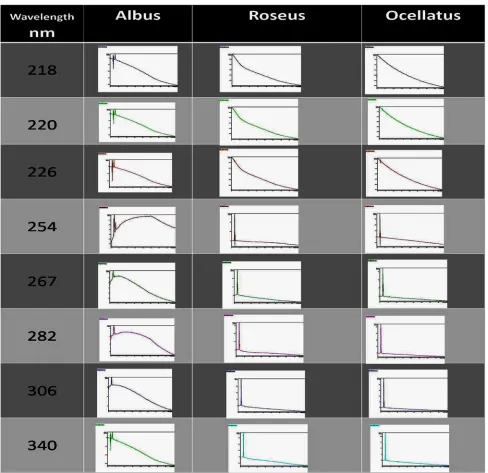
Figure 5. Representing components of the three cultivars under certain eight wavelengths (218,220,226,254,267,282,306 and 340
respectively):
From earlier represented data (tables 1-3, figures 4 and 5) it's very clear that Albus cultivar has more components
than Ocellatus and Roseus cultivars
Table 4. Summarizing a comparison between cultivars according to compounds intensity
Cultivar VLB VCR Vindoline Catharanthine Tryptophan
Albus 4240 26394 4423 39809 148756
Ocellatus 72591 17166 29176 25562 253144
39
From table (4) above, it's so clear that Ocellatus cultivar has more advantages in high content of compounds of
[image:7.612.127.487.129.341.2]interest than albus and roseus respectively.
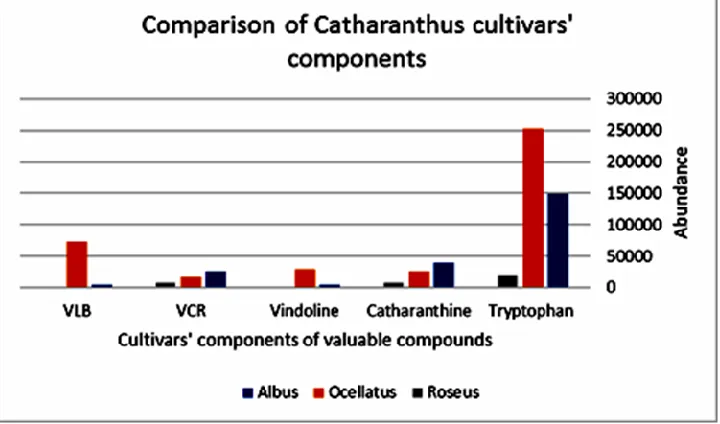
Figure 6. A chart representing a comparison Summary of components of Catharanthus roseus cultivars (Albus, Ocellatus and roseus) of
valuable compounds
Albus cultivar had the highest content of vincristine (1.5 fold) and catharanthine (1.6 fold); while Ocellatus cultivar
had the highest content of vinblastine (1.7 fold), vindoline (6.6 folds) and tryptophan (1.7 fold); Roseus cultivar had
the third grade on all levels. From that we can suggest Ocellatus cultivar then Albus cultivar for tissue culture work
as a starting material as they had the highest content (Figure 6).
CONCLUSION
From this study we can conclude that:
The albus cultivar is the richest in content then ocellatus and the poorest is roseus as total compounds identified in
albus cultivar 2962 compounds while in ocellatus cultivar 2866 compounds and in roseus cultivar 1582 compounds.
While on intensity level of valuable components ocellatus cultivar has more advantages than albus and roseus
respectively. These results are aligning with [13] findings.
REFERENCES
[1] M Sottomayor; M Lopez-Serrano; F DiCosmo; A Ros-Barcelo. FEBS Lett. 1998, 428, 299-230.
[2] R Van der Heijden; DJ Jabos; W Snoeijer; D Hallard; R Verpoorte. Curr Med Chem. 2004, 11, 1241-1253. [3] JH Renault; JM Nuzillard; G Le Croue´rour; M Ze`ches-Hanrot; L Le Men-Olivier. J Chromatogr A. 1999, 849, 431-421.
[4] A Cappiello; G Famiglini; F Mangani; P Palma. J Am Soc Mass Spectrom. 2002, 13, 265-273.
40
[6] F Ferreres; DM Pereira; P Valentao; JMA Oliveira; J Faria; L Gaspar; M Sottomayor; PB Andrade. J Pharm
Biomed Anal. 2010, 51, 65-69.
[7] AI Ibrahim; AAl Hemeida, AM Hussain; M Bekhit; AA Zweil. J Product Dev. 2013, 18(1), 77-84.
[8] E Ellis. Canadian J Botany. 1984, 62(12), 2912-2917
[9] RL Noble. Biochem Cell Biol. 1990, 68, 1344-1351.
[10] R Verpoorte; AB Svendsen. Chromatography of Alkaloids, 1964: Part 6: Gas-Liquid Chromatography and
High-Performance Liquid Chromatography, pp. 331. Elsevier Amsterdam.
[11] H Zhou; Y Tai; C Sun; Y Pan. Phytochem Anal. 2005, 16, 328-333.
[12] FM El-Domyati; AZ Abdel Azeiz; A Atef; A Elhalwagi; JSM Sabir; AM Ramadan; NO Gadalla; S Edris;
MN Baeshen; NH Hajrah; MA Al-Kordy; ASM Al-Hajar; CC Akoh; A Bahieldin. Life Sci. 2014, 11(10), 1213-1220.
[13] C Tikhomiroff; M Jolicoeur. J ChromatogrA. 2002, 955, 87-93. [14] J Murata; V De Luca. The Plant Journal. 2005, 44: 581-594.
[15] M Magnotta; J Murata; J Chen; V De Luca. Metabolic, Biochemical and Molecular Profiling of Catharanthus
roseus Flower Cultivars and Transformed Hairy Roots for Monoterpenoid Indole Alkaloid Accumulation .MSc.