
A COMPARATIVE STUDY OF USER
ACCEPTANCE TESTING BETWEEN MODIFIED
WATERFALL MODEL AND EXTREME
PROGRAMMING IN SMALL-SCALE PROJECT
IDA ARYANIE BAHRUDIN
UNIVERSITI TUN HUSSEIN ONN MALAYSIA
STATUS CONFIRMATION FOR MASTER’S DISSERTATION
A COMPARATIVE STUDY OF USER ACCEPTANCE TESTING BETWEEN MODIFIED WATERFALL MODEL AND EXTREME PROGRAMMING IN
SMALL-SCALE PROJECT
ACADEMIC SESSION: 2015/2016
I, IDA ARYANIE BINTI BAHRUDIN, agree to allow this Master’s Dissertation to be kept at the library under the following terms:
1. This Master’s Dissertation is the property of the Universiti Tun Hussein Onn Malaysia. 2. The library has the right to make copies for educational purposes only.
3. The library is allowed to make copies of this report for educational exchange between higher educational institutions.
4. ** Please Mark (√)
CONFIDENTIAL
RESTRICTED
FREE ACCESS
Approved by,
(WRITER’S SIGNATURE) (SUPERVISOR’S SIGNATURE)
Permanent Address:
NO 1C, JALAN LAMA, DR. NORAINI BINTI IBRAHIM 83700 YONG PENG, JOHOR
Date: ____________________ Date: ____________________
NOTE:
** If this Master’s Dissertation classified as CONFIDENTIAL or RESTRICTED, please attach the letter from the relevant authority/organization stating reasons and duration for such classifications.
(Contains information of high security or great importance to Malaysia STIPULATED under the OFFICIAL SECRET ACT 1972)
(Contains restricted information as determined by the Organization/institution where research was
This dissertation has been examined on date ... and is sufficient in fulfilling the scope and the quality for the purpose of awarding the Degree of Master of Computer Science (Software Engineering).
Chairperson:
PROF. DR. ISMAIL BIN ABDUL RAHMAN Faculty of Civil and Environmental Engineering DR. NOOR AZAH BINTI SAMSUDIN
Faculty of Computer Science and Information Technology Universiti Tun Hussein Onn Malaysia
Examiners:
DR. HJ. MOHD ZAINURI BIN SARINGAT
Faculty of Computer Science and Information Technology Universiti Tun Hussein Onn Malaysia
MDM. RUHAYA BINTI AB. AZIZ
Faculty of Computer Science and Information Technology Universiti Tun Hussein Onn Malaysia
A COMPARATIVE STUDY OF USER ACCEPTANCE TESTING BETWEEN MODIFIED WATERFALL MODEL AND EXTREME PROGRAMMING IN
SMALL-SCALE PROJECT
IDA ARYANIE BAHRUDIN
A dissertation submitted in partial
fulfillment of the requirement for the award of the Degree of Master of Computer Science (Software Engineering)
Faculty of Computer Science and Information Technology Universiti Tun Hussein Onn Malaysia
STUDENT DECLARATION
I hereby declare that the work in this dissertation is my own except for quotations and summaries which have been duly acknowledged
Student : ………
IDA ARYANIE BAHRUDIN
Date : ………
Supervisor : ………
ACKNOWLEDGEMENT
ABSTRACT
The successfulness of software development relies on many factors but the selection of software development methodology plays a crucial role in order to complete the project hence to get high quality software. Since the advent of traditional waterfall model, software development methodology is still evolving. There are two categories of software development methodologies that had been implemented recently considered as traditional and Agile methodology. At present, many researchers had conducted comparative studies on different agile software development methodologies. However, literature review had shown few studies investigating the comparison of software development methodologies especially in software testing between traditional methods and Agile modeling. Therefore, this research focused in details on the comparison of user acceptance testing (UAT) in Modified Waterfall model with eXtreme Programming (XP) methodology. The objectives of the research are to perform UAT to the system modules in two case studies, to identify project size and defects in two case studies and to carry out comparative analysis of the error discovery rate from UAT result of Modified Waterfall and XP for selected case studies. A Mann-Whitney U test was performed on XP and Modified Waterfall to compare the difference between error discovery rate means. The analysis shows that there is no significant difference of error discovery rate between both methodologies in the selected case studies. The main contribution of this work is to bring empirical evidence from real life cases that contribute understanding the adoption of both methodologies
ABSTRAK
Kejayaan pembangunan perisian bergantung kepada pelbagai faktor. Namun begitu, pemilihan metodologi pembangunan perisian memainkan peranan yang sangat penting untuk menyelesaikan projek seterusnya dapat menghasilkan perisian yang berkualiti. Semenjak kemunculan model tradisional Air Terjun, metodologi pembangunan perisian sentiasa berkembang. Terdapat dua kategori metodologi pembangunan perisian yang telah dilaksanakan hingga kini iaitu metodologi tradisional dan Agil.
CONTENTS
TITLE i
STUDENT DECLARATION iii
ACKNOWLEDGEMENTS v
ABSTRACT vi
ABSTRAK vii
CONTENTS viii
LIST OF TABLES xii
LIST OF FIGURES xiv
LIST OF SYMBOLS AND ABBREVIATIONS xvi
LIST OF APPENDICES xvii
LIST OF AWARDS AND PUBLICATIONS xviii
CHAPTER 1 INTRODUCTION 1
1.1 Research Background 1
1.2 Problem Statement 3
1.3 Research Objectives 4
1.4 Research Scope 4
1.5 Research Hypothesis 4
1.6 Significance of Research 5
1.7 Dissertation Outline 5
CHAPTER 2 LITERATURE REVIEW 7
2.1 Introduction 7
2.2 Software Development Methodology 8
2.2.1 Heavyweight Methodology 9
2.2.2 Lightweight Methodology 13
2.2.3 Comparison between Heavyweight and
Lightweight Methodology 18
2.3 Software Testing 20
2.3.1 Unit Testing 21
2.3.2 Integration Testing 22
2.3.3 System Testing 22
2.3.4 User Acceptance Testing (UAT) 22
2.4 Designing User Acceptance Testing 23
2.4.1 The Importance of UAT 24
2.4.2 Testing Team 26
2.4.3 Designing Test Plan 27
2.4.4 Test Cases Design 28
2.4.5 Test Execution 31
2.4.6 Software Defects 31
2.5 User Acceptance Testing in Modified Waterfall
and Agile 33
2.5.1 UAT in Agile 34
2.5.2 UAT in Modified Waterfall Model 39 2.6 Comparison of UAT in Modified Waterfall and
eXtreme Programming 42
2.7 Chapter Summary 45
CHAPTER 3 RESEARCH METHODOLOGY 46
3.2 Research Plan 47
3.2.1 Phase 1 49
3.2.2 Phase 2 51
3.2.3 Phase 3 53
3.2.4 Phase 4 55
3.2.5 Phase 5 56
3.3 Chapter Summary 57
CHAPTER 4 ANALYSIS AND DESIGN 58
4.1 Description of Modified Waterfall Model and
XP Project 58
4.2 Case Study 1 58
4.2.1 Analyzing Functional Requirements of eDoc (Modified Waterfall model) 60 4.2.2 Test Case Design for eDoc (Modified
Waterfall Model) 66
4.2.3 Analyzing User Stories of eDoc (XP
Methodology) 69
4.2.4 Test Case Design for eDoc (XP
Methodology) 76
4.3 Case Study 2 85
4.3.1 Functional Requirements of PiTOS
(Modified Waterfall Model) 87
4.3.2 Test Case Design for PiTOS (Modified
Waterfall Model) 93
4.3.3 User Stories for PiTOS (XP
Methodology) 98
4.3.4 Test Case Design for PiTOS
(XP Methodology) 104
CHAPTER 5 IMPLEMENTATION AND RESULT 112
5.1 Criteria for Case Selection 112
5.1.1 Project Size 112
5.1.2 Team Size 114
5.1.3 Duration 114
5.2 Test Case Execution for Modified Waterfall
Project 115
5.3 Analysis of Requirements and Defects in
Modified Waterfall Project 119
5.4 Test Case Execution for XP Project 121
5.5 Analysis of User Stories and Defects in XP Project 124 5.6 Comparison Between Modified Waterfall and XP
Projects 126
5.6.1 Rank Table 127
5.6.2 Test Statistic Table 127
5.7 Chapter Summary 129
CHAPTER 6 CONCLUSION AND RECOMMENDATIONS 130
6.1 Objectives Achievement 130
6.2 Conclusion 130
6.3 Future Works 132
6.4 Summary 132
REFERENCES 132
LIST OF TABLES
Table 2.1 Advantages and disadvantages of Modified Waterfall model 13
Table 2.2 Description of the Agile Methodology 15
Table 2.3 Advantages and disadvantages of XP 18
Table 2.4 Comparison of heavyweight and lightweight methodologies 19
Table 2.5 Summary of comparative study from different authors 20
Table 2.6 Traceability in user story 39
Table 2.7 Requirement traceability 42
Table 4.1 Functional requirements of eDoc 65
Table 4.2 Test case TCCS1MW100 description 66
Table 4.3 Test case TCCS1MW200 description 67
Table 4.4 Test case TCCS1MW300 description 68
Table 4.5 Test Case TCCS1MW400 description 68
Table 4.6 Test case TCCS1MW500 description 69
Table 4.7 User authentication user story and acceptance criteria 70
Table 4.8 Add new folder user story with acceptance criteria 70
Table 4.9 Insert file user story with acceptance criteria 71
Table 4.10 View report user story with acceptance criteria 72
Table 4.11 View file user story with acceptance criteria 73
Table 4.12 Create folder or subfolder user story with acceptance criteria 75
Table 4.13 User story of additional requirement for user authentication 75
Table 4.14 Test case for user authentication 77
Table 4.15 Test case for add new folder 78
Table 4.16 Test case for insert file 79
Table 4.17 Test case for view report 80
Table 4.18 Test case for view files 81
Table 4.19 Test case for Iteration 1 83
Table 4.21 Summary of functional requirements of PiTOS 92
Table 4.22 Test case TCCS2MW100 description 93
Table 4.23 Test case TCCS2MW200 description 94
Table 4.24 Test case TCCS2MW300 description 96
Table 4.25 Test case TCCS2MW400 description 96
Table 4.26 Test case TCCS2MW500 description 97
Table 4.27 Test case TCCS2MW600 description 97
Table 4.28 User authentication user story 98
Table 4.29 User story for create industrial trainee profile 99
Table 4.30 View all results user story 100
Table 4.31 Modify personal information user story 100
Table 4.32 View result user story 101
Table 4.33 User story of submit evaluation feature 102
Table 4.34 User story and acceptance criteria for Iteration 1 103
Table 4.35 User story and acceptance criteria for Iteration 1 103
Table 4.36 Test case for user authentication 105
Table 4.37 Test case for creating industrial trainee profile 106
Table 4.38 Test case for view all results 107
Table 4.39 Test case for modify personal information 108
Table 4.40 Test case for view result 108
Table 4.41 Test case for submit evaluation 109
Table 4.42 Test case for Iteration 1 110
Table 4.43 Test case for Iteration 2 110
Table 5.1 Project size 114
Table 5.2 Result summary of Test case TCCS1MW100-TCCS1MW500 115
Table 5.3 Result summary of Test case TCCS2MW100-TCCS2MW600 117
Table 5.4 Result summary for test case TCCS1XP000 to TCCS1XP200 121
Table 5.5 Result summary for test case TCCS2XP000 to TCCS2XP200 122
Table 5.6 Project size and defects number for both Modified Waterfall and XP 126
Table 5.7 Error discovery rate for each project 127
Table 5.8 Rank table 127
LIST OF FIGURES
Figure 2.1 Linear Sequential Model 10
Figure 2.2 Waterfall model 11
Figure 2.3 Modified Waterfall model 12
Figure 2.4 XP flow chart 16
Figure 2.5 Iterative project with possible documentation artifacts in Agile 17
Figure 2.6 Software testing strategy 21
Figure 2.7 UAT steps 24
Figure 2.8 Test case sample Error! Bookmark not defined. Figure 2.9 Software defects categories 32
Figure 2.10 Types of error and defect 33
Figure 2.11 AgileUAT framework 35
Figure 2.12 Sample of user story 36
Figure 2.13 Important consideration of writing user stories 37
Figure 2.14 Sample of user story with acceptance criteria 38
Figure 2.15 Requirement gathering techniques 40
Figure 2.16 SRS content 41
Figure 2.17 Comparison of Modified Waterfall and XP methodologies 44
Figure 3.1 Research activities 48
Figure 3.2 Use case for eDoc 50
Figure 3.3 Use case diagram of PiTOS 52
Figure 3.4 Index card 54
Figure 4.1 eDoc Framework 59
Figure 4.2 Process of using eDoc 60
Figure 4.3 User authentication use case 61
Figure 4.4 Use case for add new folder 62
Figure 4.6 View report use case 64
Figure 4.7 View file use case 65
Figure 4.8 PiTOS Workflow 86
Figure 4.9 PiTOS architecture 86
Figure 4.10 Login page use case 87
Figure 4.11 Create industrial trainee profile list use case 88
Figure 4.12 View all results use case 90
Figure 4.13 Modify personal information use case 90
Figure 4.14 View result use case 91
Figure 4.15 Submit evaluation use case 91
Figure 5.1 Size of selected project using Modified Waterfall model 113
Figure 5.2 Size of selected project using XP methodology 113
Figure 5.3 Project duration of selected Case Study 115
Figure 5.4 Proportions of functional requirement defects in eDoc 119
Figure 5.5 Proportions of functional requirement defects in PiTOS 120
Figure 5.6 Proportions of functional requirement defects in eDoc and PiTOS 120
Figure 5.7 Proportions of functional requirement defects for each iteration in eDoc 124
Figure 5.8 Proportions of functional requirement defects for each iteration in PiTOS 125
Figure 5.9 Proportion of defects and user stories for eDoc and PiTOS 125
LIST OF SYMBOLS AND ABBREVIATIONS
XP - eXtreme Programming
UAT - User Acceptance Testing
ID - Identification
CeDS - Centre for Diploma Studies
eDoc - Electronic Document Management System PiTOS - CeDS Industrial Online System
SDLC - Software Development Life Cycle
IS - Information system
SDM - Software development methodology
α - Constant
p - Probability Value
LIST OF APPENDICES
APPENDIX TITLE PAGE
A Computer Software Configuration Item (CSCI) 142 Capability Requirement for Electronic Document
Online System (eDoc)
B Computer Software Configuration Item (CSCI) 151 Capability Requirement for Centre for Diploma Studies
Industrial Training Online System (PiTOS)
C Test Cases Result Details for Modified Waterfall 161 Case Study
LIST OF AWARDS AND PUBLICATIONS
Awards
1. 1st Prize of Technical Category for the product Electronic Document Management System (e-Doc) at Innovative & Creative Circle Project Presentation, UTHM 2014.
2. Silver Award Category for the product Electronic Document Management System (e-Doc) at 10th Innovative & Creative Circle Convention, Universiti Malaysia Sarawak, 2014.
3.
Copyright for Electronic Document Management System (e-Doc).4. Silver Medal Awarded at Research and Innovation Festival for the product Centre for Diploma Studies Industrial Training Online System (PiTOS) organized by Pusat Penyelidikan dan Inovasi, Universiti Tun Hussein Onn Malaysia, 19-20 Disember 2013.
Journal Papers
1. Rafizah Mohd Hanifa, Shamsul Mohamad, Ida Aryanie Bahrudin and Muhammad Firdaus Kamarudin “Development of Pusat Pengajian Diploma Industrial Training Online System (PiTOS): A Step Forward” Applied
Mechanics and Materials Vols. 321- 324 (2013) pp 2528-2531 (Scopus index)
2. Ida Aryanie Bahrudin, Rafizah Mohd Hanifa, Mohd Ezree Abdullah,
Muhammad Firdaus Kamarudin, “Adapting eXtreme Programming Approach in Developing Electronic Document Online System (eDoc),”
Applied Mechanics and Materials Vols. 321-324 (2013) pp 2938-2941©
(2013) Trans Tech Publications, Switzerland
CHAPTER 1
INTRODUCTION
The aim of this chapter is to emphasize the key components of this dissertation. It provides a clear statement of the research topic which includes the research background, problem statement, research objectives, scope, hypothesis and also the significance of this research.
1.1 Research Background
The emergence of information system (IS) development history began in the year 1940. It was a shift from scientific or mathematical application to business application where the viewpoint of software was more on general view [1]. IS development was based on information technology (IT) pioneers’ individual knowledge up to the 1960s thus the period is referred as pioneer era or heroic age [2]. A systematic software development approach makes the first appearance when the software crisis occurred. It was known earlier as approach to problem solving in other disciplines which was applied to systems development at the moment. In 1970s, the structured approach based on waterfall cycle was introduced [3]. Waterfall model is a method which the software can be developed in a systematic manner by improving the probability of completing the software project within the deadline while maintaining the quality of the software product to conform certain standard [4].
modeling [5]. Heavyweight methodologies are basically based on a sequential series of steps like requirements definition, solution building, testing and deployment [6]. It is also requires defining and documenting a stable set of requirements at the beginning of a project. The examples of software development approach that fall in heavyweight category are waterfall model, prototyping and spiral model while the lightweight methodologies consist of eXtreme Programming (XP) and Scrum [5]. Agile modeling are stressed on two concepts which are the intolerant honesty of working code and the effectiveness of people working together with goodwill [7]. Agile methodologies are also focusing on the ability to embrace changes which are very likely to happen in environments that lack predictability.
Software development methodologies are considered as key tools for all software developers and also project manager in order to facilitate them in delivering projects on time, within budget constraints while at the same time accomplish customer’s requirements. The emergence of various methodologies provides the developer the numerous choices to develop software that is able to produce satisfactory results. A successful software development depends sturdily on the delivery of high quality software attributes such as customer satisfaction [8]. Accordingly, one of the first decisions that faced by the software developers for each of their project implementations is which development methodology should they use because every type of methodologies has their own uniqueness. This is a topic that gets a lot of discussion yet open into ongoing debate regarding what methodologies suit to what types of software development [9]. Both traditional and agile methodologies are usable and established methodologies that have been involved in software development projects for many years ago. Therefore, the decision of which methodology to be utilized can refine the overall process that best suit to the project goals. Eventually, although there are slight distinction between both methodologies in terms of the software developing process, delivering software that satisfies customer needs is what really takes into account.
many types of software testing such as unit testing, functional testing, system testing, integration testing, regression testing, usability testing and also user acceptance testing (UAT) [13].
Among all the types of software testing, researchers [14, 15] found that the UAT is a kind of software testing that can identify the successfulness of the developed software because the risk of software failure will increase without UAT. It can be said that UAT need to be conducted in order to test whether the developed software had met the user requirement [16]. However, the UAT in waterfall model is slightly different as compared to the agile method in terms of the way to perform the testing. The discovery on the result of UAT in selected both traditional and agile can contribute to a better consideration factors of choosing the software methodology to employ. Therefore, explorations in detail on UAT in both methodologies can improve better understanding and guarantee something beneficial findings in the future.
1.2 Problem Statement
1.3 Research Objectives
The aim of this study is to conduct the comparative analysis of UAT between Modified Waterfall model and XP in small-scale project. In order to achieve this aim, the objectives of the research are to:
(i) perform user acceptance testing to the system modules in selected case studies; (ii) identify project size and defects in selected case studies;
(iii) carry out comparative analysis of the error discovery rate from UAT result of Modified Waterfall and XP for selected case studies.
1.4 Research Scope
This research aims to analyze the output of UAT for the software developed using XP as compared to the software developed using Modified Waterfall model. This study involved two software that developed using Modified Waterfall which later redeveloped using XP. The UAT result of each case study had been analyzed in order to calculate its error discovery rate. This study focused on the XP practices mainly in pair programming and on-site customer involvement for developing the software.
1.5 Research Hypothesis
The followings are the hypothesis of this research:
(i) H1: Error discovery rate in Modified Waterfall project is higher than the XP. H1: μModifiedWaterfall Error Discovery Rate > μXP Error Discovery Rate (ii) H0: Error Discovery Rate in Modified Waterfall projects is the same or lower
than the XP.
H0: μModifiedWaterfall Error Discovery Rate ≤ μXP Error Discovery Rate
1.6 Significance of Research
XP has recently become one of the major interests among researchers, software developer and programmers in terms of new software development approach. Many studies have been conducted on XP and most studies suggested XP as one of the best agile methods that focusing on customer requirement [22] by bringing customer into the development process. Studied by Woit [23] shown that XP project is built for the customers, in accordance with their needs that stated during requirement gathering process. Despite the importance of the on-site customer requirement, few XP researches stated that XP's most problematic feature is the amount of on-site customer involvement it requires [24]. There were also many studies regarding the advantages of traditional method as compared to agile. According to Balaji [25], requirement definition is clearly stated before development starts and each phases is properly documented in waterfall model.
In order to measure how compliant the software with the business requirements, UAT were performed. Since the issues regarding the factor of selecting the suitable software development methodology that will increase the probability of achieving software that conform the requirement has long been debated and is still being discussed, more research in this area is required. Therefore, comparative study between traditional methodology and agile methodology is required because challenges in software development are somewhat different from other organizations due to the cost, duration and also the involvement of stakeholder. Moreover, this study provides the comparison of UAT between Modified Waterfall model and XP especially in small-scale project in terms of its error discovery rate.
1.7 Dissertation Outline
researchers and software developer while implementing both traditional and agile software development methodology. Inside this chapter, the advantages and disadvantages of traditional methodology especially in Modified Waterfall model and agile modelling that mainly focus in XP were identified clearly. In addition, the exploration regarding UAT in both methodologies were explained in detail including the similarities, distinction and also the way of performing the test. In Chapter 3, there were two case studies involved where UAT were performed to both case studies in order to accomplish the objectives throughout the research. This chapter explains the activities of each phases of research work plan including materials, supporting tools, standards, and the software testing procedures applied in this research. Chapter 4 consists the analysis and design of all the test cases in the case studies. The implementation and results of the UAT were described in Chapter 5 while the last chapter concludes the research work along with the future recommendation for this study.
1.8 Chapter Summary
7
CHAPTER 2
LITERATURE REVIEW
The overall goals of this chapter were to elaborate a comprehensive summary of the research particularly on UAT in both Modified Waterfall model and XP methodology. This chapter described the comparative study of software development approach between Agile and traditional methodology that performed by prior researchers. This chapter was also highlighted the framework that used by Modified Waterfall Model and XP in performing the UAT.
2.1 Introduction
Nowadays software has been an important part of the modern society. Since the computer technology is rapidly increased, a great attention has been given to ensure that the software program will perform as best as the computer hardware that it runs on. Software has gone through the continuous redesign and also upgrading process to adapt with the technology and also specification changes. Over the years, software expertise or even software developer had introduced the numbers of rules, best practices and also guidelines for developing the software. Research had shown that software development can be considered as a complicated task [26-29]. According to Yu [6], selecting software development methodology (SDM) is the most important element in software development as it portrays the necessary phases in software development. It can be said that the selection of software development methodology is very important in order to deliver the required quality for business success.
activities. Among all the phases involved in SDM, software testing is the most crucial part. Basically, it is more than a half of the whole development process time is spent on testing [10, 11]. There is a bit different way of performing software testing in different type of SDM. This chapter provided a detailed explanation of software testing particularly in UAT for Modified Waterfall model and XP.
2.2 Software Development Methodology
Basically, SDM is a process of developing or maintaining the software. It is also considered as creation of a program by generating code along with various tools. It is a challenge process when choosing the suitable SDM that really suits with the software development situation because we have to ensure that the development is completed on time and within reasonable budget. It is really important to select the methodology wisely so that it is sufficient to deliver the quality required for business success while avoiding the steps that can waste time. Every step taken along the software development has its own risk and variety of available techniques for improving development process and increase the quality of result.
The term SDM can be considered as a framework or as an approach in developing software. A SDM is a framework purposely for structuring, planning and controlling the software development process. Usually SDM includes the pre-definition of specific deliverables that are created and completed by a project team to develop or maintain an application [1]. In addition, the term SDM refers to an approach used to apply the software development methodology framework. Every SDM approach performs as a foundation for applying specific frameworks to develop and maintain software. There are several software development approaches that have been used since the origin of information technology. Broadly these are several established SDM approaches [30]:
(i) Waterfall: a linear framework
(ii) Spiral: a combined linear-iterative framework
(iii) Incremental: a combined linear-iterative framework or V Model (iv) Prototyping: an iterative framework
(vii) eXtreme programming: is a pragmatic approach to program development (viii) Adaptive software development (ASD): is a principle for creating software
that focuses on quickly making programs
(ix) Dynamic system development method (DSDM): is a robust Agile project management and delivery framework
Basically all the SDM are categorized into two categories that known as heavyweight methodology that is also known as traditional methodology and lightweight methodology or called agile methodology [31].
2.2.1 Heavyweight Methodology
Software methodologies like Waterfall model, V-Model and Rational Unified Process (RUP) are called traditional SDM and these are classified into the heavyweight methodologies [32]. These methodologies are based on a sequential series of steps like requirements definition, solution building, testing and deployment. Heavyweight methodologies require defining and documenting a stable set of requirements at the beginning of a project [6]. There are four main phases involved in heavyweight methodology which consist of project requirements set up and determine the time duration that will take to implement the various phases of development while at the same time trying to forecast any troubles that may occur in the project.
After gathering the requirements, the next step is to design the architectural planning phase in the form of diagrams or models. The next step is the development phase where code is produced until the specific goals are reached. Development is often broken down into smaller tasks that are distributed among various teams based on skill. Usually the testing phase often overlaps with the development phase to ensure issues are addressed early on. Once the project is nearly complete, the customer will become part of the testing process and the project will be delivered after the customer satisfies with it [6].
of the project set a schedule and allocate resources. The followings are the characteristics of heavyweight SDM [20]:
(i) Heavyweight SDM is usually used to develop the traditional projects that use procedural programming.
(ii) It also uses common processes likes: analysis, design, implementation, and testing.
(iii) The implementation of heavyweight SDM depends on the size of projects and type of projects
(iv) It sometimes needs the longer duration to develop the large projects.
Heavyweight SDM is considered as the linear sequential model. The linear sequential model suggests a sequential approach to software development that starts at the system level and progresses through analysis, design, coding, testing, and support [33]. Figure 2.1 illustrates the linear sequential model for software engineering.
[image:30.595.112.541.368.515.2]
Figure 2.1: Linear Sequential Model [33]
As mentioned before, there are various SDM that fall into this category but this research only focused on Modified Waterfall model.
2.2.1.1Modified Waterfall Model
Historically, the waterfall model is the classical model of software engineering which is widely used by the software developer. This model emphasizes proper planning at the beginning of the stages and ensures there is no design fault before the developing process [34]. Furthermore waterfall model does not permit any changes of requirement in between the phases of development. The phases in waterfall model consist of six
Analysis Design Code Test
phases which are analysis, design, development, testing, implementation and maintenance as shown in Figure 2.2.
Figure 2.2: Waterfall model [25]
Nowadays, the dynamic business environment makes organizations to constantly change their software requirements in order to adjust with new environment. The demand for fast delivery of software products is rapidly increase as well as accepting changing requirements [18]. This aspect contributes to the failure of meet up user requirement in this plan-driven development. Therefore, Modified Waterfall model was introduced by Winston W. Royce which improvised the sequential model or waterfall model that he developed before [2]. The Modified Waterfall uses the same phases as the pure waterfall, but is not based on a discontinuous basis. This enables the phases to overlap when needed which is unacceptable in pure waterfall model [34].
In the Modified Waterfall model, each phase influences and depends on the next and the previous phase respectively as shown in Figure 2.3. Verification and validation process have been added to each of the phases making it is more flexible. As a result, the defects and faults in software are removed in the development stage which will reduce the overhead cost of making changes to a software project before implementation stage [35].
Analysis
Design
Development
Testing
Implementation
Figure 2.3: Modified Waterfall model [2]
The overlap process contributes to give a lot of flexibility to this methodology because at the same time a number of tasks can function concurrently. The other advantage of this methodology is a more relaxed approach if compared to the traditional waterfall model. There is also drawback found while implementing Modified Waterfall model such as the flexibility of turning back to previous phase will expand the allocation time of software development process. The development team may be bored to always moving back and forth between the phases to ensure the software error will be fixed early. Table 2.1 shows the advantages and disadvantages of Modified Waterfall model.
System Requirements
Software Requirements
Analysis
Program Design
Coding
Testing
Operations
Table 2.1: Advantages and disadvantages of Modified Waterfall model [34]
Advantages Disadvantages
More flexible than the pure waterfall model. Milestones are more ambiguous than the pure waterfall.
If there is personnel continuity between the phases, documentation can be substantially reduced.
Activities performed in parallel are subject to miscommunication and mistaken assumptions.
Implementation of easy areas does not need to wait for the hard ones.
Unforeseen interdependencies can create problems.
Although heavyweight methodologies, such as Modified Waterfall model continue to dominate the software development almost few decades and much research has done in traditional methodologies, lightweight methodology brings its own uniqueness in order to satisfy the customer through early and continuous delivery of the valuable software [18].
2.2.2 Lightweight Methodology
Many years ago, when the software development is at the early stage, most of the user’s requirements were quite stable where the software development mostly followed the plans without major changes. However, as the technology growth, software development involved more critical and dynamic industrial projects that make new difficulties emerged accordingly [3]. The followings are the difficulties emerged while using the previous heavyweight methodology:
(i) Frequently changing requirements: customer requirements are always changing due to evolving business needs. Most of the customers do not have a clear vision about the specifications of their requirements at the early stages because they sometimes realize what their true requirements are only when they use an application that does not really meet their needs. This usually led to cause the major software failure which is incorrect assumptions with regard to software requirements or it can be said as faulty user expectation [36, 37]. (ii) Customer involvement: lack of customer involvement will usually leads to
higher chances of project failure [38] because in heavyweight SDM customer will only involve at the requirement phase .
tight deadlines, while at the same time, requiring high demands because of competition in the markets [39].
(iv) Miscommunications: one cause of the misunderstanding of requirements is the miscommunication between developers and customers. It is hard to gather requirements from customer as they were some barriers exist between the developer and the customer as customer came from various background. Therefore, the software practitioners are looking forward for a new SDM to face the changes. Lightweight methodologies hold practices that enable programmers to build solutions more quickly and efficiently, with better responsiveness to changes in business requirements. Basically, it is mainly focused on development based on short life cycles, involves the customer throughout the software development and also strive for simplicity along with value the people [5]. Lightweight methodologies are inherently flexible enough to be tailored to each project depending upon the characteristics of each [40]. Lightweight methodology also known as Agile methodology.
There have been several studies and ideas on improving and enhancing the overall traditional software development process such as to defeat the rapid change in organization and business need [41]. Basically, Agile methodology focuses on people, customer’s satisfaction and rapid response to change [31, 42]. According to Agile Manifesto [39], the followings are the major factors of Agile:
(i) Early customer involvement; (ii) Iterative development; (iii) Self-organizing teams; and (iv) Adaptation to change.
Table 2.2: Description of the Agile Methodology [42]
Agile Methodologies Description
Crystal methodologies The most agile method, Crystal Clear, focuses on communication in small teams developing software that is not life-critical.
Dynamic Software Development Method
It divides projects into three phases: pre-project, project life-cycle, and post project
Lean Software Development
It consists of seven principles: eliminate waste, amplify learning, and decide as late as possible, deliver as fast as possible, empower the team, build integrity, and see the whole.
Scrum Focuses on project management in situations where is difficult to plan ahead, with an importance on feedback mechanisms.
eXtreme Programming (XP)
Focuses on best practice for development which consists of twelve practices.
All the listed methodologies have their own uniqueness that will suit on different software development situation. This research focused in details on XP as one of the latest lightweight SDM.
2.2.2.1eXtreme Programming (XP)
XP is actually a deliberate and disciplined approach to Agile software development which was found to be most successful at smaller companies. The successful of XP especially at smaller companies basically it is focused on customer satisfaction [27]. XP allows developers to confidently respond to changing customer requirements in any software development phase [43]. The aim of this methodology is to deliver the software to the customer needs on time. The key element of XP is teamwork where managers, customers and developers collaborate in a team. There are five ways that improve a software project in XP which are communication, simplicity, feedback, respect, and courage.
planning, and all iterations consist of four basic phases in its life cycle: designing, coding, testing, and listening.
[image:36.595.107.515.482.658.2]XP uses an iterative and incremental software process that carried out in relatively short cycles. The life cycle of XP includes planning and also four basic iterative development phases which are designing, coding, testing, and listening. In the planning phase user stories are written, iterative implementation planning is performed, efforts are estimated, and priorities of the features are decided [45]. Although simplicity is one of the XP’s principles, it doesn’t mean that it can exclude designing process. Improper will lead to the complexity of certain project. Therefore it is then important to create a design structure that organizes the logic in the system to avoid too many dependencies in the system [46]. The other process in XP is coding which is the most important phase where programmers begin to write the code at the very beginning. Traditionally, testing is a phase of development that is carried out after the main coding effort. In contrast, XP makes the programmers to write the tests before the code. Every time new code is written on the XP project, a corresponding test case must be written and implemented first. Listening is another important process in XP lifecycle where good listening skill of the developer will enable them to understand clearly what customer want thus will develop solutions based on customers’ need as close as possible [43]. Figure 2.4 shows the flow chart of XP.
Figure 2.4: XP flow chart [43]
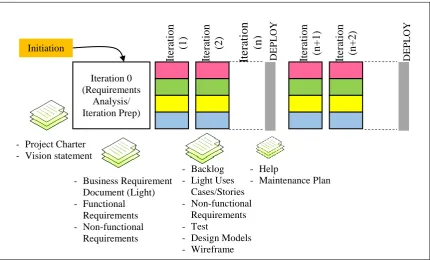
through successive improvement. Figure 2.5 shows how the iteration occur in Agile along with possible documentation artifacts [47].
Figure 2.5: Iterative project with possible documentation artifacts in Agile The stage after initiation refer as Iteration 0. In this phase initial scoping and requirements takes place. Preparation activities also occur such as assembling the technical infrastructure, setting up test harness for test driven development and assembling the team. After Iteration 0 comes a collection of iterations where each iteration delivering a part of working functionality. Iterations are bound with time allocations which tend to be between one to six weeks. The common concept in agile methods is the concept that a deployment should be occurred as conclusion of each iteration.
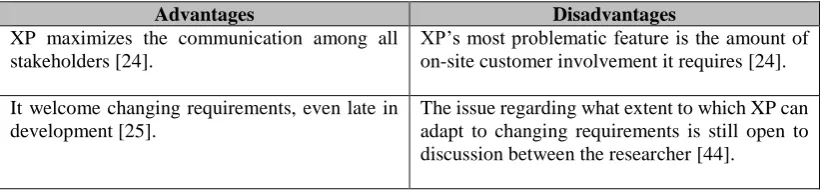
Although the advantages of XP had been proven but there are still some disadvantages of XP. Table 2.3 shows the advantages and disadvantages of XP in software development project.
Initiation Iteration 0 (Requirements Analysis/ Iteration Prep) It er at ion (1) It er at ion (2) Ite ra ti on (n) DE P L OY It er at ion (n+1 ) It er at ion (n+2 ) DE P L OY
- Project Charter - Vision statement
- Business Requirement Document (Light) - Functional Requirements - Non-functional Requirements - Backlog - Light Uses
Cases/Stories - Non-functional
Requirements - Test
- Design Models - Wireframe
- Help
Table 2.3: Advantages and disadvantages of XP
Advantages Disadvantages
XP maximizes the communication among all stakeholders [24].
XP’s most problematic feature is the amount of on-site customer involvement it requires [24].
It welcome changing requirements, even late in development [25].
The issue regarding what extent to which XP can adapt to changing requirements is still open to discussion between the researcher [44].
2.2.3 Comparison between Heavyweight and Lightweight Methodology
Many years ago, software development methodologies were basically limited to the process of coding and fixing the error found in the coding. At that moment, these heavyweight methodologies continue to dominate the systems development [18]. Despite the success it has a lot of drawbacks, like linearity, inflexibility in changing requirements, and high formal processes irrespective of the size of the project [31]. As the system grew, they became prone to bugs and also unable to run efficiently. Therefore, the newer methodologies arise with the aim of improving the software development flexibility and efficiency. As there are various models of software development life cycle, each has its own advantages and disadvantages depending upon which have to be decided and which model should be selected [4].
There are many different characteristics between the heavyweight and lightweight methodologies. According to Dyba & Dingsoyr [48], the differences between heavyweight and lightweight development basis on the an unpredictable world, as well as emphasizing the value competent people and their relationships bring to software development. Research by Moniruzzaman & Akhter [18] shown the reason of lightweight methodology adoption is mainly because of the acceleration time to market the product. Table 2.4 shows the comparison of heavyweight and lightweight methodologies [49].
Table 2.4: Comparison of heavyweight and lightweight methodologies [49]
Issues Heavyweight Lightweight
Customers Committed, knowledgeable, collocated, collaborative, representative, empowered
Access to knowledgeable, collaborative, representative, empowered customers
Requirements Mainly emergent, rapid change. Knowable early, largely stable.
Architecture Designed for current requirements Designed for current and foreseeable requirements
Size Smaller Team and Products Larger Team and Products
Primary objective Rapid value High assurance
Developers Knowledgeable, collocated, collaborative
Plan-driven, adequate skills, access to external knowledge.
Release cycle In phases (multiple cycles) Big bang (all functionality at once)
Development life cycle Linear or incremental Incremental
Style of development Adaptive Anticipatory
Documentation Light (replaced by face to face communication)
Heavy / detailed Explicit knowledge
Team members Co-location of generalist senior technical staff
Distributed teams of specialists
Client Involvement onsite and considered as a team member Active/proactive
Low involvement
Measure of success Business value delivered Conformance to plan
Table 2.5: Summary of comparative study from different authors
Author Comparative Study Result
Liu & Umphress, 2008 [50]
IEEE 1047 and XP XP is more suitable for developing grid software.
Abrahamsson et al., 2010 [17]
Among difference Agile modeling`
The better approach depends on different situation of system development.
Balaji & Murugayan, 2012 [25]
Waterfall, V-Model and Agile Modeling
The better approach is depends on how frequent the user requirement change.
Moniruzzaman & Hossain, 2013 [18]
Waterfall, Agile Modeling
Agile modeling significantly improves software development process in many ways.
Apoorva & Deepty, 2013 [4]
Waterfall, V-shaped, Rapid Application Development (RAD), Incremental, Spiral
The hybrid of all these methodologies is used with some modification will help to improve the quality of developed software.
2.3 Software Testing
Software testing is an integral part of the software development process. All the activities involved in developing software need to be carefully coordinated in order to meet the requirements. According to Mustafa & Khan [16], it is not unusual for developers to spend 40 percent of the total project time to perform software testing. Testing can be considered as a process of planning, preparing, executing and analyzing the difference between the actual and the required status [16]. According to Singh [51], testing is the process of executing a program with the intent of finding faults. In other words, software testing is a process which is used to measure the quality of software developed. Any software which is produced without any testing can be dangerous to the users. Therefore the importance of software testing in software development are as follows [52, 53]:
(i) To improve software quality; (ii) For reliability estimation;
(iii) To measure usefulness of software; and (iv) For verification and validation.
some of which is crafted method rather than good engineering methods [55]. In order to perform software testing, there are few software testing strategies that can be followed such as unit testing, integration testing, system testing and user acceptance testing. Figure 2.6 shows the relationship between all the software testing strategies while performing testing activities [51]. However, this research focused on user acceptance testing only where testing is done by the customer.
Figure 2.6: Software testing strategy [51]
2.3.1 Unit Testing
Unit testing can be considered as the basic level of software testing where it focuses on smaller blocks of a program or system [56]. This process will give developer the ability to verify whether the system unit functions as expected. Therefore, for any function with a set of inputs, we can determine if the function is returning the proper values. Although performing unit testing is to ensure that the unit implemented structure matches the intended design structure but there are also problems with unit testing [51]. The problem that usually occurred is how to run each unit independently when there is a unit that may not be completely independent.
Unit testing is generally seen as a white box test class which purposely looking and evaluating the code as implemented rather than conformance user requirements. The followings are unit testing benefits according to Abhijit et al. [55]:
(i) Unit level testing is very cost effective.
(ii) It provides a much greater reliability improvement for resources expanded than system level testing.
Unit Testing Integration
Testing System Testing
Acceptance Testing
Any testing technique (verification plus validation) is applicable. Testing
is done by testers only.
Testing is done by
the customer
Software is ready for the
(iii) Be able to test parts of a project without waiting for the other parts to be available.
(iv) Achieve parallelism in testing by being able to test and fix problems simultaneously by many engineers.
(v) Be able to detect and remove defects at a much less cost compared to other later stages of testing.
2.3.2 Integration Testing
Integration testing is a systematic technique for constructing the program structure while at the same time conducting tests to uncover errors associated with interfacing. The objective is to take unit tested components and build a program structure that has been dictated by design [55]. Integration testing can be divided into two categories which are top down integration testing and also bottom up integration testing.
2.3.3 System Testing
System testing is performed once the unit testing and integration testing had been done. In this testing all the developed software is test along with the expected environment including hardware and other associated parts [51]. System testing is conducted on the entire system in Software Requirement Specification (SRS). It tests the behaviour and even the believed expectations of the customer. It is also intended to test up to and beyond the bounds defined in the software/hardware requirements specification.
2.3.4 User Acceptance Testing (UAT)
to be one of the most important testing by user before the system is finally delivered or handed over to the end user.
Testing accomplishes a variety of things especially the quality of the application. UATdoes three things for a software development project [58]:
(i) They measure how compliant the system is with the business requirements. (ii) They expose functionality/business logic problems that unit testing and system
testing have missed out since unit testing and system testing do not focus much on functionality/business logic testing.
(iii) They provide a means of determining how done the system is.
According to Bordo [59] and Lewis [56], UAT process can be divided into six activities such as analyzing business requirement, identify UAT scenarios, define the test plan, create test case, run the tests and record the results.
2.4 Designing User Acceptance Testing
Figure 2.7: UAT steps
One of the important questions in planning to perform UAT is what need to be tested. This question is crucial as it will identify the objects that are needed for planning the UAT. During planning the UAT, elements need to be considered are documentation, business requirements, functional requirements, business processes, workflows, transactions and the software [61]. It is impossible to test every possible issue in each business system. Therefore, the most significant functionalities to be tested are business functions. Business users should have the knowledge and understanding of their business processes [62]. Even though choosing what to test is so hard, but under certain circumstances a test stakeholder as well as the test team have to consider the item to be tested [63].
2.4.1 The Importance of UAT
![Figure 2.1: Linear Sequential Model [33]](https://thumb-us.123doks.com/thumbv2/123dok_us/8759488.893642/30.595.112.541.368.515/figure-linear-sequential-model.webp)
![Figure 2.2: Waterfall model [25]](https://thumb-us.123doks.com/thumbv2/123dok_us/8759488.893642/31.595.115.549.125.331/figure-waterfall-model.webp)
![Figure 2.3: Modified Waterfall model [2]](https://thumb-us.123doks.com/thumbv2/123dok_us/8759488.893642/32.595.119.543.70.421/figure-modified-waterfall-model.webp)
![Table 2.1: Advantages and disadvantages of Modified Waterfall model [34]](https://thumb-us.123doks.com/thumbv2/123dok_us/8759488.893642/33.595.114.524.101.207/table-advantages-disadvantages-modified-waterfall-model.webp)
![Table 2.2: Description of the Agile Methodology [42]](https://thumb-us.123doks.com/thumbv2/123dok_us/8759488.893642/35.595.112.532.100.246/table-description-agile-methodology.webp)
![Figure 2.4: XP flow chart [43]](https://thumb-us.123doks.com/thumbv2/123dok_us/8759488.893642/36.595.107.515.482.658/figure-xp-flow-chart.webp)
![Table 2.4: Comparison of heavyweight and lightweight methodologies [49]](https://thumb-us.123doks.com/thumbv2/123dok_us/8759488.893642/39.595.112.542.100.490/table-comparison-heavyweight-lightweight-methodologies.webp)

