A methachromatic-based experimental model for
identification of bowel as the focus of an acute
inflammation
*
Sravya Sowdamini Nakka1, Jessica Johansson2, Faisal Shahzad1, Anders Hanning3, Fariba Nayeri1,4#
1
R & D Department, Institution for Protein Environmental Affinity Surveys, PEAS Institut, Linköping, Sweden
2
Department of Clinical Medicine, School of Health and Medical Sciences, Örebro University, Örebro, Sweden
3
Episentec AB, Fjällvägen 6B, Sollentuna, Sweden
4
Division of Infectious Diseases, Department of Clinical and Experimental Medicine, Linköping University Hospital, Linköping, Sweden Email: #[email protected]
Received 27 December 2012; revised 25 January 2013; accepted 2 February 2013
ABSTRACT
Diarrhea is the most common symptom of acute in- flammation in gastrointestinal tract and the patients are isolated in order to inhibit transmission and to conduct investigations. Yet there is no standard test to distinguish gastrointestinal infection from more gen- eralized diseases at admittance which might cause delay in therapy. Hepatocyte growth factor (HGF) is produced upon injury by mesenchymal cells. On the contrary to chronic inflammation, HGF produced in the course of acute inflammation is biologically active and shows binding affinity to heparan sulphate pro- teoglycan (HSPG) and dextran sulphate (DS). Based on this phenomenon, an agarose gel containing DS was prepared and immobilized on loops to investigate the feces samples for the presence or absence of growth factors such as HGF with affinity to DS. The study is conducted as a clinical evaluation of an ex- perimental model to distinguish acute infectious gas- troenteritis from other causes of diarrhea. 656 fecal samples gathered consequently from patients seeking for bowel disturbances and healthy were tested by the test and the medical reports were investigated. Upon interaction with DS, methylene blue changes color to pink. This phenomenon was inhibited by HGF and converted by addition of anti-HGF antibodies to the samples. The test distinguished acute infectious gas- troenteritis with high sensitivity and specificity (96% and 92% respectively) from other causes of diarrhea. We introduce a metachromatic experimental model that might distinguish acute inflammation in alimen-
tary tract from other causes of diarrhea. This model might be used in developing rapid diagnostic tests.
Keywords: Gastroenteritis; Hepatocyte Growth Factor; HSPG; Metachromasy; Rapid Test
1. INTRODUCTION
Besides to acute infectious gastroenteritis, diarrhea is the symptom of several other serious systemic infections as well as inflammatory diseases that need immediate in- tervention. Because the therapeutic strategies differ sig- nificantly between different diseases it is of great value to establish the right diagnosis as soon as possible. The most available procedures that are undertaken to estab- lish diagnosis in patients with diarrhea by examination of stool are direct microscopy, cultures, parasitological ex- aminations, PCR and Elisa tests to identify virus, deter- mination of hemoglobulin, calprotectin and toxins. How- ever, with respect to antibiotic consumptions and/or low antigen burden the tests have a limited sensitivity [1,2].
Studied widely since 20 years ago hepatocyte growth factor (HGF) has shown to be highly involved in bio- logical procedures relating to development and regenera- tion [3,4]. Thus changes in presence, structure and con- figuration of this growth factor might have consequences in lack of healing or disease development [3]. Biosensor technology, such as surface plasmon resonance (SPR), is a reproducible method for real-time evaluation of bind- ing affinity to ligands and receptors [5]. Biologically active HGF shows binding affinity to HSPG in SPR sys- tem and the affinity is decreased after addition of sul- phated oligosaccharides such as DS to the samples [6,7]. Biosensor coated with DS was recently introduced for detection of HGF in cellular medium [8]. HGF as a po- tential therapeutic strategy in treatment of chronic in- flammatory bowel diseases has been discussed in recent *There is a pending patent regarding the gel preparation.
The project was funded by ALF Grants County Council Östergötland and PEAS Institut.
The study was approved by the Ethical Committee in Linköping (M151-09).
studies [9-11]. However it might be of importance to further study the presence and quality of HGF during different inflammatory processes since high amounts of HGF is produced during acute inflammation in bowel [12].
Metachromasy is a characteristic color change that certain aniline dyes exhibit when bound to chromotrope substances [13]. This phenomenon has been widely used in study of tissue sections. Methylene blue (O-Toluidine) is considered an excellent metachromatic dye, which upon binding to high molecular weight polysaccharides, such as DS, changes the color of the indicator solution from blue to pink [13].
Taking advantage of previous studies and observations, an experimental model has been established and pre- sented using agarose membrane containing DS sodium salt that changes color to pink in contact with methylene blue [7,8]. Incubation of this membrane in feces in 10 seconds might distinguish samples containing active HGF that binds to DS and inhibits metachromasy.
2. MATERIALS AND METHODS
DS sodium salt from Leuconostoc spp. with molecular weight 6500- > 500,000, high resolution agarose, Tolu- idine Blue O (trade name for Methylene Blue indicator solution), Fetal bovine serum (FBS), Proclin 300, D-(+)- Glucose were all obtained from Sigma Aldrich, Sweden. Mannitol (150 mg/mL) was from Fresenius Kabi AB, Sweden, Phosphate Buffer Solution (pH 7.4) from Apo- teket, Linköping, Sweden, Recombinant HGF from R & D systems Inc., Minneapolis, USA and Styrene plastic loop 1 µl and micro-tubes Safe Seal 1.5 mL were ob- tained from Sarstedt AB, Linköping, Sweden.
2.1. Preparation of Gel and Immobilisation on Loops (the Test)
DS MW 100,000 (0.9 mg), Agarose high resolution (9 mg), Glucose (4 mg), 300 µl PBS in 700 µl distilled wa-ter and Mannitol (50 µl), were mixed and heated until a clear solution. Plastic loops were dipped once in the so- lution, approximately 5 mm above the loop, and were next placed with the loop pointing upwards to dry at room temperature (60 min). PBS (pH 7.4), distilled water, 0.5% serum albumin solution or 0.5% FBS were used as negative controls. Recombinant HGF (R & D) diluted in 0.5% FBS (125 - 8000 pg/ml) was used as positive con- trol.
2.2. Preparation of Indicator and Feces Diluent
A 1% methylene blue (100 mg in 10 ml distilled water) stock solution diluted to 0.003% (1 mL in 300 ml distilled water) was used as indicator solution. Proclin 300 (50 µl in 10 ml) was added to FBS which was used as feces dilution solution.
2.3. Participants
2.3.1. Retrospective
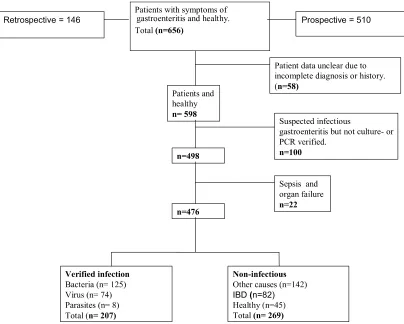
Feces samples that were gathered in 2003 during a pre- vious study of HGF in blood and feces of patients with IBD and infectious gastroenteritis (n = 146) were re- thawed once and examined by the test. This material is consisted of healthy volunteers and patients with defined diagnosis (Inflammatory Bowel Disease; IBD n = 58, 19 - 80 years old and 32 women, Infectious gastroenteritis n = 70, 9 - 90 years old and 37 women and healthy n = 6 in 3 consecutive occasions, 19 - 35 years old, 3 women).
2.3.2. Prospective
This material (1 - 100 years old) was collected at the Department of Infectious Diseases (n = 63 January 2010-June 2011) or from samples sent by other wards to the Departments of Biochemistry (n = 106, 18th May- 1st June 2011) and Microbiology (n = 313, 1st -30th June 2011). The samples were coded at once and unidentified. The project leader studied the patient-journals and the result of the test and the medical history were docu- mented directly. The files were updated daily and the results of routine tests, x-rays, endoscope procedures and final diagnosis before patient was dismissed were docu- mented consequently. Total 482 feces samples from pa- tients that searched the health care centers (n = 122) or were admitted to the University Hospital in Linköping, County hospitals in Norrkoping and Motala (n = 360) were analyzed consecutively with the test within 48 hours after collection before the culture or PCR results were available. Further 27 culture negative feces samples from healthy volunteers without diarrhea (9 - 73, Median 53 years, 17 women) were included. The physician in charge in each ward conducted the diagnosis procedure and treatment. Therefore the reference tests were per- formed accordingly on patients and it was not known to the physicians which patients were going to be included in the study.
2.4. Assay Accomplishment and Interpretation of Results
peated. This procedure was undertaken to avoid false negative results relating to hook or prozone effect (too high level of binding growth factor in the sample) [14]. In the present work all of the fresh samples were tested originally and after dilution. Positive test both in original and diluted feces indicated a high DS affinity in feces HGF. Positive test in original feces with diarrhea and negative in diluted one indicated a low affinity of HGF to immobilized DS. When the results were negative in original feces, but turned to positive after dilution, pres-ence of HGF with high affinity to DS is suspected (posi-tive). When the results are negative in both original and diluted feces it might show that no HGF with affinity to DS is present in feces. The CMYK system was used for interpretation of colors as follows: 701500, 502500, 453000 are ranges of positive result and 354000, 254000 as negative results [15].
2.5. Test Reproducibility
In order to analyze all the feces samples collected during study period it was necessary to prepare different batches of loops to supply the study with test material. Approxi- mately 500 loops could be prepared from 1 ml DS gel from each batch prepared. In order to control method variability in preparation, 5 - 10 samples were analyzed with; the old and the new batch of loops. In case the re- sult of sample analysis differed completely in more than two samples, the complete loop batch was discarded and a new batch was prepared. Twenty loops from each batch were also tested with negative controls (PBS, Albumin, FBS, distilled water) and positive control (125 pg/ml recombinant HGF). Positive and negative controls were also used prior to analysis of samples daily. Feces sam- ples were analyzed in duplicates.
2.6. Inhibition of Interaction
Feces sample from 2 patients with diarrhea caused by Salmonella enteritis (27 ng/ml HGF) and Clostridium difficile (7.9 ng/ml HGF) were diluted in distilled water, stirred and centrifuged for 20 minutes at 3000 g. The supernatant was diluted in distilled water 1:10 and sterile filtered. Anti-human HGF antibody 0.1 mg/ml (Sigma Aldrich) was added 1:5 to the samples and incubated in 1 h 37˚C. Distilled water was added 1:5 to the control sam- ple. Forty loops (10 loops for each sample with and without antibody) were tested.
2.7. Reference Tests
Stool examinations by means of a combination of mi- croscopic, virology (Calicivirus with PCR, Rotavirus and Adenovirus antigen detection with ELISA) and bacterial culture methods as well as serological and toxin-identi-
fication techniques (Clostridium difficile toxin), method for detection of semi-quantitative calprotectin and fecal hemoglobulin were performed as routine tests at the Uni- versity Hospital in Linköping. A variety of X-ray and endoscopic techniques were utilized as indicated.
Statistics
Regression analysis was performed for correlations using Graphpad prism version 5. Specificity (number of true negative/number of true negative + number of false posi- tive), Sensitivity (number of true positive/number of true positive + number of false negative), Positive Predictive Value (PPV = True positive/true positive + false positive), Negative Predictive Value (NPV = True negative/true negative + false negative) and Accuracy (True positive + true negative/true positive + true negative + false posi- tive + false negative) of the test results were calculated. The Regression analysis was performed to calculate the correlation between parameters (Graphpad prisma ver- sion 5).
3. RESULTS
3.1. Gel Preparation
The first observation showing that addition of HGF to DS solution could inhibit the interaction and thereby changing of color of methylene blue, motivated the test- ing of HSPG and DS with different molecular weights and concentration with different diluents and composi- tions. DS MW 100,000 in the composition mentioned in Material & Method gave the most reliable results.
3.2. The Diagnostic Procedures
The feces cultures (n = 195), diagnostic virology tests (n = 58), toxin (n = 318), parasitological tests (n = 44), semi-quantitative calprotectin (n = 111) and feces hemo- globulin (n = 61) were performed on feces samples (n = 482) at admittance. These tests were performed on the same feces samples used in this study. However the re-sults of the test were observed and documented before the results of reference tests were available.
3.3. Infectious Gastroenteritis
infection (Figure 1). The test was negative in 2 cases without diarrhea and 5 cases with diarrhea.
tion of colitis.
Fifty-eight samples from 2003 with defined IBD di- agnosis were included in this group and in total 82 sam- ples with IBD the test was positive in 14 cases (Table 1).
3.4. Non-Infectious Diarrhea
In 143 cases (3 - 96, median 55 years, 64 women, loose feces n = 95) bowel as focus of infection was ruled out. However in one patient with diarrhea Blastocystis hominis cyst was found in feces but the performed X-ray and endoscopy showed terminal ileitis. In this group the test was positive in six cases (Table 1).
3.6. Sepsis
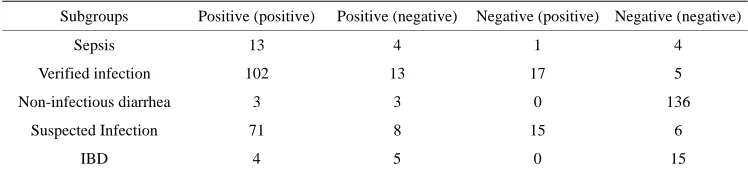
Diarrhea during the course of sepsis with multiple organ dysfunctions was observed in 22 samples from 19 pa- tients (32 - 92, median 69 years, 15 women). The test
was positive in 18 cases (Table 2). The blood cultures
yielded growth of Staphylococcus aureus in 3 cases, Klebsiella pneumoniae in 2 cases, Klebsiella pneumoniae + Bacteroides fragilis in one case, Streptococcus pneu- moniae in one case, Streptococcus Oralis in one case, Streptococcus agalactiae (GBS) + Candida albicans in one case, Proteus mirabilis in 1 case, Candida albicans in one case, Staphylococcus aureus + Bacteroides fragilis in one case, E. coli in 2 cases, Enterococcus gallinarum in one case and aerococcus spp. in one case. The blood cul- tures were negative in 3 cases with sepsis and multiple organ failure.
3.5. Inflammatory Bowel Diseases (IBD)
The patients with bowel disturbances in which infection could not be verified by stool examinations and debut or exacerbation of IBD was suspected, were classified un- der this sub-group. Total 24 samples from 21 patients (14 - 83, median 59.5 years, 14 women, loose feces n = 20, ulcerous colitis n = 15, crohn disease n = 4, micro- scopic colitis n = 4, celiac disease n = 1) were collected. The diagnosis was verified by a recent endoscopy in 14 cases. Out of 15 samples of patients diagnosed as exac- erbation of ulcerous colitis, the test was positive in both original and diluted samples in 4 patients (Table 2). En- doscopic examination (n = 4) revealed acute or exacerba-
[image:4.595.95.499.395.719.2]This group is excluded from statistical analysis be- cause the patients had generalized inflammation and or- gan dysfunction.
Table 1. Validation of the diagnostic test.
Non-infectious cases Total
Diagnostic test result Verified infectious diarrhoea
Other causes healthy IBD
Positive 200 6 0 14 220
Negative 7 136 45 68 256
Total 207 142 45 82 476
Sensitivity and specificity of the test were calculated as 96.6% and 92.5% respectively while Positive Predictive Value (PPV) and Negative Predictive Value are calculated as 90.9% and 97.2%. Validation of diagnostic test results are found to be 94.3% accurate.
Table 2. The index test result in feces samples and subgroups collected in 2011.
Subgroups Positive (positive) Positive (negative) Negative (positive) Negative (negative)
Sepsis 13 4 1 4
Verified infection 102 13 17 5
Non-infectious diarrhea 3 3 0 136
Suspected Infection 71 8 15 6
IBD 4 5 0 15
Positive/negative = test positive in undiluted form, Negative/Positive = test positive after dilution (hook effect). Nega- tive/negative result is considered as negative test. Results mentioned in brackets represent the result obtained upon dilution of faeces samples in 1:5 ration of FBS-Proclain 300 solution.
3.7. Suspected Infection
In 100 patients (4 - 93, median 64 years, 61 women loose feces n = 95) reference tests did not reveal infection but infectious gastroenteritis was highly suspected because of medical history and/or previous cultures. The test was positive in 94 cases (Table 2). This group is not included in statistical analysis because the diagnosis was not ob- jectively verified.
3.8. Unclear Cases
The medical history and/or the diagnostic procedure were incomplete or classed as high secret and therefore it was not possible to find out the cause of diarrhea in 58 patients (29 women) which were excluded from statisti- cal calculations (Figure 1).
3.9. Estimates
1) Inhibition of HGF
Incubation of diluted feces with anti HGF antibodies resulted in inhibition of HGF and a negative result in 80% (16 out of 20 loops).
2) Reliability of test
Sensitivity, specificity, positive predictive value and negative predictive value as well as accuracy were cal- culated in two groups; verified infectious gastroenteritis (n = 207) and non-infectious gastroenteritis which in turn included patients with IBD, patient with other systemic diseases and healthy (n = 268). As shown in Table 1, the test could distinguish acute infectious gastroenteritis with a sensitivity of 96.6% and specificity 92.4% and a
posi-tive predicposi-tive value of 90.9% and negaposi-tive predicposi-tive value of 97.2%. The accuracy of test was 94.3%.
The results of the test did not correlate to fecal calpro- tectin (R = 0.015, R2 = 0.02) or fecal hemoglobulin (R = 0.29, R2 = 0.08) but correlated positively to loose feces (R = 0.59, R2 = 0.35 p < 0.001). Fecal calprotectin had no correlation to feces consistence (R = 0.09, R2 = 0.008) but correlated to fecal hemoglobulin (R = 0.47, R2 = 0.22, p = 0.001).
4. DISCUSSION
In the present work an experimental model for evaluation of HGF in faeces samples and determination of bowel as the focus of acute inflammation is introduced. The chro- motropic character of HSPG and DS in inducing meta- chromatic colour change in methylene blue and toluidine blue has been used in development of test. We have shown that the results can discriminate an acute inflam- mation in bowel from a chronic one with high test predictive values.
[image:5.595.110.484.231.317.2]of the membrane. DS, 100,000 MW was used and this was in agreement to results reported by Berger et al., [8] Preparation of membrane was also dependent on volume, pH and temperature of solutions [13].
Diarrhea is the major symptom of food borne illnesses which in turn can be divided to bacterial, viral, chemical and parasitic categories. A large portion of the outbreaks are of unknown etiologies (45.1%) [21] and therefore the limited tests used at the laboratory could not possibly rule out infection in all patients with gastroenteritis. In order to evaluate the sensitivity of routine diagnostic tests to determine the etiology of gastroenteritis in our ward we studied journal of patients that were admitted to the Department of Infectious Diseases in Linköping and were dismissed under diagnosis acute infectious gastro- enteritis (n = 181, January to December 2011). Feces cultures (at least once in all of the cases), viral diagnostic tests (n = 123), direct microscopy and parasitological tests (n = 51) were performed accordingly which could verify infection in 59% of cases (submitted manuscript).
The test recognized acute inflammation caused by in-
fection with a high sensitivity in patients with diarrhea. When diarrhea was not the presenting symptom the test was negative in spite of positive cultures. It might indi- cate that the test is sensitive to the grade of inflammation not presence of an infectious agent such as in carriers. In the patients with sepsis and multiple organ failure and diarrhea, positive test might indicate a generalized in- flammatory process and a higher risk for bacteremia.
Calprotectin (semi-quantitative and quantitative) tests are recently been used as a routine to rule out a chronic inflammatory process in bowel [22]. There was no sig- nificant correlation between the test and calprotectin re- sults in our observation. However in cases with negative calprotectin and positive test viral and parasitic infec- tions might be suspected. On the other hand positive cal- protectin together with negative test might have values in detection of IBD (data not shown).
We conclude that Dextran-activity test is a simple ex- perimental model for evaluation of HGF in feces. The results are in agreement with our previous observations and the model might be used to develop rapid and cost- effective tests for distinguishing cases in which bowel is the focus of acute inflammation such as in food borne outbreaks in need of isolation. Special attention should be paid to cases of gastroenteritis with negative test which need complementary examinations to rule out more serious conditions in need of appropriate therapeu- tic strategies without delay.
5. ACKNOWLEDGEMENTS
We are grateful to Tayeb Nayeri, Prof. Fredrik Winqvist and Per Stal-
handske for their valuable suggestions in the development of method.
We are also grateful to Clinical and Laboratory staff of Linköping University hospital in helping us with collection of samples.
REFERENCES
[1] Kirby, A. and Iturriza-Gómara, M. (2012) Norovirus diagnostics: Options, applications and interpretations. Expert Review of Anti-Infective Therapy, 10, 423-433.
doi:10.1586/eri.12.21
[2] Holtz, L.R., Neill, M.A. and Tarr, P.I. (2009) Acute bloody diarrhea: A medical emergency for patients of all ages. Gastroenterology, 136, 1887-1898.
doi:10.1053/j.gastro.2009.02.059
[3] Nakamura, T., Sakai, K. and Matsumoto, K. (2011) He- patocyte growth factor twenty years on: Much more than a growth factor. Journal of Gastroenterology and Hepa-tology, 26, 188-202.
doi:10.1111/j.1440-1746.2010.06549.x
[4] Doeppner, T.R., Kaltwasser, B., ElAli, A., Zechariah, A., Hermann, D.M. and Bahr, M. (2011) Acute hepatocyte growth factor treatment induces long-term neuroprotec-tion and stroke recovery via mechanisms involving neural precursor cell proliferation and differentiation. Journal of Cerebral Blood Flow Metabolism, 31, 1251-1262.
doi:10.1038/jcbfm.2010.211
[5] Liedberg, B., Nylander, C. and Lundstrom, I. (1995) Biosensing with surface plasmon resonance-how it all started. Journal of Biosensors and Bioelectronics, 10, 1-9.
[6] Nayeri, F., Xu, J., Abdiu, A., Nayeri, T., Aili, D., Lied-berg, B., et al. (2006) Autocrine production of biologi-cally active hepatocyte growth factor (HGF) by injured human skin. Journal of Dermatological Sciences, 43, 49- 56.doi:10.1016/j.jdermsci.2006.03.004
[7] Nayeri, F., Nayeri, T., Aili, D., Brudin, L. and Liedberg, B. (2008) Clinical impact of real-time evaluation of the biological activity and degradation of hepatocyte growth factor. Journal of Growth Factors, 26, 163-171.
doi:10.1080/08977190802128083
[8] Berger, M., Welle, A., Gottwald, E., Rapp, M. and Lange, K. (2010) Biosensors coated with sulfated polysaccha-rides for the detection of hepatocyte growth factor/scatter factor in cell culture medium. Journal of Biosensors and Bioelectronics, 26, 1706-1709.
doi:10.1016/j.bios.2010.07.065
[9] Yamaji, N., Ido, A., Moriuchi, A., Numata, M., Setoyama, H., Tamai, T., et al. (2011) Hepatocyte growth factor ameliorates mucosal injuries leading to inhibition of co-lon cancer development in mice. Oncology Reports, 26, 335-341.
[10] Linares, P.M. and Gisbert, J.P. (2011) Role of growth factors in the development of lymphangiogenesis driven by inflammatory bowel disease: A review. Journal of In-flammatory Bowel Diseases, 17, 1814-1821.
doi:10.1002/ibd.21554
Translational Medicine, 8, 112-128.
doi:10.1186/1479-5876-8-112
[12] Nayeri, F., Almer, S., Brudin, L., Nilsson, I., Akerlind, B. and Forsberg, P. (2003) High hepatocyte growth factor levels in faeces during acute infectious gastroenteritis. Scandinavian Journal of Infectious Diseases, 35, 858- 862.doi:10.1080/00365540310016484
[13] Bergeron, J.A. and Singer, M. (1958) Metachromasy: An experimental and theoretical reevaluation. Journal of Biophysical and Biochemical Cytology, 4, 433-457.
doi:10.1083/jcb.4.4.433
[14] Fangous, M.S., Kerspern, H., Moineau, M.P., Kerlan, V., Alavi, Z. and Carre, J.L. (2012) The hook effect in calci-tonin immunoradiometric assay: A case report. Annual Endocrinology Journal, 73, 552-555.
doi:10.1016/j.ando.2012.07.681
[15] Pham, N.A., Morrison, A., Schwock, J., Aviel-Ronen, S., Iakovlev, V., Tsao, M.S., et al. (2007) Quantitative image analysis of immunohistochemical stains using a CMYK color model. Journal of Diagnostic Pathology, 2, 8-17.
doi:10.1186/1746-1596-2-8
[16] Lönn, J., Starkhammar, J.C., Kälvegren, H., Brudin, L., Skoglund, C., Garvin, P., et al. (2012) Hepatocyte growth factor in patients with coronary artery disease and its re-lation to periodontal condition. Results in Immunology, 2, 7-12.doi:10.1016/j.rinim.2011.12.002
[17] Lönn, J., Shahzad, F., Uhlin, F., Bengtsson, T., Almroth,
G. and Nayeri, F. (2012) High concentration but low bio-logical activity of hepatocyte growth factor in patients with chronic renal failure. Advances in Bioscience and Biotechnology, 3, 516-523.doi:10.4236/abb.2012.324068
[18] Lonn, J., Almroth, G., Brudin, L. and Nayeri, F. (2012) An antithrombin III product containing biologically ac-tive hepatocyte growth factor may be beneficial in deep ulcer infections. Cytokine, 60, 478-486.
doi:10.1016/j.cyto.2012.05.023
[19] Nayeri, F., Nilsson, I., Brudin, L. and Almer, S. (2004) Stability of faecal hepatocyte growth factor determination. Scandinavian Journal of Clinical and Laboratory Inves-tigations, 64, 589-597.doi:10.1080/00365510410002850
[20] Nayeri, F., Aili, D., Nayeri, T., Xu, J., Almer, S., Lund-strom, I., et al. (2005) Hepatocyte growth factor (HGF) in fecal samples: Rapid detection by surface plasmon reso-nance. BMC Journal of Gastroenterolology, 5, 13-20.
doi:10.1186/1471-230X-5-13
[21] Bean, N.H., Griffin, P.M., Goulding, J.S. and Ivey, C.B. (1990) Foodborne disease outbreaks, 5-year summary, 1983-1987. MMWR CDC Surveillance Summaries, 39, 15-57.