COMPARATIVE STUDY OF INFLUENCE OF IMAGE SIZE ON THE PERFORMANCE TESTING USING LOADRUNNER
OMRAN MAKI ABDELSALAM
A dissertation report submitted in partial fulfilment of the requirement for the award of the Degree of Master of Computer Science (Software Engineering)
Faculty of Computer Science and Information Technology Universiti Tun Hussein Onn Malaysia
ABSTRACT
ABSTRAK
CONTENTS
TITLE i
DECLARATION ii
ACKNOWLEDGEMENT iv
ABSTRACT v
ABSTRAK vi
CONTENTS vii
LIST OF TABLES xi
LIST OF FIGURES xiii
LIST OF SYMBOLS AND ABBREVIATIONS xiv
CHAPTER 1 INTRODUCTION 1
1.1 Background of Study 1
1.2 Problem Statement 3
1.3 Project Objectives 3
1.4 Scope of Project 4
1.5 Significant of Study 4
1.6 Expected Outcomes 4
CHAPTER 2 LITERATURE REVIEW 6
2.1 Introduction 6
2.2 Software Testing 6
2.3 Types of Testings 7
2.3.1 Manual Testing 7
2.3.2 Automated Testing 7
2.4 The Software Testing Strategy 11
2.4.1 Black-Box 11
2.4.2 White-Box 12
2.4.3 Gray-Box 13
2.5 Web Application Testing 14
2.6 Web Application Perspectives 15
2.6.1 Testing the Functional Requirement of
Web Application 16
2.6.2 Testing the Non-Functional Requirement
of Web Application 16
2.7 Performance Testing 19
2.7.1 Performance Testing Types 19
2.7.2 Performance Testing Criteria 22
2.7.3 Performance Testing Tool 24
2.8 Related Work on Web Application Performance
Testing 27
CHAPTER 3 METHODOLOGY 30
3.1 Introduction 30
3.2 Research Planning and Framework 30
3.3 Phase I: Creating a Web Application with Three
Scenarios 32
3.4 Phase II: Implement Test Cases on Loadrunner 32 3.5 Phase II: Test Module for Loadrunner Testing of
Online Shopping System 33
3.5.1 Login Test 34
3.5.2 Create Product Test 35
3.5.3 Delete Product Test 38
3.6 Phase III: Results Analysis 40
3.7 Chapter Summary 41
CHAPTER 4 IMPLEMENTATION AND RESULTS ANALYSIS 41
4.1 Introduction 42
4.2 The Web Application Scenarios 42
4.2.1 First Scenario 42
4.2.2 Second Scenario 43
4.2.3 Third Scenario 44
4.3 Implementation of Loadrunner Testing Tool in
Three Scenarios 45
4.3.1 Implementation of Test Cases for
4.3.2 Implementation of Test Cases for
Loadrunner in Second Scenario 50
4.3.3 Implementation of Test Cases for
Loadrunner in Third Scenario 55
4.4 Analysis of Result in Three Scenarios of Online
Shopping System 60
4.4.1 Analysis of Result of Online Shopping
System First Scenario 60
4.4.2 Analysis of Result of Online Shopping
System Second Scenario 62
4.4.3 Analysis of Result of Online Shopping
System Third Scenario 64
4.5 Results Discussion of the Three Scenarios of
Online Shopping System 66
4.6 Summary 70
CHAPTER 5 CONCLUSION 71
5.1 Objectives Achievement 71
5.2 Conclusion 71
5.3 Future Work 72
5.3 Summary 72
REFERENCES 73
LIST OF TABLES
2.1 Loadrunner Hardware Requirements 26 2.2 Previous Work Related To Performance Testing 28 3.1 Three Scenarios with Different Sizes of Images 32 4.1 Test Cases of Online Shopping System in First Scenario 45 4.2 Experimental results for Login Test using Loadrunner
in First Scenario 47
4.3 Experimental results for Create Product Test using Loadrunner in
1.1 First Scenario 48
4.4 Experimental results for Delete Product Test using Loadrunner
1.1 in First Scenario 49
4.5 Test Cases of Online Shopping System in Second Scenario 50 4.6 Experimental results for Login Test using Loadrunner
1.1 in Second Scenario 52 4.7 Experimental results for Create Product Test using Loadrunner
1.1 in Second Scenario 53
4.8 Experimental results for Delete Product Test using Loadrunner
1.1 in Second Scenario 54
4.9 Test Cases of Online Shopping System 55
4.10 Experimental results for Login Test using Loadrunner
1.1 in Third Scenario 57
4.11 Experimental results for Create Product Test using Loadrunner
1.1 in Third Scenario 58
4.12 Experimental results for Delete Product Test using Loadrunner
1.1 in Third Scenario 59
4.13 Experimental results in terms of average response time
1.1 in first scenario 60
1.1 in First Scenario 61
4.15 Experimental results in terms of average response time
1.1 in second scenario 63
4.16 Experimental results in terms of successful requests rates
1.1 in Second scenario 64
4.17 Experimental results in terms of average response time
1.1 in third scenario 65
4.18 Experimental results in terms of successful requests rates
LIST OF FIGURES
2.1 Black Box Testing 12
2.2 White Box Testing 13
2.3 Gray Box Testing 14
2.4 Types of Web Testing 15
2.5 Schematic Diagram for Performance Testing (Zhu & Yancui, 2010) 20
2.6 Web Application Pages Response Time (Yunming & Mingna, 2009) 22
2.7 Process of Loadrunner 25
3.1 Flow Chart the Steps of the Project Work 31
3.2 Flow Chart Process Based on Loadrunner 33
4.1 Online Shopping Application in First Scenario 43
4.2 Online Shopping Application in Second Scenario 44
4.3 Online Shopping Application in Third Scenario 44
4.4 Average Response Time of Login Test Module 67
4.5 Average Response Time of Create Test Module 67
4.6 Average Response Time of Delete Test Module 68
4.7 The Successful Requests Rate of Login Test Module 69
4.8 The Successful Requests Rate of Create Test Module 69
LIST OF SYMBOLS AND ABBREVIATIONS
DB – Database
Vuser – Virtual User
VuGen – Virtual User Generator
HTTP – Hypertext Transfer Protocol
HTML – Hypertext Markup Language
RT – Response Time
SR – Success Requests
CHAPTER 1
INTRODUCTION
This chapter provides the overview of the research done. First of all it describes the background of the research problem. Next, it elaborates the research problems that shape the direction of this research. Then, it presents the objectives and scope of the research. Finally, outlines of the dissertation report.
1.1 Background of Study
The massive growth and development of web applications and web-based services have changed the topography and the ways in information flows. This has been a substantial effect whether to the government, corporate, private services, educational and research centres. This has resulted web applications that have been developed in a user friendly interface. From here, people can see how important is a developer’s work and the creativity could be unlimited. Other than being user friendly and having a good feature, the web application must also be stable and able to handle a large number of users at the same time. To ensure confidence level on the web application reliability during peak time, the web application must be tested. Testing stage is one of the most crucial stages in software and web application life cycle as the reliability affects the final product performance once it has been released in the market (Kalita & Bezboruah, 2011).
be updated from time to time as the developers have fixed some of the bugs in the web application. It is important to know that bugs always exist in technology and it is important to detect the bugs with calculation of bugs’ density (Chakrapani & Ramesh, 2011). From the various software testing parameters available, this dissertation report focuses on performance testing on web applications.
Web application usually needs to concurrently serve many users while the developer could be working in a small group or even work alone. This creates an issue where the report and request of the users on bugs are very difficult to be fulfilled in a short time. Thus, an automatic testing system is required to manage the traffic (Yunming & Xu, 2009). In addition, as the web application’s functions are getting more complicated and more complex to cater the technological growth, many application performance analysis methods are obsolete. This is due to the technological environment becoming more dynamic and unpredictable for the users. Load testing is a great choice in web application performance analysis to simulate the user access and the web application performance as it is low cost, high flexibility and better simulation ability. In the process of using conventional load testing to analyse web application performance, it is a must to separate load tests for hardware configuration due to numerous hardware configurations in the world (Lu, Wu & Wang, 2006).
1.2 Problem Statement
In the case of web applications, system performance is a critical issue because web users are not able to wait too long for a response to their requests. Besides, they also expect that services are always available. Effective performance testing of web applications is a critical task because it is not possible to know beforehand how many users will actually be connected to a real-world running application. Web application page consists of many file types for example HTML, JavaScript and images. Images represent the biggest component of the web pages (Muntean, McManis & Murphy, 2001). Some of the pages also have a large number of images. Both size and number of images could affect both network and server performance since images often take several seconds to load (Harrison, Dey & Hudson, 2010), especially in peak hours when there are a lot of clients visiting the page. This dissertation report is the generation of various test cases by using Loadrunner in three scenarios with different sizes of images in order to analyse the factors that affected the web performance and find out how images influenced the access time of the web pages.
1.3 Project Objectives
The objectives of this research are summarized as below:
(i) To develop web application with three different scenarios based on the size of images.
(ii) To design test cases on performance testing for the three scenarios in (i). (iii) To execute test cases on Loadrunner.
1.4 Scope of Project
This study focused on the analysis of performance testing in web application testing. The Loadrunner testing tool by Hewlett-Packard (HP) was used to test the successful request rates and response time in web applications. The web application domains which were the three scenarios with different sizes of images were analysed and compared by using Loadrunner testing tool based on the parameters.
1.5 Significant of Study
In the software development life cycle, testing is highly needed to assure the quality of the software process and product. Performance testing is critical for the success of the web application. One of the major bottlenecks in performance is the limited bandwidth of the network that connects browsers to the servers. Hence, if the amount of data flowing through the network can be reduced, it is possible to improve the response times and support more users using same network infrastructure. The main aim of this research is to prove that the influence of image size on the web performance. This provides the opportunity to improve application’s performance before it becomes available for demanding users.
1.6 Expected Outcomes
1.7 Outline of the Dissertation Report
CHAPTER 2
LITERATURE REVIEW
2.1 Introduction
This chapter discusses on the literature of software testing and performance testing. It begins with a cursory review of software testing such as the concept and definition of software testing, the testing technique and the general classification of software testing techniques. Next, it presents the web application testing. This is followed by the definition of functional testing and non-functional testing. Finally, it discusses a few related work on the performance of web application testing and ends with a summary.
2.2 Software Testing
Testing is a procedure of investigating a system or its components with the expectation to determine whether it fulfills the defined prerequisites or not. This activity will bring out the real, expected and the difference in their outcomes. Basically testing is executing a system in order to identify missing features or errors which are not accounted for in the prerequisite (Pratibha & Manju, 2014). As per ANSI/IEEE 1059 standard (IEEE, 1994), testing can be characterised as a procedure of investigating a software application to discover the differences between the existing and desired conditions such as the errors, bugs, and defects in order to assess the characteristics of the software application.
2.3 Types of Testing
This section describes the different types of testing which may be used on the system under test (SUT). There are two types of testings; manual testing and automated testing. This dissertation report based upon automated testing.
2.3.1 Manual Testing
This kind of testing incorporates the physical testing of the software without utilising any automated tools or any script. In manual testing, the tester assumes the role of an end user and tests the software to recognise any unexpected features or bug (Pratibha & Manju, 2014). There are several distinctive stages for manual testing such as Unit Testing, Integration Testing, System Testing and User Acceptance Testing.
Testers will use test plan, trials or test stimulation to diagnose the software to confirm that a complete testing is done. Moreover, manual testing consists of exploratory testing as well since the testers need to explore the software before being able to identify errors.
2.3.2 AutomatedTesting
Automation testing which is also called Test automation is used when the tester composes scripts and utilises an alternate programming to test the software (Pandey, 2013). This methodology includes automation of a manual procedure. Automation test is utilised to re-run the test situations which perform manually, rapidly and repeatedly. Besides regression testing, automation testing is additionally used to test the application for load, performance and stress. Compared to manual testing, automation test expands the test scope, enhances accuracy, saves money and time (Angmo & Sharma, 2014).
perform exchanges for instance registration forms, login form and so forth should be automated (Pandey, 2013).
Besides, all Graphical User Interface (GUI) products, associations with databases, field validations and so on can be effectively tested via computerising process and then manual procedure. Test automation ought to be used by considering the following for the software (Pereira, 2012):
(i) Large and critical projects.
(ii) Projects that require testing the same areas frequently. (iii) Requirements do not change frequently.
(iv) Access the application for load and performance with many virtual users. (v) Stable software with respect to manual testing.
(vi) Availability of time.
By considering the above situations, the user will be able to determine and decide on when to use the test automation to solve the problems for the software. Based on these situations, it is obvious that automation does not really solve the problems all the time. Despite of this, it is known that there are certain situations where automation is proved to be very helpful. To clarify more on this, automation has many advantages in regression testing, static and repetitive tests, load and performance testing, data driven testing and smoke testing (Fernandes & Fonzo, 2014).
Automation testing is used in order to reduce the testing time of complex activities such as regression testing and other extensive or laborious testing process that are involved in the software development cycle. Automation testing is commonly used for the projects that require regular testing of the same sections of code at any time of the development stage.
Identifying areas within a software for automation is hard and not cost-effective to automate the whole software testing process. This is mainly due to the expensive nature of the testing tools. Not only this, it may also be due to the unstable nature of certain section of the codes used. Thus it is important to identify the areas that need to automate the testing first.
(i) Selection of appropriate tool for test automation
There are a few types of testing tools available but it is very crucial to keep in mind of the testing nature that involved when the right tools are being chosen for the automation.
(ii) Writing test scripts
Test cases and scripts need to be developed to cover the software’s large sections which might not able to be fully covered by an individual. Writing the test scripts is also to ensure that the large sections of the software are properly functioning.
(iii) Development of test suites
In order to ensure that the automated test cases run one after another without any manual intervention, the development of test suites are being carried out. To develop the test suites, multiple test cases, command line tool and a library are created in order to run the test suite.
(iv) Execution of scripts
The execution of test scripts can be done either manually with the option of test suites to run being chosen by the developer or automatically by using a monitoring mechanism as the substitute. Test scripts execution ensures that problems are identified effectively in case any other issue arises as the effect from code change or other factors.
(v) Create result reports
Result reports format needs to be created so that the details of the actions performed during the testing from individual test logs can be recorded. Not only this, the type of test reports format to be created, messages, screenshots and many more will also need to be defined.
(vi) Identify any potential bug or performance issue
An individual needs to easily identify any problems during the testing and the factors that cause them. Apart from that, these individuals also need to find out the events of any test operations that have failed and set the problems right in order to gain greater testing efficiency.
Following are the tools which can be used for automation testing:
(a) HP Quick Test Professional – This software provides regression and functional automation test for software environments and applications.
(b) Selenium – This software provides a record and playback tool for authoring test without the need to learn test scripting language.
(c) IBM Rational Functional Tester – This software is a tool for automated testing of the software applications which allows the users to create tests that mimic the actions and assessments of a human tester.
(d) SilkTest – This is a tool for regression testing and automated function of enterprise applications.
(e) TestComplete – It is a functional automated testing platform which gives testers the ability to create automated tests for iOS, Android, Microsoft Window and Web applications.
(f) Testing Anywhere – This software allows the developers and the testers to test the applications, controls, Web sites, GUI front-ends and objects.
(h) LoadRunner – This software is an automated performance and test automation for application load testing by examining system behaviour and performance while the actual load is being generated.
(i) LoadUI – It is a load testing software that mainly targeting at the web services. (j) Visual Studio Test Professional – This is an integrated toolset developed to facilitate a plan-test-track workflow for cooperation between developers and testers.
(k) WATIR – It stands for Web Application Testing in Ruby. This is an open-source family of Ruby libraries for automation of the web browsers.
Although there are a lot of tools for performance testing, Loadrunner testing tool has been chosen to be used in this dissertation report.
2.4 The Software Testing Strategy
There are different methods which can be used for software testing. This section briefly describes those methods.
2.4.1 Black-Box
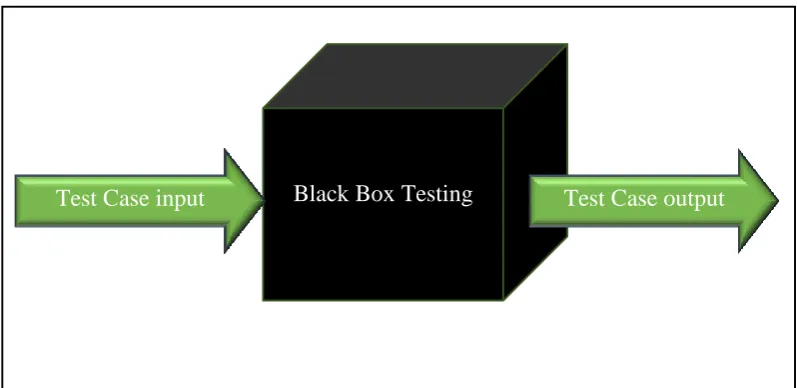
Black-box testing includes testing the software for its usefulness, it is utilised to figure out the errors in the structure of the data, interface errors and faulty functions and so on. Figure 2.1 shows the black box Testing. This testing disregards inner system of a framework (Khan & Sadiq, 2011). It analyses bugs just as per programming malfunctioning as they are discovered in its error outputs. It is utilised to discover erroneous functions that prompt undesired outputs when performed and wrong conditions which yield incorrect outputs when they are performed. Techniques listed below utilised black box testing strategies to test a system:
(i) Boundary Value Analysis (BVA) (ii) Robustness
Figure 2.1: Black Box Testing
Black Box Testing permits us to complete most of the testing classes. Most of the testing can be exclusively done by using this testing method. In addition, Black box testing requires fewer resources (Khan & Sadiq, 2011).
2.4.2 White-Box
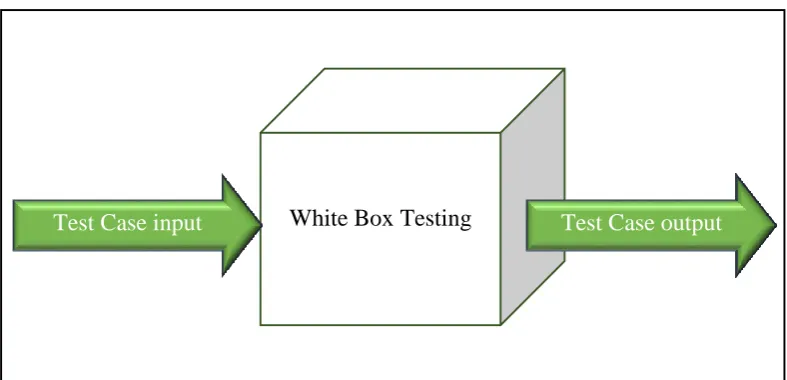
White-box testing considers the internal system of a framework or components. It is otherwise called as structural testing, clear box testing or glass box testing. It includes testing of all logic of a program, testing of loops, condition testing and data flow based testing. Figure 2.2 shows White Box Testing. This assists in recognising errors which occur even in incomplete and unclear programming specifications. The aim of this testing is to guarantee that the trials practice can be done in every path of a program. The trials likewise guarantee that all independent paths in a program have been utilised at very minimum once (Khan & Sadiq, 2011). All internal data structures are practiced to guarantee validity. All loops are executed to their limits and within operational bounds. Every branch is practiced at least once. By utilising white-box testing, a software engineer can plan trail tests which:-
(i) Exercise independent paths inside a module or unit.
(ii) Exercise logical choices on both their actual and false side. (iii) Execute loops at their limits and within their operational bounds. (iv) Practice with all internal data structures to guarantee their validity.
Black Box Testing
Figure 2.2: White Box Testing
White box testing can cover a bigger section of the program code while testing and it can disclose typographical errors as well. However, test trials need to be altered if usage changes (Khan & Sadiq, 2011).
2.4.3 Gray-Box
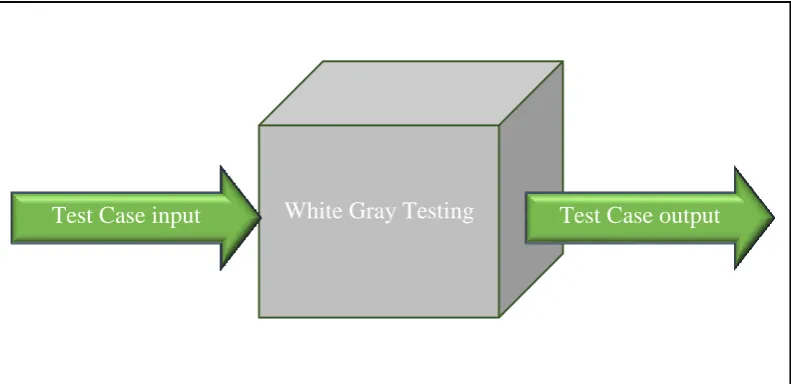
The third testing technique which is known as gray box testing has been considered as well. It is used for testing software which the tester has the knowledge of its basic code or logic. It is focuses around the internal data structures and algorithms for planning the trial tests more than black-box testing method yet less than white-box testing method. Figure 2.3 shows the Gray Box Testing. This technique is vital when conducting integration testing between two modules of code composed by two different programmers, whereby just the interfaces are exposed for the testing. Likewise, this technique can incorporate reverse engineering to fix limit values. Gray box testing is non-intrusive and fair on the grounds that it does not need the tester to know the source code (Jovanović & Irena, 2010).
White Box Testing
Figure 2.3: Gray Box Testing
Gray box testing can test software application by utilising powerful mix of both white- box testing and black- box testing technique. This is an effective and efficient method to test the application (Acharya & Pandya, 2012). The methodology use in this study, focused on black- box testing.
2.5 Web Application Testing
Web testing aims to do software testing that concentrates on web applications (Arora & Sinha, 2013). A complete web application testing needs to be done before publishing in order to trace any errors in web features. There are many tools in the market that can be used for testing the web interface and application (Rick, 2014). These tools are utilised for load, performance and stress testing of web sites, web applications, web servers and other web interfaces. Web testing is important for investigating bottlenecks and performance leakage in the site or web application being tested. Web testing is gaining importance in light of the fact that web applications are among the rapidly developing classes of programming systems being used today. These applications are generally used to aid an extensive variety of essential dealing for example business functions mainly product sale and distribution, scientific functions for example proposal review and data sharing and medical functions for example diagnoses based on expert system (Arora & Sinha, 2013).
White Gray Testing
2.6 Web Application Perspectives
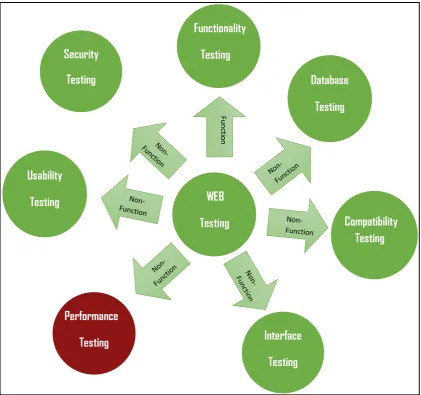
[image:26.595.113.535.355.750.2]There are different testing perspectives that have been proposed by numerous researchers over the years. Software testing divided into two distinct perspectives, non-functional testing to test how the service should perform describing the quality properties of the implementation of functional concerns. The second perspective is functional testing. It tested what the service should do (Schmeling, Charfi & Mezini, 2010). These two perspectives each held different software testing activities that were complementary to each other (Di, Giuseppe & Fasolino, 2006). Although there are different testing perspectives of web application, this dissertation has tested the performance of web application which is under testing the non-functional requirement of web application. Figure 2.4 shows the different testing perspectives which are explained in next subsections.
Figure 2.4: Types of Web Testing Security
Testing
Interface
Testing Performance
Testing Usability
Testing
Database
Testing
Compatibility Testing Functionality
Testing
WEB
Testing
Fun
ct
io
n
2.6.1 Testing the Functional Requirement of Web Application
Testing the functional requirements of an application aims at verifying that an application’s features and operational behaviour correspond to their specifications (Di, Giuseppe & Fasolino, 2006). In other words, this type of testing is responsible for uncovering application failures due to the faults in the functional requirements’ implementation, rather than failures due to the application’s running environment. In order to achieve this aim, any failures due to the running environment should be avoided or reduced to a minimum.
2.6.2 Testing the Non-Functional Requirement of Web Application
There are different types of non-functional requirements that a web application either explicitly or implicitly is usually required to design with specific aims. Descriptions of the verification activities that can be executed to test the main non-functional requirement of a web application are presented in the following:
2.6.2.1 Usability Testing
Usability is the degree to which an item can be utilised by defined users to accomplish a particular objective or objective efficiently, effectively and satisfactorily. Usability is thought to be a standout amongst the most essential quality of web applications. Usability testing system measures the ease of use of a system’s user interface (UI) and distinguishes particular issues and concerns related with a particular kind of usability testing. To execute the usability testing successfully, there are five attributes that need to be addressed (Isa et al., 2014). The five attributes are:
(i) Set specific objectives for each test (ii) Participants represent genuine clients (iii) Participants do genuine task
(iv) The person conducting the research observes and records what participants do (v) The researcher does data analysis, diagnose issues, and gives suggestions for
2.6.2.2 Compatibility Testing
Compatibility testing is a kind of software testing utilised to guarantee compatibility of the application, system or site fabricated with different objects for example, other web browsers, hardware platforms, users (in the event that a particular prerequisite is specified such as a user who can read and communicate in a specific language only), operating systems and so forth. This kind of testing assists the researcher to discover how well a framework performs in a specific environment that incorporates hardware, networking, operating systems and other programming tools and so on. It is essentially the testing of an application or an item constructed within the computing environment. Additionally, it tests whether the application or the software item constructed is compatible with the operating system, database or other programming systems and hardware (ISTQB, 2014).
2.6.2.3 Security Testing
An essential step in security assessment is to recognize the security threats and risks by considering presumed abilities of the attackers (Savola & Karppinen, 2007). In data security, a risk can be characterised by three variables which are:
(i) The likelihood of a threat which includes hazards to safety (ii) The likelihood for vulnerabilities and the potential effect
(iii) The threats are possible at any time during the entire life cycle of the system being evaluated
genuine results. Web Security Testing goes for safety testing objectives proposed by an organisation's product improvement projects, summarising the fundamental kind of tests, and for a particular segment proposed test.
2.6.2.4 Database Testing
Database testing includes the tests to check the accurate qualities which have been recovered from the database by the web or desktop application. Data ought to match correctly with the records stored in the database. Database testing is one of the real testing which obliges the tester to have abilities in checking tables, composing queries and procedure. Testing can be performed in web application or desktop and database can be utilised as a part of the application for example Standardized Query Language (SQL) or Oracle. There are numerous ventures like financing, banking and healthcare protection which requires far extensive database testing (Mandeep, 2012).
2.6.2.5 Interface Testing
2.7 Performance Testing
Performance testing is one of the fundamental activities traversing the entire life cycle of software engineering. Configuring of test environment is an essential stage before testing web applications and the suitability of a test environment will significantly influence the authenticity and precision of the test outcomes. Presently web service procedures are generally utilised in the field of business incorporated information systems, and enterprise class business-to-business applications. Before large scale web services systems are launched on the Internet, their performances need to be evaluated. Testing machines need to be purchased to assemble the essential hardware test environment. Additionally complex software environment has to be configured. Therefore a lot of investment, including a lot of time is needed to configure test environment. Besides, web application testing has numerous challenges for example testing a large number of virtual users, testing from various geographical areas, managing simultaneous demands from users and developing test flexibly (Zhang et al., 2011).
2.7.1 Performance Testing Types
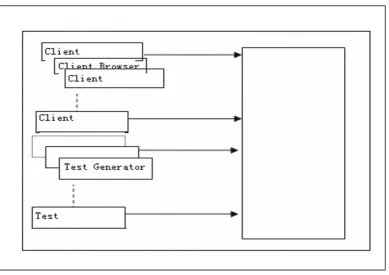
Figure 2.5: Schematic Diagram for Performance Testing (Zhu, Fu & Li, 2010)
Normally, a test generator can stimulate user’s behaviour and run hundreds of web customer software. Communication between the virtual users and web servers can be done directly without using web browsers for example Internet Explorer or Firefox. During the performance tests, the running and testing the number of the virtual users can be specified in the generator. In the event where more virtual users need to be stimulated, it can be linked to multiple load generators, and a centralised control system. In this way, a flow can be created closer to the limit set. Moreover, delay time can likewise be set between the implementation of the two tests. There are three types of web performance testing namely stress testing, load testing and strength test. Each test utilises the same testing tools, script and environment but varied testing time intervals.
2.7.1.1 Load Test
changes that occur in various system performance markers when the load is gradually increased can be ascertained. Load testing is done to depict a particular kind of stress testing that is done in order to enhance the number of users testing the application. At the same time, load testing is done by gradually increasing the number of users from relatively small till the application response time is over. Load testing and stress testing can be integrated (Zhu, Fu & Li, 2010).
2.7.1.2 Stress Test
Stress testing is carried out by continuously increasing the system load and checking the changes in system performance, and eventually determining the performance of the system under any different conditions till it reaches failure state. Therefore, the system can offer the largest number of service tests. By changing the input of the application which corresponds with the increasing load, the conditions under which the performance of the application will becomes intolerable can be identified. The disclosure of the inflection point in the performance of the application is done to distinguish the bottlenecks in a system and performance point that cannot be received so that the maximum service level test that a particular system can provide can be obtained. Stress tests analyse the current hardware and software environment which the system can withstand by identifying the maximum load and bottlenecks of the system (Zhu, Fu & Li, 2010).
2.7.1.3 Strength Test
2.7.2 Performance Testing Criteria
Performance testing which is done using automated testing tools which reenact a variety of normal and abnormal peak load conditions of the indicators is used for performance testing of a system. Performance model stipulates measurable standards of performance. The standard comprises of a series of performance indicators. Typical performance metrics are system throughput, response time, system resource utilisation, network Traffic Statistics, HTTP transactions/sec and the number of session per second and the number of concurrent users, resource request queue length and other markers which measure web performance (Zhu, Fu & Li, 2010). The following discourse concentrates on the initial three pointers.
2.7.2.1 Response Time
[image:33.595.124.512.473.619.2]Response time is a time characterised from the start of a request made by a user till the final respond from the server. Response time is the key software performance of a web application. Hence, page response time is denoted by network time (N1+N2+N3+N4) and application time (A1+A2+A3) as shown in Figure 2.6.
2.7.2.2 Concurrency User
During testing, the testing engineer concentrates on business concurrency users that is how many concurrency users from the business model are present. In equation (2), the 𝐶 is the mean of the concurrency users, 𝑁 is the number of login session, 𝐿 is the mean length of the login session and 𝑇 is the reviewed time (Yunming & Xu, 2009). A login session denotes an interval from start to the end of a session.
𝐶 =𝑁∗𝐿𝑇 (1)
Cp = C + 3 ∗ √𝐶 (2)
In equation (2), if the login session is fit to Poisson distribution, 𝐶𝑝 is crest concurrency users. For instance, in a system, there are 3000 users and the average number of users who visit this system every day are 400 users. For a typical application, the mean time begins when the user logs into the system and ends when the user log out after around 4 hours’ time, a user normally works 8 hours a day.
In this way, as indicated by equation (1) and (2), the 𝐶 and 𝐶𝑝 are: 𝐶 =400∗48 = 200
Cp = 200 + 3 ∗ √𝐶 = 242
2.7.2.3 Average Response Time
In order to evaluate website performance and user's feeling more accurate and complete, there is a special performance index which is average response time. Based on Equation (3) (Boonchieng, 2014), the average response time are calculated by dividing total Response Time with the number of the response.
Average Response Time = ∑ Response Time
𝑛
2.7.2.4 Successful Request Rate
In order to evaluate website performance and user's feeling more accurate and complete, there is a special performance index which is successful request rates. Based on the Equation (4) (Guangzhu & Shujuan, 2009), successful request rates are calculated by dividing total successful request of Online Shopping System with Total request test cases. The results are the final result for the successful request rates of the performance Testing.
Successful request rates = ∑ number of success requests
number of total requests
2.7.3 Performance Testing Tool
When conducting tests on web applications there are various performance testing tools that can be used to test the web application. This research is focused on the Loadrunner testing tool. HP Loadrunner is an automated performance and test automation product from Hewlett-Packard for application load testing. It is testing system behaviour and performance, while generating actual load. A software testing tool, HP Loadrunner works by creating virtual users who take the place of real users' operating client software, such as Internet Explorer, sending requests using the HTTP protocol to IIS or Apache web servers. HP Loadrunner can simulate thousands of concurrent users to put the application through the rigors of real-life user loads, while collecting information from key infrastructure components (Web servers, database servers etc.) The results can then be analysed in detail to explore the reasons for particular behaviour. HP Loadrunner also supports various protocol bundles for load testing: .NET Record/Replay, Database, distributed component object model, GUI Virtual Users, Java Record/replay, network, oracle e-business, remote access, remote desktop, rich internet applications, Systems Applications and Products (SAP), Service-Oriented Architecture (SOA), web and multimedia and wireless.
REFERENCES
Angmo, R., & Sharma, M. (2014). Performance evaluation of web based automation testing tools. In confluence the next generation information technology summit (Confluence). International Conference, pp. 731-735.
Arora, A., & Sinha, M. (2013). Dynamic content testing of Web Application using user session based state testing. In Confluence 2013: The Next Generation Information Technology Summit (4th International Conference), pp. 22-28.
Acharya, S. & Pandya, V. (2012). Bridge between Black Box and White Box–Gray Box Testing Technique. International Journal of Electronics and Computer Science Engineering, 2(1), pp. 175-185.
Boonchieng, E. (2014). Performance and security issue on open source private cloud. In Electrical Engineering Congress (iEECON), 2014 International, pp. 1-5. Chakrapani, A. & Ramesh, K. V. (2011). Automated Functional Testing Using IBM
Rational Robot. International Journal of Computer Science and Information Technologies, Vol. 2 (3), pp. 977-981.
Di Lucca, Giuseppe. A., & Fasolino, A. R. (2006). Testing Web-based applications: The state of the art and future trends. Information and Software Technology, 48(12), pp. 1172-1186.
Fernandes, J. & Fonzo, A.D. (2010).When to Automate Your Testing (and When Not To). Retrieved on December 20, 2014, from http://www.oracle.com /technetwork/topics/qa-testing/whatsnew/when-to-automate-testing-1-30 330.
Harrison, C., Dey, A. K., & Hudson, S. E. (2010). Evaluation of progressive image loading schemes. In Proceedings of the SIGCHI Conference on Human Factors in Computing Systems, pp. 1549-1552.
Isa, W. A. R. W. M., Lokman, A. M., Wahid, E. S. & Sulaiman, R. (2014). Usability testing research framework: Case of Handicraft Web-Based System. In Information and Communication Technology (ICoICT), 2nd International Conference on, pp. 199-204.
IEEE (1994). IEEE Guide for Software Verification and Validation Plans. USA: IEEE Std 1059.
Jovanović & Irena, (2010). Software Testing Methods and Techniques. The IPSI BgD Transactions on Internet Research. pp. 30-41.
Guangzhu & Shujuan. (2009). A quick testing model of Web performance based on testing flow and its application. In Web Information Systems and Applications Conference. WISA. Sixth, pp. 57-61.
Kanchan, G., & Madhuri, S. (2014). "An Approach to Generate the Test Cases for GUI Testing. International Journal of Innovative Science, Engineering & Technology, Vol. 1 Issue 6, pp. 2348 – 7968.
Kalita, M., & Bezboruah, T. (2011). Investigation on performance testing and evaluation of PReWebD: a. NET technique for implementing web application. Software, IET, 5(4), 357-365.
Križanić, J., Mošmondor, M., & Lazarevski, P. (2010). Load testing and performance monitoring tools in use with AJAX based web applications. InMIPRO, 2010 Proceedings of the 33rd International Convention, pp. 428-434.
Khan, M. A., & Sadiq, M. (2011). Analysis of black box software testing techniques: A case study. In Current Trends in Information Technology (CTIT), 2011 International Conference and Workshop on, pp. 1-5.
Krishnamurthy, B., & Wills, C. E. (2000). Analyzing factors that influence end-to-end Web performance. Computer Networks, 33(1), pp. 17-32.
Lu, Y., Wu, H., & Wang, Y. (2006). Web application performance analysis based on comprehensive load testing. In Wireless, Mobile and Multimedia Networks, 2006 IET International Conference on, pp. 1-4.
Mandeep, S. (2012). Database Testing Basics - How to test and what to test .Retrieved on November 11, 2014, from http://www.softwaretestingtimes.com /2012/01/database-testing-how-to-test-and-what.html.
Muntean, C. H., McManis, J., & Murphy, J. (2001). The influence of Web page images on the performance of Web servers. In Networking—ICN 2001, pp. 821-828.
Pratibha, F. & Manju, K (2014). Research of Load Testing and Result Based on Loadrunner. (SSRG-IJCE). ISSN: 2348-8352, pp. 1-4.
Pandey, K. A. (2013). Review on Software Testing Methodology. Journal of Engineering Research and Application Vol. 3, Issue 5, Sep-Oct 2013, pp. 579-583.
Pereira, j. (2012). Software Testing Fundamentals. Automation Testing. Retrieved on November 08, 2014, from https://www.linkedin.com/pulse/software-testing-fundamentals-joao-carlos-fitas-rosado-pereira.
Qian, L., Wan, J., Chen, L., & Chen, X. (2013). Complete Web Security Testing Methods and Recommendations. In Computer Sciences and Applications (CSA), 2013 International Conference on, pp. 86-89.
Rick, H. (2014). Web Site Test Tools and Site Management Tools. Retrieved on September 23, 2014, fromhttp://www.softwareqatest.com/qatweb1.html Schmeling, B., Charfi, A., & Mezini, M. (2010). Non-functional concerns in web
services: requirements and state of the art analysis. In Proceedings of the 12th International Conference on Information Integration and Web-based
Applications & Services, pp. 67-74.
Savola, R., & Karppinen, K. (2007). Practical Security Testing of Telecommunications Software--A Case Study. In Telecommunications. AICT 2007. The Third Advanced International Conference on, pp. 7-7.
Sandeep (2003). GUI Testing. Retrieved on November 13, 2014, from http://www.appperfect.com/products/application-testing/app-test-gui-testing.html.
Varesh, T. (2012). Testing Process in Load Runner in Testing. Retrieved on November 08, 2014, from http://www.c-sharpcorner.com/UploadFile/face6d/load-runner-testing-process-in-testing/
Wu, Q., & Wang, Y. (2010). Performance testing and optimization of J2EE-based web applications. In Education Technology and Computer Science (ETCS), 2010 Second International Workshop on Vol. 2, pp. 681-683.
Zhang, L., Chen, Y., Tang, F., & Ao, X. (2011). Design and implementation of cloud-based performance testing system for web services. In Communications and Networking in China (CHINACOM), 2011 6th International ICST
Conference on, pp. 875-880.
Zhu, K., Fu, J., & Li, Y. (2010). Research the performance testing and performance improvement strategy in web application. In 2010 2nd International Conference on Education Technology and Computer (Vol. 2), pp. 328- 332.