DESIGN AND IMPLEMENTATION OF FPGA-BASED DNA SEQUENCE
ALIGNMENTACCELERATOR
MOHD FIKRI BIN CHE HUSIN
A thesis submitted in
fulfillment of the requirement for the award of the Degree of Master of Electrical Engineering
Faculty of Electrical and Electronic Engineering Universiti Tun Hussein Onn Malaysia
iv
ABSTRACT
ABSTRAK
vi
CONTENTS
TITLE i
STUDENT’S DECLARATION ii
ACKNOWLEDGMENT iii
ABSTRACT iv
ABSTRAK v
CONTENTS vi
LIST OF TABLES viii
LIST OF FIGURES ix
LIST OF SYMBOLS AND ABBREVIATIONS x
LIST OF APPENDICES xi
CHAPTER 1 INTRODUCTION 1.1 Introduction 1
CHAPTER 3 METHODOLOGY
3.1 Introduction 12
3.2 System Block Diagram 14
3.3 Multiple Hits Detection Module 16 3.3.1 Multiple Hits Detection Architecture 17 3.3.2 Behaviour Simulation Multiple Hits
Detection Module 19
3.4 Hits Combination Block 20
3.5 Parallel Architecture for Multiple Hits Detection Module and Hits Combination Block 22
3.6 Ungapped Extension Block 23
CHAPTER 4 RESULTS AND DISCUSSION
4.1 Introduction 25
4.2 Multiple Hits Detection Result 26
4.3 Hardware Performance Comparison 27
4.3.1 Synthesis Performance 27
4.3.2 Speed Performance 28
CHAPTER 5 CONCLUSIONS AND RECOMMENDATION FOR FUTURE WORKS
5.1 Conclusions 30
5.2 Recommendation for Future Works 31
REFERENCES 33
viii
LIST OF TABLES
3.1 3-bit binary description for nucleic acids in a DNA 19 4.1 Synthesis performance comparison between Tree-BLAST
and my project 28
4.2 Execution time of hardware and software 29
LIST OF FIGURES
1.1 Molecular clocks four decades of evolution 3
3.1 Project Flowchart 17
3.2 BLAST algorithm with systolic array architecture 14
3.3 Block diagram of the simulated system 15
3.4 Two- dimensional systolic array 16
3.5 Architecture of the Multiple Hits Detection Module 17 3.6 Architecture of Processing Unit of Multiple Hits Detection Module
3.6 Hits Combination Block 21
3.7 Parallel Architecture Multiple Hits Finder Array and
Hits Combination Block 22
3.8 Ungapped Extension Block 23
3.9 Extension procedure 24
4.1 Systolic array 1 26
4.2 Systolic array 2 27
x
LIST OF SYMBOLS AND ABBREVIATIONS
BLAST - Basic Local Alignment Search Tool
VHDL - Very High Speed Integrated Circuit Hardware Description Language
DNA - Deoxyribonucleic acid
FPGA
-
Field-programmable gate arrayLIST OF APPENDICES
APPENDIX TITLE PAGE
A 3 input And gate 35
B Array architecture 36
C Clock division 37
D Systolic Array Architecture 38
E Source Code 39
CHAPTER 1
INTRODUCTION
This chapter presents the introduction of the thesis, including with a short overview of the design and implementation of FPGA-BASED DNA sequence alignment accelerator. Furthermore, it details the aims of the project, continuing with the objective as well as the scope of the project and finishing with the outline of the thesis.
1.1 Introduction
The discovery of sequence homology to a known protein or family of proteins often provides the first clues about the function of a newly sequenced gene. As the DNA and amino acid sequence databases continue to grow in size they become increasingly useful in the analysis of newly sequenced genes and proteins because of the greater chance of finding such homologies [1].
With increasingly sophisticated technology in the field of Bioinformatics, scientists and engineers have many options for applying the theories and methods such as algorithms and computational simulations to transform genome into sequence digit numbers.
unlock the relationship between the organism. Previously, the researchers did a comparison between the gene (queries) to a database of genes (sequences). This indeed very time consuming process and the probability of errors along the process is very high. Sequences for gene determines the function, so finding similar sequences can help to determine the function of new sequences. Therefore, the compilation of a new sequence comparison process is very dependent on a lot of the same sequence.
3
Figure 1.1: Molecular clocks four decades of evolution [2]
To increase the speed of BLAST tools, systolic array architectures have been used in combination with the parallel processing and pipelining in the design. Systolic architecture is compiled and simulated by using Altera Quartus II and Cyclone II devices targeted. Finally, the design is compared with each other to assess the performance of the proposed architecture. Blast using systolic array architecture can increase the speed of the search process better than conventional methods.
1.2 Objective of the Project
The intention of this research project is to design and implement a systolic array for DNA sequence using the VHDL language. The requirement of this project is to speed up the performance for the sequences.The objectives of the research are:
i. To explore the use of systolic array to accelerate sequence homology search.
ii. To design Basic Local Alignment Search Tool (BLAST) algorithm using the VHDL language.
1.3 Problem statement
The evolution of automated DNA sequencing technologies, increasing the rate at which DNA sequence data can be generated; the ability to assemble and analyse finished DNA sequences from sequence fragment data has been identified as a bottleneck in current large scale sequencing design. There is a lot of methods to do the sequencing, but which one is better? The long fragment of data need amount of time to finish the sequence alignment. So this project goal is to design systolic arrays for DNA sequence with reducing the time for DNA sequence alignment and reduce the memory space for analysing.
1.4 Scope of project
The scope of this project is to design and implement FPGA-based DNA sequence alignment accelerator
1.5 Thesis Outline
This report is arranged and distributed into five chapters. Chapter 1 has presented a brief introduction of the project mainly about DNA and Bioinformatics field, the problem statements, the objectives of the project and its scope, and the limitations identified using the proposed approach.
Chapter 2 of the dissertation includes a literature survey related to this project as per referred to previous studies and results obtained by past researchers. It also contains some important findings from past, researchers such as a review of existing database search algorithms presentations. Their respective advantages and disadvantages, with specific reference to the DNA sequence alignment, are discussed.
5
also includes the development Multiple Hits Detection Module, Hits Combination Block and Ungapped Extension Block.
Chapter 4 contains the results and findings of the project. A simulation is run on a systolic array architecture for BLAST algorithm and hardware performance are compared with other architecture. Simulation result is analysed and studied.
CHAPTER 2
LITERATURE REVIEW
1.1 Introduction
Needleman-Wunsch algorithm is an algorithm used in Bioinformatics for protein or nucleotide sequence alignment. The discovery of this algorithm by Saul B. Needleman and Christian D. Wunsch in 1970 [3] was the big breakthrough in the use of dynamic programming, and was first used in dynamic programming for biological sequence comparison. These algorithms provide the optimal outcome of flesh. This algorithm is a global sequence.
In a rare alignment, nucleic acids in the x matched either nucleic acids or with a gap in y and vice versa for example, the sequence GAATTC and Gatta should be aligned according to the following scoring rules. Starting score = 0, match = 2, mismatch = -1, gap = -2. The following equation must be satisfied to get the best score:
Smith-7
Waterman algorithm to make a few modifications that consider fine gap penalties and techniques are still in use.
Smith-Waterman algorithm is a more detailed and based on a dynamic programming algorithm. It compares the sequence of functions based on local alignment in order to find data matches between the two sequences. Part of the Smith-Waterman algorithm is used to compute the optimal local alignment of two sequences. This procedure consists of two steps, fill in the dynamic programming matrix and find the maximum value (score) and trace back the patch that leads to the maximum score for finding the optimal alignment.
Smith-Waterman search base is the comparison of the two DNA sequences. It used pairwise comparisons between individual characters such as an equation:
exponentially over the years. BLAST is very popular because of high execution speed.
Based on 3 database search algorithms [3], [4] and [5], BLAST was chosen for this project because of the speed, Needleman-Wunsch and Smith-Waterman algorithms are good for sensitivity but result from BLAST still acceptable for the sequence alignment purpose.
For architectural design Cge, S. etl [8] said special purpose processors designed to speed up compute-intensive sections of applications. Two extreme endpoints in the spectrum of possible accelerators are FPGAs and GPUs, which can often achieve better performance than CPUs on certain workloads. FPGAs are highly customizable, while GPUs provide massive parallel execution resources and high memory bandwidth.
Since systolic model proposed by Kung [9]. Methods of solution for demanding problems and performance potential has attracted great attention. The systolic computation rate is limited by IO operations array, the heart of controlling the flow of blood to the cells because it is a source and a destination for all blood. Systolic arrays have been balanced. Uniform grid such as architecture in which each line shows the communication path and each intersection represents a cell or a systolic element, however, is more of a systolic array processor array that perform systolic algorithms. Systolic arrays composed of elements that take one of the forms; use a special cell with a hardwired function, vector - computer, such as a cell with command decoding and processing unit and processor equipped with a control unit and processing units.
Altera Corporation [10] already present implementations of the Smith-Waterman algorithm for both DNA and protein sequences on the platform. A multistage processing element (PE) design which significantly reduces the FPGA resource usage and allows more parallelism to be exploited; a pipelined control mechanism with uneven stage latencies a key to minimize the overall PE pipeline cycle time.
9
1.2 List of Paper Review
NO RESEARCHER TITLE METHOD/DESCRIPTIONS ADVANTAGES
1 Stephen F. Ailtshcul, Warren Gish, Webb Miller, Eugene W. Myers, David J. Lipman
Basic local alignment search tool
1. The maximal
segment pair
measure 2. Rapid
approximation of scores
3. Implementation
The concept underlying BLAST is simple and robust and therefore can be implemented in a number of ways and utilized in a variety of contexts.
2 Kasap, S. , Benkrid, K., Ying Liu High performance FPGA-based core for BLAST sequence alignment with the two-hit method
The design and implementati on of a high performance
FPGA-
based core for BLAST
sequence alignment with the t
wo-hit method.
Real
hardware implementati ons show that
our core is 52 times faster than equivalent software implementatio ns, on average
3 Needleman, S. and Wunsch, C.
A general method applicable to the search for similarities in the amino acid sequence of two sequences
A computer adaptable
method for finding
similarities in the amino acid sequences of two proteins has been developed. From these findings it is possible to determine whether significant homology exists between the proteins. This information is used to trace their possible evolutionary development.
Comparisons are made from the smallest unit of significance, a pair of amino acids, one from each protein. All possible pairs are represented by a two-dimensional array, and
all possible
comparisons are
represented by
pathways through the array.
4 Smith, T.F. and Waterman, .S.
Identification of Common Molecular Subsequences
A new alignment technique was introduced by Smith and Waterman to identify the same molecules but this technique on local alignment.
Based on Needleman and Wunsch algorithm but just focus on local alignment. Better speed than Needleman and Wunsch.
5 Herbordt, M.C., Model, J., Gu, Y.F., Sukhwani, B. and VanCourt, T. Single Pass, BLAST-Like, Approximate String Matching on FPGAs
Approximate string matching (ASM) is a fundamental operation of Bioinformatics • High performance ASM is important not only for everyday queries, but also for integration as a subroutine into larger applications • HW BLAST has been challenging because it depends on random access into GB scale databases
6 Euripides Sotiriades, Christos zozanitis, Apostolos Dollas FPGA based architecture for DNA sequence comparison and database search
This research is about BLAST algorithm. The new architecture was fully designed, placed and routed. The post place-and-route cycle-accurate simulation, accounting for the I/O, shows a better performance than a cluster of workstations running highly optimized code over identical datasets.
More specifically this implementation
contains several
memories which have been all implemented using BRAMs.
7 F. Zhang, X-Z. Qiao, Z-Y. Liu
A parallel Smith-Waterman algorithm based on divide and conquer
Develop a new parallel
Smith-Waterman algorithm
using the method of divide
and conquer, named
PSW-DC
Memory space required
in the new parallel
algorithm is reduced
significantly in
comparison with
existing ones. A key
technique, named the
C&E method, is
developed for
implementation of the
new parallel
Smith-Waterman algorithm.
8 Cge, S., Li, J.,
Sheadder, J.W.,
Skadron, K.
And Lach, J.,
Accelerating
Computer-Intensive
Applications
With GPUs and
FPGAs
Special purpose processors
designed to speed up
compute-intensive sections of applications. Two extreme endpoints in the spectrum of possible accelerators are FPGAs and GPUs, which can
often achieve better
performance than CPUs on certain workloads. FPGAs are highly customizable, while GPUs provide massive parallel execution resources and high memory bandwidth.
Perform a comparative study of application
behaviour on
accelerators considering
performance and code complexity. Based on results, present an application
characteristic to
accelerate platform mapping, which can
aid developers in
selecting an
appropriate target
11
9 Xia, F., Dou, Y.
and Xu, J.Q.,
Families of FPGA-Based Accelerators for BLAST Algorithm with Multi-seeds Detection and Parallel Extension
Propose a systolic array approach to detect string
matches without using
lookup tables. The pipelining systolic array is implemented
as a multi-
seeds detection and parallel extension pipeline engine to accelerate the first two stages of NCBI BLAST famil y algorithms.
Achieves superior
performance results in both of processing element
number and clock frequency over related
works in the
area of FPGA BLAST accelerators.
10 Altera
Corporation
Implementation
of the
Smith-Waterman
Algorithm on a
Reconfigurable
Supercomputin
g Platform
Present implementations of
the Smith-Waterman
algorithm for both DNA and
protein sequences on the
platform.
A multistage
processing element
(PE) design which
significantly reduces
the FPGA resource
usage and allows more
parallelism to be
exploited; a pipelined
control mechanism
with uneven stage
latencies—a key to
minimize the overall
PE pipeline cycle time;
and a compressed
substitution matrix
storage structure,
METHODOLOGY
3.1 Introduction
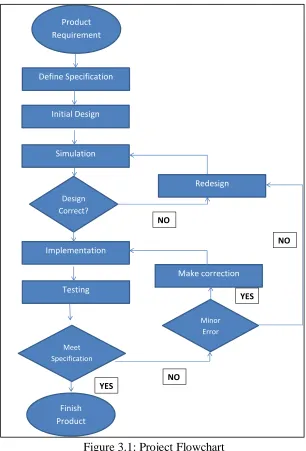
It is a well known fact that the most important step in the research process is to define the problem as well as discussed the methods of study. Research methods are referring to how the researcher gets the information and analysed the result based on the research objective. At this point, the information and details of the flowchart sequence on how the project is performed and an explanation of each step is also provided.
13
Product Requirement
Define Specification
Initial Design
Simulation
Design Correct?
Implementation
Testing
Meet Specification
Finish Product
Minor Error
Make correction Redesign
NO
NO
NO YES
[image:22.612.173.479.97.548.2]YES
Figure 3.1: Project Flowchart
The next stage is writing the VHDL code and performing the compilation using the Quartus II and doing the simulations in the ModelSim-Altera working platform. Several different types of sequencing method are simulated with their own architecture. If there is an error, the coding needs to recheck and make the correction in order to produce good output. Finally, the system is applied to the analysis of DNA databases and compared it with a previous sequencing method to see the differences. The final stage is a report writing for this project.
3.2 System Block Diagram
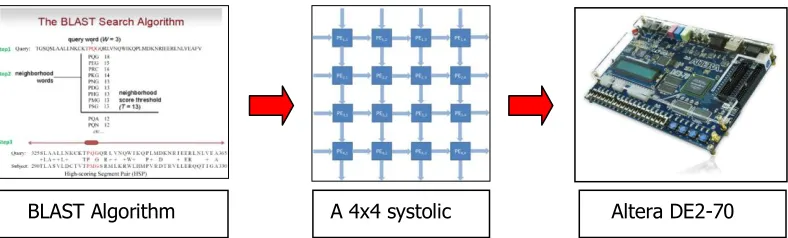
[image:23.612.119.513.394.513.2]A block diagram as shown in Figure 3.1 is basically the flow of this project. It consist of three main parts, writing VHDL code for BLAST algorithm, designing systolic array architecture and implementation of Altera DE2-70 FPGA board. These three parts are the main systems that will be focusing on this project.
Figure 3.2: BLAST algorithm with systolic array architecture A 4x4 systolic
array BLAST Algorithm
array
15
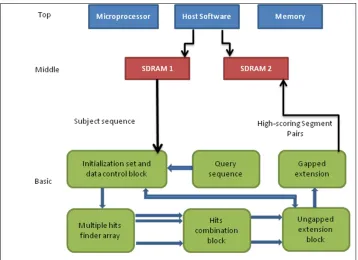
Figure 3.3: Block diagram of the simulated system
From Figure 3.2 shows DNA sequence alignment system with a systolic array architecture consists of three layers. The top layer is a host computer which runs Altera Quartus II and ModelSim for design and simulation purpose. The middle layer consists of two SDRAM. The basic layer is the systolic array-based parallel architecture fitted on FPGA. The main part of this system is the basic layer because all sequencing and comparing process occurs in this layer.
For the top layer of the system, an HP Compaq 8200 Elite desktop computer with Intel Core i5 microprocessor and 4GB RAM to run the host software. In the middle later, two 1 GB SDRAMs are attached to the FPGA where the basic layer is located.
internal block RAMs. The four other blocks implement the three steps of the BLAST algorithm in parallel. Hits Finder Arrays can detect multiple hits per clock cycle. The Hits Combination Blocks can find combinable overlapping hits and combine them. For example, it can find adjoined overlapping hits “TGA” and “GAC” then combine them into “TGAC”. Ungapped Extension Blocks extend ungapped hits in both directions until the score meets a thread value T. Gapped Extension Block extension gapped on Hit-scoring Sequence Pairs (HSPs) through an exhaustive algorithm. The block outputs HSPs and alignment scores.
3.3 Multiple Hits Detection Module
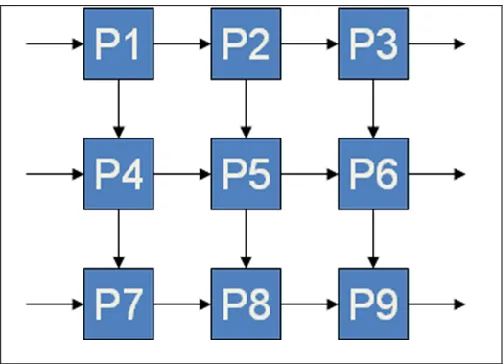
[image:25.612.203.455.473.655.2]The first approach towards a parallel implementation of a Multiple Hits Detection Module is by using two-dimensional systolic arrays. With some analysis of the data and the way systolic array synchronization process data, a two-dimensional implementation was designed. A common systolic array structure is the rectangle to be more appropriate based on way data has flowed and the operations to process computationally intensive tasks. The two-dimensional architecture of systolic array as shown in Figure 3.3.
17
Arrows represent directions of data flowing. In this architecture, data flow synchronously across two-dimensional network, usually with different data flowing in different directions. Each unit at each step takes in data from one or more neighbour ( up and right), processes the data, and in the next step outputs results in the opposite direction ( down and left).
3.3.1 Multiple Hits Detection Architecture
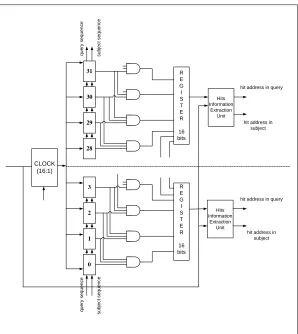
Multiple Hits Detection Module is used to detect 3-word hits and record hits addresses on the query and the subject sequence. This design can detect more than one hits in only one cycle, that is why less time is used. The architecture of Multiple Hits Detection Module is shown in Figure 3.4.
R E G I S T E R 16 bits R E G I S T E R 16 bits 31 30 29 28 3 2 1 0 CLOCK (16:1) Hits Information Extraction Unit Hits Information Extraction Unit q u e ry s e q u e n c e s u b je c t s e q u e n c e q u e ry s e q u e n c e s u b je c t s e q u e n c e
hit address in query
hit address in subject hit address in query
[image:26.612.182.480.326.660.2]hit address in subject
From the Figure 3.4, the systolic array has 32 processing units, every three units are connected to one 3-input AND gates. Every 16 gates outputs are connected to 16-bit register. The value of both registers is sent to the corresponding Hits Information Extraction Units for recording the hits address in the query and the subject sequence. For this system a Clock Division Block coordinates the systolic array and the Hits Information Extraction Units.
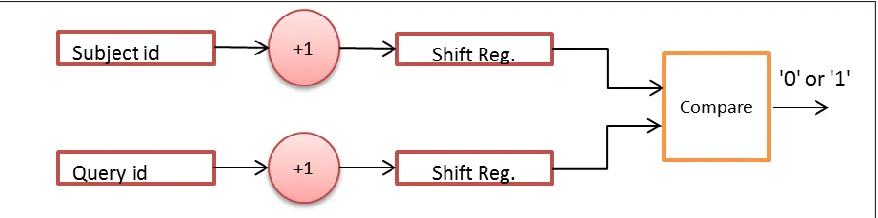
[image:27.612.109.548.433.542.2]A whole system start when a query sequence with 32 characters is forwarded into the systolic array that means each processing unit holds a character from the query sequence. Then the subject sequence drove into the systolic array by each internal clock rising edge. Meanwhile, the incoming subject character and the query character which is held by the unit are compared, if they are identical, the logic ‘1’ would be generated and otherwise, and the logic ‘0’ would be generated. The comparison result is an input of a 3-input AND gate. Every three processing units, maps to an AND gate. A hit is detected when the logic ‘1’ is generated from its output. So, the systolic array with 3-input AND gates can detect multiple hits at one internal clock rising edge. The architecture of the processing unit in the systolic array is illustrated in Figure 3.5.
Figure 3.6: Architecture of Processing Unit of Multiple Hits Detection Module
19
The Multiple Hits Detection Module is a parallel, pipelined architecture. The systolic array with 32 processing units cooperates with 32 3-inputs AND gates to detect hits in both sequences. The responsibility of Hits Information Extraction Block is recording those hits’ locations. The two processes in the module are driven by two clocks.
3.3.2 Behaviour Simulation Multiple Hits Detection Module
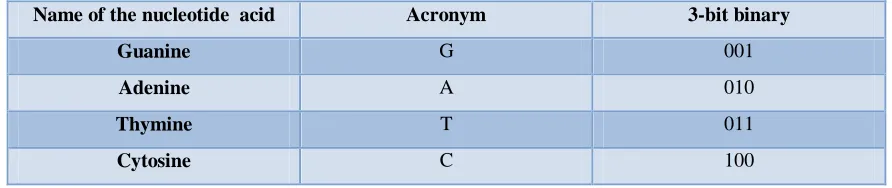
[image:28.612.104.550.351.445.2]Several experiments were made to the behaviour simulation of Multiple Hits Detection Module. 3-bit binary represents one kind of nuclide acid in a DNA. Table 3.1 describes the names of nucleic acid and their 3-bit binary.
Table 3.1: 3-bit binary description for nucleic acids in a DNA
Name of the nucleotide acid Acronym 3-bit binary
Guanine G 001
Adenine A 010
Thymine T 011
Cytosine C 100
Multiple Hits Detection Module is actually a systolic array-architecture. Several experiments were designed to show the correctness of the behaviour function of the architecture. For example:
CTATGATGATAAATGATTATATAATCATTACG-> Query sequence ATTAATTGAACTCATATTTATATAATAAGCGA-> Subject sequence
Systolic array status 1:
Query: GCATTACTAATATATTAGTAAATCAGAGTAGT Subject: TTA
Hit address in a query sequence is 16 and subject sequence is 2.
Systolic array status 2:
Query: GCATTACTAATATATTAGTAAATAGTAGTATC Subject: AGCGAATAATATATTTATACTCAAGTTAATTA
Hit address in a query and subject sequence is 25.
3.4 Hits Combination Block
The Multiple Hits Detection Module may output a large amount of hits per clock cycle if there is high similarity between query and subject sequence. Ungapped Extension Block is relatively slower than Multiple Hits Detection Module and the systolic array in this situation. Hence, the speed between both stages is unbalanced.
21
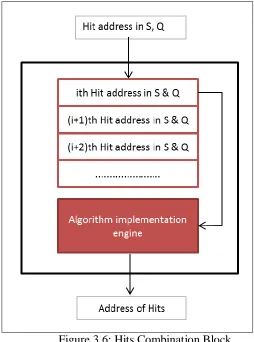
[image:30.612.200.454.205.547.2]This block contains an Hits (First In First Out) FIFO buffer which is used to store hits location addresses from both query and subject sequence. The algorithm implementation engine executes hits combination algorithm the forward the hit addresses and hit length of the Ungapped Extension Block. The data flow in this block is shown in Figure 3.6.
Figure 3.6: Hits Combination Block
starting address is the address which is recorded minus 1, because the recorded address is the address of the middle word in a 3-word hit. The ending address is the address of the last character in a sequence, so (Ending address = Starting address + (sequence length -1)). Here, the sequence length is equal to 3. Then a comparison between ith hit’s ending address and (i+1)th hit’s starting address is performed. If ith hit’s ending address is greater than or equal to the (i+1)th hit’s starting address, there will be an overlap between two hits. The algorithm can determine new addresses in both subject sequence and query sequence of the merged hit and calculate its length. Then the algorithm records the new address and hit length at the ith place in Hit’s FIFO buffer. If ith hit’s ending address is less than the (i+1)th hit’s starting address, the (i+1)th hit address will be chosen to be compared with (i+1)th hit address. This operation continues until the Hits FIFO buffer is empty.
3.5 Parallel Architecture for Multiple Hits Detection Module and Hits Combination Block
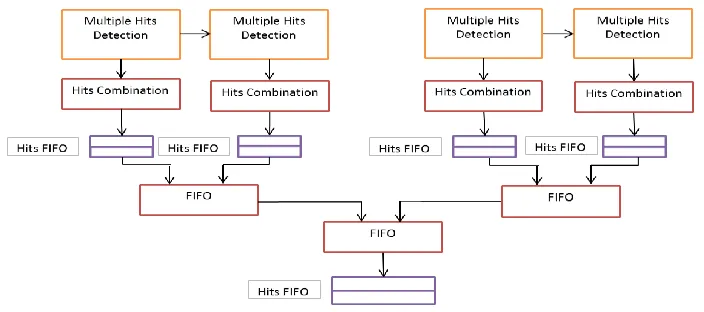
The speed for hit detection can be increased if Multiple Hits Detection Module can work together with Hits Combination Block in parallel architecture that shown in Figure 3.7.
[image:31.612.130.482.489.645.2]23
The large systolic array contains many Multiple Hits Detection Modules. Each module matches one Hits Combination Block, each of which records and combines hits detected by its mapped module. After that, it sends the hits information to a local hits FIFO. Then FIFO Combination modules combine hits FIFOs and deliver hits information to larger hits FIFOs. In this architecture, Multiple Hits Detection Modules are connected in a serial way to extend the array comparison size. Each Hits Combination Block map for a Multiple Hits Detection Module so that each block can detect overlapping hits and merge them simultaneously. The parallel implementation trades on-chip resource for speed.
3.6 Ungapped Extension Block
[image:32.612.168.486.496.673.2]This block implements the ungapped extension step of the BLAST algorithm. Hits information will be stored by FIFO. The score matrix BLAST Nucleotide Matrixis applied to find the alignment score for a pair of words. If this block detects a hit in a FIFO, the address of the hit word in query sequence and subject sequence and the hit length would be extracted from the FIFO to compute both extension points. After this step, the Ungapped Extension Algorithm Implementation Engine can finish the ungapped extension step. The data flow in the Ungapped Extension Block is shown in Figure 3.8.
From the figure, the hits information is entered the FIFO. Addresses of hits in query sequence and subject sequences included in this information. The algorithm implementation engine will calculate the start points of the extension in the query sequence and the subject sequence.
-3 6
15 6
-3
Query A G G T T A C T=15
-4 -4 5 5 5 -4 -4
Subject T T G T T C T
G G T T A T=7
-4 5 5 5 -4
T T G T T C T
32
REFERENCES
1. Stephen F. Ailtshcul, Warren Gish, Webb Miller, Eugene W. Myers, David J. Lipman (1990), Basic local alignment search tool, Journal of Molecular Biology, Volume 215, Issue 3, pp. 403-410.
2. Sudhir Kumar (2005), Molecular clocks: four decades of evolution, Nature Reviews Genetics, Volume 6, pp. 654-662.
3. Needleman, S. and Wunsch, C. (1970), A general method applicable to the search for similarities in the amino acid sequence of two sequences”, Journal of Molecular Biology, Volume 48(3), pp. 443-453.
4. Smith, T.F. and Waterman, M.S.,“ Identification of Common Molecular Subsequences”, Journal of Molecular Biology, Volume 147, pp 195-197. 5. Altschul, S. and Madden T. (1981), “Gapped BLAST and PSI-BLAST: a
new generation of protein database search programs”, Nucleic Acids Res, Volume 25 (17), pp. 3389-402.
6. Herbordt, M.C., Model, J., Gu, Y.F., Sukhwani, B. and VanCourt, T. (2006), “ Single Pass, BLAST-Like, Approximate String Matching on FPGAs”, 14th Annual IEEE Symposium on Field-Programmable Custom Computing Machines, pp. 217-226.
7. F. Zhang, X-Z. Qiao, Z-Y. Liu (2002), “A parallel Smith-Waterman algorithm based on divide and conquer,” ICA3PP ’02.
8. Needleman, Saul B. and Wunsch, Christian D. (1970), “ A general method applicable to the search for similarities in the amino acid sequence of two proteins”. Journal of Molecular Biology, Volume 48, pp. 443-453
9. H.T. Kung. (1982), “Why Systolic Architectures?”Cotnpurer, Volume 15. No. 1, pp. 37-46.
10.Rao, A.A. And Visakhapatanam (2007), “ A Tool for 8m, kilo Pairwise Alignment Algorithm”, Management Review: An International Journal, Volume 2 (1), pp. 28-40.
12.Xia, F., Dou, Y. and Xu, J.Q. (2008), “Families of FPGA-Based Accelerators for BLAST Algorithm with Multi-seeds Detection and Parallel Extension”, CCIS 13, pp. 43-57.
13.M.C. Herbordt, J. Model, Gu Yongfeng, B. Sukhwani and T. VanCourt (2006), “Single Pass, BLAST-Like, Approximate String Matching on FPGAs”, Proc. 14th Annual IEEE Symposium on Field-Programmable Custom Computing Machines , pp. 217–226.
14.S.A.M Al Junid, Z. Abed Majid, A.K Halim (2008), “Development of DNA Sequencing Accelerator based on Smith-Waterman Algorithm with Heuristic Divide and Conquer Technique for FPGA Implementation”. ICA3 23.
15.F. Zhang, X-Z. Qiao, Z-Y. Liu (2002), “ A parallel Smith-Waterman Algorithm based on divide and conquer”, ICA3 02.
16.T. Oliver T Oliver, B Schmidt, D Maskelll. (2005) “Hyper Customized Processors for Bio-Sequence Database Scanning on FPGAs”, Proceedings of the ACM/SIGDA 13th international symposium on Field programmable gate arrays (FPGA), pp 229 – 237.
17.Sidhu, R.; Prasanna, V.K. (2001) “Fast Regular Expression Matching Using FPGAs”, Proceedings of the 9th Annual IEEE Symposium on Field-Programmable Custom Computing Machines (FCCM), pp 227 – 238.
18.Hutchings, B.L.; Franklin, R.; Carver, D. (2002),” Assisting network intrusion detection with reconfigurable hardware”, Proceedings of the 10th Annual IEEE Symposium on Field- Programmable Custom Computing Machines, pp 111-120.
19.S. Guccione and Eric Keller.(2002), “Gene Matching Using JBits”. Proceedings of the 12th International Conference on Field- Programmable Logic and Applications, Lecture Notes In Computer Science; Volume 2438, pp 1168-1171.
20.K. Muriki, K.D Underwood, R. Sass (2005). “RC-BLAST: Towards a Portable, Cost-Effective Open Source Hardware Implementation”, Proceedings 19th IEEE International Symposium Parallel and Distributed Processing (IPDPS), pp 196b-196b.
34
22.D.A. Benson, I. Karsch-Mizrachi, D.J. Lipman, J. Ostell, D.L. Wheeler,( 2005), “GenBank, Nucleic Acids Res.”, Jan 1; Volume 33 (Database issue):D34-8,.
23.Jacobi, R.P., Ayala-Rinc´on, M., Carvalho, L.G.A., Llanos, C.H., Hartenstein, R.W., (2005) “Reconfigurable systems for sequence alignment and for general Dynamic programming.” Genetics and Molecular Research, 4. Volume 3, pp. 543–552.
24.G. Tempesti, D. Mange, A. Stauffer, and C. Teuscher., (2002),” The BioWall: An electronic tissue for prototyping bio-inspired systems.” Proceedings of 2002 NASA/DoD Conference on Evolvable Hardware, IEEE, pp. 221–230. 25.Kuon, I. and Rose, J. (2007), “Measuring the gap between FPGAs and
ASICs.” IEEE Transactions on Computer-Aided Design of Integrated Circuits and Systems 26.Volume 2, pp. 203–215.
26.Malhis, N., Butterfield, Y.S.N., Ester, M., and Jones, S.J.M., (2009), “Slider maximum use of probability information for alignment of short sequence reads and SNP detection.” Bioinformatics Volume 25, pp.1- 6.
27.Trapnell, C. and Salzberg, S.L., (2009), “How to map billions of short reads onto genomes.” Nature biotechnology Volume 27. pp. 5- 455.
28.T.Oliver, B. Schmidt, Y. Jakop and D.L. Maskell, (2006), “Accelerating the Viterbi algorithm for profile Hidden Markov Models using reconfigurable hardware”. Lecture Notes in Computer Science, Springer-Verlag, Volume 3991, pp. 522–529.
29.Y. Yamaguchi, Y. Miyajima, T. Maruyama and A. Konagaya, (2002), “High speed homology search with FPGAs”. In Pacific Symposium on Biocomputing, pp. 271– 282.
![Figure 1.1: Molecular clocks four decades of evolution [2]](https://thumb-us.123doks.com/thumbv2/123dok_us/8772381.899585/12.612.150.540.76.281/figure-molecular-clocks-decades-evolution.webp)