Shinde et al. World Journal of Pharmaceutical and Life Sciences
IN VITRO
EFFICACY OF BIOAGENT AND ORGANIC AMENDMENT
AGAINST DAMPING-OFF OF TOMATO PATHOGEN (
PYTHIUM
APHANIDERMATUM
)
Manisha S. Shinde1*, K. B. Rakholiya2 and R. R. Waghunde3
1
Ph. D. Scholar, Department of Plant Pathology, N. M. College of Agriculture, Navsari Agricultural University, Navsari-396450.
2
Associate Professor, Department of Plant Pathology, N. M. College of Agriculture, Navsari Agricultural University, Navsari-396450.
3
Assistant Professor, 1College of Agriculture, Navsari Agricultural University, Bharuch.
Article Received on 25/09/2016 Article Revised on 15/10/2016 Article Accepted on 07/11/2016
ABSTRACT
Studies on interaction of antagonists by dual culture method indicated that Trichoderma harzianum (Navsari isolate), Pseudomonas fluorescens (Navsari isolate) and T. fasciculatum (Navsari isolate)
were found strong antagonistic against P. aphanidermatum. Organic extracts tested in vitro against Pythium aphanidermatum revealed that, castor cake had strong inhibitory effect on the growth of P. aphanidermatum.
KEYWORDS:Bioagents, Organic amendment, Damping-off, Tomato and T. hazianum.
INTRODUCTION
Damping-off is one of the destructive disease in the greenhouse, field and nursery, affecting germinating seeds and young seedlings. Damping-off is an important disease of in greenhouse and field bed of tomatoes, causing important losses in nurseries where young and susceptible transplants are produced. It is commonly caused by Pythium spp., /Phytophthora
spp./Rhizoctonia spp./Fusarium spp./ Macrophomina spp. (Agrios, 2005). Among the fungal diseases, damping-off caused by Pythium aphanidermatum (Edson) Fitzpatrick in nurseries is a major constraint in vegetables production causing 62 % mortality of seedlings
World Journal of Pharmaceutical and Life Sciences
WJPLS
www.wjpls.org
SJIF Impact Factor: 3.347*Corresponding Author Dr. Manisha S. Shinde
Ph. D. Scholar,
Department of Plant
Pathology, N. M. College
of Agriculture, Navsari
Agricultural University,
major species causing 75-80 per cent damping-off in tomato and chilli. Manoranjitham et al. (2001) also reported 60 % mortality of chilli seedlings both in nursery and main field.
Pythium spp.is probably the most abundant and widespread plant pathogenic fungal species in soil (Pieczarka and Abawai, 1978). P. aphanidermatum and P. ultimum, a main causal agent of pre and post-emergence damping-off in tomatoes (Gravel et al., 2005). Continuous use of fungicides detoriate the soil health environmentl. Hence use of bioagent like
Trichoderma spp. Pseudomonasfluorescens, Bacillus spp. and organic amendment like caster cake FYM help in protecting soil environment and prevent diseases. Hence in present study fungal and bacterial bioagents and organic amendments are used in vitro against Pythium aphanidermatum.
MATERIAL AND METHODS
Efficacy of bioagents against Pythium aphanidermatum under in vitro condition
Experiment was carried with Completely Randomized Design with three replication and seven treatments for bioagent and three replication and six treatments in organic amendment by dual culture method during 2014.
Treatment detail
Sr. No. Bioagents (NAU, isolates)
T1 Trichoderma viride
T2 T. harzianum
T3 T. virens
T4 T. fasciculatum
T5 Pseudomonas fluorescens
T6 Bacillus subtilis
T7 Control
Various known native isolates viz., Trichoderma viride, T. harzianum, Trichoderma fasciculatum, T. virens, Pseudomonas fluorescens, and Bacillus subtilis was screened for their effectiveness against Pythium aphanidermatum. by dual culture technique as suggested by Kumar and Hooda (2007). The test organisms (Trichoderma spp.) and the pathogen was grown on PDA while bacterial bioagent was grown on nutrient agar. Sterilized PDA (20 ml) was poured aseptically in 90 mm diameter sterilized Petri plate for testing Trichoderma spp.
old actively growing culture of the bioagents and the test pathogen was cut separately with the help of sterilized cork borer and placed on solidified PDA at 4 cm away from each other. The experiment was replicated three times. Test pathogen and bioagent was subjected separately for growth and comparison. All inoculated plates was incubated at 27±1°C in BOD. The colony diameters of test pathogen in treated and control was observed periodically observation was recorded after 72 hrs. of incubation and Per cent inhibition of mycelial growth of the pathogen was calculated by using the formula given by Bell et al. (1982).
Where, I= Per cent inhibition (%)
C= Colony diameter in control plates (mm2) T= Colony diameter in treated plates (mm2)
Efficacy of extract of organic amendments against Pythium aphanidermatum under in vitro.
To find out antifungal activity of organic amendment on pathogen, different amendment viz., farm yard manure (FYM), vermicompost, poultry manure, mustard cake, castor cake, and neem cake, was evaluated following the method suggested by Jha et al. (2007).
Treatment Detail
Treatment Name of extract Concentrations (%)
T1 Neem Cake 10 20 T2 Castor Cake 10 20 T3 Mustard Cake 10 20
T4 FYM 10 20
T5 Vermicompost 10 20 T6 Control - -
Water extracts of above organic amendments was prepared by incorporating 25 g shade dried fine powder of each amendment into 250 ml of sterilized distilled water. The extracts was passed after 24 hours through muslin cloth and filtered through filter paper. This was constituted 10 per cent standard extract. In amendment oat meal powder and agar powder was added @ 2.0 per cent (w/v) to this extracts and then sterilized in autoclave for 15 min. Twenty millilitres sterilized oat meal agar medium was poured into sterilized Petri plates. Plates without addition of any amendment served as control. After solidification, the Petri
100
plates was inoculated with 5 mm diameter discs of 6 days old culture of the pathogen with the help of sterilized cork borer and placed at the centre and incubated for 3 days. Three replicates was maintained for each medium. Observations on colony diameter after 48 hrs. was recorded after incubation. Percent growth inhibition was calculated using the following formula suggested by Vincent, (1927).
PGI = C-T x 100 C
Where,
PGI = Per cent Growth Inhibition (%)
C = Average diameter of mycelial growth in control (mm). T = Average diameter of mycelial growth in treated (mm).
RESULT AND DISCUSSION
Antagonistic effect of bioagents against Pythium aphanidermatum in vitro by dual culture method.
In present study, attempts were made to identify antagonistic microorganisms for Pythium aphanidermatum in in vitro. Seven known native isolate were tested against P. aphanidermatum by dual culture method. Among them, the least growth of the pathogen was recorded in T. harzianum (Navsari isolate) (16.86 mm)which was significantly superior over the rest. Next best in order of merit was P. fluorescens (Navsari, isolate) (20.79 mm) which was followed by T. fasciculatum (Navsari isolate) (21.07 mm). The T. viride (Navsari isolate) (24.37 mm), T. virens (Navsari isolate) (44.27 mm) and Bacillus subtilis (Navsari isolate) (78.19 mm) were comparatively less effective in inhibiting the growth of P.
aphanidermatum.Trichoderma harzianum (Navsari isolate) showed maximum (81.26 %)
growth inhibition after 4 days of incubation and appeared to be the most superior over all the antagonists tested which was followed in sequence by P. fluorescens (Navsari isolate) (76.90 %), T. fasciculatum (Navsari isolate) (76.59 %), T. viride (Navsari isolate) (72.92 %), T. virens (Navsari isolate) (50.81 %) and Bacillus subtilis (Navsari isolate) (13.12 %) in decreasing order for per cent growth inhibition of P. aphanidermatum.( Table 1)
It was evident from these studies that among all the antagonists evaluated by dual culture method, T. harzianum (Navsari isolate), P. fluorescens (Navsari isolate), T. fasciculatum
considered as potential antagonists against P. aphanidermatum. T. virens (Navsari isolate) and B. subtilis (Navsari isolate) have showed poor growth inhibition of the pathogen. This suggests that biological control of damping-off tomato using T.harzianum (Navsari isolate),
T. fasciculatum (Navsari isolate) and P. fluorescens (Navsari isolate) were found very useful in South Gujarat area.
Muthukumar et al. (2011) recorded maximum growth inhibition of P. aphanidermatum by
Trichoderma species. Malhotra et al. (2011) evaluated 13 isolates of biocontrol fungi and 4 bacterial strains against damping-off fungus. The results show that among the fungal species
Gliocladium virens and T. harzianum (T8) are the most effective in inhibiting fungus mycelial growth 74.82 per cent and 73.33 per cent respectively. Among the bacterial strains maximum growth inhibition was recorded by P. fluorescens P.f.1 (73.33 %) followed by P. fluorescens P.f.2 (62.22 %). While, Yadav and Joshi (2012) found Pseudomonas fluorescens
and Bacillus subtilis were more effective in inhibiting the growth of P. aphanidermatum than
Trichoderma sp. These results are in harmony with earlier workers viz., Ramesh (2004), Kumar and Hooda (2007), Mishra, 2010) and Muthukumar et al. (2010) It may be due to production of viridin as reported by Brain (1951) or may be due to the penetration of antagonistic hyphae into hyphae of the pathogen at the place of contact as confirmed by Mukherjee et al. (2001). The antagonistic organisms act on the pathogen by different mechanisms viz., competition, lysis, antibiosis, siderophore production and hyperparasitism (Vidyasekaran, 1999). The present findings are in complete agreement with the findings of the above workers.
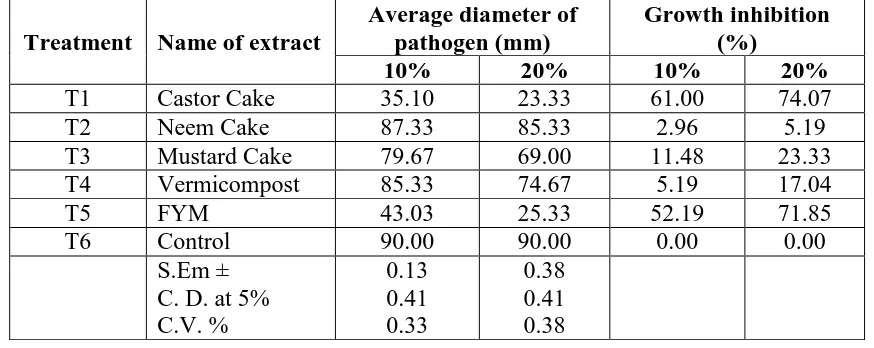
Testing of organic extracts against Pythium aphanidermatum in vitro.
The aqueous extracts of different organics were evaluated for their inhibitory effect on
Pythium aphanidermatum. Among all the organic extracts minimum growth was recorded in
mustard cake at 10 % (11.48 %) and neem cake at 20 % (5.19 %) and at 10 % (2.96 %) were least effective in inhibiting the growth of the P. aphanidermatum. (Table 2)
From this study, it is clear indicated that castor cake and FYM were found effective in reducing the growth of P. aphanidermatum causing damping-off of tomato. The present investigation is more or less similar to the work done by earlier workers Yadav (2010) who evaluated different organic amendments against P. aphanidermatum and reported that castor cake significantly reduced mycelial growth (87 %).
Table 1: Antagonistic effect of bioagents against Pythium aphanidermatumin vitro.
Table 2: Effect of organic amendment against Pythium aphanidermatum in vitro.
ACKNOWLEDGMENT
The author wish to thanks to the Department of Science and Technology, Ministry of Science and Technology, New Delhi, India for providing inspire fellowship during research work of Ph. D.
Sr.
No. Name of antagonist
Average diameter of pathogen (mm)
Growth inhibition (%)
T1 Trichoderma harzianum 16.86 81.26
T2 T. viride 24.37 72.92
T3 T. fasciculatum 21.07 76.59
T4 T. virens 44.27 50.81
T5 Bacillus subtilis 78.19 13.12
T6 Pseudomonas fluorescens 20.79 76.90
T7 Control 90.00 -
S.Em ± C. D. at 5% C.V. %
0.21 0.66 0.89
Treatment Name of extract
Average diameter of pathogen (mm)
Growth inhibition (%)
10% 20% 10% 20%
T1 Castor Cake 35.10 23.33 61.00 74.07 T2 Neem Cake 87.33 85.33 2.96 5.19 T3 Mustard Cake 79.67 69.00 11.48 23.33 T4 Vermicompost 85.33 74.67 5.19 17.04 T5 FYM 43.03 25.33 52.19 71.85 T6 Control 90.00 90.00 0.00 0.00
REFERENCES
1. Agrios, G. N. Plant disease caused by fungi. In: Plant Pathology IVth Ed. Academic Press, USA. 2005; pp. 266-270.
2. Bell, D. K., Wells, H. D. and Markham, C. R. In vitro antagonism of Trichoderma species against six fungal pathogens. Phytopathology, 1982; 72: 379-382.
3. Brain, P. W. Antibiotics produced by fungi. Botanical Rev., 1951; 17: 357-370. 4. Echobichon, D. J. Pesticide use in developing countries. Toxicology, 2001; 160: 27-33. 5. Gravel, V., Martinez, C., Antoun, H. and Tweddell, R. J. Antagonist microorganisms with
the ability to control Pythium damping-off of tomato seeds in rockwool. BioControl, 2005; 50: 771- 786.
6. Jha, A. K., Upadhayay, J. P. and Lal, H. C. Evaluation of organic amendments against white mold of Phaseolous vulgaris. J. Mycol. Pl. Pathol., 2007; 37(1): 141-142.
7. Kumar, M. R. and Hooda, I. Evaluation of antagonistic properties of Trichoderma species against Pythium aphanidermatum causing damping-off of tomato. J. Mycol. Pl. Pathol., 2007; 37(2): 240-243.
8. Mahrotra, R. S. and Agrawal, A. Rots, damping-off, downy mildews and white rusts. In: Plant Pathology, IInd Ed. Tata McGraw-Hill Publishing Company Limited, New Delhi. 2004; pp: 312-368.
9. Manoranjitham, S. K., Prakasam, V. and Rajappan, K. Biocontrol of damping-off of tomato caused by Pythium aphanidermatum. Indian Phytopath., 2001; 54(1): 59-61. 10. Mishra, V. K. In vitro antagonism of Trichoderma spp. against Pythium aphanidermatum.
J. Phytology., 2010; 2(9): 28-35.
11. Mukherjee, S., Tripathi, H. S. and Rathi, Y. P. S. Integrated management of wilt complex in frenchbean (Phaseolus vulgaris L.). J. Mycol. Pl. Path., 2001; 31(2): 213-215.
12. Muthukumar, A., Eswaran, A. and Sangeeta, G. Occurance, virulence and pathogenicity of species of Pythium inciting damping-off disease in chilli. J. Mycol. Pl. Pathol., 2010; 40(1): 67-71.
13. Muthukumar, A., Eswaran, A. and Sanjeevkumar, K. Exploitation of Trichoderma spp. on the growth of Pythium aphanidermatum in chilli. Brazilian J. Microbiol., 2011; 42: 1598-1607.
14. Pieczarka, D. J. and Abawi, G. S. Populations and biology of Pythium species associated with snap bean roots and soils in New York. Phytopathology, 1978; 68: 409-416.
16. Ramamoorthy, V., Raguchander, T. and Samiyappan, R. Enhancing resistant of tomato and hot pepper to Pythium disease by seed treatment with Fulorescent pseudomonads.
Eur. J. Plant Pathol., 2002; 108: 429-441.
17. Ramesh, R. Management of damping-off in brinjal using biocontrol agent. J. Mycol. Pl. Pathol., 2004; 34(2): 666-669.
18. Vidyasekaran, P. (1999). Biotechnological approaches to suppress seed to plant transmission of seed-borne pathogens. In: National Symposium on Seed Science and Technology. 5-7 August, University of Mysore, Manasagangotri, Mysore, India, pp.41. (Fide: Kumar P. N., M.Sc. Thesis (2009) U.A.S., Dharwad).
19. Vincent, J. M. Distortion of fungal hyphae in the presence of certain inhibitors. Nature, 1927; 150: 850.
20. Yadav, D. L. (2010). Biochemical variability in isolates of Pythium spp. Incitant of damping-off in bidi tobacco and it’s management. M.Sc. (Ag.) Thesis submitted to Anand Agricultural University, Anand.