Q
UALITY
I
MPROVEMENT OF
M
ANUKA
H
ONEY
T
HROUGH THE
A
PPLICATION OF
H
IGH
P
RESSURE
P
ROCESSING
A thesis submitted in fulfilment of the requirements for the degree of
Doctor of Philosophy in Chemical and Materials Engineering
University of Auckland
2014
Abstract
ii
ABSTRACT
The quality of honey is known to be compromised when it goes through thermal processing due to its negative impact on the unstable and thermolabile honey components which originated from the nectar and bees themselves. This present work is undertaken to access the use of an emerging food preservation technique known as “High Pressure Processing” for treating honey, as an alternative to the conventional thermal processing. In this thesis, honey quality has been addressed by measuring the effects of high pressure processing parameters (pressure, time and temperature) on nutritional properties of honey, namely total phenolic content and antioxidant activity. Honey samples, contained in small pouches, were subjected to different pressures (200-600 MPa) at close to ambient temperatures (25-33°C) for different holding times (10 to 30 min). Thermal processing (49-70°C) was also carried out for comparison purpose. Results demonstrated that high pressure processing operated at 600 MPa for 10 min has capability to increase significantly the total phenolic content and antioxidant activity by 47% and 30%, respectively. Besides, the result showed that high pressure processing can maintain the natural colour of honey which relates directly to consumer perception, while retaining its shear-thinning behaviour and viscosity with no significant changes (p > 0.05). High pressure processing can also control hydroxymethylfurfural (HMF) concentration in honey during process within the standard limit, 16.93 to 18.76 mg/kg (which is below than the maximum allowed limit of 40 mg/kg). This work also reveals that high pressure processing can enhance antibacterial activity of Manuka honey significantly. It shows an increase in the percentage inhibition of Staphylococcus epidermidis from 64.15 ± 5.86% to 84.34 ± 7.62% when honey was
Table of Contents
v
TABLE OF CONTENTS
ABSTRACT ii
DEDICATION iii
ACKNOWLEDGEMENT iv
TABLE OF CONTENTS v
LIST OF FIGURES x
LIST OF TABLES xiii
NOMENCLATURE xv
CHAPTER 1: Introduction 1
1.1 Introduction 2
1.2 Research objectives 3
1.3 Thesis framework 4
CHAPTER 2: Literature Review 6
2.1 Honey: A natural sweetener and its valuable properties 7
2.2 Production, Collection and Process of Honey 14
2.3 Conventional Thermal Treatment of Honey Processing 16
2.4 Alternative Thermal Processing Methods for Honey 22
2.4.1 Microwave heating 22
2.4.2 Infrared heating 23
2.5 Non-Thermal Processing Methods for Honey 24
2.5.1 Ultrasound 24
2.5.2 Ultraviolet 25
2.5.3 Membrane filtration 26
2.6 High Pressure Processing 27
2.6.1 Evolution of High Pressure Processing 27
2.6.2 General Principle of High Pressure Processing and
Adiabatic Heating of Compression 30
2.6.3 High Pressure Processing Equipment 33
2.6.4 Impact of high pressure on food quality 36
2.6.5 Inactivation of microorganisms under pressure 42
2.7 Advantages and Limitation of HPP 45
Table of Contents
vi
2.7.2 Limitation 46
CHAPTER 3: High pressure processing (HPP) of honey for the improvement of
nutritional value 47
Chapter Abstract 48
3.1 Introduction 49
3.2 Material and methods 51
3.2.1. Honey sample preparation 51
3.2.2. High pressure processing (HPP) equipment 51
3.2.2.1. HPP of honey 52
3.2.2.2 Ambient temperature HPP 52
3.2.2.3. Combined HPP–thermal processing of honey 52
3.2.3. Thermal processing of honey 52
3.2.4. Total phenolic content (TPC) determination 53
3.2.5. Statistical analysis 53
3.3 Results and discussion 54
3.3.1. Total phenolic content (TPC) of unprocessed Manuka honey 54 3.3.2. High pressure processing (HPP) of Manuka honey 56 3.3.3. Combined HPP and thermal processing of Manuka honey 58
3.3.4. Thermal processing of Manuka honey 60
3.3.5. Comparison of HPP, HPP–thermal and exclusively thermal
processing of Manuka honey 61
3.4 Conclusions 62
CHAPTER 4: High-Pressure Processing of Manuka Honey: Improvement of
Antioxidant Activity, Preservation of Colour and Flow Behaviour 63
Chapter Abstract 64
4.1 Introduction 65
4.2 Material and Methods 67
4.2.1 Honey Samples Preparation 67
4.2.2 Processing of Honey 67
4.2.2.1 High Pressure Processing Equipment 67
4.2.2.2 HPP of Honey at Ambient Temperature 68
4.2.2.3 Combined HPP–Thermal Processing of Honey 68
4.2.3 Thermal Processing of Honey 68
Table of Contents
vii
4.2.4.1 Antioxidant Activity 69
4.2.4.2 Colour 70
4.2.4.3 Rheological Behaviour and Viscosity 70
4.2.5 Statistical Analysis 71
4.3 Results and Discussion 72
4.3.1 Effect of Processes on Honey Antioxidant Activity 72
4.3.2 Effect of Processes on Colour of Honey 75
4.3.3 Effect of Processes on Honey Flow Behaviour 77
4.4 Conclusions 81
CHAPTER 5: High Pressure Processing (HPP) of Manuka honey: Brown pigment
formation, improvement of antibacterial activity and
hydroxymethylfurfural content 82
Chapter Abstract 83
5.1 Introduction 84
5.2 Material and Methods 86
5.2.1 Honey samples preparation 86
5.2.2 Processing honey 86
5.2.2.1 High Pressure Processing (HPP) equipment 86
5.2.2.2 HPP of honey at ambient temperature 87
5.2.2.3 Combined HPP- thermal processing of honey 87
5.2.2.4 Thermal processing of honey 87
5.2.3 Brown pigment 88
5.2.4 Antibacterial activity 88
5.2.5 Hydroxymethylfurfural, HMF content 89
5.2.6 Statistical analysis 90
5.3 Results and discussion 91
5.3.1 Influence of treatments on brown pigment formation 91 5.3.2 Influence of treatments on antibacterial activity 94 5.3.3 Influence of treatments on hydroxymethylfurfural content 96 5.3.4 The relationship between the brown pigment formation,
antibacterial activity, antioxidant activity and
hydroxymethylfurfural 98
Table of Contents
viii
CHAPTER 6: High Pressure Processed Manuka Honey: Change in Nutritional
and Rheological Properties over One Year Storage 100
Chapter Abstract 101
6.1 Introduction 102
6.2 Material and Methods 103
6.2.1 Honey samples preparation 103
6.2.2 High Pressure Processing (HPP) equipment 103
6.2.2.1 HPP of honey at ambient temperature 104
6.2.3 Monitoring changes in honey properties during storage
of one year 104
6.2.4 Physicochemical Analysis 104
6.2.4.1 Moisture content, total soluble solids and total
solids 105
6.2.4.2 pH measurement 105
6.2.4.3 Electrical conductivity 105
6.2.5 Nutritional properties analysis 105
6.2.5.1 Antioxidant activity 106
6.2.5.2 Total Phenolic Content 106
6.2.5.3 Brown pigment 106
6.2.6 Rheological behaviour and viscosity 106
6.2.7 Statistical analysis 107
6.3 Results and Discussion 108
6.3.1 Changes in physicochemical properties 108
6.3.2 Changes in nutritional properties: antioxidant activity, total
phenolic content and brown pigment formation 109
6.3.3 Changes in rheological properties and viscosity 114
6.4 Conclusions 118
CHAPTER 7: An insight on the relationship between food compressibility and
microbial inactivation during high pressure processing 119
Chapter Abstract 120
7.1 Introduction 121
7.2 Materials and Method 123
Table of Contents
ix
7.2.2 Honey inoculation and packaging 123
7.2.3 Preparation of honey samples with different concentration 124 7.2.4 High pressure processing equipment and operation 124
7.2.4.1 HPP of honey samples 124
7.2.5 Thermal processing of honey 125
7.2.6 Saccharomyces cerevisiae cells enumeration 125
7.2.7 Compressibility measurement 126
7.2.8 Statistical analysis 126
7.3 Results and Discussion 127
7.3.1 Compressibility and ° Brix during high pressure processing 127 7.3.2 The combined effect of compressibility and sugar protective
nature on the inactivation of Saccharomyces cerevisiae 132
7.4 Conclusions 137
CHAPTER 8: Conclusions, Recommendation and Implication of the Project 138
8.1 Conclusions 139
8.2 Recommendations for Future Work 141
8.3 Implications of the Project 142
Publications and Presentations Based on Thesis Work 143
Publications 144
Presentations (Oral) 146
List of Figures
x
LIST OF FIGURES
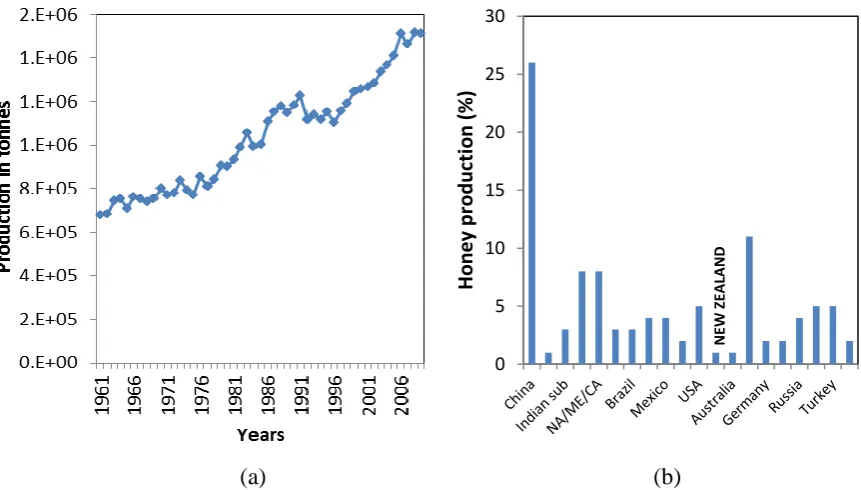
Figure 2.1: (a) Production quantity of natural honey in world from 1961 to 2009
(b) Global honey production by select country and region (FAO). 7 Figure 2.2: Average composition of honey (the data is summarized from Alvarez-Suarez
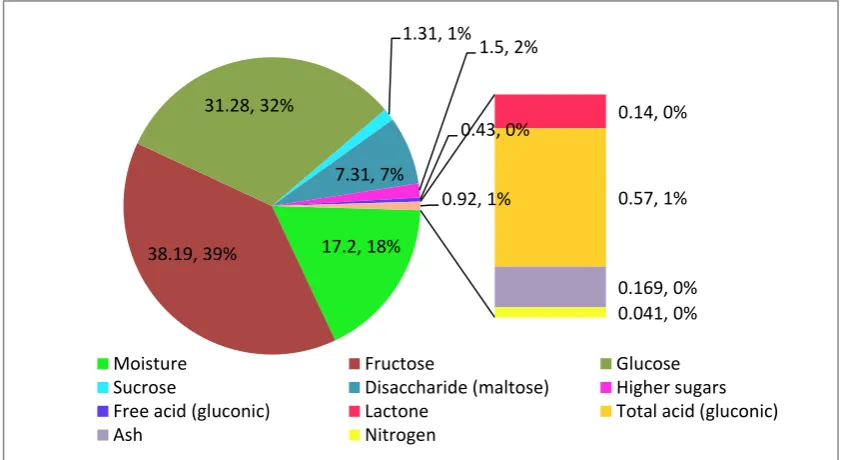
et al., 2010, Jeffrey and Echazaretta, 1996 and Olaitan et al., 2007). 9 Figure 2.3: The production of honey from nectar (adapted from Grane and Kirk
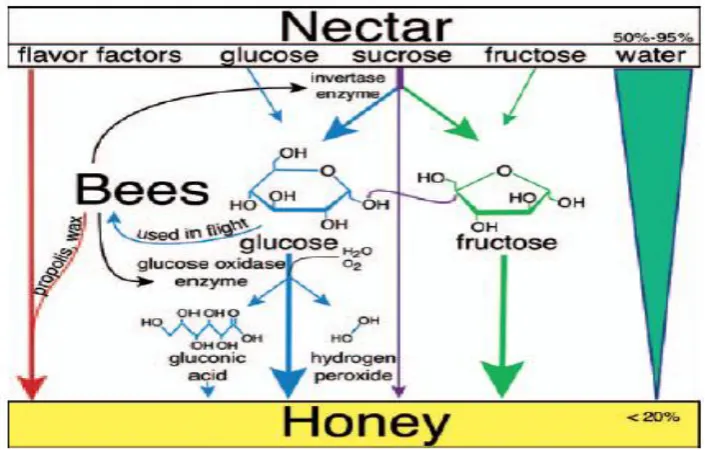
Visscher, 2007). 14
Figure 2.4: Innovative processing which includes alternative thermal processing (1-2) and non-thermal processing (3-5) provide an approach to honey safety and preservation that are designed to retain the natural and as fresh properties of
honey. 15
Figure 2.5: The flow of conventional process in honey production. 16
Figure 2.6: A brief history of high pressure food processing. 28
Figure 2.7: Industrial scale high pressure machines used worldwide and total vessel volume used for different food products; not including 15 dismantled machines installed before 2003. Total number in production in April 2013: 212. Global HPP food production in 2012: 350,000,000+ kg (Purroy, 2013). 29 Figure 2.8: Typical plot of pressure, temperature and time during high pressure
processing of honey using QFP 2L-700 Laboratory Food Processing
System (Avure Technologies, Columbus, OH, USA). 33
Figure 2.9: A typical high pressure processing system for treating food. 34 Figure 2.10: (A) Direct system for generation of high isostatic pressure and (B) Indirect
system. 35
Figure 2.11: (a) QFP 2L-700 Laboratory Food Processing System (Avure Technologies, Columbus, OH, USA), (b) 2-litre pressure vessel and (c) schematic diagram
of the system. 36
Figure 3.1: Total phenolic content of honey samples after treated with HPP at different
pressure and time in comparison to unprocessed. 57
Figure 3.2: Total phenolic content of honey samples after treated with HPP (600 MPa) for different temperature and time in comparison to unprocessed. 59 Figure 3.3: Total phenolic content of honey samples after thermal treatments, for
List of Figures
xi
temperatures for 10 min as compared with unprocessed. The samples were
subjected to HPP at 600 MPa. 62
Figure 4.1: Antioxidant activity (%) of Manuka honey for different processes. All the
processes had the duration of 10 min. 73
Figure 4.2: Correlation between antioxidant activity of HPP treated Manuka honey (600 MPa at ambient temperature) and its total phenolic content. 74 Figure 4.3: Flow curves of (a) unprocessed sample and HPP- treated samples at ambient
temperature and (b) combined HPP-thermal and thermal treated Manuka
honey. 78
Figure 4.4: The viscosity curves as a function of shear rate. (a) Unprocessed and
HPP-processed Manuka honey at ambient temperature 79
Figure 5.1: Percentage increase of brown pigment and hydroxymethylfurfural content in HPP- treated honey sample (ambient temperature) at different pressure in comparison to combined HPP-thermal and thermal treatment for 10 min
treatment time. 93
Figure 5.2: Percentage inhibition of S. epidermidis at different concentration of Manuka
honey. 94
Figure 5.3: Percentage inhibition of S. epidermidis in HPP- treated (200, 400 and 600 MPa) and thermally treated Manuka honey (50, 60 and 70°C) for 10 min.
95 Figure 5.4: Percentage increase of HMF in HPP- treated honey sample (ambient temp)
at different pressure and different processing time 97
Figure 6.1: Changes in (a) total phenolic content, (b) antioxidant activity and (c) brown pigment formation in (□) untreated and (■) HPP-treated honey during 12
months storage. 110
Figure 6.2: Percentage increase in A) antioxidant activity, B) total phenolic content and C) brown pigment formation of untreated and HPP-treated honey during 12
months storage 112
Figure 6.3: Flow curves of (a) untreated honey and (b) HPP-treated honey at different storage time. The storage time is indicated as ♦ = 0 month; ■= 5 months; χ =
11 months and ▲= 12 months. 114
List of Figures
xii
Figure 6.5: Percentage increase of viscosity of untreated and HPP-treated honey (600 MPa, 10 min, ambient temperature) at shear rate 0.1s-1 during 12 months
storage. 118
Figure 7.1: Compressibility of honey solution at different pressure levels as a function
of ° Brix after subjected to high pressure processing. 127
Figure 7.2: Saccharomyces cerevisiae cell survivor curves in honey (80° Brix) subjected to high pressure treatment (ambient temperature) at (i) ◊ = 200; □ = 400 and
Δ = 600 MPa. 129
Figure 7.3: Comparison of log reduction of Saccharomyces cerevisiae after pressure treatment at 600 MPa for 2 and 30 min and thermal treatment at 55°C for 10
min at different ° Brix. 132
List of Tables
xiii
LIST OF TABLES
Table 2.1: Honey export volumes, value and prices of New Zealand market from 2002
to 2013 (Farm Monitoring Report, 2013). 8
Table 2.2: The characteristics of honey. 10
Table 2.3: Commercial application of honey (Farm Monitoring Report, 2013). 13 Table 2.4: The summary of effects of conventional thermal treatment on honey quality. 18 Table 2.5: Overview of temperature increase during compression for some foods. 31 Table 2.6: Application of high pressure processing and its effects on the qualities of
various types of food. 38
Table 3.1: Total phenolic content from different types of honey obtained from previous
works in comparison with this study. 55
Table 4.1: The values of L*, a*, b* and total colour difference (TCD) for HPP,
combined HPP-thermal and thermal treated Manuka honey. 76
Table 4.2: Apparent viscosity of unprocessed and HPP treated Manuka honey (ambient temperature, 10 min treatment) at shear rate 5.39 s-1. 80 Table 4.3: Viscosity of combined HPP - thermally treated and thermally- treated
Manuka honey (10 min treatment) at shear rate 5.39 s-1. 80 Table 5.1: Brown pigment formation and HMF content of untreated and treated honey
samples after 10 min treatment. 92
Table 5.2: Correlation matrices for four variables (antibacterial activity, brown pigment, HMF and antioxidant activity) of high pressure-treated honey using Pearson
correlation. 99
Table 6.1: The physicochemical properties of untreated and HPP-treated Manuka honey (600 MPa/ambient temperature/10 min) after 12 months storage at room temperature (approximately 24°C). Values are presented as mean ± standard
deviation of two measurements. 109
Table 6.2: Apparent viscosity of untreated honey and HPP-treated honey at shear rate
0.1 s-1 during 12 months storage. 117
Table 7.1: Correlation between compressibility (MPa-1) and ° Brix at different pressure levels after subjected to high pressure processing. The data were reassembled
from Min et al. (2010). 128
List of Tables
xiv
various types of medium during HPP. 131
Table 7.3: The changes in log reduction (∆ log reduction) of Saccharomyces serevisiae subjected to high pressure and thermal treatment with respect to different °
Brix. 134
Table 7.4: Correlation matrices for ° Brix, compressibility and Saccharomyces cerevisiae cells reduction subjected to high pressure treatment (600 MPa, ambient temperature), obtained using Pearson correlation from Statistica
Nomenclature
xv
NOMENCLATURE
AA = antioxidant Activity
ANOVA = analysis of variance
AU = absorbance Unit
Abs = absorbance
Abscontrol = absorbance reading of the control
Abssample = absorbance reading of the sample
A660nm = absorbance at 660 nm
BPF = brown pigment formation
CFU = colony forming unit
Cp = specific heat capacity
DHA = dihydroxyacetone
DNA = deoxyribonucleic acid
DPPH = 2,2-diphenyl-1-picrylhydrazyl
D-value = decimal reduction time at specific temperature
FAO = food and agriculture organization of the United Nations
GAE = gallic acid equivalent
g = gram
HHP = high hydrostatic pressure
HMF = hydroxymethylfurfural
HPP = high pressure processing
Hz = hertz
hrs = hours
in = inches
j = joule
Nomenclature
xvi
L = litre
MGO = methylglyoxal
MIC95 = minimum inhibitory concentration of at least 95% inhibition
MPa = megapascal
MWCO = molecular weight cut off
min = min
mL = mililitre
mS = milisiemen
N = number of microorganism
NaCl = sodium chloride
Na2CO3 = sodium carbonate
No = initial number of microorganisms
nm = nanometers (wavelength)
OH = hydroxyl molecules
P = pressure
pH = decadic logarithm of acid dissociation
psi = pounds-force per square inch
R2 = linear regression coefficient/ coefficient of determination
r = correlation coefficient
rpm = revolutions per minute (measure of the frequency of a rotation)
S = entropy
SD = standard deviation
S.cerevisiae = Saccharomyces cerevisiae S. epidermidis = Staphylococcus epidermidis
T = temperature
TCD = total colour difference
Nomenclature
xvii Tavg = average temperature
Tset = setting temperature
t = time
UF = ultrafiltration
UHP = ultra high pressure
UV = ultraviolet
V = volume
YPD = yeasts peptone dextrose
Zn (CH3COO)2.2H2O = zinc acetate in water
Zp- value = Pressure required for one log reduction in the D-value.
ºC = degree centigrade
< = less than
≥ = greater than or equal to
± = plus minus
% = percentage
w/v = weight/volume
µ = micro
β = thermal expansion coefficient
W = watt
CHAPTER 1
Chapter 1: Introduction
2 1.1 Introduction
Honey is an iconic New Zealand product with an excellent export growth potential because of its high nutritional value and unique antibacterial activity. Although increasingly expanding in international markets, ($120 million exports in 2012 and expected future growth potential of $200-300 million) the growth of New Zealand honey industry is at risk due to the unpredictable quality (Farm Monitoring Report, 2013). Honey is known to have wide range of health promoting phytochemicals which can possess antimicrobial, antiviral, antiparasitory, anti-inflammatory, antioxidant, antimutagenic and antitumor effects (Bogdanov et al., 2008). The importance of these bioactive compounds on human health therefore generates a great interest in honey processing research.
In commercial processing plant, honey is usually heated for inhibiting microorganism, facilitating packaging and delaying crystallization. Although thermal processing is a convenient way to protect honey from fermentation (since an increase of water activity during crystallization tends to cause fermentation), high temperature can be detrimental to the quality and biological propertiesas well as masking its originality. The quality of honey is known to be compromised when it goes through thermal processing due to the unstable and thermolabile components, decomposition of vitamins and also destruction of the integrity of the enzymes particularly when it is heated at 60°C and above (Nagai et al. 2001). Therefore, the possibility of thermal processing to improve the nutritional value look rather limited when honey is exposed to higher temperature.
To maintain honey quality as high as possible, novel processing techniques such as non-thermal processing need to be implemented. High pressure processing (HPP) is a non-non-thermal food preservation technique that has been cited as one of the best innovations in food processing in 50 years. HPP can be applied without causing significant heating that can damage taste, texture and nutritional value of the food (Farid, 2010 ).The process involves applying about 400-900 MPa at chilled or mild process temperature, with or without the addition of heat.
Chapter 1: Introduction
3
allow most foods to be preserved with minimal effects on taste, texture, appearance or nutritional value, hence it preferred as „minimally preserved‟.
1.2 Research objectives
This research project is driven by the recent interest to develop advanced technologies and innovations in honey processing as an effort to improve its quality in comparison with conventional thermal method. The main objectives of this research were to HPP Manuka honey and investigate the effect of HPP on its quality, namely; (i) total phenolic content, (ii) antioxidant activity, (iii) colour, (iv) viscosity, (v) flow behaviour, (vi) antibacterial activity, (vii) brown pigment formation and (viii) hydroxymethylfurfural content.
The specific objectives of this research were to study:
1. The effect of HPP of Manuka honey at ambient temperature for 5 to 30 min on its quality.
2. The combined effect of pressure (200, 400 and 600 MPa) and mild temperatures (50, 60 and 70°C) processing of Manuka honey on its quality.
3. The effect thermal processing of Manuka honey on its quality in comparison to HPP at similar temperatures and time.
4. The effect of storage of HPP treated- Manuka honey for 12 months at 25°C, on its quality.
5. The effect of HPP of Manuka honey on its microbial inactivation, particularly osmophilic yeasts (Saccharomyces cerevisiae).
Chapter 1: Introduction
4 1.3 Thesis framework
In this thesis, the work was presented following the outline below:
Chapter 2 briefly introduces the background of this study, including (i) an overview of honey (ii) the production, collection and process of honey and (iii) general idea about high pressure processing as a non-thermal treatment in food processing. In this section, the effect of conventional thermal treatment on honey quality, which is determined by its sensorial, chemical, physical and microbiological characteristics, is highlighted. An alternative thermal treatment (microwave heating and infrared heating) and non-thermal treatment (ultrasound, ultraviolet and membrane filter) are also presented.
Chapter 3 introduces a detailed work on the effect of HPP on total phenolic content (TPC) as a main phytochemical in honey. From a nutritional perspective, this is associated with the production of a higher antioxidant honey, known to prevent certain diseases such as cancer. The work in this chapter has been published in Innovative Food Sciences and Emerging Technologies.
Chapter 4 then introduces work on the effect of HPP on antioxidant activity and its relation with total phenolic content. While understanding the flow behaviour of honey is of prime importance in all stages of honey production which in turn affects its quality and affects consumers‟ preference, the change of viscosity as affected by HPP during honey processing is determined. Apart from antioxidant activity and rheological properties, Chapter 4 also reports the change in colour of HPP-treated sample. The work in this chapter has been published in Food Bioprocess Technology.
Chapter 5 presents the study on the effect of HPP on brown pigment formation as well as antibacterial activity of Manuka honey against Staphylococcus epidermidis. The relationship between brown pigment formation and antibacterial activity in high pressure-treated honey is also established. The study of hydroxymethylfurfural (HMF) which is considered as an important quality parameter in honey is also included in this chapter. The work has been published in International Journal of Food Science and Technology.
Chapter 6 is then conducted to provide evidence that the change in physicochemical, nutritional (antioxidant activity, total phenolic content and brown pigment) and rheological
Chapter 1: Introduction
5
Chapter 7 focuses on an insight study on the relationship between food compressibility (where honey is chosen as a model food) and microbial inactivation (where Saccharomyces cerevisiae was selected as the testing microorganism) during high pressure processing.
CHAPTER 2
Chapter 2: Literature Review
7
2.1 Honey: A natural sweetener and its valuable properties
Honey is flower nectar which has been collected, regurgitated and dehydrated by honey bees to enhance its nutritional properties making it ready for human consumption. Known as a nature's original sweetener, honey has been used as a food for at least 6000 years. Due to the unique combination of components in honey which makes it a prized addition to the diet,
health treatment and medicine, the consumption of honey is on the rise. According to the Food and Agriculture Organization of the United Nations (FAO), total honey production in 1961 was 0.7 million tons and it was steadily increased to about 1.5 million tons in 2009 (Alvarez-Suarez et al., 2010) as presented in Figure 2.1a. It was expected that the demand will increase for the next few years. Honey production is spread throughout the world; China is the largest single producer while Europe is the largest producing region. New Zealand accounts for about 1% of global production (Figure 2.1b).
[image:28.595.84.515.367.612.2](a) (b)
Figure 2.1: (a) Production quantity of natural honey in world from 1961 to 2009, (b) Global honey production by select country and region (Source from Food and Agriculture Organization of the United Nations, FAO).
In New Zealand, honey exports are on a roll and growing rapidly. Exports have grown at a 30% compound rate for the past decade, reaching US$70 million in 2010. Exports are strong to Europe (in particular the United Kingdom and Germany) and Asia. New Zealand‟s
Chapter 2: Literature Review
8
[image:29.595.95.498.201.412.2]Manuka honey is the most expensive in the world and receives a significant premium over other suppliers. The on-going international success of Manuka honey is driving the growth of the total New Zealand honey industry (Table 2.1)
Table 2.1: Honey export volumes, value and prices of New Zealand market from 2002 to 2013 (Farm Monitoring Report, 2013).
Year ended 30
June Export volume (tonnes)
Export value ($
million fob) price ($ per kg fob) Average export
2002 3028 20.6 6.8
2003 3233 25.5 7.87
2004 2394 23.1 9.65
2005 3273 33.5 10.23
2006 3927 38.4 9.77
2007 4411 47.8 10.83
2008 5366 62.6 11.66
2009 7384 81 10.97
2010 7147 97.6 13.66
2011 6721 101.6 15.11
2012 7675 121.1 15.78
2013 8054 144.9 17.99
fob = free on board
Honey composition varies based on its plant origin and weather conditions when the honey was produced (Grane and Kirk Visscher, 2007). A general composition of all honey types can be summarized as in Figure 2.2. About 17% of honey is composed of water (Grane and Kirk Visscher, 2007) but moisture content can vary greatly in the range of 13% to 25% (White, 1961). A moisture content of below 17% in honey is considered the safe level for retarding yeast activity (Subramanian et al., 2007). Honey can be classified as; (i) blossom honey, obtained predominantly from the nectar of flowers; (ii) honeydew honey, produced by bees after they collect pierce plant cells, ingest plant cells, and then secrete it again; (iii) monofloral honey, in which the bees forage predominantly on one type of plant, and which is named according to the plant and (iv) multifloral honey (also known as polyfloral) that has several botanical sources, none of which is predominant, for example: meadow blossom honey and forest honey.
Chapter 2: Literature Review
9
acids and phenolic acids) has been shown to reduce the risk of heart disease, cancer, cataracts
and inflammatory processes (Aljadi and Kamaruddin, 2004; Bogdanov et al., 2008; Socha et
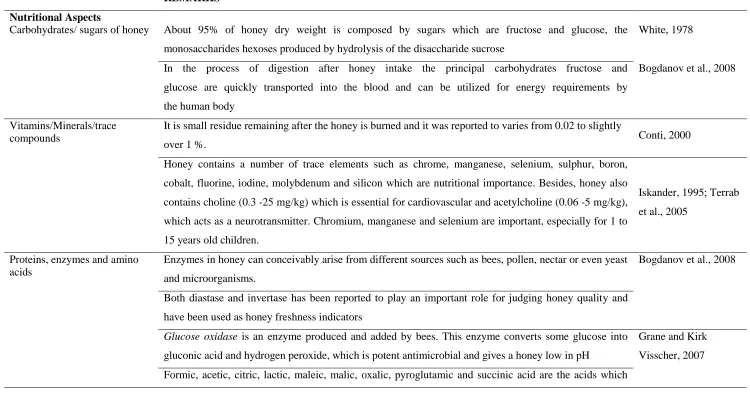
[image:30.595.87.511.175.405.2]al., 2011). These different biological effects of honey with respect to its nutritional, physical, microbiological and medicinal aspects have been summarized and presented in Table 2.2
Figure 2.2 Average composition of honey (the data is summarized from Alvarez-Suarez et al., 2010, Jeffrey and Echazaretta, 1996 and Olaitan et al., 2007).
There are several factors on why honey has a great advantage in these biological affect which are:
(i) Osmotic effect of honey. Honey is a saturated or super-saturated solution of a mixture of fructose and glucose sugars (84%), therefore, no fermentation occurs in honey (Molan, 1992).
(ii) The antimicrobial activity of honey is its acidity. The pH being between 3.2 and 4.5 is low enough to be inhibitory to many pathogens (Cooper et al., 2002).
(iii) Presence of antibacterial phytochemical components (Mavric et al., 2008; Yao et al., 2004).
(iv) Antibacterial active fraction of honey derived from the native New Zealand Manuka tree (Leptospermum scoparium), which consists of derivatives of benzoic acids, cinnamic acids and flavonoids, all of which have been identified previously in honeys which do not exhibit non-peroxide residual antibacterial activity.
17.2, 18% 38.19, 39%
31.28, 32%
1.31, 1%
7.31, 7%
1.5, 2%
0.43, 0% 0.14, 0%
0.57, 1%
0.169, 0% 0.041, 0% 0.92, 1%
Moisture Fructose Glucose
Sucrose Disaccharide (maltose) Higher sugars
Free acid (gluconic) Lactone Total acid (gluconic)
Chapter 2: Literature Review
[image:31.842.63.813.120.520.2]10 Table 2.2 The characteristics of honey.
REMARKS REFERENCES
Nutritional Aspects
Carbohydrates/ sugars of honey About 95% of honey dry weight is composed by sugars which are fructose and glucose, the monosaccharides hexoses produced by hydrolysis of the disaccharide sucrose
White, 1978
In the process of digestion after honey intake the principal carbohydrates fructose and
glucose are quickly transported into the blood and can be utilized for energy requirements by the human body
Bogdanov et al., 2008
Vitamins/Minerals/trace compounds
It is small residue remaining after the honey is burned and it was reported to varies from 0.02 to slightly
over 1 %. Conti, 2000
Honey contains a number of trace elements such as chrome, manganese, selenium, sulphur, boron,
cobalt, fluorine, iodine, molybdenum and silicon which are nutritional importance. Besides, honey also contains choline (0.3 -25 mg/kg) which is essential for cardiovascular and acetylcholine (0.06 -5 mg/kg),
which acts as a neurotransmitter. Chromium, manganese and selenium are important, especially for 1 to 15 years old children.
Iskander, 1995; Terrab et al., 2005
Proteins, enzymes and amino acids
Enzymes in honey can conceivably arise from different sources such as bees, pollen, nectar or even yeast
and microorganisms.
Bogdanov et al., 2008
Both diastase and invertase has been reported to play an important role for judging honey quality and have been used as honey freshness indicators
Glucose oxidase is an enzyme produced and added by bees. This enzyme converts some glucose into gluconic acid and hydrogen peroxide, which is potent antimicrobial and gives a honey low in pH
Grane and Kirk Visscher, 2007
Chapter 2: Literature Review
11
have been found in the honey only in small portion but it is important for the honey taste.
Aroma compounds, taste-building compounds and polyphenols
500 different volatile compounds have been identified in different types of honey. Most aroma building compounds vary in different types of honey depending on its botanical origin.
Polyphenols in honey are mainly flavonoids, phenolic acids and phenolic acid derivatives. These are compounds known to have antioxidant properties. The main polyphenols are the flavonoids, their content can vary between 60 and 460 μg/100 g of honey and was higher in samples produced during a dry season
with high temperatures.
Kenjeric et al., 2007; Tomas-Barberan et al.,
2001;
Physical Aspects
Sensitivity to heat The loss of antibacterial activity on exposure of honey to heat was of complete loss of inhibition by 17 % honey after exposure of 50% honey to 100°C for 5 min, 80°C for 10 min or 56°C for 30 min
White et al., 1964
Sensitivity to light Honey lost its ability to inhibit bacterial growth (tested in a 17 % solution) after exposing a thin film of it
to sunlight and it is confirmed that exposure of honey in a layer 1-2 mm thick to sunlight for 15 min was found to result in complete loss of non-osmotic activity
Storage effect Enzymatic activity, antimicrobial properties, microbial quality, colour and chemical composition are all
influenced by heat and storage
Microbiological Aspects
Antimicrobial activity Honey has both peroxide and non-peroxide antibacterial action, with different non-peroxide antibacterial substances involved: acidic, basic or neutral
Waili, 2004; Al-Waili and Haq, 2004;
Bogdanov et al., 1997; Molan, 1997; Mundo
et al., 2004 Antibacterial effects are different due to different substance and compounds with different chemical
properties. The high sugar concentration and low in pH is also responsible for the antibacterial activity.
Chapter 2: Literature Review
12
Medicinal Aspect
As remedy for diarrhoea Pure honey has bactericidal activity against many enteropathogenic organisms, including those of the
Samonella and Shigella species, and enteropthogenic Eschericia coli
Jeddar et al.,1985
As medicine for gastric ulcer Gastric ulcers have been successfully treated by the use of honey as a dietary supplement
Ali, 1991
For wound healing Honey is an effective treatment of wounds because it is non-irritating, non-toxic, self-sterile, bactericidal, nutritive, easily applied and more comfortable than other dressings
Bassam et al., 1997; Bergman et al., 1983;
Efem, 1988;
Ndayisaba et al., 1993;
Tan et al., 2009; Wood et al., 1997)
Rapid healing agent honey promotes healing of ulcers and burns better than any other local application
Clinical observations made are that open wounds heal faster and are ready faster for closure by stitching when dressed with honey than when dressed conventionally
Stimulation of healing process Honey has been found to be effective in starting the healing process in non-healing ulcers some of which had been present for a median time of 1 year, or had been treated for up to 2 years, or had shown no
Chapter 2: Literature Review
13
[image:34.595.65.559.168.651.2]Due to good nutritional value as it contains carbohydrates, proteins, vitamins, minerals and various other components, honey has been use as food in different parts of the world and in different ways. Commercial application of honey is summarized in table below:
Table 2.3: Commercial application of honey (Farm Monitoring Report, 2013).
Use of honey Remarks
Sweetener for sport beverages, non-alcoholic fruit, ice tea, yogurt drinks, chocolate milk beverages, fermented beverages, vinegar, vegetable juices; in mead production
Supplies different natural honey flavours and colours; honey sugars are fermentable and give alcoholic drinks unique flavours; prevent browning due to antioxidative properties Additive to poultry and other meat, to fruit and
vegetable processing
Antioxidant and preservative (antibacterial) properties, reduces browning improve sensory properties.
Additive to microwave foods: cakes, muffins, cookies, glazes
Superior microwave sensitivity and water activity managements than synthetic sugars
Additive to flour bagels, cereals, chicken marinades, French fries, bread, pasta, extruded snacks , corn chips, potato chips
Improve sensory properties, adds/retains moisture due to hygroscopic properties; improves browning due to reducing sugars
Additive to frozen ice cream and dough Better stability and sensory properties Additive to fruit spreads, peanut butter, nut
spread
Better storability and sensory properties
Additive to salsas and sauces Neutralize sour and burn intensity
Additive to fried or roasted beef, poultry Reduces the formation of heterocyclic aromatic amines and their mutagenic effects
Dried honey Convenient as consistent in texture, flavour and
Chapter 2: Literature Review
14 2.2Production, Collection and Processing of Honey
Honey is considered as a natural biological product evolved from the nectar. The honey in the nutshell is flower nectar which has been collected, regurgitated and dehydrated by honey bees. The production of honey from nectar is presented in Figure 2.3.
At first, pollen and nectar of the plants and flowers are collected by honey bees. Nectar is sucked out of the flowers using long, tube like tongues called proboscis and the bees store this nectar in their stomach before carried it to the beehive. At this stage, the nectar contains 80% water. While inside the bee's stomach for about half an hour, the nectar mixes with the proteins and enzymes produced by the bees, converting the nectar into honey. Invertase from hypo pharyngeal gland of bees will cleave the disaccharide (sucrose) into fructose and glucose which then doubles the number of molecules contributes to the osmotic potential. Honey was then dropped into the beeswax comb, which are hexagonal cells made of wax produced by the bees. The process is repeated until the combs are full. Bees fan their wings to evaporate and thicken the honey which contains about 14-18% water in order to ensure the long-term storage of honey. When this is done, the bees cap the honeycomb with wax and move on to the next empty comb, starting all over again.
[image:35.595.126.479.445.670.2]Chapter 2: Literature Review
15
In conventional honey processing, the use of heat is found to be essential for fast handling, to dissolve large sugar granules and to sustain honey quality. Two stages of heating applied in honey industry are known as liquefaction (to keep honey in liquid form for as long as possible), and pasteurization which is to kill the yeast and other spoilage microorganisms as well as preventing fermentation (Subramanian et al., 2007). Both stages are operated at a temperature of more than 50°C or even up to 77°C.
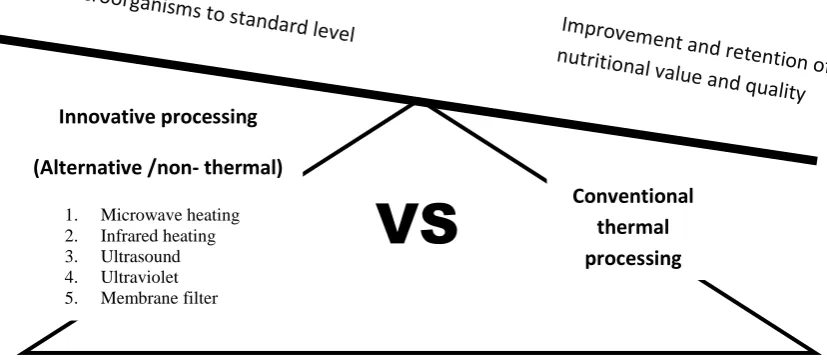
Apart from conventional treatment, alternative thermal treatment (such as microwave heating and infrared heating) and non-thermal treatment (such as ultrasound, ultraviolet and membrane filter) are proposed, explored and implemented (Barbosa-Cánovas et al., 1998) to ensure the quality and safety aspect of honey (Figure 2.4). These novel food processing technologies could provide safe, fresher-tasting, nutritive foods without the use of heat or chemical preservatives, which totally can satisfy new consumer demand (Barbosa-Canovas and Bermude-Aguirre, 2011).
Figure 2.4: Innovative processing which includes alternative thermal processing (1-2) and non-thermal processing (3-5) provide an approach to honey safety and preservation that are designed to retain the natural and as-fresh properties of honey.
Innovative processing (Alternative /non- thermal)
1. Microwave heating 2. Infrared heating 3. Ultrasound 4. Ultraviolet 5. Membrane filter
Conventional thermal processing
[image:36.595.118.532.410.591.2]Chapter 2: Literature Review
16
2.3 Conventional Thermal Treatment of Honey Processing
Thermal processing is a popular technology for food industry which ensures microbiological safety of the products. The essential principle of these methods is based on the convection and conduction mechanism of heat transfer which is generated either by combustion of fuels or by an electric resistive heateing before it transferred into the product (Pereira and Vicente, 2010).
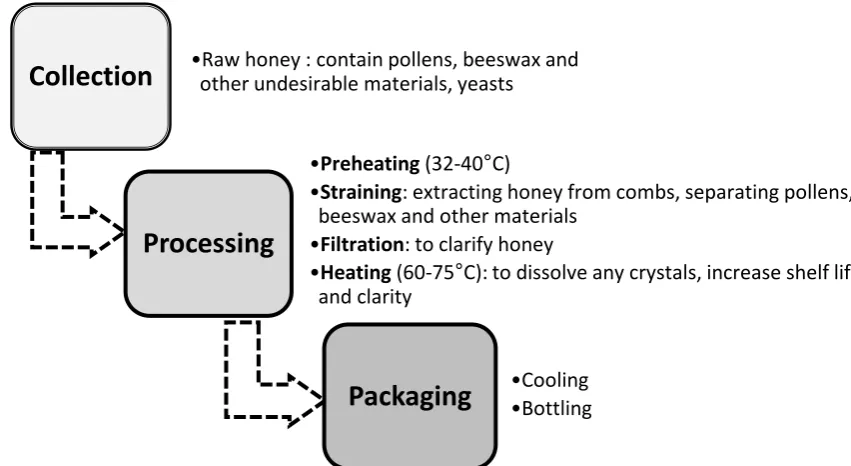
[image:37.595.114.540.419.652.2]It is known that the major problem faced by honey producers is its rapid deterioration in quality due to fermentation (Ghazali et al., 1994;Subramanian et al., 2007). Therefore, the primary objective of thermal processing of honey is to keep it stable with an extended shelf life (White, 1964). Liquefaction (operated at approximately 55°C) and pasteurization (operated normally up to 70°C) are two stages of thermal treatment applied to honey to ensure it stay in liquid form and also to destroy the microorganisms which contaminate causing it to ferment (Tosi et al., 2004). The steps of preheating, straining, filtering and indirect heating were performed before it can be stored and produced (Figure 2.5).
Figure 2.5: The flow of conventional process in honey production.
Collection
•Raw honey : contain pollens, beeswax and other undesirable materials, yeastsProcessing
•Preheating (32-40°C)
•Straining: extracting honey from combs, separating pollens, beeswax and other materials
•Filtration: to clarify honey
•Heating (60-75°C): to dissolve any crystals, increase shelf life and clarity
Chapter 2: Literature Review
17
The quality of honey is mainly determined by its sensorial, chemical, physical and
microbiological characteristics. The criteria for ensuring quality honey have been specified by the
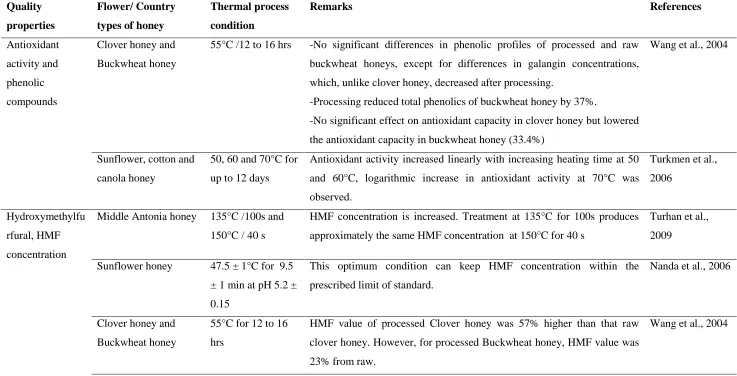
European Legislation (EC Directive 2001/110) and Codex Almentarius Commission (2001). The effect of heat processing on the quality parameters in honey is well documented and
summarized in Table 2.4.
Studies have shown that heating honey at temperature between 60 to 70°C for 10 min as well as indirect heating in conventional process which is in the range of 60 to 65°C for 25-30 min can destroy the yeasts completely. Yeasts can be grown to tens of thousands per gram although honey possesses anti-microbial characteristics, have low water content and high concentration of sugars (Bogdanov et al., 2008). Saccharomyces cerevisiae was found as the dominant yeast fermenting honey (Snowdon et al., 1996). It is also known as osmophilic or sugar tolerant yeast because it can withstand the low water content (around 16 - 21%) and high sugar concentration in honey. Food grade honey with a very high yeast count (more than 100 000 CFU/g) is not likely to be marketable (Snowdon et al., 1996). With respect to medical health applications, yeast count must be less than 500 CFU/g.
Tosi et al. (2004) reported the completely inhibition of yeasts and fungi in natural honey when heated at higher temperature, 80°C for 60 s in transient and 30 s in isothermal stage using the technique of high temperature-short time heating. Whereas, Wakhle et al. (1995) showed complete inhibition of yeast using lower temperature ranging from 63 to 65°C but with longer treatment time of 7.5 to 35 min.
Chapter 2: Literature Review
[image:39.842.66.803.94.470.2]18
Table 2.4: The summary on the effects of conventional thermal treatment on honey quality.
Quality
properties
Flower/ Country
types of honey
Thermal process
condition
Remarks References
Antioxidant
activity and phenolic compounds
Clover honey and
Buckwheat honey
55°C /12 to 16 hrs -No significant differences in phenolic profiles of processed and raw
buckwheat honeys, except for differences in galangin concentrations, which, unlike clover honey, decreased after processing.
-Processing reduced total phenolics of buckwheat honey by 37%.
-No significant effect on antioxidant capacity in clover honey but lowered
the antioxidant capacity in buckwheat honey (33.4%)
Wang et al., 2004
Sunflower, cotton and canola honey
50, 60 and 70°C for up to 12 days
Antioxidant activity increased linearly with increasing heating time at 50 and 60°C, logarithmic increase in antioxidant activity at 70°C was
observed.
Turkmen et al., 2006
Hydroxymethylfu rfural, HMF
concentration
Middle Antonia honey 135°C /100s and 150°C / 40 s
HMF concentration is increased. Treatment at 135°C for 100s produces approximately the same HMF concentration at 150°C for 40 s
Turhan et al., 2009
Sunflower honey 47.5 ± 1°C for 9.5
± 1 min at pH 5.2 ± 0.15
This optimum condition can keep HMF concentration within the
prescribed limit of standard.
Nanda et al., 2006
Clover honey and
Buckwheat honey
55°C for 12 to 16
hrs
HMF value of processed Clover honey was 57% higher than that raw
clover honey. However, for processed Buckwheat honey, HMF value was 23% from raw.
Chapter 2: Literature Review 19 Unifloral Sicilian honeys (Orange, Eucalyptus, Sulla, Chestnut)
50°C /144 hrs,
70°C / 96 hrs and 100°C / 4 hrs
No measurable amount of HMF in heated-Chesnut honey (50°C for 1
week) while orange honey after 4 days at the same temperature has exceeded the legal limit. During heating at 100°C, all honey showed
considerable formation of HMF. The HMF formation increased as heating temperature increased.
Fallico et al.,
2004
Forest honey,
multifloral honey
35, 45 or 55°C (672
hrs), 65°C (168 hrs), 75°C (24 hrs)
and 80°C (12 hrs)
HMF concentration increases with increased temperature and treatment
time
Visquert et al.,
2004
Pine, thymus, cotton,
helianthus and orange
35, 45, 55, 65 and
75°C /24 hrs
No significant increase of HMF at 55°C for 24hrs period. At 65°C HMF at
pine and orange sample is still low, while at the rest of the samples exceeded the 40 mg/kg. At 75°C the enzyme was almost destroyed and
HMF is extremely high except in pine honey which just exceeded 40 mg/kg.
Karabournioti et
al., 2001
Natural honey 100-160°C, 14-60s HMF increases from 3.9 to 10.1 mg/kg honey by 100°C 60 s heating, and
from 3.9 to 32.8 mg HMF/kg honey by 140°C 60 s treating
Tosi et al., 2004
Colour and
brown pigment formation
Orange blossom floral
honey
50, 60, 70 and 80°C
for up to 160 hrs
The increase in browning was rather negligible at 50°C and 60°C, smaller
at 70°C but very pronounced at 80°C
Vaikousi et al.,
2009
Sunflower, cotton and
canola honey
50, 60 and 70°C for
up to 12 days
Brown pigment increase as the temperature increase.
The increase was more noticeable in heated samples at
70°C than those at 50 and 60°C. The increase in brown pigment is depends on time and temperature of heating.
Turkmen et al.,
Chapter 2: Literature Review
20
Clover honey and
Buckwheat honey
55°C /12 to 16 hrs Processed Clover honey was darker in colour as compared with raw. Raw
Buckwheat honey was significantly darker in colour than processed Buckwheat honey.
Wang et al., 2004
Antibacterial activity
Manuka honey 50 - 70°C / 15 - 120 min
The highest temperature (60 and 70°C), treated for 15, 60 and 120 min exhibited the lowest percentage inhibition of Staphyloccus aureus
Al-Habsi and Niranjan, 2012
Zanthoxylum Fagara
honey
40°C/30 days, and
78°C / 5, 10 and 15 min
At 40°C, the antibacterial activity was not affected but it was decreased
significantly when honey was exposed to 78°C for 15 min
Rios et al., 2001
Canola/red stringy
bark honey
45°C / 8 hours Thermal processed honey shows significant reduction in antibacterial
activity against Staphyloccus aureus as compared with unprocessed
Chen et al., 2012
Physicochemical
properties (pH, electrical conductivity,
moisture content)
Tahonal honey 55°C / 3, 6, 9 and
12 min/
The acididity of thermal-treated Tahonal honey (55°C for 9 and 15 min)
increased during storage
Ramirez et al.,
2000
Forest honey, multifloral honey
35, 45 or 55°C (672 hrs), 65°C (168
hrs), 75°C (24 hrs) , 80°C (12 hrs)
Acidity, electrical conductivity and moisture content were unaffected by heat.
Visquert et al., 2004
Clover honey and
Buckwheat honey
55°C for 12 to 16
hours
No significant difference in moisture content between processed and raw
Clover honey. Processed Buckwheat honey showed slightly higher in moisture content as compared with raw
Wang et al., 2004
Crystallization Natural honey 140-80°C, 60-15s
(transient stage) and 30-10s
(isothermal stage)
Crystallization is inhibited at 80°C, 6s (transient stage) and 30s
(isothermal stage)
Chapter 2: Literature Review
21
Enzyme activity Natural honey 60-100°C
/120-1200s
Decrease in the diastase activity related to an increase in temperature. The
activity becomes zero at 100°C for both transient and isothermal heating.
Tosi et al., 2008
47.5 ± 1°C / 9.5 ± 1 min/ pH 5.2 ± 0.15
This optimum condition can keep diastatic activity within the prescribed limit of standard.
Nanda et al., 2006
Clover I, Clover II,
Chinese, Orange, Pepper and Buckwheat
63°C and 85°C/
5-30 min
Amylase activity was slightly decreased in all heat treated honey Babacan et al.,
2002 Longer exposure for 15 min caused honey to lose more activity in the range 4 to 28 Diastase number
Natural honey 140-80°C, 60-15s
(transient stage) and 30-10s
(isothermal stage)
An unacceptable diastase number reduction -beyond 140°C during 15 s
(transient stage), 30 s (isothermal stage)
Tosi et al., 2004
Dzidzilche honey 55°C for 3, 6, 9 and 12 min
The diastase activity diminished Ramirez et al., 2000
Pine, thymus, cotton, helianthus and orange
35, 45, 55, 65 and 75°C for 24 hrs
The decrease of invertase starts from the temperature of 35°C. The concentration of invertase at 55°C was decreased to less than the half of
its initial value at pine, about half of its initial value at orange sample and about seventy percent at cotton, thymus and helianthus. At 75°C the
enzyme was almost destroyed.
Karabournioti et al., 2001
Rheological properties and
viscosity
Dark and light honey 40, 60, 80 or 90°C /5,10 or 20 min
Both honey showed Newtonian fluids behavior. Viscosity increased with increasing ultimate heating temperature
Abu-Jdayil et al., 2002
Korean honey 55°C, 60 min Over the temperature range of 0–30°C, Korean honey varieties exhibited liquid-like rheological behavior
Chapter 2: Literature Review
22
2.4 Alternative Thermal Processing Methods for Honey
2.4.1 Microwave heating
The applications of microwave heating in food industry demonstrate significant advantages over conventional methods in reducing process time and also improving food quality. Microwave heating takes place due to the polarization effect of electromagnetic radiation at frequencies between 300 MHz and 300 GHz (Lorenz and Decareau, 1976).
The effect of microwave on the quality of honey is well documented. Power levels and treatment time are main parameters which influence the quality of honey, namely hydroxymethylfurfural, HMF content and browning (Bath and Singh., 1999; Hebbar et al., 2003). In the formation of HMF and browning pigment, the values increased with increasing both power intensity and heating duration. Hebbar et al (2003) carried out an experiment at different power levels ranging from 10 to 100 (175 - 800 W), and found that heated samples for longer duration of 45- 60s, 60s and 90 s at higher power intensity of 16.0 W/g, 11.9 W/g and 9.1 W/g, respectively resulted in rapidly high HMF (> 5 mg/kg), showing the sensitivity of honey to the power intensity and duration of heating. However, the HMF level obtained was still far below the maximum permissible statutory level of 40 mg/kg of honey. Whereas, Bath and Singh (1999) showed that power level of 280 W with heating time of 270 s give the maximum value on HMF formation with 25.789 mg/kg and 8.548 mg/kg for Helianthus annuus and Eucalyptus lanceolatus honey, respectively.
Different combinations of heating duration (15 to 90 s) and power intensity (175 -800 W) show the changes in properties. Higher power level and shorter processing time is better than lower power level and longer duration. Power level of 800W for 15s resulted in considerable reduction in yeast count (450 CFU/ mL), which is due to the rapid increase in sample temperature after exposed to the microwave heating which then leads to the rupture of yeast cell walls. They also reported that processed honey with a yeast count of 8.00 x 10² CFU/mL could be stored at 28 ± 2°C for 16 weeks without fermentation, which is due to the reduction of moisture content above 9% at power intensity of 9.1 W/g, 11.9 W/g and 16.0 W/g when the samples heated for 60 seconds.
Chapter 2: Literature Review
23
the final moisture content for all samples (19.8-21.2%) were reported in the range of the acceptable level for commercial processed honey (22%).
Ghazali et al. (1994) showed that the microwave energy used to heat samples of starfruit honey at 71°C did not affect the pH, titratable acidity, water activity, moisture, nitrogen, ash, glucose, fructose, maltose and sucrose content of the honey. However when the samples were stored over 16 weeks, major changes in moisture content, titratable acidity, sugar content and diastase activity were observed.
2.4.2 Infrared heating
Infrared heating is gaining popularity and widely applied to various thermal processing operations such as dehydration, frying and pasteurization due to higher thermal efficiency and fast heating rate / response time in comparison to conventional heating. In addition, it provides significant advantages over conventional heating such as reduced quality losses, versatile, simple and compact equipment and significant energy saving. Two conventional types infrared radiators used are electric and gas-fired heaters (Krishnamurthy et al, 2008).
In food processing, the radiant electromagnetic energy may induce changes in the electronic, vibrational and rotational states of atoms and molecules once it impinge upon a food surface. As food is exposed to infrared radiation, it is absorbed, reflected or scattered and the absorption intensities at different wavelength differ by food components. Infrared application heating was reported to be effectively used for enzyme and pathogen inactivation including bacteria, spores, yeasts and molds in both liquid and solid foods (Galindo et al., 2005; Kouzeh-Kanani et al., 1983). The efficacy of this inactivation depends on the parameters which are (i) power level (ii) temperature of food sample (iii) wavelength and bandwidth (iv) sample depth (v) types of microorganism (vi) moisture content (vii) physiological phase of microorganism and (viii) types of food materials.
Chapter 2: Literature Review
24
yeasts were noticed. They concluded that heating period of 3 to 4 min was adequate to meet all the statutory requirements of honey quality and commercially acceptable product.
2.5 Non-Thermal Processing Methods for Honey
2.5.1 Ultrasound
Ultrasound is generated by the application of a vibration force to the surface of material. Food technologist has discovered that it is possible to employ a more powerful form of ultrasound (>5 W/cm2) at a lower frequency (generally around 40 kHz), which is usually refer as power ultrasound. When applied to the surface of material, the vibration force is transmitted through the bonds within molecules. In food processing, the application of ultrasound shows considerable promises in various applications such as crystallization of fats and sugars, inhibition of enzyme activity and also enhanced preservation. Sonication in combination with heat and pressure has potential to enhance microbial inactivation (Kaloyereas, 1958; Liebl, 1977).
In honey processing, the application of ultrasound showed it benefits in eliminating the existing crystals with 9 kHz of ultrasound frequency (Kaloyereas, 1958). Liebl (1977) has improved the method for preventing granulation using higher frequency of 18 kHz which can drastically reduce the liquefaction time to less than 30 seconds. Whereas Thrasyvoulou et al. (1994) found that the ultrasound treated samples remained in the liquefied state for 344 ± 36 days, longer as compared with the heat treated sample which is remained in the liquefied state only for 282 ± 86 days. It has been reported that the probe size and cycle have significant effect on liquefaction time (Ipek, 2010).
References
148
References
Abdul Ghani, A. G. and Farid, M. M. (2007). Numerical simulation of solid–liquid food mixture in a high pressure processing unit using computational fluid dynamics. Journal of Food Engineering, 80(4), 1031–1042.
Abu-Jdayil, B., Al-Majeed Ghazawi, A., Al-Malah, K. I. M. and Zaitoun, S. (2002). Heat effect on rheology of light- and dark-coloured honey. Journal of Food Engineering, 51(1), 33–38.
Adams, C. J., Manley-Harris, M. and Molan, P. C. (2009). The origin of methylglyoxal in New Zealand Manuka (Leptospermum scoparium) honey. Carbohydrate Research, 344 (8), 1050–1053.
Ahmed, J., Ramaswamy, H. S., Alli, I. and Ngadi, M. (2003). Effect of high pressure on rheological characteristics of liquid egg. LWT - Food Science and Technology, 36(5), 517-524.
Ahmed, J., Ramaswamy, H. S. and Hiremath, N. (2005). The effect of high pressure
Treatment on rheological characteristics and colour of mango pulp. International Journal of Food Science & Technology, 40(8), 885–895.
Akhmazillah, M. F. N., M. M. Farid and Filipa, S.V.M. (2013). High pressure processing (HPP) of honey for the improvement of nutritional value. Innovative Food Science & Emerging Technologies, 20(0), 59-63.
Al, M. L., Daniel, D., Moise, A., Bobis, O., Laslo, L. and Bogdanov, S. (2009). Physico- chemical and bioactive properties of different floral origin honeys from Romania. Food Chemistry, 112(4), 863–867.
Aljadi, A.M. and Yusoff, K. (2003). Isolation and identification of phenolic acids in
Malaysian honey with antibacterial properties. Turkish Journal of Medical Sciences, 33, 229–236.
Aljadi, A. M. and Kamaruddin, M. Y. (2004). Evaluation of the phenolic contents and
antioxidant capacities of two Malaysian floral honeys. Food Chemistry, 85(4), 513– 518.
Al-Habsi, N. A. and Niranjan, K. (2012). Effect of high hydrostatic pressure on
antimicrobial activity and quality of Manuka honey. Food Chemistry, 135, 1448-1454.
References
149
Application of WLF and Arrhenius kinetics to rheology of selected dark-coloured honey. Journal of Food Process Engineering, 24, 341–357.
Alpas, H., Kalchayanand, N., Bozoglu, F., Sikes, A., Dunne, C. P. and Ray, B. (1999). Variation in resistance to hydrostatic pressure among strains of food-borne
pathogens. Applied and Environmental Microbiology, 65, 4248-4251.
Alvarez-Suarez, J., Tulipani, S., Romandini, S., Bertoli, E. and Battino, M. (2010).
Contribution of honey in nutrition and human health: a review. Mediterranean Journal of Nutrition and Metabolism, 3(1), 15–23.
Al-Waili, N.S. (2004). Investigating the Antimicrobial Activity of Natural Honey and Its Effects on the Pathogenic Bacterial Infections of Surgical Wounds and Conjunctiva. Journal of Medicinal Food, 7(2), 210-222
Al-Waili, N.S. and Haq, A. (2004). Effect of Honey on Antibody Production Against
Thymus-Dependent and Thymus-Independent Antigens in Primary and Secondary Immune Responses.Journal of Medicinal Food, 7(4), 491-494.
Amin, W.A., Safwat, M. and Ei-Iraki, S.M. (1999). Quality criteria of treacle (black honey). Food Chemistry, 67, 17–20.
Ananta, E., V. Heinz and D. Knorr (2004). Assessment of high pressure induced damage on Lactobacillus rhamnosus GG by flow cytometry. Food Microbiology, 21(5), 567-577. Anese M, Manzocco L, Nicoli M.C. and Lerici C.R. (1999). Antioxidant Properties
of Tomato Juice as Affected by Heating. J. Sci. Food Agric, 79(5), 750-754.
Anupama, D., Bhat, K. K. and Sapna, V. K. (2003). Sensory and physicochemical properties of commercial samples of honey. Food Research International, 36(2), 183–191. Areekul, V. and Toledo R.T (2010). Sporicidal effect of a continuous –flow high
pressure throttling process on honey, Phd thesis. Department of Food Science and Technology, University of Georgia.
Assil, H. I., Sterling, R. and Sporns, P. (1991). Crystal control in processed liquid honey. Journal of Food Science, 56(4), 1034–1037.
Babacan, S., L. F. Pivarnik, andA.G. Rand (2002). Honey Amylase Activity and Food Starch Degradation. Journal of Food Science, 67(5), 1625-1630.
Balasubramanian, S. and V. M. Balasubramaniam (2003). Compression heating influence of pressure transmitting fluids on bacteria inactivation during high pressure processing. Food Research International, 36(7), 661-668.
References
150
macromolecules: from structural changes to alteration of cellular processes. Biochimica Biophysica. Acta Protein Structure and Molecular Enzymology, 1595(1-2), 3-10.
Balogh, T., Smout, C., Nguyen, B. L., Van Loey, A. M., and Hendrickx, M. E. (2004). Thermal and high-pressure inactivation kinetics of carrot pectinmethylesterase: from model system to real foods. Innovative Food Science & Emerging Technologies, 5, 429-436.
Barbosa-Canovas, G. V., Pothakamury, U. R., Palou, E. and Swanson, B. G. (1998). In Nonthermal preservation of foods. New York: Marcel Decker.
Barbosa-Canovas, G. V and Bermude-Aguirre, D. (2011). Introduction Non-thermal processing technologies for food, IFT Press,UK: Wiley-BlackWell.
Barhate, R.S., Subramanian, R., Nandini, K.E. and Umesh Hebbar, H. (2003). Processing of Honey using Polymeric Microfiltration and Ultrafiltration Membranes. Journal of Food Engineering, 60, 49–54.
Barreiro, J. A., Milano, M. and Sandoval, A. J. (1997). Kinetics of colour change of double concentrated tomato paste during thermal treatment. Journal of Food Engineering, 33, 359–371.
Basak, S., Ramaswamy,H.S. and Piette, J.P.G (2002). High pressure destruction kinetics of Leuconostoc mesenteroides and Saccharomyces cerevisiae in single strength and concentrated orange juice. Innovative Food Science & Emerging Technologies, 3, 223-231.
Bassam, Z., Zohra, B.I and Saada, A. (1997). The Effects of Honey on Leishmania Parasites: An In Vitro Study. Trop Doct, 27(1), 36-38.
Bath, P. K. and Singh, N. (1999). A comparison between Helianthus annuus and Eucalyptus lanceolatus honey. Food Chemistry, 67, 389–397.
Baxter, I. A., Easton, K., Schneebeli, K. and Whitfield, F. B. (2005). High pressure processing of Australian navel orange juices: sensory analysis and volatile flavour profiling. Innovative Food Science and Emerging Technologies, 6, 372-387.
Bergman, A., Yanai, J., Weiss, J., Bell, D. and David, M. P. (1983). Acceleration of wound healing by topical application of honey. An animal model. American Journal of Surgery, 145, 374-6.