See discussions, stats, and author profiles for this publication at: https://www.researchgate.net/publication/269351366
Optimizing the Ignition Timing of a Converted
CNG Mono-Gas Engine
Article · June 2014
DOI: 10.4028/www.scientific.net/AMM.554.474
READS
36
4 authors, including:
Mas Fawzi Mohd Ali
Universiti Tun Hussein Onn Malaysia 28 PUBLICATIONS 46 CITATIONS
SEE PROFILE
Abd Fathul Hakim Zulkifli
Universiti Tun Hussein Onn Malaysia 3 PUBLICATIONS 0 CITATIONS
SEE PROFILE
Shahrin Hisham Amirnordin
Universiti Tun Hussein Onn Malaysia 18 PUBLICATIONS 10 CITATIONS
SEE PROFILE
Optimizing the Ignition Timing of a Converted CNG Mono-gas Engine
Mas Fawzi
1, a, Mohd Norfaiz Hashim
1, b, Fathul Hakim Zulkifli
1, cand Shahrin Hisham Amirnordin
1, d1
Automotive Research Group, Center for Energy and Industrial Environmental Studies, Faculty of Mechanical and Manufacturing Engineering, Universiti Tun Hussein Onn Malaysia,
86400 Parit Raja, Batu Pahat, Johor, Malaysia. a
[email protected]*, [email protected], [email protected], d
Keywords: Ignition timing, Diesel, CNG, Mono-gas
Abstract. Governmental policies on renewable energy and environmental act are aggressively being enforced to mitigate recent climate change. Natural gas is not renewable but it is the most abundant and has the lowest Lifecycle CO2 emission among fossil fuel. Realizing such promising alternative, many logistics and transportation companies are converting their existing diesel-fueled vehicle to CNG-fueled. Researchers have shown that CNG engines offer advantages compared to diesel and gasoline engines such as high efficiency and low emissions. Prior to this work, a 4.3L 4-cylinder diesel engine was modified and retrofitted with a CNG mono gas system. However, it was observed that the engine, CNG-fueled combustion is not stable especially at idling speed. The purpose of this study is to optimize the ignition timing best suited for idling both in normal operating mode (700-850 rpm) and in cold start mode (1000-2000 rpm). The ignition timings tested were 20oBTDC and 25oBTDC. The measurements were made at engine speeds from 700 to 2500 rpm. Some irregularities were found in the result, but overall, the ignition timing 25oBTDC is better than 20oBTDC in terms of fuel consumption and exhaust gas emissions. For this particular system, the results recommend that the idling engine speed should be at 700-800 rpm and 1500 rpm during the normal mode and cold start mode respectively. The use of engine speed of 1000 to 1300 rpm should be minimized to reduce overall exhaust gas emissions.
Introduction
The price of fossil fuels and recent climate change concerns among governmental bodies has led to aggressive enforcement of green and environmental policies throughout the world. All those policies have one common aim, which is to minimize the degradation of the environment while conserving the use of energy and natural resources. Until today, most shipping and logistics companies still use diesel to fuel their medium-duty, heavy-duty engines and prime mover vehicles. All these vehicles partly contribute to the pollution of our green environment. Addressing this area, a study was done by Battelle, NREL and West Virginia University. Significant exhaust gas emissions improvement was gained by modifying diesel-fueled trucks into CNG-fueled. The converted CNG engines produces 25% lower carbon monoxide, 49% lower nitrogen oxides and up to 95% lower particulate matter compared to the standard diesel engine [1].
Compressed Natural Gas (CNG) is not renewable but it is the most abundant and has the lowest Lifecycle CO2 emission among fossil fuel. CNG engines offer several advantages compared to diesel and gasoline engines such as high efficiency and low emissions while operating in lean mode [2-4]. It has long been used in stationary engines, but the application of CNG as a transport engine's fuel has been considerably advanced over the last decade with the development of lightweight high-pressure storage cylinders [5].
Researches on CNG-fueled engine ignition timing have been done by Hassan et al. in [6] and Kakaee et al. in [7]. Hassan et al. demonstrated the characteristic of engine performance when the ignition angle was varied between 22oBTDC and 34oBTDC. These ignition timings have been selected according to the characteristic of the single cylinder CNGDI engine as reported in previous Applied Mechanics and Materials Vol. 554 (2014) pp 474-478
Online available since 2014/Jun/02 at www.scientific.net
© (2014) Trans Tech Publications, Switzerland doi:10.4028/www.scientific.net/AMM.554.474
experiment conducted by the author. The torque and power trend indicate an arc with a gradient after 29oBTDC. Thus, it showed that maximum brake torque (MBT) occurs at 29oBTDC. Kakaee et al., on the other hand, studied on the sensitivity and effect of ignition timing on spark ignition engine. The speed is fixed at 3400 rpm, the ignition timing has been changed in the range of 10oCA ATDC to 41oCA BTDC, and the performance characteristics such as power, torque, thermal efficiency, pressure, and heat release are obtained and compared. Their works showed that ignition timings have a significant effect on engine performances.
Prior to this study, a 4.3L 4-cylinder diesel engine was modified and retrofitted with a CNG gas system [8]. This type of engine is mainly used by medium duty trucks, such as tanker and mini dump truck. The conversion of diesel-fueled engine which uses compression ignition into CNG-fueled which uses spark ignition, requires a spark ignition system installation in each cylinder. Following the recommended setting in the installation manual, the ignition timing was pegged at crank angle 20oBTDC. Such recommendation ignition crank angle timing may have given the best performance based on the manufacturer’s findings. However, for this particular engine, we observed that with such ignition setting, the combustion is not capable and stable especially at idling speed. The purpose of this study is to optimize the ignition timing best suited for idling both in normal operating mode (700-850rpm) and in cold start mode (1000-2000 rpm).
Experiment Setup
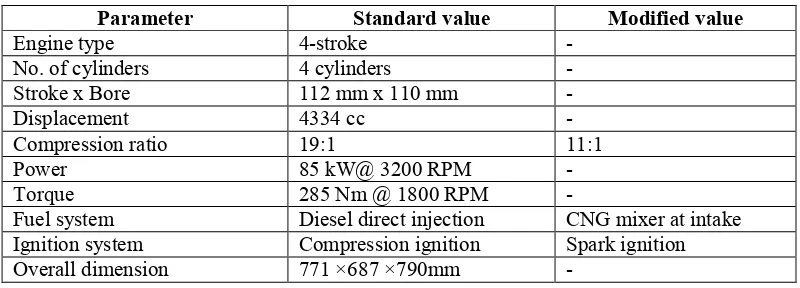
[image:3.595.91.491.454.598.2]The 4.3L 4-cylinder diesel engine specification in its standard and modified state is presented in Table 1. The compression ratio was lowered by increasing the volume of the piston crown. The original piston was machined to obtain a compression ratio of 19:1 to 11:0. This reduction is necessary to prevent engine knocking while maintaining high thermal efficiency. The diesel direct injection system was taken out and replaced by a dedicated CNG mixer installed in the engine intake pipe next to a throttle body. A close loop lambda control subsystem was also installed.
Table 1 Specification of test engine
Parameter Standard value Modified value
Engine type 4-stroke -
No. of cylinders 4 cylinders -
Stroke x Bore 112 mm x 110 mm -
Displacement 4334 cc -
Compression ratio 19:1 11:1
Power 85 kW@ 3200 RPM -
Torque 285 Nm @ 1800 RPM -
Fuel system Diesel direct injection CNG mixer at intake
Ignition system Compression ignition Spark ignition
Overall dimension 771 ×687 ×790mm -
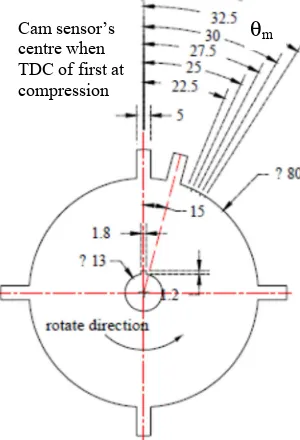
Since the conversion was made from diesel fuel to mono CNG fuel, the ignition system needs to be changed from compression ignition to spark ignition. Therefore, a spark plug was installed in each cylinder, and a coil-on-plug to provide direct ignition for each firing order. A custom ignition timing system consists of an electromagnetic-type cam sensor, and a 4+1 tooth wheel was attached to the diesel pump shaft. The sensor picks up signals from the toothed wheel which indicate the rpm of the engine and the angular position of the piston (cam shaft or crank shaft). The signals then tell the ECU the base time when to start spark and the spark sequences. A diagram of the tooth wheel is shown in Fig. 1. The relationship between the cam wheel marking, θm, and ignition timing, θg is
presented in Table 2.
The CNG fuel used in this study was obtained at a local Petronas (a Malaysian petroleum company) gas station. It was stored in a certified CNG steel tank with a pressure of 210 bar. The CNG has the following composition; methane, CH4 = 94.4 vol.%, ethane, C2H6 = 2.3 vol.%, propane, C3H8 and butane, C4H10 = 0.3 vol.% [6]. The CNG exiting the tank was regulated in two
stages until it pressure is approximately near to atmospheric pressure. Fuel flow meter and air flow meter were attached at the line just before gas and air enter the mixer. The exhaust gas emission probe was inserted at the end of the exhaust pipe while an exhaust temperature probe was placed in the exhaust manifold 30cm from the engine head. The engine was connected to a hydraulic dynamometer. Signals from the ECU were read and displayed using a PC.
In this study, the ignition timings tested were 20oBTDC and 25oBTDC, corresponding to cam wheel marking of 25oCA and 27.5oCA respectively. As mentioned earlier, the ignition timing of 20oBTDC is recommended by the developer of the ignition system. The measurements were made at engine speeds of 700, 850, 1000, 1150, 1300, 1500, 2000 and 2500 rpm. The engine load was kept at zero. A non-dispersive infrared (NDIR) type exhaust gas analyzer (SPTC Auto-Check) was used for measurement of CO, CO2, HC and O2. The Dräger MSI-200E gas analyzer was used to measure the values of NO and NOx concentration emissions.
Table 2 Ignition timing setting
Cam marking, θm (oCA)
Ignition timing, θg
(oBTDC)
32.5 35
30 30
27.5 25
25 20
22.5 15
Where;
Ignition timing, θg = 2 x (θm - 15)
Fig. 1 Cam tooth wheel diagram
Result and Discussions
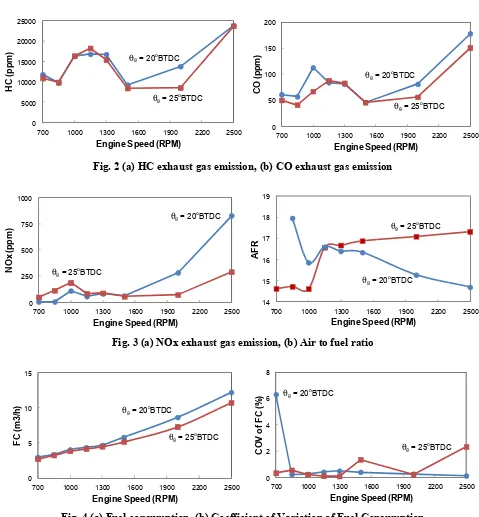
Figure 2(a) and 2(b) show the converted mono CNG gas engine hydrocarbon and carbon monoxide exhaust gas emission respectively. In each figure there are two curves, circle markers for ignition timing θg = 20oBTDC and square markers for θg = 25oBTDC. Because of the conversion
from diesel to mono CNG during this study has not been fully optimized, the overall HC exhaust gas emission is relatively high, where the minimum value is approximately 7000ppm. Both graphs show similar trends where the ignition timing θg = 25oBTDC produces lower HC and CO gas
emissions throughout the engine speed between 700 and 2500 rpm. It indicates that the ignition timing θg = 25oBTDC produced better combustion than the recommended ignition timing value.
Highly noticeable in Fig. 2(a) and 2(b) are irregular values of HC and CO emission measured between engine speed 1000 and 1300. According to the conversion system developer, the engine ECU installed does not use any fuel delivery or ignition mapping; it is simply just a PID controller. The fuel supply through the fuel mixer stepper motor is controlled by O2 signal from a lambda sensor. The conversion system was designed so that engine rotational speed does not affect the fuel control except cutting off the gas when the engine speed is lower than a certain level. At this point, even after considering the above mentioned facts, the cause of such irregularities in the exhaust gas emission have not yet discovered.
Figure 3(a) shows nitrogen oxides (NOx) emissions at specified engine speed between 700 and 2500 rpm. From the figure, the ignition timing θg = 25oBTDC produces higher NOx emission at
engine speed from 700 to 1300 rpm, but at higher engine speed (1700 to 2500 rpm) the NOx values
θm Cam sensor’s
centre when TDC of first at compression
[image:4.595.115.265.248.468.2] [image:4.595.329.489.305.447.2]are significantly lower. Figure 3(b) is the air-fuel ratio (AFR) recorded during the tests. The stoichiometric AFR for CNG is 17.0. The optimized ignition timing θg = 25oBTDC, shows a
slightly rich mixture from 700 to 1000 RPM, and maintain near stoichiometric as the engine speed is increased to 2500 rpm. In contrast, the ignition timing θg = 20oBTDC shows a lean mixture at low
engine speed and rich mixture at high engine speeds.
From Fig. 4(a), ignition timing θg = 25oBTDC shows better fuel consumption throughout the
tested engine speed ranges, compared with ignition timing θg = 20oBTDC. Using the same data,
coefficient of variation (COV) of the fuel measurement was calculated, and presented in Fig. 4(b). With an ignition timing θg = 20oBTDC, the COV of fuel consumption at engine speed 700 rpm is
6%. This high value indicates a large variation in the fuel consumption measured, thus indicates highly unstable engine operation. After changing the ignition timing to θg = 25oBTDC, the COV of
fuel consumption is reduced near to zero, which signifies relatively stabler combustion during idling. 0 5000 10000 15000 20000 25000
700 1000 1300 1600 1900 2200 2500
H C ( p p m )
Engine Speed (RPM)
0 50 100 150 200
700 1000 1300 1600 1900 2200 2500
C O ( p p m )
Engine Speed (RPM)
Fig. 2 (a) HC exhaust gas emission, (b) CO exhaust gas emission
0 250 500 750 1000
700 1000 1300 1600 1900 2200 2500
N O x ( p p m )
Engine Speed (RPM)
14 15 16 17 18 19
700 1000 1300 1600 1900 2200 2500
A
F
R
Engine Speed (RPM)
Fig. 3 (a) NOx exhaust gas emission, (b) Air to fuel ratio
0 5 10 15
700 1000 1300 1600 1900 2200 2500
F C ( m 3 /h )
Engine Speed (RPM)
0 2 4 6 8
700 1000 1300 1600 1900 2200 2500
C O V o f F C ( % )
Engine Speed (RPM)
Fig. 4 (a) Fuel consumption, (b) Coefficient of Variation of Fuel Consumption
θg = 20oBTDC
θg = 25o BTDC
θg = 20oBTDC
θg = 25o BTDC
θg = 20o BTDC
θg = 20oBTDC
θg = 20o BTDC
θg = 20oBTDC
θg = 25oBTDC
θg = 25oBTDC
θg = 25o BTDC
θg = 25oBTDC
[image:5.595.55.534.257.774.2] [image:5.595.64.534.277.410.2] [image:5.595.59.538.288.538.2]Conclusions
A standard diesel engine was converted to a mono gas CNG engine. A gaseous fuel delivery system, and spark ignition system were installed. The ignition timing was optimized using no load condition. Overall, the ignition timing θg = 25oBTDC is better than θg = 20oBTDC in terms of fuel consumption and exhaust gas emissions. The results recommend that the idling engine speed should be at 700-800 RPM and 1500 RPM during the normal mode and cold start mode respectively. The use of engine speed of 1000 to 1300 rpm should be minimized to reduce overall exhaust gas emissions.
Acknowledgement
The authors would like to thank the Ministry of Education Malaysia for partly supporting this research under the Fundamental Research Grant Scheme (FRGS) vot.1421.
References
[1] K. Chandler, K. Walkowicz, and N. Clark, "United Parcel Service (UPS) CNG Truck Fleet: Final Results," US Department of Energy, 2002.
[2] H.M. Cho and B. Q. He, "Spark ignition natural gas engines—A review, Energy Conversion and Management", vol. 48, pp. 608–618, 2006.
[3] M.F.M. Ali, Y. Kidoguchi and Y. Nada, Effect of Gas-jet Ignition Technique on the Extension of CNG Lean Combustion Limit, Applied Mechanics and Materials, Vol.315, pp.288--292, 2013.
[4] Y. Kidoguchi, S. Nakao, Y. Oka, and T. Yatsufusa, "A Study on Lean Combustion in a Direct Injection CNG Engine using Injection Control (in Japanese), Trans. of JSAE, vol. 41, 4, pp. 859-864, 2010.
[5] Semin and R.A. Bakar, "A Technical Review of Compressed Natural Gas as an Alternative Fuel for Internal Combustion Engines", American J. of Engineering and Applied Sciences, vol. 1 (4): 302-311, 2008.
[6] M.K. Hassan, I. Aris, S. Mahmod, and R. Sidek, "Influence of Injection and Ignition of CNG Fuelled Direct Injection Engine at Constant Speed", Australian Journal of Basic and Applied 01/2010; 4(10): 4870-4879, 2010.
[7] A.H. Kakaee, M.H. Shojaeefard, and J. Zareei, "Sensitivity and Effect of Ignition Timing on the Performance of a Spark Ignition Engine: An Experimental and Modeling Study", Journal of Combustion, vol. 2011, pp. 1–8, 2011.
[8] S.A. Osman, A.J. Alimin, M.Y. Ismail, and K.W. Hui, "Performance and Emission Characteristics of Direct Injection C.I Engine Retrofitted with Mono-CNG System", Applied Mechanics and Materials, Vols. 446-447 (2014) pp 443-447, 2014.
Mechanical and Materials Engineering 10.4028/www.scientific.net/AMM.554