MODELLING AND OPTIMISING THE TRANSHIPMENT PROBLEM OF
NAGAPATTINAM MUNICIPALITY SOLID WASTE MANAGEMENT
Dr. R. Sophia Porchelvi,
(1)
Associate professor,Dept of Mathematics, A.D.M College for women, Nagapattinam 611001,TamilNadu,India.
P. Jamuna Devi,
(2)
Assistant Professor,Dept of Mathematics, E.G.S.Pillay Engineering College , Nagapattinam 611001,TamilNadu,India.
ABSTRACT
There is a need for mathematical tools in order to manage the municipal solid waste and thereby
providing a healthy environment to the society. The transportation problem is a special class of
the linear programming problem. It deals with the situation in which a commodity is transported
from Sources to Destinations. The transshipment problem is an expansion of the transportation
problem where intermediate nodes which are also referred to as transshipment nodes are added
to account for locations such as warehouses. The flow of waste from the source spot through
processing spot to the destination spot has been formulated alternatively as a transshipment
model. The main objective of this paper is to model solid waste management as a transshipment
problem and also minimize the cost in transporting them. Transshipment problem has been
formulated to a Transportation problem algorithm and TORA Software has been used to
analyze the data. If Nagapattinam municipality adapts this method, the cost of transporting
waste will be minimized also the waste will be processed in the processing plants and its
by-product will be used in the market and the total quantity sent to the dumping yard will be
reduced which will help in increasing the life span of dumping yard.
Keywords: MSW-TSP model- Optimal Solution- Case Study
About 55 million tonnes of Municipal Solid Waste (MSW) and 38 billion liters of sewage
are generated in the urban areas of India. It is estimated that the amount of waste generated in
India will increase at a per capita rate of approximately 1-1.33% annually. The Ministry of New
and Renewable Energy has predicted that there exists a power generation potential of about 1500
MW from the MSW generated in India and the Indian Government is actively promoting the
waste to energy technologies, by providing various incentives and subsidies for waste to energy
projects. But according to the Indian Renewable Energy Development Agency (IREDA), only
2% of the potential has been tapped in India so far. Nagapattinam district is an eastern coastal
region of Tamilnadu, India. Major population depends on fishing and its by-products. In every
value addition stage of improving the quality of sea foods, leads to lots of wastage. In the boat
house and fish markets tones of fish waste due to improper size or poor quality are collected.
44% of the waste is collected from residential areas. 19% from hospitals,17% from fish market,
11% from commercial areas and 9% waste from institutional areas. At present, waste is disposed
off through dumping in a disposal yard outside the town. The disposal yard is situated at a
distance of 5 km from the town and it is spread over 19 acres. The disposal yard is sufficient for
another 15 years. The disposal is done only through dumping. Nagapatinam municipality is in
the process of implementing measures to develop the dumping yard and implement composting.
Waste management is necessary for every country because it directly affects the health of
the people and environment. In Nagapattinam town, dengue breaks out in rainy season due to the
mosquitoes for which the garbage is the dwelling place. It spreads many diseases like malaria,
cholera, typhoid, chikunkunia etc., The municipal solid waste mixes up with the river water
which affects the quality of water. It also affects the living organisms like fish. The nutrients
from the waste make the river and lakes a better place to grow for water hyacinth and other
unwanted weeds, which leads to loss of water sources. From the rotten garbage, toxic gases
emerge out which is deadly to human beings, animals and plants. As population grows year by
year, there will be a scarcity in land which is used for disposal. Therefore there is an urgent need
for solving all those problems. Solid waste management by mathematical models will be
definitely useful for decision makers for reducing waste, for minimizing travelling cost and also
MSW-TSP MATHEMATICAL MODELLING:
The objective of transportation problem is to transport various quantities of a single homogenous
commodity from the origin to different or one single destination with the aim to reduce the
transportation cost. To achieve this one should know the capacity and location of source and
destination. Along with that the cost of transporting one unit of goods from various origin to
various destination must also be known. In addition to this there exist points through which units
of goods can be transshipped from source to destination. Models with this additional feature is
called transshipment model. The transshipment technique is used to find the shortest route from
one point to another point representing network diagram. The flow of waste from the source spot
through processing spot to the destination spot has been formulated alternatively as a
transshipment model. The transshipment model to manage municipal solid waste is termed as
MSW-TSP model. The MSW-TSP model is a network in a linear form which owes to minimize
the transportation cost. In this paper we have discussed a simple method for solving MSW by
transshipment model for arriving optimal solution.
Source spot: Source spot is nothing but it can send all the waste materials to another spot say
processing plant, dumping yard but cannot receive waste materials from other place.
Destination spot: Destination spot is a spot which can receive waste or recoverable waste from
other points but it cannot send materials to another spot. In our study dumping yard and market
are the destination points.
TSP spot: This is nothing but it can both collect waste materials from some points and also send
the waste or recovered material to other points. In our study processing plants, separators are
Let the source be represented as A and destination as Z , then Xaz represents the amount of waste
transported from ath position Aa to the zth position Zz and Caz represent the cost for transporting unit mass of waste material where Xaa and Xzz both are zero since no material would be
transported from a to a or z to z. Assume m terminals A1,A2,… Am the total out shipment exceeds the total in shipment by amounts OS1,OS2,… OSm respectively and at the remaining n terminals Am+1, Am+2,…. Am+n the total in shipment exceeds the total out shipment by amounts
ISm+1, IS m+2,… IS m+n respectively. The total in shipment at terminals A1, A2,… Am be t1,t2,t3..tm and total outshipment at terminals Am+1,Am+2…. Am+n be tm+1,tm+2,…tm+n respectively.
𝑀𝑖𝑛𝑖𝑚𝑖𝑧𝑒 𝐶𝑜𝑠𝑡 = 𝐶𝑖𝑗 𝑋𝑖𝑗
𝑛
𝑗 𝑚
𝑖
Subject to the supply constraint 𝑋𝑖𝑗𝑛𝑗 ≤ 𝑆𝑖 , 𝑖 = 1,2,3 … 𝑛
And demand constraint 𝑋𝑖𝑗𝑚𝑖 ≥ 𝐷𝑗, 𝑗 = 1,2,3 … 𝑚
Transshipment constraint 𝑋𝑖𝑗𝑛𝑖 − 𝑋𝑖𝑗𝑚𝑗 ≥ 0
In the transshipment node the waste will be processed and the useful material will be sent to the
market.ie Output from transshipment node necessarily need not be equal to the total quantity
from the source.
This section deals with data collection, data analysis and discussion, the discussion of transshipment of waste from sources to the landfill. The data was collected from Nagapattinam
Municipality Office and Official Website of Nagapattinam town. The cost of transporting waste
involves fuel consumption of vehicles and labour cost. At present there is two dumping yard, one
in the outer skirt of the Nagapattinam town and another near Nagur bridge. There are no
processing plants at Thethi, Sellur and Akkaraipet. All the waste from sources is directly taken to
the landfill except very negligible quantity to the compost near the landfill. In this paper
decisions are basically based on intuition and experience. Consider the following transshipment
model involving 4 sources and 3 destinations with 3 transshipment nodes. The supply value of
the sources be s1, s2, s3 and s4.
Zone 1 – Nagur(NG)
Zone 2- Vellipalayam(VL)
Zone 3- kottavasappadi(KT)
Zone 4- Keechankuppam and Akkaraipet (KE)
And three destination spot – ie the dumping yard , where all the wastages are taken.
DumpingYard 1- Nagapattinam outer (NO)
Dumping yard 2- Andanappetai outer (AO)
Dumping Yard 3- Nagur Bridge outer(NB)
Before taking all the waste directly to dumping yard, they are carried to the processing plants
(incinerator, compost, biofuel plant) which acts as transshipment node.
TSP node 1- Sellur (SL)
TSP node 2-Akkaraipet(AK)
The transportation cost per unit between different sources and destination are given in a
generalized matrix form.
S1 S2 S3 S4 P1 P2 P3 D1 D2 D3
S1 0 CNG-VL CNG-KT CNG-KE CNG-NO CNG-AO CNG-NB CNG-SL CNG-AK CNG-TT
S2 CVL-NG 0 CVL-KT CVL-KE CVL-NO CVL-AO CVL-NB CVL-SL CVL-AK CVL-TT
S3 NG VL 0 KE NO AO NB SL AK
CKT-TT
S4 CKE-NG CKE-VL CKE-KT 0 CKE-NO CKE-AO CKE-NB CKE-SL CKE-AK CKT-TT
P1 CNO-NG CNO-VL CNO-KT CNO-KE 0 CNO-AO CNO-NB CNO-SL CNO-AK CNO-TT
P2 CAO-NG CAO-VL CAO-KT CAO-KE CAO-NO 0 CAO-NB CAO-SL CAO-AK CAO-TT
P3 CNB-NG CNB-VL CNB-KT CNB-KE CNB-NO CNB-AO 0 CNB-SL CNB-AK C
NB-TT
D1 CSL-NG CSL-VL CSL-KT CSL-KE CSL-NO CSL-AO CL-NB 0 CSL-AK C
SL-TT
D2 CAK-NG CAK-VL CAK-KT CAK-KE CAK-NO CAK-AO CAK-NB CAK-SL 0 C
AK-TT
D3 CTT-NG CTT-VL CTT-KT CTT-KE CTT-NO CTT-AO CTT-NB CTT-SL CTT-AK 0
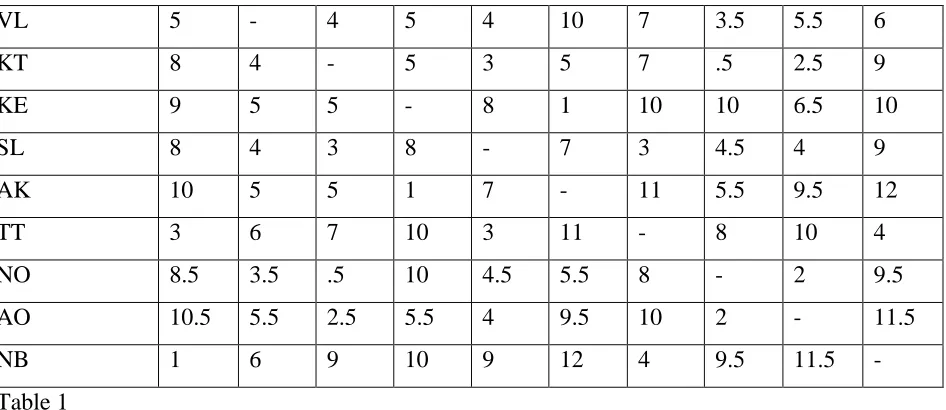
The following table shows the distance between the locations in Kilometers
NG VL KT KE SL AK TT NO AO NB
VL 5 - 4 5 4 10 7 3.5 5.5 6
KT 8 4 - 5 3 5 7 .5 2.5 9
KE 9 5 5 - 8 1 10 10 6.5 10
SL 8 4 3 8 - 7 3 4.5 4 9
AK 10 5 5 1 7 - 11 5.5 9.5 12
TT 3 6 7 10 3 11 - 8 10 4
NO 8.5 3.5 .5 10 4.5 5.5 8 - 2 9.5
AO 10.5 5.5 2.5 5.5 4 9.5 10 2 - 11.5
[image:7.612.74.547.84.289.2]NB 1 6 9 10 9 12 4 9.5 11.5 -
Table 1 Source:Google Map
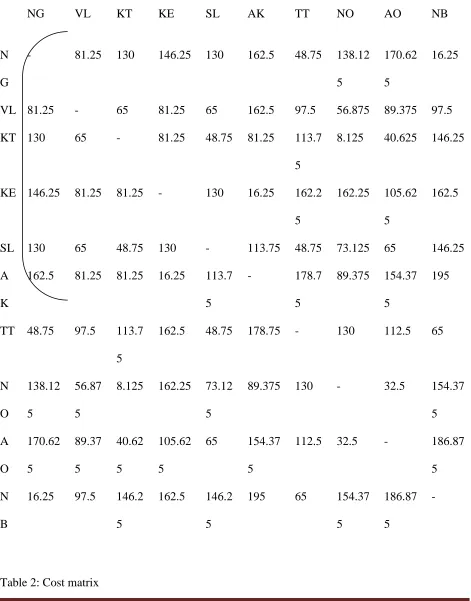
The following table shows the fuel consumption cost (in Rs) on every movement made. Assume
the vehicles involved in collecting and disposing waste are of same capacity and same type with
same efficiency. During this study (2014)1 liter of Diesel costs Rs 62.50. The labour cost is also
added for calculating the cost matrix. The Shipping cost is obtained by multiplying the cost per
NG VL KT KE SL AK TT NO AO NB
N
G
- 81.25 130 146.25 130 162.5 48.75 138.12
5
170.62
5
16.25
VL 81.25 - 65 81.25 65 162.5 97.5 56.875 89.375 97.5
KT 130 65 - 81.25 48.75 81.25 113.7
5
8.125 40.625 146.25
KE 146.25 81.25 81.25 - 130 16.25 162.2
5
162.25 105.62
5
162.5
SL 130 65 48.75 130 - 113.75 48.75 73.125 65 146.25
A
K
162.5 81.25 81.25 16.25 113.7
5
- 178.7
5
89.375 154.37
5
195
TT 48.75 97.5 113.7
5
162.5 48.75 178.75 - 130 112.5 65
N O 138.12 5 56.87 5
8.125 162.25 73.12
5
89.375 130 - 32.5 154.37
5 A O 170.62 5 89.37 5 40.62 5 105.62 5
65 154.37
5
112.5 32.5 - 186.87
5
N
B
16.25 97.5 146.2
5
162.5 146.2
5
195 65 154.37
5
186.87
5
[image:8.612.72.543.106.707.2]-
Sources: Secondary data from Nagapattinam Municipality office and Website
The following table shows the cost matrix in Rs. Supply availability is shown at the far right
column and demand is shown at the bottom row. Overall the solid waste generated ads up to 55
tones with a collection efficiency of 75.22 per cent with a manpower of 111 for Solid waste
management. On the basis of the figures furnished by Nagapattinam municipality, it was
observed that 85 per cent of the solid wastes are compostable on wet basis and 15 per cent of
rags, plastics, etc. are not compostable in the district.
Total supply= 55 movements
Total Demand= 55 movements
One movement = 1000 Kg= 1 ton of waste.
D1 D2 D3 D4 D5 D5
S1 130 162.5 48.75 138.125 170.625 16.25
S2 65 162.5 97.5 56.875 89.375 97.5
S3 48.75 81.25 113.75 8.125 40.625 146.25
S4 130 16.25 162.25 162.25 105.625 162.5
S5 - 113.75 48.75 73.125 65 146.25
S6 113.75 - 178.75 89.375 154.375 195
S7 48.75 178.75 - 130 112.5 65
Table:3
Pure Sources: S1, S2,S3,S4
Transhipment Nodes: S5,S6,S7
Pure destination: D4 , D5, D6
Optimal solution to this problem can be found using the following steps.
Make the problem a balanced one by adding dummy such that supply matches the demand.
Shipment from a point to itself will be zero. If any dummy is added, shipment to a dummy is also
zero.
Each transshipment point will have a supply equal to the points original supply and a demand
equal to its original demand. Total amount transshipped will not exceed the total supply S.
To form the transshipment table , the route from source to destination through processing plants
which takes minimum cost is chosen.
Cost cell S1D1= Min(S1P1D1,S1P2D1,S1P3D1)=Min(203.125,251,875,178.75)= 178.75
Cost cell S1D2= Min(S1P1D2,S1P2D2,S1P3D2)=Min(195,316.875,211.25)= 195
Cost cell S1D3= Min(S1P1D3,S1P2D3,S1P3D3)=Min(276.25,357.5,113.75)= 113.75
Cost cell S2D1= Min(S2P1D1,S2P2D1,S2P3D1)=Min(138.125,251.875,227.5)= 138.125
Cost cell S2D3= Min(S2P1D3,S2P2D3,S2P3D3)=Min(211.25,357.5,162.5)= 162.5
Cost cell S3D1= Min(S3P1D1,S332D1,S1P3D1)=Min(121.875,170.625,243.75)= 121.875
Cost cell S3D2= Min(S3P1D2,S3P2D2,S3P3D2)=Min(113.75,235.625,276.25)= 113.75
Cost cell S3D3= Min(S3P1D3,S3P2D3,S3P3D3)=Min(195,276.25,178.75)= 178.75
Cost cell S4D1= Min(S4P1D1,S4P2D1,S4P3D1)=Min(203.125,103.625,292.25)= 103.625
Cost cell S4D2= Min(S4P1D2,S4P2D2,S4P3D2)=Min(195,170.625,324.75)= 170.625
Cost cell S4D3= Min(S4P1D3,S4P2D3,S4P3D4)=Min(276.25,211.25,227.25)= 211.25
TABLE:4
D1
D2
D3
SUPPLY
S1
178.75
195
113.75
7
S2
138.125
130
162.5
12
S3
121.875
113.75
178.75
16
S4
103.625
170.625
211.25
20
DEMAND
22
17
16
55
This problem can be modeled as
178.75 X11 + 195 X12 + 113.75 X13
138.125X21+ 130 X22 + 162.5 X23
121.875 X31 +113.75 X32 +178.75 X33
103.625 X41 +170.625 X42 +211.25 X43
X21+ X22 +X23 = 12
X31+ X32 +X33 = 16
X41+ X42 +X43 = 20
X11+X21+X31+X41= 22
X12+X22+X32+X42= 17
X13+X23+X33+X43= 16
COMPUTATIONAL PROCEDURE:
For calculation TORA software WINDOWS 8 version and 64 bit capacity and HP computer with
500 GB as hard disk size 4 GM DDRZ Ram has been used.
The initial basic feasible solution is
Capacity K =( XB11,X12,X13,XB21,X22,X23,XB31,XB32,X33,X41,XB42,XB43)
= (178.75,0,0,138.125,0,0,121.875,113.75,0,0,170.625,211.25)
Total cost= Rs 8815.625
Next we use the optimality condition to improve the solution using MODI method
Cij=Ui +Vj
Consider U1=0 we get
V1=89.375, U2=48.75, V2=81.25, U3=32.5, V3=113.75, U4=14.25
At the end of iteration , the basic feasible solution is
Capacity K= (0,0,113.75, 0,162.5,121.875, 113.75,0,103.625,0,0)
REFERENCE
1. Arul P asian Tsunami Ecological implication and Rehabilationprocesses along
Nagapattinam coast 2012
2. Asmuth R., Curtis E. B. and Peterson E. L. (1979).Computing Economic Equilibria on
Affine Networks with Lemke's Algorithm. Journal of the institute of operations research
and management sciences
3. Bruce H. and Tardos E. (1997). The Quickest Transshipment Problem Journal of the
institute of operations research and management science
4. Dahan E. (2009). The Transshipment Problem with Partial Lost Sales. M.Sc Thesis
Department of Industrial Engineering and Management Isreal institute of technology.
5. De Rosa B., Improta G., Gianpaolo G. and Musmanno R. (2001).The Arc Routing and
Scheduling Problem with Transshipment. Journal of the institute of operations research
and management sciences
6. George Marfo Ofori 2012 Modelling the distribution of bank notes by banh of Ghana as a
transshipment problem, Kwame Nkrumah University of Science and Technology
7. Glover F., Karney D., Klingman D. and Russell R. (2005). Solving Singly Constrained
Transshipment Problems. Journal of the institute of operations research and management
science
8. Gong Y. and Yucesan E. (2006).The Multi-Location Transshipment problem with
Positive Replenishment Lead Times. ERIM Report Series Reference No.
ERS-2006-048-LIS
9. Hanany E., Tzur M., and Levran A. (2010).The transshipment fund mechanism:
Coordinating the decentralized multilocation transshipment problem
10.Hezarkhani B. and Wiesław K. (2010). Transshipment prices and pair-wise stability in
coordinating the decentralized transshipment problem. Proceedings of the Behavioral and
Quantitative Game Theory: Conference on Future Directions
11.Horowitz A. (2009). The Transshipment Problem. Masters degree Thesis,Department of
Civil Engineering and Mechanics University of Wisconsin – Milwaukee
13.Orden A. (1956). The Transhipment Problem. Journal of the institute of operations
research and management science vol. 2 no. 3 276-285
14.Ozdemir D., Yucesan E, and Herer Y. T. (2003). A Monte Carlo simulation approach to
the capacitated multilocation transshipment problem. Simulation Conference report.
Proceedings of the 2003 Winter.
15.Perincherry V. and Kikuchi S. (1990). A fuzzy approach to the transshipment problem.
Uncertainty Modeling and Analysis, First International Symposium
16.Topkis, D.M(1984). Complements and Substitutes among Locations in the Two-Stage
Transhipment Problem. European Journal of Operational Research, ISSN: 0377-2217.
17.Xiao H. and Greys S.(2008).Transshipment of Inventories: Dual Allocations vs.
Transshipment Prices. http://msom.journal.informs.org/content
18.Yale T. H. and Tzur M., (2001). The dynamic transshipment problem. Journal of Naval
Research Logistics (NRL). Fleischer L. (1997). A Faster Algorithm for the Quickest
Transshipment Problem. Proceedings of the Ninth nnual ACM/SIAM Symposium on