Citation:
Chang, V (2003) The role and effectiveness of e-learning: key issues in an industrial context. In: The First International Conference in the United Nations Information Society, 8-10 December 2003, Geneva, Switzerland.
Link to Leeds Beckett Repository record: http://eprints.leedsbeckett.ac.uk/807/
Document Version:
Conference or Workshop Item
The aim of the Leeds Beckett Repository is to provide open access to our research, as required by funder policies and permitted by publishers and copyright law.
The Leeds Beckett repository holds a wide range of publications, each of which has been checked for copyright and the relevant embargo period has been applied by the Research Services team.
We operate on a standard take-down policy. If you are the author or publisher of an output and you would like it removed from the repository, please contact us and we will investigate on a case-by-case basis.
1
The role and effectiveness of e-learning: key issues in an
indus-trial context
(presented in the United Nations IS World Forum)
Victor Chang
Web Development Officer, Department of Physics University of Cambridge, United Kingdom
Abstract
This paper identifies the current role and effectiveness of e-learning and its key issues in an industrial context. The first objective is to identify the role of e-learning, particu-larly in staff training and executive education, where e-learning (online, computer-based or videoconferencing learning) has made significant impacts and contributions to several organisations such as the Royal Bank of Scot-land, Cisco and Cap Gemini Earnst Young. With e-learning, staff training and executive education provides more benefits and better efficiency than traditional means.
1 United Nations IS World Forum
The second objective of this research is to understand the effectiveness of e-learning. This can be classified into two key issues: (1) methods of e-learning implementations; and (2) factors influencing effective and ineffective e-learning implementations.
One learning point from (1) is that centralized e-learning implementations may prevail for big organizations. How-ever, more organizations adopt decentralized e-learning implementations due to various reasons, which will be dis-cussed in this paper. From the research results, a proposed way is to retain the decentralized way. The second learning point is about interactive learning (IL), the combination of both e-learning and face-to-face learning. IL has been making contributions to several organizations, including the increase in motivation, learning interests and also effi-ciency. The popular issues about IL are (a) how to mini-mize the disadvantages of IL and (b) the degree of interac-tivity for maximizing learning efficiency.
One learning point from (2) is to analyze the factors influ-encing effective and ineffective implementations, which reflect the different focuses between industrialists and aca-demics. In terms of effective e-learning implementations, factors identified by both groups can map to particular cases in industry. In contrast, factors causing ineffective implementations rely more on primary source data. In or-der to find out these factors and analyze the rationale
be-hind, case studies and interviews were used as research methodology that matched the objective of the research.
Keywords
E-learning, staff training, executive education.
INTRODUCTION: Human capital
"Truly the most distinctive feature of our economic system is the growth of human capital. Without it there would be only hard, manual work and poverty except for those who have income or property" (Schultz, 1961). The view of learning as investment in an organisation's future is ex-plained in the phrase "human capital", which includes knowledge, skills, competencies, relationships and creativ-ity implicit in an organisation's workforce (Reynolds et al, 2002). As a result, many organisations have regarded hu-man capital as one of their greatest competitive assets, par-ticularly in knowledge-based sectors such as information technology, biological science and consultancy.
"The most successful companies and the most successful countries will be those that manage human capital in the most effective and efficient fashion -- investing in their workers, encouraging workers to invest in themselves, pro-viding a good learning environment, including social capi-tal as well as skills and training" (Becker 2001). As Becker suggests, it is vitally important to manage human capital and invest in employees. Many organisations conduct train-ing programmes to improve the quality of the human capi-tal. E-learning, an emerging technique for learning and training, is used for staff training and executive education.
INTRODUCTION: e-learning
Training programs include a variety of online modules, videos, face-to-face workshops, evaluations, trainer obser-vations and two-way feedback. This is an example of interactive e-learning that enables branch employees to access to staff training centre by a variety of media. Thus, employees can learn particular skills and knowledge that they need for work. This saves RBS the extra time, resources and money that would be needed to allocate
face-and money that would be needed to allocate face-to-face training for its 10,000 staff at 650 branches.
This directly influences the efficiency in organisations, because work can be completed in a shorter time. Within staff training, easy accessibility is a major issue (Alexander et al, 2001). E-learning offers a solution to this problem since in many companies staff already have access to the IT infrastructure that would support the learning. E-learning not only supports staff training but also executive educa-tion, a higher level of training for executives and managers. E-learning also strongly supports distance learning (Caley, Reid 2002). All employees do not need to be physically present for the class. Instead they can connect to the intra-net for learning. This makes learning flexible, because the staff can learn anywhere within the company without geo-graphical and time restrictions. There is no travelling in-volved, which saves the travel costs that account for two-thirds of most corporate training budgets (Electric Perspec-tive 2001). Employees can also be given the freedom to learn at their own pace. Another benefit of e-learning is scalability. E-learning supports large-scale training that can involve many thousands of staff. This is more efficient than face-to-face training, which requires more workshops, more time, more travelling and more instructors' time. Hence, e-learning saves the organisations time and re-sources (Caley, Reid 2002).
One example of implementing e-learning in indus-try: The Royal Bank of Scotland
The lack of training was a major issue for Royal Bank of Scotland (RBS) for four years prior to 1998. Though RBS maintained several training centres that included residential programs, these sites were unable to accommodate large numbers of employees and were also expensive to main-tain. Moreover, RBS had no formal training for its retail branch network for nearly four years. This caused problems for its 650 branches that had 10,000 employees, about half of its total number of employees.
RBS decided to solve this problem in 1999 and a team from 3 departments, HR, communications and IT, devel-oped a solution, Training and Communication Network (TCN). TCN has three parts:
• Access to the company intranet (Previously it was un-available to branch staff).
• Online training and training assessment capability. • An interactive "virtual" classroom.
Research Methods: Case studies and interviews
When research is at an exploratory phase, qualitative meth-ods are more appropriate since it is unclear of what needs to be measured. Qualitative methods include surveys, in-terviews, case studies, active observation and action-research. Before selecting appropriate methods, the strengths and weaknesses for each method were carefully examined and the more relevant methods were taken into consideration. Due to the exploratory nature of the project, identifying the role and effectiveness of e-learning is a new but poorly understood phenomenon. The reason is that fac-tors vary from organisation to organisation and the extent of influence varies from different types of e-learning im-plementations. As a result, case studies are considered as an appropriate method.
A data collection method is required for a case study. Sur-veys and interviews are the common methods, which can make different types of contributions. In this research, in-terviews are chosen as the data collection method because first, survey questions are 'static' but interviewing questions are 'dynamic'. To elaborate this, interviewing questions can be open-ended that allow asking relevant questions accord-ing to interviewees' responses. In contrast, all survey ques-tions are fixed and are unable to ask all relevant quesques-tions suited to individual organisations. Second, the response rate of surveys is lower because of the lack of human touch. However, interviews yield a higher response rate partly due to the power of human network that several in-terviewees have introduced the researcher to other inter-viewees. In general interviews have two distinctive advan-tages: higher response rate and the possibility of getting more detailed information.
Sampling of organizations
A large number of organisations were asked to provide information, either by interviews (face-to-face or phone) or by providing the data. Finally, only 10% of them agreed. These organisations were from several sectors (especially academic, engineering and finance organisations) located in the UK, Singapore and Australia. 90% of participating organisations chose interviews as the preferred way of pro-viding information. Each interview normally took about 30 minutes.
Data analysis from the interviews with industrial-ists
free-dom to answer. The first list was set in October 2001 and the revised list was set in February 2002
Not all industrialists can comment on factors influencing effective e-learning implementation. 25% of interviewees do not know about learning, particularly interactive e-learning. 45% of interviewees cannot think of any answers due to the lack of knowledge or experience. Only 30% of interviewees contributed their answers, the majority of whom had personally used e-learning, however 2/3 of whom had multiple roles, either as managers training their staff with e-learning, or technical providers of e-learning. Among these 30% of interviewees, 50% of them com-mented on positive factors (good practices) and the other 50% commented on negative factors (bad practices). It was a coincidence to get 50% for each. Based on interviewees' feedback, the factors were recorded and summarized in Table 1.
Altogether there were 120 industrialist interviewees (20 in Singapore, 50 in Australia and 50 in the UK) including directors, project managers, software developers, users, trainers and consultants from various organisations.
[image:4.612.311.587.247.370.2]During interviews, interviewees were asked several key questions such as "What are the factors influencing effec-tive implementations?", "Is staff training useful to your work?", "How do you feel about interactive learning and whether is it useful?", and "Among all types of training, which one do you feel the most helpful?". The answers were recorded and the key results were summarised in the next section.
Figure 1 illustrates interview results taken in Singapore (December 2001), Australia (March - April 2002) and the UK (October - November 2001, February - March 2002, and April 2002), of which the results taken in Australia indicate the highest percentages of interviewees recogniz-ing the usefulness of staff trainrecogniz-ing and interactive e-learning. Based on interviewees' answers, one likely reason is that higher proportions of interviewees in Singapore are from small firms and they are not in favor of staff training due to their preference to hire experienced staff or their preference to face-to-face training. In contrast higher pro-portions of interviewees in Australia are from big organiza-tions where staff training, particularly interactive e-learning, is favored.
Table 1: Top 5 factors in effective e-learning implementations for industrialists (Sample size: 18)
Rank Factors %
1. Systems that speed up and simplify the processes 94.4 =1. Systems that assist the organization to reach its
tar-gets
94.4
3. Strong support and co-operation between colleagues 83.3 =3. Supportive and flexible organization cultures and
management
83.3
5. Cost-effectiveness (saves training costs or/and ongo-ing operational costs)
77.7
Figure 1: Percentages of interviewees agreeing with staff training and interactive learning (IL).
1. Staff training is useful from the organisation's perspective (76% in Singapore vs. 96% in Australia vs. 84% in the UK)
2. Combination of staff training and interactive e-learning is useful (59% in Singapore vs. 84% in Australia and 68% in the UK) 3. Interactive e-learning is the most effective type of learning (35% in
Singapore vs. 64% in Australia vs. 42% in the UK).
Rank Factors %
1. Systems that are too difficult to set up and use 88.9 =1. Systems that add extra unnecessary work to the
em-ployees
88.9
=1. Disagreements or conflicts within the teams or man-agement
88.9
4. Abusing / misusing e-learning system (For example, using it for computer games)
72.2
=4. Systems that are not user-friendly (For example, poor
online presentation) 72.2
76 96
84
59 82
68
35 64
42
0 10 20 30 40 50 60 70 80 90 100
Percentage of interviewees agreeing
1 2 3
Interview results analysis 1 (Sample size: 120)
Interviewees in Singapore Interviewees in Australia
Interviewees in the UK Table 2: Top 5 factors in ineffective e-learning implementations
[image:4.612.51.301.532.728.2]for industrialists (Sample size: 18)
factor is that systems are not user-friendly, for instance, poor online presentation.
3.3.1.1 Lesson learnt: Awareness of the draw-backs caused by different e-learning implementa-tions at one organisation
[image:5.612.51.309.167.289.2]Altogether twenty academics working in e-learning or re-lated areas were interviewed. All of them could answer every question with their own rationale. Their feedback was recorded and these factors are listed in the following table:
Different departments at the University A adopt their own forms of e-learning implementation that take up additional resources and manpower within the organisation. This leads to two major disadvantages. First, it adds extra work for administration because each department is busy han-dling its own administration and fighting for resources to facilitate e-learning. In organisations where only one de-partment is in charge of e-learning, for instance the Univer-sity B, it minimises the overlapping of the work being done by different departments. The second disadvantage is that this easily leads to confusion in learning, particularly for multi-disciplined students. For instance, those who are tak-ing electrical engineertak-ing, physics, mathematics and com-puting for the first two years of Engineering / Science dual degrees, need to learn four different ways of e-learning for each major subject. Ten undergraduate students were inter-viewed and their feedback was summarised in the follow-ing figure:
Sample Size: 20
Table 3: Top 5 factors in effective e-learning implementations for academics
Rank Factors %
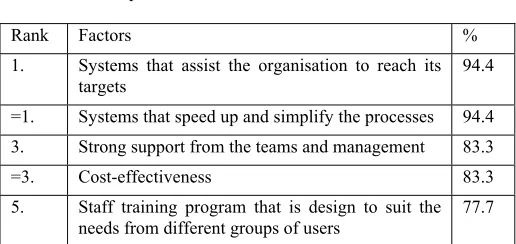
1. Systems that assist the organisation to reach its targets
94.4
=1. Systems that speed up and simplify the processes 94.4 3. Strong support from the teams and management 83.3
=3. Cost-effectiveness 83.3
5. Staff training program that is design to suit the needs from different groups of users
77.7
Figure2: Percentages of interviewees' opinions about dif-ferent implementations of e-learning
Comparing factors in effective e-learning implementations between industrialists and academics, results are similar except academics consider "staff training program that is designed to suit the needs from different groups of users" is an important factor that influences effective e-learning im-plementations. Based on their comments, one likely reason is staff training should be designed to suit different types of needs, different groups of trainees and different competen-cies of trainees. This type of training, improves the quality of the office-workers, who can perform up to expectations
for their jobs. 90
10
90 10
0% 10% 20% 30% 40% 50% 60% 70% 80% 90% 100%
Percentages of interviewees'
comments
1 2
Interview analysis 2 (Sample size: 10)
3.3 Case studies from the primary source data
In this part of the paper, three case studies are presented to illustrate three types of e-learning implementations in three different organisations, in which several people have been interviewed and also requested to provide data. Among these three organisations presented, the names of two re-main confidential due to interviewees' requests. In the case of Cambridge University, anonymity was not requested.
1. Students find it confusing or find learning more difficult when each subject offers its own ways of e-learning implementations (Agree: 90%, disagree: 10%, no opinion: 0%)
2. Students' opinions about whether the university should change its cur-rent ways of e-learning implementations (Agree: 90%, disagree: 10%, no opinion: 0%)
3.3.1 The e-learning implementation at the Univer-sity A in Australia
3.3.1.2 Interviewees' feedback
90% of interviewees find it confusing or find learning more difficult when each subject offers its own form of e-learning implementation. Hence, they feel that they have less interest and motivation in learning. Furthermore, 90% of interviewees also feel that the university should change its current form of e-learning implementations and suggest that the university should try to simplify the learning proc-University A is a leading Australian university and is in
esses by integrating different teaching and assessment methods into only one way of e-learning implementation.
In conclusion, though e-learning is an effective method for students and lecturers at the University A, it brings prob-lems to the administration and complicates learning. This leads to a research question on the methods of e-learning implementations, either a big organisation should adopt a centralised or decentralised implementation. The details are discussed in Section Four.
3.3.2 The e-learning implementation in the Com-pany B in Singapore
Company B is a big IT firm with about 3,000 office-workers based in Singapore, where e-learning is particu-larly used in staff training, executive education and knowl-edge management. Staff training can be delivered online with instruction and learning materials updated regularly. This brings benefits for both trainers and trainees. For trainers, they can save time in administration and also save extra effort in repeating teaching. For trainees, they can get access to the learning materials at their own convenience and pace. This is particularly useful to young software en-gineers who need to learn new computer languages but do not have much time for face-to-face learning. In other words, e-learning provides greater flexibility for staff train-ing and does not restrict learntrain-ing to particular sites. Simi-larly, trainers can deliver parts of the executive education courses for the managers and directors with the use of software and web technologies.
3.3.2.1 Lesson learnt: Improved knowledge man-agement by distributed technologies
In the context of Company B's e-learning implementation, distributed technologies were chosen as e-learning's tech-nological focus instead of web technologies. E-learning's distributed technologies (Intranet, database and email) at Company B assist knowledge management, in which knowledge creation, knowledge sharing and discussions are strongly encouraged among knowledge-workers located at different parts of the world.
This brings three benefits to the firm. First, before the start of a new project the knowledge shared by the experienced staff allows a team to work towards the right approaches, which can assist project completion on time. Hence, the team will spend less time to explore other methods of re-solving problems and will also avoid possible mistakes. Second, knowledge sharing among different teams not only stimulates the awareness of knowledge management but also saves the firm resources and money for outsourcing, since the internal staff from other departments can solve the problems. Last, regular discussions and encouragement
raise motivation, because team members can help and sup-port each other that leads to a higher team morale, which is a likely factor for improving the efficiency (Cross, Baird, 2000). Therefore, e-learning is observed as a useful solu-tion for staff training, executive educasolu-tion and knowledge management.
3.3.2.2 Lesson learnt: Increased efficiency after staff training using e-learning
Company B invests 1.1 million pounds annually in 3000 officworkers in terms of staff training, among which e-learning is the most preferred method. There are two ways of staff training. The first way is to organise a training ses-sion for 100 office-workers that uses interactive learning. Trainees learn new skills or knowledge from software packages and can consult trainers for help when they en-counter problems. Assessments are normally not required. The second type of training is especially for software de-velopers who are given software packages for self-learning and are given opportunities to attend face-to-face courses to improve their skills. Assessments are normally con-ducted in terms of both practical and written tests.
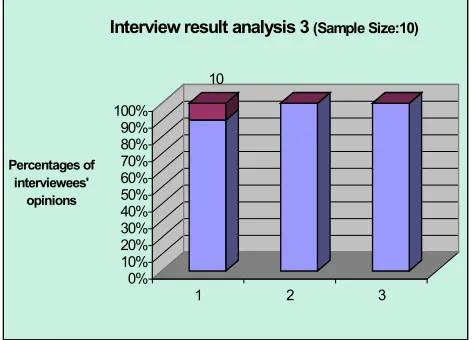
In order to investigate the e-learning's effects on staff train-ing, ten software developers were interviewed and their comments, especially their improvements before and after staff training, were recorded. The following figure summa-rises the results.
[image:6.612.320.556.530.700.2]
Figure 3: Percentages of interviewees' opinions of e-learning for staff training
1. E-learning is the most suitable way for training (90%: Yes, 10% No) 2. Self-improvements in competencies of new computer languages (100%: With improvements).
3 Better efficiency after staff training (100%: agrees with better effi-ciency).
0% 10% 20% 30% 40% 50% 60% 70% 80% 90% 100%
Percentages of interviewees'
opinions
1 2 3
Interview result analysis 3 (Sample Size:10)
10
In the context of Company B, efficiency is determined by the duration to complete a quality project. Figure 3 shows that all interviewees agree with improvements in their competencies after training and also efficiency after train-ing. Improvement in efficiency is further supported by the result that the average duration to complete a quality pro-ject drops from 6 months to 4 months after training. Based on interviewees' feedback, one reason is that with improved skills and knowledge, these software developers feel more competent to handle the projects and can also complete the same amount of quality work in less time.
70
10 20
90
10
0 10 20 30 40 50 60 70 80 90
Percentags of interviewees
agreeing
1 2
Interview result analysis 5
3.3.3 The e-learning implementation at Cambridge in the UK
Cambridge University has interests in e-learning for educa-tion and training, which have taken place in seven different departments over a period of time. There are six cases. However, only one case is presented and the five cases are described in the oral presentation.
3.3.3.2 Summary of interviewees' feedback:
From Figure 4, results obviously reflect that a higher
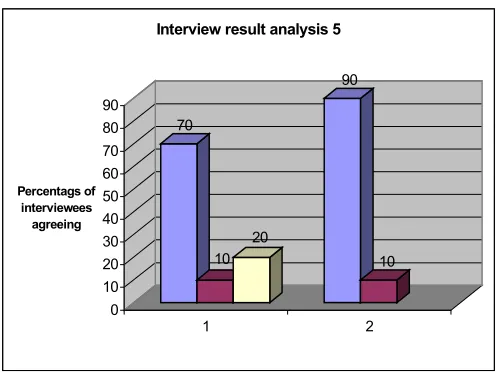
per-centage of interviewees prefer interactive learning (IL) to self-directed learning and also recognise the importance of IL. The majority of participants feel that IL is useful (70%) and is better than self-directed learning (90%). The major-ity prefers IL because of the combined benefits from face-to-face learning and e-learning. One example is that 30% of them are not familiar with technology and are in need of tutors for help but after workshops, they can revise again by learning from software themselves.
3.3.3.1 E-learning offered by Cambridge Comput-ing Service
Cambridge University Computing Service provides com-puting facilities and related services to support research and teaching at the university. The services include set up and maintenance of computer network, World Wide Web, emails and software packages. Other than IT services, Computing Service offers two types of e-learning. The first type is the self-directed learning, which means learners borrow CDs and software packages and they learn new knowledge by themselves. The second type is training workshops which combine both face-to-face learning and e-learning, in other words interactive learning (IL), for both postgraduate students and academic staff to support re-search and teaching. One of the workshops taught by IL is offered for postgraduate students at the Judge Institute of Management Studies (JIMS).
The figure also shows 20% of interviewees feel both meth-ods are useful since they can learn different aspects of knowledge. 10% of them feel self-directed learning is bet-ter because there is no need to attend workshops at a par-ticular time and there is a greater freedom to learn when-ever they like.
This interview analysis reflects that interactive learning (IL) is a preferred type of learning. Moreover, it illustrates that IL is helpful to education. One likely reason is that IL highlights the advantages of facto-face learning and e-learning and minimise the disadvantages of each. However, more details will be described in Discussions and Conclu-sion, which illustrates how IL influences effective e-learning implementations and the extents of such influ-ences.
In order to investigate the learning effects of both self-directed learning and IL, interviews from those who at-tended SPSS (a statistical software) workshops and also those who learned SPSS by themselves were taken. There were 10 interviewees who did both types of e-learning and all their feedback was recorded. The following figure illus-trates the learning effects of self-directed learning and IL.
[image:7.612.316.564.57.245.2]4. Discussion and Conclusion
Figure 4: Percentages of interviewees whose comments about interactive learning and self-directed learning
In this part of the paper, interesting findings from the litera-ture review and fieldwork (interviews and case studies) are discussed in detail. The role of e-learning is summarised in order to identify how organisations and individuals use it.
1. Interactive learning (70%) or self-directed learning (10%) or both methods (20%) are useful
Key issues for the effectiveness of e-learning are consid-ered under two headings. First the methods of implement-ing e-learnimplement-ing are discussed and second the factors affect-ing effective e-learnaffect-ing implementations. Each issue is ana-lysed and discussed. The major insights and implications for industry are developed. Figure 5 below summarises the content and flow of Discussion and Conclusion.
4.1 The role of e-learning
The role of e-learning today is particularly linked with staff training and executive education in organisations. The pur-pose is to improve the knowledge and skills of office-workers, which may directly influence the efficiency in organisations, because work can be completed in a shorter time.
4.1.1 Impact on staff training
E-learning adds new aspects to the present Business-to-Employee (B2E) model, which revolutionises training (Sloman, 2001). Before the introduction of e-learning, training was thought to be tedious, cost-ineffective and troublesome at some organisations. For instance, travel and accommodation costs were often more expensive than costs of training itself (Cisco; General Electric, 2001). It was difficult to train thousands of office-workers at the same time, leading to organisations like Royal Bank of Scotland (RBS) and Cisco to recruit more trainers and facilitate many training workshops.
However, e-learning has made training more effective than traditional methods. Travel and accommodation costs are minimised. The time spent on travelling is reduced, so that office-workers can spend more time at work in RBS and Cisco. Training also becomes "personalised", which allow office-workers to choose to learn at their own time and progress, especially those attend training at Cambridge Programme for Industry (CPI) and Malpas Flexible Learn-ing (MFL). This may increase office-workers' interests in learning. Another advantage is easy accessibility, which allows staff to learn anywhere with internet access. Other than individual benefits, the organisations can get more benefits. For instance, the organisations can save money by recruiting fewer trainers. They can also save more spaces, resources and materials for allocating training.
E-learning has made impacts on training and the cases from RBS, Cisco and Cap Gemini Earnst and Young (CGEY) further support this argument. CGEY created the Virtual Business School (VBS) that allows learning, training and research to take place at different offices in Europe, espe-cially the UK. Furthermore, the example of Company B in Section Three demonstrates that the efficiency after train-ing, particularly by interactive learntrain-ing, has improved
greatly and made progressive contributions to software developers. Thus, e-learning not only revolutionises train-ing but also enhances the efficiency after traintrain-ing.
4.1.2 Impact on executive education
E-learning has become a major technique in delivering executive education, the purpose of which is to improve the knowledge for managers and executives of the organisa-tions. From the cases of CPI, MFL and CGEY, interactive learning (IL) is adopted as a major technique in delivering executive education. Many organisations and individuals reflect that they obtained more benefits, which include the following characteristics:
• Learning becomes learner-centred which encourages personal development planning.
• Learning and training can be delivered effectively through an online learning network.
• All e-learning related events at a particular online net-work become centralised, which integrates staff train-ing, executive education, knowledge management and research together.
• Participants can choose programs that are useful to their work and helpful for their career advancement.
4.2 Methods of implementing e-learning
Methods of implementing e-learning include two major issues. The first issue is centralised versus distributed e-learning implementation and the second issue is about in-teractive learning (IL).
4.2.1 Discussions from case studies: centralised versus decentralised implementation
With centralisation, each department does not need to fight for the limited resources. However, the resources can be used and shared by everyone in the organisations. This maximises the uses of resources. Each department does not need to employee someone to look after the e-learning sys-tem, thus maximising the uses of manpower.
4.2.1.1 Advantages of adopting centralised learning implementations over decentralised e-learning implementations
In Section Three, the disadvantages of using decentralised implementations at University A are that:
It strengthens specialisation of e-learning • Students get confused more easily
• Students feel it is more difficult to learn different
tech-niques of e-learning systems Centralisation encourages the grouping of office-workers with similar areas of specialisation, thus enhancing team-work and strengthening the areas of expertise. This is com-mon in many organisations, which group those with similar areas of specialisation and form various units that play im-portant roles in the organisations, including Oracle and SAP (in oral presentation).
• It adds extra work to each department
• Each department fights for limited resources to imple-ment e-learning
At the University of Technology, Sydney (UTS), a central-ised e-learning implementation creates fewer problems for students and also maximises the uses of resources and manpower within the organisation. From the comparisons between the previous two cases, a centralised e-learning implementation is more in favoured of due to the following reasons.
4.2.1.2 Lessons from the e-learning implementa-tions at Cambridge University
The fieldwork results raise the question whether big or-ganisations such as Cambridge University should stay with a decentralised e-learning implementation or change to a centralised e-learning implementation in the future.
• It creates fewer problems and less confusion for
office-workers. Factors influencing Cambridge University for
e-learning implementations • It maximises the use of resources and manpower
within the organisation.
• It strengthens specialisation of e-learning. Before suggesting whether Cambridge University should adopt a decentralised or centralised e-learning tion, factors influencing centralised e-learning implementa-tions should be discussed. From fieldwork results, the most important factors are (1) the focus and the culture of the department that implements e-learning; (2) the availability of funding; and (3) the improvements in the quality of edu-cation. The first factor is obvious because the focus and culture at each department are varied; the details of which have been described in Section Three.
Each of these three points is explained below:
It creates fewer problems and less confusion for office-workers
Decentralised e-learning implementations create more problems due to several reasons. First, different methods of implementation may cause internal system incompatibility between different departments due to uses of different software and IT systems. The incompatibility may cause regular problems such as time delay and inefficiency in information processing. Thus, confusions and interruptions are common among office-workers when they are more subject to these problems. However, a centralised e-learning implementation integrates all different types of software and systems into one system. The organisations and individuals do not need to know the techniques of all types of e-learning systems. Thus, this minimises the prob-lems caused by different ways of implementations. With less problems, office-workers will have less confusions and interruptions.
The second factor is the availability of funding. This is a key factor driving some departments into e-learning rsearch. For instance, the Judge Institute officially started e-learning research in 2001 after receiving sponsorship from HP. Another example, CARET, develops software pack-ages for their client organisations that have paid and re-quested for online education.
The third factor, the improvements in the quality of educa-tion, is the main reason for both School of Clinical Medi-cine (SCM) and Engineering Department. SCM provides a personalised web-based learning environment tailored to each individual student on the Cambridge Clinical Course. The system allows teachers to make selected educational resources available to an individual or selected groups of students.
After discussing these three factors, the findings reveal that each department has very different needs and different ex-pectations for the students and academic staff. Further-more, there is an uncertainty of receiving funding continu-ously, which may stop the progress of any e-learning im-plementation. Based on the above factors and reasons, a centralised e-learning implementation at Cambridge Uni-versity is not likely.
Hybrid recommendation
Many organisations have inter-disciplinary centres for a particular subject, which bring several benefits including (1) maximising the uses of resources and manpower, (2) preventing different departments fighting for the limited resources, (3) strengthening the expertise and collaboration (McKay, 2000).
Cambridge University also has inter-disciplinary centres, for instance, Natural Language and Information Processing Group at Computer Laboratory. It collaborates with the Systems Research Group and the Theory and Semantics Group from Computer Laboratory, with Speech Robotic Group from Engineering Department and the Research Centre for English Applied Linguistics from Linguistics Department. Similarly, it is possible to make an inter-disciplinary e-learning centre that combines different as-pects of e-learning into a centralised place. This may en-able Cambridge University to retain its decentralised e-learning implementation while co-ordinating in a central-ised way.
4.2.1.3 Implications for industry: The choice be-tween centralised or decentralised e-learning im-plementations
The above discussions suggest that centralisation seems to be more suitable for two big organisations. However, this rule does not always apply if each department at the or-ganisation is well established and supplied with enough manpower, resources and funding. In reality, there are more organisations, especially global firms, adopting de-centralised e-learning implementations due to various rea-sons. Reasons for adopting decentralised e-learning can be discussed in the oral presentation.
From the table, all the interviewees feel that "different poli-cies or focuses at different overseas offices make central-ised e-learning implementation difficult", because policies often vary from country to country, from department to department, which make centralisation very difficult. In contrast the second factor, the third factor and fifth factor suggest that each department of the organisation prefers making its own e-learning implementation, thus either they have e-learning implementation at different periods of time,
or they prefer more freedom and authority. Therefore, it takes more time and money to centralise and integrate eve-rything. The fourth factor suggests that management have great authority to decide the e-learning implementation within the organisation. In some organisations, this is the most dominant factor.
The following two statements conclude the implications for industry:
(1) For those organisations that do not implement e-learning but consider it as a solution for large-scale training, executive education or research project, they may consider implementing centralised e-learning sys-tems.
(2) For those organisations that already have e-learning implementations at different departments, they can stay with the decentralised e-learning implementations. However, it is worthwhile to form an inter-disciplinary centre or a centralised centre (from the cases of RBS and CGEY), which can (a) maximise the uses of re-sources and manpower; (b) prevent different depart-ments fighting for the limited resources; (c) strengthen the expertise and collaboration.
4.2.2 Interactive learning
Interactive learning (IL), a particular type of e-learning, has been used increasingly in a growing number of organisa-tions. The previous sections describe IL as an emerging and recommended way of achieving effective e-learning implementations. For instance Section One describes the benefits of IL for two organisations. Section Two explains that the main reason for adopting IL for training and learn-ing is that IL combines advantages from both face-to-face learning and e-learning. Section Three compares IL and self-directed learning (another common type of e-learning) and concludes that IL is a better way of learning, based on results from interviews. Section Five provides further illus-trations of IL, as an effective way of achieving e-learning implementations, which draw out some implications for industry.
4.2.2.1 Advantages and disadvantages of interac-tive learning (IL)
Advantages Disadvantages
• Communication is more complete comparing to e-learning.
• Learners are treated equally.
• Learners become more self-reliant.
• Instructors can observe the per-formance of participants.
• Instructors and participants share knowledge and the burden of learning.
• It is not easy to implement interac-tive learning.
• Not everyone can participate.
• Instructors must work harder.
Comparing to distant learning by correspondence, distant learning by IL allows instructors to lead online discussion groups, which allow participants to ask questions and pro-vide feedback. From these questions and feedback, experi-enced instructors can tell approximately how well the learners understand particular topics in their subjects. Online forums and assessment also assist instructors in the observation of learners' performance. In distant learning by correspondence, it is hard to tell whether learners under-stand and there are doubts about whether learners copy their assignments from someone or somewhere.
Learners share knowledge and the burden of learning:
4.2.2.2 Discussions for advantages:
Interactive learning also emphasises knowledge sharing and transfer between learners, particularly in a virtual learning community. Learners can harvest knowledge of the entire community and therefore draw inspiration from the wealth of viewpoints contributed. Sharing knowledge can ease the burdens of instructors because the instructor is not the only evaluator, as the learners are also likely to spot problems and offer creative insights.
Each point in Table 4.1 can be further explained below:
Communication is more complete:
Interactive learning offers both face-to-face and online communications, thus providing more opportunities and options for communications between learners themselves and between learners and instructors. In online communica-tions, learners can communicate more freely when they become more accustomed to the ease of electronic interac-tion. This leads to more lively conversations, which in turn spur more interactions (Rafaeli and Sudweeks, 1998). Therefore, more questions are asked and more ideas are stimulated due to the "openness" of the communications.
4.2.2.3 Discussions for disadvantages:
It is not easy to implement interactive learning
Horton claims that it is often difficult, inefficient and de-moralising to implement IL because discussions are some-times hostile, leading to arguments and debates all over the learning community. This may reduce participants' motiva-tion and also minimise interests to take part in the learning community.
Learners are treated equally:
In some types of interactive learning (IL), learners are anonymous and less subject to bias and stereotyping. Race, gender, age, background, appearance, and disabilities mat-ter less than knowledge and creativity. Anonymity empow-ers people to participate more fully and confidently in IL.
Not everyone can participate
Most types of IL offer real-time discussions and learning activities in the virtual community. Although this has the benefits of making distant education possible, it also re-quires more time for learners to participate. Some learners cannot participate in synchronous events due to illness, travel, business engagements, or family duties. Further-more, some types of IL need high-tech, such as the latest software versions, high bandwidth and fast internet access, to support the implementations. Without fulfilling one of the requirements, learners will face difficulty in learning. Learners become more self-reliant:
Learners, in the absence of face-to-face contact with in-structors, can compensate in two ways. First, they are forced to seek their own sources of information, learn to evaluate them critically, and monitor their own learning. Second, participants can learn from interactions such as study groups and active discussions. Furthermore, learners become more resilient because they learn to take more
re-sponsibility and authority for themselves (Schutte, 1997). Instructors must work harder
In some types of IL, face-to-face contact takes place only occasionally. Learners instead demand more virtual contact with their instructors through emails, chat and discussion Instructors can observe the performance of
groups. Instructors may need to answer questions in both face-to-face learning and online learning. Furthermore, instructors need to spend more time putting handouts onto the intranet.
4.2.2.4 How to minimise the disadvantages with an industrial example
Minimising the disadvantages of interactive learning (IL) is an important aspect of effective e-learning implementa-tions. Drawbacks of IL usually come from human-related issues such as arguments in learning community, less moti-vation and learning interests among learners and lastly, unavailability to take part. These drawbacks reflect that problems in Information Systems often come from human, social and management issues.
To minimise the disadvantages, it is important to have col-laborations and supports between all the learners, tors, managers and the organisations. For instance, instruc-tors can provide more learning assistance to learners. Learners should not only avoid arguments but also try to understand and appreciate each other's opinions. Managers can act as co-ordinators in the learning events on the or-ganisations' behalf. The organisations can design and im-plement better ways of learning methods based on all the participants' feedback. To implement IL effectively, it needs everyone's participation, enthusiasm, commitment, motivation, co-ordination and collaboration.
Company B (Section Three) has adopted this strategy. It has reported that the minimisation of disadvantages of IL brings the organisation more benefits and better efficiency because there are not only fewer conflicts but also more collaborations between the employees themselves, between learners and instructors, between the employees and the management. This improves efficiency and teamwork be-cause more time is spent on collaboration and support, which is a long-term benefit for Company B.
4.2.2.5 The degree of interactivity
Based on interviewees' feedback, the degree of interactivity is another highlight of the present effective e-learning im-plementations. The purpose of getting a high degree of interactivity in interactive learning (IL) is to strengthen the ease of communications and knowledge sharing among learners and instructors, eventually leading to improvement in learning efficiency.
Among all types of IL, role-playing scenarios and virtual laboratories were encountered in the fieldwork. Both types of IL emphasise the higher degree of interactivity in order to enhance communication and knowledge sharing.
How-ever, the main difference is that role-playing scenarios em-phasise human interactions whereas virtual laboratories em-phasise learning interactions with technology.
Among IL, some organisations focus on human interactions but some focus on interactions with technology. It is diffi-cult to conclude which way is better. However, the priority should depend on the organisation's objectives and focuses for implementing IL. For instance, the UTS has stressed that one objective is to improve the quality of education and also improve students' learning interests and motiva-tion. Hence, they decided that role-playing scenarios was an appropriate way to provide students opportunities to learn, discuss and co-operate among themselves, face-to-face. This would increase learning interests and motiva-tions among students. Hence, more students became keen to take part in online learning events.
4.3 Factors influencing effective and ineffective e-learning implementations
Having discussed various issues in methods of implementa-tions, it is important to explore the second key issue, fac-tors influencing effective and ineffective implementations. This helps understand the research question better, "what influences effective e-learning implementation in an indus-trial context?" Section Three presents these factors from both industrial and academic viewpoints. All the factors are listed and compared in Table 4.2 and Table 4.3.
4.3.1 Tables listing all the factors
Industrialists versus Academics
Rank Factors Rank Factors
1. Systems that speed up and simplify the proc-esses
1. Systems that speed up and simplify the proc-esses
=1. Systems that assist the organisation to reach its targets
=1. Systems that assist the organisation to reach its targets
3. Strong support and
co-operation between col-leagues
=1. Strong support from the
teams and management
=3. Supportive and flexible
organisation cultures and management
4. Cost-effectiveness
5. Cost-effectiveness (saves
training costs or/and ongoing operational costs)
5. Staff training program that
[image:12.612.308.566.449.668.2]is designed to suit the needs from different groups of users
Table 6 Comparisons between factors influencing effective e-learning implementations from industrialists and academics
Rank Factors Rank Factors
1. Systems that are too difficult to set up and use
1. Systems that are too difficult to set up and use
=1. Systems that add extra
unnecessary work to the employees
=1. Poor project management
=1. Disagreements or
con-flicts within the teams or management
3. Disagreements or conflicts
within the teams or man-agement
4. Abusing / misusing
e-learning system (For example, using it for computer games)
4. Have poorly-organised
staff training program or ignore any staff training
=4. Systems that are not
user-friendly (For example, poor online presentation)
=4. Systems that add extra
unnecessary work to the employees
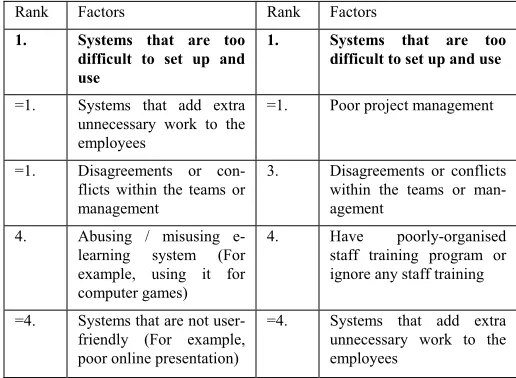
There are some differences between both groups' factors. For instance, "strong support and co-operation" is ranked the third factor for industrialist but ranked the first factor for academics. Another factor, "cost-effectiveness" is ranked the fifth for industrialists but ranked the fourth for academics. Moreover, third factors from industrialists are similar to "strong support from the teams and management" from academics but the industrialists are more specific in classifying that colleagues and management are two differ-ent aspects. The last factor from academics suggest that staff training program should be designed to suit the needs from different groups of users.
[image:13.612.43.301.58.247.2]4.3.1.2 Analysis for factors influencing ineffective e-learning implementations
Table 7: Comparisons between factors influencing ineffective e-learning
implementations from industrialists and academics There is only one common agreement between
industrial-ists and academics, as shown in bold print. Both groups have similar opinions on commenting their reasons, stating that if the systems are too difficult to set up and use, this will cause various problems such as delay, inefficiency and cost-ineffectiveness, which obviously are ineffective im-plementations.
4.3.1.1 Analysis for factors influencing effective e-learning implementations
Table 4.2 demonstrates that industrialists and academics have the same opinions for the top factors influencing ef-fective e-learning implementations, which are shown in bold print. When asked their reasons for suggesting such factors, reasons from industrialists and academics vary.
Other factors are varied and positioned in different ranking. For instance, industrialists feel that "disagreements or con-flicts within the teams or management" is one of the top-ranked factors whereas academics feel that this is the third-ranked factor. Industrialists feel that "systems that add ex-tra unnecessary work to the employees" is one of the top-ranked factors but academics feel that this is the fourth-ranked factor.
Many industrialists feel that the primary objective is to speed up the daily processes and to simplify the compli-cated processes in engineering or accounting. The reasons are: (1) Quality time is a focus in industry; (2) It takes them too much effort to deal with specific problems due to the lack of competencies. In industrialists' opinions, effective e-learning implementations should help them to handle their tasks better, by either reducing the time to complete the entire processes with ease, or assisting them to over-come problems by new skills learnt from e-learning. This may improve the individual performance, and then the team performance. Eventually this assists the organisation to reach its targets, since individual and team performance have improved.
There are other differences in both groups' factors. For example, academics feel that "poor project management" is one of the top-ranked factors but industrialists do not rank this factor among the top five. This indicates that academ-ics emphasise management as an important factor for effec-tive e-learning implementations. Another two factors, "abusing / misusing e-learning system" and "systems that are not user-friendly" are ranked the fourth. This may sug-gest that industrialists focus on practical applications of e-learning implementations. The factor "have poorly-organised staff training program or ignore any staff train-ing" suggests that some academics emphasise that e-learning implementations should go hand-in-hand with effective staff training. Another factor, "systems that add extra unnecessary work to the employees" is ranked the first for industrialists but ranked fourth for academics. This also indicates that industrialists emphasise practical appli-cations.
Some academics feel that effective e-learning implementa-tion should increase efficiency or productivity by speeding up or simplifying the work or the processes. Some academ-ics feel that the purpose of implementing e-learning is to improve the quality of their employees, which is a usual organisational target. By improving the efficiency, this also achieves part of the organisational targets. Some academics regard "strong support from the teams and management" as the most important factor. This supports Information sys-tems review in Section Two that problems are often related to human and management issues.
The above analysis reveals an interesting finding about differences between industrialists and academics regarding factors influencing effective and ineffective e-learning im-plementations. Both groups have close ideas in identifying factors influencing effective implementations but have some variations in identifying factors influencing ineffec-tive implementations. There is a significant difference be-tween their rationale. Industrialists' rationale emphasise practical applications, in contrast academics' rationale em-phasise the literature review and research findings. How-ever, more data should be obtained to further support this point.
4.3.2 How do factors identified map to the particu-lar cases
4.3.2.1 Effective e-learning implementations:
A top factor, "systems that assist the organisation to reach its targets", is influential in several cases such as RBS, CGEY, Company B, Cisco, SAP and Oracle. At the RBS, the target was to enable its 10,000 employees at 650 re-gional branches in the UK access its staff training centre. Effective e-learning implementations (EEI) save RBS time, money and resources for staff training. At CEGY, EEI pro-vides employees with a centralised centre of learning and training in order to update their knowledge and leadership abilities. In Company B, EEI assist the software developers to improve their competencies and eventually work effi-ciency. At Cisco, EEI helps them training a large number of office-workers. Another top factor, "systems that sim-plify and speed up the processes", is influential to CPI, CGEY and Lotus. CPI provides training and executive education that accelerate the competencies of client organi-sations' employees, thus helping their clients speeding up their human resource management. For CGEY, its learning centre speeds up the learning, training and research pro-gress. Lotus simplifies the group communications since everyone is connectable in the database.
The factor, "cost-effectiveness", is influential to RBS, CGEY and particularly Cisco, where costs of training were reduced, thus saving operational costs. The factor, "strong support from the teams and management", is not easily identified in the secondary source data. However, in the primary source data, industrialist interviewees can provide specific examples supporting this factor.
4.3.2.2 Ineffective e-learning implementations:
Unlike the previous section, factors causing ineffective e-learning implementations rely more on the primary source data because the secondary source data usually do not de-scribe much about failure examples, rather, successful sto-ries from effective e-learning implementations. From the
interviews, both industrialists and academics can provide specific examples that demonstrate factors causing ineffec-tive e-learning implementations based on their personal experience. For instance, the factor, "systems are too diffi-cult to set up and use", is a common problem to many e-learning implementations thus it is a top factor.
Bibliography
Alexander S., "E-learning developments and experiences", Education + Training, Volume 43, No. 4/5, MCB Univer-sity Press, 2001.
Alexander S., Cosgrove, M. (1995), "The Design of an Interactive Multimedia Program to Facilitate Understand-ing of Basic Electrical Concepts", at European Association for Research in Learning and Instruction, the University of Nijmegen, The Netherlands, on 26-31 August, 1995.
Alexander S., provided the details about her model of e-learning and role-playing simulation at her institution.
ASK International, "A New Training Concept, JUST IN TIME." http://www.askintl.com/concept.html . ASK International. 22 June 1999.
Bates A.W. (1995) "Technology, Open Learning and Dis-tance Education", London/New York: Routledge.
Bates A.W., "Restructuring the University for Technologi-cal Change", the Carnegie Foundation for the Advance-ment of Teaching, "What Kind of University?", 18-20 June 1997, London, England.
Becker D., "Training in Demand." TechWeek, January 1999.
Becker G.S., "Taking human capital with Professor Gary S. Becker, Nobel Laureate". Learning in the New Economy, Spring 2001 - at: www.linzine.com.
Bostock S., "Designing Web-Based Instruction for Active Learning." In Web-Based Instruction. Englewood Cliffs, New Jersey: Educational Technology Publications, 1997, 225-230.
Buglass D., Royal Scotland Bank, "E-learning - The Key to the Bank", Knowledge Management Review, Jul/Aug 2001, Vol.4 Issue 3, p3, 1p.
Hargis, J., "Can students learn Science using the Internet?", Journal of Research on Computing in Education, Summer 2001, Vol. 33 Issue 4, p475.
Caley L., Reid S., "Core Values - Global Market: Design-ing a LearnDesign-ing Programme for Clinical Research Associate Tutors", University of Cambridge Programme for Industry, March 2002.
Horton, W., "Designing Web-based Training", John Wiley & Sons Publisher, 1st edition, 2000.
Huges B., Cotterell M., "Software Project Management", McGraw-Hill Companies, Second Edition, 1999.
Cross and Baird, "Improve corporate performance by building organisational memory", Sloan Review, 2002.
Iadevaia D., "An Internet-Based Introductory College As-tronomy Course with Real-Time Telescope Observing." T.H.E Journal, January 1999.
Danson, S., provided success factors for IT system imple-mentations, April 2002.
Katzy, B., provided his definition of interactive learning from the fieldwork.
Davenport S., Davis J., "Managers and Research Collabo-ration: Opportunities for Organisational Learning", pub-lished in the book "Management of Technology, Sustain-able Development and Eco-Efficiency", edited by Lefebvre et al, 1998, Elsevier Science Ltd.
Kimble, C., Ubon A.N., "Knowledge Management in Online Distance Education", Network Learning 2002, Uni-versity of York.
Day, G.S. and Schoemaker, P.J.H. with Gunther R.E "Wharton on managing emerging technologies", John Wiley and Sons, 2000.
Kroder S.L, Susse J. and Sachs D., "Lessons in Launching Web-based Graduate Courses." T.H.E Journal, May 1998.
Kubala T., "Addressing Student Needs: Teaching on the Internet." T.H.E Journal, 1998, 25 (8), 71-74.
De Long and Fahey, Cultural barriers to knowledge man-agement, Sloan Review, 1998.
Laister J., Koubek A., "3rd Generation Learning Platforms
Requirements and Motivation for Collaborative Learning", European Journal of Open and Distance Learning, 2001. Direct feedback from interviews. Data collection and
analysis based on the fieldwork.
Easterby-Smith M., Thorpe R., Lowe A., "Management Research: An Introduction", SAGE Publication, 1st edition,
1991 and also 2nd edition, 2002.
Lorriman J., "Continuing Professional Development, a practical approach", 1997, the Institution of Engineers. Lucas, H. C., "Information Technology for Management", McGraw-Hill Higher Education, International Edition, 7th
Edition, 2000. Freeman and Capper, "Exploiting the web for education:
An anonymous asynchronous role simulation", Australia Journal of Educational Technology, 1999, 15(1), 95-116.
Maise E., "Making Sense of Learning Specification & Standards: A Decision Maker's Guide to their Adoption", The Maise Center e-learning Consortium, 2001.
Gilson J. W. and Herrera J. M. "A Pilot Study to Set Up an Asychronous Web-Based Distance Learning Program in Undergraduate Business." 7th Annual Lifelong Learning
Conference, National University, CA: National University
Research Institute, 1998, 1-5. MALPAS Flexible Learning July 2002 - June 2003 bro-chure, Charted Institute of Professional Development. McKay, E., 1994. "Developing an electronic lecture", Workshop presented at APITITE 94, Asia Pacific Informa-tion Technology in Training and EducaInforma-tion Conference. Grudin J., “Groupware: Eight challenges facing
develop-ers”, Volume 31, Issue 1, Start Page 92, Jan 1994, ISSN: 00010782.
Construct", Journal of Applied Measurement, 1(3),
257-291. Schultz T.W. (1961), "Investment in human capital," The American Economic Review. Vol. 51, No.1, pp1-17. Moran N., "Financial Times IT Case Studies: Cisco
Sys-tems - Desktop training system saves time and money", June 2001, also available online: http://specials.ft.com/ftit/june2001/FT3XHBH0JNC.html
Selected interviewees from the University B and the pany C. Obtained data from the University B and the Com-pany C, from October 2001 to April 2002.
Oracle Corporation, "Handbook: Oracle I-Learning 4.0
Product Overview", 2002 Edition. Schutte J. G., "Virtual Teaching in Higher Education: The New Intellectual Superhighway or Just Another Traffic Jam?" Northridge, CA: California State University, 1997. Nairn G., " Financial Times IT Case Studies: Lotus Notes -
Groupware giant seeks position of note", June 2001, avail-able online:
http://specials.ft.com/ftit/june2001/FT3OM6GYJNC.html
Shoib G., Runde J. (CMI and the Judge), Dennis C. (CMI), from the Judge Institute of Management Studies, provided information on their e-learning research and videoconfer-encing implementation.
Pantel C., "A Framework for Comparing Web-Based Learning Environments." Master of Science. http://www.telelearn.ca/g_access/showcase.html . Simon Fraser University, October 1997.
Sloman M., "The e-learning revolution from propositions to action", Charted Institute of Personnel and Development, 2001, first edition.
Stahl G., "WebGuide: Guiding Collaborative Learning on the Web with Perspectives", Journal of Interactive Media in Education, 2001.
Peet D., "Report of Web Development Officer in the Cavendish Laboratory, Department of Physics, University of Cambridge", May 2002.
Steele L.W., "Managing Technology: The Strategic View", McGraw-Hill Book Company, 1989.
Peet D., Moran T., Hounslow C., provided details of future e-learning project at Canvendish Laboratory, Department of Physics, University of Cambridge, July 2002.
Yin, Robert K., "Case Study Research Design and Meth-ods", Applied Social Research Methods Series, Volume 5, 1994, 2nd Edition.
Rafaeli S., Sudweeks F., "Interactivity in the Nets." In Net-work and Net Play: Virtual Groups on the Internet Menlo Park. CA: AAAI Press/The MIT Press, 1998.
The web addresses of
• Centre for Applied Research Educational Technology, CARET: http://www.caret.cam.ac.uk
Rashbass J., Norman J., Williams R., Danson S., from CARET, provided the details of project implementations and factors influencing effective e-learning implementa-tions.
• Cambridge Programme for Industry, CPI: http://www.cpi.cam.ac.uk
• The Judge Institute of Management Studies: http://www.jims.cam.ac.uk
• Cambridge-MIT Institute, CMI: http://www.cmi.cam.ac.uk Remenyi D., Williams B., Money B., Swartz E., 1998,
"Doing Research in Business and Management: An
Intro-duction to Process and Method", TechTrans Limited. • Cambridge Computing Services: http://www.cam.ac.uk/cs
• Cavendish Laboratory: http://www.phy.cam.ac.uk Reid S., Reynolds J., from CPI, provided their opinions on
CPI's e-learning implementations. • Natural Language and Information Processing Group at Computer Laboratory: http://www.cl.cam.ac.uk/Research/NL
• SAP: http://www.sap.com Reynolds J., Caley L., Mason R., Cambridge Programme
for Industry, How do People Learn?", Charted Institute of
Personnel and Development, First published 2002. • • MySAP.com: http://www.mysap.com Oracle: http://www.oracle.com SAP: " Supporting User Performance: Interactive,