Explorations of soil microbial processes
driven by dissolved organic carbon
Thesis committee
Promotors
Prof. Dr R.N.J. Comans
Professor of Soil Chemistry and Chemical Soil Quality
Wageningen University
Prof. Dr E. Hoffland
Personal chair at the Department of Soil Quality
Wageningen University
Other members
Prof. Dr H. Smidt, Wageningen University
Prof. Dr K. Kalbitz, Dresden University of Technology, Germany
Dr G. J. van Os, Applied Plant Research, Wageningen UR
Dr P. Buurman, Wageningen University
This research was conducted under the auspices of the C.T. de Wit
Graduate School for Production Ecology and Resource Conservation
Explorations of soil microbial processes
driven by dissolved organic carbon
Angela L. Straathof
Thesis
submitted in fulfilment of the requirements for the degree of doctor
at Wageningen University
by the authority of the Academic Board,
in the presence of the
Thesis Committee appointed by the Academic Board
to be defended in public
on Wednesday 17 June 2015
at 11 a.m. in the Aula.
Angela L. Straathof
Explorations of soil microbial processes driven by dissolved organic
carbon,
146 pages.
PhD thesis Wageningen University, Wageningen, NL (2015)
With references, with summaries in English and Dutch
v
Abstract
Dissolved organic carbon (DOC) is a complex, heterogeneous mixture of C compounds which, as a substrate, may influence various processes of the soil microbial community. Microbial respiration and volatile production are two such processes. These have both been linked to general disease suppression (GDS), a phenomenon in agricultural soils which inhibits pathogenic infestation in crops. The underlying hypothesis of this thesis is that the quality of DOC, via regulation of microbial processes, may be an important indicator of soil functions, including GDS. Properties of DOC quality include proportions of hydrophobic and hydrophilic fractions, and aromaticity. This thesis describes a high range in DOC fractions from various types of compost, which is often added to soil as an amendment to promote GDS. Differences in soil microbial respiration rates were attributed to differences in the composition of compost DOC added to soil in a laboratory incubation experiment. Compost DOC high in proportion of the hydrophilic (Hi) fraction promoted respiration rates. Depletion of the hydrophobic humic acid (HA) fraction was also observed. The relationship between DOC and microbial respiration was further explored in a survey of 50 arable soils. Both HA and Hi fractions of DOC that were found to be statistically, significantly related to respiration rates in these soils. Furthermore, in an assay measuring in vitro pathogen suppression by microbial volatile production, DOC concentration and microbial respiration were linked to growth suppression of Rhizoctonia solani, Fusarium oxysporum, and Pythium
intermedium via multivariate regression modelling. This thesis provides
evidence for the importance of DOC and DOC quality’s influence on microbial respiration and volatile production, thus supporting the hypothesis that DOC is a microbially-relevant soil chemical parameter, and potential indicator of general disease suppression in agricultural soils.
vii
Table of Contents
List of abbreviations... viii
Chapter 1 General Introduction... 1
Chapter 2 Input materials and processing conditions control compost dissolved organic carbon quality... 15
Chapter 3 Dynamics of soil dissolved organic carbon pools reveal both hydrophobic and hydrophilic compounds sustain microbial respiration... 27
Chapter 4 Dissolved organic carbon characteristics of Dutch agricultural soils: Quality indicators and their relationship with microbial respiration... 51
Chapter 5 Soil parameters linked to volatile-mediated suppression of plant pathogens... 71
Chapter 6 General Discussion... 107 References... 121 Summary... 131 Samenvatting... 135 Acknowledgements... 139
PE&RC Training and Education Certificate... 143
viii
List of Abbreviations
CEC
cation exchange capacity
DAX-8
nonionic, macroporous, hydrophobic resin (Sigma-Aldrich)
DOC
dissolved organic carbon
DOM
dissolved organic matter
DWE
dry-weight equivalent
FA
fulvic acids
FC
fresh compost
GDS
general disease suppression
HA
humic acids
Hi
hydrophilics
HoN
hydrophobic neutrals
HY
hydrophilics
IHSS
International Humic Substances Society
IRS
Dutch Sugar Beet Research Institute
ITS
internal transcribed spacer
LMW
low molecular weight
MC
mature compost
OM
organic matter
OTU
operational taxonomic unit
PCA
principal component analysis
PCR
polymerase chain reaction
PDA
potato dextrose agar
PPO
Applied Plant Research Group of Wageningen University
RDA
redundancy analysis
SFA
Segmented Flow Analyser
SIR
substrate-induced respiration
SOC
soil organic carbon
SUVA
specific ultraviolet absorption at 254 nm
TOC
total organic carbon
UPW
ultra-pure water
VOC
volatile organic compounds
WHC
water-holding capacity
ix
This thesis is dedicated to the memory of my grandma, Catharina Straathof, in whose garden my love for soil began.
1
Chapter 1
General Introduction
2
1.1 Motivation
Robust soil quality is an important factor in supporting the productivity of agricultural systems. One major threat to productivity is plant disease caused by soil-borne plant pathogens. Incidence of disease caused by these pathogens, however, is reduced in soils exhibiting general disease suppression. General disease suppression (GDS) is a naturally-occurring phenomenon whereby the soil microbial community is antagonistic towards multiple pathogens (Hoitink and Boehm, 2003). This suppression of pathogens may be a result of the non-pathogenic community producing compounds inhibitory to pathogen development, or it may be the result of competition for resources between pathogenic and non-pathogenic organisms (Termorshuizen and Jeger, 2008).
One resource that pathogenic and non-pathogenic organisms may compete for in soil is organic matter. Organic matter (OM) is a source of organic carbon (C), which fuels soil microbial processes (Haynes, 2005). Therefore, the ability of non-pathogenic organisms to consume organic C may influence both the availability of this substrate for the pathogens, and the microbial community’s production of inhibitory compounds. The quality of organic C in soils, however, affects its availability as a substrate (Boyer and Groffman, 1996). If microbial community consumption of organic C with particular qualities could be linked to that community’s ability to suppress pathogens, then organic C quality could be used as an indicator of a soil’s capacity for GDS. An indicator of GDS would be valuable not only for informing users about a soil’s current state (Janvier et al., 2007), but also for identifying management practices that may enhance desirable OM and organic C characteristics, and reduce plant disease incidence. This need for an indicator of GDS was the impetus for the research presented in this thesis, which intends to advance knowledge of soil C-driven microbial processes and contribute to the identification of a GDS indicator.
3
1.2 Organic Carbon in Soils: An Introduction
Soils are the largest terrestrial sink of C and almost 2/3 of the C stored in soils globally is in organic form (Lal, 2004). In arable soils alone, 167 Pg of organic C is stored (Cole et al., 1997). Soil organic carbon (SOC) is former living material in various stages of decomposition and it is found to varying degrees in every soil type. Two main pools of SOC are present in soils: stabilized SOC, and labile SOC (Haynes, 2005), which are in a constant state of flux between each other. Stabilized SOC is generally referred to as such because it is relatively resistant to decomposition, either by being composed of a recalcitrant substance such as humus, or being physically fixed to the soil mineral phase (Stevenson, 1994). Through decomposition or desorption, however, even stabilized SOC can enter the pool of labile SOC where it can be taken up by soil microorganisms or remain in solution (Haynes, 2005; Sollins et al. 1996). In solution, SOC is also known as dissolved organic carbon.
1.2.1 Soil Dissolved Organic Carbon
The term dissolved organic carbon (DOC) refers to both a phase of SOC and an operational definition as well. Carbon in soil solution that has been collected or extracted (Burford and Bremner, 1975; Curtin et al., 2011) and filtered to 0.45 µm is defined as DOC (Kalbitz et al., 2000).
Once SOC enters the pool of DOC, it has several possible fates (Figure 1.1): it may re-enter the SOC pool; it may be decomposed and remain in the DOC pool; or it may be decomposed and released as carbon dioxide (CO2) as a result of microbial activity (Kalbitz et al., 2000). The nature of DOC as a pool in constant flux makes it difficult to study DOC dynamics and this difficulty is often exacerbated by low DOC concentrations in soils; in forest soils only up to 2% of SOC is in DOC form, and this upper limit even lower (0.4%) in agricultural soils (Haynes, 2005).
4
In addition to SOC, a potential source of DOC is OM input (Figure 1.1). Additions of OM that contribute to DOC are generally in the process of decomposition and may include plant material, decaying animal and microbial organisms, and root exudates (Kalbitz et al., 2000), although the primary source is most often plant litter (Cadisch and Giller, 1997; Paul et al., 1996). In arable soils, however, a higher degree of anthropogenic control is garnered over plant litter inputs compared to unmanaged ecosystems, and OM sources can also be imported to the system and applied as a soil amendment. These potential sources are described in further detail in the following section.
1.2.2 Organic Amendments as Dissolved Organic Carbon Sources
For the purposes of this thesis, organic amendments will refer to any OM source that is deliberately and anthropogenically applied to arable soils. Organic amendments serve many purposes in their application to agricultural soils, including nutrient supplementation (Chang et al., 2007), SOC Figure 1.1: Sources and potential fates of dissolved organic carbon in soils (Adapted from Kalbitz et al., (2000)).
5
supplementation (Gregorich et al., 1998; Smith et al., 1997), physical stabilization of the soil (Diacono and Montemurro, 2010), and suppression of plant diseases (Hoitink and Fahy, 1986; Paulitz and Bélanger, 2001). These amendments may range from animal manure (both liquid or solid forms), sawdust, and crop residues (Chantigny, 2003) to compost (Hargreaves et al., 2008) and are often integrated into field management strategies. Organic amendments influence the quantity and composition of soil DOC by either entering the soil DOC pool directly in the form of leachate (Chantigny, 2003), or decomposing further to become incorporated in the SOC pool (Kalbitz et al., 2000), and indirectly entering the DOC pool via SOC desorption or decomposition (Figure 1.1).
As a source of DOC, organic amendments can vary largely in both the absolute concentrations and chemical properties of the DOC they release, including biodegradability (Chefetz et al., 1998; Wei et al., 2014). Upon integration of organic amendment DOC into soil DOC (Figure 1.1), the new characteristics of soil DOC may shift to reflect that of the added DOC (Kalbitz et al., 2003b), with implications for soil DOC quality.
1.2.3 Dissolved Organic Carbon Quality
Soil DOC quality broadly refers to the composition of the total pool of DOC and the properties of the C compounds within the DOC pool. These compounds include soluble humic and fulvic substances (Thurman and Malcolm, 1981; Zsolnay, 1996), organic and amino acids (Amery et al., 2009), and carbohydrates ranging from mono- to poly-saccharides (Herbert et al., 1995). As DOC is a heterogeneous mixture of C compounds, characterizing DOC by the nature of these compounds provides insight into the relevance of DOC either as a substrate for microbial activity, or the capacity for feedback between pools of SOC and DOC (Figure 1.1).
Several methods are well-established for the qualification of DOC. Due to the complexity and heterogeneity of the substances, molecular identification of DOC substances only provides insight into a small proportion of total DOC
6
(Marschner and Kalbitz, 2003). Leenheer and Croué (2003) estimate that <10% of DOC can be identified as specific compounds and the cost increases associated with such analyses are exponential compared to identifying broader classes of compounds. Amino acids and carbohydrates are examples of low molecular weight (LMW) compound classes that have had ample methodological development (Jones, 2002; Myklestad et al., 1997). Other methods of determining physical and/or chemical DOC properties include specific UV absorbance (Amery et al., 2008) and fluorescent or infrared spectroscopy (Ellerbrock et al., 1999; Kalbitz et al., 2003) as indicators of aromaticity, size-exclusion chromatography as an indicator of molecular weight (Her et al., 2003), or fractionation based on classes of relative hydrophobicity (Guggenberger et al., 1994; Thurman and Malcolm, 1981).
1.2.4 Fractionation of Dissolved Organic Carbon
Fractionation of DOC from soil is adapted by Swift et al., (1996) from methods developed to measure humic substances in aqueous solutions (Aiken et al., 1985; Thurman and Malcolm, 1981). Hydrophobic and hydrophilic fractions of DOC are distinguishable from one another based on their solubility under acidic conditions and/or their affinity for binding to hydrophobic resin. Operational definitions of hydrophobic and hydrophilic DOC compounds have been developed and described by the International Humic Substances Society (IHSS). The advantage of this method and the employment of IHSS’s operational definitions of these DOC fractions is the standardization of their measurement across experimental conditions.
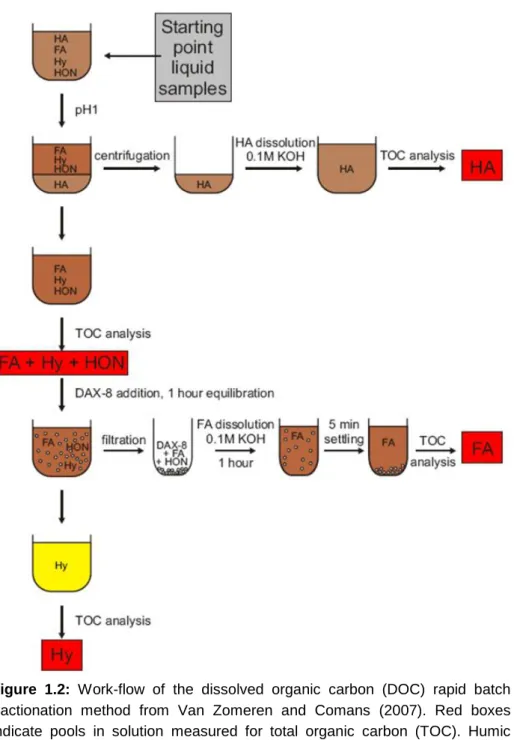
The fractionation procedure is described in detail by Aiken et al. (1985) but the most important outcome of this method to emphasize here is the isolation of four fractions: humic acids (HA), fulvic acids (FA), hydrophobic neutrals (HoN) and hydrophilics (Hy) (Figure 1.2). These fractions range from most hydrophobic (HA) to least (Hy) and are themselves heterogeneous mixtures of C substances, though they are considered relatively more homogeneous than total DOC (Leenheer, 1981). Hydrophobic HA molecules
7
Figure 1.2: Work-flow of the dissolved organic carbon (DOC) rapid batch fractionation method from Van Zomeren and Comans (2007). Red boxes indicate pools in solution measured for total organic carbon (TOC). Humic acids (HA), fulvic acids (FA), and hydrophilic compounds (Hy) are measured directly while hydrophobic neutrals (HON) remain adsorbed to the resin (DAX-8) after equilibration and their pool size is calculated.
8
are considered quite recalcitrant to microbial degradation and thus one of the most stable soil organic compounds (Kalbitz et al., 2003b), even in solution. Conversely, when measuring how specific compounds are partitioned between hydrophobic and hydrophilic pools, Amery et al. (2009) observed the majority of aliphatic, LMW C and 97% of glucose were measured in the hydrophilic pool. Guggenberger et al. (1994) have proposed that hydrophobic compounds (including FA and HON) may be in an intermediary state of decomposition between DOC source material and Hy fractions. Each fraction therefore may have properties unique to it beyond hydrophobicity.
One draw-back of the fractionation procedure has been that it is time-consuming and labour-intensive (Malcolm, 2005). These disadvantages have recently been overcome by the development of a batch-fractionation procedure (Figure 1.2) by Van Zomeren and Comans (2007) which allows for a greater number of DOC samples to be processed in a shorter amount of time with no loss of precision. Although fractionation is a widely-used and (becoming a more) accessible method for characterizing DOC, relatively little is known about the importance of the isolated fractions for soil function, particularly biological activity.
1.2.5 The Biological Relevance of Dissolved Organic Carbon (Fractions)
Due to its soluble nature and ability to permeate the soil matrix, DOC has been presumed a relatively bioavailable source of C for soil microorganisms (Kalbitz et al., 2000; Marschner and Kalbitz, 2003). The microbial processes shown to be influenced by soil DOC (quality) include: nutrient mineralization (Haynes and Beare, 1997; Janzen et al., 1997), biomass accumulation, and activity (respiration) rates (Boyer and Groffman, 1996; Brooks et al., 1999; Janzen et al., 1997; Marschner and Noble, 2000). However, in reviewing many studies on the biodegradability of DOC, Haynes (2005) determined a range of only 10-40% of DOC that is available for decomposition to CO2 by the soil microbial community. Since biological activity of soils is frequently proposed
9
as a potential indicator of overall soil quality (Gregorich et al., 1994; Janvier et al., 2007), this 10-40% of DOC may be critical for many processes.
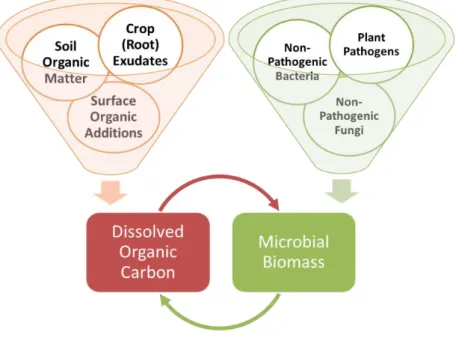
The remaining proportion of DOC considered “non”-bioavailable is suggested to be composed of recalcitrant humic-like substances (Haynes, 2005). Indeed, Jandl and Sollins (1997) and Qualls and Haines (1992), in some of the few studies on the biodegradability of specific DOC fractions, confirmed that hydrophilics were the fraction of DOC most rapidly depleted by soil microorganisms. However, the recalcitrant nature of HA has been challenged (Boyer and Groffman, 1996) and it may be more useful to think of HA molecules as a potential reservoir of LMW C that is intermittently adsorbed to HA surfaces (Sutton and Sposito, 2005). The biological relevance of DOC may not only support microbial activity and thus soil CO2 production (Figure 1.1), but the activity may in turn influence concentrations and quality of DOC (Magill and Aber, 2000). Figure 1.3 is a conceptual representation of the feedback between the components of the soil microbial biomass and the pool of total DOC. As different functional groups of soil microorganisms have different
Figure 1.3: Conceptual framework of dissolved organic carbon and microbial biomass feedback loop in agricultural soils.
10
C substrate preferences (Fierer et al., 2008; Kramer and Gleixner, 2008), and secondary (non-CO2) products of decomposition remain in solution as DOC (Kalbitz et al., 2003), the feedback between properties of the microbial community and DOC pools in soils may be intricate and rapid. However, much remains to be explored about this feedback, including the role of DOC fractions as indicators of DOC quality as a substrate, and the implications of this for various microbial processes.
1.2.6 Predicting Disease Suppressiveness of Agricultural Soils
One microbially-mediated soil process that may also be influenced by DOC quality is GDS. This thesis is one outcome of the Dutch Technology Foundation-funded project Predicting Disease Suppressiveness of Agricultural
Soils. The objective of this project is to identify indicators of a soil’s capacity
for GDS and develop management recommendations for farmers to increase GDS. The research presented in this thesis was conducted in close collaboration with that conducted for the thesis Suppression of Soil-Borne Plant Pathogens, by Maaike van Agtmaal (2015), which the reader is also encouraged to refer to. Together, these two theses investigate the hypotheses of Predicting Disease
Suppressiveness of Agricultural Soils, which are that:
1) GDS is determined by soil microbial community activity, including decomposition of the substrate DOC, and production of pathogen-inhibiting volatile compounds;
2) The activity rates of the soil microbial community are reflected in the quantity and composition of the soil DOC pool, any organic amendment DOC pool, and/or subfractions of these pools;
3) OM management is a tool in management of DOC and consequently of GDS.
11
1.3 Research Objectives
The three hypotheses developed for the project Predicting Disease
Suppressiveness of Agricultural Soils were the foundation of the research
objectives of this thesis. The broad objectives of this thesis were to determine how DOC and DOC fractions ranged among soils, and how DOC properties were related to various processes of the soil microbial community. Addressing these broad objectives was approached by sequentially addressing the following more specific research objectives:
1) To investigate differences in the DOC characteristics of organic materials used for soil amendment, and relate these differences to how the materials were processed (Chapter 2);
2) To measure how differences in DOC from different organic amendments influenced fractions of soil DOC (Chapter 3);
3) To measure how changes in fractions of soil DOC were related to changes in soil microbial respiration (Chapter 3);
4) To determine how DOC properties ranged among different agricultural soil types, and to what degree these properties could be used to explain microbial respiration (Chapter 4);
5) To relate DOC properties among different agricultural soil types to the microbial production of pathogen-suppressing volatiles (Chapter 5);
6) To consider DOC in a new context relative to soil microbial functions, especially GDS, and develop hypotheses for future research consideration (Chapter 6).
12
1.4 Thesis Outline and Experimental Approach
The research objectives outlined in this thesis were investigated using a variety of experimental approaches. Many were exploratory and aimed to gather information about DOC properties from sources that we previously had little information for (Objectives 1, 4 and 5), while others used a systematic application of treatments (Objectives 2 and 3) that built on earlier experiments.
In Chapter 2, I characterized DOC from various compost types that had received different input material and undergone different processing conditions, thereby addressing Objective 1. Based on vast variation reported in the literature about how soil microbial functions may respond to compost application, I hypothesized that the range in DOC fraction concentration may be the mechanism behind these differences, so I measured this potential range. While previous studies had investigated changes in DOC quality in one compost type over time, or differences in total DOC among compost types, this would be the first study to perform an in-depth comparison of DOC quality among many compost types. The high range measured suggested that these differences may indeed be significant enough to result in differences in soil microbial response.
The results of Chapter 2 thus prompted our experimental treatments in Chapter 3. In Chapter 3 I aimed to determine if the differences in compost DOC quality found in Chapter 2 had discernible effects on soil DOC fractions when that compost DOC was added to soil. To this end, I selected two of the composts measured in Chapter 2 that had different DOC fraction profiles. I hypothesized that not only would the differences in compost DOC quality affect soil DOC quality upon addition (Objective 2), but that these differences would be further reflected in the rates of soil microbial activity measured from this soil over a period of incubation (Objective 3). In addition to confirming both of these hypotheses, Chapter 3’s experiment produced some surprising results: humic acid DOC fractions that were expected to remain stable over the incubation period were actually very dynamic. The results of Chapter 3 were unique and important, but I wondered how representative this one soil type was of what may be measured in other agricultural soils.
13
Therefore, in follow-up to Chapter 3, a much broader survey of agricultural soils was conducted in another exploratory experimental approach. The 50 soils sampled for Chapters 4 and 5 came from a variety of arable soil types undergoing several different management regimes. All 50 soils were measured in collaboration with BLGG Agroexpertus and the Netherlands Institute of Ecology to determine the broadest set of physical, chemical, microbial and DOC parameters. In both Chapters 4 and 5, using a statistical approach, I determined the influence of DOC properties on the soil microbial processes of respiration and suppressive-volatile production, respectively.
Chapter 4 describes both the general patterns of variability in indicators of DOC quality and the (lack of) influence of field management practices on those indicators. These DOC properties were then analysed separately and together as independent variables in a model explaining variation in soil microbial respiration rates, which is motivated by Objective 4. By comparing performances of models with various DOC properties as independent variables, more insight is provided into the biological relevance of DOC fractions and their aromaticity, which supplements the findings of Chapter 3. Peripheral to Objective 4, the results of this experiment revealed interesting relationships between the properties of DOC aromaticity and proportions of DOC hydrophilic fractions. The survey I performed in Chapter 4 is the most detailed study conducted to date on the properties of DOC (fractions) among agricultural soils. Succeeding my analysis of DOC’s influence on microbial respiration is Chapter 5’s analysis of pathogen-suppression rates. This final experiment builds on the statistical approach of Chapter 4, but includes DOC properties in conjunction with a wider range of soil chemical and microbial community properties as independent variables, and considers the production of pathogen-suppressing microbial volatiles as the dependent variable. Identifying the nature of this relationship is the research priority of Objective 5. The importance of DOC for pathogen-suppression in vitro is confirmed by the significance of both DOC and microbial respiration as model parameters for the overall suppression of three soil-borne plant pathogens. These results subsequently lead to the
14
recommendations I make for future research, which are proposed in Chapter 5 and elaborated on in Chapter 6.
Chapter 6 is the final chapter in this thesis, in which I interpret the results of each chapter not only relative to one another, but to the broader body of literature on soil organic carbon quality and microbial function. Furthermore, as per Objective 6, I go on to describe the implications of this thesis for development of future research priorities in such pertinent fields as soil OM turnover and general disease suppression.
15
Chapter 2
Input materials and processing conditions control
compost dissolved organic carbon quality
Angela L. Straathof, Rob N.J. Comans
This chapter has been published in the journal Bioresource Technology. DOI: 10.1016/j.biortech.2014.12.054
16
Abstract
Dissolved organic carbon (DOC) has been proposed as an indicator of compost maturity and stability. Further fractionation of compost DOC may be useful for determining how particular composting conditions will influence DOC quality. Eleven composts ranging in input materials and processing techniques were analysed; concentrations of DOC ranged from 428 mg kg-1 to 7300 mg kg-1. Compost DOC was qualified by fractionation into pools of humic acids (HA), fulvic acids (FA), hydrophobic neutrals (HoN), and hydrophilic (Hi) compounds. The range in proportion of DOC pools was highly variable, even for composts with similar total DOC concentrations. Longer composting time and higher temperatures consistently corresponded with a depletion of hydrophilics, suggesting a preferential turnover of these compounds during the thermophilic composting phase. Qualification of DOC pools through fractionation may be an informative tool in predicting the effects of a processing technique on compost quality and, ultimately, soil functional processes.
17
2.1 Introduction
Composts are produced using many different processing techniques and with a broad range of input materials, resulting in physical and chemical heterogeneity between compost types (Lannan et al., 2012). This heterogeneity makes it difficult to predict how a soil’s biogeochemical properties are influenced by compost application. Dissolved organic carbon (DOC) concentration is associated with many indicators of both compost and soil quality, including maturity and microbial activity, respectively. Therefore, DOC has been proposed as an indicator of compost maturity and stability (Bernal et al., 1998; Zmora-Nahum et al., 2005). Between compost types, however, DOC quality may range broadly and independently of total DOC, depending on input materials (Wei et al., 2014) and duration of composting (Said-Pullicino et al., 2007).
Qualification of DOC is often performed by isolating and quantifying the pools of hydrophobic and/or hydrophilic DOC in a solution extracted from solid-phase materials (Aiken et al., 1985), such as compost. Hydrophobic compounds include humic acids, fulvic acids and hydrophobic neutrals. These compounds tend to be more aromatic and higher in molecular weight than hydrophilic compounds (Aiken et al., 1985). These various pools of DOC also function distinctly from one another; the size and hydrophobicity of compost humic acids facilitate their ability to complex contaminants such as trace metals, polycyclic aromatic hydrocarbons, and pesticides (Semple, 2001). Meanwhile, hydrophilics extracted from compost have been found to influence rates of microbial activity in soils (Straathof et al., 2014) which may subsequently impact nutrient availability and turnover. As compost’s application purposes range from remediation to nutrient supplementation to pathogenic disease suppression (Termorshuizen et al., 2006), the characterization of the respective pools that influence these processes may be valuable information for end users.
The objective of this experiment was to investigate the range in quality of dissolved organic carbon from a variety of composts. It was hypothesized that composts sourced from different organic input materials and composted
18
under different processing conditions would have different DOC quality profiles independent of total DOC concentration. Furthermore, it was hypothesized that increasing the length of maturation time and/or increasing proportions of woody input material would result in higher concentrations of hydrophobic compounds relative to hydrophilic compounds. This will provide insight into how input materials and processing conditions of a particular compost influence the DOC quality of the final product.
2.2 Materials and Methods
2.2.1 Compost Collection and Characterization
Eleven compost types were collected from different composting facilities in The Netherlands between March 2012 and June 2013. Each compost was collected on-site from the commercial composting facilities (Table 2.1) except MW6, which was received from the supplier in commercial packaging. Composts collected on-site were shoveled from a minimum depth of 30 cm below the surface of the compost heap, from multiple points in the heap, and homogenized manually into one sample. All composts were collected at the stage of readiness for commercial distribution (i.e. a final product). The input materials and/or processing conditions (Table 2.1) were different for each compost, to better obtain a broad range in properties. Composts were transported to the laboratory and refrigerated (4°C) for a maximum of one week before pretreatment and analysis.
Prior to chemical analysis (Table 2.2), composts were air dried at 40°C and ground (<1mm) for homogeneity of each sample. For pH, total soluble N and PO4-P, samples were equilibrated for 1h in a 1:10 ratio of dry material to 0.01M CaCl2, and filtered to 0.45 µm. Nitrogen and P were measured on a San++ 6 channel segmented flow analyser (SFA) (Skalar, The Netherlands). Calcium carbonate content on each compost was determined using the
19 T able 2 .1 : C om po s ts i nc lud ed i n t h is s tud y , s o urc e m at eria l i ng red ie nts of th e c om po s t, a nd proc es s ing proc e du re. Com p o s t c o d e Com p o s ti n g f a c ili ti e s So u rc e m a te ri a l Pe a k T a °C T im e a t p e a k T d Ad d iti o n a l MW -1 Va n I e rs e l C o m p o s t, Bi e z e n m o rte l, NL 5 5 % s h re d d e d w o o d , 2 5 % g ra s s litt e r, 2 0 % l e a f litt e r 80 52 Si e v e d t o 1 0 m m . 10 d i n w ind row (tu rne d 5 x ), 4 2 d o n t a b le b e d (t u rn e d 4 x ) MW -2 Va n I e rs e l C o m p o s t, Bi e z e n m o rte l, NL 5 5 % s h re d d e d w o o d , 2 5 % g ra s s litt e r, 2 0 % l e a f litt e r 80 52 Si e v e d t o 1 5 m m . 1 0 d i n w in d ro w (t u rn e d 5 x ), 4 2 d o n t a b le b e d (t u rn e d 4 x ) FL Va n I e rs e l C o m p o s t, Bi e z e n m o rte l, NL Fo re s t (l e a f) l itt e r 70 28 Si e v e d t o 3 0 m m . W in d ro w , tu rn e d 6 x SG Va n I e rs e l C o m p o s t, Bi e z e n m o rte l, NL 7 5 % s o il s ie v e d f ro m w o o d y m u n ic ip a l w a s te + 2 5 % g ra s s l itt e r 75 14 Si e v e d t o 2 0 m m . W in d ro w , tu rn e d 7 x MW -3 Van Ie rs el C om p os t, Bi e z e n m o rte l, NL 65 % s hre d de d w oo d, 17 .5 % g ras s litt e r, 1 7 .5 % l e a f litt e r 80 52 Si e v e d t o 1 5 m m . 1 0 d i n w in d ro w (t u rn e d 5 x ), 4 2 d o n t a b le b e d (t u rn e d 4 x ) FG -1 Va n I e rs e l C o m p o s t, Bi e z e n m o rte l, NL 7 0 % s h re d d e d w o o d , + 3 0 % c la y , g ra s s l itt e r & c o m p o s t a s i n o c u lu m 70 84 W in d ro w , tu rn e d 1 5 x FG -2 O rg a w o rl d , L e ly s ta d , NL G ra s s c lip p in g s + fu n g a l-in o c u la te d m u lc h e d w o o d >6 5 21 T u rn e d 7 -1 0 x . In o c u la te d w ith Tri c h o d e rm a s p p . MW -IW O rg a w o rl d , Ze e a s te rw e g , NL 8 0 % m u n ic ip a l o rg a n ic w a s te + 2 0 % i n d u s tr ia l o rg a n ic w a s te 50 -65 1 T u rn e d 2 x MW -4 O rg a w o rl d , Le ly s ta d, NL M u n ic ip a l o rg a n ic w a s te b 50 -65 1 T u rn e d 2 x MW -5 O rg a w o rl d , Drac h te n , NL M u n ic ip a l o rg a n ic w a s te 65 -70 10 T u rn e d 3 x MW -6 Com g o e d , Dir k s la n d , NL M u n ic ip a l o rg a n ic w a s te 55 -6 0 ; >5 0 3 ; 14 T u rn e d 4 -5x . 3 d a t p e a k T t h e n 1 4 d s lig h tl y b e lo w p e a k T . a Int ern al m ax im u m te m pe ra ture of c om po s t h ea p b Mu n ic ip al organ ic w as te i s a m ix ture of v eg e tab le, fr ui t a nd ga rd en was te c o llec te d f ro m c urb -s ide m un ic ipa l progr am s
20
Scheibler method (ISO10693) and total elemental C and N measurements were performed on a LECO Truspec CHN analyser (LECO Corporation, St. Joseph, MI, USA) (Table 2.2). Organic matter (OM) content was determined by loss on ignition from 105 to 550°C (Table 2.2).
Extraction of DOC was performed on dry-weight-equivalent fresh compost material in ultra-pure water (1:10). Due to heterogeneity of the fresh compost materials, four suspensions of 10 g compost were equilibrated, filtered, and subsequently pooled. Equilibration for 1 h via end-to-end shaking preceded 0.45 µm filtration of the solution. A subsample of the pooled solution was taken for measuring total DOC concentration on a TOC-5050A analyser (Shimadzu Corporation, Kyoto, Japan). The remainder of the total DOC sample was fractionated.
Table 2.2: Chemical properties of 11 composts analysed. Data presented is based on dry matter. Extractions (pH, total soluble N and P) were performed in
1:10 solutions of dry, ground compost in 0.01M CaCl2, except dissolved organic
carbon (DOC) concentration, which was extracted from 1:10 solutions of fresh compost (dry-matter equivalent) in ultra-pure water. OM= organic matter content.
Compost pH N – total
soluble P-PO4 CaCO3 DOC
Total C Total N OM mg kg-1 mg kg-1 % mg kg-1 g kg-1 g kg-1 % MW-1 6.74 226 15.1 0.54 663 101.0 8.1 18.6 MW-2 7.13 218 13.4 0.69 997 102.6 7.7 20.6 FL 6.91 59 89.9 0.41 903 182.2 8.4 42.5 SG 7.30 88 10.9 0.34 904 74.2 4.9 18.5 MW-3 6.92 101 31.8 0.65 1085 151.2 10.7 26.7 FG-1 7.39 79 2.1 0.62 428 83.4 5.1 17.9 FG-2 7.14 248 11.9 0.96 527 97.0 7.3 25.3 MW-IW 7.07 381 48.4 2.33 4674 258.1 19.1 37.0 MW-4 7.16 1102 238 3.95 7307 194.0 15.3 45.3 MW-5 7.18 649 52.6 2.86 6753 165.4 14.6 35.9 MW-6 7.0 N/A N/A 2.90 505 183.3 11.7 31.6
21
2.2.2 Fractionation
of DOC
After extraction, the total DOC sample was fractionated using the operational definitions set by the International Humic Substances Society (IHSS) and described by Aiken et al. (1985). Hydrophobic humic acid (HA), fulvic acid (FA) and neutral (HoN) compounds were physically separated from hydrophilic (Hi) compounds through pH changes to the solution and equilibration with a resin. In this experiment, the batch fractionation procedure (Van Zomeren and Comans, 2007) was used; first, the total DOC sample was acidified to pH 1 with 6 M HCl and allowed to stand overnight. This precipitated humic acids out of solution. The acidified solution was then centrifuged (15 min, 3000 g), separating the HA from the supernatant containing FA+HoN+Hi. Next, the HA pellet was resuspended in 0.1 M KOH (pH 12) and the HA DOC concentration was determined on a TOC-5050A analyser (Shimadzu Corporation, Kyoto, Japan). The supernatant (FA+HoN+Hi) was then added in a 1:10 resin to solution ratio to the resin DAX-8 (Sigma-Aldrich). DAX-8 is a non-ionic, macroporous resin. The resin was prepared for use by extracting organic impurities in a 24 h Soxhlet extraction with acetonitrile and then methanol, as described by Van Zomeren and Comans (2007), and rinsed with ultra-pure water. The resin was then equilibrated with FA+HoN+Hi for 1 h using horizontal shaking. This pulled the hydrophobic FA and HoN compounds out of the solution by binding them to the surface of the resin. The Hi compounds do not bind to the resin but remain in the solution, which was separated from the resin after equilibration. The DOC concentration of Hi was measured on the San++ 6 channel SFA (Skalar, The Netherlands). Finally, the resin with the adsorbed FA+HoN pools was equilibrated in several wash steps with 0.1 M KOH. Each wash step re-dissolved part of the FA pool from the resin surface and they were repeated until the concentration of the wash solution was not higher than a blank sample (4 to 6 wash steps per sample, depending on the FA concentration in the starting total DOC solution). The DOC concentration of FA was also measured on the SFA. The DOC concentration of the HoN pool is calculated by determining the
22
proportion of the DOC which was not re-dissolved from the resin (as it remains bound to the resin even under alkaline conditions). The percent DOC return from the beginning to the end of the fractionation procedure was 85 to 105%.
2.3 Results and Discussion
2.3.1 Compost chemical properties
The compost samples selected for this study were found to encompass a broad range of chemical properties (Table 2.2). pH was the least variable parameter measured, with all composts having near-neutral pH. Total soluble N was positively correlated with Total N (r=0.68, P=0.03), although compost MW4 had relatively high soluble N to total N (Table 2.2). This sample also had a very high DOC concentration (7307 mg kg-1) relative to its total C concentration (194 g kg-1). Organic matter (OM) had a broad range between samples (18.5 to 45%) but did not seem to correspond with any particular input materials or processing procedure (Table 2.1).
The most nutrient-rich composts in terms of both total and total soluble N, PO4, and total C were MWIW, MW4 and MW5. These were also the composts with the shortest periods (1 to 10 d) spent at peak internal composting temperature (Table 2.1) and all were sourced from municipal organic waste household collection programs. These three composts also had the highest DOC concentrations, which were 6 to 10 times higher than the mean of the other eight composts. While they did have relatively high % OM, there were composts with comparably high % OM and much lower DOC (See FL and MW6, Table 2.2). These three high-DOC composts (MWIW, MW4 and MW5) had reached maturation according to the manufacturer’s internal standards, but did not meet the DOC level of 4000 mg kg-1 recommended by Zmora-Nahum et al. (2005) as the upper limit of DOC concentration for a compost to be considered mature. This high DOC concentration is most likely because of C preservation from the compost spending less time at peak composting temperature (Table 2.1). During
23
the composting process, the most biodegradable forms of C are mineralized (Bernal et al., 1998; Paré et al., 1998) along with other nutrients (i.e. N and P), fuelling microbial activity. While all other composts spent 14 to 42 d at maximum internal temperature, MWIW, MW4, MW5 and MW6 had shorter opportunity for C turnover (1 to 10 d). Paré et al. (1998) describe a compost with maximum loss of C as CO2 during days 4 to 11 of a 59 d composting period. Decreases in DOC concentration during the thermophilic composting phase are well reported in the literature (Benito et al., 2003; Paré et al., 1998; Raj and Antil, 2011). Therefore, it is likely that the conservation of total DOC in these three composts is a result of reduced cumulative microbial activity which, as described below, subsequently alters the composition of the remaining DOC as well.
2.3.2 Compost DOC quality
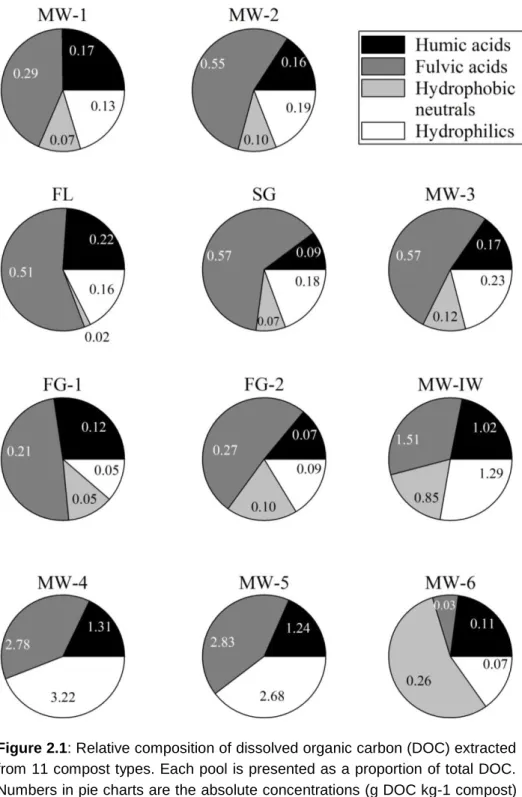
Variability was found between samples not only in total DOC concentrations, but also in the composition of the DOC quality profiles (Figure 2.1). When considering HA, FA, HoN and Hi pool sizes relative to one another, FA nearly consistently had the highest proportion of total DOC. Humic acids had low variability relative to other pools (10 to 27%). Of the hydrophobic compounds (HA+FA+HoN), HoN tended to have the lowest concentrations across the compost types (except MW6). These HoN compounds are highly aliphatic in compost (Chefetz et al., 1998), including quinones (Amery et al., 2009), which are known to be released by microbial turnover (Paul, 2006). The Hi pool, typically comprised of low-molecular weight sugars and amino acids (Amery et al., 2009), had both the highest absolute concentrations and proportion of total DOC under conditions of <10 d in thermophilic phase.
Three composts had both the highest absolute DOC concentrations and the highest proportions of hydrophilic (Hi) DOC: MWIW, MW4 and MW5. These three composts underwent the shortest durations at peak composting temperature (Table 2.1) and all three were sourced from municipal household
24
Figure 2.1: Relative composition of dissolved organic carbon (DOC) extracted from 11 compost types. Each pool is presented as a proportion of total DOC. Numbers in pie charts are the absolute concentrations (g DOC kg-1 compost) of the corresponding DOC pools.
25
organic waste, i.e. low prevalence of woody materials. All other composts underwent a longer composting period (>10 d), higher composting temperature (≥70 °C (except MW6)), and had lower proportions of Hi, which indicates turnover of these compounds during composting. The Hi pool may be preferentially used as a substrate by microorganisms throughout the composting process (Said-Pullicino et al., 2007), subsequently contributing a lower proportion to the composition of the remaining DOC. Furthermore, when added to soil, compost DOC high in Hi proportion has been found to promote short-term (<2d) microbial activity rates more so than a compost with a higher proportion of hydrophobic compounds (Straathof et al., 2014). Measurement of Hi DOC may therefore be a more informative indicator of the effect compost addition may have on soil microbial activity rates than measurements of OM or even total DOC. Alternatively, HA DOC and other hydrophobic pools (FA+HoN) dominated composts that underwent ≥28 d at peak composting temperature (Figure 2.1; Table 2.1). These hydrophobics are aromatic and more resistant to turnover than hydrophilic compounds and thus, as hydrophilics are depleted, they constitute a larger proportion of total DOC. The aromatic and recalcitrant nature of the hydrophobics may also contribute to their ability to bind pollutants when applied to soil (Semple, 2001). Particularly the HA in this hydrophobic fraction may contribute to the formation of soil aggregates and, hence, to the remediation of soil structure through HA’s ability to bind strongly to reactive mineral surfaces (Weng et al., 2006).
Composts with the most similar DOC profiles were those with both similar inputs and similar lengths of time at peak temperature. Composts MW2 and MW3 both had a DOC pool breakdown of approximately 55% FA, 20% Hi, 15% HA and 10% HoN. As both composts were processed similarly in terms of temperature, time, and sieving (Table 2.1), this suggests these treatments are reflected in the DOC composition. The two samples varied slightly in input materials (Table 2.1), but by <10%. Compost MW1 also underwent the same processing treatment and had a similar quality composition as MW2 and MW3. However, it was sieved to a smaller size (10 mm vs. 15 mm), which probably resulted in a larger proportion of its material dominated by highly decomposed
26
materials. This is reflected in its more dominant proportion of HA (Figure 2.1), a highly transformed DOC pool. These three composts’ processing similarities are reflected in their shared DOC quality profiles, validating the consistency of this fractionation method as an indicator of compost input materials and processing treatments.
2.4 Conclusions
The DOC fractionation method showed consistency between composts with similar input materials and processing conditions. Composts with the shortest thermophilic periods (≤10 d) and lower composting temperatures (≤70 °C) had the highest DOC concentrations and the highest proportion of hydrophilic compounds. This suggests preferential turnover of hydrophilics during composting, while hydrophobics remain relatively conserved. Based on the variability of these pools between composts, and the consistent influence of processing conditions on DOC composition, these results suggest that DOC quality via fractionation is a valuable parameter to consider when assessing the suitability of a compost for application to soil.
Acknowledgements
This research is supported by the Dutch Technology Foundation (STW), a branch of the Netherlands Organisation for Scientific Research (NWO) (grant number 10716). The Dutch composting companies Orgaworld, Van Iersel Compost, and Comgoed were indispensable in providing access to, and information on, their composting facilities. The authors also wish to acknowledge the scientific input of Gera van Os, Gerard Korthals, Aad Termorshuizen, Wietse de Boer, Maaike van Agtmaal, and Ellis Hoffland.
27
Chapter 3
Dynamics of soil dissolved organic carbon pools
reveal both hydrophobic and hydrophilic
compounds sustain microbial respiration
Angela L. Straathof, Riccardo Chincarini, Rob N.J. Comans, Ellis Hoffland
This chapter has been published in the journal Soil Biology and Biochemistry. DOI: 10.1016/j.soilbio.2014.09.004
28
Abstract
The quality of dissolved organic carbon (DOC) released from soil organic amendments may influence soil microbial activity and the quality of the soil’s DOC pools. Measurements of total DOC are often considered in relation to microbial activity levels but here we propose that quantification of DOC fractions is a more informative alternative. In a laboratory incubation, soil received DOC that was extracted from three organic matter sources: fresh compost, mature compost, and a mixture of the two. Soil microbial respiration (CO2 emission), and concentrations of hydrophobic (humic acids (HA), fulvic acids (FA) and neutrals (HoN)) and hydrophilic (Hi) DOC fractions were measured throughout the 35 d incubation. The A254 specific UV absorption of total and HA DOC were measured at the start and end of the incubation as an indicator of aromaticity. Microbial respiration rates were highest in soils amended with fresh compost DOC, which had a higher proportion of Hi compounds. Concentration of Hi was significantly and positively correlated with soil respiration, explaining 24% more variation than total DOC. Humic acid concentrations significantly decreased over 35 d, including a 33% reduction in HA from an unamended control soil. Compost treated soils’ HA pools increased in aromaticity, suggesting preferential mineralization of the least aromatic HA molecules. A decrease in SUVA254 values in other HA pools may be the result of HA degradation in the absence of low-aromatic HA. Our observation of depletion of hydrophobic compounds from the HA fraction provides evidence that humic substances can be a relatively reactive pool, which can provide, together with hydrophilic compounds, a readily available C source to the microbial community.
29
3.1 Introduction
Dissolved organic carbon (DOC) plays a key role in sustaining soil microbial activity due to its solubility and lability (Kalbitz et al., 2000; Chantigny, 2003) and thus may be a pertinent indicator of soil quality. Soil DOC is both a substrate for microbial activity and a byproduct of the subsequent microbial metabolic processes (Marschner and Kalbitz, 2003; Van Hees et al., 2005; Bolan et al., 2011). The quality of DOC influences the variability of several soil factors, such as microbial community composition (De Graaff et al., 2010), nutrient availability and leaching (Gerard H. Ros et al., 2010), and the rate of soil C turnover (Boddy et al., 2007; Jandl and Sollins, 1997). As a substrate, DOC may originate from plant residues, root exudates, decomposing litter, and, in agricultural soils, from applied organic amendments (Chantigny, 2003). The range in potential sources results in a biochemically heterogeneous DOC solution, which exacerbates uncertainty in predicting how a particular amendment impacts soil microbial activity and C turnover rates.
Several studies have measured the influence of various qualities of C additions on soil C turnover (Guggenberger et al., 1994; De Nobili et al., 2001; Kalbitz et al., 2003a; Boddy et al., 2007). Those describing rapid evolution of CO2 from soil (<1h after C addition) attributed this to the turnover of low molecular weight (LMW) C compounds (De Nobili et al., 2001; Boddy et al., 2007), such as short-chain polysaccharides and amino acids. Van Hees et al. (2005) compared forest soil respiration rates between LMW and high molecular weight DOC compounds and concluded that the latter drives only 14% of CO2 emissions. This suggests that DOC containing high proportions of LMW compounds would stimulate microbial activity relatively more than DOC with a smaller proportion of LMW C. Qualifying DOC into proportions of labile, LMW C vs more recalcitrant, aromatic C compounds may therefore provide a more powerful indication of C turnover rates and microbial activity potential than measurements of DOC concentration alone.
One method of qualifying DOC is to partition the total pool into operationally defined fractions based on their solubility and relative
30
hydrophobicity (van Zomeren and Comans, 2007). This is a rapid-batch procedure based on the International Humic Substances Society’s standard method for isolation of humic substances from organic matter in soils and natural waters (Swift, 1996; Thurman and Malcolm, 1981). By equilibrating a DOC solution with an absorbent hydrophobic resin (DAX-8), hydrophobic compounds are pulled out of solution and physically separated from hydrophilic compounds. The isolated pools resulting from this fractionation are distinguishable as aromatic, hydrophobic fraction (humic (HA) and fulvic acids (FA), hydrophobic neutrals (HoN)) and a hydrophilic fraction (Hi). Despite the relative ease of the method and its pervasiveness in environmental chemistry applications, only a few studies have looked at the dynamics of DOC quality over time using these fractions as a proxy. Ros et al. (2010) quantified fractions in three different soils after 35 d of incubation at different temperatures. They observed a decrease in the absolute concentration of a sandy soil’s HA fraction at 10 and 20°C, which resulted in this pool contributing a smaller proportion of the total DOC. At the same time, this study observed a stable Hi concentration at the end of incubation, which seems counterintuitive in contrast with other studies describing a high degradability of LMW compounds (Boddy et al., 2007; Bolan et al., 2011; De Nobili et al., 2001; Lannan et al., 2012a) which would be present in the Hi pool. In a study of how known compounds in homogenous, prepared solutions are partitioned between hydrophobic and hydrophilic pools, Amery et al. (2009) observed the majority of aliphatic C and 97% of a fractionated glucose solution was measured in the hydrophilic pool. This pool contains the largest proportion of LMW compounds (<500 Da) (Thurman et al., 1982). Conversely, hydrophobic HA molecules are considered a source of C quite recalcitrant to microbial degradation and thus one of the most stable soil organic compounds (Kalbitz et al., 2003b). This HA pool also contains larger, more aromatic molecules, in the range of 500-10000 Da (Thurman et al., 1982). Fulvic acids tend to be less aromatic and lower in molecular weight (500-2000 Da (Thurman et al., 1982)) than humic substances. Guggenberger et al. (1994) have proposed that hydrophobic compounds may be in an intermediary state of decomposition between DOC source material and Hi
31
fractions, but the authors do not identify a mechanism behind this flux or explore the implications for soil quality.
The biological relevance of each of these DOC fractions in soil remains unclear, especially for agricultural soils (Haynes, 2005), as research has yet to link fractionation in real-time with measurements of microbial activity. Although Chantigny (2003) describes the effect of organic amendments on soil DOC concentration, their impact on soil DOC quality over time may be highly variable depending on the amendment’s composition and their effect on C turnover rates. The aim of this study was to investigate the dynamics of soil DOC quality using fractionation and specific UV absorbance, in parallel with measurements of soil microbial respiration, in a soil amended with compost-derived DOC. Due to increased bioavailability, we hypothesized that soils receiving DOC with a higher proportion of hydrophilic compounds would have respiration rates stimulated more so than those receiving more aromatic hydrophobic compounds. We expected DOC extracted from soil to reflect the characteristics of the added DOC with respect to prevalence of certain fractions and aromaticity measurements. These quality measurements and soil microbial respiration rates were carried out simultaneously, in order to elucidate the influence of hydrophobic vs hydrophilic DOC fractions on soil C turnover rates and better understand the contribution of DOC to soil activity levels.
3.2 Materials and Methods
3.2.1 Amendment Characterization
Two different composts were used as a source of DOC to add to soil. To obtain DOC varying in quality, the composts were selected based on their different source materials and maturation treatments. They were collected in October 2012 from two different commercial compost facilities in the Netherlands. The first compost, hereafter referred to as fresh compost, was collected from the Orgaworld Biocel fermentation facility in Lelystad, The
32
Netherlands. The input material of the fresh compost consisted of municipally collected household fruit, vegetable and garden residues. These materials were composted for 1 d above 65°C (internal temperature of the compost heap) and 6 d above 45°C, with two instances of the material being turned. The second compost, hereafter referred to as mature compost, was collected from the Van Iersel compost facility in Biezenmortel, The Netherlands. It consisted, by mass, of 75% soil sieved from woody compost inputs and 25% municipal grass cuttings. The composting period for the mature compost lasted for 2 weeks at an internal temperature of 60-70°C, and the compost heap was turned twice a week. After this period, the mature compost was cured at ambient outdoor temperatures for 6-8 weeks. Both composts were collected at the stage of being a final, commercial product and their chemical characteristics are described in Table 3.1.
The compost DOC was obtained via a 1:2 compost to ultra-pure water (UPW) extraction: after 1 h equilibration by horizontal shaking, 20 min centrifuging at 3000 g and 10 min ultra-speed centrifuging at 11700 g, the supernatant was vacuum-filtered through a 0.2 m cellulose nitrate membrane, which had been pre-rinsed with 100 ml UPW to avoid C release from the membrane itself (Khan and Subramania-Pillai, 2006). The filter size was selected to exclude any microbes from the solution (Norris and Ribbons, 1969). This extraction was performed on both fresh and mature compost, as well as a 50/50 mass mixture of the two (hereafter referred to as mix compost) so that three DOC amendment solutions ranging in quality were prepared. The solutions were then freeze-dried for stable storage and to allow for re-dissolution at equal DOC concentrations.
3.2.2 Soil Collection and Characterization
The soil was collected in October 2012 from the Wageningen UR Applied Plant Research site in Vredepeel, Netherlands, from the 0-20 cm layer of an agricultural field. It is classified as non-calcareous loamy sand soil. It was suitable to assess DOC dynamics, since a high level in carbonates and clay
33
minerals strongly affects DOC concentration and adsorption (Chantigny, 2003; Kalbitz et al., 2000), and contribute to abiotic soil CO2 release; this soil was less than 0.01% CaCO3 (Table 3.1) and only 1% clay. Roots and crop residues were manually removed and the soil was air dried at 22±1°C for 8 hours until 30% water holding capacity was reached.
Table 3.1: Initial characteristics of the soil and composts used in the study. Numbers in brackets are SE for dry matter (n=2; except organic matter (OM), where n=3). Humic acid (HA), fulvic acid (FA), hydrophobic neutral (HoN) and hydrophilic (Hi) dissolved organic carbon (DOC) are presented as a percent of total DOC. Source material pH OM CaCO3 Total DOC HA FA HoN Hi % % mg kg-1 % % % % Soil 6.68 3.6 (0.1) 0.01 38.2 6.3 18.6 41.4 33.7 Fresh Compost 8.12 38.7 (1.2) 3.95 1624 (270.1) 23.5 (0) 31.2 (3.1) 10.1 (4.6) 35.3 (1.4) Mature Compost 8.35 17.5 (0.5) 0.34 559 (30.1) 16.1 (3.8) 37.3 (5.0) 23.8 (0.6) 22.9 (0.6)
3.2.3 Soil Incubation and Respiration Measurements
An incubation experiment was established in November 2012 to measure DOC turnover in soil to which the extracted compost DOC had been added. The incubation was conducted in 575 ml glass bottles with 150 g dry-weight-equivalent soil at 20°C in the dark for 35 d. After soil was placed in the bottles but before DOC addition, a pre-incubation period of 5 d occurred. This was to avoid measurement of CO2 that may have been produced as a result of physical or chemical changes caused during sampling and transfer of the soils to the bottles. The compost DOC was resuspended in UPW and solutions were added at rates of 70 or 30 g C g-1 dry soil (high (H) and low (L) rates,
34
respectively), which adjusted the final soil moisture content to 60% water holding capacity. The control treatment received only UPW. These rates correspond with a compost application of 50 or 20 Mg ha-1 compost. Thus, three DOC source types were added at two rates of DOC addition, making six treatments. Five replicates per treatment and for the control were established (3 DOC sources x 2 DOC rates x 5 replicates + 5 controls = 35 jars for CO2 measurements). Soil moisture in each bottle was adjusted to 60% water holding capacity using UPW as needed, at least once per week.
The soil’s CO2 emission was measured from each bottle’s headspace by sealing the jar with a rubber-septum for a time duration which increased from 6-24 h throughout the 35 d incubation period, depending on the emission concentration at that point in the incubation. Headspace CO2 concentrations were measured using an INNOVA 1412 Photoacoustic field gas-monitor (LumaSense Technologies, Ballerup Denmark). This procedure was repeated on days 1, 2, 4, 7, 10, 14, 21, 28 and 35. The CO2 emission rate (g C g
-1
soil h-1) from each replicate was calculated as:
where Vtot, Vgm and Vhs are the total, gas monitor’s and bottle’s headspace volumes (l), CO2hs and CO2air are the measured CO2 concentrations (l CO2 l
-1 ) of the bottle’s headspace and the ambient air, Wsoil is the soil dry weight (g), t is the duration of the sealing (h), 22.4 is the molar volume of CO2 (l mol
-1
) at STP, and 12 the molar mass of C (g mol-1). Respiration rates on days between measurements points were calculated using linear interpolation. Respiration related to the addition of DOC (i.e. independent of basal respiration) was calculated by subtracting the mean CO2 emission rate of the unamended control soil from the rates of soils with added DOC measured at the same time point.
The cumulative curve of C mineralized as a percent of total C added was calculated after linear interpolation between measurements as:
35
where rate(i) and rate(j) are the CO2 emission rates on different days (g C g-1 soil h-1) after subtraction of basal respiration rates, t(i-i0) and t(j-i) are the time differences between consecutive measurements (h) and Cadded is the C rate applied at the experiment’s beginning g C g-1 of compost DOC solution).
3.2.4 DOC Extraction and Fractionation
To measure DOC dynamics over the course of the 35 d incubation, 12 additional microcosms for each treatment were established and incubated in parallel to the five CO2-measured replicates. Three of these additional microcosms from each treatment were destructively harvested on days 2, 6, 13 and 35. On these days, DOC was extracted from each replicate in 1:2 soil to UPW solution ratio in the same method as the aforementioned compost extraction. The filtered DOC solution was then qualified using a rapid-batch fractionation procedure described by Van Zomeren and Comans (2007). This fractionation method uses precipitation and dissolution properties established by the International Humic Substances Society (IHSS) to operationally isolate four DOC pools: humic acids (HA), fulvic acids (FA), hydrophobic neutrals (HoN), and hydrophilics (Hi), the concentrations of which are either measured directly or calculated by differences before and after isolation. Briefly, the starting solution of the total extracted DOC was acidified to pH 1 using 6 M HCl, which results in the precipitation of any humic acids that were in solution. The acidified solution was then centrifuged, separating the HA from the supernatant. The pellet of HA was resuspended in a base solution of 0.1 M KOH and the concentration determined on a Shimadzu total organic carbon analyzer (5000A). The supernatant was then equilibrated with the resin DAX-8 (Sigma-Aldrich) for 1 h at 220 rpm horizontal shaking at a 1:5 resin to solution ratio. This equilibration step pulled hydrophobic FA and HoN compounds out of solution
36
by binding them to the surface of the resin. The compounds that remained in solution are operationally defined as hydrophilic and their concentration was measured as DOC on a Segmented Flow Analyzer (SFA). Finally, the resin separated from the Hi fraction was equilibrated in 0.1 M KOH, re-dissolving the FA pool. The concentration of FA was also measured as DOC on an SFA while the concentration of the HoN pool was calculated by determining the proportion of the DOC which was not re-dissolved from the resin (as it remains bound to the resin even under alkaline conditions). We deemed 90-110% mass balances of the sum of the individual fractions, relative to the original total DOC concentration, as an acceptable return.
To test for the adsorption of added DOC to the soil solid phase throughout the incubation time, an acid and base extraction and fractionation of the total soil matrix was also performed, as described by Van Zomeren and Comans (2007).
3.2.5 Aromaticity of DOC
To assess aromaticity of the DOC solutions, specific ultraviolet absorbance (SUVA) was measured in total DOC and HA fractions extracted after 2 and 35 d of incubation. Three replicates of 1.5 ml soil-extracted DOC from each treatment were analyzed with a spectrophotometer (Genesys 10S UV-VIS, Thermo Fisher Scientific Inc., Waltham MA, USA) and UPW was used as a blank. Three replicates of 1.5 ml isolated and redissolved HA from each treatment were also analyzed with 0.1M KOH used as a blank. Specific UV absorbance (SUVA, l g-1 cm-1) at 254 nm was calculated through the following equation, as described by Weishaar et al. (2003) and adapted by Amery et al. (2008):
where A254 is absorbance at 254 nm (dimensionless), b is the length path (cm) and DOC the dissolved organic carbon concentration (mg l-1) of the solution.