A.W. Roscoe
Oxford University Computing Laboratory
[email protected]
Abstract
We re-examine the needs of computer security in perva-sive computing from first principles, specifically the prob-lem of bootstrapping secure networks. We consider the case of systems that may have no shared secret informa-tion, and where there is no structure such as a PKI avail-able. Nevertheless we propose a protocol which achieves a high degree of security based on a combination of human-mediated communication and an ordinary Dolev-Yao com-munication medium. In particular it resists combinatorial attacks on the hash values that have to be compared by human users, seemingly optimising the amount of security they can achieve for a given amount of work. A variant of this protocol achieves one-sided authentication in a sce-nario similar to that of authenticating one or more blue-tooth devices. We discuss the properties and verification of these protocols.
1. Introduction
Imagine that a group of people come together and agree that they want to transfer data between them securely, mean-ing that they want it to be secret and of authenticated ori-gin. They all have some piece of computing hardware (e.g., a mobile phone or a PDA). Unfortunately none of them knows the unique name of any of the others’ equipment, and in any case there is no PKI which encompasses them all. How can they achieve their goal in the context that their machines are connected by an insecure network (whether created by WIFI, the internet, telephony, or a mixture of these)?
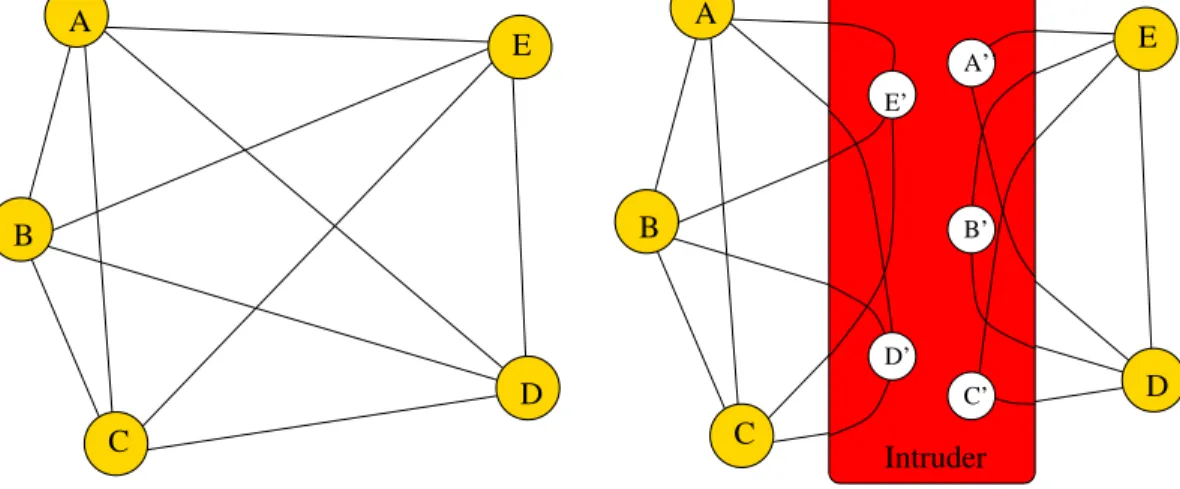
The conventional answer to this question would be that it is impossible, since it is impossible to prevent some im-poster I playing the man-in-the-middle between the par-ticipants A. For an example see Figure 1. Here, 5 users are trying to form a group and believe they have the con-nections on the left. But the intruder has partitioned them into two subgroups and invented 5 identities of its own to make both of these up to the right size. It then sets up
group sessions involving, respectively,{A,B,C,D,E}and {A,B,C,D,E} and can then pass transactions between the two groups or, if it wishes, impersonate a member of the group. As far as they know,{A,B,C,D,E}are connected to each other, and cannot tell that the intruder is present since they have no security framework to distinguish, say, A from A.
However a little creative thinking can easily solve the problem: if each person tells the others (using human con-versation) a public key for his or her machine, they can then use something like the Needham-Schroeder-Lowe protocol [11] (over the insecure network) to establish secure, authen-ticated communications. (If there are more than two partic-ipants then they would either have to adapt that protocol or to use it multiple times.)
They will have bypassed the intruder for the crucial step of exchanging electronic identities.
Unfortunately this idea would require a serious amount of effort on the part of the humans unless, perhaps, they all carried a card with them containing their public key that other machines could read – but of course that would again introduce a compatibility problem as well as limiting the range of applications. What we shall demonstrate in this paper is that high quality security can be obtained using this same idea of human activity bypassing the intruder for cru-cial steps, but with a greatly reduced amount of work. In-deed, it seems that we essentially minimise this.
Putting this in the context of earlier work, the author, Creese, Goldsmith, Zakiuddin and others [4, 3, 1, 2, 5] have developed the idea that the concept of a PKI is not ideal for many pervasive computing applications, for the follow-ing reasons. It is not realistic to assume that one is both sufficiently universal and sufficiently available to cover all scenarios. In any case, in the pervasive world, processes will not know the names of the others they wish to contact – essential for a conventional PKI. And finally, it is unrealistic to expect the average user to understand, and react properly to questions posed by, PKI such as “Do you trust certificates issued by authority X?”
If we are not identifying a system by name, there must be some other feature which identifies the ones we wish to
A A
B
C
D E
What might really be there
t
E
D C
B
What the users see
D’ B’ Intruder ’ B’ E’ C’ A’’ D’
Figure 1. Man in the middle
interact with securely. In pervasive computing this feature is frequently one of position or proximity [10, 13]. We have argued that these features can often be captured as low bandwidth empirical channels between systems in ad-dition to the insecure (Dolev-Yao) high bandwidth channels used for most communication. In the scenario set out ear-lier, these empirical channels would be implemented by the human users and can be assumed to be non-spoofable1: an intruder can’t persuade A that an empirical message is from B if it is not.
We gave several protocols in [3, 1, 2] for different classes of empirical channel, an exercise we intend to continue. These included several related protocols for the scenarios of a group of people attempting to form a secure network, and of a single user connecting to an external device, such as a printer, with a high degree of security. The assumption was that the human or humans implement non-forgeable chan-nels between their systems.
We emphasise that the protocols discussed in this paper are designed for groups of systems that already trust each other: we enable these to gain authenticated connection to each other. The protocols do not of themselves prove that agents are trustworthy or have particular names. In the case where the empirical channels are human based, our proto-cols essentially lift trust that the human(s) have, to computer security. This explains the name of this paper: Human Cen-tred Computer Security.
In this paper we show that such protocols can be vulnera-ble to combinatorial attacks, meaning that the humans have
1“Spoofing”, “faking” and “forging” are synonymous terms used in the
literature for the same activity by the intruder.
to handle larger data items than ideal. The main innovation of this paper is a pair of protocols, one for the group sce-nario and a variation for the user-plus-devices one, which appear to be essentially optimal in the amount of security they offer in return for a given amount of human effort: we analyse this issue in Section 4.
Since these are protocols for arbitrary-sized groups and are intended to defend against a new and stronger attacker model they pose new problems for the verifier. We discuss these issues and set out some progress. a given amount of human effort to supplement Dolev-Yao channels.
2. Protocols for ad hoc groups
In this section we concentrate on a group G of humans attempting to achieve a secure link between their laptops. Throughout this paper, N ≥2is the size of G. A protocol for just these purposes was proposed in [3]:
1. ∀A→N ∀B :{A,kc(A),NA}wkk
2. ∀A→N ∀B :{all Messages 1d,NA}pk(B)
3a. ∀A displays :hash({all Messages 2d}), number of processes
3b. ∀A→E ∀B :Users compare hashes and check numbers
4. ∀A→N ∀B :hash({all Messages 2d})
Here,∀A means that a message is sent/received by all the participants A. In some cases this might be a broadcast, in others a special version will be required for each recipi-ent. Md denotes the decrypted contents of message M. The boundary between Message 1 and Message 2 is determined
the users to compare the hashes and only to proceed if these are the same and the number of participants is the same as the size of the group who are trying to form a connection (and whom they intend to constitute the group).
In the notation of [3],→Nmeans the normal Dolev-Yao network, where all messages are subject to overhearing, taking out and spoofing, whereas→E means the empirical channels which are, in this case, immune to spoofing. Note that actually a two-way exchange is necessary for the agree-ment in Message 3b: each user tells each other his or her values, who then indicate their agreement. See Section 4 for more discussions on patterns of communication.
kc(A)means A’s key certificate. We have to be slightly careful here about the concepts of name and public key here since it is in the nature of our ad hoc networks that these are not generally known in advance, and public keys may not be generated by any recognised authority. Therefore one sys-tem hearing a name A in a Message 1 carries no particular information to the recipient other than that an entity calling itself A is trying to make contact. In many circumstances kc(A)will simply be a public key, and indeed the name A might also be replaced by the key and the two fields con-flated. An agent is free to use different names and different public keys in different runs of this protocol, and there is no need for public keys to be certified by any authority.
Under standard Dolev-Yao assumptions about the →N channel and about encryption and hashing, for example that given a hash value it is infeasible to create a preimage that will map to it, it is straightforward to show that this protocol is secure. This was done in some detail in [2]. The essen-tial point is that the agreement on Message 3 demonstrates that all the participants are present in the protocol run, and that there are no more participants other than the intended group. For under our assumptions, agreeing the hash value is tantamount to agreeing the things hashed (though without making them public).
The assumption that all cryptographic constructs are, in effect, unbreakable is fairly standard in the world of crypto-graphic protocol modelling and is termed the perfect cryp-tography hypothesis. It is made in the natural desire for separation of concerns. The idea of perfect cryptography has been weakened in some instances to allow for the spe-cial algebraic and deductive properties of individual cryp-tosystems such as Vernam and RSA, but still in an entirely symbolic way: creating perfect cryptography under differ-ent sets of rules.
In essence, the perfect cryptography hypothesis is a spec-ification that must be satisfied by a combination of able cryptographers and sufficiently long keys, nonces, hashes etc. In the context of the protocol above, it is a reasonable assumption to make about all the cryptographic objects that are transmitted on→N.
for the hash that the human users compare. Let us imag-ine our human users comparing their hash values. They are not likely to want to handle more than a few characters. In some scenarios they might have a better way of compar-ing these values than just readcompar-ing them out, but we need to consider the worst case, for example on the telephone. The hash length we are likely to be able to use conveniently may be vulnerable to a combinatorial attack as long as an intruder (in the guise of A–E) can try many nonces so as to get a particular value in Message 3. An attack achieved by exploiting this would not be found under the perfect cryp-tography hypothesis. Let us assume that the set of possible human-compared hash values has size H.
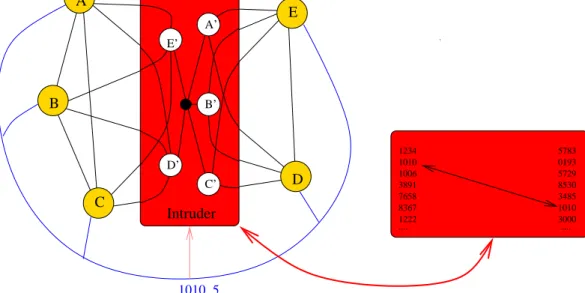
There is indeed a such an attack on the above protocol. This involves partitioning a group G of N agents who want to form a single session into two nonempty subsets S1and S2, with the intruder engaging in a separate session with each. For each, it uses exactly the right number of identities to expand the subset to size N, in each case using identi-ties for which it has the secret keys. Therefore it uses the scheme we have seen in Figure 1. The two runs of the pro-tocol operate in parallel, with the intruder manipulating the Dolev-Yao network so that only the messages within each subset get through. In each case it runs Message 1 with the appropriate group Siand waits for all the nodes in G to contribute their Message 2’s to the two runs. It then must invent N different nonces NA to transmit its Message 2’s. Using whatever time it has, it can search for combinations of values which make the two hash values in Message 3 the same (note that it has all the information to compute these hashes for any choice it may make of nonces). Note that, since the intruder can work with the two hashes at once, it can expect to get a coincidence if it creates just over √H hashes on each side, thanks to the “birthday paradox”. For example, for a hash consisting of six digits, only about three thousand hashes must be computed for the intruder to have a 90% chance of success. If it succeeds in doing so it trans-mits the appropriate Message 2’s to the respective members of S1and S2. This is illustrated in Figure 2. In this figure, the line connecting A–E with only an arrow to the intruder represents the no-spoofing empirical channels. We see the intruder trying to make the communications on these con-sistent with the man-in-the-middle structure derived from Figure 1. The box at the bottom right represents the in-truder looking for, and finding, a coincidence between two lists of hashes.
Upon reaching Message 3, all the humans (from the two groups combined) will then see identical hashes and cor-rect counts on their laptops, and so will agree to proceed beyond Message 3. The intruder then just has to manipu-late the network for Message 4 and contribute the correct final message in each of the two sessions. This leaves our
A B E D C ’ Intruder B’ D’ C’ D’ B’ A’’ E’ 1010 1234 7658 .... .... 1010 5 1010 1006 3891 8367 1222 5783 0193 5729 8530 3485 3000
Figure 2. Birthday attack in progress
intruder with connections to the two subgroups, including knowledge of all the secrets arising from the runs. They, on the other hand, believe there is a single authenticated ses-sion between the whole of G. The intruder is then in a posi-tion to transmit the group’s messages while understanding them or to impersonate group members to each other.
“Birthday attacks” like this are well known in other are-nas where cryptographic hash functions are used. See [12], for example. They are, however, brought into particular focus by the human role in the protocols we are now dis-cussing. We can take account of an attacker who can work out2Mhashes by adding2M bits to the hash function, but of course this means that a more powerful attacker could make headway, and in any case it involves the humans in extra work. So if k hash bits would have been required had com-binatorial attacks been impossible,2M+k are now actually required.
Similar attacks exist against all the protocols of [2]. In [1], several protocols are proposed for authenticating a de-vice such as a printer to a user. Of these, only the follow-ing one (Protocol 2) addresses the objectives set out above, since others are either for a different sort of empirical chan-nel or require confirmation of more data than we would like (including a user’s unique ID). It provides an interesting half-way house as regards this type of combinatorial attack. In the following, A is a user and B is a printer, and pk(P) is the public key of all printers, which plays essentially the same role as wkk above. K is intended to be used as a
ses-sion key.
1. A→N B : {A,pkA,NA}pk(P)
2. B →N A : {A,B,pkA,NA,K}pkA
3. B →E A : hash(Message2)
This is secure under perfect cryptography. It does not ap-pear to be subject to a classic birthday attack since these can only work if the hash value is fixed by the attacker, whereas in the above it is always fixed by the printer (through the values it sends in Message 2). However, if the attacker has the ability to compute the same order of magnitude of hashes as the size of the hash space (far from incon-ceivable if only a few digits or letters are agreed) there is still an attack. The intruder acts as a man in the mid-dle, switching his own public key pkI into the Message 1 received by B. Then, when he receives Message 2, he seeks to find K such that hash({A,B,pkA,K}pkA) = hash({A,B,pkI,K}pkI)The number of hash bits required to counter this would here grow like M+k rather than2M+k. The first protocol could be strengthened to M+k growth as opposed to2M+k if it were de-symmetrised so that a member of G declares themselves to be the finaliser of the hash. (To do this, this node must not issue its Message 2 until it has received Message 2’s from all other participants.) One can, however, do better than that. We now propose a different protocol for the first scenario, but which seems to avoid combinatorial attacks altogether. For this proto-col we assume our hash functions have a key such that, for each choice of this key, they represent separate hash func-tions, and we distinguish between sh(hk,m)and lh(hk,m): short and long hash functions. The first of these is what the
combinatorial attack. In both cases it must be infeasible to compute hk or m from the values (or indeed any number of hashes in which one or other is fixed and the other varying). In the long case it is infeasible given any reasonable time to find hk and m (or one given the other) which hash to a given value. We will discuss the length of the short hash later.
We give a special role to one of the members of G, who initiates the protocol and who makes all members of the group aware that he is playing this role. It is crucial that all members of G know, by the end, that one of their number has initiated this run of the protocol. The protocol is as follows, where A represents a typical non-initiator node, B a node of either type, and Mdagain represents message M decrypted. 0. I→N∀A :I 1. ∀B→N∀B :{B,kc(B),NB}wkk 2. I→N∀A :lh(hk,all Messages 1d) 2b. See note 3. I→N∀A :{hk}pk(A)
4a. ∀B displays :sh(hk,all Messages 1d) init(I,B),participant count
4b. ∀B→E ∀B :Users compare
5. ∀B→N∀B :{lh(hkpub,S)}dual(pk(B)) The following notes explain these messages.
• Message 0 gets the protocol going and informs the par-ticipants of the identity of I.2
• Message 1 has the same role as the same message in the first protocol of introducing fresh data and a public key from each participant.
• Message 2 has I invent a new hash key hk. It then sends each node the hash of something which every node knows, and knows to be fresh. On the basis of this information no-one other than I knows the value of hk, but no-one who has accepted this message can be fooled into thinking that any other value of hk is correct.
• Message 2b is some way of ensuring that I will not send a Message 3 while any other agent in G is still waiting for a Message 2. The most obvious way of do-ing this is to use the empirical channel at this point: each laptop displays a signal which the users then con-vey to the user of I.
One of the functions of Message 2 of the first protocol was to act as preliminary test of the probable coher-ence of a run of the protocol in advance of the humans 2In practical implementations it might be a good idea to have I
intro-duce some public nonce that will act as an identifier for this particular run of the protocol: it could be used to reduce confusion rather than increase security by being added as a tag to all the other→Nmessages.
in the present protocol. Therefore, both to save the humans unnecessary effort and to prevent incorrect di-agnosis of an attack (see Section 4) we might want to add a Message 2a in which all nodes broadcast a public hash of the Message 1’s for this purpose.
• In Message 3, I sends each node the hash key under its own public key. Since this message is firmly bound to Message 2 there seems to be no reason to add any further contextual information. Note that at this point each node can check the value of hk by testing to see if it produces the correct value for Message 2. They only proceed if this is true.
• Message 4a makes a similar display to Message 3a in the first protocol. The only difference is init(I,A), which gives information about the initiator, at least whether this node is the initiator of the session. • Message 4b has the members of G compare hashes and
check the number of participants as before. The differ-ence this time is that one of them must be able to say “I am the initiator”. If these fail the run is abandoned. • Message 5 acts as a confirmation amongst the laptops,
like Message 4 did in the first protocol. At this point hk is a shared secret amongst G; assuming that some shared secret S is needed to take the session forward from here they can construct one in a systematic way from the run data – necessarily involving hk since the rest of the data is public. This message consisting of a hash of this secret (the hash key hkpub is publicly known) simply acts as a confirmation. The signature using the duals of the public keys established makes this quite strong: since authentication is actually es-tablished by Message 4 it could be simplified without compromising security.)
We will call this the HCBK protocol, for Hash Commit-ment Before Knowledge. Note that though this protocol is asymmetric, both the set-up of empirical channels and the final result are symmetric. The final result is that the mem-bers of G (identified by the empirical channels) are authen-ticated to each other as the owners of the public keys they have introduced, and have the shared secret S.
We can analyse the HCBK protocol as follows:
1. After Message 4 all participants know that I, one of their number (and therefore trustworthy) has generated a value hk and that the value they have just agreed to (created using their various views of hk) all coincide with I’s own. Under the perfect cryptography hypoth-esis this, together with the same reasoning used for the first protocol, would prove security. [In essence this is that each group member knows that it, and, thanks to
the agreement, the other N−1nodes, all belong to this hash of N sets of values. It follows that they are all present and no-one else is.]
2. Before Message 3 is sent, all members of G have a long hash which has apparently been computed using hk, but I has not divulged hk itself to anyone. Of course the intruder might have sent any of the Message 2’s, but he has no way of knowing at this stage what the hash value computed in Message 4 will be. Therefore there is no constructive way in which the intruder can manipulate the Message 2’s for his own purposes.
3. Since it is computationally infeasible for the intruder to find other inputs for which a long hash comes up with a given answer, the fact that a member of G gets past Message 3 means that he or she has the same view of hk and of the Message 1’s as the initiator of its run.
4. At the point at which a laptop A accepts a Message 2, the hash value it will generate in Message 4 is com-pletely determined; however neither it nor any other entity but I is in a position to compute that value yet.
5. Supposing that A has agreed the hash value HV in Mes-sage 4, there are two possibilities:
• It is part of the same run as I, so all is well. • It is part of another run that happens to have the
same hash value. But for this to be true the in-truder has fixed another run (which A is in, sim-ilar to the attack on the first protocol) to have value HV in advance of knowing what HV is. This can only be done via a single guess, which we have assumed has negligible probability of success. It cannot be multiplied by attacking sev-eral members of G since as soon as one of them spots a discrepancy the run will be abandoned.
This reasoning depends crucially on having a trustwor-thy participant declaring that he or she is the initiator. Oth-erwise the intruder could act as initiator in two separate runs with members of G, giving it the opportunity to select hk values for which the short hashes will co-incide.
It is vital for the correctness of this protocol that the non-initiator nodes never start another protocol run between the acknowledgement of the receipt of Message 2 (namely Message 2b) and the final agreement about the hash val-ues. For otherwise an intruder might persuade one of them to abandon the first run, and start a second one where he manipulates the final hash using a similar combinatorial at-tack to the one described earlier against the printer protocol. This could be achieved, for example, by putting timing con-straints on how fast a second run can be started after one is abandoned and how long the initiator will wait for the final
agreement. Or it could be achieved by the addition of run numbers to some of the messages. In some human-mediated implementations of the empirical channels we might find it reasonable to assume they cannot be blocked, which would mean that a node whose run is abandoned can communicate this fact to the others.
3. Asymmetric authentication
We have already seen that the HCBK protocol is much safer against combinatorial attacks than the earlier one. It is natural to ask whether similar ideas could lead to stronger protocols than others that have been based on the quote above. One such example is Protocol 2 from [1] which we quoted above.
We cannot simply apply HCBK to this scenario for two reasons. The first is that we only have a one-directional em-pirical channel. The second is that this new scenario is not one where the concept of mutual trust makes any sense. In-stead we are assuming that the user A has some grounds for trusting the device B: maybe it is owned by her or someone she trusts. We are not considering the authentication of A to B. In summary, the scenario is no longer symmetric.
In fact a very similar protocol works, which is the same as HCBK except that all the empirical communications that are not to the user A – who always plays the role I – are deleted. Note that this is a group protocol in that it can authenticate any number of devices to a single user. We pay the penalty that the users other than A do not have anyone authenticated to them. The authentication provided is that A is sure that the session really is with the devices from which he has empirical channels (which will usually be provided by displays on the devices that he can see).
Once again it is vital that a device will not participate in a second run, apparently with A, while A is still running the first. For obvious reasons this version of the protocol will be termed Asymmetric HCBK, or AHCBK.
4. Optimality?
Our protocols are designed to initiate a secure and au-thenticated session between the owners of a set of empiri-cal no-spoofing channels. Where these channels are imple-mented by humans it is natural to want to keep the amount they do to a minimum. We might therefore pose the follow-ing question:
From a position where nodes in a group have no shared secrets or knowledge of each other ex-cept for a complete set of no-spoofing empiri-cal channels, what is the most security that can be achieved in a group-formation protocol for a
channels?
In order to answer this question we first have to decide what “the most security” means. The answer we propose to that question is:
The security offered by a given protocol instance is the minimum, over all potential attacks with a more than infinitesimal chance of success, of the probability that the attack is discovered divided by the probability that it succeeds.
Here, an attack is a strategy by an intruder in-tended to make some agreed security specifica-tion of individual runs fail, and it succeeds if – on a particular run – the specification does fail.
This, or the log of this value, seem to the author to be reasonable definitions since, upon discovering an attempted attack, the participants can make subsequent runs more se-cure by putting more resource into them. If there were an attack with no chance of being discovered, then presumably it could be repeated ad nauseam until it eventually succeeds. For that reason this seems to him to be a safer definition than just the reciprocal of the probability of success.
In the following analysis we will discount the possibility that an attacker of HCBK or other candidate protocol can make the perfect cryptography hypothesis fail except on the empirical comparison of hash values. More precisely, we assume that the probability of such an approach working is infinitesimal, hence the use of this word above.
Since it is readily provable that HCBK is secure if we had perfect cryptography, and the only place we are saying this can fail is on the short hash values, it follows that for an attack to succeed we must have different members of the group G producing the same hash value from different antecedents. The group will not proceed without an initiator I present, so we can concentrate on the case where another node A has different antecedents for the same hash value as I.
I knew that A was committed to the antecedents of some final hash value at the point when it first sent Message 3 to anyone; further we know, thanks to an assumption we made, that A cannot have become committed to another value since.
An intruder could only know whether the final hash value of A coincided with I’s after I has sent a Message 3. Assum-ing that our hash functions etc have the properties we expect of them (namely that the short hash is uniformly distributed as a function of hk for all values of the other parameters, and that the intruder cannot infer any information about that hash from Message 2), the intruder will have at best1/H chance of success, where H is the size of the hash space. (This is the chance of a single A with different antecedents matching I on the final comparison.)
on. If he were unlucky then this attack is not going to suc-ceed, so we should investigate how the intruder might be discovered and try to evade discovery.
If the intruder simply lets the nodes from G carry on then they will discover something wrong. If the intruder ensures (as he can) that they all get Message 3’s consistent with their Message 2’s then final agreement will fail, and if any of them gets a Message 3 that is inconsistent it can report intrusion. The most drastic action our intruder can take is to prevent any of the Message 3’s getting through, but then all nodes will know that something has interfered with their run.
The only way of avoiding this would be if the intruder could somehow modify the states of the nodes so that they would in fact agree, perhaps on the correct values that the nodes from G actually intended. This could only be done if at least one of them were forced to abandon its present session and start a new one that would agree. But we have specified that, once they have got beyond Message 2 this cannot happen and that it would lead to an attempted attack being registered.
It therefore seems that if an attacker allows his attack to proceed to the point when he knows if it will succeed then he will be discovered whenever it does not. Therefore, to have a H1 chance of success he must have a H−H1 chance of discovery. So our measure of security seems to be H−1.
How much human/empirical work is required to do this? We will disregard the work done in comparing the number of participants, since (i) these do not have to be communi-cated (each user independently checks the number on his or her own screen) and (ii) these numbers serve to factor our general protocol into different N-ary specific protocols. As-suming we are using empirical messages for 2b, it is clear that this requires N−1, so let us consider the final agree-ment phase. The protocols themselves envisage all the par-ticipants sending the hash values to each other, but all that is actually required is that there is a connected graph of agree-ment exemplified by
• The initiator communicating the hash value to one other node.
• If this node agrees it sends the value to a further node. • This is repeated until all nodes have seen this value: the last one in the chain then knows they all agree and so sends an acknowledgement message back to its pre-decessor.
• This is repeated until the initiator gets its acknowl-edgement, at which point all nodes know they all agree.
Note that since it is the initiator I who sets this chain going, this strategy would also act as the confirmation required that the initiator is a member of G.
It seems reasonable to measure the work required to send a message as1 + [log k], where k is the number of poten-tial message values and [x]is the smallest integer r ≥ x. The 1 is for the overheads of the message and the rest is the number of bits. Given this, our agreement strategy re-quires N−1communications of cost1 + [log H]and N−1 of weight 1. It follows that the total cost including 2b is
(N−1)(3+[log H]−2. If the empirical channels are broad-cast rather than point-to-point (as in members of a group talking) agreement can be achieved in a single announce-ment of weight1+[log H]by I followed by N−1responses of weight 1 from the rest. (All of these have had to do the work of comparing the hash value independently.) So the total cost is[log H] + 2N−1.
Intuitively, it seems that this must be close to minimal amongst all conceivable protocols with security measure H−1.
Let us examine this question briefly: we will start with the binary (N= 2) case. We do not claim that the following argument represents a formal proof; rather a strong indica-tion that one exists.
In the absence of the two nodes A and B having any pre-existing knowledge of each other, or any security infrastruc-ture, an arbitrary protocol P is certain to have a man-in-the-middle attack against it unless the empirical channels are used. For our attacker can simply set up parallel sessions with A and with B; each will know they are in a session, and the intruder is free to translate the messages each send the other from one session to the other.
Each of A and B has to receive an empirical message from the other for them to be mutually authenticated, since either that did not receive could not tell who they were con-nected to. It follows that the total work required is at least two plus the number of bits they communicate in their mes-sages3.
If A and B send a total of k bits of information to each other on empirical channels during a run of the protocol, then in order for the above attack to succeed the messages expected in the two attack sessions must be the same as are expected in the proper session that A and B imagine they are having.
The worst case for the intruder is when the protocol gives him no information about what empirical communications are coming from A and/or B in the two sessions, and when the structure of the two sessions does not allow him to trans-mit information between A and B in such a way that these expectations match up. (In the HCBK protocols the use of
3Note that it would be possible for them to send information to each
other via patterns of content-free communication, but that the cost of such communication would exceed sending it as bits.
the nodes’ public keys in the hash achieves this.)
Whatever values the intruder has chosen to inject into the two runs (noting that in the two combined it injects a com-plete set since it is playing all roles, and that the intruder is trying to get agreement) will have a chance of the empiri-cal communications agreeing no worse than the reciproempiri-cal of the number of value combinations communicated. That is precisely what is achieved in HCBK. Since that protocol (with 2b) uses three messages as opposed to the two proved above, the cost of HCBK for two nodes exceeds the theo-retical bound we have established by only one.
Now let us consider the case of a group of N>2agents who wish to be mutually authenticated. If broadcast com-munication is being used, it is clearly impossible to achieve agreement in less than one k-bit communication followed by N−1null communications, since all must send an em-pirical communication, and k bits of information have to be compared somehow.
If point-to-point communication is used, then there must be a first node A that knows that the run is secure. From that point on clearly exactly N −1 basic communications are necessary and sufficient: all others have to receive some-thing that tells them, and A can simply communicate the fact by one communication to each (either directly or via a deeper tree). The author conjectures that no node can know the run is secure until(N−1)k bits have been communicated in the network, but has yet to find a proof of this.
5. Verification
Our protocols offer new challenges to automated veri-fication. These are the fact that they are group protocols where the size of the group is checked as part of the pro-tocol, and the use of a new and stronger attacker model. Additionally, though this had been solved previously (e.g. [2]), we need to model empirical channels specially so they cannot be spoofed. This last one is very straightforward.
The author cannot claim to have made much progress on the first of these as yet: it may well be that this, with its im-plicit use of arithmetic, is better suited to theorem proving than model checking. All he has been able to do is to build CSP models for FDR in which the group size was bounded above by some small natural number (e.g. 2 or 3).
The agreement implied by the short hash under perfect cryptography is, as we have observed, so strong that it would appear that the only possible source of attacks will be from the attacker’s ability to create a fresh value so that some construction involving it will hash to an already-known value. (This is strong enough to allow both for birth-day attacks and for the cruder style of attack we discussed for the printer protocol.)
The main difficulty this creates for the CSP/FDR model of protocols is that hashing can no longer be a simple free
into the protocol data-type Fact:
Fact ::= ATOM.Atom
|SQ.Fact
|PK.Fact.Fact
|ENCRYPT.Fact.Fact
|HASH.Fact
makes all hashes of distinct objects distinct (the effective assumption in perfect cryptography). The solution that the author adopted was to retain the basic structure of this data-type with two modifications:
• Since sets are used in the protocol as a natural conse-quence of modelling groups of members with the same role, a SETconstruct was added.
• Two hashing constructs were used, SHORTHASH and LONGHASH, each taking two arguments reflecting the usage in HCBK.
but then to modify how the hashes are computed over this type.
Long hashes are worked out in the same simple way as previously, namely
lh(hk,f) =LONGHASH.hk.f
since they are still assumed to satisfy perfect encryption. The function sh, on the other hand, is computed via a lookup table that can be manipulated by the intruder. The lookup table is implemented as a separate process which maps hash keys and facts to short hash values in which each combina-tion(hk,f)defaults to SHORTHASH.hk.f , but if the intruder creates a fresh atom A which is a part of the fact f or is hk (both of which the intruder knows given A), then the in-truder is allowed to make the lookup table send(hk,f)to shv for any short hash value shv it already knows.
In runs of FDR, the lookup table was limited to have a single manipulated hash value, to reduce the state space.
As we would have expected, this model finds the same attack we illustrated earlier on our first protocol. It finds no attacks on HCBK or AHCBK.
6. Conclusions
We have seen how a new approach to computer security allows this to develop from trust that may have arisen in subtle and non-technical ways. This will often just be a human trusting hardware he or she can see and has decided to trust (in the case of the asymmetric protocol) or which is in the hands of other humans in the same group.
We believe that this new paradigm should be helpful in many circumstances, including the following.
haps in a military or business context – to set up a highly secure network where the membership is pre-cisely them, and no external user or piece of hardware needs to be trusted.
• It can perform the same role where the users are so heterogeneous that it is difficult or impractical to build an overarching security management system.
• It can re-inforce an existing security structure, for ex-ample because
– It is feared that some hardware might have fallen
into enemy hands. Our protocols can prevent connection to parties unless there is human-to-human trust.
– Users want reassurance that they are connected
to the particular member of a security structure that they want to be.
In this context we should perhaps regard the optional use of wkk in the protocols as a clich´e for the idea that the messages of our protocols might be sent within some wider security structure.
• It can be used by parties to any radio, telephone or video-phone conversation to achieve secrecy quite in-dependently of any carrier, provided we discount the possibility that an attacker might successfully imper-sonate each human to the other(s) in the agreement phase.
• The user of any device in line of sight4can be assured
of a secure connection with it (or a group of these in only one run).
We have given a relatively informal demonstration that our protocols seem to be near optimal in the trade-off be-tween human/empirical effort and the chance of a successful attack. We have also shown how the stronger attacker of this new protocol can be modelled on FDR. The author would like to find a better way of modelling this that does not have to be limited to a single manipulation – this development would be very similar to the evolution of the “perfect spy” of [6] from our early intruder models that had a small finite memory. Particularly in that case, he hopes that it might find use in other circumstances in computer security where combinatorial attacks on hashes are an issue.
It is worth comparing what our protocols achieve against the secure mode of Bluetooth. The latter also uses an empir-ical channel in that both ends of a secure communication are primed with a PIN. The key for the transmission of secure
4Or in any other context where there is a non-spoofable channel from
information within that protocol is then computed from this PIN and some broadcast random information. It is well doc-umented (for example [9]) that it is vulnerable to a number of attacks. These both make it imperfect within its defined context and severely limit the extent to which it can be used outside this. Firstly, unlike our protocols where we allow the empirical channel to be heard by an attacker, this would be fatal to Bluetooth. If the PIN becomes known to an at-tacker he can simply compute the key.5 Even if the PIN is
not revealed directly, Bluetooth is vulnerable to a post hoc attack in which the attacker just tries each candidate PIN in turn. This is in some ways worse than the situation with our first protocol, since there at least the combinatorial attack has to be contemporary with the protocol run, and is there-fore harder. The HCBK protocols, of course, eliminate this entirely.
It would be interesting to take further the idea of quanti-fying the security provided by a protocol. One can imagine a number of alternative measures, and a protocol having dif-ferent measures relative to difdif-ferent specifications (maybe secrecy and authentication). It should ultimately be possi-ble to automate it using probabilistic model checking tools such as those described in [8, 7].
It is clear that any use of our protocols would benefit from several sorts of human factors research. Most obvi-ously, how should we present our hash values so that human users will find it both easy and tolerable to compare as large a range as possible. Might they be composed of characters, letters, digits, words, or be sentences, or symbolic in some way? If the computers are close together, should our hu-mans perhaps compare images, or have their hardware play a sequence of musical notes together? Obviously the opti-mal way of doing this might vary from context to context. How safe is the voice or video-telephone communication of hash values against attack; what is the best strategy for making an attack difficult in such circumstances?
Other questions in this area include how to explain to users their important role in the protocols, and present the data in such a way that they will not ignore the needs of security.
Acknowledgements The conceptual model of computer security proposed in this paper emerged in a series of dis-cussions the author had with Sadie Creese, Michael Gold-smith and Irfan “Zak” Zakiuddin. In particular it was Zak who introduced, and emphasised the importance of, the problem of bootstrapping security from a minimal starting point. This joint work was reported in our earlier papers. I have had useful discussions with Gavin Lowe and Michael Goldsmith relating to this paper.
5This would seem to make the Bluetooth protocol susceptible to attack
whenever the attacker might be physically present in some way, or over-hearing the PIN if it is spoken.
References
[1] S. J. Creese, M. H. Goldsmith, R. Harrison, A. W. Roscoe, P. Whittaker, and I. Zakiuddin. Exploiting empirical en-gagement in authentication protocol design. In D. Hutter and M. Ullmann, editors, Proceedings of2nd International
Conference on Security in Pervasive Computing (SPC’05),
volume 3450 of LNCS, Boppard, Germany, April 2005. Springer.
[2] S. J. Creese, M. H. Goldsmith, A. W. Roscoe, and M. Xiao. Bootstrapping multi-party ad-hoc security. In Proceedings
of IEEE SAC Security Track, 2006. to appear.
[3] S. J. Creese, M. H. Goldsmith, A. W. Roscoe, and I. Zaki-uddin. The attacker in ubiquitous computing environments: Formalising the threat model. In T. Dimitrakos and F. Mar-tinelli, editors, Workshop on Formal Aspects in Security and
Trust, Pisa, Italy, September 2003. IIT-CNR Technical
Re-port.
[4] S. J. Creese, M. H. Goldsmith, A. W. Roscoe, and I. Zakiud-din. Security properties and mechanisms in human-centric computing. In P. Robinson, H. Vogt, and W. Wagealla, ed-itors, Privacy, Security and Trust within the Context of
Per-vasive Computing, Kluwer International Series in
Engineer-ing and Computer Science. SprEngineer-inger, 2004. ProceedEngineer-ings of Workshop on Security and Privacy in Pervasive Computing, Wien, April 2004.
[5] S. J. Creese, G. M. Reed, A. W. Roscoe, and J. W. Sanders. Security and trust for ubiquitous computing. In ITU WSIS
Thematic Meeting on Cybersecurity, Geneva, 2005.
[6] M. H. Goldsmith and A. W. Roscoe. The perfect ‘spy’ for model-checking cryptoprotocols. In Proceedings of
DIMACS Workshop on Design and Formal Verification of Cryptographic Protocols, Rutgers, 1997.
[7] M. H. Goldsmith and P. Whittaker. A CSP frontend for prob-abilistic tools, 2005.
[8] A. Hinton, M. Z. Kwiatkowska, G. Norman, and D. Parker. PRISM: A tool for automatic verification of probabilistic systems. In Proceedings of TACAS’06, 2006. to appear. [9] M. Jakobsson and S. Wetzel. Security weaknesses in
blue-tooth. In Proceedings of 2001 conference on cryptology, volume 2020 of LNCS. Springer Verlag, 2001.
[10] T. Kindberg and K. Zhang. Validating and securing sponta-neous associations between wireless devices. In6th Informa-tion Security Conference (ISC’03), number 2851 in LNCS.
Springer-Verlag, October 2003.
[11] G. Lowe. Breaking and fixing the Needham-Schroeder public-key protocol using FDR. In Proceedings of TACAS, volume 1055 of LNCS, pages 147–166. Springer Verlag, 1996. Also in Software – Concepts and Tools, 17:93102, 1996.
[12] B. Schneier. Applied cryptography. Wiley, 1996.
[13] F. Stajano and R. Anderson. The resurrecting duckling: Se-curity issues for ad-hoc wireless networks. In B. Christian-son, B. Crispo, and M. Roe, editors, Security Protocols,
7th International Workshop Proceedings, pages 172–194.