Implementation Guide
EHF Catalogue
Version: 1.0
EHF Catalogue 25. September 2013 Page 2 of 52
TABLE OF CONTENT
1 Introduction ... 4
1.1 Background and Objective ... 4
1.2 Target group ... 4
1.3 Document structure ... 5
1.4 About the document ... 5
2 Document history ... 6
3 EHF – Elektronisk handelsformat (electronic commerce format) ... 7
3.1 About EHF ... 7
3.2 Information Consistency ... 7
3.3 Message transport ... 7
3.4 Message level response ... 8
3.5 Profiles and messages ... 8
3.6 Use of collaboration agreements ... 9
3.7 Versioning ... 10
3.7.1 Main version ... 10
3.7.2 Sub version ... 10
3.7.3 Revision ... 10
4 Definitions... 11
5 Catalogue process and business requirements ... 12
5.1 About the Catalogue messages ... 12
5.2 Functionality and Roles ... 12
5.3 Profiles and messages ... 13
5.3.1 ProfileID ... 13
5.4 Catalogue process ... 13
6 Description of selected elements of EHF Catalogue ... 15
6.1 Roles and Actors ... 15
6.2 Action code ... 16
6.3 Product Identification ... 17
6.4 Product Name and Description ... 17
6.5 Keyword ... 18
6.6 Quantities and units ... 19
6.7 Prices ... 21
6.8 Related Products and Accessories ... 22
6.9 Product Classification ... 23
6.10 Hazardous Item ... 23
6.11 VAT ... 24
6.12 Attachments ... 24
6.13 Logistics Information ... 25
6.14 Environment, Social responsibility and ecological ... 26
6.15 Dimension (height, width etc.) ... 27
6.16 Replacement product ... 28
6.17 Additional Item properties ... 28
7 Information content ... 30
7.1 Information content Catalogue ... 31
7.2 Information content Catalogue Response ... 42
8 Validation ... 44
8.1 Validation principles ... 44
EHF Catalogue 25. September 2013 Page 3 of 52
8.3 Validation rules per ProfileID and CustomizationID ... 46
8.3.1 ProfileID BII01, catalogue ... 46
8.4 Validation rules ... 47
8.4.1 Catalogue ... 47
8.4.2 Catalogue Response ... 51
9 Attachments ... 52
9.1 Attachment 1 – Structure tables ... 52
9.2 Attachment 2 – Message tables ... 52
9.3 Attachment 3 – Code lists ... 52
9.4 Attachment 4 - UBL 2.1 Schema ... 52
9.5 Attachment 5 – Schematron files ... 52
EHF Catalogue 25. September 2013 Page 4 of 52
1 INTRODUCTION
This document describes the EHF Catalogue format to be used for the exchange of Catalogue information between trading partners. The document is part of Difi’s (Direktoratet for Forvaltning og IKT) standardization work related to electronic commerce.
1.1 BACKGROUND AND OBJECTIVE
The Norwegian government has played an active role in the dissemination of electronic commerce both in domestic and foreign trade. The government white paper labeled
“St.Meld. nr. 36 (2008-2009) Det gode innkjøp” (The good procurement), states among other things:
«It’s the Government’s opinion that increased use of electronic solutions is important to improve and increase the efficiency of public procurement. The use of electronic solutions may reduce time spent on public procurement, increase the competition and arrange for purchases to be more transparent and easier to re-examine. By spending less time and money on procurement, resources will be available for both modernizing the public sector and more welfare.
The goal for introducing electronic solutions is to contribute to a better, simpler and more secure procurement. »
The «Ministry of Government Administration, Reform and Church Affairs» (FAD) considers use of open standards as a vital means to build a well-functioning public administration, with good internal collaboration and a high level of service for both inhabitants and businesses. Definition of Open Standard:
An Open Standard is a standard that is recognized and will be maintained by a non-profit
organization. Development and changes to the standard is based on processes that are open to all parties having interest in the standard. The Standard is made available for free or for a small charge. This must include the right to copy, distribute and use the standard. The specification of the standard must be implemented on a royalty-free basis and with no patent protection. There are no
restrictions related to re-use of the standard. 1
The purpose of this document is to describe a common format for the exchange of Catalogue information in the Norwegian market and to arrange for an effective implementation of Catalogue messages based on this format.
This Implementation Guide covers the exchange of Catalogues in a post-award process, after a commercial agreement has been signed between the Supplier and Buyer.
1.2 TARGET GROUP
The target group for this Implementation Guide (hereafter called IG) is both technical and non-technical personnel involved in the exchange of catalogue messages. The IG may also be used by system providers and message brokers.
EHF Catalogue 25. September 2013 Page 5 of 52 Chapter 1 to 5 are directed to non-technical personnel
Chapter 6 to 9 (attachments) are directed to technical personnel
1.3 DOCUMENT STRUCTURE
The document consists of the following parts:
Chapter 1 outlines the background and objective for the document. Chapter 2 contains document history.
Chapter 3 describes the principles and conditions for EHF. Chapter 4 contains definitions.
Chapter 5 describes the ordering process.
Chapter 6 describes selected parts of the formats.
Chapter 7 contains the information contents of the messages. Chapter 8 describes the validation of the messages.
Chapter 9 contains the following references to separate documents: o Appendix 1: Message structure (branching tree)
o Appendix 2: Message description o Appendix 3: Code lists
o Appendix 4: Link to UBL 2.1 Schema for Catalogue and Catalogue Response
o Appendix 5: Schematron files o Appendix 6: XML Example files 1.4 ABOUT THE DOCUMENT
Implementation Guide EHF Catalogue version 1.0 is compliant with CEN BII2 and Peppol BIS 1A Catalogue version 2.0.
EHF Catalogue 25. September 2013 Page 6 of 52
2 DOCUMENT HISTORY
Version Comment Author Approved by Date
EHF Catalogue 25. September 2013 Page 7 of 52
3 EHF – ELEKTRONISK HANDELSFORMAT (ELECTRONIC COMMERCE FORMAT)
3.1 ABOUT EHF
EHF is an anagram of the Norwegian expression «Elektronisk handelsformat» (Electronic Commerce Format).
EHF is based on the work performed by CEN BII2. This is further adjusted to comply with the Norwegian accounting regulations and current practices for the different business processes in the Norwegian market. Difi pursues the goal to cover the full trading process using EHF documents, both before and after the signing of a contract.
Documents, from the tender catalogue to the credit note will be gathered under the EHF umbrella. During 2013 Difi will prepare for the use of EHF formats in what is known as the post award process, i.e. the part of the business process that starts when a supplier and a customer have signed a contract.
By using the EHF documents the collaboration between the supplier and the customer will be predictable. Elements from the tender Catalogue will be re-used in the Order, and elements from the Order will be re-used in the Invoice. This leads to a holistic use of all the documents under the EHF umbrella.
Difi has chosen to use CEN BII3 as a base for the EHF formats and the Universal Business Language (UBL) 4 as a foundation for the implemented syntax. Both EHF and UBL are open standards and as such not liable to any licensing fees or royalties.
EHF is managed and maintained by Difi. 3.2 INFORMATION CONSISTENCY
The different EHF formats mentioned above contain a number of common information elements (supplier, customer, item etc.). It is important to preserve consistency in those common information elements, and that means that elements with identical content are declared in the same way and as far as possible given the same element tag name. EHF invoicing formats will for instance re-use elements from the Catalogue and Order to ensure consistency between the messages and to make sure that the information from the business transactions are reflected in the invoicing documents. This makes it possible to implement an efficient and automated control of the invoice and the originating
transactions.
3.3 MESSAGE TRANSPORT
Open PEPPOL Transport Infrastructure will provide an efficient use and transport of the EHF formats.
2 http://www.cen.eu/cwa/bii/specs/ 3 http://www.cen.eu/cwa/bii/specs/
EHF Catalogue 25. September 2013 Page 8 of 52 The objective is to make it easy for parties in different countries to do cross-border trade. Experience shows that it is easy to implement electronic messaging in Norway, because most of the service providers use standard processes.
It must be noted that every document scheduled for this infrastructure must be validated with no errors by Difi’s own validation service. This is likely to be done by the document issuer or by the service provider on behalf of the document issuer.
According to circular P-10/20125 FAD recommends all central government agencies to use this transport infrastructure.
3.4 MESSAGE LEVEL RESPONSE
The response message (Message Level Response) is an optional response message that the receiver of an electronic message, like an EHF Invoice, may use to:
a) Acknowledge the reception of a message and/or
b) Report any validation discrepancies in the received message.
The response message should be perceived as a technical response message being exchanged between the two parties’ messaging systems and used in addition to any other business oriented response messages described in the different profiles.
The response message will be documented in a separate EHF implementation guide scheduled to be published within first half of 2013.
The ability to receive a response message must be registered in ELMA along with every other electronic message.
3.5 PROFILES AND MESSAGES
In line with the underlying methodology for the EHF formats (cf. www.cenbii.eu) the
electronic messages included in a specific format will be exchanged between the parties as a part of an electronic collaboration process; a profile.
CEN BII has defined a profile as “A specification of how one or more business processes are executed by specifying the business rules governing its business collaborations and the information content (data model) of the electronic business transactions exchanged.” To the largest extent the EHF is using profiles prepared by BII (ref www.cenbii.eu) or PEPPOL (cf. www.peppol.eu). Examples of relevant profiles are:
Interaction process Messages BII/PEPPOL
ProfileID
EHF ProfileID
Invoice only Invoice bii04
EHF Catalogue 25. September 2013 Page 9 of 52
Credit note only Credit note biixx
Invoice and credit note Invoice
Credit note
bii05
Invoice, credit note and reminder Invoice Credit note Reminder biixy
Order and invoice Order
Order response Invoice Credit note
bii06
The messages being exchanged within a profile are customized to comply with the requirements given for that particular business document. A CustomizationID is used to identify the business rules that apply to the document in question, i.e. the whole set of business rules the document issuer founded the document on.
The example CustomizationID below indicates that the contents of the current message is based on business rules determined by BII
(urn:www.cenbii.eu:transaction:biicoretrdm010:ver1.0), customized and clarified by PEPPOL (urn:www.peppol.eu:bis:peppol5a:ver1.0) and further customized and clarified in this implementation guide regarding the Norwegian businesses
(urn:www.difi.no:ehf:faktura:ver1).
<cbc:CustomizationID>urn:www.cenbii.eu:transaction:biicoretrdm010:ver1.0:#urn:www.peppol.eu:bis :peppol5a:ver1.0#urn:www.difi.no:ehf:faktura:ver1</cbc:CustomizationID>
3.6 USE OF COLLABORATION AGREEMENTS
The combination of the ELMA registration and the implementation guides referred to in that context eliminates the need for any formal collaboration agreement between the sender and the receiver. The ELMA registration verifies that an actor has declared the ability and the commitment to receive business documents composed according to the specific
implementation guide, and any party is free to send the business document to this actor. Exchanging Catalogue and Order requires no registration in ELMA, and actors are advised to include the use of electronic messages in the purchase contract or to supply an collaboration
EHF Catalogue 25. September 2013 Page 10 of 52 agreement6 as an attachment, in order to link the electronic collaboration with the
mercantile regulations and thus achieve a regularly revision of the electronic process. 3.7 VERSIONING
Difi claims the right to exchange the current format with a new one as and when needed. If so, Difi will inform the public via the web site and their registered users via e-mail.
Difi manages the formats in this way: 3.7.1 MAIN VERSION
A new main version will be announced at least 5 months prior to release. When a main version is released, there will be at least a 12 months implementation period before the new version is made mandatory.
Difi intends to relate every main version to the regulations concerning IT standards in the public sector.
3.7.2 SUB VERSION
A new sub version will be announced at least 3 months prior to release and is made mandatory 5 months after release.
All sub versions must be backwards compatible. 2 months after the new sub version has become mandatory, the support (validation service and implementation guide) is ceased for preceding versions.
3.7.3 REVISION
A revision is in principle a result of bug fixing the latest sub version, and will be announced at release time and should be implemented without further delay.
EHF Catalogue 25. September 2013 Page 11 of 52
4 DEFINITIONS
Term Description
Catalogue A document describing the properties of products and services. Supplier A person or company delivering products or services.
Buyer A person or company buying a product or service at a set price. Catalogue provider A person or company collecting catalogue information and sending
the catalogue.
Catalogue receiver A person or company that is responsible for the reception of the catalogue.
UBL UBL (Universal Business Language) is a collection of XML-formats (XML Schema) for the exchange of electronic documents such as Catalogue, Order and Invoice.
BII Core BII (Business Interoperability Interfaces) Core is a subset of UBL containing documents and content that is required for electronic collaboration in the European public sector.
Does not include separate XML Schemas. Schematron
validation
Validation of a message towards business requirements. Additional to the syntax check against XML Schema.
EHF Catalogue 25. September 2013 Page 12 of 52
5 CATALOGUE PROCESS AND BUSINESS REQUIREMENTS
This chapter describes the catalogue process and functional requirements covered by EHF Catalogue. The description is based on the CEN BII profile BII01 Catalogue Only.
5.1 ABOUT THE CATALOGUE MESSAGES
The messages covered by this Implementation guide are EHF Catalogue and EHF Catalogue Response. Buyer and Seller must exchange both messages electronically to be in compliance with this guide.
An Electronic Catalogue is a listing of products and services to be used in a purchasing process. The EHF Catalogue can serve different purposes during the lifecycle of Catalogue information:
Establish a new Catalogue Replace an existing Catalogue Add or delete Catalogue lines
Update product properties or prizes on existing Catalogue lines
When doing changes to catalogue lines, it is recommended to replace the whole catalogue and not update separate lines.
A Catalogue containing sufficient information about articles and services will prevent faulty deliveries causing lost income for both suppliers and buyers.
Most often an Electronic Catalogue will be integrated with a Catalogue tool and a Search engine. The Search engines are set up differently providing possibility to search for different catalogue elements. The number of elements available will decide the preciseness of the search, and a well set up Search engine will in the end improve the quality of the purchase. 5.2 FUNCTIONALITY AND ROLES
This Implementation Guide covers exchange of catalogues in a post-award process, i.e. after the contract is signed between supplier and buyer. The content may also be used in a pre-award process (tendering), but with less mandatory elements.
EHF Catalogue 25. September 2013 Page 13 of 52 Figure 1: Functionality and roles
5.3 PROFILES AND MESSAGES
The definition of a profile is given in chapter 3.5.
The profile relevant to the EHF ordering process is shown in the table below:
Interaction process Messages BII/PEPPOL
ProfileID
EHF ProfileID
Catalogue process Catalogue
Catalogue Response
BII01
5.3.1 PROFILEID
The ProfileID identifies the process the business document is part of. EHF uses the identification system according to BII:
Profile contents ProfileID
Catalogue process urn:www.cenbii.eu:profile:bii01:ver2.0
5.4 CATALOGUE PROCESS
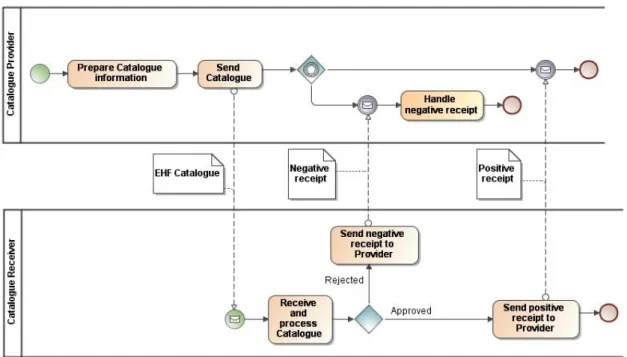
The Catalogue exchange is the first part of the post-award process and can be described as follows:
1. The Catalogue provider (Supplier) collects information about products or services and transforms these into a Catalogue format. This can either be a complete Catalogue or a Catalogue containing selected articles with changes.
2. The Catalogue is sent to the Catalogue receiver (Buyer) either directly or via a third party.
3. The Catalogue receiver controls if the Catalogue is syntactically correct and contains sufficient information.
EHF Catalogue 25. September 2013 Page 14 of 52 4. If the Catalogue is accepted, the Catalogue receiver sends a positive Catalogue
Response to the Catalogue provider. The Catalogue is now approved for ordering purposes.
5. If the Catalogue is rejected, the Catalogue receiver sends a negative Catalogue Response to the Catalogue provider with an explanation to the rejection. The Catalogue provider will then make corrections to the Catalogue and resend it.
Figure 2 shows the Catalogue process including the exchange of the EHF Catalogue messages.
Figure 2: Process model for Catalogue exchange.
The Catalogue itself will not be returned from buyer to supplier. If a Catalogue message is rejected, a new corrected Catalogue must be sent.
If the exchange involves the use of a Catalogue tool, this may include a more advanced dialogue between buyer and supplier than described here.
EHF Catalogue 25. September 2013 Page 15 of 52
6 DESCRIPTION OF SELECTED ELEMENTS OF EHF CATALOGUE
There are no formal requirements to catalogue content according to Norwegian regulations. The content requirements are therefore based on the following:
Information content in the existing Procurement Platform (EPP) UBL 2.1
CEN BII2
Peppol BIS 1A catalogue
The format will also be verified against requirements in certain areas of the Norwegian private sector.
The following chapters describe selected areas of the format and specifically information elements being important for use in the Norwegian market. 6.1 ROLES AND ACTORS
The following roles are defined in the EHF Catalogue. These roles can either be hold by the same physical actor of by different actors depending on how the catalogue administration is organized.
Role Description
Catalogue Provider (ProviderParty)
Responsible for the preparation and transfer of the Catalogue to the Catalogue receiver. Can be the Supplier itself or a third party providing this service.
Catalogue Receiver (ReceiverParty)
Responsible for the reception and control of the Catalogue. Can be the Buyer itself or a third party providing this service to the Buyer.
Supplier
(SellerSupplierParty)
Responsible for the delivery of products or services specified in the Catalogue.
Buyer
(ContractorCustomerParty)
The party buying products or services from the Catalogue. Manufacturer
(ManufacturerParty)
The name of the Manufacturer.
Example of Supplier information on header level in an EHF Catalogue message: <cac:SellerSupplierParty>
<cac:Party>
<cbc:EndpointID schemeID="NO:ORGNR">987654321</cbc:EndpointID> <cac:PartyIdentification>
<cbc:ID schemeID="NO:ORGNR">984297793</cbc:ID> </cac:PartyIdentification>
<cac:PartyName>
<cbc:Name>Supplier</cbc:Name> </cac:PartyName>
<cac:PostalAddress>
<cbc:StreetName>Per Krohgs vei 1,Karihaugen</cbc:StreetName> <cbc:CityName>OSLO</cbc:CityName>
EHF Catalogue 25. September 2013 Page 16 of 52 <cac:Country>
<cbc:IdentificationCode listID=" ISO3166-1:Alpha2">NO</cbc:IdentificationCode>
</cac:Country> </cac:PostalAddress> <cac:Contact>
<cbc:Name>Ole Olsen</cbc:Name>
<cbc:Telephone>+46123123123</cbc:Telephone>
<cbc:ElectronicMail>[email protected]</cbc:ElectronicMail> </cac:Contact>
</cac:Party> </cac:SellerSupplierParty>
Example of Manufacturer information on line level: <cac:CatalogueLine> ….. <cac:Item> …. <cac:ManufacturerParty> <cac:PartyName>
<cbc:Name>Manufacturers name</cbc:Name> </cac:PartyName>
</cac:ManufacturerParty>
6.2 ACTION CODE
The Action code holds instructions about the treatment of the Catalogue by the recipients system. The Action code can be stated either on header or line level.
It is strongly recommended only to use Action code on header level.
Use of Action codes on line level must be explicitly agreed between sender and receiver. Guidelines for use:
Action code must be sent on either header or line level. If Action code is not sent the Catalogue message will be rejected.
Action code sent on header level will overrule possible Action codes sent on line level.
If Action code is not sent on header level it is mandatory to send Action codes on all catalogue lines.
Legal values for Action Code are Add, Replace, Update or Delete. Action Code on header level:
Action code Treatment
Add A new Catalogue with belonging product lines shall be created. If the Catalogue already exists, it must be rejected by receiver.
Replace An existing Catalogue shall be completely replaced by a new version. The current version should be archived by the receiver. If the
Catalogue does not exist, it must be rejected by receiver.
Update Catalogue lines that are sent shall update existing Catalogue lines. The current version should be archived by the receiver. If the Catalogue does not exist, it must be rejected by receiver.
EHF Catalogue 25. September 2013 Page 17 of 52 Delete The whole Catalogue shall be deleted. If the Catalogue does not exist,
the complete Catalogue message must be rejected. Action Code on line level:
Action code Treatment
Add A new Catalogue line shall be created. If the Catalogue line already exists, the complete Catalogue message must be rejected.
Update An existing Catalogue line shall be completely replaced by a new version of the line. If the Catalogue line does not exist, the complete Catalogue message must be rejected.
Delete The Catalogue line shall be deleted. If the Catalogue line does not exist, the complete Catalogue message must be rejected.
Message response from receiver to sender shall be done according to description in chapter 3.3.
Example of Action code on header level: <cac:Catalogue>
….
<cbc:ActionCode listID="ACTIONCODE:PEPPOL">Add</cbc:ActionCode> …..
Example of Action code on line level: ….
<cac:CatalogueLine>
<cbc:ID>12345</cbc:ID>
<cbc:ActionCode listID="ACTIONCODE:BII2">Update</cbc:ActionCode> …..
6.3 PRODUCT IDENTIFICATION
Product identification must be done using the identifiers described below. Sellers ID.
Standard ID, e.g. GTIN
Manufacturers ID which is necessary when the same product is bought from several suppliers.
Either Sellers ID or Standard ID must be sent. Manufacturers ID shall be sent if available.
Which identifier to use depends on what is known at the time of catalogue exchange or what is commonly used in the relevant business sector. Example of Sellers ID:
<cac:SellersItemIdentification> <cbc:ID>222222</cbc:ID> </cac: SellersItemIdentification>
EHF Catalogue 25. September 2013 Page 18 of 52 The Product name shall be sent in tag <Item/Name> on line level. Long Description of a product shall be sent in <Item/Description> on line level.
The Product name is often sent in the order from buyer to seller. The field length should not exceed 160 characters being the maximum length sent from most existing public purchasing systems. This element is also included in the shopping basket when OCI punch-out (round trip) is used.
Description should not exceed 2000 characters since this is stated as maximum field length from most existing public purchasing systems. This element is not included in the shopping basket when OCI punch-out (round trip) and is not sent in the order. The Description is only shown to the Buyer when searching for the product in the Catalogue.
Example in an EHF Catalogue message:
<cbc:Description>GUDBRANDSDALOST G35 1KG. En enhet består av: 10STK à
1KG</cbc:Description> ….
<cbc:Name>GUDBRAND.OST G35 1KG</cbc:Name>
6.5 KEYWORD
Keywords are sent to let the Buyer search for a product without knowing the Product ID or name. Keywords can be repeated, but the number should be limited to ensure correct handling in the receiving system. If more than one Keyword is sent, they should be put in the same tag separated by the %-sign since this is already being used by several actors (but a different sign can be agreed by the trading partners).
Keywords may also be put in separate tags. Example of several Keywords in the same tag:
<cac:Item>
<cbc:Description> Pallet of water </cbc:Description> <cbc:Name languageID="no">Water</cbc:Name>
<cbc:Keyword>sparkling%natural%water</cbc:Keyword> <cac:SellersItemIdentification>
<cbc:ID>111111</cbc:ID> </cac:SellersItemIdentification> </cac:Item>
Example of Keywords in separate tags: <cac:Item>
<cbc:Description>Pallet of water</cbc:Description> <cbc:Name languageID="no">Water</cbc:Name> <cbc:Keyword>sparkling</cbc:Keyword>
<cbc:Keyword>natural</cbc:Keyword> <cbc:Keyword>water</cbc:Keyword> <cac:SellersItemIdentification>
<cbc:ID>111111</cbc:ID> </cac:SellersItemIdentification> </cac:Item>
EHF Catalogue 25. September 2013 Page 19 of 52 6.6 QUANTITIES AND UNITS
Various Quantities and Units can be stated in the EHF Catalogue. These are both related to the ordering process and the logistics process.
The table below lists quantities and units in the format. To all quantities there must be a legal Unit according to the Code list.
Element name / (Tag name) Description Orderable unit
(OrderableUnit)
Unit code for the line item. Mandatory if the item is orderable. Code according to Code list
Content of Consumer item(s) (ContentUnitQuantity)
Content of Consumer item(s) in orderable unit, e.g. ml in bottles of Shampoo.
Quantity increment
(OrderQuantityIncrementNumeric)
Possible limitation to the number of articles that can be ordered. If the Quantity increment is 6 the article must be ordered in a quantity of 6, 12, 18 etc.
Minimum Order Quantity (MinimumOrderQuantity)
The smallest number of items that can be ordered (most often 1).
Maximum Order Quantity (MaximumOrderQuantity)
The largest number of items that can be ordered (most often unlimited).
Pack Quantity (Item/PackQuantity)
Number of items on next lower level, e.g. number of Consumer units in a Trading unit.
Number of Consumer items (Item/PackSizeNumeric)
Number of Consumer items. E.g. number of bottles on a Pallet.
Example 1:
1 bottle Case of 6 bottles Pallet of 18 cases
Line identifier 4 5 6
Supplier Item identifier 1111 111 11
Item Name Shampoo 250 ml 6x250 ml Shampoo Shampoo
Orderable unit EA CS PF
Packaging level CU TU DU
Packed units EA CS
Packed quantity 6 18
Consumable unit EA EA EA
Consumable unit quantity 1 6 108
ItemNetQuantity 250 1500 27000
Unit MLT MLT MLT
MinimumOrderQuantity 1 1 1
Unit EA EA EA
Component related item Identifier 1111 111
EHF Catalogue 25. September 2013 Page 20 of 52 EHF example:
<cac:CatalogueLine> <cbc:ID>4</cbc:ID>
<cbc:OrderableUnit>EA</cbc:OrderableUnit>
<cbc:ContentUnitQuantity unitCode="ML" unitCodeListID="UNECERec20">250
</cbc:ContentUnitQuantity>
<cbc:OrderQuantityIncrementNumeric>1</cbc:OrderQuantityIncrementNumeric> <cbc:MinimumOrderQuantity unitCode="CS" unitCodeListID="UNECERec20">1
</cbc:MinimumOrderQuantity>
<cbc:PackLevelCode listID="GS17009:PEPPOL">CU</cbc:PackLevelCode>
…….
<cac:Item>
<cbc:Description languageID="en">Shampoo 250 ml</cbc:Description> <cbc:PackSizeNumeric>1</cbc:PackSizeNumeric> <cac:SellersItemIdentification> <cbc:ID>1111</cbc:ID> </cac:SellersItemIdentification> …… </cac:Item> ... </cac:CatalogueLine> Example 2: Pack of 500 sheets paper Case of 5 packs paper Pallet of 18 cases copypaper Line identifier 7 8 9
Supplier Item identifier A AA AAA
Item Name 500 copy paper 5*500 Copy paper Pallet of paper
Orderable unit EA CS PX
Packaging level CU TU DU
Packed units EA EA
Packed quantity 5 18
Consumable unit EA EA EA
Consumable unit quantity 1 5 90
ItemNetQuantity 500 2500 45000
Unit EA EA EA
MinimumOrderQuantity 1 1 1
Unit EA EA EA
Component related item Identifier A AA
Component related item quantity 5 18
EHF Example: <cac:CatalogueLine>
<cbc:ID>8</cbc:ID>
<cbc:OrderableUnit>CS</cbc:OrderableUnit>
EHF Catalogue 25. September 2013 Page 21 of 52 </cbc:ContentUnitQuantity>
<cbc:OrderQuantityIncrementNumeric>1</cbc:OrderQuantityIncrementNumeric> <cbc:MinimumOrderQuantity unitCode="CS" unitCodeListID="UNECERec20">1
</cbc:MinimumOrderQuantity>
<cbc:PackLevelCode listID="GS17009:PEPPOL">TU</cbc:PackLevelCode> <cac:ComponentRelatedItem>
<cbc:ID>A</cbc:ID>
<cbc:Quantity unitCode="EA" unitCodeListID="UNECERec20">5
</cbc:Quantity> </cac:ComponentRelatedItem>
…….
<cac:Item>
<cbc:Description languageID="en">5*500 Copy paper</cbc:Description> <cbc:PackQuantity unitCode="CS" unitCodeListID="UNECERec20">5
</cbc:PackQuantity> <cbc:PackSizeNumeric>5</cbc:PackSizeNumeric> <cac:SellersItemIdentification> <cbc:ID>AA</cbc:ID> </cac:SellersItemIdentification> ... </cac:Item> ... </cac:CatalogueLine> 6.7 PRICES
All prices in the format are related to the article or service within this Catalogue. The following prices can be stated:
Net price including all discounts and charges but excluded Vat.
Item comparison price defining price for a certain quantity. Used for comparing prices for different articles with various quantities.
Conditional price related to a specific location or a certain order quantity. Campaign price.
Be aware that no Gross prices can be sent in the format (price before discount and charges). All prices must have Currency as an attribute. Currency shall be according to Code list. Example of Prices in EHF Catalogue:
Net Price: …
<cac:RequiredItemLocationQuantity> <cac:Price>
<cbc:PriceAmount currencyID="NOK">100.00</cbc:PriceAmount> <cac:ValidityPeriod> <cbc:StartDate>2012-04-26</cbc:StartDate> <cbc:EndDate>2012-05-26</cbc:EndDate> </cac:ValidityPeriod> </cac:Price> <cac:RequiredItemLocationQuantity>
EHF Catalogue 25. September 2013 Page 22 of 52 Comparition Price:
…
<cac:ItemComparision>
<cbc:PriceAmount currencyID="NOK">100.00</cbc:PriceAmount> <cbc:Quantity unitCode="EA" unitCodeListID="UNECERec20">1
</cbc:Quantity> </cac:ItemComparision> Conditional Price: … <cac:RequiredItemLocationQuantity> <cac:Price>
<cbc:PriceAmount currencyID="NOK">75.00</cbc:PriceAmount>
<cbc:BaseQuantity unitCode="EA" unitCodeListID="UNECERec20">100
</cbc:BaseQuantity> <cac:ValidityPeriod> <cbc:StartDate>2012-04-26</cbc:StartDate> <cbc:EndDate>2012-05-26</cbc:EndDate> </cac:ValidityPeriod> </cac:Price> <cac:RequiredItemLocationQuantity>
6.8 RELATED PRODUCTS AND ACCESSORIES
Products can be related to each other for ordering or logistic purposes. All related products must also be sent as separate Catalogue lines.
Types of relations:
Products that are bundled and ordered/invoiced together, e.g. bottles and desposits. Products that are connected in a product line or a logistics structure, e.g. consumer
units and trading units of the same article.
Accessories that might be sold together with a product, e.g. disk station to a laptop. Example of related products in an EHF Catalogue message:
Bundled products:
<cac:RequiredRelatedItem> <cbc:ID>987654</cbc:ID>
<cbc:Quantity unitCode="EA" unitCodeListID="UNECERec20">1
</cbc:Quantity> </cac:RequiredRelatedItem>
Logistics structure (also described in chapter 4.11): <cac:ComponentRelatedItem>
<cbc:ID>2</cbc:ID>
<cbc:Quantity unitCode="EA" unitCodeListID="UNECERec20">12
</cbc:Quantity> </cac:ComponentRelatedItem>
EHF Catalogue 25. September 2013 Page 23 of 52 Accessories:
<cac:AccessoryRelatedItem> <cbc:ID>123456</cbc:ID>
<cbc:Quantity unitCode="EA" unitCodeListID="UNECERec20">1
</cbc:Quantity> </cac:AccessoryRelatedItem>
6.9 PRODUCT CLASSIFICATION
A product must be classified according to UNSPSC being the mandatory public classification schemes. Products can also be classified according to regulatory schemes or classification schemes used in certain business sectors. The type of classification shall be stated in the attribute listID.
Product Classification.
Classification must be according to a relevant product classification scheme. UNSPSC is mandatory for all public purchases and must be stated for all products.
Example of Product classification: <cac:CommodityClassification>
<cbc:ItemClassificationCode listID="UNSPSC">43212105
</cbc:ItemClassificationCode> </cac:CommodityClassification>
6.10 HAZARDOUS ITEM
If a product is classified as Hazardous item, a reference to the relevant UNDG-code must be stated and further specification must be provided in an attached document or on a web-site (URI). Example: <cac:HazardousItem> <cbc:HazardClassID>H332</cbc:HazardClassID> </cac:HazardousItem> ….. If Hazardous: <cac:ItemSpecificationDocumentReference> <cbc:ID>1</cbc:ID>
<cbc:DocumentDescription languageID="en">HMS Safety sheet
</cbc:DocumentDescription>
<cac:Attachment>
EHF Catalogue 25. September 2013 Page 24 of 52 <cbc:URI >http://www.klif.no/no/Tema/Kjemikalier/Klassifisering-og-merking-av-kjemikalier-CLP/Klassifisering-CLP-avsnitt-I-II-og-V/ </cbc:URI> </cac:ExternalReference> </cac:Attachment> </cac:ItemSpecificationDocumentReference> 6.11 VAT
VAT-information is optional in EHF Catalogue and should be sent as a Category defining the VAT-percent. Catalogue receivers may require VAT-information in the Catalogues based on user or system requirements. If so this must be stated in the Purchasing contract or the Collaboration agreement.
The following VAT-codes are available
S (Standard rate = 25%)
H (Higher rate = 15%)
AA (Low rate = 8%)
E (VAT exemption rate = 0%) Z (Zero rate = 0%)
Example:
<cac:ClassifiedTaxCategory>
<cbc:ID schemeID="UNECE5305">S</cbc:ID> <cac:TaxScheme>
<cbc:ID>VAT</cbc:ID> </cac:TaxScheme>
</cac:ClassifiedTaxCategory>
6.12 ATTACHMENTS
Attachments can be sent on line level in the Catalogue. This can be images or additional descriptions of a product. It is strongly recommended to use external references in the form of URI’s for attachments.
Example: <cac:Item>
…..
<cac:ItemSpecificationDocumentReference>
<cbc:ID>LK8788</cbc:ID>
<cbc:DocumentDescription>Product image</cbc:DocumentDescription>
<cac:Attachment>
<cac:ExternalReference>
<cbc:URI>http://img.trioving.net/Låskasser/LK8788_PRD_FPM_000.JPG</cbc:URI>
</cac:ExternalReference>
</cac:Attachment>
</cac:ItemSpecificationDocumentReference> ……
EHF Catalogue 25. September 2013 Page 25 of 52 6.13 LOGISTICS INFORMATION
EHF Catalogue includes elements to support the need for logistics information which is a requirement in many industries in the Norwegian market. These elements are not mandatory, but trading partners can agree upon the use in the commercial agreements.
The Logistics elements can be used to specify different pack levels for the same article. This must be done as follows:
Each pack level is regarded as a unique product and must be sent as a separate Catalogue line and identified with a unique ID such as GTIN. Information about pack level is done in the element PackLevelCode on
line level. The Pack level codes are based on the Edifact/Eancom-standard and the following codes are available (codes in brackets are used in some business sectors in Norway):
o DU = Dispatch Unit (T-Pak or Pall)
o HN = Handling Unit (level between TU and DU). Not commonly used.
o TU = Traded Unit (D-Pak or L-Pak) o CU = Consumer Unit (F-Pak)
It must be stated if the pack level is orderable.
The relation between pack levels must be specified, e.g. that a Dispatch unit contains Traded units.
Below is an example of Logistics information in an EHF Catalogue message. The example shows a Dispatch unit (DU) containing a Traded unit containing a Consumer unit.
<!—Catalogue line for Dispatch unit, highest pack level...--> <!—Contains 12 Traded units (cases) ...-->
<cac:CatalogueLine> <cbc:ID>1</cbc:ID>
<cbc:ActionCode listID="ACTIONCODE:BII2">Add</cbc:ActionCode> <cbc:OrderableIndicator>false</cbc:OrderableIndicator>
<cbc:PackLevelCode listID="GS17009:PEPPOL">DU</cbc:PackLevelCode> <cac:ComponentRelatedItem>
<cbc:ID>2</cbc:ID>
<cbc:Quantity unitCode="EA" unitCodeListID="UNECERec20">12
</cbc:Quantity> </cac:ComponentRelatedItem> <cac:Item>
<cbc:Description>Drikke Helpall</cbc:Description>
<cbc:PackQuantity unitCode="EA" unitCodeListID="UNECERec20">1
</cbc:PackQuantity>
<cbc:Name languageID="no"> Drikke</cbc:Name> <cac:SellersItemIdentification>
<cbc:ID>111111</cbc:ID> </cac:SellersItemIdentification> </cac:Item>
</cac:CatalogueLine>
<!—Catalogue line for Traded unit...--> <!—Contains 6 consumer units ...--> <cac:CatalogueLine>
EHF Catalogue 25. September 2013 Page 26 of 52 <cbc:ActionCode listID="ACTIONCODE:BII2">Add</cbc:ActionCode>
<cbc:OrderableIndicator>true</cbc:OrderableIndicator>
<cbc:PackLevelCode listID="GS17009:PEPPOL">TU</cbc:PackLevelCode> <cac:ComponentRelatedItem>
<cbc:ID>3</cbc:ID>
<cbc:Quantity unitCode="EA" unitCodeListID="UNECERec20">6
</cbc:Quantity> </cac:ComponentRelatedItem> <cac:Item>
<cbc:Description>Drikke lagerpakning</cbc:Description>
<cbc:PackQuantity unitCode="EA" unitCodeListID="UNECERec20">1
</cbc:PackQuantity>
<cbc:Name languageID="no">Drikke</cbc:Name> <cac:SellersItemIdentification>
<cbc:ID>222222</cbc:ID> </cac:SellersItemIdentification> </cac:Item>
</cac:CatalogueLine>
<!—Catalogue line for Consumer unit, lowest pack level...--> <!—Contains prepack with 4 bottles of water ...-->
<cac:CatalogueLine> <cbc:ID>3</cbc:ID>
<cbc:ActionCode listID="ACTIONCODE:BII2">Add</cbc:ActionCode> <cbc:OrderableIndicator>false</cbc:OrderableIndicator>
<cbc:PackLevelCode listID="GS17009:PEPPOL">CU</cbc:PackLevelCode> <cac:Item>
<cbc:Description>Drikke 4-pack</cbc:Description>
<cbc:PackQuantity unitCode="EA" unitCodeListID="UNECERec20">1
</cbc:PackQuantity>
<cbc:Name languageID="no">Drikke</cbc:Name> <cac:SellersItemIdentification>
<cbc:ID>333333</cbc:ID> </cac:SellersItemIdentification> </cac:Item>
</cac:CatalogueLine>
6.14 ENVIRONMENT, SOCIAL RESPONSIBILITY AND ECOLOGICAL Public actors will have requirements related to the environment, ecologically produced food and fair trade. They will also demand that basic human rights are respected in the product production and trade. To be able to highlight products that meet some of these criteria, the EHF Catalogue contains elements to
document Environmental labeling and Social certificates. The labels are connected to the relevant product or service on line level enabling the Search engines to make them visible for the buyer during the purchasing process. Detailed information about the different labels can be found on the issuing party’s web-site which is referred to via an URI.
Several labels can be connected to each product, but for practical reasons there is a limitation of 8 labels on the Electronic Procurement Platform (EPP).
The classification codes and labels used on EPP are chosen from the site
EHF Catalogue 25. September 2013 Page 27 of 52 Introducing these classification codes in the electronic messages will support the
aim for correct purchases. The Procurement systems must collect the order lines with environmental and social labels and report them to the statistics tools available for the buyers. This will make it possible to measure the purchasing behavior and monitor that the requirements from the tendering process are fulfilled.
Example of Classification codes:
Example of labeling in an EHF Catalogue message: …..
<cac:Certificate>
<cbc:ID>NEO</cbc:ID>
<cbc:CertificateTypeCode>EcoLabel</cbc:CertificateTypeCode> <cbc:CertificateType>EcoLabel</cbc:CertificateType>
<cac:IssuerParty>
<cac:PartyName>
<cbc:Name>Svanemerket</cbc:Name> </cac:PartyName>
</cac:IssuerParty>
<cac:DocumentReference> <cac:Attachment>
<cac:ExternalReference>
<cbc:URI>http://www.svanemerket.no/</cbc:URI> </cac:ExternalReference>
</cac:Attachment> </cac:DocumentReference> </cac:Certificate>
CertificateTypeCode is not in use today, but can be used by the Purchasing systems to group the different labels.
6.15 DIMENSION (HEIGHT, WIDTH ETC.)
Physical properties are important for logistics. The following values can be stated: Height (HT)
Width (WD) Length (LN)
Svanemerket
Classification Code (ID) NEO
Certificate TypeCode: EcoLabel (Environment)
Fairtrade
Classification Code (ID) FBL
Certificate TypeCode: SosialLabel (Social responsibility) EU organic products label
Classification Code (ID) EOP
EHF Catalogue 25. September 2013 Page 28 of 52 Gross weight (AAE)
Temperature (TC) Example: …. <cac:Item> …. <cac:Dimension>
<cbc:AttributeID schemeID="UNCL6313">HT</cbc:AttributeID> <cbc:Measure unitCode="CMT">12.5</cbc:Measure>
</cac:Dimension> …..
</cac:Item>
6.16 REPLACEMENT PRODUCT
Replacement product is used to identify a product replacing an existing product in the Catalogue. The existing product is stated as replaced on the Catalogue line for the new product. Example: …. <cac:CatalogueLine> …. <cac:ReplacedRelatedItem> <cbc:ID>12345</cbc:ID>
<cbc:Quantity unitCode="EA" unitCodeListID="UNECERec20">5
</cbc:Quantity>
<cbc:Description languageID ="no">Toner B (erstattes av Toner C)
</cbc:Description> </cac:ReplacedRelatedItem> ….
</cac:CatalogueLine>
6.17 ADDITIONAL ITEM PROPERTIES
Additional properties are meant for product properties that cannot be sent in any of the defined elements in EHF Catalogue. Additional properties consist of the Name of the property and the actual Value.
Example of additional properties: Color
Allergens.
Legal values: YES, NO, UNKNOWN, FREE. Nutrition.
Stated with amount per 100 g/ml. Genetically modified.
EHF Catalogue 25. September 2013 Page 29 of 52 Example in EHF Catalogue message:
<cac:AdditionalItemProperty>
<cbc:Name languageID="no">Farge</cbc:Name> <cbc:Value languageID="no">Rød</cbc:Value> <cbc:ValueQualifier>Color</cbc:ValueQualifier> </cac:AdditionalItemProperty>
…..
<cac:AdditionalItemProperty>
<cbc:Name>Farge</cbc:Name> <cbc:Value>Rød</cbc:Value>
<cbc:ValueQualifier>Color</cbc:ValueQualifier> </cac:AdditionalItemProperty>
…..
<cac:AdditionalItemProperty>
<cbc:Name>ContainNuts</cbc:Name> <cbc:Value>YES</cbc:Value>
<cbc:ValueQualifier>Allergen</cbc:ValueQualifier> </cac:AdditionalItemProperty>
…..
<cac:AdditionalItemProperty>
<cbc:Name>NutritionProtein</cbc:Name>
<cbc:ValueQuantity unitCode="GRM" unitCodeListID="UNECERec20">2.5
</cbc:ValueQuantity>
<cbc:ValueQualifier>Nutrition</cbc:ValueQualifier> </cac:AdditionalItemProperty>
…..
<cac:AdditionalItemProperty>
<cbc:Name>GeneticallyModified</cbc:Name> <cbc:Value>True</cbc:Value>
EHF Catalogue 25. September 2013 Page 30 of 52
7 INFORMATION CONTENT
The table on the next pages describes all elements of the EHF Catalogue. Below are explanations of the columns in the table.
Name contains the descriptive name of the element. Names in blue are composite elements that should be read as headers for the following lines.
Description provides supplementary information of the element and possible rules for the use of it.
Req. states if the element is M = Mandatory R = Recommended O = Optional
Max rep. States number of repletion’s for the element. 1 Element can only be repeated once.
unbounded Element can be repeated as many times as wanted Example shows examples of content.
EHF Catalogue 25. September 2013 Page 31 of 52 7.1 INFORMATION CONTENT CATALOGUE
Name Name Description Req. Max rep. Example XML Element
EHF Catalogue Norwegian catalogue format based on BII2 Catalogue
UBL VersionID Identifies the UBL version on which the transaction instance is based
M 1 2.1 cbc:UBLVersionID
Customization identifier Identifies the specification of content and rules that apply to the transaction.
M 1 urn:www.cenbii.eu:transaction:biitrns019:ver2.0: extended:urn:www.peppol.eu:bis:peppol1a:ver2.0 :extended:urn:www.difi.no:ehf:katalog:ver1.0
cbc:CustomizationID
Profile identifier Identifies the BII profile or business process context in which the transaction appears.
M 1 urn:www.cenbii.eu:profile:bii01:ver2.0 cbc:ProfileID
Catalogue identifier An catalogue instance must contain an identifier. The identifier enables positive referencing the document instance for various purposes including referencing between transactions that are part of the same process.
M 1 Cat-02 cbc:ID
Catalogue action code Identifies how a received catalogue should be used against existing catalogue lines sent in previous catalogues, so that no discrepancies occur between the suppliers and customers information. Describes how to treat existing items, not part of the received catalogue and those that are included (unchanged, changed or deleted). Default action is to fully replace the source catalogue.
Legal values: Add, Update, Delete.
R 1 Add cbc:ActionCode
Catalogue name A name of the catalogue for general reference. E.g. "Christmas catalogue"
O 1 Spring Catalogue cbc:Name
Catalogue issue date The date on which the catalogue instance was issued. M 1 2013-04-01 cbc:IssueDate
Catalogue version The version of the catalogue revision. The version ID is used to controll how a Catalogue transaction acts on existing lines that are not stated in the transactions. Should they be left alone or deleted. If Catalogue transaction is „Replace“ then action codes on the line have no relevance. All existing lines are deleted and the ones stated in the Catalogue transaction added. If Catalogue transaction is „Update“ then action codes on lines controll each line.
R 1 v2 cbc:VersionID
Validity period Information about Validity period M 1 cac:ValidityPeriod Period start date The date on which the period starts. The start dates counts as
part of the period.
M 1 2013-04-01 cbc:StartDate
Period end date The date on which the period ends. The end date counts as part of the period.
R 1 2013-08-01 cbc:EndDate
Contract A referece to a document or other source that can be positively identified.
EHF Catalogue 25. September 2013 Page 32 of 52 Name Name Description Req. Max rep. Example XML Element
Reference identifier Positive identification of the reference such as a unique identifier.
O 1 Contract-01 cbc:ID
Contract Issuedate Date of referenced contract O 1 2013-09-15 cbc:IssueDate
Reference type The short description of what is reference such as contract type, document type , meter etc.
O 1 Frame agreement cbc:ContractType
Source catalogue reference Reference to prior catalogue O 1 cac:SourceCatalogueReference Source catalogue identifier Identifies the existing, already received catalogue that this
message should be acted upon, so that no discrepancies occur between the suppliers and customers information.
O 1 Cat-01 cbc:ID
ProviderParty The party that sends the catalogue. M 1 cac:ProviderParty Electronic address ID A catalogue may contain the providing party electronic address.
The address can be of any format and the format should be identified in the message.
M 1 123456789 cbc:EndpointID
Party identification Information about PartyID O 1 cac:PartyIdentification Party identifier Use in the absence of or in addition to Party Name. Use an
identifier known to the document recipient.
R 1 7080000985698 cbc:ID
Party name Information about party name O 1 cac:PartyName
Party name Use in the absence of or in addition to Party Identifier. R 1 Provider cbc:Name
Postal address Information about Postal address O 1 cac:PostalAddress Address line 1 The main address line in a postal address usually the street name
and number.
O 1 Torggata 2 cbc:StreetName
Address line 2 An additional address line in a postal address that can be used to give further details supplementing the main line. Common use are secondary house number in a complex or in a building.
O 1 cbc:AdditionalStreetName
City The common name of the city where the postal address is. The
name is written in full rather than as a code.
O 1 Kristiansand cbc:CityName
Post code The identifier for an addressable group of properties according to the relevant national postal service, such as a ZIP code or Post Code.
O 1 4634 cbc:PostalZone
Country Subdivision For specifying a region, county, state, province etc. within a country by using text.
O 1 cbc:CountrySubentity
Country Country information O 1 cac:Country Country code The country where the address is. The country should always be
given by using ISO code 3166 alpha 2
O 1 NO cbc:IdentificationCode
Legal entity Assosiation to Party Legal Entity O unbounded cac:PartyLegalEntity
EHF Catalogue 25. September 2013 Page 33 of 52 Name Name Description Req. Max rep. Example XML Element
Company ID The supplying organisations legal organisation number. For norwegian suppliers: Attributes: schemeID="NO:ORGNR", schemeName="Foretaksregisteret" for companies AS, ASA and NUF, but is recommended for all companies registered in "Foretaksregisteret".
schemeAgencyID="82"
O 1 987654321 cbc:CompanyID
Address Adress for the legal entity O 1 cac:RegistrationAddress
City name The name of the city where the provider is legally registered. O 1 Oslo cbc:CityName
Country Country information O 1 cac:Country
Country The country in which the provider is legally registered. O 1 NO cbc:IdentificationCode
Receiver party The party to which the catalogue is sent. M 1 cac:ReceiverParty Electronic address ID A catalogue may contain the receiving party electronic address.
The address can be of any format and the format should be identified in the message.
M 1 923654321 cbc:EndpointID
Party identification Information about PartyID O 1 cac:PartyIdentification Party identifier Use in the absence of or in addition to Party Name. Use an
identifier known to the document recipient.
R 1 7080000374200 cbc:ID
Party name Information about Party name O 1 cac:PartyName
Party name Use in the absence of or in addition to Party Identifier. R 1 Receiver cbc:Name
Postal address Information about Postal address O 1 cac:PostalAddress Address line 1 The main address line in a postal address usually the street name
and number.
O 1 Mainstreet 13B cbc:StreetName
Address line 2 An additional address line in a postal address that can be used to give further details supplementing the main line. Common use are secondary house number in a complex or in a building.
O 1 cbc:AdditionalStreetName
City The common name of the city where the postal address is. The
name is written in full rather than as a code.
O 1 London cbc:CityName
Post code The identifier for an addressable group of properties according to the relevant national postal service, such as a ZIP code or Post Code.
O 1 N8 7DY cbc:PostalZone
Country subdivision For specifying a region, county, state, province etc. within a country by using text.
O 1 cbc:CountrySubentity
Country Country information O 1 cac:Country Country code The country where the address is. The country should always be
given by using ISO code 3166 alpha 2
O 1 GB cbc:IdentificationCode
Legal entity Assosiation to Party Legal Entity O unbounded cac:PartyLegalEntity
EHF Catalogue 25. September 2013 Page 34 of 52 Name Name Description Req. Max rep. Example XML Element
Company ID The supplying organisations legal organisation number. For norwegian suppliers: Attributes: schemeID="NO:ORGNR", schemeName="Foretaksregisteret" for companies AS, ASA and NUF, but is recommended for all companies registered in "Foretaksregisteret".
schemeAgencyID="82"
O 1 987654321 cbc:CompanyID
Address Adress for the legal entity O 1 cac:RegistrationAddress
City name The name of the city where the receiver is legally registered. O 1 Oslo cbc:CityName
Country Country information O 1 cac:Country
Country The country in which the receiver is legally registered. O 1 NO cbc:IdentificationCode
Supplier The party that provides the items specified in the catalogue. O 1 cac:SellerSupplierParty
Party Party information O 1 cac:Party
Electronic address ID A catalogue may contain the receiving party electronic address. The address can be of any format and the format should be identified in the message.
R 1 123456789 cbc:EndpointID
Party identification Information about Party identification O 1 cac:PartyIdentification Party identifier Use in the absence of or in addition to Party Name. Use an
identifier known to the document recipient.
R 1 7080000985134 cbc:ID
Party name Information about Party name O 1 cac:PartyName
Party name Use in the absence of or in addition to Party Identifier. R 1 Supplier cbc:Name
Postal address Information about Postal address O 1 cac:PostalAddress Address line 1 The main address line in a postal address usually the street name
and number.
O 1 Storgata 1 cbc:StreetName
Address line 2 An additional address line in a postal address that can be used to give further details supplementing the main line. Common use are secondary house number in a complex or in a building.
O 1 cbc:AdditionalStreetName
City The common name of the city where the postal address is. The name is written in full rather than as a code.
O 1 Oslo cbc:CityName
Post code The identifier for an addressable group of properties according to the relevant national postal service, such as a ZIP code or Post Code.
O 1 0612 cbc:PostalZone
Country subdivision For specifying a region, county, state, province etc. within a country by using text.
O 1 cbc:CountrySubentity
Country Country information O 1 cac:Country Country code The country where the address is. The country should always be
given by using ISO code 3166 alpha 2
EHF Catalogue 25. September 2013 Page 35 of 52 Name Name Description Req. Max rep. Example XML Element
Contact Contact information O 1 cac:Contact
Contact person name The name of the contact person. O 1 Ole Olsen cbc:Name
Contact telephone number A phone number for the contact person. If the person has a direct number, this is that number.
O 1 90123456 cbc:Telephone
Contact fax number A fax number for the contact persons. O 1 cbc:Telefax
Contact email address The e-mail address for the contact person. If the person has a direct e-mail this is that email.
O 1 [email protected] cbc:ElectronicMail
Customer Customer information O 1 cac:ContractorCustomerParty Party Party information O 1 cac:Party
Electronic address ID A catalogue may contain the receiving party electronic address. The address can be of any format and the format should be identified in the message.
R 1 cbc:EndpointID
Party identification Information about Party identification O 1 cac:PartyIdentification Party identifier Use in the absence of or in addition to Party Name. Use an
identifier known to the document recipient.
O 1 7080000374764 cbc:ID
Party name Information about Party name O 1 cac:PartyName
Party name Use in the absence of or in addition to Party Identifier. O 1 cbc:Name
Contact Contact information O 1 cac:Contact Kjøpers referanse Name or identifier specifying the customers reference (Eg
employee number)
O 1 cbc:ID
Contact person name The name of the contact person. O 1 cbc:Name
Contact telephone number A phone number for the contact person. If the person has a direct number, this is that number.
O 1 cbc:Telephone
Contact fax number A fax number for the contact persons. O 1 cbc:Telefax
Contact email address The e-mail address for the contact person. If the person has a direct e-mail this is that email.
O 1 cbc:ElectronicMail
TradingTerms General payment conditions O unbounded cac:TradingTerms
General payment conditions Description of general payment conditions O unbounded cbc:Information
Catalogue line Information on Catalogue line M unbounded cac:CatalogueLine Line identifier Each line must have an identifier that is unique within the
document to make it possible to positively reference the line. For example, from other documents.
EHF Catalogue 25. September 2013 Page 36 of 52 Name Name Description Req. Max rep. Example XML Element
Line action code Used to instruct the catalogue receier on what action should be taken on the identified line when revising a catalogue. See rule on catalogue version ID. When using Update or Delete codes, the entire Catalogue Line is updated or deleted.
Legal values: Add, Update, Delete.
M 1 Update cbc:ActionCode
Contract Subdivision Reference to subsection of contract O 1 cbc:ContractSubdivision
Orderable indicator Default value is True i.e. Item on the Catalogue Line can be ordered. Can be used to indicate if an Item is temporarily out of stock (via a Catalogue Update).
M 1 true cbc:OrderableIndicator
Orderable unit The unit in which the item described in this catalogue line can be ordered. The same item can be described in more than one catalogue line with different orderble units. E.g. catalogue line 1 describes item X that can be ordered in boxes at a given price. Line 2 may describe the same item X as orderable in pallets where the price is lower.
O 1 EA cbc:OrderableUnit
Item net quantity The net quantity of the item that is contained in each consumable unit, excluding any packaging materials.
O 1 10 cbc:ContentUnitQuantity
Order quantity increment The increment of Orderable units that can be ordered. O 1 1 cbc:
OrderQuantityIncrementNumeric
Minimum order quantity The minimum number of orderable units that can be ordered according to details provided in the catalogue line, such as price.
O 1 1 cbc:MinimumOrderQuantity
Maximum order quantity The maximum number of orderable units that can be ordered according to details provided in the catalogue line, such as price.
O 1 100 cbc:MaximumOrderQuantity
Line warranty information Warranty information that applies to the catalogue line item. O 1 cbc:WarrantyInformation
Packaging level The packing level of the catalogue line. O 1 TU cbc:PackLevelCode
Validity period The period during which the information in the catalogue line is valid. An orderable catalogue item is no longer orderable after the validity period expires. Used for example for promotional item or prices.
O 1 cac:LineValidityPeriod
Period start date The date on which the period starts. The start dates counts as part of the period.
O 1 2013-04-01 cbc:StartDate
Period end date The date on which the period ends. The end date counts as part of the period.
O 1 cbc:EndDate
Item comparison Used to provide price information based on a standard quantity
O unbounded cac:ItemComparison
Standardized unit price The item price based on a standarized unit. E.g. Price of each liter.
See guideline on Items and packing units in a catalogue.
EHF Catalogue 25. September 2013 Page 37 of 52 Name Name Description Req. Max rep. Example XML Element
Standard unit quantity The quantity of standard units that are in each consumable unit. E.g. if consumable units are bottles and each bottle contains 0, 333 liters the standard unit quantity is 0,333
See guideline on Items and packing units in a catalogue.
O 1 cbc:Quantity
ComponentRelated Item Product that is a component to current product O unbounded cac:ComponentRelatedItem
Item identifier The sellers identifier for the related item. O 1 cbc:ID
Item quantity The quantity that applies to the relationship. O 1 cbc:Quantity
AccessoryRelated Item Product that is an accessory to current product O unbounded cac:AccessoryRelatedItem
Item identifier The sellers identifier for the related item. O 1 cbc:ID
Item quantity The quantity that applies to the relationship. O 1 cbc:Quantity
RequiredRelated Item Product that is a required component to current product and is always sold together
O unbounded cac:RequiredRelatedItem
Item identifier The sellers identifier for the related item. O 1 cbc:ID
Item quantity The quantity that applies to the relationship. O 1 cbc:Quantity
ReplacedRelated Item Product that is being replaced by current product O unbounded cac:ReplacedRelatedItem
Item identifier The sellers identifier for the related item. O 1 cbc:ID
Item quantity The quantity that applies to the relationship. O 1 cbc:Quantity
RequiredItemLocationQuantity Used to specify the price of the item. Can also be used to specify prices that may be dependent on quantities and/or locations.
O unbounded cac:
RequiredItemLocationQuantity
Price lead time The order lead time for the particular location. O 1 1 cbc:LeadTimeMeasure
Quantity threshold Minimum quantity for the given price O 1 cbc:MinimumQuantity
Quantity ceiling Max quantity for the given price O 1 cbc:MaximumQuantity
ApplicableTerritory Address Use to specify the area or place to which the Item Location Quantity values e.g. lead time, base price and base quantity, apply.
O unbounded cac:ApplicableTerritoryAddress
Address line 1 The main address line in a postal address usually the street name and number.
O 1 cbc:StreetName
Address line 2 An additional address line in a postal address that can be used to give further details supplementing the main line. Common use are secondary house number in a complex or in a building.
O 1 cbc:AdditionalStreetName
City The common name of the city where the postal address is. The
name is written in full rather than as a code.
The common name of the city where the postal address is. The name is written in full rather than as a code.
O 1
O
cbc:CityName
Post code The identifier for an addressable group of properties according to the relevant national postal service, such as a ZIP code or Post Code.