A Perspective on a Management Information
Systems (MIS) Program Review
Bee K. Yew
Fayetteville State University, Fayetteville, NC, USA
Executive Summary
This paper highlights relevant curriculum issues that were identified in a Management Informa-tion Systems (MIS) program review undertaken by a group of business faculty in a small regional university. The program review was initiated to improve job marketability of graduates and stu-dent enrollment. The review process is described as a collective effort in continuous improvement in program planning and assessment. A reference framework on the technical-business orientation of the program is applied. The framework explains the varying degree of emphasis in techni-cal/business knowledge and skills in Information Technology (IT) and Information Systems (IS) programs. Outcomes associated with the program review process include new elective courses in MIS Internship/Co-Op and Supply Chain Management and increased emphasis in both technical and business skills in MIS courses.
The initial focus of this program review was to identify critical job skills for MIS majors through IT professional job descriptions and IT job market statistics. These sources of information led to several viewpoints that the program should emphasize more the “T” for technical skills. The “I” for business knowledge and skills in IT was overlooked or largely ignored. Further literature re-view on MIS (or IS) program rere-views and IT outsourcing job trends indicated that business skills, such as communications and collaborative work skills, are important, and business knowledge in integrative value chain processes is valued by employers. Project management and system inte-gration knowledge and skills are also valued as more enterprise applications are being imple-mented in business organizations.
With perfect information, curriculum design or redesign decisions could be highly rational and effective. Information about job placement rates for graduates, feedback from alumnus, inputs from employers and recruiters, and IT job trends are useful for aligning curriculum with the job market. For a new program, this information is either not available or limited. Adopting the sys-tems approach for decision analysis, student characteristics are examined as input to the program. A significant number of our incoming undergraduate business students have little or no back-ground in IT, nor do they have a notable backback-ground in problem-solving and analytical skills.
Therefore, a primary focus in develop-ing technical programmdevelop-ing skills is not expected to be an appropriate focus for this program.
“Attractiveness” of the program to stu-dents is an enrollment issue that is also discussed during this process. To in-crease student enrollment to the pro-gram, the group identified IT certifica-tion program offering, student internship and co-op program, new courses, and
Material published as part of this publication, either on-line or in print, is copyrighted by the Informing Science Institute. Permission to make digital or paper copy of part or all of these works for personal or classroom use is granted without fee provided that the copies are not made or distributed for profit or commercial advantage AND that copies 1) bear this notice in full and 2) give the full citation on the first page. It is per-missible to abstract these works so long as credit is given. To copy in all other cases or to republish or to post on a server or to redistribute to lists requires specific permission and payment of a fee. Contact [email protected] to re-quest redistribution permission.
recruitment strategies as important steps to follow through.
Keywords: management information systems, information technology, information systems, cur-riculum, IT-IS orientation, job marketability, IT job trends, technical skills, business skills.
Introduction
Periodic program reviews are important for a continuous curriculum improvement initiative. Col-leges or schools seeking accreditation or re-accreditation from various establishments go through a process of analyzing and reporting information that testify to the quality of their programs. This process usually requires a comprehensive evaluation of programs that is effort-intensive for fac-ulty and administrators. In most cases, a successful accreditation is the result of effective, con-tinuous improvement program activities that have been implemented and documented for the re-porting period.
The program review for the case highlighted in this paper focuses on the first periodic review for the MIS program. The University of North Carolina system academic planning process policy requires progress reporting for new programs at its 1st to 2nd year and 3rd to 4th year of operation
(University of North Carolina, 2003). Such reporting requirement provides rationale for decisions to allocate limited funds to support productive academic programs.
In this case, the program review directive from the Dean provides for a faculty initiative in pro-gram improvement. An expected process outcome is that a consistent view of a propro-gram direction among faculty members could lead to a more synergistic continuous improvement effort in cur-riculum development. Such potential benefit is subject to group dynamics within the structural and contextual dimensions of the academic unit.
The MIS program review in this small regional southeastern university was initiated based on several concerns. The MIS program in question is an undergraduate program that has evolved from a concentration program within the Business Administration degree program in the Man-agement department. The program review occurred at its second year of operation and a few months after the School of Business had completed a successful review process for the AACSB accreditation of its programs. Faculty and administrator concerns for the MIS major program were: a lack of technical skill emphasis in course content, employment marketability of gradu-ates, and enrollment of majors in the program. During the review process, the first two concerns became a single concern when a junior faculty member viewed programming skills as the key to job marketability for our graduates.
The program review effort was a new experience for six MIS faculty members and the chair of the department. The process evolved from an initial focus on MIS graduates getting jobs in the IT industry. Tasks assigned to faculty were to look for job positions in IT and to identify knowledge and skill competencies suitable for our graduates. This effort resulted in divergent thinking on jobs deemed suitable for our graduates.
The discussion on MIS program review in this paper will be organized in the following sequence: a review of existing literature on IS/IT job skills and IT industry trends, an overview of the pro-gram review process, IS-IT propro-gram orientation, alignment of propro-gram with job market, and con-clusions about the process.
Literature Review
Literature identified to be relevant for the purpose of this program review can be broadly catego-rized as: 1) industry expectations of MIS graduates, and 2) IT job outlook and trends.
Industry Expectations
Trauth, Farwell, and Lee (1993) focused on the perception gap between industry participants’ and IS professors’ perceptions of important IT knowledge/skills in the New England region. Their study concluded that, while knowledge/skills in three areas – 1) technology and applications inte-gration, 2) business processes, and 3) interpersonal skills – are perceived to be important by IS professionals, they were not emphasized in IS curricula. Trauth et al. suggested that the lack of rewards in curriculum development coupled with campus recruitment criteria that favored techni-cal skills over soft skills might be the reasons for the expectation gap between the needs of the industry and the programs that prepare majors to meet employers’ needs. Their study indicated that integration knowledge and skills are demanded, as new technologies are required to co-exist with prevailing environments in joint ventures, mergers, downsizing, globalization, and cost con-trol initiatives. They suggested that internships and cooperative education programs could offer more realistic environments for students to learn about systems integration. In their conclusions, they also noted that the increasing trends in end-user developed applications, off-the-shelf soft-ware, telecommunications, systems integration, and outsourcing have generated multiple entry points for IS careers, ranging from technical to functional orientation. The continuum of IS career paths refers to a technical specialist as someone who is required to have a strong understanding in one or more specific technologies, such as telecommunications/networking, database, and operat-ing systems, while the functional IS professionals must demonstrate a strong understandoperat-ing of business areas and diverse technology solutions.
Todd, McKeen, and Gallupe’s (1995) content analysis of IS positions looked at the count and proportion of technical and business knowledge/skills requirement phrases in job advertisements. Their results indicated a high number of phrases that referred to technical skills requirements in job advertisements, with an increasing trend for technical skills in programmer, analyst, and man-ager positions in the service industry. Although the number of phrases for business skill require-ments is significantly fewer than for technical skills, there is an increasing trend for business skill positions. Their conclusions are that technical skills, knowledge of business, problem-solving skills, and general management skills are important, and emphasis on technical skills over “soft” or business and interpersonal skills should be further examined to address a perceived recruitment gap. The recruitment gap defined by the authors is a mismatch between the criticality of “soft” or business skills as perceived by senior IS managers and practices by lower level
manag-ers/supervisors who have strong preferences in hiring based on specific technical skills.
In another study, academicians and practitioners in IT ranked the importance of variables defined for IS core knowledge and skills and software tools (Lee, Koh, Yen, & Tang, 2002). Their results indicate that perception gaps exist for IS core knowledge and skills. Practitioners’ mean rankings for knowledge about organizations and training skills were found to be significantly higher (or more important) than academicians. Overall, the practitioner sample ranked interpersonal skills and personal traits to be more important than core IS knowledge in technologies and organization or business. In the area of software tools, academicians ranked most of the 29 software tools to be more important than the practitioners, with both groups concurring on electronic tools as the most important, and Internet/navigation, office productivity, and query tools to be very important. There were several inconsistencies on perception of tool importance between the two groups, no-tably the project management tool. Practitioners ranked this tool to be very important (5th
rank-ing) while academicians ranked this tool to be not that important (18th rank). Expert systems,
pro-cedural languages, decision support systems, simulation, and statistical tools were also considered to be less important by practitioners.
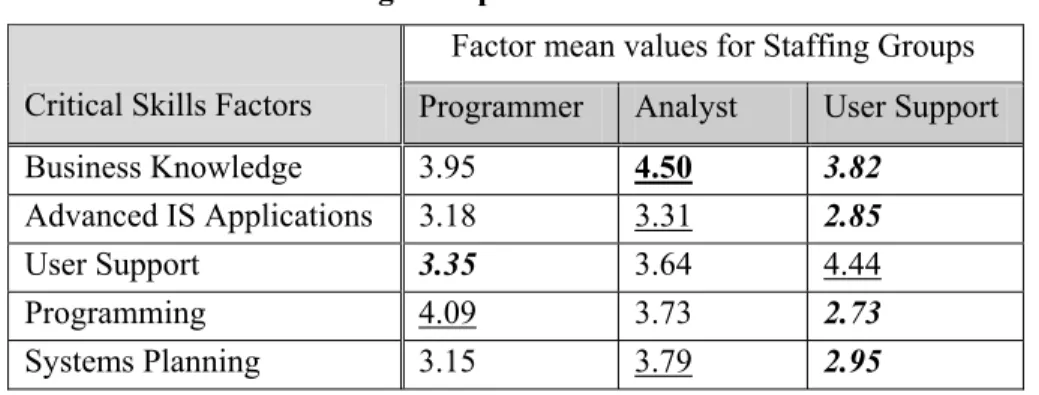
Noll and Wilkins (2002) conducted a survey to elicit the importance of IS skills in three staffing groups. The results of their analysis are summarized in Table 1.
Table 1: Staffing Groups and Critical Skill Factors
Factor mean values for Staffing Groups Critical Skills Factors Programmer Analyst User Support Business Knowledge 3.95 4.50 3.82
Advanced IS Applications 3.18 3.31 2.85
User Support 3.35 3.64 4.44
Programming 4.09 3.73 2.73
Systems Planning 3.15 3.79 2.95
Based on Noll and Wilkins (2002)
In Table 1, underlined numbers denote the highest mean values for each factor across the staffing groups. The bolded italicized numbers indicate the lowest mean values for each factor. For the programmer group, business knowledge and programming are almost equally important critical skill factors. For the analyst group, business knowledge is clearly the most important factor, while for the user support group business knowledge is the second most important factor. All skill fac-tors are relatively important for the Analyst group. Noll and Wilkins (2002) recommendations for IS curricula for the staffing groups studied included:
•Knowledge of business functional areas, business environment and specific industry •Ability to interpret business problems and to develop appropriate technical solution
• Ability to work collaboratively in a team project environment, and to plan, organize and lead projects
•Ability to develop and deliver effective, informative and persuasive oral presentations, and to write technical manuals, documents and reports
Ehie (2002) focused on industry expectations of MIS graduates as a basis for development of a new MIS program. Their development strategy involved an extensive review of literature and current programs and obtaining input from MIS professionals and employers on a draft program proposal. Their study concluded that, “employers are looking for individuals with a strong sys-tems orientation and a good understanding of an integrative business value-chain” (Ehie, 2002, p. 151). On programming skills, interviews with employers revealed that in-house training opportu-nities are available, and while MIS hires are not expected to be programmers, “a general knowl-edge of programming logic and thought process with reasonable proficiency in at least one pro-gramming language” is desirable (Ehie, 2002, p. 156). People and communication skills were considered critical for developing working relationships with clients from diverse backgrounds and needs.
In investigating skills and knowledge required by IS professionals in their jobs, Wade and Parent (2002) analyzed the relationship between job skill deficiency/surplus and performance for the Webmaster position. Although a job content analysis on descriptions for 800 Webmaster posi-tions indicated that they are primarily technical posiposi-tions with requirements for limited organiza-tional skills, their empirical study revealed that organizaorganiza-tional or “soft” skill deficiencies have a larger negative effect on job performance than technical skill deficiency. The measurement of skill deficiency or surplus in the study was based on participants’ perceptions of the usefulness and proficiency of organizational and technical skills. The set of organizational skills defined in the study included communications, project management, teamwork, customer service, and gen-eral management skills. Measurement of technical skills includes perceived proficiency and
use-fulness of tools such as Windows, Unix, HTML, Perl, and Visual Basic. The authors concluded that a balance of technical and organizational skills is important for perceived job performance. Surveys of graduates in an IS program indicated that non-technical skills are considered to be more important than technical skills (Davis & Woodward, 2006). In this study, the results of sur-veys for graduates from 1999 to 2005 were combined and analyzed. Participants in this survey ranked the importance of thinking skills, personal characteristics, teamwork skills, and communi-cation skills for their jobs. A breakdown of graduates hired in different areas is technical/user support (35%), computer programming (12%), networking (11%), and database design (9%), with providing technical support (54%) and installing software (45%) as the top two tasks per-formed on a regular basis. Table 2 shows the percentages of graduates’ employment areas based on 179 graduates:
Table 2: Primary Job Focus of Graduates Employed in IT Areas Job Focus in Different Areas Total*
Technical/end user support 34.6% Computer programming 12.3% Networking 10.6% Database design/development 8.9% Web design/development 6.7% Information management 6.2% System analysis/design 3.9% Information security 2.2% Information management and security 1.7%
E-commerce 0.6%
Other 12.3% Based on Davis, Woodward, and Belle (2006)
* refers to combining the results of surveys for graduates from 1999 to 2005
IT Job Outlook and Trends
Most students consider job prospects a significant factor in their decisions to major in a field of study. Therefore, the student perception of job prospect associated with the degree is expected to be a major factor in determining the “attractiveness” of a program. The job outlook for IT/IS in-dustry was researched to aid alignment of MIS program focus with job market outlook.
For the faculty involved in this MIS program review, defining which IT positions to focus on for development of critical skills and knowledge competencies was less straightforward than initially assumed. This was due to 1) lack of clarity about IT positions, and 2) diverse IT/IS positions ranging from technical to functional (or business) orientation.
The US Bureau of Labor Statistics (BLS) publishes a biennially updated Occupational Outlook Handbook that provides important career information about the job market (U.S. Department of Labor, Bureau of Labor Statistics, 2008-9). The BLS classification of occupations has ten major groups in which there are subgroups. Descriptions for IT-related professions are found in the sub-group titled “Computer and Mathematical Occupations” which is then sub-grouped under “Profes-sional and related occupations”. The “Computer and Mathematical Occupations” subgroup classi-fication of IT jobs could be misleading to students who are not drawn towards fields that require
strong mathematics or computer science education. In fact, a number of IT positions do not re-quire advanced mathematics beyond that which is normally found in business programs.
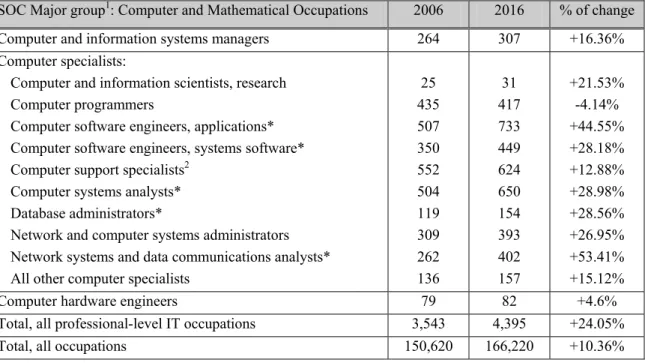
The BLS job projection summary data extracted from the November 2007 Monthly Labor Report shows projected increases (2006 to 2016) for the top three IT professional categories (Dohm & Schniper, 2007). These three categories are computer and information systems managers, com-puter specialists and comcom-puter hardware engineers. The data are shown in Table 3.
Table 3: Projected Employment for Professional IT workers in United States by Occupations for the Period 2006-2016 (in thousands)
SOC Major group1: Computer and Mathematical Occupations 2006 2016 % of change
Computer and information systems managers 264 307 +16.36%
Computer specialists:
Computer and information scientists, research Computer programmers
Computer software engineers, applications* Computer software engineers, systems software* Computer support specialists2
Computer systems analysts* Database administrators*
Network and computer systems administrators Network systems and data communications analysts* All other computer specialists
25 435 507 350 552 504 119 309 262 136 31 417 733 449 624 650 154 393 402 157 +21.53% -4.14% +44.55% +28.18% +12.88% +28.98% +28.56% +26.95% +53.41% +15.12%
Computer hardware engineers 79 82 +4.6%
Total, all professional-level IT occupations 3,543 4,395 +24.05%
Total, all occupations 150,620 166,220 +10.36%
Based on Dohm and Schniper (2007)
1: The U.S. Standard Occupational Classification (SOC) is a universal occupational classification system that is developed by various federal agencies to allow for comparison of occupational statistical data and to monitor evolution of occupations
2: “Computer Support Specialists” includes technical support specialists and help desk specialists
*: These occupations are among the 30 occupations that have been projected to be the fastest growing with rates of at least 27% for the period 2006 to 2016
In Table 3, the “all other computer specialists” category is a residual catchall label that includes various job titles not found in the BLS occupational classification system (Subramaniam & Bur-nett, 2007). IT-related job titles such as “software trainer,” “knowledge management specialist,” “BI specialist,” “technical writer,” “computer IT analyst,” “e-business specialist,” and “user inter-face analyst” are expected to be included in this category. In researching job positions appropriate for the program review, the use of several job titles for similar job descriptions could be poten-tially misleading for student and faculty. For example, the job description for a “Business Ana-lyst” is similar to that of the “Systems AnaAna-lyst” and the “Requirements AnaAna-lyst” positions. The International Institute of Business Analysis (2008) described a business analyst to be someone who has strong business functional and technical knowledge/skills and who performs duties such as user requirements analysis and recommend improvements in business processes based on IT. Comparisons between systems analyst and business analyst job titles are inconclusive as they are used interchangeably in organizations for the same role. There are some differences between
these two roles in that a systems analyst is more technically proficient in coding, and a business analyst is more functionally proficient in business and management (deBree, 2007).
In Table 3, job titles indicated with an asterisk next to them are among the list of 30 fastest grow-ing occupations published in the Monthly Labor Review (Dohm & Schniper, 2007). These jobs are also ranked to be “Very High” in annual median salary (at least $46,360), for which a college degree is the most significant source of postsecondary education and training.
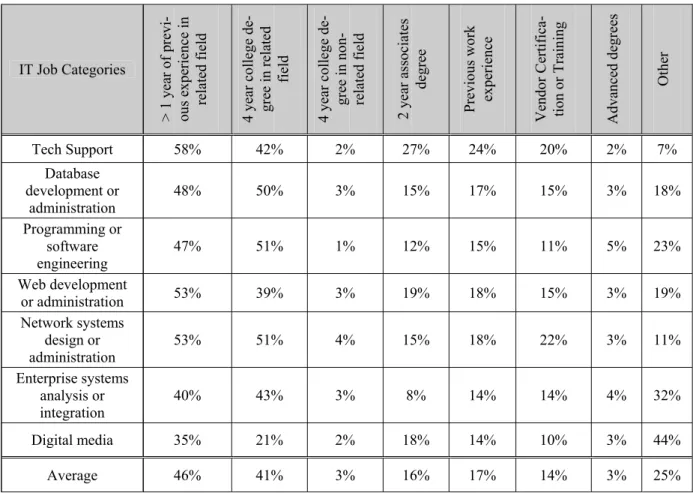
The 2004 annual workforce development survey report (Information Technology Association of America, 2004) reported the best backgrounds for all IT employment job categories defined by the National Workforce Center for Emerging Technologies. Their results were based on a survey of 500 practitioners who oversee the hiring of IT staff (Table 4).
Table 4: Hiring Managers’ Indications of Best Background for IT Job Categories
IT Job Categories > 1 yea r of p re vi -ous e xpe ri ence in related fiel d 4 year col le ge de-gr ee in related field 4 year col le ge de-gr ee in no n-related fiel d 2 year ass ociates degree Pre
vious work expe
rience Vendo r Certifica-tion or Trai ni ng Adva nced de grees Othe r Tech Support 58% 42% 2% 27% 24% 20% 2% 7% Database development or administration 48% 50% 3% 15% 17% 15% 3% 18% Programming or software engineering 47% 51% 1% 12% 15% 11% 5% 23% Web development or administration 53% 39% 3% 19% 18% 15% 3% 19% Network systems design or administration 53% 51% 4% 15% 18% 22% 3% 11% Enterprise systems analysis or integration 40% 43% 3% 8% 14% 14% 4% 32% Digital media 35% 21% 2% 18% 14% 10% 3% 44% Average 46% 41% 3% 16% 17% 14% 3% 25%
Based on Information Technology Association of America Annual Workforce Development Survey (2004). The percentages in Table 4 show the proportion of managers who selected a background as ‘best’ for hiring decisions in each job category. Since the row percentages do not add up to 100%, it is speculated that managers in the survey were allowed to indicate more than one background for hiring decisions. This refers to managers who would consider hiring junior and senior positions within the same job category.. The summary statistics show that, “experience is still important but for many IT jobs getting the right degree could mean getting the right opportunity” (Informa-tion Technology Associa(Informa-tion of America Annual Workforce Development Survey, 2004, p. 10). Hiring managers consider the “combination of previous experience in a related field (an average of 46%) and a 4-year college degree in a related field (an average of 41%) as the most important preparation for job attainment” (p. 10).
Of particular interest to the program review group is the vendor certification or training back-ground. The summary statistics shows that for Tech Support, and Network Design and Admini-stration more than 20% of managers consider vendor certification/training as the best background in hiring decisions. This led to our review group considering the possibility of partnerships with community colleges to offer certification programs in these areas to increase job placement rates for program graduates. It was also noted that a background of less than 1 year of experience has significant weight in hiring decisions. Our review group felt that internship and cooperative edu-cation programs might serve as good substitutes for the experience.
In addition to evaluating market demand for critical skills in the IT industry, a broader look at general trends is important for shaping IS curriculum. The increasing use of offshoring IT tasks is a matter for concern to IT graduates. Jobs that require specialized IT skills, such as global project management, large-scale integration, system architecture, and IT liaison, are predicted to more commonly stay onshore (Shao & David, 2007). Localized activities that require face-to-face in-teractions with clients are also more likely to say onshore, for example, security expertise, pre-liminary requirement analysis, and logic design, system testing/deployment, and user training. Other jobs that are less vulnerable to losses involved activities that support core, evolving busi-ness functions that are tied to the firm’s bottom-line, such as supply chain management, logistics, and inventory management. On the other hand, non-core business processes, such as human re-sources, accounting, and financial reporting, are at risk of being outsourced to offshore providers. Routine labor-intensive IT tasks that require little or no interactions with clients, such as “nuts-and-bolts” programming in application development, detailed design, program coding and testing, and systems maintenance and support, are also expected to move offshore. These projections im-ply the need for a shift in focus for MIS programs to reduce emphasis in technical programming skills and knowledge in non-core business processes and to increase emphasis in project man-agement, system integration, computer networking and communications skills, and knowledge about core business processes and technologies.
The Review Process
Fayetteville State University is a member of the University of North Carolina system of 16 public institutions and is a historically black institution established to serve the minority community of African Americans. The university is ranked by the 2008 America’s Best Colleges publication to be in the Tier 1 group of historically black colleges and universities (Morse & Flanigan, 2007). The MIS program review was initiated out of concerns for program focus and enrollment. The outcome for the review process was a report on strategies to strengthen the program. In Spring 2008, the MIS program at Fayetteville State University had 46 MIS student majors, 12 Manage-ment student majors with MIS concentration, and 45 MIS student minors. MIS student minors were mostly Accounting and Computer Science student majors.
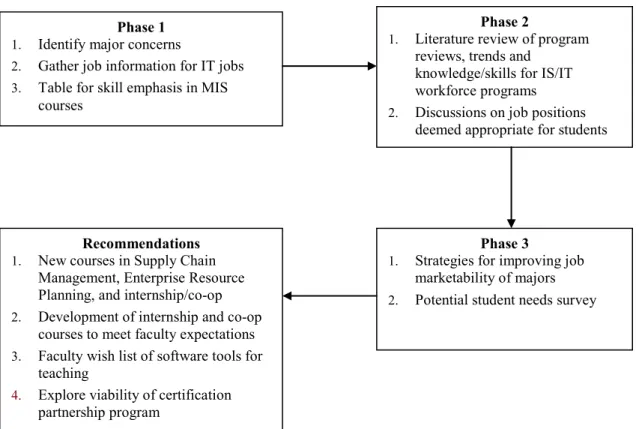
The faculty group consists of seven members. Six faculty members teach at least two MIS courses every semester, and five also teach Management courses in Operations Management, Quantitative Methods, or Business Statistics. The process for the review is illustrated in the Fig-ure 1:
Phase 1
1. Identify major concerns
2. Gather job information for IT jobs
3. Table for skill emphasis in MIS courses
Phase 2
1. Literature review of program reviews, trends and
knowledge/skills for IS/IT workforce programs
2. Discussions on job positions deemed appropriate for students
Phase 3
1. Strategies for improving job marketability of majors
2. Potential student needs survey
Recommendations
1. New courses in Supply Chain Management, Enterprise Resource Planning, and internship/co-op
2. Development of internship and co-op courses to meet faculty expectations
3. Faculty wish list of software tools for teaching
4. Explore viability of certification partnershipprogram
Figure 1. MIS Program Review Process Flowchart
In Phase 1, enrollment and technical skills emphases in the program were discussed. An informal survey of positions advertised on the Internet identified skills in demand. A table with skills in demand was circulated among MIS faculty to gather details on technical-related skills covered in each course with an additional column for the faculty to suggest any additional skills and soft-ware tools required for the course (see Appendix). Further discussion about the courses listed in the table is provided in the section on alignment of MIS curriculum with the job market.
Junior faculty with doctoral degrees in the area of Operations Management identified a set of technical skills that were in demand for technical positions, such as database developers or engi-neers, system analyst, web developers or engiengi-neers, and web designers. However, a few faculty members thought that it would be more appropriate to analyze skills for positions that are func-tionally (or business) oriented, such as business analyst, information specialist, junior database analyst, and assistant project manager positions. All MIS faculty have programming proficiency in at least one programming language: C, Java, VBA, macro, and procedural languages. The pro-gram requires all MIS majors to take a 200-level VBA propro-gramming course and offers an elective course in Java programming. This minimal level of programming does not prepare our students to assume technical positions that require programming skills.
While the majority of faculty in the group agreed that a greater emphasis on programming skills would help to build students’ problem solving and logic thinking skills, there were practical con-cerns – such skills are often considered difficult by the average college student. Limited faculty experiences in teaching programming courses with insufficient computer lab resources are other practical concerns. Furthermore, it is expected that in developing and making revisions to our curriculum, we should consider the consequences of creating in-house competition with the com-puter science program for students and resources. With an enrollment of less than 50 student ma-jors for the program, a decision on program focus would depend on the use of current faculty and facility resources. More importantly, research in industry expectations and job outlook and trends
indicate that project management, systems integration, computer networking, and communica-tions skills are more critical than programming skills.
In the second phase, the concerns for the direction of the program review led to referencing the computing-related programs or disciplines established by the Association of Computing
Machin-ery (
programs is found in the IT-IS program orientation section of this paper.
In the third phase, enrollment concerns were discussed including the need to increase recruitment efforts in a nearby military base. Two faculty members, who were teaching courses in the military base, designed a survey to collect information about interest level in the program. The survey re-vealed that more than 60% of the respondents would be interested in a program that focused on logistics and supply chain management topics. Other potential recruitment activities included linking student organization activities with recruitment effort and faculty participation in events sponsored by the university, such as the open house event and high school visits, and the School of Business sponsored event for new incoming freshmen. In the final phase, a brief report was prepared with recommendations that included new courses, recruitment strategies, and IT certifi-cation programs. A presentation of the report and a group discussion session with the Dean of the School of Business concluded the process.
IT-IS Program Orientation
The faculty group tackled the issue of job marketability of graduates by first identifying appropri-ate IS positions for graduappropri-ates of the program. Initial attempts resulted in technical positions that led to the research literature review process. The process identified the need to clarify the pro-gram orientation. For our propro-gram, the IS-functional orientation was found to be more appropri-ate for current student and faculty backgrounds. The next step in the process identified the appro-priate mix of technical and business knowledge/skills required to graduate students with market-able skills in positions targeted to be suitmarket-able for the program.
An outcome of the initial focus on job positions revealed an issue with business (or functional) and technical orientations of the program. Guidelines for establishing the program came from two sources: selected IS/MIS programs in other business schools and faculty input. The approach of benchmarking may not have offered the best approach if these selected programs were misaligned with current IT job market trends for skills and knowledge competencies. Additionally, we needed to acknowledge that student backgrounds, program visibility, recruiting efforts, and re-gional job opportunities might affect graduates to a significant degree in terms of employment marketability. For example, large consulting firms hire non-MIS or non-CS graduates such as Math or English majors for their IT positions. Personal traits (soft skills) such as analytical, prob-lem-solving, and communication skills are seen to be critical assets in these IT career positions. These new hires go through on-the-job training assignments and career building programs to ac-quire highly demanded technical IT knowledge or skills sponsored by the company.
Misunderstandings and different perspectives on the issue of orientation prompted a need for a reference point for the discipline. The ACM Internet career guide for IS programs states “IS pro-fessionals must understand both technical and organizational factors, and must be able to help an organization determine how information and technology-enabled business processes can provide a foundation for superior organizational performance. They serve as a bridge between the techni-cal and management communities within an organization,” and the fact that, “majority of IS pro-grams are housed in business schools, and may have different names such as Management Infor-mation Systems (MIS), computer inforInfor-mation systems (CIS), or business inforInfor-mation systems (BIS)” (Association for Computing Machinery, n.d.).
In general, MIS and IS-related degree programs have varying degrees of emphasis in business and technical topics in program learning goals. Programs differ substantially in the development of knowledge/skill in programming, data administration, and networking topics. In determining the orientation of the program under review in this case, two of the ACM’s computing disci-plines, Information Technology (IT) and Information Systems (IS), are used to construct a con-tinuum model for identifying program orientation in development of technical and organization (functional) knowledge/skills. According to the ACM, graduates of IT programs are expected to be knowledgeable on a selection of appropriate hardware/software and be able to integrate tech-nology infrastructure to meet the needs of the organization, while providing a secure and effective environment to support its users’ computing activities. IT graduates are, therefore, expected to be knowledgeable about scripting languages to connect existing system components. The IS gradu-ates, on the other hand, must demonstrate a strong understanding of both technical and organiza-tion factors and be able to help the organizaorganiza-tion to determine how informaorganiza-tion and business proc-esses can support its business goals. Thus, the concern for lack of technical skills in the program should, therefore, be reflected in the context of technical and functional orientation. The multiple entry career points in IS career path as suggested by Trauth, Farwell and Lee’s (1993) study im-plicates curriculum design to the diverse roles of IS professionals
Alignment of MIS Curriculum with Job Market
A summary of current emphasis of MIS skills and new skills identified for existing courses for the program is provided in a table in the Appendix. The second column provides a general de-scription of the courses. Courses such as MIS 330 Systems Analysis and Design and MIS 331 Systems Development have coverage of business processes for learning system modeling tools, user requirement, and system design techniques. A review of the course content in the MIS cur-riculum led to the identification of additional skills that should be added to each course to im-prove the skill set for business analyst, junior system analyst, and project management assistant positions. To strengthen the MIS curriculum, additional resources and software are required. The two greatest needs are better access to CASE tools and a network lab for students to have “hands-on” learning experience in network security and configurations in the MIS 430 Data Communica-tions and Network course.The MIS Internship/Co-op program is expected to provide students with learning experiences that will help them to understand the complexities of IT technologies employed to serve the business needs of organizations and its users. These experiences may include learning specific software packages, setting up computer networks, installing software, and understanding teamwork and building communications skills. Development of the internship/co-op program requires faculty to define formative assessment of students and resources needed to establish the program. MIS 498 (Internship) and MIS 499 (Co-op) are two new courses added to the MIS program.
Based on the group’s review on IT certification, faculty development in certification and partner-ship with community colleges in offering certification program emerged as strategies to improve program visibility and graduates job marketability.
Conclusions
The program review process described in this paper was an initiative designed to increase pro-gram enrollment and relevancy in preparing graduates for the job market. Implemented outcomes associated with the process were new courses such as MIS internship and co-op (cooperative), faculty involvement in MIS education conferences, availability of funds for establishing certifica-tion programs, and continuing effort in rethinking curriculum. Continuous effort in curriculum evaluation requires assessment of learning outcomes. In assessment of student learning outcomes, faculty need to examine their course materials to reflect learning goals that are consistent with
critical IS knowledge and skills identified in this review process. Although the diverse perspec-tives on the process goals and related curriculum issues bound the results of this review process, the author believes that the process is necessary to achieve a coordinated effort in program im-provement. Various levels of faculty involvement in the process may be explained by perceived lack of reward or recognition in the process. Trauth et al. (1993) made a similar observation in their explanation for curriculum gaps that were found to exist in their study. A “piecemeal” ap-proach and continuity in program review effort would likely to have better results than a single comprehensive review process due to limited faculty resources.
The learning outcome of this process is the view that our MIS graduates are to be employed for their business and information systems knowledge with team, communications, and analytical skills in applying software tools for improving business processes. In line with the concept of multiple career paths in IS, MIS students should be advised to increase their employability through their selection of course electives in the program.
Although the current MIS curriculum is designed to develop student competency in both business and IT areas, it is essential that students learn to synthesize the two knowledge areas and apply them to business situations. Topics in Enterprise Resource Planning (ERP), Customer Relation-ship Management (CRM), and Supply Chain Management (SCM) are to be included in course-work to improve student understanding of integrative business value chain. Software tools for these topics will need to be identified in a continuous curriculum development process to bridge theory with practice in these areas.
The 2004 Annual Workforce Development survey report in Table 3 revealed that certification is an important consideration for hiring decision in Network Design and Administration and Tech Support categories of IT jobs. Faculty resource constraints in setting up a full-fledged certifica-tion program will require collaborating with community colleges in offering IT certificacertifica-tion to students to increase program enrollment.
Lee et al.’s (2002) perception gap study indicated that knowledge about IS technologies, such as packaged software products and trends, is considered to be important by practitioners. Addition-ally, project management, spreadsheet, and database software tools were considered by IS practi-tioners to be within the top ten important skills, along with electronic mail and query languages. Thus, an emphasis on technical skills in using application development software such as CASE and ORACLE, and MS Project 2003, are learning outcomes that will be included System Analy-sis and Development, Database, and Project Management courses. In courses such as Decision Support Systems and Introductory to Database Management Systems, more advanced Microsoft Excel, and Access skills that require students to learn about macros and some VB programming should be considered. The trend in enterprise application development means that our graduates must demonstrate a conceptual understanding of business applications and tools. “Soft” skills and their importance to employers require faculty to reinforce emphasis in such skills in core MIS subjects such as System Analysis and Design, Database Management Systems, and System De-velopment.
Overall, the program review process was a good learning experience for the faculty as it resulted in broadening faculty perspectives on program focus based on the IT-IS continuum. Literature review related to current IT job trends increase faculty awareness of “value-added” business process knowledge in supply chain management and customer relationship management, and that “soft” skills such as communications, team and project management skills are competencies that are of value to employers.
References
Association for Computing Machinery. (n.d.). Computing degrees & careers: Information systems.
Re-trieved from
Davis, D. C., & Woodward, B. (2006). An analysis of skills required of graduates of an information sys-tems program. Information Technology, Learning, and Performance Journal, 24(2), 11-20.
deBree, T. (2007). Differences between systems analyst and business analyst. Retrieved June 28, 2008 from
Dohm, A., & Schniper, L. (2007) Employment outlook: 2006-16: Occupational employment projections to 2016. Monthly Labor Review Online, 130(11), 93-98. Retrieved June 8, 2008, from:
Ehie. I. C. (2002). Developing a management information systems (MIS) curriculum: perspectives from MIS practitioners. Journal of Education for Business, 77(3), 151-158.
Information Technology Association of America Annual Workforce Development Survey (2004). Adding value…growing careers: The employment outlook in today’s increasingly competitive IT job market.
Retrieved April 1, 2007 from
International Institute of Business Analysis, (2008) “Becoming a BA”. Retrieved June 23, 2008, from
Lee, S., Koh, S., Yen, D., & Tang, H. (2002). Perception gaps between IS academics and IS practitioners: An exploratory study. Information and Management,40, 51-61.
Morse, R., & Flanigan, S. (2007). How we calculate the historically black colleges and universities
rank-ings. Retrieved July 1, 2008, from
Noll, C. L., & Wilkins, M. (2002). Critical skills of IS professionals: A model for curriculum development.
Journal of Information Technology Education, 1(3), 143-154. Retrieved from
Shao, B., & David, J. S. (2007). The impact of offshore outsourcing on IT Workers in developed countries.
Communications of ACM, 50(2), 89-94.
Subramaniam, M., & Burnett, K. (2006). What’s the matter with the information technology workforce?
First Monday, 11(5). Retrieved June 27, 2008, from
Trauth, E. M., Farwell, D. W., & Lee, D. (1993). The IS expectation gap: Industry expectations versus aca-demic preparation. MIS Quarterly, 17(3), 293-301.
Todd, P. A., McKeen, J. D., & Gallupe, R. B. (1995). The evolution of IS job skills: A content analysis of IS job advertisements from 1970 to 1990. MIS Quarterly, 19(1), 1-27.
U.S. Department of Labor, Bureau of Labor Statistics (2008-9). Occupational outlook handbook, 2008-9
edition. Retrieved June 15, 2008, from
University of North Carolina. (2003). Academic program development procedures. Retrieved October 19,
2007, from
Wade, M. R., & Parent, M. (2002). Relationships between job skills and performance: A study of webmas-ters. Journal of Management Information Systems, 18(3), 71-96.
Biography
Dr. Yew earned her doctorate degree from Southern Illinois University at Carbondale. She has published in Information Technology, Learning and Performance Journal, Journal of the Operational Research Society, and Journal of Higher Education Management. Dr. Yew's publications have also appeared in DSI, INFORMS and IEEE Society proceedings. Her research interests include data mining, knowledge management and sharing, and self-directed learning. She also has a book chapter on knowledge management in Decision Support Systems: Achievements and Challenges for next Decade.
Appendix
MI S co ur se Descri pt ion Prere quisite course Cu rren t sk ill em ph asis Soft ware to ols Add itio na l requ ired Sk ills Add itio req uire Resources M IS 30 0 Intr o t o In fo rm ation Syste m s B ADM 2 14 , C S C 1 02 M S O ffi ce A ppl icat ions MS Excel, MS Access Basic W eb de sig n sk ills usi ng M S Fr on tPage MI S 3 20* In trod uc tion toData Base Managem
ent Syste m s CSC 10 2, MIS 30 0, M GT 31 1 Dat a m odel in g, dat abase Desi gn , using Access , Dra w ing ER D usi ng Vi si o, an d el em ent ary SQL MS Access , Visio, SQL+ Data Str uctu re M IS 32 1* Ad va nced DB M IS 32 0 Ad va nced S Q L Pr og ram m in g SQL+ C reat ing f orm s an d rep orts , Data A dm in, Web-based Da tabases MI S 3 30* Syste m s A nalysis an d Desig n M IS 32 0, C S C 1 02 Plan ni ng , A nal ysis an d D esign o f IS, Dat a m odel ing, p rocess m odel ing, MS Project, MS ACCESS, Visio Usi ng C ASE T ool s, Business Proce ss Reengi neeri ng, Pseudocodes CASE Too MI S 3 31* Syste m s Devel opm ent M IS 33 0 Data Mod eling, Pro cess M odel in g, A rc hi tect ure Desi gn , Im pl em ent ati on of IS MS Project, MS A CCE SS , V ISIO
CASE Tools, Visual Basi
c Pr og ram m ing, Arc hi tect ure D esi gn CASE Too MI S 4 20* M anagem ent Su pp ort Sy st em s CSC 10 2, MIS 30 0, M G T 31 1, M G T 3 25 Decision an alysis, qu an titativ e m odel s, dat a m ini ng m odel s E xc el SO LV ER, S A S enter prise m iner f or dat a m ini ng Bias redu ction strateg ies in deci si on m aki ng , AH P f or e val ua ting m ul tip le criteria decisions, i nfl uence di ag ram m ing Ex pert C MI S 4 30* Data C om m uni cat io ns and Com puter Net w or ki ng M IS 30 0 Pri nci pl es o f N et w or ki ng an d dat a com m uni cat ion VIS IO Som e practical expe rience in Syste m A rch ite ct ur e De si gn , sim ulation of s yste m s A lab fo com puter net w or ki
MI S co ur se Descri pt ion Prere quisite course Cu rren t sk ill em ph asis Soft ware to ols Add itio na l requ ired Sk ills Add itio req uire Resources MG MT 340 IT Pro ject M gmt CSC 10 2, MIS 30 0, B ADM 21 6
Project Scope, Cost,
Tim e m anagem ent, Risk As sessm en t an d Con tro l; Qu ality an d HR m anagem ent Is sues MS Project MI S 4 35* Electronic Co mmer ce CSC 10 2, MIS 30 0, MG MT31 1 Devel opm ent o f e-busi nes s pl an, use of we b ser ver an d fi le trans fer, we b h ost in g, we b desi gn , we b br owse r c ont ro l,
active server page
MS Fron tPag e, HTML, CSS, DHTML , Ja va script, ASP Scri pt XML, XHTM L, an d m ore ad va nced sk ills in CSS, Ja vasc ript, and ASP Su fficien
Space for stude
nt (at 50 0 M B s M IS 41 0 Su ppl y C hai n M anagem ent BA D M 21 6, M IS300 SCM concepts , analysis, design, IT issu es, qu ality issu es, in tern ation al el em en ts, E-Business M S O ffice Si m ulatio n M IS 44 0 Java Pr ogr ammin g CSC 10 2, MIS 30 0 Devel opm ent o f J A V A ap plication s JAVA es: B ADM 21 4 i s a c ou rse in im pl em ent ing b usi ness a ppl icat ions usi ng pr oduct iv ity soft ware .