USMC
US Marine Corps
PCN 143 000042 00
MAGTF
Communications System
DISTRIBUTION STATEMENT C: Distribution authorized to US Government agencies and their contractors.
Changes: Readers of this publication are encouraged to submit suggestions and changes through the Universal Need Statement (UNS) process. The UNS submission processs is delineated in Marine Corps Order 3900.15_, Marine Corps Expeditionary Force Development System, which can be obtained from the Marine Corps Publications Electronic Library Online (http://www.marines. mil/news/publications/Pages/Publications137.aspx).
The UNS recommendation should include the following information: • Location of change
Publication number and title Current page number
Paragraph number (if applicable) Line number
Figure or table number (if applicable) • Nature of change
Addition/deletion of text Proposed new text
Additional copies: A printed copy of this publication may be obtained from Marine Corps Logistics Base, Albany, GA 31704-5001, by following the in-structions in MCBul 5600, Marine Corps Doctrinal Publications Status. An electronic copy may be obtained from the MCCDC Doctrine World Wide Web home page: https://www.doctrine.usmc.mil.
Unless otherwise stated, whenever the masculine gender is used, both men and women are included.
Washington, DC 20380-1775
8 January 2010 FOREWORD
Marine Corps Warfighting Publication (MCWP) 3-40.3, MAGTF Communications Sys-tem, presents doctrine, tactics, techniques, and procedures (TTP) for the employment of the communications system to support Marine air-ground task force (MAGTF) command and control. It builds on the philosophy in Marine Corps Doctrinal Publication 6, Com-mand and Control, and links that philosophy to the detailed TTP in MCWP 3-40.1, MAGTF Command and Control, and MCWP 3-40.2, Information Management.
MCWP 3-40.3 is written for all MAGTF commanders, staff officers, and Marines who support command and control.
This publication supersedes MCWP 6-22, Communications and Information Systems, dated 16 November 1998.
Reviewed and approved this date.
BY DIRECTION OF THE COMMANDANT OF THE MARINE CORPS
GEORGE J. FLYNN
Lieutenant General, U.S. Marine Corps
Deputy Commandant for Combat Development and Integration Marine Corps Combat Development Command
Publication Control Number: 143 000042 00
DISTRIBUTION STATEMENT C: Distribution authorized to US Government agencies and their contractors. Other requests for this document will be referred to Marine Corps Combat Development Directorate, Command and Control Integration Division.
MAGTF C
OMMUNICATIONS
S
YSTEM
T
ABLE
OF
C
ONTENTS
Chapter 1. Command and Control and the Marine Air-Ground Task Force Communications System
Command and Control Environment . . . 1-1 Information Management . . . 1-2 MAGTF Communications System Characteristics . . . 1-6 MAGTF Communications System Responsibilities. . . 1-7
Chapter 2. Organizations
Section I. Marine Corps Organizations . . . 2-1 Operating Forces. . . 2-1 Marine Corps Forces . . . 2-1 Marine Air-Ground Task Forces . . . 2-2 Marine Corps Forces Reserve. . . 2-4 Marine Special Operations Command . . . 2-4 The Supporting Establishment . . . 2-5 Section II. MAGTF Communications System Organizations . . . 2-6 Communications Battalion . . . 2-6 Marine Wing Communications Squadron . . . 2-8 Communications Company, Headquarters
Battalion, Marine Division . . . 2-9 Communications Company, Combat Logistics Regiment,
Marine Logistics Group . . . 2-9 Communications Platoons, Branches, and Sections . . . 2-10 Special Security Communications Teams . . . 2-10 Amphibious Communications Teams . . . 2-11 Section III. Command and Control Organizations . . . 2-12 Marine Expeditionary Force Command Element . . . 2-12 Ground Combat Element . . . 2-14 Aviation Combat Element . . . 2-14 Logistics Combat Element . . . 2-17 Intelligence Command and Control . . . 2-18 Fire Support Centers . . . 2-19 Rear Area Operations Centers . . . 2-19 MAGTF Communications System Control . . . 2-20 Amphibious Command and Control Facilities . . . 2-22 Mobile Command Posts . . . 2-24
Chapter 3. Global Information Grid Components . . . 3-1 Planning . . . 3-4 Access Services. . . 3-4 Voice Services. . . 3-5 Data Services. . . 3-5 Applications . . . 3-6 Video Services . . . 3-7 Satellite Communications Services. . . 3-7 Manangement of the Global Information Grid . . . 3-11 Electromagnetic Spectrum Management . . . 3-14
Chapter 4. MAGTF C2
What is MAGTF C2? . . . 4-1 MAGTF C2 Capabilities . . . 4-3
Chapter 5. MAGTF Communications Network
Communication and the Electromagnetic Spectrum. . . 5-1 Elements of a MAGTF Communications Network . . . 5-9
Chapter 6. Communications Planning
Planning for a Dynamic Network . . . 6-1 Marine Corps Planning Process . . . 6-3 Communications Control . . . 6-4 Commander’s Intent . . . 6-6 Center of Gravity Analysis . . . 6-6 Commander’s Critical Information Requirement . . . 6-6 Communications Control Agencies . . . 6-8
Chapter 7. Information Systems Securtiy
Section I. Communications Security. . . 7-1 Responsibilities . . . 7-2 Cryptosecurity . . . 7-3 Transmission Security. . . 7-3 Emission Security . . . 7-4 Physical Security. . . 7-4 Section II. Computer Security. . . 7-6 Threat to Computer Security. . . 7-6 Protection . . . 7-7 Section III. Incident Response . . . 7-10
Marine Corps Network Operations and Security Command
and Expeditionary Support Center . . . 7-10 Naval Network Warfare Command . . . 7-10
Appendices:
A MAGTF Single-Channel Radio Nets . . . A-1 B Communications Symbology and Diagrams . . . B-1 C Transmission System Link Designator Numbering . . . C-1 D Command Communications Service Designator . . . D-1 E Communications Planning Checklist . . . E-1 F Sample Annex K. . . F-1 G Information Systems Directory . . . G-1 H Example of a Guard Chart . . . H-1
Glossary References
C
OMMAND
AND
C
ONTROL
AND
THE
M
ARINE
A
IR
-G
ROUND
T
ASK
F
ORCE
C
OMMUNICATIONS
S
YSTEM
This publication, Marine Corps Warfighting Publication (MCWP) 3-40.3, MAGTF Commu-nications System, outlines the responsibilities of the MAGTF communications system (MCS) personnel and users to ensure that those sys-tems provide effective command and control (C2) support. This publication is written, to the extent possible, in nontechnical language; how-ever, chapters 3, 4, and 5 contain many commu-nications system and networking terms that may be unfamiliar to most Marines. These terms are defined in the glossary.
The MCWP 3-40.3 focuses on the communications system used to support the Marine air-ground task force (MAGTF) in the operational environment. It addresses the MCS’s employment to support the Marine Corps component headquarters (HQ). This publication also discusses how the Marine Corps establishes command relationships and organizes to provide communications system support to the MAGTF. It describes the information systems and services that support command and control and the employment of communications systems and net-works to link these information systems.
This publication emphasizes the impact of the rap-idly evolving joint C2 environment of the MCS. It identifies approved doctrine for communications system support of joint operations and outlines the responsibilities of the Marine Corps to ensure effective communications support to commanders. It addresses how communications systems support the conduct of joint operations, including how systems are to be configured, deployed, and employed. Finally, this publication provides the guidance necessary to plan, manage, employ, and execute communications system support at the MAGTF operational and tactical levels.
Command and Control Environment
The C2 environment is characterized by rapid change and continuous challenge. Implementa-tion of maneuver warfare doctrine, with its emphasis on speed and tempo, demands com-pressed planning, decisionmaking, execution, and assessment cycles. At the same time, the volume of information that needs to be processed and analyzed to support decisionmaking is ever increasing and threatens to overwhelm command-ers and staffs. The MAGTF must employ limited communications system resources to meet these challenges. To help satisfy the operational requirement, the Marine Corps is changing its manpower structure, its education and training processes, and its doctrine through the combat development process.
Developments in the joint C2 arena are another significant factor in the C2 environment. The Department of Defense (DOD) is significantly enhancing the C2 capabilities of the armed forces by rapid exploitation of advanced information technologies and significant improvements in interoperability. The objective of the joint communications system is to assist the joint force commander (JFC) in the command and control of military operations. Effective command and control is vital for proper integration and employment of operational capabilities. The communications system supporting the JFC is the Glo b a l I n f o r m a t i o n G r id ( G I G ) . T h e G I G includes all joint and Service communications systems, and interfaces with non-DOD and multinational users.
One of the most difficult C2 issues the Marine Corps now faces is the requirement to support a deployable Marine Corps component HQ with MCS personnel and equipment. The primary source of support is the communications battalion (COMM BN). The requirement to provide sup-port to a deployed Marine Corps component HQ can have a significant effect on the availability of MCS resources to support the MAGTF.
The MCS must be able to satisfy the C2 require-ments of the expeditionary battlefield. It must pro-vide MAGTF commanders and their staffs with the tools necessary to collect, process, analyze, and exchange information rapidly in support of operations planning and execution. These systems must make the necessary information available when and where it is needed on the battlefield. Employment of these systems must not adversely affect the MAGTF’s freedom of action and mobil-ity, and they must be reliable, flexible, responsive, and configurable to mission needs. The success of the MAGTF on the modern battlefield depends on designing, planning, and employing a communica-tions system that satisfies the information needs of the MAGTF process.
Information Management
Much of the information obtained for any endeavor or purpose is incomplete. This is espe-cially true in a battle of wills between opposing forces in military or political conflicts in which each side seeks to deceive the other with false information. The commander cannot, therefore, be certain that the information obtained depicts the situation with absolute certainty, only that it provides an approximation of reality.
Generally, the level of accuracy of the com-mander’s estimate of reality can be increased with more time to collect and analyze additional
information. However, reality also changes with time because of enemy and friendly actions and the environment. These changes then introduce additional information that requires processing and analysis. At some point, the commander must make decisions based on the best information available. Although the MCS provides useful tools, the application of sound information man-agement principles is required to satisfy the com-mander’s information requirements. Information management principles address information rele-vance, timeliness, accuracy, completeness, objec-tivity, and usability.
Information Defined
In this publication, the term information refers to all information that is needed to support the decisionmaking process on the battlefield—that information required to execute the planning, decision, execution, and assessment cycles in combat. Joint Publication (JP) 1-02, Department of Defense Dictionary of Military and Associated Terms, provides two definitions for information: (1) facts, data, or instructions in any medium or form, and (2) the meaning that a human assigns to data by means of the known conventions used in their representation.
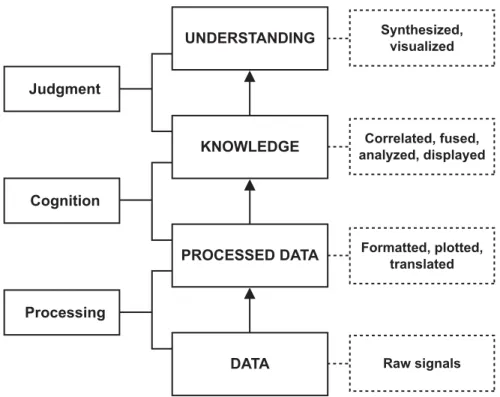
It is important to understand that information, in its broadest sense, includes everything from raw data such as a radar signal or a suspected enemy sighting by an observation post, to data that has been extensively processed to be meaningful to a decisionmaker. Ultimately, study and analysis of information lead to an understanding of the situa-tion—a situational awareness. Naval Doctrine Publication 6, Naval Command and Control, and Marine Corps Doctrinal Publication (MCDP) 6, Command and Control, describe a 4-step cogni-tive process by which the transformation from raw data to situational awareness takes place (see fig. 1-1). These four steps may be viewed as defining an information hierarchy.
Figure 1-1. Information Hierarchy.
Data
The first step in the cognitive process is to col-lect raw data. The raw data can take many forms: radar signals, intercepted radio signals, meteoro-logical data from a weather balloon, or even bar-coded logistic data scanned from the side of a container. This data may be transmitted by tele-phone, radio, or facsimile; transferred between computers over local area networks (LANs); or sent by messenger as rolls of undeveloped film or digital media. Regardless, to be useful, this raw data must be processed into a form that can be understood by the end user.
Processed Data
The second step, processing data, involves a wide range of functions, such as decoding and translat-ing intercepted communication, filtertranslat-ing and cor-relating sensor returns, and developing film. Processing is putting information into a readily interpretable form, such as a graphical display or
a formatted message. Some information will come to the MAGTF in processed form and will not require further processing. Once data has been processed, it is referred to as information in the cognitive process. At this point, some infor-mation may have immediate value for Marines in close contact with the enemy. Such information is known as combat information. It is usually extremely perishable and should be disseminated to units needing it as rapidly as possible.
Knowledge
In the third step, information is analyzed and evaluated to produce knowledge. For example, the analysis of intelligence information helps build a picture of the enemy situation.
Understanding
The fourth and last step in the process is develop-ing an understanddevelop-ing of the situation based on the information available. Understanding is the result
Judgment Cognition Processing UNDERSTANDING KNOWLEDGE PROCESSED DATA DATA Synthesized, visualized Correlated, fused, analyzed, displayed Formatted, plotted, translated Raw signals
of applying human judgment based on individual experience, expertise, and intuition to gain a full appreciation of the battlefield. This understanding is situational awareness and provides a sound basis for operational decisions. It allows the com-mander to anticipate events and to uncover criti-cal vulnerabilities for exploitation. As the commander strives to gain an understanding of the situation, however, he must recognize that time is working against him. He may not be able to gain complete situational awareness before he has to act. Developing situational awareness with limited and uncertain information under severe time constraints is the fundamental C2 challenge.
Information Quality
Information quality and availability have a direct effect on the commander’s capability to effec-tively command and control forces. Good infor-mation reduces confusion and contributes to situational awareness. It is essential to plan, mon-itor, and influence operations effectively. Infor-mation quality cannot be taken for granted and must be assessed with care.
The following paragraphs identify criteria for determining information quality, they are neither exhaustive, of equal importance, nor are they independent of each other. It is counterproduc-tive to seek complete information if the search for completeness makes the information untimely. Irrelevant information is worse than none and false information can be disastrous, especially if it is part of an enemy deception.
Relevance
Information must apply to the mission, task, or situation. Exhaustive, unfiltered information often detracts from the commander’s ability to make timely, effective decisions. Furthermore, the transmission and processing of exhaustive information burdens the MCS unnecessarily.
Timeliness
Information must be available at the appropriate place and time to be useful. Information manage-ment procedures and techniques must ensure the following: the timely, unimpeded flow of relevant information; a well-planned and implemented communications system; clearly identified infor-mation requirements; effective collection, report-ing, and dissemination; and decisiveness by commanders and their staffs.
Accuracy
Information must be as accurate as possible. Although information systems can collect, transport, process, disseminate, and display information, Marines must still evaluate the information and decide whether it is accurate, timely, and relevant.
Completeness
Information about a situation may be useful only when it is complete; however, by the time com-plete information is obtained, it may no longer be timely. If subordinates are aware of the com-mander’s intent and critical information require-ments, they can provide only those information fragments needed for situational awareness.
Objectivity
Information must be provided in the most undis-torted, factual, and unbiased way possible. Any interpretation should be highlighted.
Usability
The display or presentation of information to the user must be understandable and useful. Stan-dard, clearly understandable information for-mats, symbols, and terms should be used to exchange information and present it to users. Information exchanged and presented in non-standard forms causes delays in interpretation and is easier to misunderstand, leading to longer deci-sion and execution cycles and, ultimately, to less reliable decisions.
Types of Information and the Commander’s Critical Information Requirement
The information required for situational aware-ness falls into three general categories: informa-tion about the enemy, informainforma-tion about the environment, and information about friendly forces. The identification of the commander’s critical information requirement (CCIR) is a way to focus and direct the collection and processing of information into those categories. The CCIR is the information regarding the enemy, friendly activities, and the environment identified by the commander as critical to maintaining situational awareness, planning future activities, and facili-tating timely decisionmaking. Designation of the CCIR reduces the volume of information to a manageable level and helps to ensure the accu-racy, relevance, and timeliness of that informa-tion. The CCIR consists of priority intelligence requirements (PIRs), friendly force information requirements (FFIRs), and essential elements of friendly information (EEFI). Clearly defining these information requirements is one of the most difficult and important tasks of command. The CCIR will not only govern the quantity and qual-ity of the information available to support deci-sionmaking, but also will have a direct effect on the workload of the staff and subordinate units.
PIR
The PIRs are associated with a decision that will affect the overall success of the command’s mis-sion. They include information about the enemy and the environment. Information about enemy capabilities and intentions is critical for com-manders to anticipate and analyze possible enemy courses of action (COAs). Information on the environment includes reports on the weather, the terrain, the local population, the local communi-cations and transportation infrastructures, and a host of other factors that may affect the conduct of military operations. Through identification of PIRs, commanders ensure they direct limited intelligence resources to obtaining intelligence information essential for decisionmaking.
FFIR
To complete the picture of the situation, the com-mander requires information on friendly forces. The FFIRs are the pieces of information about friendly forces the commander needs to be able to develop plans and make effective decisions. Depending on the circumstances, any informa-tion acquired on unit locainforma-tion, composiinforma-tion, readiness, personnel status, and logistic status could become FFIRs. Just as it is essential for the commander to use PIRs to identify the most important requirements for information on the enemy, it is also necessary that the commander specify what critical friendly force information is required to support planning and execution. The commander must have real-time or near real-time information on the location, status, and capabili-ties of friendly forces; however, he must priori-tize FFIRs to limit and focus the collection and processing effort. It is easy to overburden subor-dinate units and to overload communications net-works with requests for nonessential information. The FFIRs help commanders, staffs, and subordi-nate units understand precisely what information is needed to support the planning, decision, exe-cution, and assessment cycles.
EEFI
The EEFI are specific facts about friendly inten-tions, capabilities, and activities needed by adver-saries to plan and execute effective operations against our forces. These EEFI may be viewed as representing the opposing commander’s PIR. Identification of the EEFI is vital to planning effective information security (INFOSEC), oper-ations security (OPSEC), and other force protec-tion operaprotec-tions.
Flow of Information
The goal of information management is to facili-tate a rapid, unconstrained flow of information throughout an organization from its source, through intermediate collection and processing nodes, to its delivery to the end user. The CCIR serves as a necessary filter to ensure that only
relevant information is delivered to prevent infor-mation overload. Inforinfor-mation must flow in all directions to support a common operational pic-ture of the battlefield among all units senior, sub-ordinate, adjacent, supporting, and supported. A flexible, responsive C2 architecture is required that pushes relevant, time-sensitive information to the user while allowing the user to pull addi-tional detail as required. This C2 architecture consists of the C2 facilities, information sys-tems, and communications networks that are described in chapters 2, 3, 4, and 5.
A number of information-sharing techniques are widely used to improve the flow of information, both within and among Marine Corps organiza-tions. These techniques support improved situa-tional awareness and collaborative planning. Networking also offers tremendous opportuni-ties for electronic reachback. The concept of electronic reachback may reduce the size of deployed staffs through the use of specialists, the military, Government civilians, or consultants located in garrison.
The most widely used information-sharing tech-nique is electronic mail (e-mail), which provides a convenient way to exchange information between organizations and individuals. It is a highly effective means of communication, sup-porting rapid dissemination of time-critical infor-m a t i o n b e t w e e n H Q a n d s u b o r d i n a t e organizations and across staff sections. E-mail permits a single user to disseminate information to one or several users simultaneously; however, in a deployed environment, the potential to over-load the communications system requires a disci-plined approach to the establishment and use of e-mail accounts.
Other networking techniques, such as using Web pages or shared network drives on a LAN, sup-port the concept of information pull and have the potential to reduce the load on the communica-tions network to improve information flow. These techniques, however, are no guarantee of receipt by the intended audience.
Pull techniques are generally unacceptable for the promulgation of time-sensitive, critical informa-tion such as fragmentary orders (FRAGO) or warning orders. Although brief messages could be sent indicating that the order had been posted and requiring addressees to acknowledge and com-ply, the order normally would not have been l e n g t h y e n o u g h t o m a k e t h i s a n e f f i c i e n t approach. On the other hand, when selective access to information in large databases is required to support an analysis, pull techniques are more efficient than push techniques.
MAGTF Communications
System Characteristics
It would be impossible to provide adequate C2 support on the modern battlefield without the MCS. This publication defines the MCS as any system that primarily functions to collect, process, or exchange information. The MCS should be reliable, secure, timely, flexible, interoperable, and survivable.
Reliability
The MCS should be available when needed and perform as intended with low failure rates and few errors. Reliability is also attained by standardizing equipment and procedures and by building neces-sary electronic jamming and deception. Systems should perform reliably on board ships and aircraft, in garrison, and in austere field environments.
Security
The MCS should provide security commensurate with the user’s requirements and with the vulnera-bility of the transmission media to interception and exploitation. Security is achieved by using appro-priate protection and cryptographic systems and transmission security techniques. It is also achieved by educating and training personnel in operational, management, and technical security procedures.
Timeliness
The MCS should process and transfer informa-tion among decisionmakers rapidly enough to maintain a high tempo of operations. It should ensure that our decision and execution cycles remain ahead of any potential adversary’s.
Flexibility
The MCS should be capable of being reconfigured quickly to respond to a rapidly changing environ-ment. Flexibility can be obtained through system design or by using commercial facilities, mobile or transportable systems, or prepositioned facilities.
Interoperability
The MCS should enable information to be exchanged among all of the commanders and forces involved in an operation. The MCS also should possess the interoperability required to ensure information exchange in joint and multi-national operations and in operations with other governmentagencies.
Survivability
In the context of communications, survivability refers to the measures taken to prevent disrup-tion of the MCS by enemy interference or natu-ral disaster. Survivability can be enhanced by the dispersal and protection of key nodes, physi-cal and electromagnetic hardening, and redun-dancy of communication paths and information processing nodes.
MAGTF Communications
System Responsibilities
The communications officer, officer MOS [mili-tary occupational specialty] 0602, is responsible for the MCS and responsibility for this functional area has been assigned to the communications officer (G-6/S-6). Since the technology associ-ated with such systems and networks continues to
evolve, specific responsibilities continue to evolve as well. Already, it is clear that the respon-sibility for installing and operating information systems will be shared among MCS specialists and functional area users. For example, the com-mand and control personal computer (C2PC) sys-tem will be operated by personnel from the operations office (G-3/S-3) who will be assisted by MCS personnel with its installation and inter-face with LAN and wide-area networks (WANs). Just as important as the responsibility for install-ing, operatinstall-ing, and maintaining MCS is that of m a n a g i n g t h e i n f o r m a t i o n p r o c e s s e d a n d exchanged by those systems. Each staff section will be responsible for the quality of the informa-tion in the databases of the systems that support that particular staff section. However, overall information management policies and proce-dures will be under the staff cognizance of the chief of staff (C/S) or the executive officer (XO).
Commander
The commander is responsible for the planning and employment of the MCS within the com-mand, although the authority to plan and employ communications and information systems may be delegated. The commander must provide the G-6/ S-6 adequate authority commensurate with the responsibilities expected or assigned, and ade-quate guidance, including necessary assumptions and constraints. The commander is also responsi-ble for providing the focus for information man-a g e m e n t t h r o u g h o u t t h e o r g man-a n i z man-a t i o n man-a n d participating directly in the information manage-ment process by establishing the CCIR discussed in this chapter.
Communications Officer
The communications officer is responsible to the commander for all matters concerning the planning and employment of MCS within the command. As a general or executive staff officer, the communications officer serves as an
advisor, planner, supervisor, and coordinator. Specific responsibilities include the following:
• Providing the commander and other staff officers with—
o Advice on information management policies and procedures.
o Estimates of the supportability of COA. o Estimates of requirements for MCS
resources, including personnel, equipment, supplies, and facilities.
o Recommendations for the allocation and use of MCS resources.
o Recommendations for MCS training for the command.
o Recommendations on the location, echelon, and displacement of the command post and C2 facilities.
o Advice on operational aspects of information assurance (IA). (See chapter 7 for detailed G-6/S-6 responsibilities.)
• Preparing MCS plans, orders, and standing operating procedures (SOPs) to implement the commander’s policies and decisions on MCS employment.
• Assisting the staff in the area of the MCS to prepare studies, estimates, plans, orders, instructions, and reports.
• Employing of MCS personnel.
• Installing, operating, and maintaining com-munications networks.
• Managing LAN and WAN, including Internet protocol (IP) address and routing management.
• Providing technical and system administration support for functional users in the installation, operation, and maintenance of information systems hardware and common user software.
• Providing communications systems training and, in coordination with functional users, information systems training.
• Supplying and maintaining the MCS.
• Complying with SOP and interoperability standards.
• Providing MCS security in coordination with the other staff sections.
• Coordinating MCS matters with related staff sections and with staffs of other units, as required.
• Establishing MCS liaison with senior, subordinate, adjacent, supported, and supporting units.
Unit Information Management Officer
The unit information management officer is a special staff officer operating under the staff cog-nizance of the C/S or XO. If an information man-agement officer is not designated, then this duty is the responsibility of the C/S or XO. The infor-mation management officer is responsible for establishing the policy and procedures for infor-mation management within the command. Responsibilities include—
• Coordination, with the assistance of the information management officers of each staff section and subordinate units, of information management efforts throughout the org-anization.
• Development and publication of the in-formation management plan. The inin-formation management plan establishes policies and procedures for ensuring the quality and flow of information within the organization.
• Coordination of the CCIR process: the nomination of the CCIR; approval of the CCIR by the commander and collection and reporting of the CCIR by the staff; dissemination of the CCIR to higher, adjacent, and subordinate commands; and maintenance of the CCIR.
• Development and implementation of effective information dissemination techniques in close coordination with the communications officer,
other staff principals, and the information management officers of subordinate units.
• Development of training programs on infor-mation management procedures.
• Coordination with the unit security manager in the development and implementation of INFOSEC procedures.
• Coordination with the communications officer on LAN management and networking issues, communications channels prioritization, and traffic management.
Staff Section Information Management Officer
Each staff section should appoint an information management officer. The staff section informa-tion management officer is responsible for—
• Coordinating the internal and external infor-mation flow for the staff section and its integration with the information flow of other staff sections, including identifying and prioritizing information management require-ments.
• Providing the unit information management officer with input to the information manage-ment plan.
• Coordinating information management training for section personnel with the unit information officer.
• Coordinating the identification and processing of all CCIRs within the staff section’s area of operations (AO).
Functional User Responsibilities
On the modern battlefield, it is essential that func-tional users of information be able to operate the information systems supporting their functional area. Such ability facilitates increased speed and operator knowledge in establishing a distributed network. It also ensures that functional area users are able to best exploit and control the capabilities
of systems that support their needs. Functional users include every staff section supported by the MCS. Consequently, all staff principals have functional user responsibilities for the functional areas over which they have staff cognizance. For example, the G-3/S-3 has functional user respon-sibilities for C2PC. Functional user responsibili-ties include—
• Identifying the primary point of contact (POC), both internal and external to the command, for issues affecting information systems that support the functional area.
• Serving as the configuration manager for information systems that support the functional area.
• Conducting routine information user ad-ministration, such as performing user data/file storage and management and conducting file backups.
• Coordinating with the G-6/S-6 to ensure that adequate hardware, software, trained personnel, and procedures are in place before im-plementing a new system or system modi-fication.
• Coordinating with the G-6/S-6 to develop and maintain user training programs for the MCS.
• Identifying to the G-6/S-6 information system support requirements.
• Identifying to the G-6/S-6 specific communi-cations requirements, including requirements to interface with other information systems and potential interface problems.
• Complying with applicable MCS security measures.
• Reporting malfunctions and outages and coordinating with the G-6/S-6 to restore service.
Communication Between Commands
The responsibility for establishing communica-tion between units must be clearly delineated.
These responsibilities are a cornerstone of com-munications doctrine; however, when support-ing combat operations, unit communications capabilities may be destroyed and responsibility may become unclear or irrelevant. Flexibility, common sense, initiative, cooperation, and mutual assistance must prevail in these instances. Communication responsibilities are as follows:
• Communication between a senior and sub-ordinate unit is the responsibility of the senior commander.
• Communication between adjacent units is the responsibility of the first common senior commander.
• Communication between a supporting and supported unit is the responsibility of the supporting unit commander.
• Communication between a reinforcing and reinforced unit is the responsibility of the reinforcing unit commander.
• Communication between a unit and an attached unit is the responsibility of the commander of the unit to which the attachment is made.
G-6/S-6 Staff Cognizance and Technical Direction
Communications units and detachments operate under the staff cognizance and technical direc-tion of the supported unit’s G-6/S-6. The Marines assigned to these units, in concert with personnel assigned to G-6/S-6 sections and functional area users, are responsible for employing the MCS to support command and control. Accordingly, commanders should ensure that the staff principal G-6/S-6 have the authority commensurate with the responsibility assigned or expected.
O
RGANIZATIONS
S
ECTION
I. M
ARINE
C
ORPS
O
RGANIZATIONS
The MCS is employed to support the command and control of Marine forces. To understand the requirements for MCS support, it is necessary to understand the organization and mission of those forces. Marine forces are organized, trained, and equipped under a total force concept to conduct a wide range of expeditionary operations. The Marine Corps total force consists of three compo-nents: the operating forces, the Marine Reserve, and the supporting establishment. The operating forces are expeditionary forces-in-readiness, pro-viding forward presence, crisis response, and rapid power projection capabilities to warfight-ing combatant commanders (CCDRs). The United States Marine Corps Forces Reserve (MARFORRES) is an integral part of the total force team. It continuously trains and operates with the active forces and is fully prepared to augment or reinforce them in times of crisis. The supporting establishment is responsible for recruiting, training, equipping, and sustaining the force, both active and reserve.
Operating Forces
The two major components of the operating forces are United States Marine Corps Forces Command (MARFORCOM) and United States Marine Corps Forces, Pacific (MARFORPAC), together constituting the expeditionary combat power of the Marine Corps. Other elements of the operating forces include the Marine Corps Secu-rity Forces at naval installations; United States Marine Corps Forces, Special Operations Com-mand (MARSOC) at Camp Lejeune, NC; and the Marine Corps Embassy Security Command with
detachments at embassies and consulates. Consis-tent with doctrine in JP 1, Doctrine for the Armed Forces of the United States, each CCDR is assigned a Marine Corps Service component for the planning and execution of various operation plans (OPLANs). The MARFORCOM, headquar-tered in Norfolk, VA, is the Marine Corps Service component for the US Joint Forces Command, the US Southern Command, and the US European Command. The MARFORPAC, headquartered at Camp Smith, HI, is the Marine Corps Service component for the US Pacific Command and the Commander, United Nations Command/Com-bined Forces Command.
Marine Corps Forces
Marine Corps forces (MARFOR) is the designa-tion given all Marine component commands. A Marine Corps component command consists of all MARFOR assigned to a joint force. There are two levels of Marine Corps components: those assigned to a CCDR or a subordinate unified commander and those assigned to a joint task force (JTF). A Marine Corps Service component may consist of one or more MAGTFs and other required theater-level organizations, such as a Marine logistics command (MLC). Normally, a JTF Marine Corps component will only include one MAGTF and no additional Marine Corps organizations. A MAGTF commander may be dually designated as the Marine Corps Service or JTF Marine Corps component commander. Unless higher authority establishes otherwise, the Marine Corps component commander commands all assigned MARFOR and exercises operational
or tactical control over other assigned or attached forces. The Marine Corps component commander deals directly with the JFC in matters affecting assigned MARFOR. The Marine Corps compo-nent commander commands, trains, equips, and sustains all MARFOR. Combat operations are executed by assigned MAGTFs.
When designated by the joint commander, a Ser-vice or JTF Marine Corps component com-mander may also serve as a functional component commander. A functional component command normally comprises forces of two or more Mili-tary Departments that may be established to per-form particular operational missions. Functional component commanders are normally selected from among Service component commanders who provide the preponderance of the functional capability in question.
A Service component commander who has been designated as a functional component com-mander retains Service component responsibili-ties. A Marine Corps component commander is more likely to be designated a functional compo-nent commander in smaller scale contingencies where MARFOR constitute a large portion of the joint force. The Marine Corps component com-mander could be designated as the joint force maritime component commander, joint force land component commander, or joint force air component commander.
MCWP 3-40.8, Componency, describes three possible staff organizations for the component HQ:
• One commander and one staff—A single commander is designated as both the Marine Corps component and MAGTF commander. Likewise, a single staff executes both component and MAGTF functions.
• One commander and two staffs—A single commander serves as both component and
MAGTF commander; however, the com-mander is supported by two separate staffs.
• Two commanders and two staffs—This organization provides for two separate com-manders, each with a dedicated staff. Although this is the most effective arrangement, it is also the most costly in terms of personnel, equip-ment, and facilities.
Marine Air-Ground Task Forces
Marine Corps operating forces are further nized into MAGTFs. These MAGTFs are orga-nized, equipped, and trained to conduct forward-presence and crisis-response missions anywhere in the world. They can conduct expeditionary operations across the full range of military opera-tions, including forcible entry by amphibious assault, and are also capable of noncombat opera-tions such as noncombatant evacuaopera-tions and disaster relief. Because MAGTFs are task-orga-nized, they differ in organization, but retain the same basic structure.
Core Elements
Each MAGTF has four core elements: a command element (CE), a ground combat element (GCE), an aviation combat element (ACE), and a logistics combat element (LCE). This structure is carefully designed to provide operational flexibility and coordinated execution, maximizing the contribu-tion of each element to the overall mission.
CE
The CE is the MAGTF HQ. It is task-organized to provide the C2 capability necessary for the effective planning and execution of operations. The CE, with the HQ staff, includes units and detachments that provide the MAGTF with com-munications, information systems, and intelli-gence support.
GCE
The GCE is task-organized to conduct ground operations to support the MAGTF mission. It is formed around an infantry organization and rein-forced with artillery, reconnaissance, armor, engineers, and other forces as needed. The GCE can vary in size and composition: as small as a reinforced infantry battalion or as large as one or more Marine divisions. During amphibious oper-ations, it projects ground combat power ashore by using transport helicopters from the ACE, organic assault amphibious vehicles, and Navy landing craft.
ACE
The ACE is task-organized to perform all or part of the six functions of Marine aviation in support of MAGTF operations. The six functions of Marine aviation are: offensive air support, antiair warfare (AAW), electronic warfare (EW), assault support, control of aircraft and missiles, and reconnaissance. During amphibious operations, the ACE can vary in size and composition, from a reinforced aviation squadron or detachment with appropriate air command and control and logistics to one or more Marine aircraft wings (MAWs).
LCE
The LCE is task-organized to provide the full range of combat service support (CSS) capabili-ties necessary to support and sustain MAGTF operations. During amphibious operations, the LCE may vary in size and composition, from a task-organized CSS detachment to one or more Marine logistics groups (MLGs).
Types of MAGTFs
All MAGTFs are expeditionary forces that are task-organized for a specific mission and they vary greatly in size and composition according to the mission. Marine Corps doctrine categorizes MAGTFs into Marine expeditionary forces
(MEFs), Marine expeditionary brigades (MEBs), Marine expeditionary units (MEUs), and special purpose MAGTFs (SPMAGTFs).
MEFs
Most Marine Corps operating forces are assigned to the three standing MEFs (see table 2-1). These standing MEFs can deploy as a MEF that is nor-mally in echelon. They may also deploy subordi-nate units task-organized for assigned missions. All three MEFs provide MEUs for service afloat.
The MEF is the principal Marine Corps warfight-ing organization for larger crises or contwarfight-ingen- contingen-cies. Normally commanded by a lieutenant general, it is capable of a full range of military operations, including amphibious assault and sus-tained combat operations ashore. Consisting of a permanent CE, one Marine division, a MAW, and an MLG, each of the three standing MEFs for-ward deploys MEUs continuously. The size and composition of a deployed MEF can vary greatly, depending on the mission, from elements consist-ing of less than a full division, MAW, or MLG to elements consisting of more than a full division, MAW, or MLG. A MEF can deploy with forces attached from the other standing MEFs as well as from the Marine Reserve. With accompanying supplies for 60 days, MEFs are capable of both amphibious operations and sustainment ashore. With appropriate augmentation, especially in the area of C2 capability, the CE can perform the mission of a JTF HQ, with the MEF as its nucleus. The MCS requirements associated with such taskings are significant.
Table 2-1. Standing Marine Expeditionary Forces.
MARFORPAC MARFORCOM
I MEF III MEF II MEF
Based in California Forward based in Okinawa, mainland Japan, and Hawaii
Based in North and South Carolina
A MEF normally deploys in echelon and desig-nates its lead element as the Marine expeditionary force (Forward) (MEF [Fwd]). The deployment of the MEF (Fwd) does not automatically trigger the deployment of the entire force. This would occur only if the crisis is large enough to require the entire MEF.
MEBs
The MEB normally consists of a reinforced infan-try regiment, a combat logistics regiment (CLR), a composite Marine aircraft group (MAG), and a CE. A MEB, commanded by a general officer, is task-organized to meet the requirements of a spe-cific situation. It can function as part of a JTF, as the lead echelon of the MEF, or alone. It varies in size and composition, but is larger than a MEU and smaller than a MEF. The MEB is capable of conducting missions across the full range of mili-tary operations.
MEUs
The MEU is normally composed of a reinforced infantry battalion; a reinforced helicopter squad-ron, which may include vertical/short takeoff and landing attack aircraft; a MEU combat logistics battalion (CLB); and a CE. The MEU is com-manded by a colonel and deploys with supplies for 15 days. The MARFORCOM and MARFOR-PAC routinely forward deploy MEUs on board amphibious ships in the Mediterranean Sea, Indian Ocean, Persian Gulf, and Western Pacific. When deployed as part of an expeditionary strike group (ESG), the MEU provides a combatant or operational commander with a sea-based, rapid-reaction force for a wide variety of missions. The MEU has a limited forcible entry capability and can facilitate the employment of follow-on forces, including joint and combined forces as well as a MEF.
SPMAGTFs
A SPMAGTF may be formed to conduct a spe-cific mission that is limited in scope, focus, and, often, duration. It may be any size, normally the
size of a MEU or smaller, with narrowly focused capabilities chosen to accomplish a limited mis-sion. Common missions include raids, peace-keeping, noncombatant evacuation, disaster relief, and foreign humanitarian assistance.
Marine Corps Forces Reserve
Rapid force expansion is possible through the activation of the MARFORRES. The Marine Reserve, like the active forces, consists of a bal-anced combined-arms team with ground, aviation, and logistic units. Organized under the Com-mander, MARFORRES, units are located at 185 training centers in 48 states, Puerto Rico, and the District of Columbia. The MARFORRES is closely integrated with the active component under the Marine Corps total force concept. The Marine Reserve provides individuals and specific units to augment and reinforce active capabilities.
Marine Special Operations Command
Established February 24, 2006, the MARSOC is the Marine Corps’ component of US Special Operations Command (USSOCOM). It is head-q u a r t e r e d a t C a m p L ej e u n e , a n d i n c l u d e s approximately 2,500 Marines, Sailors, and civil-ian employees.
It performs the functions of manning, organiz-ing, trainorganiz-ing, and equipping Marine special oper-ations forces to accomplish its mission. The MARSOC HQ is responsible for identifying the unique requirements of Marine special opera-tions; developing MARSOC tactics, techniques, procedures, and doctrine; and executing assigned missions in accordance with designated condi-tions and standards.
A Marine Corps major general commands MAR-SOC with a supporting staff designed to be com-patible in all functional areas with USSOCOM and Headquarters, Marine Corps (HQMC).
Although the MARSOC HQ is a nondeployable unit, the MARSOC commander and staff may “battle roster” as needed to deploy in support of USSOCOM tasks to form, deploy, and employ a joint special operations task force.
The MARSOC includes five subordinate units: The Foreign Military Training Unit; two Marine special operations battalions (MSOBs), one at Camp Pendleton, CA, and the other at Camp Leje-une; the Marine Special Operations Support Group; and the Marine Special Operations School.
The Supporting Establishment
The supporting establishment consists of 16 major bases, training activities, formal schools, the Marine Corps Recruiting Command, the Marine Corps Combat Development Command, the Marine Corps Systems Command, and HQMC. The supporting establishment’s contribu-tions are vital to the overall combat readiness of the Marine Corps. Furthermore, because of the interconnected nature of the MCS support infra-structure, the supporting establishment plays a direct role in supporting the command and con-trol of all MAGTFs. This support is necessary to effectively deploy and implement modern infor-mation technology in support of the MAGTF,
both in garrison and when deployed. In particular, the Marine Corps Network Operations Center and the Marine Corps Tactical Systems Support Activity (MCTSSA) provide essential support to the operating forces in the employment and oper-ation of the MCS.
The Marine Corps Network Operations and Secu-rity Command (MCNOSC) located in Quantico, VA, acts as the focal point for technical support of Marine Corps data networks. This activity pro-vides assistance in planning for and maintaining data networks for the MAGTF by coordinating with external agencies, such as Defense Informa-tion Systems Agency (DISA); advising opera-tional planners; providing software support including contact teams; and providing Marine Corps-wide network operations management. The MCTSSA, located at Camp Pendleton, pro-vides support to the operating forces for the oper-ation and maintenance of the fielded MCS. As the designated post-deployment system support activity for most of the MCS, MCTSSA receives trouble reports, analyzes problems, and takes corrective action. The Fleet Marine Force Sup-port Division of MCTSSA provides direct, con-tinuous liaison with the operating forces to identify and resolve problems. It provides train-ing and operational support for exercises and actual contingencies.
S
ECTION
II. MAGTF
C
OMMUNICATIONS
S
YSTEM
O
RGANIZATIONS
Marines dedicated to using the MCS are organized by table of organization (T/O) into the units described in the following paragraphs. The units may deploy and be employed as a complete unit or they may provide task-organized detachments to support elements of a MAGTF. These units and detachments operate under the staff cognizance of the G-6/S-6 of the supported unit. Separate units and detachments will be found only at higher eche-lons. At regiments and below, the communications unit will be an integral part of the HQ, and the communications unit commander may also serve as the S-6. The Marines assigned to these units, in concert with personnel assigned to G-6/S-6 sec-tions and functional area users, ensure that an effective MCS network is planned, installed, oper-ated, and maintained. Communications units and the detachments they deploy are crucial to provid-ing MCS capability for the MAGTF elements that they support. Missions, tasks, and concepts of orga-nization and employment of these units are identi-fied in their T/O and summarized in this section.
Communications Battalion
The mission of the COMM BN is to provide communications support to a MARFOR compo-nent HQ, a MEF CE or a MEF (Fwd) CE, a com-ponent HQ deployed simultaneously with a MEF CE and a MEF (Fwd) CE, or two MEF (Fwd) CEs. An additional mission is to provide support to three MEU CEs. The COMM BN provides—
• Command element communications for the supported CE: MEU, MEF (Fwd), MEF, and component HQ.
• Communications connectivity between the sup-ported CE and senior, adjacent, and subor-dinate HQ.
• The supported CE with an entry into the GIG.
The battalion’s command and control is exercised through the battalion commander and the execu-tive staff. The COMM BN consists of the HQ company, a service company, three direct sup-port communications companies, and a general support company. Elements of COMM BN may be employed separately as task-organized detach-ments to support organizations smaller than a MEF CE, or the entire battalion may be employed to support larger MAGTF CEs. The HQ company includes the structure necessary to provide detachments to support two MEU CEs.
The COMM BN normally deploys as a task-organized unit or deploys task-task-organized detach-ments in support of MAGTF CEs. Upon notifica-tion and before deployment of a MEF CE, C O M M B N t a s k - o r g a n i ze s t o s u p p o r t t h e deployment. Upon notification and before the deployment of a MEF (Fwd) CE or a component HQ, a direct support communications company is task-organized to support the deployment. The MAGTF CE G-6/S-6 exercises staff cognizance over MAGTF communications. To facilitate sys-tem planning and engineering, COMM BN con-ducts concurrent planning with the component MAGTF G-6/S-6.
Headquarters Company
The mission of the HQ company is to provide organic command, administration, logistic, and other required support for a COMM BN. It also supports system planning and engineering for operating MAGTF communications networks as required. The HQ company—
• Plans and engineers the MCS for the MAGTF CEs as required.
• Installs, operates, and maintains network and system control facilities for the component HQ
and MAGTF CEs that are MEF (Fwd) size and larger.
• Installs, operates, and maintains message centers, radio links, and tactical switchboard/ telephone systems for two MEU CEs.
The HQ company is organized into functional groups to provide for a battalion and company HQ and support the primary mission and tasks. The company normally collocates with the battal-ion HQ and operates in support of the battalbattal-ion. As required, the various sections can be assigned to task-organized COMM BN detachments in support of deployed MAGTFs.
Direct Support Communications Company
The mission of the direct support communica-tions company is to install, operate, and maintain the communications system for a MEF (Fwd) CE, MEF CE, or component HQ. The direct support communications company—
• Installs, operates, and maintains com-munications center facilities for the supported CE/HQ.
• Maintains radio stations on the MCS and on administrative, logistic, and other radio nets as required. See appendix A for an explanation of the various types of nets.
• Installs, operates, and maintains switchboard and telephone services for the supported CE/HQ. The direct support communications company is organized into a company HQ and three platoons along functional lines, tailored to support the pri-mary mission and tasks listed above. The direct support communications company operates under the direct control of the COMM BN. When oper-ating in support of a MEF CE, the company deploys and collocates with the COMM BN. When in support of a MEF (Fwd) CE or compo-nent HQ, the company, with reinforcements, can deploy as a separate unit.
General Support Communications Company
The mission of the general support communica-tions company is to install, operate, and maintain the component HQ, MEF CE, and MEF (Fwd) CE message and voice switches and links to JTF HQ, major subordinate commands (MSCs), adja-cent units, and the GIG. The general support communications company—
• Installs, operates, and maintains the MEF digital transmission backbone by using cable and multichannel radio (MCR) equipment.
• Installs, operates, and maintains digital switches to provide secure and nonsecure voice, facsimile, message, and data service to the MEF CE command posts.
• Interfaces the component and MEF CE MCS with national systems; naval telecommunica-tions system; commercial telecommunicatelecommunica-tions systems; and senior (CCDR/JTF), adjacent, and subordinate systems and networks as required.
• Installs, operates, and maintains tactical WANs/ LANs for MAGTF CEs of MEF (Fwd) size or larger.
• The general support communications company is organized into a company HQ, a switching platoon, a satellite communications platoon, and a terrestrial communications platoon. It operates under the direct control of the COMM BN. When operating in support of the MEF CE, the general support communications company deploys and collocates with the COMM BN. When in support of a MEF (Fwd) CE or component HQ, detachments from the general support communications company augment a task-organized direct support communications company to provide a switched communications hub for an area communications network. Simultaneously, ground mobile forces (GMFs) satellite communications teams and terrestrial transmission teams, as required, deploy as attachments to MSCs to connect the MEF CE with subordinate commands.
Service Company
The mission of the service company is to provide the following services for a COMM BN:
• Heavy transportation support to operating companies.
• Communications-electronics equipment main-tenance support to operating companies.
• Primary electrical power distribution and ser-vice for the battalion.
• Materiel handling support to the battalion.
• Combat trains in support of the battalion. The service company is organized into a com-pany HQ and the following three platoons:
• A motor transport platoon to provide the operation and maintenance of heavy motor transportation equipment organic to the bat-talion.
• A communications-electronics maintenance platoon capable of performing third-echelon maintenance on digital switches, telephones, cables, computers, cryptographic equipment, and radio equipment, including high fre-quency (HF), very high frefre-quency (VHF), ultrahigh frequency (UHF), super high frequency (SHF), and extremely high fre-quency (EHF) single and multichannel assets organic to the operating companies of the COMMBN.
• An engineer platoon that installs, operates, and maintains power distribution, air conditioning, refrigeration systems, and materiel handling equipment organic to the COMM BN.
When the COMM BN is deployed as a unit, the service company normally collocates with the bat-talion HQ and provides support. As required, per-sonnel and equipment from the service company can be assigned as part of task-organized COMM BN detachments.
Marine Wing Communications Squadron
The mission of the Marine wing communica-tions squadron (MWCS) is to provide expedition-ary communications for the ACE of a MEF, including communications support for the deployment of task-organized elements of a MAW. The MWCS—
• Assists in the system planning and engineering of ACE communications and installs, operates, and maintains expeditionary communications to support the command and control of the MEF ACE.
• Provides operational systems control centers, as required, to coordinate communications functions internally and externally to the ACE.
• Provides maintenance support for ground-common communications equipment in the MAW.
• Provides the digital backbone communications support for the ACE HQ, forward operating bases, and Marine air command and control system (MACCS) agencies for up to two airfields per detachment. The MACCS agencies include the tactical air command center (Marine TACC), tactical air operations center (TAOC), direct air support center (DASC), early warning/control (EW/C) sites, low altitude air defense (LAAD) teams, and Marine air traffic control detachments (MATCD).
• Provides tactical, automated switching and telephone services for the ACE HQ and Marine TACC.
• Provides electronic message distribution for the ACE HQ, primary MACCS agencies, and tenant units.
• Provides external, single-channel radio (SCR), MCR, and radio retransmission communications support for ACE operations as required.
• Provides deployed WAN and LAN server support for the ACE HQ and primary MACCS agencies.
• Provides the support cryptographic site for all ground-common and MACCS-assigned com-munications security (COMSEC) equipment within the ACE.
The MWCS consists of one HQ element and one or two detachments. It provides communications support for the ACE HQ and Marine TACC. Each detachment may be independently deployed to provide external communications for up to two airfields and four forward bases.
Communications Company,
Headquarters Battalion, Marine Division
The mission of the communications company is to install, operate, and maintain the communica-tions system for a Marine division HQ. The com-munications company—
• Installs, operates, and maintains commun-ications center facilities for the division HQ.
• Maintains radio stations on the MCS, admin-istrative, logistic, and other radio nets as required.
• Installs, operates, and maintains switchboard and telephone services for the division HQ.
• Installs, operates, and maintains MCR ter-minals for support of internal division com-munications links as required.
• Provides, in coordination with the artillery regi-ment, communications support for the division naval gunfire (NGF) officer, division air officer, and division fire support coor-dination center (FSCC).
• Installs, operates, and maintains enhanced position location reporting system in support of MAGTF operations. The division commun-ications company consists of a company HQ and seven platoons organized by function to support the assigned mission.
The division communications company fur-nishes communications capability for the divi-sion main, the dividivi-sion rear, and the alternate command post. It provides multichannel commu-nications to the three infantry regiments; the artillery regiment, which may act as the alternate division command post; and to the DASC. The MCR is the primary means of communication with major subordinate units. Wire communica-tions will not normally be installed to major sub-ordinate units, but may be installed to separate battalions if located within approximately 1 mile of the division HQ. Otherwise, wire service is restricted to internal HQ installations for local telephone and multichannel lines. Multichannel communications service will be disrupted during displacement of the division HQ.
Communications Company,
Combat Logistics Regiment,
Marine Logistics Group
The mission of the communications company is to provide communications support to the HQ of the MLG, subordinate battalions, and LCEs. The communications company—
• Provides communications support to the MLG HQ/force CSS area and other LCEs established to support MAGTF operations.
• Provides communications support for the MLG HQ; forward CLR; and maintenance, supply, and dental battalions.
• Augments the communications needs of the direct support CLR, engineer support, and medical battalions.
• Installs, operates, and maintains communications control facilities.
• Installs, operates, and maintains tactical automatic switching and wire communications for the MLG HQ/force CSS area. When required, provides small-scale automated switching within maintenance, supply, medical, and dental battalions; the explosive ordnance disposal platoon and bulk fuel company; the engineer support battalion; and the MLG.
The communications company is structured to provide communications support to the MLG HQ in MEF operations and task-organized detach-m e n t s t o t h e H Q o f L C E s d e p l o y e d w i t h MAGTFs smaller than a MEF. Augmentation from the MEF COMM BN is required if a dedi-cated naval telecommunications system/defense communications system entry is required.
The communications company provides the pri-mary communications support for the MLG HQ and other LCE HQ.
Communications Platoons,
Branches, and Sections
Communications platoons, branches, and sec-tions provide communicasec-tions support at the regi-mental/group, battalion/squadron, and, in some i n s t a n c e s , c o m p a n y / b a t t e r y l e v e l s o f t h e MAGTF. These communications units are orga-nized to support the communications networks and command posts of their parent organizations. The artillery unit communications platoons are further required to provide support for establish-ing the communications links to the units receiv-ing their artillery support. The radio battalion communications platoon provides special intelli-gence communications support for the MAGTF CE. Communications platoons, branches, and sections are found in the following organizations: MEF CE
• Headquarters and service (H&S) company, radio battalion.
Marine Division
• HQ company, infantry regiment.
• H&S company, infantry battalion.
• HQ battery, artillery regiment.
• HQ platoon, artillery battery.
• HQ battery, artillery battalion.
• H&S company, tank battalion.
• H&S company, assault amphibian battalion.
• H&S company, combat engineer battalion.
• H&S company, light armored reconnaissance battalion.
MLG
• H&S company, engineer support battalion.
• H&S company, medical battalion.
• HQ company, direct support CLR. MAW
• Marine air support squadron, Marine air control group (MACG).
• H&S battery, LAAD battalion, MACG.
• Marine air control squadron, MACG.
• Airfield operations division, Marine wing support squadron, Marine wing support group. MEU
• MEU CE communications platoon.
• H&S company, battalion landing team.
• Communications detachment, CLB.
• Communications section, MACG, ACE.
Special Security Communications Teams
The mission of the special security communica-tions teams is to provide special intelligence communications support to the MAGTF. The special intelligence communications support for the MAGTF CE is provided by special intelli-gence communications personnel organic to the radio battalion or radio battalion detachment. The special intelligence communications support for the division and MAW HQ is provided by special security communications teams—small force units organic to each division and MAW. These teams operate under the staff cognizance of the assistant chief of staff, intelligence officer (G-2)/ special security officer. The special security communications element or team provides the personnel and equipment to install, operate, and maintain special intelligence communications terminals. Communications circuits are provided by the communications unit supporting the HQ— the COMM BN for the MAGTF CE, the commu-nications company for the division HQ, and the communications squadron for the MAW HQ. Close coordination is maintained with support-ing systems control (SYSCON) and technical control (TECHCON) to ensure adequate support and circuit priority.
Amphibious Communications Teams
In 1998, Marine communications detachments and Marine tactical C2 sections were reorganized into amphibious squadron deployment teams to provide support for landing forces on board all amphibi-ous ships. In 2003, amphibiamphibi-ous squadron deploy-ment teams were split into two landing force system teams to work for the amphibious group commander at the amphibious group in support of the landing force. In 2007, the amphibious group was called the ESG. The amphibious communica-tions teams were assigned to naval units on the waterfront to provide the same level of support. As the naval architecture migrates toward a more stan-dardized, network centric environment, it is critical to look at all amphibious platforms as a node in the
GIG and provide the proper personnel support to facilitate these requirements.
Amphibious communications teams provide the required expertise and leadership to maintain cur-rent Marine Corps situational awareness by con-tinually evaluating and providing feedback for future amphibious communications systems. The Marine Corps communications staffing billets, as part of the Commander Naval Surface Forces staffs, will facilitate essential amphibious com-munications and networks planning, coordina-tion, installacoordina-tion, and maintenance. In addicoordina-tion, the amphibious communications teams provide appropriate manpower to address critical defi-ciencies in amphibious requirements determina-tion, programming at flag and staff levels, and necessary operational support.