The Ethics of Acupuncture
Paul Connelly (5th year MBChB)
Correspondence to: Paul Connelly : [email protected]
ABSTRACT
Complementary and alternative medicine (CAM) incorporates a broad range of healthcare systems and therapeutic practices that are not traditionally associated with conventional medicine. The use of CAM has increased substantially in the last 20 years and it is believed as much as a fifth of the UK population utilize this form of healthcare in some form. This article discusses some of the principles that clinicians should think about when managing patients who use CAM practices themselves or when referring patients to NHS supported CAM therapy providers using a case study. Key Words: Complementary Medicine; Acupuncture; Medical EthicsCase Summary
A 49‐year old female with multiple sclerosis presented to general practice with a 9‐week history of a progressively worsening, persistent, aching, left shoulder pain. At its most severe this pain measured 8/10 on a pain scale. Previous treatments had included the use of paracetamol, diclofenac and co‐codamol. Such agents were found to be ineffective and resulted in the patient experiencing side effects such as nausea, drowsiness and indigestion. In response to the expression of dissatisfaction with conventional analgesia, the patient’s neighbour, a practice nurse, suggested the use of acupuncture to alleviate this discomfort. The patient’s local surgery incorporated 3 general practitioners that provided this therapy on the NHS. After 4 sessions the patient indicated that there had been a significant reduction in her pain. This patient also has a history of multiple miscarriages and it was suggested that she would not be able to carry a pregnancy to term. She attributes the subsequent birth of her daughter to the use of reflexology. As a consequence, this patient is very open towards the use of complementary and alternative treatments. However, when such treatments are not available on the NHS she limits their use due to the cost implications.
Complementary and Alternative Medicine
Complementary and alternative medicine (CAM) incorporates a broad range of healthcare systems and therapeutic practices and includes acupuncture, osteopathy and homeopathy that are not traditionally associated with the conventional medical profession1. The use of CAM has increased substantially in the last 20 years and it is believed as much as 20% of the UK population utilize this form of healthcare2. Although the majority of these servicesare offered by private practitioners, many treatments are now offered by the NHS. The integration of these treatments occurs predominantly within primary care, whereby therapies such as acupuncture may be performed by physicians3. In the treatment of disease
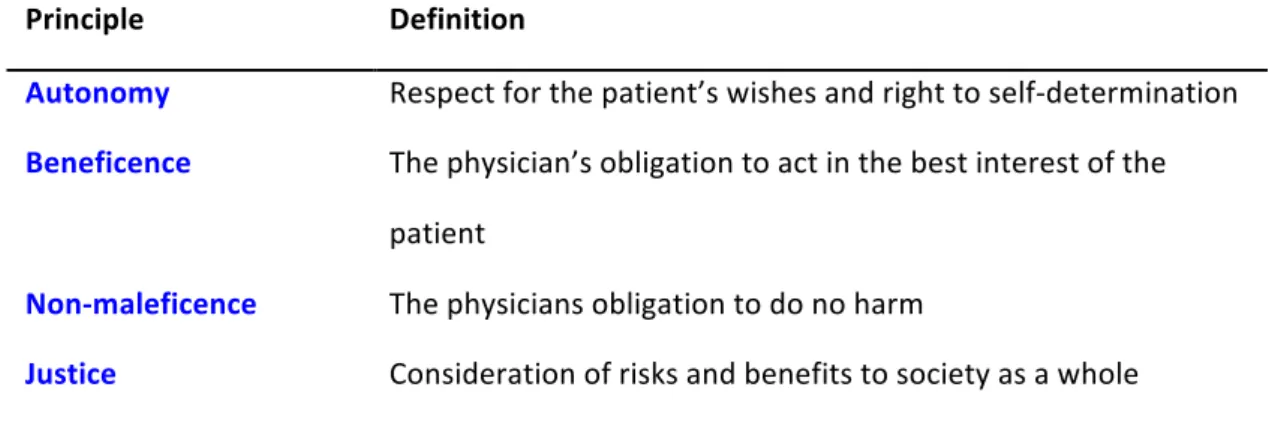
clinicians must uphold moral, ethical and legal obligations towards their patients and therefore such principles must be addressed with regards to CAM if they are to be considered as a viable treatment option (Table 1).
Table 1. Glossary of ethical principles
CAM is becoming more popular and acceptable in the UK2. In Western society the most
frequent users of CAM are educated, middle class Caucasians between the ages of 25 and 494. It has been posited that patients gravitate towards CAM for numerous sociocultural and
personal factors including a sense of dissatisfaction with conventional medicine, a desire for personal control in their healthcare, and philosophical congruence, whereby CAM appear more compatible with patient’s values, worldview, spiritual philosophy and meaning of health and illness5. Accordingly, this patient demonstrated frustration in the ineffectiveness
of conventional analgesia, the desire to manage her condition and an active spiritual orientation, and therefore conforms to this cohort. Furthermore, this patient’s previous experience with reflexology will undoubtedly shape her views regarding her healthcare beliefs and the potential efficacy of acupuncture6.
Acupuncture is defined as the practice of inserting one or more needles into specific points on the body surface for therapeutic purposes 7. This therapy is endorsed by approximately
25% of general practitioners (GPs) in the UK and is most frequently utilized for the treatment of chronic pain8. Despite originating in China 3,000 years ago the use of acupuncture
remains highly controversial within the medical profession primarily due to its limited advances towards evidence based practice and in particular the paucity of randomised control trials (RCTs)9‐11. Meta‐analyses and systematic reviews investigating the potential
analgesic effect of acupuncture have yet to unequivocally demonstrate an effect greater than that produced by placebo12, 13. An ethical dilemma therefore arises as a physician must
question whether it is right to perform a therapeutic intervention in the absence of quantifiable efficacy in order to respect a patient’s health beliefs10.
Is the use of acupuncture in the NHS ethical?
The principle of autonomy requires the physician to respect the wishes of the patient. Adopting paternalism and disregarding a patient’s health beliefs would be detrimental to the doctor‐patient relationship by diminishing the physician’s capacity to address the physical, emotional, and spiritual manifestations of illness14. Furthermore, this would only encourage
the patient to seek this therapy from private practitioners10. It is argued that the patient
centred approach employed in CAM guarantees a respect for patient autonomy15, 16.
However, to uphold this principle, physicians have the responsibility to ensure that patients are appropriately informed11. This obligation to obtain informed consent would therefore
require the physician to discuss evidence of acupuncture and the limitations of this intervention. Some authors argue that informed consent cannot truly be obtained with regards to CAMs due its inadequate investigation, while an awareness of treatment limitations may in turn negate any potential placebo effect and therefore violate beneficence1, 16. Principle Definition Autonomy Respect for the patient’s wishes and right to self‐determination Beneficence The physician’s obligation to act in the best interest of the patient Non‐maleficence The physicians obligation to do no harm Justice Consideration of risks and benefits to society as a whole
The ‘nihil nocere’ principle requires physicians to base treatment decisions on risk benefit analysis. Application of beneficence and non‐maleficence to acupuncture is however difficult due to the insufficient evidence supporting the substantial claims of efficacy and safety reported by some practitioners9. With only 0.0085% of the UK medical research budget
spent on CAM, it is unsurprising that the potential advantages of acupuncture have yet to be elucidated17. Uncertainty is not uncommon in orthodox medicine with only an estimated
13% of treatments demonstrating robust evidence of their beneficial effects18. However, the
level of ambiguity concerning the effectiveness of acupuncture, and CAM in general, is considerably greater. This patient stated that she felt more comfortable receiving this treatment from her GP who was performing this treatment in her best interests rather than to make a profit. Therefore in addition to putative analgesic effects, providing acupuncture in primary care may also improve continuity of care and strengthen patients’ trust in doctors as a consequence of addressing their health needs. This is undoubtedly advantageous with regards to patient enablement, compliance and the therapeutic effect of the doctor‐patient interaction19. Evidence regarding the risks of acupuncture such as pain, bleeding and bruising are better understood and believed to occur in 7‐11% of patients7. Despite the majority of adverse events being minor in nature, rarer complications such as a pneumothorax, cardiac tamponade, or the transmission of hepatitis C or HIV have also been documented10, 20.
Nevertheless, if this treatment alleviates the suffering of patients and anecdotally exceeds the total therapeutic effect of conventional analgesia without exposing the patient to any great harm, it could be argued that such actions do serve the patient’s best interest and should be utilized.
In the UK acupuncture is predominately accessed through either private practitioners or individual GPs offering this service. This therapy is time consuming, due to the requirement of frequent appointments, and largely unfunded, whereby GPs as independent contractors are not remunerated for performing such treatments. Acupuncture is therefore not available across all socioeconomic classes or geographical regions2. Assuming CAMs provide more
good than harm, the unequal distribution of these therapies in the population violates the fundamental ethical principle of justice21. In order to adhere to this principle and permit
patient autonomy, general access would have to be provided throughout the health service. The uniform integration of this service into the NHS will undoubtedly redistribute funds from services with stronger evidence of efficacy and therefore would be both unethical and inefficient16. Accordingly patients will experience limitation in healthcare choices until the
utility of this treatment has been fully validated6.
Acupuncture regulation in Scotland
Practitioners require the competence to ensure the maximum benefit of any given treatment is delivered while imposing the least amount of acceptable risk. However, there is great disparity among the standards of practice exhibited by those providing CAM as a consequence of the diversity and informality of qualifications available and the proliferation of unregulated training bodies10. Professional self regulation aims to ensure high, uniform
standards of practice22. Several professional acupuncture organizations exist, such as the
British Medical Acupuncture Society; however, there is no statutory regulation of this profession and therefore no assured level of proficiency23. In Scotland, acupuncturists, who
are not members of a regulated health profession, are required to be licensed with the local authority under The Civic Government (Scotland) Act 1982 in the same manner in which a tattoo artist is required to be licensed24. The absence of a regulatory body therefore poses
knowledge and experience, and to hold them accountable for actions deemed to be hazardous.
Nevertheless, the position relating to the regulation of health professionals, such as doctors, who wish to incorporate CAM into their reperoire of therapies is different from the position of CAM practitioners. The code of ethics and disciplinary procedures of the General Medical Council (GMC) extend to the use of all therapies utilized in treating patients. It is acknowledged that under the Medical Act 1983, a registered medical practioner is free to practice any form of unconventional therapy, including CAM, if they believe it will benefit their patients25. Consequently, additional training undertaken by this physician in this
complementary discipline and subsequent reasonable practice renders his or her actions legally defensible26. However, ambiguity exists regarding whether the training of
conventional healthcare professionals by professional organizations is adequate to negate risk27. Controversy regarding this regulatory arrangement also exist as a consequence of the
GMC Good Medical Practice guidelines, which state that doctors ‘must provide effective treatments based on the best currently available evidence27. This would not encourage the
use of acupuncture. Nevertheless, this guidance also stipulates the importance of treating pain and therefore to withold a treatment, which is providing relief, would be equally unacceptable.
Conclusion
Philosophical, epistemological and practical differences exist between mainstream and alternate medicine26, 28 Nevertheless, these disciplines share the goals of promoting health
and relieving the suffering of patients. The integration of CAM into general practice therefore permits the utilization of a holistic approach of promoting wellness and treating disease. Despite the inadequacies of the acupuncture evidence base, to disregard this treatment and ignore cultural health beliefs would inevitably drive patients towards a largely unregulated profession and erode the doctor‐patient relationship. From the standpoint of a consequentialist, I would suggest that the utilization of acupuncture is therefore justified.
References
1. Sugarman J, Burk L. Physicians ethical obligations regarding alternative medicine. JAMA. 1998;280(18):1623‐5.
2. Ernst E. The BBC survey of complementary medicine use in the UK. Complement Ther Med
2000;8(32‐36).
3. Rajput M. Attitudes about acupuncture and homeopathy among doctors in research positions: a survey. J Altern Complement Med. 2005;11:229‐31.
4. Astin JA. Why Patients Use Alternative Medicine. JAMA: The Journal of the American Medical Association. 1998;279(19):1548‐53.
5. Vincent C, Furnham A. Whydo patients turn to complementary medicine? An empirical study. Br J Clin Psychol. 1996;35:37‐48.
6. Ernst E. Patient choice and complementary medicine. Journal of the Royal Society of Medicine. 2004;97:41.
7. Ernst E. Acupuncture – a critical analysis. Journal of Internal Medicine. 2006;259(2):125‐37.
8. White A, Resch K, Earnst E. Complementary medicine: use and attitudes among GPs. Fam Pract. 1997;14:302‐6.
9. Ramey D, Buell P. A true history of acupuncture. Focus Altern Complement Ther. 2004;9(269‐273). 10. Stone J. Ethical issues in complemtary and alternative medicine. Complementary Therapies in Medicine. 2000;8:207‐13.
11. Schneiderman L. Alternative Medicine or Alternatives to Medicine? A Physician's Perspective.
Cambridge Quarterly of Healthcare Ethics. 2000;9(01):83‐97.
12. Masden M, Gotzsche P, Hrobjartsson A. Acupuncture treatment for pain: systematic review of randomised clinical trials with acupuncture, placebo acupuncture, and no acupuncture groups. BMJ. 2009;338(330‐3).
13. Green S, Buchbinder R, Hetrick S. Acupuncture for shoulder pain. Cochrane database of systematic reviews. 2005(2):CD005319.
14. Barrett B. Alternative, complementary, and conventional medicine: is integration upon us? . J Alt Comp Med. 2003;9:417‐27.
15. Mertz M. Complementary and alternative medicine: The challenges of ethical justification.
Medicine, Health Care and Philosophy. 2007;10(3):329‐45.
16. Ernst E. The ethics of complementary medicine. Journal of Medical Ethics. 1996;22:197‐8. 17. Colquhoun D. What to do about CAM? BMJ. 2007;335:736.
18. Garrow JS. How much of orthodox medicine is evidence based? BMJ. 2007;335(7627):951‐. 19. Kearley K, Freeman G, Heath A. An exploration of the value of the personal doctor–patient relationship in general practice. British Journal of General Practice. 2001;51(470):712–8.
20. Ernst E, White A. Life‐threatening adverse reactions after acupuncture? A systematic review. Pain. 1997;71:123‐6.
21. Ernst E, Cohen M, Stone J. Ethical problems arising in evidence based complemntary and alternative medicine. J Med Ethics. 2004;30:156‐9.
22. Stone J, Matthews J. Complementary medicine and the law. Oxford: Oxford University Press; 1996. 23. Analysis report on the 2009 consultation on the statutory regulation of practitioners of acupuncture, herbal medicine, traditional Chinese medicine and other traditional medicine systems practised in the UK. In: Health Do, editor. 2011.
24. The Scottish Government. The Civic Government (Scotland) Act 1982 (Liscensing of skin piercing and tattooing) Order 2006. Edinburgh2006.
25. Great Britain. Medical Act 1983. London: HMSO; 1983.
26. Zollman C, Vickers A. Complementary medicine in conventional practice. BMJ. 1999;319(7214):901‐4.
27. Department of Health. Report to ministers from the Department of Health steering group on the statutory regulation of practitioners of acupuncture, herbal medicine, traditional Chinese medicine and other traditional medicine systems practised in the UK. London: Department of Health, 2008. 28. Kaptchuk TJ, Miller FG. Viewpoint:: What is the Best and Most Ethical Model for the Relationship Between Mainstream and Alternative Medicine: Opposition, Integration, or Pluralism? Academic Medicine. 2005;80(3):286‐90.
Declaration of Interest
Paul Connelly is a member of the SUMJ Dundee committee. This article, as with all SUMJ articles, was subject to rigorous double‐blind peer review to prevent bias.