NAVAL
POSTGRADUATE
SCHOOL
MONTEREY, CALIFORNIA
THESIS
Approval for public release;distribution is unlimited METHODOLOGY TO IMPROVE AVIATION SECURITY
WITH TERRORIST USING AIRCRAFT AS A WEAPON
by
Boon Chew Winson Sheo September 2013
Thesis Advisor: Gary O. Langford
REPORT DOCUMENTATION PAGE Form Approved OMB No. 0704-0188
Public reporting burden for this collection of information is estimated to average 1 hour per response, including the time for reviewing instruction, searching existing data sources, gathering and maintaining the data needed, and completing and reviewing the collection of information. Send comments regarding this burden estimate or any other aspect of this collection of information, including suggestions for reducing this burden, to Washington headquarters Services, Directorate for Information Operations and Reports, 1215 Jefferson Davis Highway, Suite 1204, Arlington, VA 22202-4302, and to the Office of Management and Budget, Paperwork Reduction Project (0704-0188) Washington DC 20503.
1. AGENCY USE ONLY (Leave blank) 2. REPORT DATE September 2013
3. REPORT TYPE AND DATES COVERED
Master’s Thesis
4. TITLE AND SUBTITLE
METHODOLOGY TO IMPROVE AVIATION SECURITY WITH TERRORIST USING AIRCRAFT AS A WEAPON
5. FUNDING NUMBERS
6. AUTHOR(S) Boon Chew Winson Sheo
7. PERFORMING ORGANIZATION NAME(S) AND ADDRESS(ES)
Naval Postgraduate School Monterey, CA 93943-5000
8. PERFORMING ORGANIZATION REPORT NUMBER
9. SPONSORING /MONITORING AGENCY NAME(S) AND ADDRESS(ES)
N/A
10. SPONSORING/MONITORING AGENCY REPORT NUMBER
11. SUPPLEMENTARY NOTES The views expressed in this thesis are those of the author and do not reflect the official policy or position of the Department of Defense or the U.S. Government. IRB Protocol number ____N/A____.
12a. DISTRIBUTION / AVAILABILITY STATEMENT Approval for public release;distribution is unlimited
12b. DISTRIBUTION CODE 13. ABSTRACT (maximum 200 words)
The aviation industry is a large network of agglomerated systems that connects people and places. Since the 9/11 attacks, aviation security in the United States has undergone tremendous changes and improvements. Nonetheless, threat detection mechanisms remain imperfect as seen from hijacking attempts by passengers who have gone undetected via security. Alternate ways of thinking and looking at security was explored through a system perspective. The focus was on passenger security system with the intention of identifying potential areas of improvement for aviation security with terrorist using aircraft as a weapon. A supply chain approach was taken as the model to move and deliver people as goods through security checks to the aircrafts. Together with this approach, the concept of risks, uncertainties and the associated risk assessment of potentially defective “goods” were examined. A systems engineering process was used. Through systematic analysis scrutinizing interactions between airport objects and passengers (as objects), this thesis pin-points possible gaps, and thereby identify approaches or means to safeguard and counter these risks. Analysis included the exploration of the trade space between different entities within the system and the interactions between objects, functions, processes, and its associated results.
14. SUBJECT TERMS Passenger security system, Aviation security, Supply chain, Risk index 15. NUMBER OF PAGES 91 16. PRICE CODE 17. SECURITY CLASSIFICATION OF REPORT Unclassified 18. SECURITY CLASSIFICATION OF THIS PAGE Unclassified 19. SECURITY CLASSIFICATION OF ABSTRACT Unclassified 20. LIMITATION OF ABSTRACT UU
NSN 7540-01-280-5500 Standard Form 298 (Rev. 2-89)
Approval for public release;distribution is unlimited
METHODOLOGY TO IMPROVE AVIATION SECURITY WITH TERRORIST USING AIRCRAFT AS A WEAPON
Boon Chew Winson Sheo
Military Expert 5 (ME5), Singapore Army B.Eng., Nanyang Technological University, June 2002
Submitted in partial fulfillment of the requirements for the degree of
MASTER OF SCIENCE IN SYSTEMS ENGINEERING
from the
NAVAL POSTGRADUATE SCHOOL September 2013
Author: Boon Chew Winson Sheo
Approved by: Gary O. Langford Thesis Advisor
Mark Stevens Second Reader
Cliff Whitcomb
ABSTRACT
The aviation industry is a large network of agglomerated systems that connects people and places. Since the 9/11 attacks, aviation security in the United States has undergone tremendous changes and improvements. Nonetheless, threat detection mechanisms remain imperfect as seen from hijacking attempts by passengers who have gone undetected via security.
Alternate ways of thinking and looking at security was explored through a system perspective. The focus was on passenger security system with the intention of identifying potential areas of improvement for aviation security with terrorist using aircraft as a weapon. A supply chain approach was taken as the model to move and deliver people as goods through security checks to the aircrafts. Together with this approach, the concept of risks, uncertainties and the associated risk assessment of potentially defective “goods” were examined.
A systems engineering process was used. Through systematic analysis scrutinizing interactions between airport objects and passengers (as objects), this thesis pin-points possible gaps, and thereby identify approaches or means to safeguard and counter these risks. Analysis included the exploration of the trade space between different entities within the system and the interactions between objects, functions, processes, and its associated results.
TABLE OF CONTENTS
I. INTRODUCTION...1
A. BACKGROUND ...1
B. THESIS MOTIVATION AND FOCUS ...2
C. PROBLEM DEFINITION ...2
D. APPROACH, AND METHODOLOGY ...4
E. SCOPE ...6
F. RESEARCH QUESTIONS ...6
II. UNITED STATES AVIATION SECURITY SYSTEM ...7
A. OVERVIEW ...7
1. Definition of Terms ...8
B. U.S. AVIATION SECURITY MODEL ...9
III. SUPPLY CHAIN MODEL...17
A. CHARACTERISTICS OF THE SUPPLY CHAIN MODEL ...17
B. AIRPORT PASSENGER SECURITY MODEL ...19
IV. INTEGRATIVE FUNCTIONAL ANALYSIS ...21
A. SYSTEM BOUNDARIES ...21
1. Behavioral, Functional and Physical Boundaries ...21
a. Behavioral Boundary ...22
b. Functional Boundary ...22
c. Physical Boundary ...23
B. AIRPORT PASSENGER SECURITY SYSTEM AS A SUPPLY CHAIN MODEL ...23
1. Passenger Physical Flow in Airport System ...24
a. F.3.0 Airport Domain...24
C. DECOMPOSITION OF AIRPORT FUNCTIONS AND PROCESSES ..27
1. Airport Process Decomposition ...27
2. Passenger Process Decomposition ...28
D. INTERACTIONS BETWEEN OBJECTS TO CREATE FUNCTIONS ...33
1. Process Passenger Check-in (airport kiosk perspective) versus Process Check-in (Passenger Perspective) ...33
2. Process Baggage Check-in (Airline Counter Perspective) versus Check-in Baggage (Passenger Perspective) ...36
3. Screen Passenger (Security Checkpoint Perspective) versus Clear Security (Passenger Perspective) ...38
4. Surveillance of Airport Environment and Surrounding (Surveillance Camera Perspective) versus Fulfill Wants/Needs (Passenger Perspective) ...45
B. RISK INDEX (RI) ...47
1. Risk Index of Passenger Flow in Supply Chain ...48
a. Risk Assessment Scenario ...48
b. Risk Index Discussion ...50
c. Analysis of Risk Index ...54
d. Application of Real-time Monitoring and Tracking of Risk Index Profile ...57
VI. CONCLUSION AND RECOMMENDATIONS ...59
A. CONCLUSION ...59
B. RECOMMENDATIONS ...60
LIST OF REFERENCES ...65
LIST OF FIGURES
Figure 1. Sequential and Layered Mechanisms Enacting Security Functions
(Adapted from TSA, 2013c). ...8
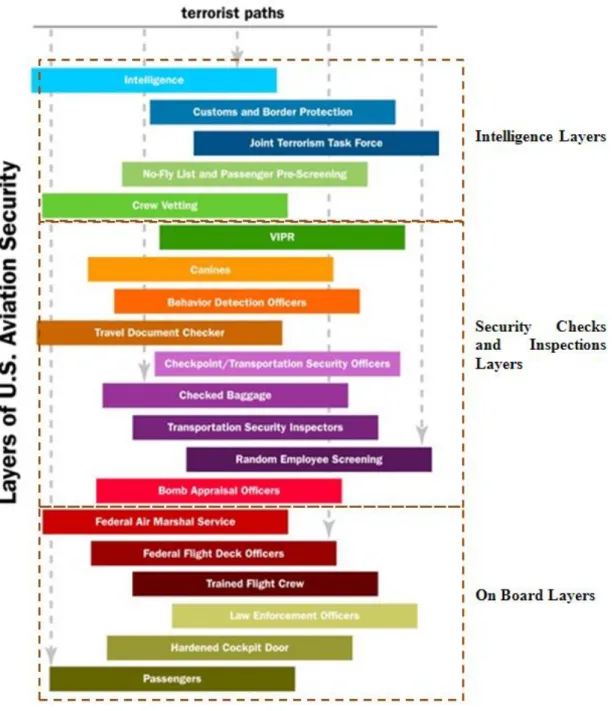
Figure 2. Twenty Different Layers of Security (Adapted from TSA, 2013c). ...10
Figure 3. U.S. Aviation Security Model (Adapted from Fletcher, 2011)...14
Figure 4. Movement of Passenger through Airport System Boundaries. ...24
Figure 5. Typical Passenger Flow within Airport Domain (Object Movement Route). ...25
Figure 6. Typical Layout of Airport Terminal (“Terminal Guide–Richmond International Airport,” n.d.). ...27
Figure 7. Process Decomposition of Airport System. ...28
Figure 8. Typical Passenger Process Flow Block Diagram. ...29
Figure 9. Check-in Process. ...29
Figure 10. Baggage Check-In Process. ...30
Figure 11. Clear Security Process. ...30
Figure 12. Go to Boarding Gate Process. ...31
Figure 13. Fulfill Wants/Needs. ...32
Figure 14. Passenger Risk Index Profile. ...55
Figure 15. Cost-effectiveness of Airport. ...61
Figure 16. Hypothetical Model for Airport Passenger Security System of the Future. ....62
LIST OF TABLES
Table 1. Results of Interactions between Functions and Processes of Airport Kiosk, Passenger and Building. ...34 Table 2. Results of Interactions between Functions and Processes of Airline
Counter System and Passenger. ...37 Table 3. Results of Interactions between Functions and Processes of Passenger
Security Screening System and Passenger. ...39 Table 4. Results of Interactions between Functions and Processes of CCTV
LIST OF ACRONYMS AND ABBREVIATIONS
AIT Advanced Imaging Technology
BAO Bomb Appraisal Officer
CAT-BPSS Credential Authentication Technology – Boarding Pass Scanning Systems
DPHS Department of Homeland Security
EBSP Electronic Baggage Screening Program
EDS Explosive Detection System
EMMI Energy, Matter, Material wealth, and Information
ETD Explosives Trace Detector
FBI Federal Bureau of Investigation
FFBD Functional Flow Block Diagram
FOV Field of view
GAO Government Accountability Office
ICT Information and communication technology
IED Improvised Explosive Device
ID Identity
LE Loop Exit
LP Loop
NCC National Counterterrorism Center
RI Risk Index
SFPD Secure Flight Passenger Data
SE Systems Engineering
SoS System of Systems
SPOT Screening of Passengers by Observation Techniques
TDC Travel Document Checker
TSA Transportation Security Administration VIPR Visible Intermodal Prevention and Response
EXECUTIVE SUMMARY
The aviation industry is comprised of various systems, agglomerated into a large network of systems that connects people and places. Each day, millions of travelers rely heavily on this system of systems (SoS) for transportation between domestic and global locations. According to the Bureau of Transportation Statistics, an average of about 1.76 million domestic passengers boarded domestic flights in the United States in 2012. The September 11 hijacking of aircraft in a coordinated terrorist attack in the United States was a milestone in the history of aviation security. Since the 9/11 attacks, aviation security in United States has undergone tremendous changes with a defense-in-depth approach. While improvements have been incorporated into aviation security at airports, threat detection mechanisms remain imperfect as seen from the occasional reports of hijacking attempts by passengers who have gone undetected via the various layers of security.
Alternate ways of thinking and analyzing security were explored through a system perspective. The focus was on passenger security system within the aviation security SoS, with the intention of identifying potential areas of improvement for aviation security with terrorists using aircraft as a weapon. A supply chain approach was taken to model movement and delivery of people as goods through security checks to their respective aircrafts. The analogy is for passengers to pass through various phases in the supply chain, with each phase being the means of detecting “security defects” in the “goods” (i.e., passengers). The purpose is to have a flow of goods through the supply chain in a timely fashion with the end state of delivering defect-free passengers with the appropriate certification of security at the doorstep of each outbound aircraft. Together with this approach, the concept of risks, uncertainties, and the associated risk assessment of potentially defective goods as they flow through the supply chain was also examined.
A systems engineering process premised on problem solving that was iterative, recursive, and illative was used. A systematic analysis of the airport passenger security
exploited by malicious parties, and thereby identify approaches, means or even measures to safeguard and counter against these risks. The analysis included the exploration of trade space between the different entities within the system and the interactions between objects, functions, processes, and its associated results. Through the analysis, new security measures and processes for improvement were identified.
ACKNOWLEDGMENTS
I would like to express my gratitude to Dr. Gary O. Langford for his constant guidance and encouragement through the thesis journey. He is a man of wisdom, someone who possesses immense patience, and is always approachable. Well-versed and knowledgeable the professor offered interesting perspectives in the field of Systems Engineering, helping me to gain a better understanding and appreciation for the discipline.
I would also like to thank my thesis second reader, Professor Mark Stevens, for taking the time and effort in reviewing and providing valuable feedback for my thesis.
Lastly, but not least, I would like to thank my wife, Hui Peng, for her unfaltering love, support and encouragement that she had provided me with for our years of marriage, especially in the last 18 months when I was in the master’s programs, both in NUS and NPS. My kids, for the fun and laughter they have brought to the family.
I.
INTRODUCTION
A. BACKGROUND
The first reported hijacking of aircraft was traced to 1931 in Peru (Jenkins, n.d.). Since then, aircraft have been hijacked for various reasons ranging from hijackers seeking asylum to the exchange of prisoners. Over the years, terrorists have “revolutionized” the hijacking of commercial aircraft by using aircraft-as-weapons to attack targets of interest. Most notably, the simultaneous hijacking of four aircraft by Al-Qaeda-affiliated extremists on September 11 culminated in a coordinated terrorist attack on civilian and government targets in the United States. The magnitude and significance of this attack continues to have lasting effects on the global landscape of aviation security as well as on behaviors and attitudes worldwide. According to the Government Accountability Office (GAO) Report, Department of Homeland Security: Progress made and work remaining in implementing Homeland Security missions 10 years after 9/11, “in the aftermath of the attacks, the Department of Homeland Security (DHS) was created with key missions1 that include preventing terrorist attacks from occurring within the United States” (GAO, 2011).
The current aviation security system in the United States is based on a defense-in-depth approach which implies sequential and layered mechanisms that enact security functions to increase freedom from danger or threat. Multi-layered security enacted through a sequence of overlapping security mechanisms provides validation and verification of performance, as well as time to detect, evaluate and respond to threats. The security risks or threats that are being detected by mechanisms are known as security defects in the context of this thesis. The detection of defects would save lives and minimize damage. Effective detection is based on the principle that the greater the distance and time allotted to detection, the higher the probability there is for detecting defects. These layers of security mechanisms include intelligence collection and analyses, pre-screening of passengers, access control to airport areas, passenger security screening,
passenger checked baggage screening, cargo screening, and on-flight security. While each individual security layer is aimed at a specific threat identified in aviation travel, these layers collectively are intended to provide a secure environment in general for aviation travel. The majority of these security mechanisms across the various security layers is intended to be transparent to an individual bound for air travel as these measures are being implemented and performed in the background. A few exceptions to this intended transparency are passenger security screening2 and passenger checked baggage screening3 which involve a direct interaction with the individual traveling. While improvements have been incorporated into aviation security at airports, there are still occasional reports of hijacking attempts by individuals who have gone undetected via the various layers of security.
B. THESIS MOTIVATION AND FOCUS
The objectives of the thesis are to identify different ways of thinking about and looking at security and to identify potential areas of improvement for aviation security. Particular attention was placed on preventing the use of aircraft as a weapon. The thesis focused on the passenger security system within the aviation security system of systems (SoS). The research was carried out over a nine-month period and examined the interactions between airport objects and passengers (as objects) bound for air travel with the purpose of identifying new ways of thinking about security and potential improvements to security, in terms of both mechanisms and processes.
C. PROBLEM DEFINITION
The aviation industry is comprised of various systems, agglomerated into a large network of systems that connects people and places. Each day, millions of travelers rely heavily on this SoS for transportation between domestic and global locations. While the images and effects of the 9/11 attacks remain vividly in the minds of many travelers, the
2 This comprises both security checks of carry-on baggage and physical inspection of individuals
bound for air travel.
3 Direct interaction with individuals occurs when the checked baggage poses problems to security
impact of the immediate aftermath on air passenger travel was overcome when air passenger travel reached its pre-9/11 peak in July 2004 (Notis, 2005). Since mid-2004, the number of travelers has continued to grow. According to the Bureau of Transportation Statistics, a total of 642,202,749 passengers (RITA‒BTS, n.d.) boarded domestic flights in the United States in 2012. This magnitude of passengers translates into an average of about 1.76 million domestic passengers per day distributed across the airports in United States.
Since the 9/11 attacks, aviation security in the United States has undergone tremendous changes in security and improvements in passenger safety. With the passage of the Aviation and Transportation Security Act, the National Strategy for Aviation Security implemented a robust system of detection, protection and interdiction through 20 layers of security actions in place at more than 450 airports (Pistole, 2011). Amongst the various systems and elements within the aviation security system, those involving the passenger have a direct impact on the possible use of the aircraft as a weapon to carry out an attack, as demonstrated in the 9/11 attacks. While the authorities continue to refine and enhance the aviation security SoS, the ability to focus on the passenger security system amidst other systems at the airport is of core relevance.
The problem is the existing threat mechanisms for detecting defects are imperfect. Imperfect mechanisms generally require redundancy and sequential implementation. This approach of using overlapping mechanisms can be in either the spatial or temporal domain, or both. Further, the failure of mechanisms that detect and identify anomalous behaviors may allow a breach of security to pass unnoticed without a sufficiency of time to recognize the breach with some form of backup mechanism(s).
Possible alternative solutions include: improving technology; improving mechanisms; increasing depth (the number and the distance-time factor that determines “depth”) and effectiveness of the mechanisms, and increasing redundancy through overlap and adding more mechanisms. Additionally, solutions would include changes or additions/deletions to processes (procedures, activities, and acts).
D. APPROACH, AND METHODOLOGY
Airport security currently adopts a risk-based approach toward passenger screening (TSA, 2013e), categorizing the majority of passengers to be low risk. The limitation of such an approach is the shifting of focus to a smaller group of passengers by facilitating faster security clearance for passengers identified and categorized to be of low risk. While this seems to be a logical approach from many perspectives, it is susceptible to the inaccuracy and quality of the categorization of low risk passengers. To improve the detection of would-be-terrorists, the approach taken in this thesis is to view the movement of people through the airport to the aircraft as a supply chain, harnessing its characteristics of defect detection and continuous monitoring.
With the intent of adopting different ways of thinking about and looking at security, a systems perspective was taken (as opposed to SoS perspective) on the passenger security system. Langford (2012) defined a system as “a bounded, stable group of objects exhibiting properties that through the interactions and exchange of energy, matter, material wealth, and information (EMMI) provide functions.” A system can also be understood from Maier and Rechtin (2009) as “a collection of things or elements that, working together, produce a result not achievable by the things alone.” Thinking of the passenger security system as a “system” implies that a terrorist is part of the passenger security system (as a participant), but an externality to the system (as a disruptor). Langford (2012) defined an SoS to be “a set of systems that are both integrated and interoperable to achieve a set of metasystem functions in which all the component systems participate.” Jamshidi (2009) has reviewed several potential definitions of SoS and defined SoS as “large-scale integrated systems that are heterogeneous and independently operable on their own, but are networked together for a common goal.” Thinking of the passenger security system as part of an SoS implies that a terrorist is not a part of the “system,” but rather part of another system, i.e., the “terrorist system.” In the SoS construct, the passenger security system interacts with the “terrorist system.”
In the context of this thesis, the passenger security system possessed the conditions to be a system when it was able to exercise control over, for example, the intelligence data that were being made available and fed from external agencies or
databases, otherwise known as other systems, into the system. Similarly, if a passenger with security defects was detected and potentially traced or linked to other individuals or organizations residing physically outside the airport boundaries or the passenger security system boundaries, the passenger security system would then hand over the investigation and pursuit of these linkages to the detected defects to other law enforcement agencies (i.e., external systems). This behavior is expected from a system as compared to a passenger security SoS that would otherwise trigger other SoS elements to follow up.
This thesis took a systematic analysis of the aviation system with a specific focus on the airport passenger security system scrutinizing the passenger (as mereological objects) to pin-point possible gaps and vulnerabilities that could be potentially exploited by malicious parties, and thereby identify approaches, means or even measures to safeguard and counter against these risks. This analysis would include the exploration of trade space between the different entities within the system and the interactions between objects, functions, processes and its associated results. A systems engineering (SE) process premised on problem solving that is iterative, recursive and illative was adopted. This thesis adopted the following structure: Chapter I discusses the background and basis for the thesis; Chapter II examines the current U.S. aviation security system and principles; Chapter III discusses the use of the supply chain as a model to view airport passenger security, relating supply chain characteristics to the airport security model and analysis; Chapter IV identifies the limitations in existing security systems as problems that need to be solved through an SE process involving the use of tools such as functional decomposition, functional flow block diagram and evaluative functional analysis. It also discusses the conceptualization of improvements (or solutions) to these identified problems; Chapter V discusses the development of a risk index (RI) as a form of defect assessment within the supply chain; and Chapter VI discusses the improvements to passenger security system arising from the thesis research and identifies areas for subsequent research.
E. SCOPE
The scope of this thesis is to investigate the passage of passengers through airport security. The broader scope that involves discussion of boundaries beyond the airport physical structures and perimeter are included as part of the movement of passengers through the functional and behavioral boundaries of the airport.
F. RESEARCH QUESTIONS
The thesis utilizes the following questions as a guiding tool in laying out the content.
What are the (new) possible security measures or processes (resulting from the analysis of interactions) that airport security authorities could possibly consider to help further their view of security?
How do the (new) potential measures compare to existing security procedures/measures?
Can the supply chain model of viewing passengers as goods be used in the analysis of the airport passenger security?
Can the methodological approach of analysis provide a new perspective (new way of doing things) on airport passenger security?
II.
UNITED STATES AVIATION SECURITY SYSTEM
A. OVERVIEW
This chapter examines the existing U.S. aviation security system. The current aviation security system is based on a defense-in-depth approach which implies sequential and layered mechanisms that enact security functions to increase state of being free from danger or threat.
The principle of sequential mechanisms can be stated as: sequential mechanisms provide a higher degree of reciprocity between objects. The greater the number of interactions between objects, the higher the reciprocity by which objects learn more about each other.
The principle of layered mechanisms can be stated as: overlapping mechanisms validate the failure of one or more of the overlapped mechanism(s). The greater the overlap of the mechanisms, the higher the situational awareness.
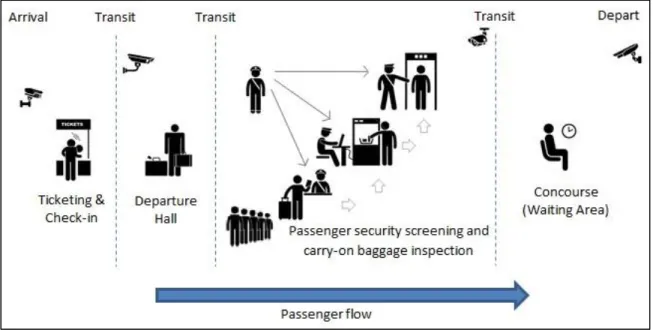
In the context of this thesis, the security risks or threats that are being detected by mechanisms are also known as security defects. Security defects are defined as anomalies in security which may result in a loss of life, material or information. Examples include (1) acts or behaviors by individuals which contravene security rules and procedures, (2) materials or artifacts that do not conform to security requirements and (3) information provided that does not reconcile with security guidelines. The detection of defects would save lives and minimize damage; and the greater the distance and time, the higher the probability of detecting defects. As depicted in Figure 1, the multi-layered security is enacted through a sequence of overlapping security mechanisms that provide validation and verification of performance as well as time to detect, evaluate and respond to threats. The different phases in the passenger flow from arrival to departure depict the sequential mechanisms, while the layered mechanisms arise from the multiple layers of security, for example, at the passenger security screening checkpoints consisting of front-line TSA checkers, a second layer of supervision and a third layer of oversight coming from the command center through the surveillance mechanisms.
Figure 1. Sequential and Layered Mechanisms Enacting Security Functions (Adapted from TSA, 2013c).
1. Definition of Terms
Function is defined as “specific or discrete action (or series of actions) that is necessary to achieve a given objective; that is, an operation that the (security) system must perform…” (Blanchard & Fabrycky, 2011). It can also be seen as “an action that is realized when objects interact” (Langford, 2012).
Sequential is defined as a systematic series of steps, activities or processes that objects would flow through in an airport passenger security system.
Reciprocity is defined as interactions and exchanges of EMMI between objects.
Object (airport object or passenger as an object) is defined “as a fundamental element, entity, or representation … Objects have boundaries and may be comprised of other objects, each of which is related by interactions” (Langford, 2012).
Interaction is defined “as the transfer of EMMI. Interaction is characterized by the transfer of something from one object (sender) to another object (receiver)” (Langford, 2012).
“Mechanisms are the means by which objects and processes change. The effect of a mechanism is to transform an input EMMI into an output EMMI. A mechanism is that which operates in the context of force” (Langford, 2012).
Overlapped mechanisms provide partial coverage of the same area of (security) function, or purpose, serving as back-up to the original function, or purpose.
Situational awareness is defined as the conscious and knowledge of being aware of the activities or occurrence of events within the boundaries of an object or entity in context of the airport security system.
Validation is “the process of demonstrating the effectiveness of service (security) through an assessment of the operational system that exposes and quantifies the systems’ limitations” (Langford, 2012).
Verification is “the process of confirming the truth or accuracy by describing the characteristics of interactions, the enactments of mechanisms or procedures, or the consequences of EMMI” (Langford, 2012).
“Performance is the action associated with a (security) function. Performance is measured by the extent to which various standards are met” (Langford, 2012).
B. U.S. AVIATION SECURITY MODEL4
The Transportation Security Administration (TSA) has adopted a layered security concept for its transportation system, which includes the aviation system. This concept uses multiple layers of security, each serving a different purpose but cumulatively serving the common intention of stopping a terrorist attack, as shown in Figure 2 (TSA, 2013c). Note: in this thesis, the different layers of security are interpreted as representing different roles and implying distinguishable responsibilities. With a combination of security layers, the combined security effect is multiplied, creating a more secure aviation system. With a total of 20 layers of security in place, the terrorist would need to find gaps in each layer and overcome the combined effect of the layers to have any chance of carrying out a successful attack. These different layers can be categorized generally by type and location of layers. The broad categories are: 1) Intelligence, 2) Security Checks and Inspections at airports and 3) Security Measures on board aircraft.
Figure 2. Twenty Different Layers of Security (Adapted from TSA, 2013c). Similar to other security models, intelligence activities form one of the first layers in aviation security. Intelligence for aviation security is being fed into the system from various information sources within the U.S. intelligence community. These sources include agencies such as the Federal Bureau of Investigation (FBI) and the National
Counterterrorism Center (NCC). In addition, this information is regularly supplemented by other sources of intelligence supplied to the United States by its Coalition partners, and collectively these form the intelligence picture for aviation security. Besides providing valuable information for the aviation security system to support proactive planning and preparation against potential threats, it also serves as a basis of reference for the TSA Secure Flight Program. Under the Secure Flight Program, travelers are required to submit additional personal information5 to the airline when they reserve or purchase their tickets. The airline in turn submits the information to Secure Flight, which uses it to perform watch list matching based on its existing database which is supported by the intelligence picture. The aim is to deny individuals identified on the “No Fly List” from boarding an aircraft and to identify individuals on the “Selectee List” for additional screening before allowing them to board. After the completion of watch list matching, Secure Flight then transmits the results back to airlines so they can issue passenger boarding passes accordingly (TSA, 2013f).
Moving from the intelligence layers into the security checks and inspections layers, individuals and their belongings could be subjected to a series of scheduled or random security checks and inspections at the airport.
TSA has taken a risk-based approach in its screening procedures based on the following premises: (TSA, 2013e).
“The majority of airline passengers are low risk.
By having passengers voluntarily provide more information about themselves, TSA can better segment the population in terms of risk.
Behavior detection and interviewing techniques should be strengthened in the screening process.
TSA must accelerate its effort to optimize screening processes and use of technology to gain system-wide efficiencies.
Increase security by focusing on unknowns; expedite known and trusted travelers.”
All checked baggage in the United States has been subjected to 100% screening since December 2003 under TSA’s Electronic Baggage Screening Program (EBSP) that uses Explosive Detection System (EDS) equipment and Explosives Trace Detector (ETD) devices as the primary screening technologies to identify potentially hazardous baggage (Kane, 2009). All traveling individuals are required to present themselves with the appropriate travel documents and personal identification papers to the Travel Document Checker (TDC) to commence the scheduled security checks and inspections. At the station, the presented documents are checked for authenticity together with the checking of passengers’ identities against a valid boarding pass to prevent any fraudulent use by any other individual to gain access to the concourse area and subsequently to the aircraft. Since October 2011, TSA has also started a pilot program on the use of document verification technology, known as Credential Authentication Technology–Boarding Pass Scanning Systems (CAT-BPSS) to identify fraudulent identity documents and authenticate boarding passes efficiently and effectively (TSA, 2012). Beyond the TDC stage, passengers are directed to one of the lines for checks and inspections of carry-on bags and personal belongings through X-ray machine checks by TSA officers. Passengers are subjected to screening by walking through a metal detector or through Advanced Imaging Technology (AIT)6. In addition, a series of security technologies and procedures are employed in this stage of scheduled checks and inspection to aid in the identification of prohibited items7. This equipment includes bottled liquids scanners to detect potential liquid or gel threats, CastScope to ensure that a cast or prosthetic does not contain concealed threat, explosive trace detection to screen for traces of explosives, and TSA’s 3-1-18 for carry-ons. Besides the scheduled checks and inspections, random checks and inspections are also conducted at any time from the moment an individual enters the airport premises until he/she boards the aircraft. These inspections are carried out by the
6 Imaging technology screening is optional for all passengers. Passengers who do not wish to receive
imagining technology screening will receive alternative screening, including a physical pat-down (TSA, 2013, May 21).
7 The latest TSA Prohibited Items list can be accessed via
http://www.tsa.gov/sites/default/files/assets/pdf/prohibited_items_brochure_0.pdf
8 This includes a 3.4 ounce (100ml) bottle or less (by volume); 1 quart-sized, clear plastic, zip-top bag;
1 bag per passenger placed in screening bin. One-quart bag per person limits the total liquid volume each traveler can bring. 3.4 ounce (100ml) container size is a security measure (TSA, 2013, July 3).
Visible Intermodal Prevention and Response (VIPR) team to detect and respond to potential security threats, explosive detection canine teams, and Screening of Passengers by Observation Techniques (SPOT) program. The SPOT program served to observe normal passenger characteristics and anxieties and to identify anomalies for detecting individuals who may be a security threat to the aviation system (Hawley, 2006). Detected threats are subject to additional screening and checks In addition, TSA has also implemented the Bomb Appraisal Officers (BAOs) program to prevent explosives and IEDs from being introduced into the aviation system and provide on-site assistance to resolve suspected alarms. These layers are augmented by a comprehensive network of surveillance cameras that provide live images and video coverage on activities within the aviation system in support of security.
The final layers of security are those on board the aircraft. These are aimed at safeguarding the flight and its passengers from any threat that was not detected and eradicated by the previous layers. These layers comprise of the federal air marshal service which places trained air marshals on board a flight. Air marshals provide an added measure of security resulting from threat information and intelligence, vulnerabilities and consequence9 (Lord, 2009), when the flight is on route to its destination. The federal flight deck officers program authorizes eligible flight crewmembers10 to use firearms to defend against acts of criminal violence to gain control of an aircraft. Trained flight crew assist in handling security incidents that happen on board an aircraft. Moreover, law enforcement officers may be on board the flight, hardened cockpit doors may be in place to prevent unauthorized access to the flight deck and passengers are at heightened awareness should they need to act.
These different layers of security (i.e., different roles and responsibilities for security personnel) constantly evolve and are updated to address emerging threats as a result of improvements to existing measures. Associated with these roles and responsibilities are changes in security procedures and measures to handle the threats, or new approaches and technologies that improve detection capabilities of prohibited items.
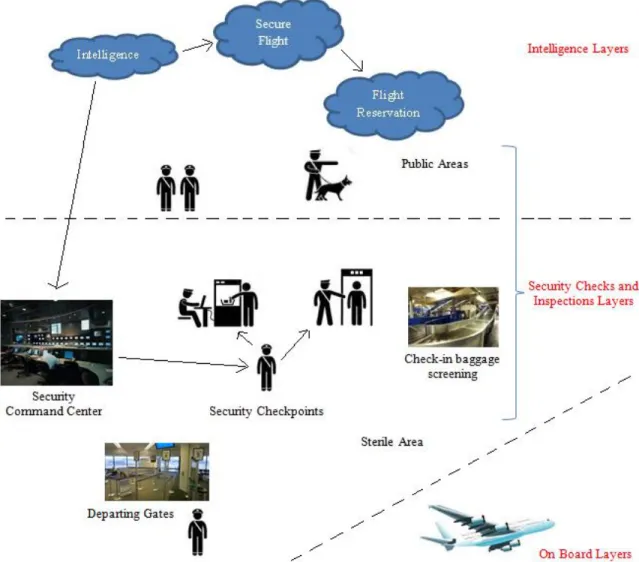
An example of these evolving improvements is the numerous screening initiatives11 introduced by TSA over recent times to align to risk-based security more effectively. The various security measures as described in the existing aviation system can be depicted in a model of U.S. aviation security, shown in Figure 3.
Figure 3. U.S. Aviation Security Model (Adapted from Fletcher, 2011).
11 These include “TSA Pre ✓™ Expedited Screening, Screening for Active Duty U.S. Service
Members, Screening for Passengers 12 and Under, Screening for Passengers 75 and Older, Managed Inclusion.” (TSA, 2013, March 14).
The measures in the security model (Figure 3) are as follows:
Intelligence layers
Intelligence and Secure Flight program
Security checks and inspection layers
Visible intermodal prevention and response team, canine teams and SPOT program
Security checkpoints (travel document checker, walk-through metal detector, advanced imaging technology, X-ray screening of carry-on bags and personal belongings, bottled liquid scanners, CastScope checks, explosive trace detection, Bomb Appraisal Officers program)
Electronic Baggage Screening Program
Onboard layers
Federal air marshal service, federal flight deck officers program, trained flight crew, law enforcement officer, hardened cockpit door, passengers
III.
SUPPLY CHAIN MODEL
This section discusses the use and relevancy of the supply chain model in the context of defects detection in airport passenger security system. Bozarth and Handfield (2006) defined supply chain as “a network of manufacturers and service providers that work together to convert and move goods from the raw materials stage through to the end user.” Supply chain management can been seen as a form of SoS architecture with different entities interacting at the various levels and phases with the aim of improved product, reduced cost and reduced time required to deliver the product. With the aim of on time delivery of the required amount of goods to the customer, one of the specific features of best value supply chains is the supply chain information systems (Ketchen, Rebarick, Hult, and Meyer, 2008). This information system includes the ability to have almost real-time monitoring and tracking of goods status, demand and inventory within the supply chain. While the supply chain model can serve as a basis to examine and possibly reduce costs, and to shorten the time through security, the intent of its use in this thesis is to focus on managing risk. The aviation system can be seen as a large supply chain composed of a network of service providers in the form of airports transporting and moving people to their final destinations. Similarly, airport passenger security can be seen as a supply chain model to move and deliver people as goods through security checks to their respective aircraft. The analogy is for the people to pass through various phases in the supply chain, with each phase being the means of detecting security defects in the “goods.” The purpose is to have a flow of goods through the supply chain in a timely fashion with the end state of delivering defect-free passengers with the appropriate certification of security at the doorstep of each outbound aircraft. As the goods progress through the supply chain, testing will be conducted to ensure conformance to security requirements.
A. CHARACTERISTICS OF THE SUPPLY CHAIN MODEL
defined by Beamon (1998), “a supply chain is comprised of two basic, integrated processes: (1) the production planning and inventory control process, and (2) the distribution and logistics process, providing the basic framework for the conversion and movement of raw materials into final products.” As implied by the definition, integrated processes can be seen as one of the key characteristics of a supply chain model. The integrated supply chain is the outcome of interactions between the different processes supporting the various phases of a supply chain in the production and delivery of the final product. In the context of aviation travel, integrated processes exist with different entities each having their own procedures and processes, interacting together to support the transportation of passengers to their respective destinations. Similarly, within the aviation travel system, the airport passenger security system can be seen to possess integrated processes working toward providing safe transportation for all passengers.
Another characteristic of the supply chain model is the use of information and communication technology (ICT). Kollberg and Dreyer (2006) considered ICT to be “a key enabler for supply chain management through its ability to support information sharing and shortening information processing time.” The harnessing of ICT in the supply chain can provide instant information, forecasting and replenishment knowledge (Lee, 2000), thereby improving situational awareness and facilitating informed decision making. This concept of monitoring and tracking goods and the status of the supply chain is likewise applicable in the context of the airport passenger security system. The status (defective or not defective) and risk profile of each individual passenger can be tracked in real-time as he/she flows toward the aircraft, providing up-to-date information to security agencies for the type of security measures or procedures to activate. Information and knowledge on individual goods, traffic patterns at different airports and at different times of the year can further be collated into trends and databases providing valuable knowledge for the purpose of goods profiling and subsequent referencing.
Quality conformance is the other characteristic of the supply chain model that is of relevance to the airport passenger security system. Bozarth and Handfield (2006) identified “number of defects” and “number of mistakes” as possible measures of quality conformance. “A defect or mistake, by definition, means that the product or service failed
to meet specifications” (Bozarth & Handfield, 2006). There is a need to understand the dimensions of quality that are important to users and incorporate the appropriate processes within the supply chain model to meet users’ requirements. In the case of the airport passenger security system, the requirement of having defect-free passengers at the doorstep of each aircraft drives the processes and measures required to detect defects in passengers at any point within the supply chain.
B. AIRPORT PASSENGER SECURITY MODEL
The model for integrated security assumes airport passengers participate and can be represented as goods in the supply chain. Each physical object in the supply chain is identified with a risk index that can change with context and environment. This risk index is equivalent to the measure of defects within the notion of goods to be moved. As the goods progress through the supply chain toward the end of production, they undergo various checks and tests to measure the defect level of the goods as part of the supply chain quality control process. Goods that pass the quality control checks will be delivered, while goods that do not meet the quality standards (with an RI exceeding the defect threshold) would be rejected. Given the growing importance of situational awareness, the model focuses on real-time monitoring and tracking characteristics of the supply chain to monitor and track defects in the goods so that the movement of people to the aircraft can be presented to the crew of the aircraft as defect-free goods. This process would include the identification and testing of defects (suspected or identified flaws) in the goods across the different phases, as part of the supply chain. An example of such real-time tracking and monitoring of passengers once they enter the boundaries of the airport system is Project SAMURAI (Suspicious Abnormal Behavior Monitoring Using a netwoRk of cAmeras & sensors for sItuational awareness enhancement) (Centre for Strategy & Evaluation Services, 2011). Defects measured in the form of an RI that would be assigned to every good that is bound for air travel. Depending on the activities, interactions and outcomes, the RI would vary as goods flow through the different phases of the model. The RI and its changing profile would be tracked and monitored in
real-While the concept of RI will be discussed in greater detail in Chapter V, at this point RI can be broadly categorized as Low, Medium or High. Anyone who boards any mode of transportation with an end terminal at the airport would be assigned a low RI. Someone who disembarks before reaching the airport would have his/her RI reset and the relevant information stored and archived. Depending on the exhibited actions, behavior and interactions during the trip or over multiple trips towards the airport, the RI of the individual would vary. When the RI exceeded the TEST threshold, the individual would be tested through built-in tests along the phases. The RI level can be a reduced, increased or maintained RI depending on responses and observations during testing (e.g., nervousness, dry mouth) and the outcome of testing. While an unclear act may result in a maintained RI, a suspicious act would definitely increase one’s RI. The RI and its profile would be tracked and monitored in real time for decision making, which could mean going through other testing or even being refused final clearance to board the aircraft.
IV.
INTEGRATIVE FUNCTIONAL ANALYSIS
Integrative functional analysis is a method that shows how interactions between objects result in functions that help describe the potential uses of an object or system (Langford, 2012). This method is premised on a systematic approach to analyzing the consequences of interactions between objects that comprise another object, system or system of systems. Through the technique of decomposing functions into sub functions, the partitioning of objects into modules that comprise single inputs and output, and the interactions between modules of each object to be analyzed, this method provides a framework to sift through processes and procedures to identify potential areas of improvement.
A. SYSTEM BOUNDARIES
The airport system comprises many different objects and each of these objects has its own set of unique boundaries evolving around how the object would exist on its own within the system or interact with other objects as part of the airport system. As part of the analysis of the airport system, the study of the system boundaries provides insights into the characteristics of the system and an additional dimension of the problem at hand. A change in boundary conditions could result in emergence that impacts the entire system. For example, allowing the carrying of pocket knives on board a flight (Ahlers, 2013) would have an impact on overall system operations and the interoperability of all constituent systems especially if the change in policy runs contrary to existing state law (Durkin, 2013).
1. Behavioral, Functional and Physical Boundaries
People bound for air travel will pass through defined boundaries and domains as they make their way to departure gates and boarding areas. These boundaries and domains are the behavioral, functional and physical aspects of limitations that characterize travel to board aircraft.
a. Behavioral Boundary
Generally, transportation lines to the airport are planned and designed to terminate at the airport with the airport being either the final destination or starting point for the airport system. These lines can be in the form of a road network, railway tracks or even pedestrian walkways. People on the various modes of transportation on these lines may be bound for all possible destinations that are linked or interconnected to the lines. People bound for different destinations with various purposes may behave and act differently on each of these transportation lines. The behavioral boundary signifies the behavioral perimeter where the airport system functions and objects influence the behavior of the individuals who are traveling to the airport. This is the point beyond which the behaviors observed of the remaining individuals on the transportation lines would be similar to those of all people going to the airport even though they may be traveling to the airport for different purposes, such as working at the airport and traveling as a passenger. This behavioral boundary also serves as the boundary where the intention of all remaining individuals on the transportation lines becomes clear that they are all bound for the airport. The context and perspective of the travelers serve to identify behavioral boundaries.
b. Functional Boundary
Functional boundaries are formed at the interface of objects due to the interactions of objects (Langford, 2012). In the airport system, functional boundaries are determined by interactions between the objects of transportation that link the airport and individuals using them. For individuals with a perspective of going to the airport, any embarkation point on the transportation lines (be it a bus stop, a train station or any point along the way) signifies the functional boundary of the function of ‘to transport’ as signified by “going to the airport.” In essence, the functional boundary of the airport system is a function of interactions between objects residing both within and outside the system and can change depending on the dynamics of interactions between the objects. The traveler’s use or lack of use of the objects associated with and comprising the transportation links identify the functional boundaries.
c. Physical Boundary
Physical objects can be thought of as the exterior perimeter of a solid object, a network of physical objects, and structures with holes, voids and gaps. The structures may be rigid or flexible or small or large (Langford, 2012). In the context of the airport system, the domain of “close proximity” signifies the physical perimeter boundary of the airport system. The corporeal boundary can also be conveniently considered and used as the extended physical boundary of the airport passenger security system.
B. AIRPORT PASSENGER SECURITY SYSTEM AS A SUPPLY CHAIN
MODEL
The airport passenger security system can be thought of as the supply chain in a manufacturing model; it moves and delivers people (passengers) as goods through security checks to the respective flights. The analogy is for the people to pass through various phases in the supply chain, with each phase being the means of detecting security defects12 in the “goods.” Security errors are defined as mistakes committed by individuals intentionally or unintentionally which could potentially result in downstream security defects. Defective individuals are defined as individuals who deliberately commit a security error or contribute to a security defect. In the airport passenger security system, security defects can be associated with passengers or carry-on items or belongings, i.e., objects, functions and behaviors. The aim is to have a smooth flow of goods through the supply chain in a timely manner with the end state of delivering defect-free13 passengers with the appropriate certification of security at the doorstep of each outbound aircraft. As the goods progress through the supply chain that is grounded in the physical world of objects (i.e., physical locations are used to inventory or inspect the progress of goods through a sequence of physical objects; for example, checkpoints, can be considered a like-kind equivalent for security at airports), testing will be conducted to ensure conformance of security requirements.
1. Passenger Physical Flow in Airport System
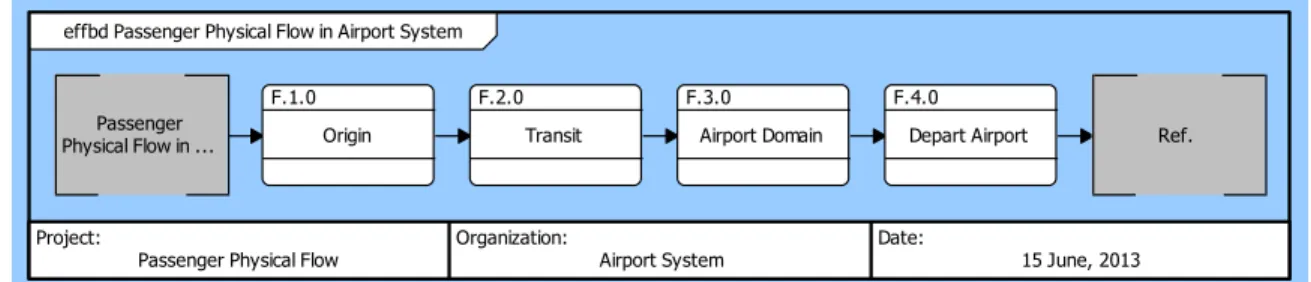
Anyone with the intention of traveling to the airport would need to board one of the available transportation lines to make their way to the airport. As the individual travels toward the airport, he would enter the behavioral boundaries of the airport system as observed through the exhibited behavior of the individual traveling to the airport. The interactions between individuals (who are to be or are bound for the airport) with airport system functions or other individuals (or objects related to air travel and the particulars that distinguish the traveler) would determine the behavioral boundaries of the airport system. The interactions between the individual and the functions of the transportation lines would determine the entry into the functional boundaries of the airport system as the individual travels beyond doubt toward the airport. The crossing of the individual into the perimeter boundary of the airport signifies the entry into the physical domain of the airport system. This physical flow of the passenger within the airport system is as shown in Figure 4 and discussed in the following sub-sections.
Figure 4. Movement of Passenger through Airport System Boundaries.
a. F.3.0 Airport Domain
On entry to the physical domain of the airport system, the individual would undergo a typical physical travel14 to the airport departure gates as shown in Figure 5. Individuals arriving at the airport domain (airport building) have the option of commencing the required travel procedures with the respective airlines. There is a
14 While there could be other passenger flows within the airport domain, for example, individuals transiting at the airport undergo a different flow process; the discussion in this section focuses on a typical passenger flow in the airport domain
Passenger Physical Flow in ... F.1.0 Origin F.2.0 Transit F.3.0 Airport Domain F.4.0
Depart Airport Ref. effbd Passenger Physical Flow in Airport System
Project:
Passenger Physical Flow
Organization:
Airport System
Date:
presumed expectation by the airport authority and security that passengers who travel to the airport domain involve some interest in the functions of the airport. This analysis of airport functions will be discussed in greater detail under the decomposition of the airport system.
Figure 5. Typical Passenger Flow within Airport Domain (Object Movement Route). (1) F.3.1 Passenger Drop Off. Regardless of the mode of transportation used to commute to the airport, all passengers arriving at the airport domain would generally commence their movement through the different phases (Figure 5) from the passenger drop off area. The starting point could be the vehicular drop off area by the curbside, the train station platform, or the bus terminal serving shuttles. Passengers residing in a hotel within the airport domain may enter the system via other connection means such as internal transit system or even by foot.
(2) F.3.2 Enter Airport Building. From the drop off point(s), passengers would enter the confines of the main airport building to start the traveling procedures as required by airlines and airport authorities.
(3) F.3.3 Go to Check-In Point. The confirmation of an individual’s intention to board and fly on the scheduled flight could be performed via one of the many means available. According to Delta Air Lines, a passenger could possibly adopt one of the five different ways15 to check in on any given traveling day (DELTA, 2013). With different airlines having varying check-in procedures, individuals who have checked in online could potentially proceed straight to the next phase of security checks upon arriving at the airport, completely bypassing the need to visit any airline counter or airport kiosk. Individuals who are checking in at the airport domain would need to
process their check-in by physically going to one of the check-in points available within the airport domain.
(4) F.3.4 Go Through Security Checkpoints. Depending on the nature of the travel to the airport, travelers going to the airport for different purposes16 undergo various forms of security screening. A centralized airport passenger security screening has been implemented for all traveling individuals to identify the presence of security defects. Checking of travel documents, inspection of individuals through the use of walk-through detectors, and physical inspection of carry-on items are being conducted here. Besides providing a physical demarcation for a security boundary within the airport domain, separating the sterile area (commonly known as the concourse area) for security screened passengers from the non-sterile area or the common public accessible domain, this centralized security screening also serves as a zone of interaction between security screeners and the traveling passengers.
(5) F.3.5 Enter Concourse Area. After passing through (“clearing”) security, passengers could move through hallways connecting the concourse area or enter the concourse area directly, leading to the access area beyond the security checkpoints to their respective departing gates. This sterile area is an out-of-bounds area except for all security screened passengers and the relevant support personnel working within the area.
(6) F.3.6 Go to Departure Gates. Within the concourse area are the departure gates. The final access points to the respective flights are defined by the doorway to the aerobridge connecting the aircraft to the terminal or the doorway to the tarmac for boarding directly from tarmac. Current procedures require individuals traveling through airports to present certain types of documentation, e.g., boarding passes and sometimes photo identification, at the various gates for boarding. As shown in Figure 6, a typical layout of the above listed parts make up the whole of the airport security and its boundary types.
16 Some examples include delivery of goods, individuals working at the airport within the concourse
Figure 6. Typical Layout of Airport Terminal (“Terminal Guide–Richmond International Airport,” n.d.).
C. DECOMPOSITION OF AIRPORT FUNCTIONS AND PROCESSES
Decomposition of airport functions and processes entails breaking down the airport system into its constituent functional parts to facilitate the analysis of the system and the interactions of the objects within the system.
1. Airport Process Decomposition
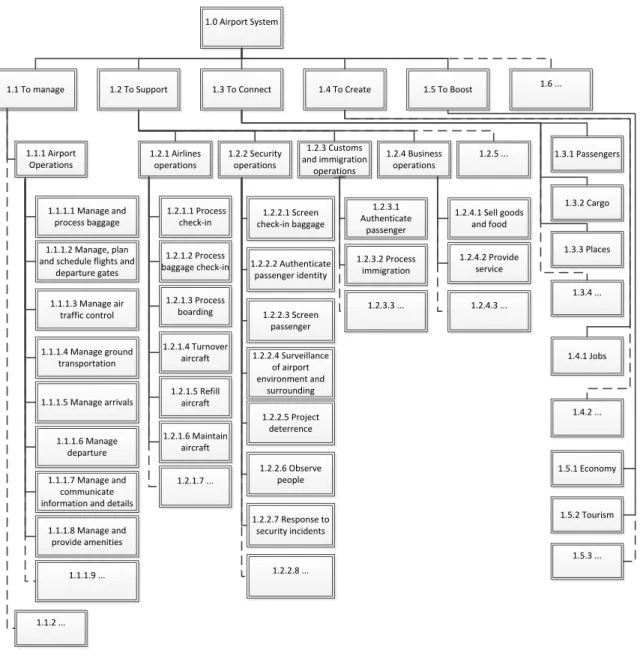
While the airport system exists to serve many different functions within its physical boundaries, the focus of this study is on the functions and processes relevant to the passengers as stakeholders in the analysis of the airport passenger security system. See Figure 7 for the process decomposition of the airport system.
1.0 Airport System 1.4 To Create 1.2 To Support 1.5 To Boost 1.1 To manage 1.1.1 Airport Operations 1.1.1.1 Manage and process baggage 1.1.1.2 Manage, plan and schedule flights and
departure gates 1.1.1.3 Manage air traffic control 1.1.1.4 Manage ground transportation 1.1.1.5 Manage arrivals 1.1.1.6 Manage departure 1.1.1.7 Manage and communicate information and details
1.1.1.8 Manage and provide amenities 1.6 ... 1.1.1.9 ... 1.1.2 ... 1.2.1 Airlines operations 1.2.2 Security operations 1.2.3 Customs and immigration operations 1.2.4 Business operations 1.2.5 ... 1.2.1.1 Process check-in 1.2.1.2 Process baggage check-in 1.2.1.3 Process boarding 1.2.1.4 Turnover aircraft 1.2.1.5 Refill aircraft 1.2.1.6 Maintain aircraft 1.2.1.7 ... 1.2.2.1 Screen check-in baggage 1.2.2.2 Authenticate passenger identity 1.2.2.3 Screen passenger 1.2.2.4 Surveillance of airport environment and surrounding 1.2.2.5 Project deterrence 1.2.2.6 Observe people 1.2.2.7 Response to security incidents 1.2.2.8 ... 1.2.3.1 Authenticate passenger 1.2.3.2 Process immigration 1.2.3.3 ... 1.2.4.1 Sell goods and food 1.2.4.2 Provide service 1.2.4.3 ... 1.3.2 Cargo 1.3.3 Places 1.3.4 ... 1.3 To Connect 1.3.1 Passengers 1.4.1 Jobs 1.4.2 ... 1.5.1 Economy 1.5.2 Tourism 1.5.3 ...
Figure 7. Process Decomposition17 of Airport System.
2. Passenger Process Decomposition
As each stakeholder has a significantly different perspective of the airport system and the system’s requirements (Buede, 2009), each of them will behave, interact and response differently within the context of the system based on their effective needs and motivation. While there are many stakeholders involved in the airport system, the focus
17 There are other processes under the airport system that are reflected as “…” since they are not be
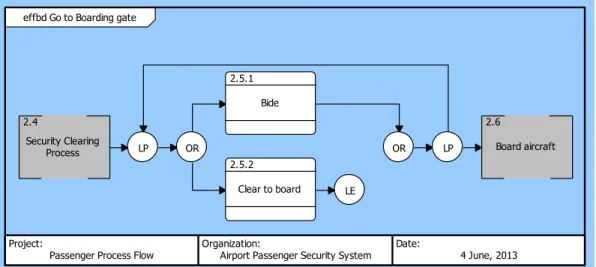
on passengers within the system is predicated on the intent to use the aircraft as a weapon. The process flow block diagrams in Figures 8 to 13 depict the typical passenger process and the detailed breakdown of its associated processes.
Figure 8. Typical Passenger Process Flow Block Diagram.
A typical passenger in the airport system would generally perform the processes shown in Figure 8 as part of the airport process flow to get on board a scheduled flight.
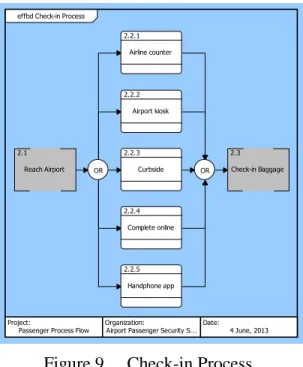
Figure 9. Check-in Process.
The check-in process can be performed through one of the five possible ways by the stakeholder (in this instance, the passenger) and could possibly vary between passengers or even between flights by the same passenger.
Ref. 2.1 Reach Airport 2.2 Check-in Process 2.3 Baggage Check-in Process 2.4 Clear Security 2.5 Go to Boarding gate 2.6
Board aircraft Ref. effbd Passenger Process Flow
Project:
Passenger Process Flow Organization: Airport Passenger Security System Date: 4 June, 2013
2.1 Reach Airport OR 2.2.1 Airline counter 2.2.2 Airport kiosk 2.2.3 Curbside 2.2.4 Complete online 2.2.5 Handphone app OR 2.3 Check-in Baggage effbd Check-in Process
Project:
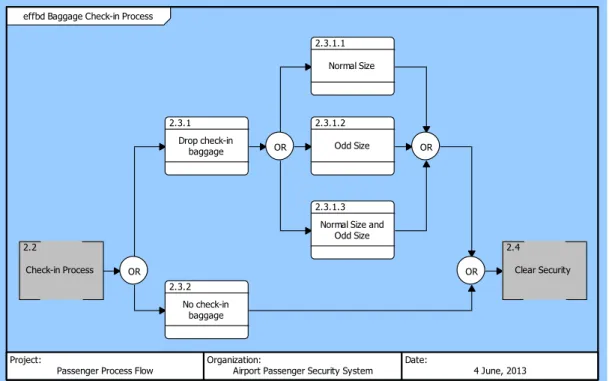
Figure 10. Baggage Check-In Process.
Depending on what the passenger brings along for the flight, he has the ability to perform this process of baggage check-in whenever necessary.
Figure 11. Clear Security Process.
2.2 Check-in Process OR 2.3.1 Drop check-in baggage OR 2.3.1.1 Normal Size 2.3.1.2 Odd Size 2.3.1.3 Normal Size and
Odd Size OR 2.3.2 No check-in baggage OR 2.4 Clear Security effbd Baggage Check-in Process
Project:
Passenger Process Flow Organization:Airport Passenger Security System Date: 4 June, 2013
2.3 Baggage Check-in Process
2.4.1 Check Identity (ID) and travel
papers AND 2.4.2 Check carry-on and belongings 2.4.3 Passenger screening OR 2.4.3.1 Undergo metal detector 2.4.3.2 Undergo metal detector and advanced imaging technology OR AND 2.5 Go to Boarding gate effbd Security Clearing Process
Project: