Miguel Pires Egídio Reis
Bachelor of Computer Science and Engineering
Blockchain-Enabled DPKI Framework
Dissertation submitted in partial fulfillment of the requirements for the degree of
Master of Science in
Computer Science and Informatics Engineering
Adviser: Henrique João Lopes Domingos, Departamento de Informática, FCT/UNL
Examination Committee
Chairperson: Miguel Carlos Pacheco Afonso Goulão Raporteur: Nuno Miguel Carvalho dos Santos
Blockchain-Enabled DPKI Framework
Copyright © Miguel Pires Egídio Reis, Faculty of Sciences and Technology, NOVA Univer-sity Lisbon.
The Faculty of Sciences and Technology and the NOVA University Lisbon have the right, perpetual and without geographical boundaries, to file and publish this dissertation through printed copies reproduced on paper or on digital form, or by any other means known or that may be invented, and to disseminate through scientific repositories and admit its copying and distribution for non-commercial, educational or research purposes, as long as credit is given to the author and editor.
This document was created using the (pdf)LATEX processor, based in the “novathesis” template[1], developed at the Dep. Informática of FCT-NOVA [2].
Ac k n o w l e d g e m e n t s
Firstly, I want to thank my thesis advisor Prof. Henrique João Domingos, for his support and advice. Working with him was truly an honor. I also want to thank every teacher I had during my journey in Faculty of Sciences and Technology of the NOVA University of Lisbon, I learned immensely from them. I will cherish the moments I lived during the last years for the rest of my life. I look forward to apply what I have learned in my professional career.
I thank my parents, sister, and close friends, for their support and encouragement through stressful times. Without them, these years would be incredibly harder. Finally, I want to thank some of my closest colleagues Rui Louro, Rafael Figueiredo, and Arthur Rocha, for our fun experiencies and projects.
A b s t r a c t
Public Key Infrastructures (PKIs), which rely on digital signature technology and estab-lishment of trust and security association parameters between entities, allow entities to interoperate with authentication proofs, using standardized digital certificates (with X.509v3 as the current reference). Despite PKI technology being used by many appli-cations for their security foundations (e.g. WEB/HTTPS/TLS, Cloud-Enabled Services, LANs/WLANs Security, VPNs, IP-Security), there are several concerns regarding their inherent design assumptions based on a centralized trust model.
To avoid some problems and drawbacks that emerged from the centralization assump-tions, a Decentralized Public Key Infrastructure (DPKI), is an alternative approach. The main idea for DPKIs is the ability to establish trust relations between all parties, in a web-of-trust model, avoiding centralized authorities and related root-of-trust certificates.
As a possible solution for DPKI frameworks, the Blockchain technology, as an enabler solution, can help overcome some of the identified PKI problems and security drawbacks. Blockchain-enabled DPKIs can be designed to address a fully decentralized ledger for managed certificates, providing data-replication with strong consistency guarantees, and fairly distributed trust management properties founded on a P2P trust model. In this approach, typical PKI functions are supported cooperatively, with validity agreement based on consistency criteria, for issuing, verification and revocation of X509v3 certifi-cates. It is also possible to address mechanisms to provide rapid reaction of principals in the verification of traceable, shared and immutable history logs of state-changes related to the life-cycle of certificates, with certificate validation rules established consistently by programmable Smart Contracts executed by peers.
In this dissertation we designed, implemented and evaluated a Blockchain-Enabled Decentralized Public Key Infrastructure (DPKI) framework, providing an implementa-tion prototype soluimplementa-tion that can be used and to support experimental research. The proposal is based on a framework instantiating a permissioned collaborative consortium model, using the service planes supported in an extended Blockchain platform lever-aged by the Hyperledger Fabric (HLF) solution. In our proposed DPKI framework model, X509v3 certificates are issued and managed following security invariants, processing rules, managing trust assumptions and establishing consistency metrics, defined and
executed in a decentralized way by the Blockchain nodes, using Smart Contracts. Cer-tificates are issued cooperatively and can be issued with group-oriented threshold-based Byzantine fault-tolerant (BFT) signatures, as group-oriented authentication proofs. The Smart Contracts dictate how Blockchain peers participate consistently in issuing, sign-ing, attestation, validation and revocation processes. Any peer can validate certificates obtaining their consistent states consolidated in closed blocks in a Meckle tree structure maintained in the Blockchain. State-transition operations are managed with serializabil-ity guarantees, provided by Byzantine Fault Tolerant (BFT) consensus primitives.
Keywords: PKI, DPKI, Blockchains, Distributed Ledger, Consortium Blockchains, Hyperledger- Fabric (HLF) Platform , Byzantine Fault Tolerance (BFT), BFT Consensus, Group-Oriented Cooperative Multisignatures (COSigs), Threshold Digital Signatures.
R e s u m o
As soluções PKI (ou infraestruturas de chave pública) baseiam-se na utilização de assinaturas digitais e suportam o estabelecimento de chaves públicas ou demais atributos de confiança associados à identificação de entidades principais, para uso como provas de autenticação. Uma PKI suporta a emissão, gestão ou revogação de certificados normali-zados para autenticação desses atributos, sendo a norma X.509v3 o padrão prevalente. Os certificados são emitidos em cadeias, a partir de entidades centrais instituídas como autoridades raiz da certificação (CAs), sendo aceites como entidades de confiança. As CAs são constituídas por empresas, sectores governamentais ou outras organizações, atu-ando como entidades terceiras, externas aos principais para os quais os certificados são emitidos, e independentes do contexto de interação entre esses principais. As funções de uma CA são similares às padronizadas emframeworkspara soluções PKI, sendo o padrão PKIX uma referência relevante. Embora tais soluções sejam geridas transversalmente aos sistemas que utilizam os certificados, os seus serviços estão na base de confiança destes sistemas.
As funções de uma CA ou de soluções PKIs estão assim na base de confiança de protocolos de segurança de comunicações (ex: HTTPS, TLS, IPSec, VPNs), aplicações de segurança (ex: Web/HTTPS, S/MIME, DKIM), na segurança do sistema DNS (ex.: DNS-SEC) e nos mais diversos serviços de software para computação ou de armazenamento de dados em nuvem. A utilização de CAs e PKIs tem ainda repercussão no uso de dispositi-vos Bluetooth ou NFC, na utilização confiável de automóveis, equipamentos hospitalares, serviços desmart-cities, aplicações IoT,smart-cards, cartões bancários, cartões de cidadão ou passaportes, entre muitos outros casos e sistemas críticos.
Dada a sua relevância, existem hoje preocupações crescentes acerca dos modelos de concepção de PKIs e respectivos modelos de confiança centralizados, em que a raiz de confiança é detida por entidades centrais atuando com cariz autoritário ou oligárquico. Estas são susceptíveis de operação incorreta, podem constituir pontos centrais de falha ou ataque e operam na prática sem escrutínio das condições de operação por parte dos principais para os quais os certificados são emitidos. Perante estas preocupações, o rede-senho de soluções PKI com base em modelos decentralizados pode apresentar vantagens interessantes.
Várias soluções para descentralização da base de confiança foram propostas e algumas tornaram-se historicamente relevantes e bem conhecidas, no contexto de aplicações espe-cíficas, como por exemplo o sistema PGP (Pretty Good Privacy) orientado para gestão de certificados para Email ou para troca de ficheiros autenticados, num modelo de confiança P2P do tipoWeb-of-Trust. Mais recentemente, a ideia de descentralizar a confiança numa solução PKI para uso genérico está associada à noção de DPKI (DecentralizedPKI). Numa DPKI pretende-se descentralizar as funções de uma PKI sem que prevaleçam entidades com autoridade central. As funções e operações de uma PKI podem ser realizadas de forma cooperativa, envolvendo várias entidades distribuídas.
A tecnologia Blockchain potencia a abordagem de soluções DPKI, por permitir ende-reçar modelos descentralizados de notarização de operações com controlo de integridade do estado dessas operações, bem como de replicação desse estado em todas as entidades prticipantes, com garantias de consistência e com base em interações P2P. Numa DPKI suportada em plataformas Blockchain pode perspectivar-se a emissão colaborativa de certificados X509v3 com base em regras de emissão, validação ou de revogação, executa-das por toexecuta-das as entidades com critérios de consistência. É ainda interessante suportar critérios de reação rápida na verificação de históricos partilhados e rastreáveis relativos ao estado dos certificados. As anteriores operações podem ser processadas por Smart Contracts, programáveis para serem executados de forma consistente e autónoma pelas entidades que cooperam na DPKI.
Esta dissertação objetiva a concepção, implementação e avaliação experimental de uma solução DPKI baseada numa plataforma Blockchain. A solução baseia-se numa fra-mework que endereça um modelo de consórcio colaborativo, alavancada por planos de serviços suportados na plataforma Blockchain Hyperledger Fabric (HLF). Os certificados X509v3 são emitidos e geridos respeitando invariantes de segurança e confiabilidade, com regras de processamento definidas e executadas pelos nós da Blockchain expressas em Smart Contracts (ou Chaincodes). Os certificados são emitidos de forma cooperativa, sendo autenticados por assinaturas digitais orientadas a grupos ou assinaturas de limiar, com propriedades de tolerância a falhas ou ataques bizantinos. Os Smart Contracts ex-pressam os critérios e condições de emissão, assinatura, atestação, validação e revogação, sendo executados autonomamente e consistentemente por todas as entidades na Block-chain. O histórico de estados dos certificados são guardados em blocos de operações com garantias de integridade e imutabilidade, agregados numa estrutura de árvore Meckle mantida e replicada na Blockchain. As operações de transição de estado são processadas com garantias de serialização e ordenação suportadas por protocolos de consenso tole-rante a falhas bizantinas (ou consenso BFT).
Palavras-chave: PKI, DPKI, Blockchains, Notarização Distribuída, Blockchains de Consórcio, Plataforma Hyperledger Fabric (HLF), Tolerância a Falhas Bizantinas (BFT), Consenso com BFT, Assinaturas Cooperativas Orientadas a Grupo (COSigs), Assinaturas Digitais de Limiar (Threshold Signatures.
C o n t e n t s
List of Figures xvii
List of Tables xix
Listings xxi
Acronyms xxiii
1 Introduction 1
1.1 Context and Motivation. . . 1
1.2 Problem Statement . . . 6
1.3 Objective and Contributions . . . 7
1.4 Document Structure. . . 8
2 Related Work 9 2.1 Background . . . 9
2.2 Public Key Infrastructure . . . 9
2.2.1 PKI and PKIx . . . 10
2.2.2 PKI Implementations . . . 12
2.3 Web-of-Trust Models . . . 14
2.4 Blockchain . . . 16
2.4.1 Blockchain Characteristics and Foundations . . . 17
2.4.2 Blockchain Trends. . . 20
2.4.3 Blockchain Platforms . . . 20
2.4.4 Decentralized Ledgering with Resilient Group Signatures . . . 23
2.5 Blockchain-Enabled PKI Approaches . . . 24
2.5.1 Background . . . 24
2.5.2 PB-PKI . . . 25
2.5.3 Blockchain-Based PKI Management Framework . . . 26
2.5.4 IKP . . . 27
2.5.5 CertCoin . . . 28
2.5.6 PomCor: Backing Rich Credentials with a Blockchain PKI . . . 29
C O N T E N T S
2.5.8 SCPKI . . . 30
2.5.9 Other Approaches. . . 30
2.6 Discussion . . . 31
3 System Model and Architecture 35 3.1 Application Scenario . . . 35 3.2 System Model . . . 36 3.2.1 Entities . . . 37 3.2.2 Interactions . . . 39 3.2.3 Requirements . . . 43 3.3 Reference Architecture . . . 43
3.4 Software Architecture Components . . . 45
3.4.1 Base Hyperledger Fabric . . . 45
3.4.2 Extended Hyperledger Fabric . . . 47
3.4.3 Blockchain-Enabled DPKI Proxy . . . 53
3.5 Adversary Model Considerations . . . 55
3.6 Summary . . . 56
4 System Implementation 57 4.1 Prototype Overview and Technologies . . . 57
4.2 Prototype Implementation . . . 58 4.2.1 Blockchain Network . . . 58 4.2.2 DPKI Proxy . . . 59 4.2.3 DPKI Chaincode. . . 65 4.2.4 DPKI Signatures. . . 67 4.2.5 Bootstrap Signatures . . . 67 4.2.6 Internal Clients . . . 68
4.2.7 X509v3 Certificates and CRL Extensions . . . 69
4.3 Summary . . . 69
5 Experimental Evaluation and Analysis 71 5.1 Evaluation Environment . . . 72
5.2 X509v3 Certificate Issuing for External Clients . . . 72
5.2.1 Cryptographic operations and their impact on the system . . . 73
5.2.2 Latency variation in the issuing process . . . 74
5.2.3 Impact in the size of issued X509v3 certificates . . . 75
5.2.4 Impact of the number of endorsers . . . 75
5.2.5 Impact of the number of normal peers . . . 76
5.2.6 Comparison with the Issuing Process in a Conventional PKI Solution 77 5.3 Revocation of certificates and CRL Issuing . . . 78
5.4 OCSP Requests. . . 79
C O N T E N T S
6 Conclusion and Final Remarks 81
6.1 Conclusion . . . 81
6.2 Future Work . . . 82
Bibliography 85
L i s t o f F i g u r e s
2.1 Hierarchy of a PKI certificate chain (left) and Architectural model of a PKIx
(right) . . . 10
2.2 Process of a simple PKI using OpenSSL . . . 12
2.3 Threshold signature construction . . . 23
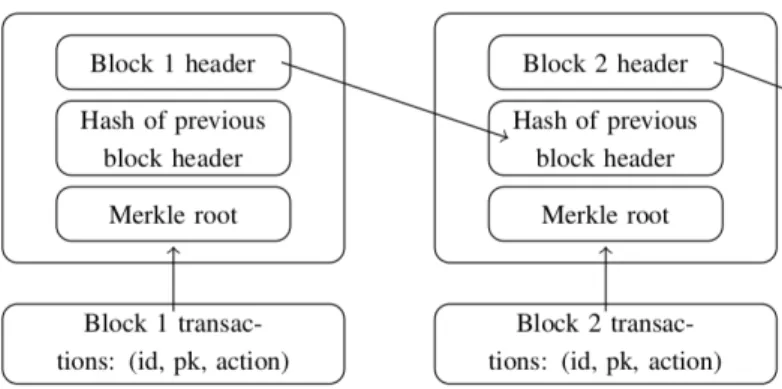
2.4 Example of a PKI Blockchain structure . . . 25
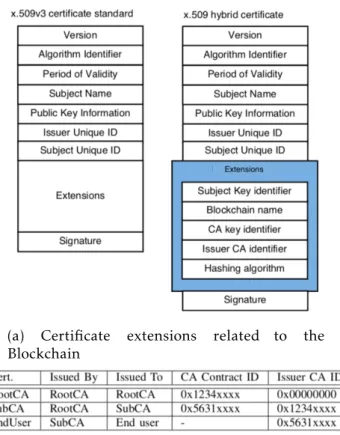
2.5 Certificates in Blockchain-Based PKI Management Framework . . . 26
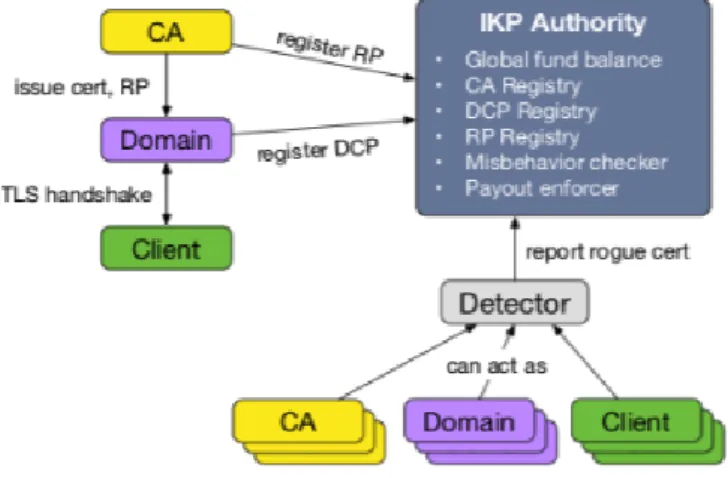
2.6 IKP schema . . . 28
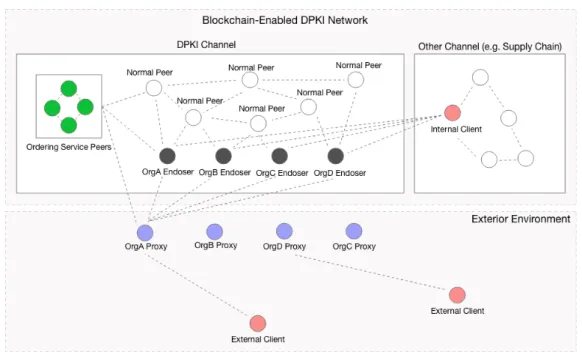
3.1 Application Scenario . . . 37
3.2 Standard Model Sequence Diagram . . . 39
3.3 Self-Signed Certificate Model Sequence Diagram . . . 41
3.4 CSR Model Sequence Diagram . . . 42
3.5 Architectural View . . . 44
3.6 Hyperledger Fabric Architecture. . . 46
3.7 Hyperledger Fabric Transaction Flow . . . 47
3.8 BFT Consensus service for Hyperledger Fabric . . . 48
3.9 Certificate Validation and Signature. . . 49
3.10 Blockchain Public-Key Certificate State (BCS) . . . 50
3.11 Example of Certificate Trust Level . . . 52
3.12 Blockchain-Enabled DPKI X509v3 certificate . . . 55
4.1 DPKI Signature Flow . . . 68
4.2 A certificate issued by the Blockchain-Enabled DPKI . . . 69
5.1 Variation in the latency in issuing X509v3 extended certificates. . . 74
5.2 Number of Endorsers and size of issued certificates. . . 75
5.3 Latency in issuing X509v3 extended certificates with a variable number of Endorsers. . . 76
5.4 Latency in issuing X509v3 extended certificates with a variable number of Regular Peers. . . 76
5.5 Performance of Threshold Signatures and Multi-Signatures in the revocation of certificates. . . 78
L i s t o f F i g u r e s
5.6 Performance of OCSP processing when using Threshold Signatures and Multi-Signatures. . . 79
L i s t o f Ta b l e s
2.1 Comparison of Blockchain Platforms. . . 21
4.1 Proxy REST API Endpoints . . . 60
4.2 Proxy HLF SDK Client Interface . . . 64
4.3 Excerpt of Chaincode Functions . . . 67
5.1 Testbench Environment . . . 72
5.2 Analysis of different Cryptographic Algorithms and Key Sizes. . . 73
L i s t i n g s
3.1 Example of an Extended Smart Contract . . . 52
Ac r o n y m s
API Application Programming Interface. ARP Address Resolution Protocol.
BaaS Blockchain-as-a-service.
BCS Blockchain Public-Key Certificate State. BFT Byzantine Fault Tolerance.
CA Certificate Authority.
CoSigs Cooperative Signatures (or Group Oriented Cooperative Multi-signatures).
CPS Certificate Practice Statement. CRL Certificate Revocation List. CRR Certificate Revocation Request. CSR Certificate Signing Request. DDoS Distributed Denial of Service. DHT Distributed Hash Table. DNS Domain Name System. DoS Denial of Service.
DPKI Decentralized Public Key Infrastructure. ESCC Endorsement System Chaincode.
EVM Ethereum Virtual Machine. HLF Hyperledger Fabric.
HSM Hardware Security Module. HTTP Hypertext Transfer Protocol.
AC R O N Y M S
IETF Internet Engineering Task Force. IKP Instant Karma PKI.
IoT Internet-of-Things. IP Internet Protocol.
IPFS InterPlanetary File System. IPSec IP Security.
JSON JavaScript Object Notation. LAN Local Area Network.
MAN Metropolitan Area Network. MITB Man-in-the-Browser.
MITM Man-in-the-Middle.
NFC Near Field Communication. OCSP Online Certificate Status Protocol. OID Object Identifier.
P2P Peer-to-Peer.
PAN Personal Area Network.
PB-PKI Privacy-Aware Blockchain-based PKI. PBFT Practical Byzantine Fault Tolerance. PEM Privacy-Enhanced Mail - Format. PGP Pretty-Good-Privacy.
PKCS Public Key Cryptography Standards. PKI Public Key Infrastructure.
PKIx PKI based on the industry standard X.509 model. PoET Proof of Elapsed Time.
PoS Proof of Stake. PoW Proof of Work.
RA Registration Authority.
REST Representational State Transfer. RFC Request for comments.
AC R O N Y M S
SCPKI Smart Contract-based PKI. SDK Software Development Kit. SSH Secure Shell.
TCP Transmission Control Protocol. TLS Transport Layer Security. UI User Interface.
VA Validation Authority.
VAN Vehicular Area Network (including VANETs Vehicular AdHoc Net-works).
VPN Virtual Private Network. WAN Wide Area Network.
WLAN Wireless Local Area Network.
X509v3 X509 Certificate with extension fields. XSPP Extended Signing Policies Provider.
C
h
a
p
t
e
r
1
I n t r o d u c t i o n
1.1
Context and Motivation
Public Key Infrastructures.The IETF RFC 4949 (Internet Security Glossary) [55] defines public-key infrastructure (PKI) as the set of hardware, software, entities, policies, and operational procedures needed to create, manage, store, distribute, and revoke digital certificates for the use of public-key cryptography, authentication and key-distribution protocols and for standardized digital signatures. PKIs enable the secure, convenient, trust and efficient acquisition of public keys related to principals, with <Subject IDs to Public Keys> mappings established by the certificate attributes and their policy enforce-ments. The IETF-PKI working group [52] has been the driving force behind setting up a formal (and generic) standardized model based on X.509 PKI frameworks for X509 certificates [29], suitable for deploying a certificate-based architecture on the Internet. The PKIX model [59] is generically behind the standardization of the entity model and functions in PKI solutions in different available platforms. It is also the base framework of the PKI technology used by Internet Certification Authorities (CAs) on the Internet. In the PKI model, the certification structure is based on the use of X509 certificates, issued and managed in certification chains used as hierarchies of certification, with an arbitrary number of certification levels. In such hierarchies, each level L corresponds to an entity certifying the certificate for an entity in Level L-1. In practice, these levels are usually levels of the certification of the sameCA. On top of each certification chain, there is a root-of-trust certificate, corresponding to the top certification level of theCA, accepted as a centralized trust authority [59]. In the validation of those certification chains, Pub-lic Keys ofCAs (or Root Public Keys), are pre-installed in local key stores, provided as pre-configured objects in software systems (e.g. devices, computers, operating systems, software solutions, as provided by their manufacturers).
C H A P T E R 1 . I N T R O D U C T I O N
Based on the assumption that a root-of-chain (or a root in a certification chain) is con-sidered trustable, certification chains can be processed and validated, by verifying each certificate in the chain, according to the respective standard attributes. The process is in general conducted in a direct way (considering that each certificate is issued and signed by an entity with an upper-layer certificate public-key). However, is also possible to adopt a reverse way (when a public key of a previously validated and trusted certificate was used to certify upper-layer certificate). Cross-certification is also possible, mixing direct and reverse certification chains. By possible peering agreements between two different CAs in different hierarchies, it is possible to address a model based on an oligarchy of in-dependentCAs. A set ofCAs can constitute such close oligarchies, as a variant extension of the centralized model, allowing for better scale-out conditions, but always following a centralized authority model.
PKI Limitations and Drawbacks.Despite its various advantages, the PKI trust model assumptions has several drawbacks [16]. CAs, as centralized roots of trust, and conse-quently central points of failures, can be compromised to issue fake certificates that are still valid due to bad practices. There is also a lack of transparency concerningCA behav-iors. Information about certificate revocation is also slowly spread and verification of the certificates revocation status is prone to errors.
PKIs are cornerstones in the trust computing bases of most devices, systems, appli-cations, services or protocols. The certification and validation of X509 certificates (and included public-keys for asymmetric cryptographic methods) are in fact behind the secu-rity guarantees of all the most used secusecu-rity protocols in the Internet from Cloud-Based Web-Enabled Security Protocols and Web/HTTPS environments to other TLS-supported secure channels, DNS-Security, SSH-Services, IPSec or Secure VPNs, as well as for access-ing Wireless Local Area Networks. Many of the problems are induced by the centralized trust model, as addressed in PKI frameworks, and the related issues have been known and extensively discussed for many years by many authors.
At the same time, current implementations have suffered from several critical issues. One issue is the reliance on the user to make an informed decision when there is a problem in verifying a certificate. Unfortunately, it is clear that most users do not understand what a certificate is and why this might be a problem. This issue is also applicable to many programmers, due to the complexity involved in extended attributes and policies that are today involved in an X509 certificate and how these attributes must be completely managed in the verification processes in the context of specific applications. Hence they choose to accept a certificate, or not, for reasons that have little to do with their security policies, which may result in the compromise of their systems.
Another critical problem is the assumption that all of the CAs represented in the “trust store” of end-users are equally trusted and managed, and apply correct and equiv-alent management policies. The reality shows that this is not true. Those policies are really unknown by the users. This was dramatically illustrated by compromises from
1 . 1 . C O N T E X T A N D M O T I VAT I O N
well-knownCAs [23], that resulted in many fraudulent certificates issued with public-keys mapped in well-known organization names and private public-keys controlled by others. Other concern is that different software implementations use different trust stores and different validation policies, hence presenting different security views under different trust assumptions. In this way, there are differences in the verification assumptions from different software even if executed in the same computer.
Summarizing, the centralized PKI model and the role ofCAs can have problems and limitations, generally because it relies on central trusted parties acting as a possible cen-tral failure or attack points, and so, paradoxically, as possible untrustable parties. Trust centralization is also a big problem in terms of transparency. It leaves the management of outsourced trust without scrutiny from the certificated entities for which the certifi-cates are issued. This is a door open for attackers to conduct man-in-the-middle (MITM) attacks, intrusion attacks against the CAs, or misbehaviors and bad operation ofCAs, without any awareness control from the users. Currently, there are thousands of claimed trustedCAs around the world that have been appearing as attractive targets for cyber-criminals. These thousands ofCAs have the ability to create alternative identities for one same entity, with different issuing practices in generating certain attributes in certificates. This is a problem in the control and correct validation of such identities and certificates in multilevel certification chains, a well-known vulnerability with serious security incidents and repercussions. Even considering the standardization effort behind the X509v3 frame-work, the fact is that differentCAs also issue certificates with different attribute values and meanings, as well as, with different attributes considered critical for the validation under the sole responsibility of users.
Attacks against certificates issued on centralized roots of trust have been also con-ducted with a mixed of MITM attacks (combining different techniques such as: ARP
spoofing, IP spoofing, DNS spoofing, HTTPS spoofing) and man-in-the-browser (MITB) attacks, as well as, other intrusions in computers where the certificates are used, with numerous incidents that have already shown to increase the risk of MITM attacks and new intrusions, when we place too much trust in one or a reduced number ofCAs. In practice, the registration process of identities for certification requests is also a problem requiring special attention of registration processes conducted byCAs, or Registration Authorities (RAs) working as delegates ofCAs. Attackers can trick theCAs and RAs into thinking they are someone else, or they can go so far as to compromise theCA, and get it to issue a rogue certificate for a fake or for a stolen digital identity. These attacks oc-curred frequently in the past. This was the case of the DigiNotar incident that happened in 2011 [14] when fraudulent certificates from the Dutch CA company were issued as a result of an attack.
More recently, in an incident that happened in 2017, hackers took control of Brazilian banks DNS server and tricked a CA into issuing a valid certificate to them [24].
C H A P T E R 1 . I N T R O D U C T I O N
and single point of failures, in breaking encrypted online communication, as well as, in breaking the authenticity of communicating entities. This is a risk for all the security protocols and systems used today on the Internet (in different levels of the TCP/IP se-curity stack and services). In the research community, there is also a growing opinion arguing that centralized PKI systems are struggling to keep up with the evolving and fu-ture requirements in the digital landscape and the modern world of scalability challenges, requiring a better designed and decentralized approach to PKIs.
It is interesting to note that the Internet Engineering Task Force (IETF), responsible for Web-enabled PKI standardization itself, has created a draft memo describing current issues and concerns on PKIs [28], sharing also the above concerns.
Independently, groups of researchers, for example, around the “Rebooting the Web of Trust” movement [54]), also assessed current PKI weaknesses in their publications, agree-ing that the current implementation of centralized and Web-accessible PKI solutions have serious problems that should not be ignored.
DPKIs – Decentralized Public Key Infrastructures.
Decentralized public key infrastructures (DPKIs) are a possible alternative approach and are regarded as a promising way to return the control of online identities, and related public keys, to the entities they belong to. By doing so, DPKI solutions are envisaged as a way to address many usability and security challenges that plague traditional PKIs [59]. The goal of DPKIs is to ensure that, unlike the conventional PKIX framework design model, no single third-party can compromise the integrity and security of any system as a whole. In a DPKI the trust management must be decentralized by design, through the use of technologies that make it possible for geographically and politically disparate entities to reach consensus on the state of identities in a shared database. The DPKI approach, as approached in [2] focuses primarily on a decentralized key-value datastores and operations not depending on single points of failures or attack targets. More recently, the possible use of Blockchains is advanced as an enabling technology for that purpose, despite that other technologies can also provide similar or superior security properties for consistently distributed trust assumptions and distributed and consistently maintained shared databases.
Blockchains. In 2008 Satoshi Nakamoto caught the attention of many people and organizations by publishing an article regarding aP2Pcryptocurrency system called Bit-coin [42]. This system uses a distributed ledger technology in a consistently replicated database, known as Blockchain: an immutable and public chain of blocks aggregating transactions ordered and validated under a model known as Proof of Work (PoW). To-day, Blockchains are in the core of more than 2073 cryptocurrency systems [10], but this technology is now explored in many other applications such as IoT applications, supply chains, health records, and other application domains (e.g. [36,41,51]). Also, other con-sensus algorithms started to be used for different types of Blockchains, mainly due to the
1 . 1 . C O N T E X T A N D M O T I VAT I O N
fact that PoW, as a safe eventual-consistency model, is computationally very expensive, being a source of bad performance metrics for latency conditions and transaction through-puts, and harmful in terms of energy efficiency. Consensus planes for Blockchains can be also addressed by other solutions, includingByzantine Fault Tolerance(BFT) protocols, looking carefully for scalability vs. performance tradeoffs [13]. Relevant examples today use Practical Byzantine Fault Tolerant Protocols (PBFT) in different variants [8,9,40] in the core of different consensus planes in different types of Blockchains [7,22,26,53].
Blockchain-enabled DPKIs.Several Blockchain-enabled DPKI solutions have been approached in recent proposals, each with different purposes (e.g. [1,4,38,66]). Diff er-ently, models inspired by Web-of-Trust [59,65], particularly used for managing public-key certificates, already addressed in the past the context of distributed-systems [48,58]. Considering Blockchain service planes for the implementation of decentralized ledgers and replicated consistent logs of immutable and ordered operations, this technology can potentially help to overcome some identified problems of conventional centralized PKI systems, avoiding their root-of-trust model assumption. Blockchain-enabled DPKIs can be designed with a decentralized ledgering model, data-replication consistency guaran-tees, and distributed trust management properties. Therefore, PKI functions for issuing and managing X509v3 certificates can be based on a web-of-trust model enabled by the Blockchain services.
The research motivation and the hypothesis in our dissertation are to address Blockchain technology as a possible enabling technology for DPKI solutions, helping in resolving the identified issues, limitations and security drawbacks in conventional PKI systems and their centralized design models.
The decentralized nature of Blockchain-enabled DPKI management frameworks seems to be interesting to tackle the problems of conventional PKIs, providing the typical re-quired functions. At the same time, the idea is to use the potential of Blockchains to eliminate single points of failures, and reacting fast to misuses of the managed certifi-cates in their lifecycles, as well as, revocation operations.
Summarizing, some points emerge as initial advantages:
• A Blockchain can make the process of certificates’ issuing and revocation states stored in a transparent, reliable, and immutable shared ledger. This can prevent attackers from breaking in or inducing in integrity breaks, thus effectively avoiding the MITM attacks against PKI and CA targets or intrusions on single nodes; • Trust management can be established consistently by consensus protocols. All peers
participating in the DPKI solution have to follow the rules of the consensus protocol, so the state of certificates will be regarded consistently, with all the operations that can change the replicated state observed by each peer with total order guarantees; • A DPKI can benefit from the use of different types of Blockchain service planes,
C H A P T E R 1 . I N T R O D U C T I O N
that make it possible for geographically and politically disparate entities, or peers, using neutral data storage solutions and flexible support for arbitrary data types. This allows the management of certificates and their life-cycle states in different representation formats, as well as different forms of binding information between identifiers and related certificates, that can be globally accessed and readable. Furthermore, some researchers argued that the logic of key management and func-tions can be implemented on Smart Contracts [1], provided as a key element that can be extended with the necessary expressiveness requirements to execute the processing conditions on peer-operations, in many current Blockchain platforms.
Nevertheless, the use of Blockchains to design a DPKI solution always imposes some attention, for example, in requiring a device of a peer to synchronize a full copy of all the consensus data or different types of synchronization modes. The scalability consid-erations for the DPKI requirements must be also carefully analyzed in terms of induced workloads, as well as the tradeoffon the anonymization of Blockchain peer-identifiers, particularly in permissionless platforms, and DPKI participants and identifiers bind-ing to the managed certificates. The support forBFTconsensus primitives beyond the Blockchain-enabled DPKI operations is also another issue that must be investigated. To address these issues, some initial design considerations must be addressed, related to the adversarial model conditions, the management of peer identifiers and namespaces used for certificates’ subjects, the registration process of such identifiers, or the way smartcards can be used to support the typical PKI functions. All the above dimensions are related to the objectives of the present dissertation in the definition of the system model and architecture for the proposed Blockchain-enabled DPKI solution, as well as, to drive the choice of the base Blockchain platform and its service planes.
1.2
Problem Statement
There are proposals to enhance PKIs [33] by promoting PKI transparency and responsi-bility using public logs. Recent proposals require that more than one entity confirm a certificate or allow domains to express security policies for their certificates, and detect wrong behaviors through shared logs. Although these proposals are a step forward, they did not have much impact in practice, mainly due to the difficulty and costs of imple-mentation, performance penalties and others. Due to its characteristics, the Blockchain technology can help build safer and stronger PKIs. An immutable public ledger where we may store certificates and other information offers transparency and can be managed cooperatively. Data can be quickly disseminated, which is suitable for revocation data and it may be possible to specify rules related to certificates or CAs with the use of Smart Contracts, by also automatizing reactions such as reports or rewards [38].
In the last years, several Blockchain-based solutions started to come to life [1, 4,
1 . 3 . O B J E C T I V E A N D C O N T R I B U T I O N S
applications. Blockchains are also very different in their services planes, permission vs. permissionless models, under open vs. consortium-basedP2Pdistributed environments.
For the context of the dissertation we defined our problem in the following way: Can we design a Blockchain-enabled DPKI framework addressing its required functions, in a cooperative P2P environment with a distributed ledger and decentralized trust model? Can we provide the necessary services allowing different entities to cooperate, in order to overcome the identified problems of PKI design assumptions based on a root-of-trust model?
We defined the objectives of our dissertation by addressing the above questions.
1.3
Objective and Contributions
In this dissertation we propose, design, prototype and evaluate, a Blockchain-Enabled DPKI framework model, based on service planes leveraged by the Hyperledger Fabric (HLF) platform [26], extended by some required services present in [21]. In our proposed PKI framework, X509v3 certificates are issued and managed following security invariants, processing rules, and trust and consistency control, expressed and executed by Blockchain Peers using Smart Contracts. Certificates are issued cooperatively, using group-oriented digital multi-signatures (COSigs), as aggregated multi-signatures or, optionally, byBFT
threshold-signatures [61]. The Smart Contracts dictate how Blockchain peers participate in issuing, signing, attestation, validation and revocation processes, in a consistent way. Any peer can validate certificates by verifying its consistent state, stabilized in searchable blocks in a Merkle tree structure, maintained in the Blockchain. State-transition opera-tions are managed with serializability and total ordering guarantees, provided by BFT
consensus primitives, in a consensus plane designed for the HLF Platform. Summarizing, our contributions are:
• Design of the framework, in a consortiumBFT-enabled Blockchain model, defining its entities, roles, components, protocols, and operations, to enable the required PKI services. With the purpose of cooperative issuing of certificates, with certificates authenticated by cooperative Multi-signatures orBFTThreshold Signatures, repre-senting a cooperative CA. Furthermore, with the use of Smart Contracts to define the issuing, certification, validation and revocation rules and invariants.
• Implementation of the framework in a prototype developed1on the HLF Blockchain in a Cloud-Blockchain PKI as a Service solution.
• Experimental evaluation of the developed prototype to validate the solution, includ-ing the observation of performance metrics with different parameterizations and
1Central repository of the Blockchain-Enabled DPKI prototype: https://github.com/miguelreisa/ thesis-prototype-general
C H A P T E R 1 . I N T R O D U C T I O N
comparative analysis of such indicators faced to functions supported in a conven-tional and centralized PKI solution. The evaluations cover the following observa-tions:
– X509v3 certificate Issuing, including:
* Evaluation of cryptographic operations
* Latency of the certificate issuing process
* Size of extended X509v3 certificates
* Variability in the number of peers in the issuing process
* Comparison with certificate issuing in a conventional PKI
– Scale impact in the number of participant nodes and their roles in the DPKI
– Evaluation of processes for certificate revocation and issuing of Certificate Revocation List(CRL)
– Evaluation of certificate validation requests supported by the providedOnline Certificate Status Protocol(OCSP) implementation
1.4
Document Structure
The remaining chapters of this report are organized as follows: in Chapter2we survey and discuss related work references to address our objectives and expected contribu-tions, presenting and summarizing the identified inspiracontribu-tions, differences, limitations or drawbacks, considering our specific goals; Chapter3addresses the system model, de-sign principles and architectural foundations of our proposed Blockchain-Enabled DPKI solution; Chapter 4is focused on describing the implementation of a prototype of our designed solution; Chapter5is dedicated to the experimental evaluation effort conducted to analyze and to validate the proposed solution; finally, Chapter6concludes the disser-tation report, presenting the main conclusions and final remarks, as well as, proposing future research work directions.
C
h
a
p
t
e
r
2
R e l a t e d Wo r k
2.1
Background
The background aspects for the objectives of the dissertation involve (i) the study of PKI (Public-Key Infrastructures) and the standardized frameworks behind the current imple-mentations, (ii) the understanding of principles of trust decentralized models (namely Web-Of-Trust models), particularly addressed for the distributed management of public-keys and related X509 certificates, (iii) a study on different Blockchain platforms, to understand their typologies and relevant differences in the services’ planes provide, and (iv) the study of recent proposals in the literature to address Blockchain-enabled PKI frameworks and solutions. We summarize those related work strands in the following sections, concluding with a critical analysis of related work issues focusing on the defined objectives and expected contributions.
2.2
Public Key Infrastructure
A Public-Key Infrastructure (PKI) is a set of software, hardware, policies, roles and proce-dures needed to create, distribute, store and revoke digital certificates based on asymmet-ric encryption. The main purpose of developing a PKI is to allow safe, convenient and efficient acquisition of public keys which allows us to encrypt and sign data [59].
The PKI has several tasks, such as: • Define key pair creation policies.
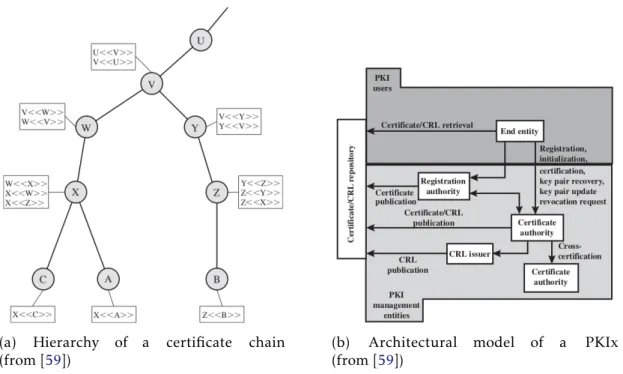
• Define policies regarding the issuing and revocation of certificates of public keys. • Define certification chains. Figure2.1ashows an example of a chain of certificates.
C H A P T E R 2 . R E L AT E D WO R K
(a) Hierarchy of a certificate chain (from [59])
(b) Architectural model of a PKIx (from [59])
Figure 2.1: Hierarchy of a PKI certificate chain (left) and Architectural model of a PKIx (right)
issued the certificate for the subject C. • Generate key pairs if needed.
• Distribute, publicly, public key certificates, as well as the public key revocation certificates.
2.2.1 PKI and PKIx
PKIx is a PKI based on the industry-standard X.509 model that is appropriate for devel-oping and deploying a certificate-based architecture on the Internet [59].
The main elements of PKIx are the following:
• End entity: a term used to describe the end-users, devices or other entity that can be identified on the subject field of a certificate. They normally use the PKI services. • Certification Authority (CA): issuer of certificates and Certificate Revocation Lists
(CRLs). It can also support a wide variety of administrative functions, even though these functions are normally delegated to one or more Registration Authorities (RAs).
• Registration Authority (RA): an additional component that may assume a variety of administrative functions from the CA. Associated to the final process of the end entities registration, but can also assist in other areas.
2 . 2 . P U B L I C K E Y I N F R A S T R U C T U R E
• Repository: any method used for storing certificates and CRLs, so the end entities are able to retrieve them.
Figure2.1bshows the architectural model of a PKIx. Besides the main elements, PKIx identifies several management functions that must be supported by the management protocols, these functions are:
• Registration: the process in which a user makes himself known for the first time to the CA (directly or through an RA). Occurs before the CA issues a certificate to the user. This initiates the process of registration to a PKI. The end entity receives one or more secret keys to share for future authentication.
• Initialization: A client system must have the necessary key materials related to the keys stored elsewhere in the infrastructure before it can operate with security (e.g. the client needs to be initialized with the public key and other information regarding the trusted CAs to be used in certificate paths validation).
• Certification: Process in which a CA issues a certificate related to a user’s public key. The certificate is returned to the user’s client system and/or posts that certificate in a trusted repository.
• Cross Certification: A cross-certificate is a certificate issued by one CA to another CA, it contains a CA signature key used for issuing certificates. In order to establish this certificate, two CAs must exchange information.
• Key Pair Recovery: When using a key pair, it is important to provide a mechanism to recover the necessary decryption keys when access to the keying material is not possible. Without this mechanism, it will not be possible to recover the encrypted data. This allows entities to restore their key pair from an authorized key backup facility (normally it is the CA that issued the end entity’s certificate).
• Key Pair Update: Key pairs need to be updated regularly and new certificates issued. This is required when the certificate lifetime expires or it is revoked.
• Revocation Request: A trusted person advises a CA of an abnormal situation that requires a certificate revocation. Reasons for this include private key compromised, affiliation change, name change, and others.
Various PKI enhancements were proposed in the last years in order to improve the weak aspects of the TLS PKI. One predominant concern is the dissemination of revoked certificates which is made by a CA. The dissemination should be fast to keep all the clients and servers connections secure and the revocation status needs to be authentic, that is, clients can verify if the revocation was created by a trusted CA [62]. Another concern is the fact that there is no effective way to monitor SSL/TLS certificates in real-time. Fake certificates can be issued by compromised CAs or simply due to mistakes.
C H A P T E R 2 . R E L AT E D WO R K
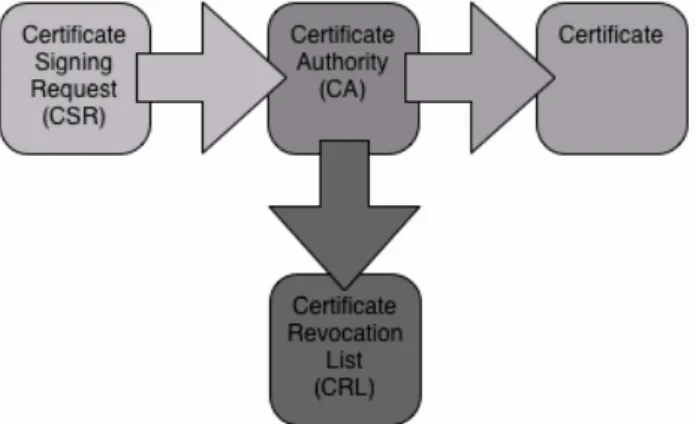
Figure 2.2: Process of a simple PKI using OpenSSL
• Approaches based on public logs that are constantly verified to monitor CAs [32]. • Recent propositions require that multiple entities must confirm the validity of a
certificate.
• Revocation systems that spread information of non-expired certificates that were invalidated (e.g. private keys leaked).
• Allow domains to express security policies regarding their TLS certificates and detect incorrect behaviors by publishing policies in public logs.
Despite the appearance of new proposals, they didn’t have a practical impact. CRLs are still the best-established approach to disseminate information of revocation, although it is not activated in mobile browsers and most desktop browsers.
2.2.2 PKI Implementations
Public Key Infrastructures (PKIs) are needed since most applications need to be secured with certificates and respective keys but they are difficult and expensive to implement since the implementation of a flexible trust center software is expensive and prone to mistakes.
OpenSSL[49] is Apache-licensed and it is the most basic form of CA and tool for PKI and is included in the main Linux distributions. It is a toolkit for the SSL/TLS protocols that allows creating a PKI with the basic components CA, RA, certificate, Certificate Signing Request(CSR), CRL andCertificate Practice Statement(CPS), where the last one is a document that describes the structure and processes of a CA [50]. The OpenSSL command line allows to easily create CAs, certificates, and others.
A process of a simple PKI is shown in Figure2.2(from [50]). The requestor generates a CSR and submits it to the CA, the CA then issues the certificate based on the CSR and returns it to the requestor. Later, if the certificate is revoked, the CA adds it to the CRL.
2 . 2 . P U B L I C K E Y I N F R A S T R U C T U R E
Root CAs issue certificates for CAs, intermediate CAs also issue certificates to CAs but are bellow the root, and signing CAs issue certificates for users.
OpenCA[46] is an open-source PKI implementation based on three main components: web interface to perform operations, OpenSSL backend for the cryptographic operations and a database that store the needed information, such as CSRs, certificates, Certificate Revocation Requests (CRRs), and CRLs.
OpenCA has many elements, such as a public interface, RA interface, CA interface, flexible certificate extensions, CRL issuing, warnings for soon to expire certificates and many others. It is designed for a distributed infrastructure in order to support maximum flexibility for big organizations.
EJBCA[15] is a PKI CA software built with the Java language. It is based on com-ponents and independent of the platform. Besides that, it guarantees flexibility and scalability and can be used to build a complete PKI infrastructure for any organization.
It can have multiple CAs and. an unlimited number of SubCAs and RootCAs. X.509 is one of the standards and supports certificates of long or short expiration. An RA Web UI is available for self-registry and issuing by the administrators. It also possesses revocations and CRLs.
Big scale installations can use multiple EJBCA instances running on a cluster, a dis-tributed database in a separated cluster and a third cluster with HSMs (Hardware Security Module that offers additional security) that stores the keys of different CAs.
It supports multiple PKI architectures, such as:
• Single CA/RA: single instance that acts as CA and RA.
• CA with distributed RAs: having multiple RA instances allows to register a diverse set of users and devices. CAs have role-based access control in order to decide what each RA is allowed to do.
• External RA with only outgoing connections: an external RA (or several) stores the certificate requests and revocations in a separated database. The CA can, periodi-cally, pull these requests from the database (only outcoming traffic is allowed from the CA). This is a way to isolate the CA for security reasons, allowing flexibility in registering entities at the same time.
• Validation Authority (VA): EJBCA has a VA incorporated, therefore the Single CA/RA setup has validation of certificates. However, if we want to build a big-ger PKI it is better to separate the VA from the CA for performance reasons or, if we want to use a VA for multiple PKIs, for example.
• Cluster and High Availability: both CA and VA can be clustered in order to achieve more availability and performance. This means that there are more servers involved, but the architecture doesn’t change whether it is clustered or non-clustered.
C H A P T E R 2 . R E L AT E D WO R K
2.3
Web-of-Trust Models
Web-of-Trust [59, 65] is a concept introduced in the design of security services for dis-tributed systems. This model, targeted for decentralized trust management functions, was considered in the past as a support component in the design ofPretty-Good-Privacy
(PGP), GnuPG, and other OpenPGP-Email systems [48,67] to establish authentication proofs of binding between public keys and principals, as defined in the IEEE RFC 822 standard [60], where unique identifiers are related to email addresses. The Web-of-Trust model was defined as an opposite approach for centralized trust models (e.g. PKIs). Based on this model, is also possible to address multiple and independent Webs of Trust, where any peer, through their identity certificate, can be a part of multiple webs, acting as a CA for their own certificates, managed inP2Pinteraction models.
For the decentralized management of public-keys and certificates, each peer main-tains locally a ring of its private keys, maintained securely and possibly encrypted with passphrase-based encryption methods, and a ring of public keys that includes sets of self public keys and public keys of other peers. The main idea is not to include any spec-ification for establishing certifying authorities or centralized trust. Instead, the model offers autonomous and convenient means of deciding trust, associating trust-information metrics with the public keys stored in the public-key ring structure.
The trust information on the public keys is included as additional data in each public-key entry of the public public-key ring. Trust data is managed and computed as a result of the dissemination of certificates inP2Pinteractions, where new, unknown or already known, certificates are received in announcements, originally sent and disseminated by different peers.
In a basic model, the structure for a public-key ring organization is as follows: • Each entry is a public-key that corresponds to a certificate. Associated with each
entry there is a key legitimacy field that indicates the extent to which the peer node managing the ring will trust that public key which belongs to another peer node; the higher the level of trust, the stronger is the binding of that peer with the stored public key.
• Also associated with a public key entry there are zero or more digital signatures (collection of signatures certifying the public key). These signatures are collected from messages arrived from other peers in the dissemination process of certificates. • Each signature in the collection has an associated signature trust field that indicates
the degree to which the principal trusts the signer to certify other public keys. • The key legitimacy field for each public key certificate is derived from the collection
of signature trust fields in each entry.
• Finally, each entry defines a public key associated with a particular owner, with an owner trust field included. This field indicates in each moment the degree to which
2 . 3 . W E B - O F -T R U S T M O D E L S
this public key is trusted to sign other public-key certificates.
In the management of the trust-related information of certificates stored in the public key ring, the levels of trust are assigned form initial parameterizations and computations, defined and executed in an autonomous way, by each peer (in isolation). In the model, signature trust fields are in practice cached copies of the owner trust field from another entry. Locally to each peer, the management process for public-key rings can be conducted by using the following rules:
• When the peer inserts a new public key on the managed public-key ring, it must assign a value to the trust associated with the owner of this public key. If the owner is the peer itself, and therefore this public key also appears in the private-key ring, then a value of ultimate trust can be automatically assigned to the trust field. Otherwise, it will be necessary to decide some trust value to be assigned to the owner of this key. For this decision, it can be specified that the owner is unknown or that a certain level of trust will be decided, according to possible local peer parameterizations for this purpose.
• When the new public key is entered, one or more signatures may be attached to it (depending on the received messages signing that public key). As new signatures can arrive in the future, more signatures may be added later to the public-key entry. When a signature is inserted into the entry it is necessary to search the public-key ring to find if the signature is among the known public-key owners. If so, the owner trust field value for this owner is assigned to the trust field for this signature. If not, an unknown user value is assigned (or some other default metrics).
• The value of the key legitimacy field is then computed considering the signature trust fields present in the entry. If at least one signature has a signature trust value of ultimate, then the key legitimacy value can be considered as complete. Otherwise, it is computed a weighted sum of the trust values. For example, a weight of 1/X can be given to signatures that are always trusted and 1/Y to signatures that are usually trusted. X and Y are configurable parameters in each peer node. When the total of weights of the introducers of a Key/PeerID combination reaches 1, the binding can be considered to be trustworthy, and the key legitimacy value is then set to complete. Thus, in the absence of ultimate trust, the peer must collect X signatures that are always trusted, Y signatures that are usually trusted, or some combination to achieve the complete trust.
The management process of public key rings continues as a dynamic process, being orthogonal to the use of public keys by different applications running in the peer node. Any peer may wish to revoke its current public keys. This can happen due to the compro-mise of the respective private keys or is simply to renew the validity of the public keys. Note that the compromise would require that an adversary, somehow, had obtained the
C H A P T E R 2 . R E L AT E D WO R K
involved private keys or that the opponent had obtained the private key from the private key ring, as a consequence of an intrusion attack.
The convention for revoking a public key is for the owner to issue and to sign a key revocation certificate, sending it to other peers. Each peer can also reroute an observed revocation certificate to other peers. A revocation certificate can be similar to a regular certificate, only including a special attribute mentioning that the purpose of the certificate is to revoke the respective public key. The corresponding private key must be used to sign the revocation certificate that revokes the corresponding public key. The owner should then attempt to disseminate this certificate as widely and as quickly as possible, to enable potential correspondents to update their public-key rings as soon as possible. Note that an adversary who has compromised the private key of an owner can also issue a revocation certificate. However, this would deny the adversary, as well as the legitimate owner in the future use of the public key. Therefore, it seems a much less likely threat than the malicious use of a stolen private key.
There are two main considerations we must mention about the presented Web-of-Trust model. The first consideration is that the model follows an asynchronous process of convergence, with no prior consistency guarantees on the state of the distributed public-key rings that are stored and managed differently by the different peers. Furthermore, the collection of signatures for each disseminated public key corresponds to different aggregations of individual signatures and is not signed cooperatively and consistently by the same group of peers. The last observation is relevant for the approach of the solution as we must address in the dissertation.
2.4
Blockchain
The Blockchain is a paradigm that can reinvent the way we deal with distributed databases, contracts, transactions for shared logging, or notarization systems under properly dis-tributed system model assumptions. It can enable the creation of transparent global networks, allowing for direct relations between agents without the intervention of central authorities.
In the more essential engineering vision, a Blockchain is a distributed database, used as a decentralized and immutable ledger, with the purpose of managing distributed transactions and to store the state of such transactions in a replicated and consistent environment. The participating nodes execute consensus mechanisms and protocols in order to validate transactions and to store consistent states in the public shared ledger.
The Blockchain design principles introduce an innovative way to establish trusted relationships in P2P interaction models, avoiding the need for intermediation entities to act as central trust authorities. Centralized intermediation, besides being a slowness factor, is vulnerable to failures due to the fact that if it fails or operates incorrectly, all the trustability assumptions of dependent principals will be compromised, and they will be strongly affected. With Blockchain-enabled services, it is no longer necessary to
2 . 4 . B L O C KC H A I N
place trust in intermediary entities. Trust assumptions are based on verifiable consensus mechanisms, running in the services planes and structural internet working support for
P2P interactions [37]. Apart from many incorrect uses, Blockchains are used today in business areas that can take advantage of the technology, including Finance, Energy, Mo-bility, Transports, Smart Cities, Smart Cars, IoT systems, with lots of industrial projects on-going, and a few interesting successfully cases showing innovation and competitive factors for new business-models or organizational-processes [13].
2.4.1 Blockchain Characteristics and Foundations
Backgound.A Blockchain system is supported by different planes of services, operating together to provide the required properties. In such planes there are in general three main essential components: (i) the immutable public ledger containing logged-transactions, (ii) the consensus mechanisms and related algorithms to validate and order transactions, (iii) and well-established processing rules to validate and to maintain the Blockchain state in the expected way, with the required consistency criteria [37].
Optionally, depending on the nature, the characteristics or application purposes of dif-ferent Blockchains may be designed with different flavors, and other complementary ser-vices planes can be added: authorization (or permission) service planes (for permissioned-Blockchains), membership control planes to regulate the participation and roles of peers (in consortium Blockchains), alternative or configurable consensus planes, as well as se-curity and privacy services planes or trusted execution environment components (for security requirements).
A relevant component in a Blockchain is the mechanism targeted to address incentive models, a relevant feature related to the sustainability conditions of the Blockchain in order to incentivize the participation and engagement of nodes. This is particularly relevant to permissionless Blockchains. Incentive models can have strong repercussions on the support for the verification of transactions, as well as on the engagement of nodes in the consensus plane mechanisms. For example, the mining process in Bitcoin addresses exactly the above dimensions, allowing participants to obtain rewards from their proof of engagement, usingProof of Work(PoW) as a consensus-style mechanism [42].
Currently, another important element of Blockchain platforms is the establishment of processing rules and algorithms using conventionally named Smart Contracts [57]. In a more pragmatic vision, these contracts are essentially computer programs that can be expressed in a programming language, expressing invariants, conditions and other processing rules. Smart Contracts are stored and executed by the Blockchain nodes and can be used to automate the unstoppable transfer of crypto-tokens between users, according to agreed-upon conditions. In other application-domains, Smart Contracts are also used to deliver things, such as weather data, currency exchange rates, airline flight information, and sports statistics.
C H A P T E R 2 . R E L AT E D WO R K
data-structure (such as a Merkle-Tree) containing blocks of transactions, with each block having proof of integrity with a cryptographic hash of the previous block. In Blockchains that use PoW consensus mechanisms, the blocks contain a nonce.
The chain establishes the total order of transactions and, therefore, avoids double-spending attacks, since the adversary can’t change the block data without the other nodes noticing due to the hashes present in the chain, and because there is a mechanism to select the right chain (based on the number of blocks computed). This means that it is only possible to append or read data from the ledger, after the validation of the blocks.
Types of Blockchain platformsThere are three main types of Blockchains, regard-ing membership management and permission model: permissionless, permissioned and consortium [45]:
• Permissionless/Public:the ledgers are stored inP2Pnetworks with decentraliza-tion and anonymity. PoW is the most used consensus protocol and it has the objec-tive to limit the rate which new blocks are committed. Anyone can join the network but consensus needs a big amount of energy and time. Bitcoin and Ethereum use this type of membership.
• Permissioned/Private: also known as distributed ledger technology. Normally, a single organization has control of the Blockchain in order to manage the participa-tion membership. Parties have verifiable IDs and need access control to participate. This allows the secure interactions between identity groups that possess a common objective but don’t fully trust each other. It is possible that in such cases, different roles for participants can be defined. It may exist a closed group of nodes with the task of creating new blocks by executingBFTalgorithms to determine the order of the blocks stored in the ledger. Not all roles will be involved in such operations, given the scalability and performance problems that can be related to such algo-rithms. Unlike permissionless architectures, permission Blockchains do not spend a big amount of energy and time in the consensus algorithm. Multichain [22] for example uses this type of membership control.
• Consortium Blockchains:semi-decentralized and permissioned Blockchains, but instead of a single organization having the control, a number of organizations have the control of the Blockchain where, for example, each one may control a node of the network. The administrators restrict reading rights to certain users as they wish or can assign specific roles to other users. Data can be public or private. In concrete implementations, sometimes we verify that not all functions are based on a full
P2Pmodel due to the presence of different roles. For example, Hyperledger Fabric (HLF) [26] uses this type of membership management control.
Blockchain consensus plans and consensus proofs. Depending on the design as-sumptions for consensus guarantees and possibly related inventive model, different types
2 . 4 . B L O C KC H A I N
of consensus mechanisms can be involved in consensus planes. The most well-known are the following [11]:
• Proof of Work (PoW): as introduced above, is particularly used in permissionless Blockchains and for cryptocurrency ecosystems. This algorithm consists of the com-putation of a strong hash-function, having a random nonce and the hash of the block as input, to obtain a previously defined result. Peers repeat this computa-tion process until they achieve the result. When a peer solves this cryptographic puzzle, he sends the block in question to the rest of the network. Peers receiving the block verify its contents and the solution of the puzzle, appending the block to the ledger if the block and solution are valid. The peer that solved the puzzle receives a monetary reward for the energy and effort spent. The downsides of PoW approaches are the energy consumption and the fact that decentralization may be lost if a miner has more computation power than the rest of the network, resulting in the renaissance of oligarchies in practice (a situation that is happening in the current crypto-currency systems).
• Proof of Elapsed Time (PoET): an approach that tries to remove the computational cost of PoW maintaining at the same time its advantages. For each block, miners must wait an agreed set time, and the first to finish waiting is selected to validate the block. A platform is used to ensure that the miners, in fact, waited the defined time (under certain trustability assumptions). The downside is that the platform seller must be trusted and proofs of elapsed time must be obtained and exhibited with required trusted verification.
• Proof of Stake (PoS): in this case, the creator and validator of a new block is selected in a deterministic way, depending on its wealth/stake. The more wealth a miner has, the more mining power he has. Miners are incentivized simply due to the fact that if they do not have correct behavior, they lose their wealth. The drawback is that wealthy miners acquire more easily more cryptocurrencies, where new miners have difficulties to do so, causing the possibility of centralized wealthy peers with more power.
• Consensus Proofs with Practical Byzantine Fault Tolerance (PBFT): interesting for consortium Blockchains, is one of the consensus algorithms used in HLF that supports pluggable consensus components. A leader does the ordering of the trans-actions and consensus is made through these steps: leader broadcasts a request, each validator signs and broadcasts a prepare message, and if enough prepare messages are received, the validators broadcast committed messages. The request is accepted if enough commits are received. This algorithm has a considerably better perfor-mance when compared to consensus algorithms used in permissionless Blockchains, but it does not scale well when the number of participating nodes in the consensus
C H A P T E R 2 . R E L AT E D WO R K
rises. The optimization of PBFT consensus in scalable Blockchains has been an interesting research area, addressing scalability vs. performance tradeoffs.
2.4.2 Blockchain Trends
Cryptocurrencies are among the many applications that can be implemented using the Blockchain. Its distributed and decentralized characteristics make it possible for the creation of many different types of applications.
In the last year, we saw the use of the Blockchain technology by companies to ex-plore new ways to approach business processes, IoT, content streaming [35], security (mentioned in this paper) and many others.
In the future, we will probably see an increase in the use of this technology in the use of Smart Contracts in traditional business systems, security innovations, Blockchain-as-a-service(BaaS) [3], and others. The food industry can suffer major changes regarding transparency and traceability in its flow. Even the art industry can take advantage of a Blockchain ledger to fight thieves and art forgers.
2.4.3 Blockchain Platforms
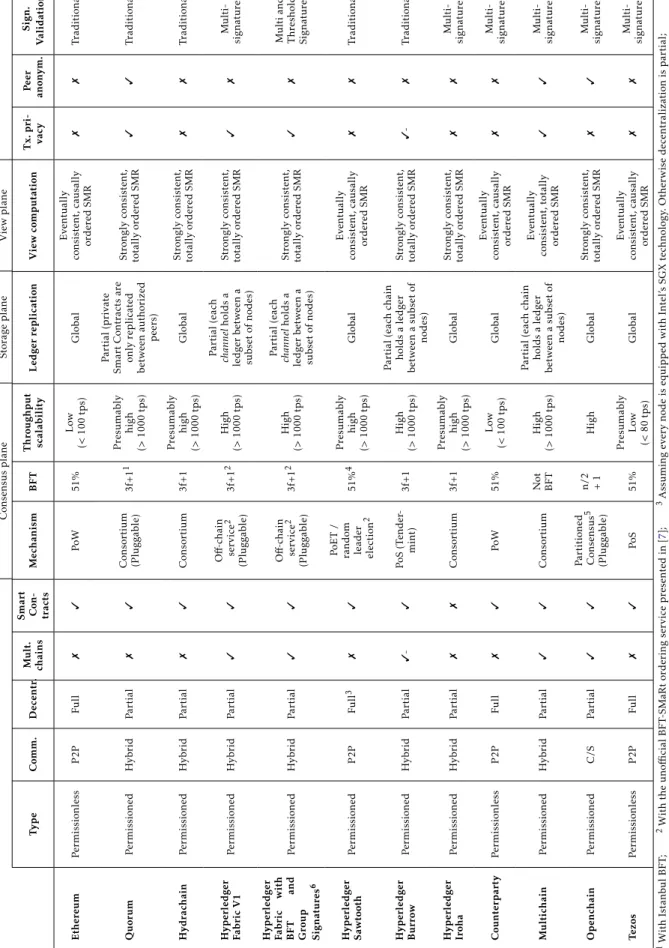
There are many platforms, each with its focus points and characteristics. Table2.1, based on a table from [21], compares several platforms regarding their main characteristics. The platforms are briefly explained:
• Ethereum [17]is used by many applications, some of them approach PKIs and are mentioned in this report. It is a decentralized platform that runs Smart Contracts in a virtual machine (Ethereum Virtual Machine - EVM) that requires payments via the cryptocurrency ‘gas’. It is designed so it can be used for any type of application. The consensus mechanism is PoW but it is expected that, in the future, a PoS based algorithm named Casper [18] will be used.
• Quorum [53]is an enterprise and permissioned version of Ethereum. The consen-sus mechanism is based on a voting process that uses Smart Contracts to assign voting rights, offering better performance when compared to Bitcoin and Ethereum. There are open and private transactions: open transactions are similar to Ethereum’s transactions and in private transactions data is not publicly shown.
• Hydrachain [25]is a permissioned extension of the Ethereum platform. It allows the setup of private or consortium chains. Ethereum’s Smart Contracts are fully compatible with this extension. Instead of using PoW, like Ethereum, it uses aBFT
consensus protocol named HC Protocol, where a quorum of validators signs the blocks. One of the upcoming features is the possibility of multi-chain setups. • Hyperledger Fabric [26] is a permissioned Blockchain that allows the insertion
2 . 4 . B