Contents lists available atScienceDirect
Astronomy and Computing
journal homepage:www.elsevier.com/locate/ascomFull length article
HOPE: A Python just-in-time compiler for astrophysical
computations
✩J. Akeret
∗, L. Gamper, A. Amara, A. Refregier
ETH Zurich, Institute for Astronomy, Department of Physics, Wolfgang Pauli Strasse 27, 8093 Zurich, Switzerland
h i g h l i g h t s
• We discuss the reasons for the lower execution speed of Python.
• We present HOPE, a specialised Python just-in-time compiler.
• The package combines the ease of Python and the speed of C++.
• HOPE improves the execution speed up to a factor of 120 compared to plain Python.
• The code is freely available under GPLv3 license on PyPI and GitHub.
a r t i c l e i n f o Article history:
Received 30 September 2014 Accepted 2 December 2014 Available online 10 December 2014
Keywords:
Python
Just-in-time compiler Benchmark
a b s t r a c t
ThePythonprogramming language is becoming increasingly popular for scientific applications due to its simplicity, versatility, and the broad range of its libraries. A drawback of this dynamic language, however, is its low runtime performance which limits its applicability for large simulations and for the analysis of large data sets, as is common in astrophysics and cosmology. While various frameworks have been developed to address this limitation, most focus on covering the complete language set, and either force the user to alter the code or are not able to reach the full speed of an optimised native compiled language. In order to combine the ease ofPythonand the speed ofC++, we developedHOPE, a specialisedPython
just-in-time (JIT) compiler designed for numerical astrophysical applications.HOPEfocuses on a subset of the language and is able to translatePythoncode intoC++while performing numerical optimisation on mathematical expressions at runtime. To enable the JIT compilation, the user only needs to add a decorator to the function definition. We assess the performance ofHOPEby performing a series of benchmarks and compare its execution speed with that of plainPython,C++and the other existing frameworks. We find thatHOPEimproves the performance compared to plainPythonby a factor of 2 to 120, achieves speeds comparable to that ofC++, and often exceeds the speed of the existing solutions. We discuss the differences betweenHOPEand the other frameworks, as well as future extensions of its capabilities. The fully documentedHOPEpackage is available athttp://hope.phys.ethz.chand is published under the GPLv3 license on PyPI and GitHub.
©2014 The Authors. Published by Elsevier B.V. This is an open access article under the CC BY-NC-ND license (http://creativecommons.org/licenses/by-nc-nd/3.0/).
1. Introduction
In recent years, the
Python
programming language has gained a wide acceptance beyond its original use of simple scripting for system administration and test automatisation.Python
has evolved to become a primary programming language for vari-ous industries and many scientific research fields, notably in as-trophysics (TIOBE Software,2014;Diakopoulos et al.,2014). The✩ This code is registered at the ASCL with the code entry ascl:1411.005.
∗Corresponding author.
E-mail address:[email protected](J. Akeret).
reasons for this success are the simplicity, flexibility and main-tainability of
Python
code as well the wide range of its libraries. In particular, the widely used numericalPython
packagesNumPy
(van der Walt et al., 2011) and
SciPy
(Jones et al., 2001) allow for fast prototyping and development of new applications. The flexi-ble runtime and the dynamic typing are further features of the in-terpreter language that are valued by developers. However, these advantages come with a drawback: typically the execution time ofPython
programs can be slower than native compiled languages such asC
orFortran
by orders of magnitudes.While for many applications the performance of the software is not a priority, in astrophysics and cosmology where large sim-ulations and data analysis over large data sets are often required,
http://dx.doi.org/10.1016/j.ascom.2014.12.001
2213-1337/©2014 The Authors. Published by Elsevier B.V. This is an open access article under the CC BY-NC-ND license (http://creativecommons.org/licenses/by-nc-nd/3. 0/).
speed can be crucial (see e.g.Refregier and Amara, 2014,Akeret et al., 2013and references therein for cosmology). In order, to in-crease the overall performance one can parallelise the programs to take advantage of multicore CPU architectures. An alternative and complementary approach is to focus on improving the single thread performance. The problem of improving the single thread performance of dynamic languages, such as Python, has been ad-dressed in various different ways that can be grouped broadly into two categories: (1) development of optimising just-in-time (JIT) compilers and (2) development of faster interpreters (Arnold et al., 2005). The concept of the latter is to reduce the overhead introduced by the dynamic nature of the language. The idea of a JIT compiler is to produce faster machine or byte code dur-ing runtime when needed (Cuni, 2010). In the
Python
landscape both approaches have been implemented in various projects e.g. thePyPy
1 interpreter, theNumba
2 JIT package or theCython
3 C-extension and others.While most of these approaches aim to support the complete language or a large portion of it, we find that some of the solutions are often intrusive (i.e. require the user to tailor the code to the framework) and that only a few of them are able to reach the full speed of an optimised native compiled
C++
code. To fully combine the ease ofPython
and the speed of C++, we have therefore devel-oped theHOPE
package.HOPE
is a specialisedPython
JIT compiler that supports a subset of thePython
language – primarily numer-ical features commonly used in astrophysnumer-ical calculations – and aims to reach the highest possible execution speed. The package translatesPython
code intoC++
and is able to perform numeri-cal optimisation on mathematinumeri-cal expression at runtime. By usingHOPE
, the user benefits from being able to write common numeri-cal code inPython
while having the performance of compiled im-plementations. To enable theHOPE
JIT compilation, the user only needs to add a decorator to the function definition. The package does not require additional information, which ensures thatHOPE
is as non-intrusive as possible.
We used the
HOPE
package in astrophysics applications such as the development ofPyCosmo
(Refregier et al., in preparation) and to rewriteUFig
(the Ultra fast image generator) (Bergé et al., 2013) intoPython
.PyCosmo
is aPython
cosmology package that numerically integrates the Einstein–Boltzmann differential equa-tions and computes various cosmological observables. TheHOPE
package allowed us to improve the performance of the integration by a factor of 50
×
compared to the purePython
implementation by JIT compiling the integrated function.UFig
is an image gener-ator developed to simulate wide field cosmological galaxy surveys thus enabling tight control of systematics effects through forward modelling (Refregier and Amara, 2014;Bergé et al.,2013).HOPE
has allowed us to rewrite the original
C++
implementation ofUFig
into
Python
. Benchmarks show a performance comparable to the earlierC++
code, but the new implementation has increased the modularity, extensibility and readability of the code.This paper is organised as follows. In Section2, we discuss the reason for the lower execution speed of dynamic languages, and review the existing solutions to address the performance implica-tions in
Python
. Section3explains how we address the perfor-mance requirements using our JIT compiler package and describe theHOPE
architecture and design. In Section4we introduce the benchmarks we used to compare the performance ofHOPE
to the existing solutions. We show and discuss results in Sections5and6and finally conclude in Section7. Information for downloading the
HOPE
package and on its performance on an alternative platform are described inAppendices AandB, respectively.1http://www.pypy.org. 2http://numba.pydata.org. 3http://www.cython.org.
2. Review of existing solutions
Python
is a dynamic interpreted language, which requires an interpreter for the execution of a program. Typically the perfor-mance ofPython
is much slower thanC
or comparable compiled languages. There are several reasons for this:Python
has not been designed to be a fast language, but, instead, readability has been defined to be more important. In addition, everything inPython
, including simple values, are represented as objects in memory. Therefore, the evaluation of a numerical expression requires the interpreter to unbox every value and to load the appropriate oper-ation, as operators can be overwritten dynamically.Currently four main implementation of interpreters exist:
CPython
,Jython
,IronPython
andPyPy
.CPython
is the ref-erence implementation written inC
and the most widely usedPython
interpreter.Jython
andIronPython
are alternative im-plementations ofPython
interpreters targeting the Java virtual machine and the .NET frameworks, but they typically do not im-prove performance (Cuni, 2010).PyPy
is the most prominent ef-fort to develop an alternative interpreter in order to increase the execution speed. In the following, we always refer to theCPython
implementation if not explicitly stated otherwise.
If performance is critical, one approach is to write the critical code in
C
orC++
and interface the implementation withPython
bindings. With this approach the performance requirements can typically be met but often at the cost of the readability. Experience shows that this makes it difficult for diverse users to maintain and extend the
C/C++
code. A further drawback of this approach is that every change in the code requires a recompilation. During development this has to be performed repeatedly, which lowers the productivity and the development velocity of the team.To be able to implement a code in
Python
but nevertheless be able to properly address the performance needs, different alter-native approaches exist, including:Numba
,Cython
,Nuitka
andnumexpr
(seeTable 1). TheNumba
package is a JIT compiler that generates optimised machine code at runtime using theLLVM
com-piler infrastructure. A similar but different approach is to translate and compile thePython
source code. TheCython
C-extension forPython
is widely used for this. TheNuitka
project4 is a staticPython
compiler that focuses on full support of the language. A further approach is thenumexpr
package5that specialises in eval-uating numerical expressions and additionally allows parallel ex-ecution on multiple cores. Besides the frameworks listed in Ta-ble 1further solutions exist.Pyston
6is a very new project un-der current development at Dropbox and is also built on theLLVM
compiler infrastructure. Further frameworks are topic to research projects such as
Pythran
(Pythran,0000;Guelton et al.,2014), a staticPython
compiler andparakeet
(Rubinsteyn et al., 2012), which follows a similar approach asHOPE
.3. HOPE—A Python just-in-time compiler
HOPE
is a specialised method-at-a-time JIT compiler written inPython
. It translatesPython
source code intoC++
and com-piles the generated code at runtime. In contrast to other existing JIT compilers, which are designed for general purpose, we have fo-cused our development of the subset of thePython
language that is most relevant for astrophysical calculations. By concentrating on this subset,HOPE
is able to achieve very high performance for these applications.4 http://www.nuitka.net.
5 https://github.com/pydata/numexpr. 6 https://github.com/dropbox/pyston.
Table 1
Description of existing packages with the version number used for the benchmarks.
Name Description Version
Numba Numbais an open source package, which brings JIT compiling toPythonby generating machine code using theLLVMsoftware stack.
Numbahas been targeted to integrate into scientificPythonapplications. Similarly toHOPEthe user can use a simple decorator to instructNumbato compile a function. As JIT compilerNumbais able to use the type information available at runtime to generate the byte code.
0.13.3
Cython Cythonis a compiler forPythonand for theCythonprogramming language. It allows the user to integrateCorC++function into
Pythoncode as well as to compilePythoncode into machine code by adding static type declaration. This is done by using function decorators and type definition extensions.Cythonsupports the functionality of theNumPypackage.
0.20.2
PyPy PyPyis aPythoninterpreter written in a restricted subset of thePythonlanguage itself (RPython).PyPyis targeted towards speed and efficiency. The included JIT compiler allows translating thePythoncode into native code at runtime.
2.3.1
Nuitka Nuitkais a staticPythoncompiler aiming to support the entirePythonlanguage definition. It allows the compilation of aPython
code into an executable.
0.5.3
numexpr Thenumexprpackage is designed for the efficient evaluation of numerical operations on array-like objects of theNumPypackage. Additionally, the evaluation can be executed in parallel.
2.4
HOPE
is able to translate commonly used unary, binary and comparison operators as well as augmented assign statements. Currently the supported native built-in data types arebool
,int
and
float
and their correspondingNumPy
data types (e.g.int32
,float32
resp.int64
,float64
, etc.). This applies to scalar values as well as theNumPy
arrays with these types. Several features ofNumPy
and mathematical functions like sin, cos, exp, etc. are also supported. HOPE, for instance, allows operations onNumPy
arrays with the common slicing syntax (e.g. a[5:, 5:] = x). A full list of the functionality backed by the package is published online7and a set of examples is provided on GitHub.8The package can be used withPython
2.7 as well as withPython
3.3+. We have testedHOPE
in Linux and Mac OSX environment withgcc
andclang
compilers.HOPE
infers the data types by analysing the function signature and inspecting the Abstract Syntax Tree (AST) of the function at runtime. This information is used to translate thePython
function into statically typedC++
code. UsingPython
’s native extensions for C API9the code is compiled into a shared object library, which is then loaded into the interpreter runtime. During the process of generating theC++
code,HOPE
is able to apply various numerical optimisations in order to improve the execution performance of the compiled function (see Section 3.1). Once compiled, the function is cached to disk to minimise lag on future executions of the same code.We have chosen to generate
C++
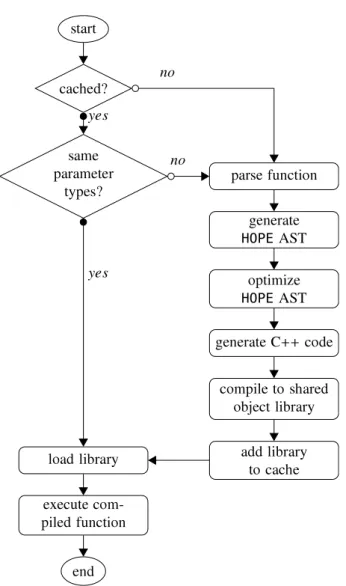
code and compiling the code into a library over other approaches, such as the direct generation of byte code. This design decision was made as the intermediate product – the generated code – is human readable, which greatly simplifies the development and debugging process and, further-more, allows the use of automatic hardware specific optimisation of modern compilers without additional effort. The just-in-time compiling process is described inFig. 1. A function call undergoes the following several steps:Start The
Python
interpreter loads a function or method previously decorated with the@hope.jit
decorator. Cache verificationHOPE
checks if a compiled version of therequested functions has previously been cached. In case the code is executed the first time,
HOPE
returns a wrapper function containing a reference to the original function.Parse function The first time the decorated function is called, the wrapper generates an abstract syntax tree (AST) by parsing the function definition using the
Python
built-inast
package.7http://pythonhosted.org/hope/lang.html.
8https://github.com/cosmo-ethz/hope/tree/master/examples. 9https://docs.python.org/2/extending/extending.html.
Fig. 1. Flow diagram of the step executed during a function call decorated with
HOPE.
Generate HOPE AST Using the visitor pattern, the
Python
AST is traversed and a correspondingHOPE
specific AST is generated. During the traversal we use thePython
built-ininspect
package to infer the data types of the live objects such as parameters, variable and return values. Using this information we are able to statically type theHOPE
AST i.e. scalar variables will be assigned a type and array liked variable will receive a data type and a shape information. Operations on arrays with the sameshape will be grouped into blocks. Furthermore a scope is assigned to each variable in order to identify if it will be passed as parameter or if it has to be instantiated. In the latter case
HOPE
distinguishes between temporary variables, used only once (block scope), and variables used multiple time in the function (body scope). Numerical optimisationHOPE
traverses the new AST in order toidentify numerical optimisation possibilities and alters the tree accordingly. A detailed explanation of the optimisation is discussed in Section3.1.
Generate C++ code A
C++
code is generated from theHOPE
AST. First the function signature is created using the name of the function, the type of the return value and the names of the parameters including their type and shape information. If necessary, statements for the instantiation of new variables are generated. Next, each block is turned into a loop statement according to the shape information of the contained arrays. By grouping array operations, we are able to evaluate the operation element-wise, which improves cache locality. For variables with block scope we can avoid allocating a whole array and instead a scalar value can be allocated (an example is discussed in Section3.2). Finally, the generated code is augmented with Python’s native extensions API statements, so that the code can be called from thePython
interpreter. Compile code to shared object library ThePython
built-insetuptools
package is then used to compile a shared object library from the generated code. Using this pack-age and defining the generated code as an extension greatly simplifies the handling of compiler and ensures compatibility with the interpreter.Add library to cache Using the extracted information from the function signature and a hash over the function body the compiled shared object library is cached for future calls. Load library The shared object library is dynamically loaded into
the runtime and the pointer to the wrapper is replaced with the pointer to the function in the shared object library to avoid unnecessary overhead.
Execute compiled function A call to the function is directed to the function in the shared object library and executed with the passed parameters.
Subsequent function call
HOPE
analyses the types of the passed arguments and queries the cache for a function matching the requested name and arguments. If the system registers a cache hit for a function, the shared object library is then loaded into the runtime and the compiled function is evaluated, otherwise a new function will be generated and compiled.3.1. Optimisation
After the
HOPE
specific AST has been created the package performs a static recursive analysis of the expressions to introduce numerical optimisation. The supported possibilities are divided into three groups: (1) simplification of expressions, (2) factorising out subexpressions and (3) replacing thepow
function for integer exponents. To simplify expression we have used theSymPy
library (SymPy Development Team, 2014).
SymPy
is aPython
library for symbolic mathematics and has been entirely written in Python. To apply the optimisation, the AST expression is translated into
SymPy
syntax AST and passed to thesimplify
function. The function applies various different heuristics to reduce the complexity of the passed expression. The simplification is not exactly defined and varies depending on the input. For instance, one example of simplification is that sin(
x)
2+
cos(
x)
2 will besimplified to 1. Furthermore the
SymPy
library is used to factorise out recurring subexpression (common subexpression elimination) using the previously createdSymPy
AST andSymPy
’scse
function.
From
C++11
on, thepow
function in the C standard library is not overloaded for integer exponents.10The internal implementation of the computation of a base to the power of a double exponent is typically done using a series expansion, though this may vary depending on the compiler and hardware architecture. Generally this is efficient for double exponents but not necessarily for integer exponents.HOPE
therefore tries to identify power expressions with integer exponents and factorises the expression into several multiplications e.g.y=
x5will be decomposed intox2
=
x2and y=
x2×
x2×x
. This reduces the computational costs and increasesthe performance of the execution.
3.2. Example
In this section, we show the translation process of
HOPE
using the following simple example:@hope . j i t def f k t ( x , y ) :
z = x∗∗2 + 1 r e t u r n z + y
As soon as this function is called,
HOPE
will create a statically typed AST using the type information available at runtime. Assuming that the function call was done withx
andy
defined as one dimensionalfloat64 NumPy
array with same length, the resulting AST can be visualised as the following pseudo code:f k t (numpy : : f l o a t 6 4 [ ] x , numpy : : f l o a t 6 4 [ ] y )−> numpy : : f l o a t 6 4 [ ] { new numpy : : f l o a t 6 4 [ ] r e t = numpy : : f l o a t 6 4 [ len ( x ) ]
f o r( i n t i = 0 ; i < len ( x ) ; ++ i ) { numpy : : f l o a t 6 4 tmp = x [ i ] ∗x [ i ] numpy : : f l o a t 6 4 z = tmp + 1 r e t [ i ] = z + y [ i ] } r e t u r n r e t
Using the inspected data types of the parameters and by analysing the mathematical expressions,
HOPE
is able to identify that operations are performed on arrays with compatible data types and dimensions and will group those expressions into a block. The result of this block is a new array with the same data type and dimension, which will also be used as return value. This information tellsHOPE
that a new array has to be instantiated and how the function signature will be defined. Next, the block is turned into a loop over every element of the arrays, which includes the power operation as well as the addition operations. Finally, the power operation on thex
value with the integer exponent is optimised into a multiplication of thex
value.3.3. Quality assurance
The
HOPE
package has been developed using the test-driven de-velopment (TDD) approach, allowing us to ensure a high level of code quality and numerical accuracy up to type-precision. For ev-ery supported language feature we have written a unit test that is executed for all the supported data types and array shape combi-nations. This results in over 1600 unit tests being executed on our continuous integration server per supportedPython
version.4. Benchmarks
In this section, we describe benchmarks aimed at assessing the performance of
HOPE
and at comparing it to the other packages described in Section2. Since a standardised set of benchmarks for testing the performance of software does not exist, we have gen-erated our own series of tests. The first set are three numerical micro-benchmarks published on theJulia
language website11 and which are supported by the current version ofHOPE
. These benchmarks have already been applied to various languages. We omitted benchmarks with matrix manipulations, as good perfor-mance typically depend on the proper use of specialised matrix li-braries such as Intel’s Math Kernel Library (MKL) or the Basic Linear Algebra Subprograms (BLAS). Additionally, we defined two bench-marks favouringnumexpr
as they test the ability to compute poly-nomials and mathematical expression which can be simplified. Finally, we have specified two special purpose benchmarks rep-resenting simplified versions of common problems in astrophysics to compare the performance of the general-purpose frameworks. To have a reference and baseline, we additionally implemented all the benchmarks inC++
.For our benchmark tests we have chosen packages where the user should, in principle, be able to write a code in Python and that only minor modifications would needed to enable the performance improvements. All the benchmarks have been made available online as
IPython
notebooks.12The following describes the benchmarks and provide the associatedPython
source code.4.1. Fibonacci sequence
The Fibonacci sequence is a common measurement of the execution speed of repeated recursive function calls. The sequence is defined as:
Fn
=
Fn−1+
Fn−2,
F0=
0,
F1=
1.
We executed all the benchmarks withn
=
20 resulting in the answer 6765. ThePython
implementation is as follows:def f i b ( n ) : i f n < 2 :
r e t u r nn
r e t u r n f i b ( n− 1 ) + f i b ( n− 2 )
4.2. Quicksort
Quicksort is a powerful yet simple sorting algorithm that gained widespread adoption in
Unix
as the default sorting function and in theC
standard library. It extends the complexity of the previous recursive benchmark with a loop, multiple comparison and different data types. The algorithm was implemented as follows: def q s o r t _ k e r n e l ( a , lo , h i ) : i = l o j = h i i f F a l s e : r e t u r n a while i < h i : p i v o t = a [ ( l o + h i ) / / 2 ] while i <= j : while a [ i ] < p i v o t : i += 1 while a [ j ] > p i v o t : j −= 1 i f i <= j : tmp = a [ i ] 11http://julialang.org. 12http://hope.phys.ethz.ch. a [ i ] = a [ j ] a [ j ] = tmp i += 1 j −= 1 i f l o < j : q s o r t _ k e r n e l ( a , lo , j ) l o = i j = h i r e t u r n aThe algorithm is used in the benchmarks to sort an array of 5000 uniform random
float64
.4.3. Pi sum
This benchmark is a simple approximation of
π/
2, testing the run time behaviour of two nested for-loops.p
=
501
j=1 10001
k=1 1 k∗
k def pisum ( ) : f o r j i n range ( 1 , 501) : sum = 0 . 0 f o r k i n range ( 1 , 10001) : sum += 1 . 0 / ( k∗k ) r e t u r nsum 4.4. 10th order polynomialIn this numerical benchmark a logarithm is approximated using a Taylor expansion resulting in a 10th order polynomial. The approximation is defined as follows:
ln
(
x)
≈
9
i=1=
(
−
1)
i−1(
x−
1)
i iand can be implemented in
Python
as such:def ln_python (X) :
r e t u r n ( X−1)− ( X−1)∗∗2 / 2 + ( X−1)∗∗3 / 3− ( X−1)∗∗4 / 4 + ( X−1)∗∗5 / 5− ( X−1)∗∗6 / 6 + ( X−1)∗∗7 / 7−
( X−1)∗∗8 / 8 + ( X−1)∗∗9 / 9
For our benchmarks, a slightly optimised version of this implementation has been used:
def ln_python_exp (X) : x = (X− 1 ) x2 = x∗x x4 = x2∗x2 x6 = x4∗x2 x8 = x4∗x4 r e t u r n x−x2 / 2 + x ∗x2 / 3−x4 / 4 + x∗ x4 / 5−x6 / 6 + x6 ∗x / 7−x8 / 8 + x8∗x / 9
where
X
as been defined as an array of 10,000 uniform randomfloat64
.4.5. Simplify
This benchmark has been specified as
y
(
x)
=
sin2(
x)
+
(
x 3+
x2−
x−
1)
(
x2+
2∗
x+
1)
+
cos 2(
x)
def y (X) : r e t u r nnp . s i n ( x )∗∗2 + ( x∗∗3 + x∗∗2−x−1 ) / ( x∗∗2 + 2∗x + 1 ) + np . cos ( x )∗∗2where
X
as been defined as an array of 5000 uniform randomfloat64
. The benchmark tests the ability of the packages to efficiently compute polynomial expressions. As the expression can be simplified toy=
xthis benchmark will favour frameworks, which analyse and optimise the expression such asnumexpr
and4.6. Pairwise distance
Computing the two-point correlation function for a set of points is a common problem in many areas of astronomy and cosmology. A similar but simplified problem is the computation of the distance between all the points. Using thel2norm this results in an
×
nmatrix for a given input array of sizen. The distance is defined as:
Di,j
=
N
k=0(
Xi,k−
Xj,k)
2,
∀i
∈
I,
∀j
∈
JwhereN
=
3 is the number of dimensions andI=
J=
1000 is the number of points in the array. The naive solution used in the benchmark is implemented as follows:def pairwise_python ( X, D) : M = X . shape [ 0 ] N = X . shape [ 1 ] f o r i i n range (M) : f o r j i n range (M) : d = 0 . 0 f o r k i n range (N) : tmp = X[ i , k ]−X[ j , k ] d += tmp∗tmp D[ i , j ] = np . s q r t ( d )
Additionally we benchmark the vectorised implementation of this test using the
NumPy
package:def pairwise_numpy ( X, D) : M = X . shape [ 0 ]
f o r i i n range (M) :
D[ i , : ] = np . s q r t ( np . sum ( ( X[ i , : ]−X [ : ] ) ∗∗ 2 , a x i s =1) )
4.7. Point Spread Function
This benchmark has been inspired by calculations that simulate astronomical imaging data. One step in these simulations is to make realistic simulations of the images of stars. For many astronomical applications stars are smaller than the resolution of the instrument. Therefore, the resulting images are realisations of the Point Spread Function (PSF) coming from the finite resolution and atmospheric effects. A good model for the PSF of ground-based telescopes is a circular Moffat profile (Moffat, 1969), given by
I
(
r)
=
I0
1+
rα
2
−βwhereI0is the value at the origin (r
=
0),α
andβ
are parametersdepending on the conditions of the observation (see Appendix B in Bergé et al., 2013). The numerical integration in thex andy
direction is done using Gauss–Legendre integration with 7th order coefficients:
def pdf ( density , x_range , y_range , x_center , y_center , w2D, r50 , b , a ) : f o r x i n range ( x_range ) : f o r y i n range ( y_range ) : dr = np . s q r t ( ( x−x_center ) ∗∗ 2 + ( y− y_center ) ∗∗ 2 ) d e n s i t y [ x , y ] = np . sum(w2D∗2∗ ( b− 1 ) / ( 2 ∗np . p i ∗ ( r50 ∗a )∗∗2) ∗ ( 1 + ( dr / ( r50 ∗a ) )∗∗2)∗∗(−b ) ) r e t u r n d e n s i t y
The
density
andw2D
variables are 20×
20 and 7×
7Numpy
arrays, respectively, while the other parameter are defined as scalar values. A very similar approach has been implemented in the
UFig
project (Bergé et al., 2013).5. Results
We ran the benchmarks on a MacBook Pro OS X 10.9.2 with a Intel Core i7 2.3 GHz processor and 16 GB 1600 MHz DDR3 memory as well as on a Mac Pro (seeAppendix Bfor details). The results with the second system can be found inAppendix B.Table 1shows the versions of the packages used to conduct the test runs. To compile the
C++
code andHOPE
benchmarks we usedclang-503.0.40
and the
-march=native
,-stdlib=libc++
and-std=c++11
compiler options.
The benchmarks from Section4have been executed with all the frameworks ofTable 1except
numexpr
which could only be used for the computation of the 10th order polynomial and the simplify benchmark. Every test has been executed 100 times using the built-intimeit
package and the median of the measured runtime has been used for comparison in order to reduce the influence of other processes interfering with the timing accuracy.For all the benchmarks using
Cython
we have disabled thewraparound
andboundscheck
compiler flags. The benchmarks withnumexpr
have been executed with parallelisation using the 8 cores available on the testing infrastructure.Table 2shows the benchmark run times relative to theC++
implementation. The Pairwise distance benchmark has been performed using both, the plainPython
implementation, as well as the vectorised imple-mentation using theNumPy
package (see results in parenthesis in the table).Generally
Cython
was able to improve the performance by a factor 1.
2×
up to 53×
compared to thePython
runs. An excep-tion is the simplify benchmark where the timing was marginally worse. The runs with theNumba
package show that, if the frame-work is able to properly infer the data types and compile the func-tion toLLVM
, the performance is comparable toCython
. We have not been able to perform the Quicksort benchmark usingNumba
as the execution resulted in an
Internal error
. This might be due to the currently limited support for recursive function calls. The Pairwise distance benchmark shows that vectorising the code with theNumPy
package can drastically improve performance. The impact is more pronounced onPython
andNuitka
(155×
and 131×
, respectively) as withPyPy
andNumPy
(4.
6×
). However, vectorisation is not always possible or can be difficult and may in-crease memory consumption due to vector broadcasting. The al-ternative interpreterPyPy
was able to improve the performance compared toCPython
in the first three benchmarks (1.
7×
–26×
) but performed worse in the others (1.
2×
–17×
slower).Numexpr
achieved better runtimes than
Python
for the two benchmarks conducted. The improvement of the parallelisation was small, which may be ascribable to the parallelisation overhead. For larger problems the speed up could be larger. Attempts to conduct the benchmarks with theparakeet
project, which is implementing a similar approach toHOPE
, succeeded only for the Simplify and Pair-wise distance benchmark. The improvement for the first bench-mark was small and for the second,parakeet
was faster than the vectorisedNumPy
implementation by a factor of 5.1×
.Our
HOPE
package was able to speed up the computation in all of the benchmarks. A very large improvement can be seen in the pairwise distance benchmark. This can be ascribed to the naivePython
implementation using multiple nested loops. As the bad performance of loops inPython
is commonly known, we expect developers to implement this benchmark usingNumpy
instead. Therefore we disregard this speed up for the further comparisons. As can be seen inTable 2HOPE
improved the performance by a factor of 2.
4×
to 119×
compared to thePython
runs and was only marginally slower than the nativeC++
implementation.For the Pi sum benchmark
Numba
andPyPy
were able to improve the performance as much asHOPE
and to match that ofTable 2
Benchmarks times relative toC++. Best results are highlighted in bold.
Python Numba Cython Nuitka PyPy numexpr HOPE C++
(NumPy) (NumPy) (NumPy) (8 cores)
Fibonacci 57.4 65.7a 1.1 26.7 21.1 – 1.1 1.0 Quicksort 79.4 –b 4.6 61.0 45.8 – 1.1 1.0 Pi sum 27.2 1.0 1.1 13.0 1.0 – 1.0 1.0 10th order 2.6 2.2 2.1 1.2 12.1 1.4 1.1 1.0 Simplify 1.4 1.5a,b 1.8 1.4 23.2 0.6 0.015 1.0 Pairwise distance 1357.8 1.8 1.0 1247.7 277.8 – 1.7 1.0 (8.7) (9.5) (60.4) Star PSF 265.4 250.4a 46.2 234.6 339.5 – 2.2 1.0 aNumbawas not able to compile down to LLVM.
b Compilation attempt resulted inInternal error.
HOPE
and reached the same performance as the nativeC++
implementation. The simplify benchmark shows the power of the optimisation capabilities of the
HOPE
package. Disabling the optimisation option inHOPE
would result in similar timing as the nativeC++
implementation. For specialised problems such as the Point Spread Function,HOPE
andC++
both clearly outperform all the alternative frameworks tested. The benchmarks conducted on the Mac Pro system yield comparable results (seeTable B.3 ofAppendix B). 6. Discussion
When using
Cython
, the user has to provide to the package a statically typed function signature, as well as statically typed vari-ables in order to achieve the desired performance improvements. The packagenumexpr
yields good performance (as can be seen inTable 2) but it requires the user to write expressions as strings. This limits the applicability and, more importantly, removes syntax highlighting and variable recognition in editors and integrated de-velopment environments (IDE). The benchmarks indicate that thePyPy
interpreter is only able to partially increase the performance compared toCPython
. The project is under active development and interesting concepts are being addressed within it. Packages with C extension such asSciPy
are currently not fully supported, which limits the use ofPyPy
in scientific applications. Since com-piling thePython
code with the static compilerNuitka
improved the performance only marginally, the overhead arising from the compilation process do not appear to be justified.Numba
, which is the only package besidesHOPE
that does not require the user to alter the code or change the runtime environment, shows good performance as soon the package is able to compile down toLLVM
. As the project is also under active development we expect that fur-ther support and features will be implemented soon. Focusing on a subset of thePython
language enablesHOPE
to generate C++ code targeted towards high execution performance without the need for the user to modify the Python implementation. The performance differences compared to theC++
implementation arise through small overheads introduced by the code generation process. It has to be noted thatHOPE
is still under active development and many language features ofPython
are currently not supported. In cases whereHOPE
is not able to translate the code it will provide the user the according information including the line of code, which caused the problem. In these cases exploring possible improvements in performance throughCython
would be an option. This requires the user manually adapt the code. For an experienced user gains are likely to be possible.7. Conclusion
Python
is becoming increasingly popular in the science com-munity due to the large variety of freely available packages andthe simplicity and versatility of the language. However, a draw-back of
Python
is the low runtime and execution performance of the language. For many use cases this is acceptable but for large simulations and numerical computations, such as those used in as-trophysics and cosmology, accelerating the performance of codes is crucial. This can be achieved by parallelising the computation on multicore CPU architectures. Alternatively and complementar-ily, the single thread performance of the code can be optimised. Rewriting the application in C (or other compiled languages) can be time consuming and reduces the readability and maintainabil-ity of the code. A set of solutions exists in thePython
landscape to improve the performance, such as alternative interpreters, staticPython
code compiler or just-in-time compilers. We find that some of those solution are intrusive i.e. they require the user to change the code and some are not able to fully achieve the speed of a correspondingC/C++
implementation.To address these limitations, we introduced
HOPE
, a specialisedPython
just-in-time compiler able to apply numerical optimisa-tion to mathematical expressions during the compilaoptimisa-tion process. We conducted different benchmarks to assess its performance and compared it with existing solutions. The tests show thatHOPE
is able to improve the performance compared to plainPython
by a factor of 2.
4×
–119×
depending on the benchmark scenario. We find that the performance of our package is comparable to that ofC++
. Some of the other packages that we tested are also able to improve the execution speed but do not increase the per-formance in specialised test cases such as the computation of a ground-based point spread function. We have used our package to improve the performance of thePyCosmo
project (Refregier et al., in preparation) as well as to be able to rewrite the Ultra fast im-age generator (UFig
)C++
package (Bergé et al., 2013) inPython
without compromising its performance. We plan to apply
HOPE
to further projects and therefore continuously increase its supported language features and improve its optimisation capabilities. To simplify the installation we are distributing the code through the central PyPI server13 and provide the full documentation of the package online.14InAppendix Awe describe the distribution and installation ofHOPE
.Appendix A. Distribution
Detailed documentation, supported language subset and in-stallation instructions can be found on the package website
http://hope.phys.ethz.ch. The
HOPE
package is released under the GPLv3 license and has been uploaded to PyPI15and can be installed using pip16:13https://pypi.python.org/pypi/hope. 14http://hope.phys.ethz.ch. 15https://pypi.python.org/pypi/hope. 16www.pip-installer.org/.
Table B.3
Benchmarks times relative toC++(Mac Pro). Best results are highlighted in bold.
Python Numba Cython Nuitka PyPy numexpr HOPE C++
(NumPy) (NumPy) (NumPy) (8 cores)
Fibonacci 65.5 62.6a 1.0 31.6 12.4 – 1.0 1.0 Quicksort 109.0 –b 5.0 62.7 39.2 – 1.1 1.0 Pi sum 31.9 1.0 1.0 16.6 1.1 – 1.0 1.0 10th order 4.0 3.9 3.8 3.5 25.8 2.3 1.2 1.0 Simplify 1.4 1.3a,b 1.4 1.2 7.9 0.8 0.017 1.0 Pairwise distance 2076.6 16.2 1.0 1460.8 254.4 – 1.7 1.0 (13.9) (13.7) (75.2) Star PSF 374.7 385.9a 98.8 348.7 500.1 – 2.0 1.0 aNumbawas not able to compile down to LLVM.
bCompilation attempt resulted inInternal error.
$ pip install hope --user
This will install the package and all of the required dependen-cies. The development is coordinated on GitHub http://github. com/cosmo-ethz/hopeand contributions are welcome.
Appendix B. Mac Pro results
The benchmarks described in Section4have been conducted on a Mac Pro system with an Intel Xeon E5 Ivy Bridge 12-core (2.7 GHz) and 64 GB (4
×
16 GB) of 1866 MHz DDR3 memory to test the effect of different hardware. As can be seen inTable B.3, the timings are comparable to the results inTable 2, leading to the same conclusions as discussed in Section6.References
Akeret, J., Seehars, S., Amara, A., Refregier, A., Csillaghy, A., 2013. CosmoHammer: cosmological parameter estimation with the MCMC Hammer. Astron. Comput. 2 (0), 27–39.arXiv:1212.1721. URL:
http://www.sciencedirect.com/science/article/pii/S221313371300022X. Arnold, M., Fink, S., Grove, D., Hind, M., Sweeney, P., 2005. A survey of adaptive
optimization in virtual machines. Proc. IEEE 93 (2), 449–466.
doi:10.1109/JPROC.2004.840305.
Bergé, J., Gamper, L., Réfrégier, A., Amara, A., 2013. An ultra fast image generator (UFIG) for wide-field astronomy. Astron. Comput. 1, 23–32,
doi:10.1016/j.ascom.2013.01.001,arXiv:1209.1200.
Cuni, A.,2010. High performance implementation of Python for CLI/.NET with JIT compiler generation for dynamic languages (Ph.D. thesis), DISI, Universitá di Genova, Technical Report DISI-TH-2010-05.
Diakopoulos, N., Romero, J., Cass, S., IEEE Spectrum’s 2014 Ranking (07 2014). URL:
http://spectrum.ieee.org/static/interactive-the-top-programming-languages[cited 2014-08].
Guelton, S., Falcou, J., Brunet, P., 2014. Exploring the vectorization of Python constructs using Pythran and Boost SIMD. In: Proceedings of the 2014 Workshop on Programming Models for SIMD/Vector Processing. WPMVP’14. ACM, New York, NY, USA, pp. 79–86.doi:10.1145/2568058.2568060, URL:
doi:10.1145/2568058.2568060.
Jones, E., Oliphant, T., Peterson, P., et al. SciPy: open source scientific tools for Python, (2001). URL:http://www.scipy.org/(accessed 12.08.14).
Moffat, A.F.J.,1969. A theoretical investigation of focal stellar images in the photographic emulsion and application to photographic photometry. Astron. Astrophys. 3, 455.
Pythran: enabling static optimization of scientific pythran: enabling static optimization of scientific Python programs. In: Proc. of the 12th Python in Science Conf., SCIPY 2013.
Refregier, A., Amara, A., 2014. A way forward for Cosmic Shear: Monte-Carlo control loops. Phys. Dark Universe 3, 1–3.arXiv:1303.4739,
doi:10.1016/j.dark.2014.01.002.
Refregier, A., Amara, A., Gamper, L., Akeret, J.,2015. PyCosmo: a cosmological Boltzmann solver in accelerated Python. Astron. Comput. (in preparation) tbd.
Rubinsteyn, A., Hielscher, E., Weinman, N., Shasha, D., 2012. Parakeet: a just-in-time parallel accelerator for Python. In: Presented as Part of the 4th USENIX Workshop on Hot Topics in Parallelism. USENIX, Berkeley, CA, URL:
https://www.usenix.org/conference/hotpar12/parakeet-just-time-parallel-accelerator-python.
TIOBE Software. Tiobe index for August 2014 (08 2014). URL:http://www.tiobe. com/index.php/content/paperinfo/tpci/index.html[cited 2014-08].
SymPy Development Team, SymPy: Python library for symbolic mathematics, 2014. URL:http://www.sympy.org.
van der Walt, S., Colbert, C., Varoquaux, G., 2011. The NumPY array: a structure for efficient numerical computation. Comput. Sci. Eng. 13,