ImprovIng
cooperatIon
between
Internal and
external audIt
POSITION PAPER
enHancIng governance tHrougH
Internal audIt
Improving cooperation between internal and external audit
2
contents
3 IntroductIon4 Internal audIt’s role and responsIbIlIty
- Definition according to the Institute of Internal Auditors 5 external audIt’s role
and responsIbIlIty - Definition according to
International Auditing and Assurance Standards Board 6 tHe InteractIon between
Internal and external audIt - The distinct roles of internal
and external audit
- Interaction and cooperation 9 conclusIons
10 appendIx
- Examples of best practice in effective cooperation - Assurance mapping - The banking sector - The utilities sector
enHancIng governance
tHrougH Internal audIt
ECIIA is the European Confederation of Institutes of Internal Auditing.
It is organised under Belgian law and its members are the national IIA institutes.
ECIIA has 34 members and represents 40.000 internal auditors.
Its mission is to be the consolidated voice for the profession of internal auditing in Europe by dealing with the European Union, its Parliament and Commission and any other appropriate institution of influence and to present and develop the internal audit profession and good corporate governance in Europe.
contact:
European Confederation of Institutes of Internal Auditing (ECIIA)
Koningsstraat 109-111 Bus 5, BE–1000 Brussels, Belgium Phone: +32 2 217 33 20 Fax: +32 2 217 33 20 Email: [email protected] www.eciia.eu
Thank you to the working group for this paper, comprising:
• Volke Hampel, Chief Executive Officer, IIA Germany
• David Lyscom, Policy Director, IIA UK and Ireland
• Sandijs Mikelsons, Assistant
Manager PricewaterhouseCoopers, Chairman of the Board IIA Latvia
• Bente Sverdrup, Chief Audit Executive Gjensidige Forsikring ASA
• Michel Uhart, EDF Deputy Senior Vice President Corporate Audit
• Pascale Vandenbussche, ECIIA Secretary General
Thank you to all ECIIA members and ECIIA Board members for their review and contribution
Improving cooperation between internal and external audit
3
IntroductIon
In
the resolution of the European Parliament on the lessons learned from thefinancial crisis and the impact on auditing1, the Parliament recommends distinguishing clearly between internal and external audit. Currently, the European Commission is working on its audit reform project, which will clarify the responsibilities of external audit and the governance of the audit firms themselves.
In the current environment, governing bodies, such as the board and the audit committee, and senior management are responsible for monitoring the effectiveness of the company’s internal control and risk management systems. In performing this function, they seek assurance from various sources both from within and outside their organisations. Governing bodies should play a key role in coordinating the different players and delineating the responsibilities for risk management and control to ensure that significant risks are addressed and suitable controls exist to mitigate and reduce these risks.
The Institute of Internal Auditors (IIA)2 promotes the “Three Lines of Defence” model as an important tool for integrating, coordinating and aligning all assurance
activities in order to optimise the level of governance, risk and control oversight.
In this model, the first line has ownership, responsibility and accountability; the
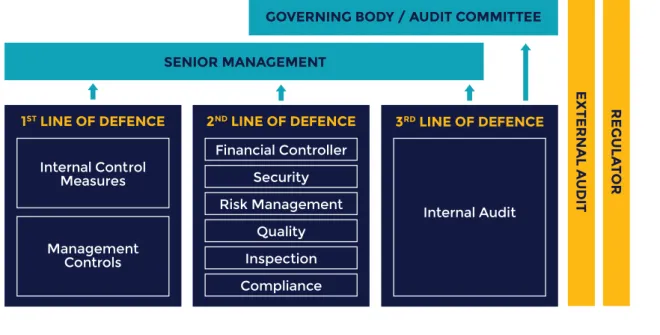
second line is in charge of methodology and monitoring; and the third line provides assurance on the effectiveness of governance, risk management and internal controls. Reporting lines, as illustrated in Fig. 1, show internal audit’s functional reporting line as being direct to the audit committee, which offers independence from the executive body and provides the necessary degree of objectivity to the role. Internal audit provides comprehensive assurance to the governing body and to senior management.
External audit can be considered as an additional line of defence, outside the organisation, with a limited mandate and specific scope to express an opinion on the financial statements.
This publication seeks to clarify the areas of difference between internal audit and external audit as well as to explain the working relationship between the two forms of audit. It will illustrate this with some examples of best practice.
SENIOR MANAGEMENT
GOVERNING BODY / AUDIT COMMITTEE
R E G U LA TO R E X TE R N A L A U D IT 1ST LINE OF DEFENCE Internal Control Measures Management Controls 3RD LINE OF DEFENCE Internal Audit 2ND LINE OF DEFENCE Financial Controller Security Risk Management Quality Inspection Compliance
Fig. 1: the three lines of defence model
31 Resolutions of the European Parliament, Official Journal – March 2013
2 IIA Global, Global Advocacy Platform, www.theiia.org
Improving cooperation between internal and external audit
4
Internal audIt’s role
and responsIbIlIty
Definition according to the
Institute of Internal auditors:
“Internal auditing is an independent, objective assurance and consulting activity designed to add value and improve an organisation’s operations. It helps an organisation accomplish its objectives by bringing a systematic,
disciplined approach to evaluate and improve the effectiveness of risk management, control, and governance processes.” 3 Internal audit is an important part of a company’s governance and assists boards and executive management in the effective operation of the organisation.
Internal audit acts as a catalyst for improving an organisation’s effectiveness and efficiency by
making recommendations based on objective analyses and assessments of data and processes.
To support the accomplishment of these responsibilities, the IIA International Professional Practices Framework (IPPF) provides a global framework for the profession. It includes the Standards, the Code of Ethics and the Practice Advisories. Moreover, IIA has developed international qualifications, such as Certified Internal Auditor (CIA) and other specific certifications (CRMA, CCSA) to support the acquisition of the knowledge and skills required of an internal auditor. Some country institutes offer their own recognised equivalents.
Improving cooperation between internal and external audit
5
Definition according to
International auditing and
assurance standards board:
“The external auditor shall express an opinion whether the financial statements are prepared, in all material respects, in accordance with the applicable financial reporting framework. The external auditor’s responsibilities are:
(i) To identify and assess the risks of material misstatement of the financial statements, whether due to fraud or error, design and perform audit procedures responsive to those risks, and obtain audit evidence that is sufficient and appropriate to provide a basis for the auditor’s opinion. The risk of not detecting a material misstatement resulting from fraud is higher than for one resulting from error, as fraud may involve collusion, forgery, intentional omissions, misrepresentations, or the override of internal control.
(ii) To obtain an understanding of internal control relevant to the audit in order to design audit procedures that are appropriate in the circumstances, but not for the purpose of
expressing an opinion on the effectiveness of the
entity’s internal control. In circumstances when the auditor also has a responsibility to express an opinion on the effectiveness of internal control in conjunction with the audit of the financial statements, the auditor shall omit the phrase that the auditor’s consideration of internal control is not for the purpose of expressing an opinion on the effectiveness of the entity’s internal control” 4 In addition to this role, external audit may carry out other assignments on a contractual basis that do not conflict with their primary role. External auditors have sole responsibility for the opinions they express on the financial statements.
International norms exist for the profession and are codified in the International Standard on Auditing (ISA) issued by the International Auditing and Assurance Standards Board. In each European country, specific laws apply for statutory audit in terms of nomination, standards and reports.
external audIt’s role
and responsIbIlIty
Improving cooperation between internal and external audit
6
tHe InteractIon
between Internal
and external audIt
Internal
audit functions are established as part of an entity’s internal control, risk and governance structures. The international norms for internal audit define the way internal audit may rely on other assurance providers (Standard 2050). In some industries, such as the financial sector, it is required by law to establish an internal audit function. The objectives and scope of an internal audit function vary widely and depend on the size and structure of the entityand the requirements of management. ISA 6105 sets out how the knowledge and experience of the internal audit function can inform the external auditor’s understanding of the entity and its environment. The standards for both internal and external audit require effective information sharing and coordination.
The external auditor has sole responsibility for the audit opinion expressed, and that responsibility is not reduced by the external auditor’s use of the work of the internal audit function.
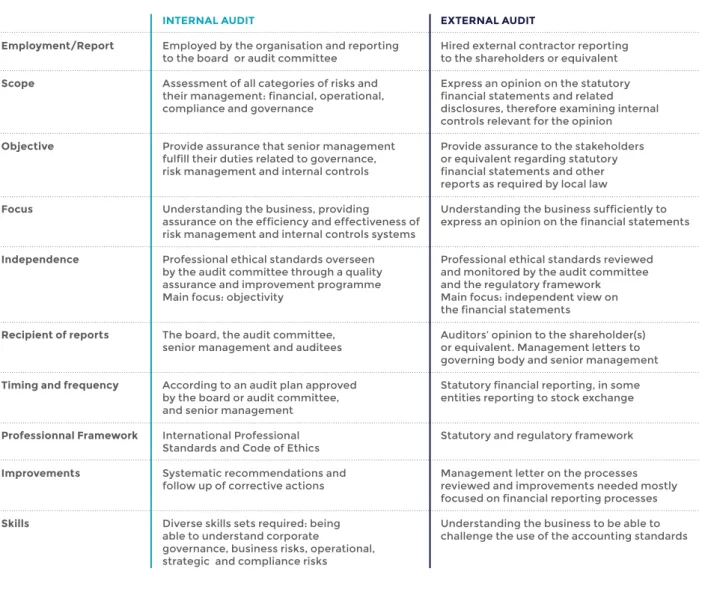
Fig. 2: the distinct roles of internal and external audit
65 The international norms for the external auditors (ISA 610 ) define the way external audit may use the work of internal audit to
modify the nature or timing or reduce the extent of the audit procedures to be performed directly by them
6 Best practice employment/report scope objective Focus Independence recipient of reports
timing and frequency
professionnal Framework Improvements
skills
Internal audIt
Employed by the organisation and reporting to the board or audit committee
Assessment of all categories of risks and their management: financial, operational, compliance and governance
Provide assurance that senior management fulfill their duties related to governance, risk management and internal controls
Understanding the business, providing
assurance on the efficiency and effectiveness of risk management and internal controls systems Professional ethical standards overseen by the audit committee through a quality assurance and improvement programme Main focus: objectivity
The board, the audit committee, senior management and auditees
According to an audit plan approved by the board or audit committee, and senior management International Professional Standards and Code of Ethics Systematic recommendations and follow up of corrective actions
Diverse skills sets required: being able to understand corporate
governance, business risks, operational, strategic and compliance risks
external audIt
Hired external contractor reporting to the shareholders or equivalent
Express an opinion on the statutory financial statements and related disclosures, therefore examining internal controls relevant for the opinion
Provide assurance to the stakeholders or equivalent regarding statutory financial statements and other reports as required by local law
Understanding the business sufficiently to express an opinion on the financial statements
Professional ethical standards reviewed and monitored by the audit committee and the regulatory framework Main focus: independent view on the financial statements
Auditors’ opinion to the shareholder(s) or equivalent. Management letters to governing body and senior management Statutory financial reporting, in some entities reporting to stock exchange
Statutory and regulatory framework
Management letter on the processes reviewed and improvements needed mostly focused on financial reporting processes
Understanding the business to be able to challenge the use of the accounting standards
Improving cooperation between internal and external audit
7
Interaction and cooperation
Interaction and cooperation between the internal auditors and external auditors should help the governing body obtain a more comprehensive view of operations and risks whilst eliminating areas of possible duplication of audit effort. Good communication between internal and external audit should also be of benefit to senior managers as both audit engagements and subsequent recommendations to the improvement of risk management and internal control will be better coordinated.
If the external auditor should decide to use the internal auditor’s work in arriving at their opinion, the process will be regulated by ISA 610.
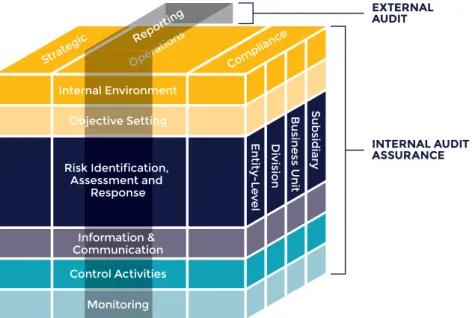
Given the specific scope and objectives of their mission, the risk information gathered by external auditors is typically limited to financial reporting risks, and does not include the way senior management and the board/ audit committee are managing/monitoring the organisation’s strategic, business and compliance risks. However, internal audit function can
provide assurance on these areas to senior management as well as the governing body.
This distinction between external and internal audit assurance can be graphically illustrated (See Fig. 3).
Whilst the objectives of external and internal audit activities are different, there may be some potential areas of overlap, particularly in the area of financial reporting. In particular, external audit may provide “management letter comments” in relation to internal control weaknesses noted in the course of their audit engagement.
Internal audit should consider these points in its audit planning process and may initiate separate follow-up activities to ascertain the effectiveness of management’s corrective actions. Similarly, external audit should consider internal audit findings as an input into their own work.
Before the cooperation takes place, each auditor will assess the work that can be reused from the other auditors.
A minimum level of interaction will be:
• That audit planning by both audit types should be coordinated in order to avoid duplication and overlap
• The internal auditors should make available the executive summary of their report to the external auditor and the external auditor should send a copy of their report and management letter to the chief audit executive
Fig. 3: coso’s enterprise risk management (erm) framework
E n tit y-Le ve l D iv is io n B u sin e ss U n it S u b sid ia ry Comp liance Strate gic Opera tions INTERNAL AUDIT ASSURANCE EXTERNAL AUDIT eratio ns Oper Repo rting Internal Environment Objective Setting Information & Communication Control Activities Monitoring Risk Identification, Assessment and Response
Improving cooperation between internal and external audit
8
• The internal and external auditors shouldmeet at least once a year to discuss common issues and concerns and ensure coordination
• The chief audit executive should attend the audit committee (or board) meeting for agenda items relating to the external auditors status report. A higher and more frequent level of cooperation may include:
• The exchange of information and discussion during the risk assessment exercise
concerning financial and other types of risks
• The evaluation of internal controls evidenced in the detailed internal audit reports could be made available to the external auditors
• An exchange of views on methodology and framework in order to establish a mutual understanding of audit approach
• Regular information to the external auditor on updates to the internal audit plan
• Upon request, and where allowed by law, enable access to specific working papers
• Internal audit interim reports including
current status and progress on implementation of recommendations could be made available to external audit
• Regular meetings between the internal auditors and external auditors to discuss any relevant issues
• Depending on the level of risks, the inclusion of the external auditors’ recommendations in the internal audit status report
• The regular participation of the chief audit executive in any meetings the audit committee (or board) holds with the external auditor.
It is recommended that the degree of
cooperation should be discussed and defined at audit committee (or board) level. The
confidentiality of audit work must be respected7. The detailed nature of the cooperation may also be specified in the internal audit charter. The chief audit executive8 should assess on a regular basis the coordination between the internal auditors and the external auditors.
7 International Standard on Auditing 610 §33
Improving cooperation between internal and external audit
9
Internal
audit assists the board in the effective operation of the company. External audit expresses an opinion on the financial statements addressed to the board and the markets.Each type of audit has its well-defined role, scope and responsibilities. Most internal audit engagements review non-financial processes, while external audit is mainly focused on financial processes.
Nevertheless, it is recommended that internal audit and external audit collaborate in order to harmonise the message received by the governing body. The audit committee should define and manage the scope of this cooperation.
The level and intensity of the collaboration may vary based on various factors on both sides, but organisations should ensure a certain degree of cooperation between the two functions.
As a minimum, we would advise organisations to exchange information on the planning of the work to be performed, and in areas of work with potentially high levels of impact. Executive summaries, or an annual report, should be made available by internal audit to external audit. External audit should share their report and management letter with internal auditors.
This relationship between internal audit and external audit will facilitate the work of both sets of auditors, avoid duplication, and ensure the maximum coverage of the risks faced by the entity. It will also help the governing body obtain a comprehensive view of the controls and the risks of the entity.
conclusIons
Improving cooperation between internal and external audit
10
examples of best practice in
effective cooperation:
The nature and extent of cooperation varies from one organisation to another. The level of maturity of the internal audit department is important, as well as its level of professionalism and resources.
For this reason, cooperation can best be illustrated through concrete examples.
1. assurance mapping
According to IIA Standard Practice Advisory 2110: “The internal audit activity must evaluate and contribute to the improvement of governance, risk management, and control processes using a systematic and disciplined approach…. Coordinating the activities of and communicating information among the board, external and internal auditors, and management.”
There are different functions in the organisation in charge of controls and risk. Each one is looks at a defined part of the organisation with its own methodology. This is why assurance mapping is a useful tool for obtaining a global overview of the various risk evaluations. Its purpose is to visualise which controls have been effective in the
reporting period for highlighting key risks. It helps the governing bodies to get a comprehensive view of the way risks are managed.
Fig. 4 illustrates that there might be areas where risk management and compliance give different ratings based on their separate remits and priorities. Internal audit should make its own independent review of these ratings and external auditors should consider on which processes it is necessary to get comfort in order to enable them to express their opinion on the financial statements.
appendIx
Fig. 4: assurance mapping
1st lIne 2nd lIne 3rd lIne External audit
In charge Risk Compliance Internal audit internal control
Management relevant to financial reporting process segment a Process 1 Process 2 N/A … segment b Process 1 Process 2 N/A … segment c
Process 1 N/A N/A
Process 2 N/A … ratIngs: Satisfactory Improvements needed Unsatisfactory
Improving cooperation between internal and external audit
11
2. the banking sector
There are many opportunities for cooperation between internal audit and external audit in the audit cycle, as shown below.
pHase planning (annual/strategic) execution reporting 1. regular 2. annual Internal audIt Risk assessment
Identifying and assessing control design and efficiency for all processes (including financial reporting process).
1. Reporting to management.
2a. Reporting to external audit regarding controls audited and effectiveness. 2b. Audit committee/ supervisory board on the overall control environment and main risks/actions. external audIt Risk assessment Evaluating financial reporting processes, control efficiency and level of reliance on them
1. Reporting to management, the chief executive officer and internal audit 2. Reporting to management, the chief executive officer, board, internal audit and shareholders.
cooperatIon Agreeing on high risks, agreeing on scope of both internal and external audits to save resources. Using of the same numbering for financial processes to ease communication during the internal audit of key controls. *Risk management/ compliance function can be involved in control identification work. Agreeing on deadlines for reporting is very important for external audit to be able to use information from internal audit in its work. Also, internal audit should receive data from external audit considering risk areas identified in the financial reporting process and in other areas, such as IT.
3. the utilities sector
The internal audit plan is presented to the external auditors in December. It is approved by management and the audit committee before the end of March in the presence of the external auditors. The final plan of the external auditors is then approved by the chief financial officer in April so that he or she can ensure that cooperation between the audit functions has been planned properly by each side.
The external auditors are invited to the audit committee twice a year to discuss internal audit matters: audit planning and the summary of the audit engagements’ findings and recommendations.
Before they issue their half-yearly financial report, the external auditors receive the internal audit reports for the same half-year period being examined.
Before an internal audit of a large entity starts, the internal auditors meet with the external auditors in order to exchange views on relevant information.
Before the review of any financial process, the internal auditors present their terms of reference and their audit program to the external auditors. They discuss the approach taken, and the external auditors communicate any information they may have previously collected on the processes being reviewed. In this way there is no redundancy in the work performed.
An internal audit guide for financial processes has been set up showing common and specific objectives for each process. The guide has been discussed and approved by the external auditors.
The internal auditors are present at the meeting organised by the external auditors to present their management letters and recommendations.
European Confederation of Institutes
of Internal Auditing (ECIIA)
Koningsstraat 109-111
Bus 5, BE–1000
Brussels, Belgium
www.eciia.eu
our mIssIon
To be the consolidated voice for the profession of internal auditing in Europe by dealing with the European Union,its Parliament and Commission and any other appropriate institution of influence and to present and develop the internal audit profession and good corporate governance in Europe.
IIA Austria www.internerevision.at
IIA Azerbaidjan www.audit.gov.az
IIA Belgium www.iiabel.be
IIA Bosnia and
Herzegovina www.interni-revizori.info
IIA Bulgaria www.iiabg.org
IIA Croatia www.hiir.hr
IIA Cyprus www.iiacyprus.org.cy
IIA Czech www.interniaudit.cz
IIA Denmark www.iia.dk
IIA Estonia www.theiia.org/chapters
IIA Finland www.theiia.fi
IIA France www.ifaci.com
IIA Germany www.diir.de
IIA Georgia www.theiia.org/chapters
IIA Greece www.theiia.org/chapters
IIA Hungary www.iia.hu
IIA Iceland www.fie.is
IIA Italy www.aiiaweb.it
IIA Latvia www.iai.lv
IIA Lithuania www.theiia.org/chapters
IIA Luxembourg www.theiia.org/chapters
IIA Montenegro www.iircg.co.me
IIA Morocco www.theiia.org/chapters
IIA Netherlands www.iia.nl
IIA Norway www.iia.no
IIA Poland www.iia.org.pl
IIA Portugal www.ipai.pt
IIA Romania www.aair.ro
IIA Serbia www.theiia.org/chapters
IIA Slovakia www.skiia.sk
IIA Slovenia www.si-revizija.si/iia/
IIA Spain www.auditoresinternos.es
IIA Sweden www.internrevisorerna.se
IIA Switzerland www.svir.ch
IIA Tunisia www.iiatunisia.org.tn
IIA Turkey www.tide.org.tr