AN INVESTIGATION OF SELF-BIASES IN
PERCEPTION AND VISUAL
PERSPECTIVE TAKING
BRADLEY DALE MATTAN
A thesis submitted to the University of Birmingham
for the degree of DOCTOR OF PHILOSOPHY
School of Psychology College of Life and Environmental Sciences University of Birmingham December 2015
University of Birmingham Research Archive
e-theses repositoryThis unpublished thesis/dissertation is copyright of the author and/or third parties. The intellectual property rights of the author or third parties in respect of this work are as defined by The Copyright Designs and Patents Act 1988 or as modified by any successor legislation.
Any use made of information contained in this thesis/dissertation must be in accordance with that legislation and must be properly acknowledged. Further distribution or reproduction in any format is prohibited without the permission of the copyright holder.
ABSTRACT
This thesis addressed three questions regarding our tendency to prioritise recently learned self-associations. Following an overview of cognitive self-biases in Chapter 1, Chapter 2 explored how novel self-associations impact higher-level social cognition, namely, visual perspective taking (VPT). In Experiments 1–3, we examined how participants respond to third-person perspectives (3PPs) associated with self and other. Participants showed superior performance when explicitly targeting a self-associated (vs. other-associated) 3PP. Chapter 3 extended this line of research by examining whether these self-bias effects are related to social-cognitive ability and executive function. In Experiments 4–5, we found that both individual differences in empathy and putative age-relevant motivations reliably modulated self-bias in third-person VPT. These findings suggest that VPT paradigms draw on specific and domain-general capacities. Chapter 4 examined the extent to which interpersonal dimensions (e.g., day-to-day personal relevance and valence) may explain self-tagging effects. Using
behavioural and fMRI methodology, Experiments 6–8 showed that self-processing was largely independent of responses to relevance and valence in others. Finally, Chapter 5 provides a broader discussion of findings from the preceding chapters, offering some possible future research directions.
DEDICATION
I dedicate this thesis to my parents who, long before I ever read the words Per Ardua Ad Alta, taught me by example to work diligently and be the best that I can be. I am immensely grateful for their loving support and for their patience with my propensity to live in places very far from home.
ACKNOWLEDGMENTS
The work reported in this thesis was made possible thanks to the support of many1. I would first like to acknowledge my supervisors Drs. Kim Quinn (#kimquinn) and Pia Rotshtein who guided me throughout these three years. Through Kim and Pia, I benefitted greatly from exposure to, and integration of, social psychology and cognitive neuroscience approaches. I also benefitted from Kim’s and Pia’s evident passion both for research and life in general. Working with them, I learned just how enjoyable the research process can be. (After all, how many social cognition researchers have their own hashtag?) I can’t thank Kim and Pia enough for the training I have received here at Birmingham.
Beyond my supervisors, I received key feedback on my work from a number of researchers at Birmingham and beyond. I would like to thank Prof. Ian Apperly for kindly inviting me to attend his lab meetings. Ian and his lab members were very helpful during the initial design and subsequent development of the 3PP-3PP and 1PP-3PP paradigms reported in Chapters 2–3. I would also like to thank Drs. Jie Sui and Dana Samson, whose research on self-tagging and visual perspective taking, respectively, inspired the development of the 3PP-3PP and 1PP-3PP-3PP paradigms. I am most grateful for their insightful comments on my findings at various stages. I also thank Dr. Biman Chakraborty at the University of Birmingham for his comments on the sensitivity analyses reported in Experiments 6–7. I would also like to thank the members of the Friday morning cognitive neuroscience breakfast group. I’m grateful both for the feedback I received in those meetings as well as members’ patience with my occasional
1
Because this work is truly a collaborative effort, this is the only section of the thesis where the reader will find the first-person pronoun (notwithstanding the Jamesian “I” in Chapter 1 and incidental item descriptions). I instead use “we” when adopting the active voice in the main text.
badgering of volunteers to give presentations. Finally, I would like to thank my former office mates, in particular Robin Green and Ahmad Abu-Akel, both of whom offered friendly support and thoughtful advice on projects, career development, and life in the UK.
During my time here at Birmingham, I was fortunate to receive training in fMRI data collection and analysis. There are so many to thank, especially regarding the implementation of Experiment 8. I’m thankful to my friend and colleague Johnny Lau for assisting as scanner operator for Experiment 8. I certainly won’t forget the late nights at BUIC, nor stand-up paddling at the reservoir! I also thank my office mates Aimee Goldstone and Rosalind Baker for stepping in during those crucial moments when we happened to be without a full scanner operator. I am grateful for Pia’s time and patience both during the data collection process and in training this social psychologist to use SPM—not an easy feat! I thank my participants for their patience with scheduling problems and their enthusiasm to support the present research. Finally, I thank BUIC for hosting this project and supporting it financially with 30 unfunded scanner hours.
I would like to acknowledge all of the undergraduate research volunteers and project students who assisted with data collection and programming during my PhD. I thank volunteers Stephanie Acaster, Phoebe Armitage, and Rebecca Jennings for assisting with Experiment 5, third-year project students Zoe Olumoyegun and Victoria Scrase for assisting with Experiment 4, and volunteer team Abisayo Abiloye, Adenike Adesanya, Joanne Bottell, Alexandra Cryer, William Robson, and Emily Sumner for assisting with Experiment 6. Data collection in China for Experiment 7 was coordinated by Yang Sun, a postgraduate researcher in Dr. Jie Sui’s lab at Tsinghua University in Beijing. For all studies involving ageing, I would like to thank Denise Clissett for her impeccable organisational ability as well as the older participants who are some of the brightest and most interesting individuals I had the pleasure of
meeting in the UK. Finally, I would like to thank research volunteer Agnieszka Rześniowiecka and third-year project students Abigail Dorling and Anna Kubinski for their collaboration in projects not reported in this thesis.
Finally, as an international student, none of the work presented here would have been possible were it not for the generous funding I received from the University of Birmingham’s Doctoral Researcher Elite Scholarship.
TABLE OF CONTENTS
ABSTRACT ... i DEDICATION ... ii ACKNOWLEDGMENTS ... iii TABLE OF CONTENTS ... vi LIST OF TABLES ... xiLIST OF FIGURES ... xiii
GLOSSARY ... xv
CHAPTER 1: REVIEW OF COGNITIVE SELF BIASES ... 1
1.1. Self-Priority Effects in Memory ... 1
1.2. Self-Priority Effects in Attention ... 3
1.3. Overview of Research Programme ... 5
CHAPTER 2: SELF-TAGGING OF VISUAL PERSPECTIVES ... 7
2.1. Introduction ... 7
2.1.1. Review of Existing Visual-Spatial Perspective-Taking Paradigms ... 7
2.1.2. Self in the First- and Third-Person ... 11
2.1.3. Chapter Overview ... 12
2.2. Experiment 1: 3PP-3PP Task Pilot ... 14
2.2.1. Introduction ... 14
2.2.2. Method ... 16
2.2.3. Results ... 21
2.2.4. Discussion ... 24
2.3. Experiment 2: 3PP-3PP Task Replication ... 26
2.3.1. Introduction ... 26
2.3.2. Method ... 27
2.3.3. Results ... 31
2.3.4. Discussion ... 33
2.4. Experiment 3: Comparison of 3PP-3PP and 1PP-3PP Tasks ... 36
2.4.1. Introduction ... 36
2.4.2. Method ... 37
2.4.4. Discussion ... 44
2.5. General Discussion of Experiments 1–3 ... 48
2.5.1. Chapter Summary ... 48
2.5.2. Prioritisation of Self-Relevant Perspectives ... 48
2.5.3. Implications for Perspective Computation and Selection ... 52
2.5.4. Methodological Considerations ... 55
2.5.5. Conclusion ... 55
CHAPTER 3: VISUAL PERSPECTIVE TAKING AND INDIVIDUAL DIFFERENCES IN SOCIAL COGNITION ... 57
3.1. Introduction ... 57
3.1.1. How Social Is Visual Perspective Taking? ... 57
3.1.2. Chapter Overview ... 60
3.2. Experiment 4: Self Priority as a Function of Empathic Tendency ... 61
3.2.1. Introduction ... 61
3.2.2. Method ... 63
3.2.3. Results ... 69
3.2.4. Discussion ... 73
3.3. Experiment 5: Prioritisation of Self-Relevant Perspectives in Ageing ... 78
3.3.1. Introduction ... 78
3.3.2. General Method ... 82
Participants. ... 82
3.3.3. Results and Discussion ... 84
3.3.3.1. Task 1: Avatar Identity-Matching Task ... 84
3.3.3.2. Task 2: 3PP-3PP Task ... 86
3.3.3.3. Task 3: 1PP-3PP Task ... 89
3.3.4. General Discussion ... 97
3.3.4.1. Age-Related Biases in Perspective Taking ... 97
3.3.4.2. Future Directions ... 101
3.3.4.3. Alternative Interpretations ... 104
3.3.4.4. Conclusion ... 106
3.4. General Discussion ... 108
3.4.2. Overlapping Systems for Visual and Social Perspective-Taking ... 108
3.4.3. Alternative Interpretation: Executive Capacity ... 111
3.4.4. Conclusion ... 111
CHAPTER 4: NEUROCOGNITIVE DETERMINANTS OF SOCIAL TAGGING ... 113
4.1. Introduction ... 113
4.1.1. Self-Effects in Perception and Attention, Revisited ... 114
4.1.2. Chapter Overview ... 116
4.2. Experiment 6: Mapping Self and Others by Relevance and Valence ... 117
4.2.1. Introduction ... 117
4.2.1.1. Relevance and Valence in Memory and Attention ... 117
4.2.1.2. Individual Differences in Relevance/Valence Sensitivity ... 119
4.2.1.3. Analyses and Predictions ... 119
4.2.2. Method ... 120
4.2.3. Results ... 123
4.2.3.1. Performance for Non-Self Shapes ... 123
4.2.3.2. Performance for the Self Shape ... 125
4.2.3.3. Evidence for Self-Anchoring in Social Space ... 126
4.2.4. Discussion ... 131
4.3. Experiment 7: Cross-Cultural Differences in Self−Other Mapping ... 138
4.3.1. Introduction ... 138
4.3.1.1. Cross-Cultural Evidence for a Unique and Positive Self ... 138
4.3.1.2. Mapping the Self and Others across Cultures ... 142
4.3.1.3. Present Study ... 144
4.3.2. Method ... 145
4.3.3. Results ... 145
4.3.3.1. Performance for Non-Self Shapes ... 146
4.3.3.2. Performance for the Self Shape ... 148
4.3.3.3. Cross-Cultural Evidence for Self-Anchoring in Social Space ... 150
4.3.4. Discussion ... 151
4.4. Experiment 8: Neural Coordinates of Self and Others Using fMRI ... 154
4.4.1. Introduction ... 154
4.4.1.2. Hippocampus ... 156
4.4.2. Method ... 157
4.4.3. Results ... 160
4.4.3.1. Summary of Behavioural Results ... 160
4.4.3.2. fMRI Group-Level Analysis ... 161
4.4.3.3. fMRI Individual Differences Analysis ... 165
4.4.4. Discussion ... 168
4.4.4.1. Main Effects ... 169
4.4.4.2. Relevance × Valence Interaction ... 171
4.4.4.3. Valence Sensitivity and Neural Self Bias. ... 173
4.4.4.4. Summary of Key Findings and Conclusions ... 177
4.5. General Discussion ... 181
4.5.1. Chapter Summary ... 181
4.5.2. Implications for the Self and Social Cognition Literatures ... 182
4.5.3. Methodological Considerations ... 184
4.5.4. Conclusion ... 186
CHAPTER 5: GENERAL DISCUSSION ... 188
5.1. Summary and Significance of Empirical Findings ... 188
5.2. Future Directions ... 191
5.2.1. Visual Perspective Taking and the Intergroup Context ... 191
5.2.2. Integrated Model of Social Cognition for Self and Others ... 192
5.3. Conclusion ... 195
REFERENCES ... 197
APPENDICES ... 233
1. Author’s Note ... 233
2.1. 3PP-3PP Pilot Task Design for Experiment 1 ... 234
2.2. 3PP-3PP Task Design Modifications for Experiment 2 ... 235
2.3. Mismatch Trial Analyses for Experiment 2 ... 236
2.4. Mismatch Trial Analysis for Experiment 3 ... 237
2.4.1. 3PP-3PP Task ... 237
2.4.2. 1PP-3PP Task ... 238
3.2. Analysis of RT and Accuracy Data for Experiment 4 ... 241
3.2.1. Perspective-Taking Task Replication ... 241
3.2.2. Empathy and VPT ... 242
3.3. Cognitive Assessment Data for Experiment 5 ... 247
3.4. Supplementary Analysis for Experiment 5 ... 248
3.4.1. Introduction ... 248
3.4.2. Avatar Identity-Matching Task ... 249
3.4.3. 3PP-3PP Task ... 252
3.4.4. 1PP-3PP Task ... 257
3.5. Mean Untransformed Data for Experiment 5 ... 272
3.5.1. Avatar Identity-Matching Task ... 272
3.5.2. 3PP-3PP Task ... 272
3.5.3. 1PP-3PP Task ... 273
4.1. Mismatch Trial Analyses for Experiment 6 ... 274
4.1.1. Performance for Non-Self Shapes ... 274
4.1.2. Performance for the Self Shape ... 275
4.2. Sensitivity Analysis for Experiment 6: Predicting the Self-Tagging Advantage ... 277
4.2.1. Sensitivity Index Computation ... 277
4.2.2. Primary Analysis ... 278
4.2.3. Supplementary Analysis ... 284
4.3. Analysis of Chinese Participants Only for Experiment 7 ... 286
4.3.1. Performance for Non-Self Shapes ... 286
4.3.2. Performance for the Self Shape ... 288
4.3.3. Relevance and Valence Sensitivity Analyses ... 289
4.4. Mismatch Trial Analyses for Group-Level Analyses, Experiment 7 ... 300
4.4.1. Performance for Non-Self Shapes ... 300
4.4.2. Performance for the Self Shape ... 301
4.5. Optimisation of the Social-Tagging Task for fMRI ... 306
4.6. Behavioural Data Analysis for Experiment 8 ... 308
4.6.1. Performance for Non-Self Shapes ... 308
LIST OF TABLES
TABLE 2.1. Descriptive Statistics for the Avatar Identity-Matching Task, Experiment 1... 22
TABLE 2.2. Descriptive Statistics for 3PP-3PP Task, Experiment 1...23
TABLE 2.3. Descriptive Statistics for the Avatar Identity-Matching Task, Experiment 2... 31
TABLE 2.4. Descriptive Statistics for 3PP-3PP Task, Experiment 2...33
TABLE 2.5. Descriptive Statistics for the Avatar Identity-Matching Task, Experiment 3... 40
TABLE 2.6. Descriptive Statistics for 3PP-3PP Task, Experiment 3...42
TABLE 2.7. Descriptive Statistics for 1PP-3PP Task: Efficiency Scores, Experiment 3...44
TABLE 2.8. Descriptive Statistics for 1PP-3PP Task: RT and Accuracy, Experiment 3...46
TABLE 3.1. Descriptive Statistics for 3PP-3PP Task, Experiment 4...70
TABLE 3.2. ANCOVA Summaries for Empathy Subscales: Efficiency, Experiment 4...71
TABLE 3.3. Descriptive Statistics for the Avatar Identity-Matching Task, Experiment 5... 85
TABLE 3.4. Response Accuracy by Condition: 3PP-3PP Task, Experiment 5...88
TABLE 3.5. Summary of Findings for Experiment 5...95
TABLE 4.1. Descriptive Statistics for the Perceptual Matching Task, Experiment 6... 124
TABLE 4.2. Group-Level Contrasts for Relevance and Valence, Experiment 8...162
TABLE 4.3. Interactions between Valence Sensitivity and Self–Other Bias, Experiment 8....166
TABLE S1. ANCOVA Summaries for Empathy Subscales: RT Data, Experiment 4... 243
TABLE S2. Demographic and Cognitive Measures for Older Participants, Experiment 5...247
TABLE S3. Descriptive Statistics for the Avatar Identity-Matching Task: Match/Mismatch Trials, Experiment 5...249
TABLE S4. Descriptive Statistics for the 3PP-3PP Task: True/False Trials, Experiment 5.... 253
TABLE S5. ANOVA Summaries for the 3PP-3PP Task: True/False Trials, Experiment 5...255
TABLE S6. Descriptive Statistics for the 1PP-3PP Task: True/False Trials, Experiment 5.... 258
TABLE S8. Follow-up ANOVAs for the 1PP-3PP Task: True/False Trials, Experiment 5...267
TABLE S9. Untransformed RTs: Avatar Identity-Matching Task, Experiment 5...272
TABLE S10. Untransformed RTs: 3PP-3PP Task, Experiment 5... 272
TABLE S11. Untransformed RTs: 1PP-3PP Task, Experiment 5... 273
TABLE S12. Self-Tagging-Effect Regression Summaries, Experiment 6... 283
TABLE S13. Mean-Performance Regression Summaries, Experiment 6...285
TABLE S14. Descriptive Statistics for the Perceptual-Matching Task, Experiment 7...287
TABLE S15. Self-Tagging-Effect Regression Summaries, Experiment 7... 293
TABLE S16. Mean-Performance Regression Summaries, Experiment 7...299
LIST OF FIGURES
FIGURE 2.1. Illustration of Original 3PP-3PP Task Virtual Room from Experiment 1...15
FIGURE 2.2. Trial Procedure for the 3PP-3PP Task Used in Experiments 1–3, and 5...20
FIGURE 2.3. Illustration of 3PP-3PP Task Virtual Rooms from Experiment 2 and 5...27
FIGURE 2.4. Trial Procedure for the 1PP-3PP Task Used in Experiments 3 and 5...39
FIGURE 3.1. Illustration of the 3PP-3PP task Virtual Rooms from Experiment 4……… 67
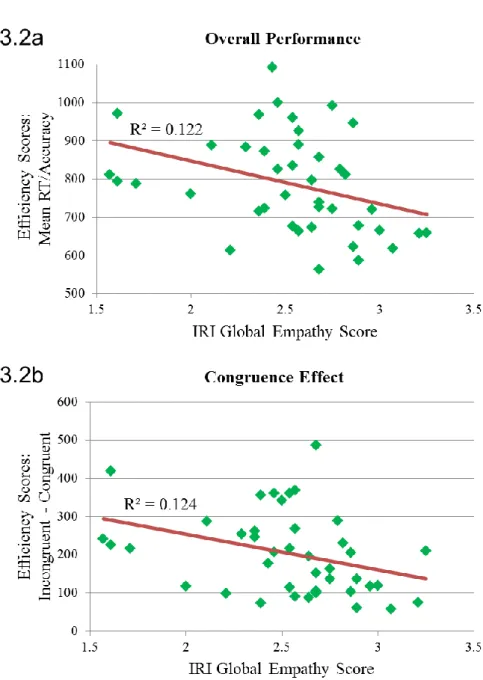
FIGURE 3.2. Empathy Predicts Overall VPT Efficiency and Interference, Experiment 4... 72
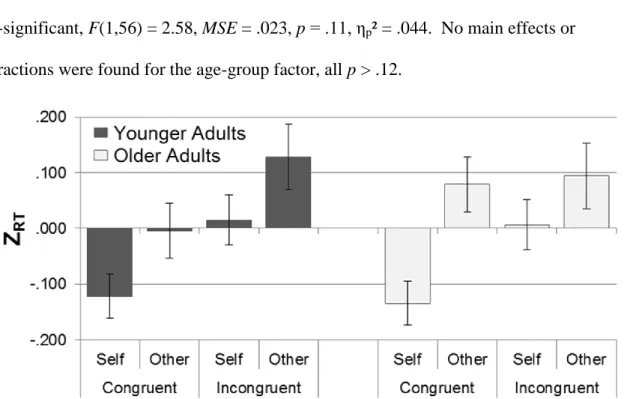
FIGURE 3.3. Z-Transformed RT Data in the 3PP-3PP Task, Experiment 5...88
FIGURE 3.4. Z-Transformed RT Data in the 1PP-3PP Task, Experiment 5...92
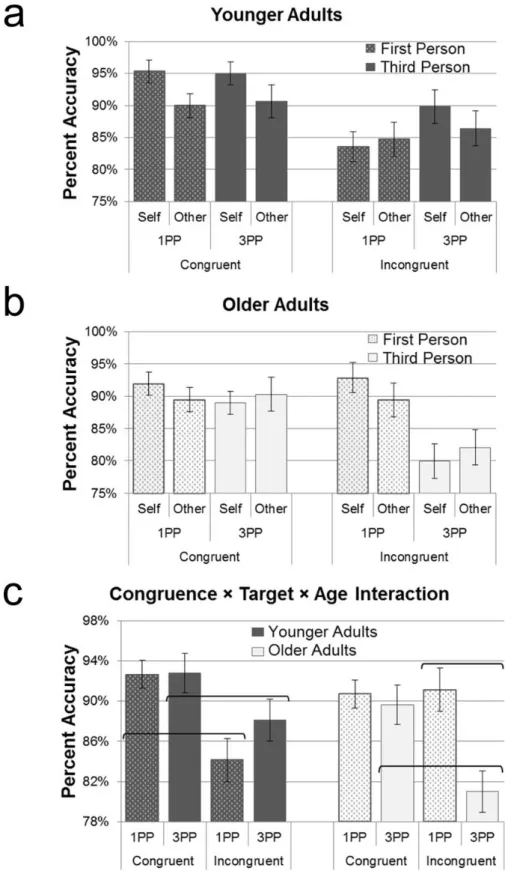
FIGURE 3.5. Accuracy Data in the 1PP-3PP Task, Experiment 5...94
FIGURE 4.1. Shapes Used in the Perceptual-Matching Task, Experiments 6–8...122
FIGURE 4.2. Accuracy Data from the Perceptual-Matching Task, Experiment 6... 125
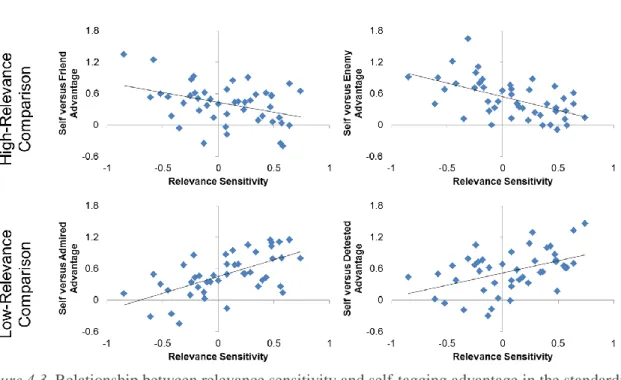
FIGURE 4.3. Relevance Sensitivity and Self-Bias in the RT data, Experiment 6...127
FIGURE 4.4. Valence Sensitivity and Self-Bias in the RT data, Experiment 6... 127
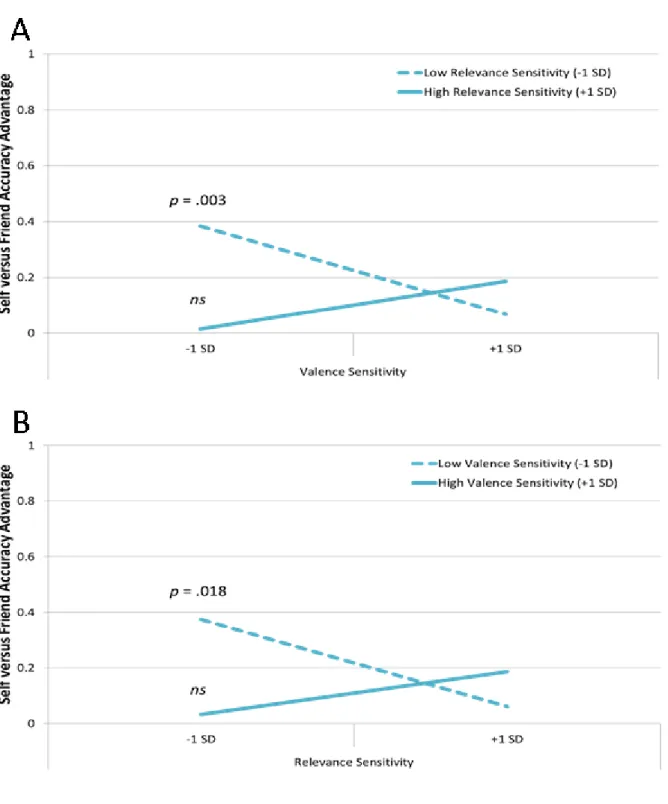
FIGURE 4.5. Simple Slopes for the Self-vs-Friend Accuracy Regression, Experiment 6... 129
FIGURE 4.6. Simple Slopes for the Self-vs-Detested Accuracy Regression, Experiment 6....130
FIGURE 4.7. Overall Neural Sensitivity to Relevance and Valence, Experiment 8... 163
FIGURE 4.8. Neural Sensitivity to Relevance × Valence Interaction, Experiment 8...164
FIGURE 4.9. Valence Sensitivity and Neural Self-vs-Friend Bias, Experiment 8...167
FIGURE 5.1. Hypothetical Three-Dimensional Social Space Including Self and Others...193
FIGURE S1. Example of a Completed Social Distance Map, Experiment 4...240
FIGURE S2. Empathy and RT Perspective Interference Effects, Experiment 4... .244
FIGURE S3. Perspective Congruence × Target Perspective × Age Group Interaction in the 3PP-3PP Task from Experiment 5...254
FIGURE S4. Trial Type × Perspective Congruence × Avatar Identity × Age Group Interaction in the 1PP-3PP Task from Experiment 5...261
FIGURE S5. Trial Type × Perspective Congruence × Target Perspective × Age Group Interaction in the 1PP-3PP Task from Experiment 5... 262
FIGURE S7. Simple Slopes for the Self-vs-Friend Accuracy Regression, Experiment 7...294 FIGURE S8. Simple Slopes for the Self-vs-Detested Accuracy Regression, Experiment 7… 297
GLOSSARY
1PP First-Person Perspective
1PP-3PP Task First- versus Third-Person Perspective-Taking Task
3PP Third-Person Perspective
3PP-3PP Task Third-Person Perspective-Taking Task
AC–PC Axis Axis from Anterior Commissure to Posterior Commissure
ANCOVA Analysis of Covariance
ANOVA Analysis of Variance
BOLD Signal Blood Oxygenation Level Dependent Signal
DARTEL Diffeomorphic Anatomical Registration using Exponentiated Lie Algebra DLPFC Dorsolateral Prefrontal Cortex
DMPFC Dorsomedial Prefrontal Cortex
EPI Echo-Planar Image
fMRI Functional Magnetic Resonance Imaging
FWE Family-Wise Error
FWHM Full-Width Half Maximum
GBP British Pound Sterling
GLM General Linear Model
HRF Haemodynamic Response Function
IFG Inferior Frontal Gyrus
IPL Inferior Parietal Lobule
IPS Intra-Parietal Sulcus
IRI Interpersonal Reactivity Index
MFG Middle Frontal Gyrus
MNI Montreal Neurological Institute
OFC Orbitofrontal Cortex
PET Positron Emission Tomography
POS Parieto-Occipital Sulcus
pSTS Posterior Superior Temporal Sulcus
RMB Chinese Yuan
RT Response Time
SAN Self-Attention Network
SCM Stereotype Content Model
SFG Superior Frontal Gyrus
SMG Supra-Marginal Gyrus
SPM12 Statistical Parametric Mapping, Version 12
TPJ Temporo-Parietal Junction
V6 Visual Area 6, Occipital Lobe
VMPFC Ventral Medial Prefrontal Cortex
VPT Visual Perspective Taking
CHAPTER 1: REVIEW OF COGNITIVE SELF BIASES
Philosophers and psychologists alike have long considered the self to be comprised of at least two components, one that perceives and another that is displayed and seen by others (see Damasio, 1999; Gallagher, 2000; James, 1890). The perceived self (Jamesian “me”), refers to aspects of the self that are externally accessible. Examples of this aspect of the self include one’s own face, voice, name, and may even be extended to include one’s own belongings (Beggan, 1992). The perceiving self (Jamesian “I”) refers to those aspects of the self that are intrinsic to subjective consciousness. Thus, the perceiving self is thought to include phenomena such as interoceptive awareness (Seth, 2013) and the general sense that reality is coherent and fluidly organised around a unitary point (Sass & Parnas, 2003).Although the perceiving self is notoriously difficult to study (S. B. Klein, 2012), the perceived self has generated much research. Consequently, this thesis is primarily concerned with the perceived self. In this chapter, we provide a review of key self biases in memory and attention prior to outlining the programme of research covered in subsequent chapters.
1.1. Self-Priority Effects in Memory
One of the first popular approaches to the perceived self was in the field of memory. Initial reports suggested that perceivers are more likely to remember stimuli processed in reference to the self (Rogers, Kuiper, & Kirker, 1977). Subsequently coined the “self-reference effect”, this phenomenon has been replicated numerous times (see Symons & Johnson, 1997, for a meta-analysis). This memory advantage for self-relevant information is thought to be due to the elaborate structure of the self-concept, which facilitates the
assimilation of new information into memory (Markus, 1977). Notably, these memory improvements are observed for both explicitly and minimally self-relevant stimuli. In one
study on minimal self-relevance (Cloutier & Macrae, 2008), pairs of participants sequentially selected numbers either from a bowl (“selected” condition) or from pre-sorted piles of
numbers placed in front of each participant (“assigned” condition). These numbers were paired with trait words that were spoken aloud by the experimenter to both participants. Memory for words selected by the self (versus those chosen by the other dyad member) was better in the “selected” condition relative to the arguably less self-involved “assigned” condition. In summary, it appears that explicit self-related processing is not necessary to obtain a self-reference memory effect.
The phenomenon of superior encoding of self-relevant stimuli also extends to the social domain. Dual-process models of person perception (e.g., Brewer & Feinstein, 1999; Fiske, Lin, & Neuberg, 1999) propose that a social target’s personal relevance is a key determinant of the extent to which the perceiver individuates and ultimately remembers that target (see also Quinn & Rosenthal, 2012). In these models, individuation refers to a tendency to encode and elaborate on person-specific information rather than relying on minimal category-based processing. For example, if the social target happens to be from one’s own ingroup or a co-worker, that person is likely to be processed in more depth (i.e., individuated) than a stranger belonging to an outgroup, who is summarily processed as non-individuated representative of a relatively non-specific social category (e.g., immigrant). Inspired by classic models of person perception, an extensive literature has demonstrated that perceivers indeed show general processing and memory deficits for low-relevance outgroup members (Hugenberg & Sacco, 2008; Hugenberg, Young, Bernstein, & Sacco, 2010). Notably, this tendency is reduced when outgroup targets become personally relevant either through experience (Hancock & Rhodes, 2008; Rhodes et al., 2009) or the sudden
part of one’s ingroup: Bernstein, Young, & Hugenberg, 2007; Cassidy, Boutsen, Humphreys, & Quinn, 2014; Cassidy, Quinn, & Humphreys, 2011; Hehman, Mania, & Gaertner, 2010; Shriver, Young, Hugenberg, Bernstein, & Lanter, 2008).
1.2. Self-Priority Effects in Attention
Beyond memory, the self also appears to guide attention. Despite our ability to hone our attention on one aspect of a perceptually noisy environment (e.g., a quiet conversation, as in the cocktail party effect; Moray, 1959; Wood & Cowan, 1995a), we are especially likely to experience interference from unattended cues if they are self-relevant (e.g., one’s own first name; A. R. A. Conway, Cowan, & Bunting, 2001; Moray, 1959; Wood & Cowan, 1995b). Additional work supports the notion that self-relevant information captures attention relative to non-self-relevant information both when it is detrimental to conscious task performance (Geller & Shaver, 1976; Hull & Levy, 1979) and presented outside of conscious awareness (Bargh, 1982). However, attentional effects of self-related stimuli are not limited to words and auditory stimuli. Visual stimuli such as one’s own face elicit faster behavioural responses (Keenan et al., 1999; Sui, Zhu, & Han, 2006) and are harder than other faces to ignore
(Brédart, Delchambre, & Laureys, 2006; Devue & Brédart, 2008). Moreover, self-face recognition is thought to be supported by different brain regions compared to well-liked and personally familiar faces (Keenan, Wheeler, Gallup, & Pascual-Leone, 2000; Sugiura et al., 2012; Sui, Liu, & Han, 2009).
One difficulty with existing approaches to the self in both memory and attention is that the self is frequently confounded with variables such as familiarity or valence. For example, we are more familiar with our own faces and names than those of others. However, one approach pioneered by Jie Sui and colleagues known as “self-tagging” involves using novel associations with neutral stimuli (e.g., geometric shapes) to study the neurocognitive
characteristics of the self. This approach thus bypasses concerns that self-stimuli are somehow more familiar or likeable. Critically, it has revealed that even these novel self-associations with simple geometric shapes can have remarkably robust attentional effects (e.g., Sui, Liu, Wang, & Han, 2009). In an initial study of self-tagging, Sui and colleagues (Sui, He, & Humphreys, 2012), used a simple 60-second procedure in which participants were first given shape–identity associations (e.g., “Mary [the stated best friend of the participant] is a circle; you are a triangle; and a stranger is represented by a square”), and then completed a task in which they were required to indicate the name of the person associated with a given shape presented in written form (e.g., “triangle”). Following this induction, self-tagging effects were assessed in a perceptual-matching task in which each trial presented a geometric shape (e.g., picture of a triangle) and a name label (e.g., “Mary”), and participants indicated whether the shape and label were correctly paired or not. This social-tagging procedure resulted in facilitated performance on self-shape trials relative to other trials (Sui et al., 2012; Sui, Rotshtein, & Humphreys, 2013). Sui and colleagues (2012) also showed that sensitivity to self-associated shapes remained high even after the stimuli were degraded by reducing the contrast; this was not the case for shapes associated with others. Subsequent research
provides evidence of a relatively automatic expectancy bias (Sui, Sun, Peng, & Humphreys, 2014) and salience (Sui, Liu, Mevorach, & Humphreys, 2015) associated with self-tagged shapes, but not other-tagged shapes. Attentional biases stemming from such novel self-associations have also been documented in movement (Frings & Wentura, 2014) and social cognition (Mattan, Quinn, Apperly, Sui, & Rotshtein, 2015; Mattan, Rotshtein, & Quinn, in press).
Consistent with the attentional effects of self-tagging in the behavioural literature reviewed above, neuroimaging studies on the perception of novel self-associations highlight
regions in the fronto-parietal attentional network (DLPFC, IPS) as well as regions more frequently implicated in self-processing such as the VMPFC and pSTS (see Humphreys & Sui, 2015). Similarly, self-tagged stimuli also facilitate visual selection by altering perceptual salience, with a corresponding increase in left IPS activity (Sui, Liu, et al., 2015). Notably, although it has been proposed that the self is intrinsically tied to reward (Northoff & Hayes, 2011; Tamir & Mitchell, 2012), current findings provide some evidence that self-tagging is partially distinct from reward-tagging (i.e., associating stimuli with financial incentive rather than people). Existing neuroimaging findings have not implicated any primary reward
regions in the processing of self-tagged stimuli. A similar conclusion may be warranted from the behavioural literature. Relative to reward (and non-self shapes), self-tagging effects are more resistant to stimulus degradation (Sui et al., 2012), tend to be processed in a more integrated fashion (Sui, Yankouskaya, & Humphreys, 2015), and are more closely tied to motivation (Sui & Humphreys, 2015).
1.3. Overview of Research Programme
This thesis addressed three broad but interconnected questions regarding our tendency to prioritise people and objects associated with the self.
In Chapter 2, we asked whether the robust self-tagging effects reviewed above may extend to higher-level social cognition, namely, visual perspective taking (VPT).
Specifically, we examined how participants respond to visual perspectives tagged with self- and other-associations. Critical to this approach is that we presented both self and other as third-person perspectives. True to everyday life, most of the VPT literature (e.g., David et al., 2006; Samson, Apperly, Braithwaite, Andrews, & Bodley Scott, 2010) confounds the self with the first-person perspective (1PP) and others with the third-person perspective (3PP).
We therefore examine what self-biases may be attributable to perspective (1PP vs. 3PP) and what may be attributable to self-relevant versus other-relevant 3PPs.
In Chapter 3, we extended the above research by examining whether the self-bias effects observed in Chapter 2 are related to social-cognitive ability (e.g., empathy, age-relevant motivations) and more domain-general abilities such as executive function. In approaching this question, we draw considerably on work from the empathy and ageing literatures.
In Chapter 4, we explored the extent to which interpersonal dimensions such as day-to-day relevance and valence may explain self-tagging effects, on the assumption that the self is both highly relevant and positive relative to others. Using both behavioural and fMRI methodology, we found evidence for self-effects that were independent of responses to
relevance and valence in others. Findings from this line of work touch on work in other-based social cognition and in the study of self-perception. Implications for both literatures are discussed.
Finally, Chapter 5 offers a brief general discussion and some possible future directions based on the research presented in the empirical chapters.
CHAPTER 2: SELF-TAGGING OF VISUAL PERSPECTIVES
22.1. Introduction
2.1.1. Review of Existing Visual-Spatial Perspective-Taking Paradigms
For most, the social world is characterised by multiple perspectives, each competing for attention. From one-to-one conversations to larger group interactions and activities, every participating individual has his or her own perspective on the state of the world, and these perspectives frequently differ. Successful social interaction (e.g., teamwork) thus requires the tracking and management of these perspectives. Indeed, whether and how these perspectives are prioritised is implicated in research ranging from stereotyping (e.g., Galinsky &
Moskowitz, 2000) to visual attention (e.g., Keysar, Barr, Balin, & Brauner, 2000; Samson et al., 2010). One means of prioritising amongst perspectives is by their degree of relevance (e.g., self-relevant vs. other-relevant people). To what extent do perceivers prioritise perspectives that are closely tied to their own sense of self? If such perspectives are prioritised, does this occur automatically or is it contingent on some level of effort or intention?
Although much is known about the effects of self-relevant stimuli in basic attention and memory (see Chapter 1), it is unclear how self-associations may affect more complex social processes such as perspective taking. In the perspective-taking literature, the self is often understood as the first-person perspective (Gallagher, 2000; Vogeley & Fink, 2003),
2
Experiments 2–3 were recently published together as an empirical article in Journal of Experimental Psychology: Learning, Memory, and Cognition (Mattan, Quinn, Apperly, Sui, & Rotshtein, 2015). All co-authors contributed to that publication, which also benefitted from the valuable feedback of action editor Prof. Robert Greene, reviewer Prof. Gabriel
that is, the view held by the research participant. This first-person perspective is most often contrasted with the view of a third-person avatar, which may or may not hold the same view as the research participant (e.g., Aichhorn, Perner, Kronbichler, Staffen, & Ladurner, 2006; Samson et al., 2010; Vogeley et al., 2004). In the director task, for example, observers’ gaze is shown to be biased toward their own first-person perspective view when their view is in conflict with the director’s third-person perspective (Keysar et al., 2000). This effect is especially pronounced in Western cultures (S. Wu & Keysar, 2007). Nonetheless, it is possible that responses in this paradigm are biased in favour of the first-person perspective due to factors such as stimulus complexity or the mental rotation (see Zacks, Rypma, Gabrieli, Tversky, & Glover, 1999) implicated in adopting the visual perspective of the director.
Unlike the director task, other perspective-taking paradigms do not show consistent self-advantages. One popular paradigm (e.g., Samson et al., 2010) presents participants with a virtual room containing an avatar in the centre facing a wall, with varying numbers of dots appearing on the wall. The avatar’s view of the room is partially occluded (i.e., some of the walls are behind her), unlike the view of an outside observer (i.e., the participant) who can see all the walls. Participants are prompted to respond based on the number of dots they see (first-person perspective; hereafter, 1PP) or the avatar sees (third-person perspective; hereafter, 3PP). For congruent trials, the number of dots seen by the avatar is the same number seen by the participant. For incongruent trials, one or more dots appear behind the avatar’s head, resulting in the participant seeing more dots than the avatar. Whereas some studies show an advantage for judgements when explicitly adopting 1PP relative to 3PP (e.g., Surtees & Apperly, 2012; Vogeley et al., 2004), several studies report no such advantage (Qureshi, Apperly, & Samson, 2010; Ramsey, Hansen, Apperly, & Samson, 2013; Samson et al., 2010). Furthermore, a series of experiments by Samson and colleagues (Ramsey et al.,
2013; Samson et al., 2010) revealed an interaction whereby 3PP judgements were more efficient than judgements for the 1PP, provided both perspectives were congruent. The authors interpret this finding as a computational advantage for 3PP (i.e., the avatar).
Samson and colleagues (2010) speculate that the first-person view may not immediately be considered as a perspective in the same way as the third-person avatar. Specifically, when the two perspectives are congruent and the avatar’s perspective is the judgement target, the total dot number can be easily grouped, subitised, and made salient by the avatar’s gaze (see discussion of gaze cues below). An additional but unnecessary step would be to attribute the view of the whole scene to a congruent first-person “self”
perspective (e.g., “I see the same number of dots as the avatar”). On congruent trials where perspective judgements are based on the 1PP, this further step becomes relevant, resulting in a delayed response time. Thus, Samson and colleagues (2010) propose that the computation of gaze-cued perspectives is distinct from perspective-identity assignment. Nonetheless, it is important to note that not all studies using this paradigm report an advantage of 3PP in the congruent trials (Qureshi et al., 2010; Surtees & Apperly, 2012).
Another important finding from studies using the above VPT paradigm is that neither perspective can be ignored when the two perspectives are incongruent. In other words, there is a reliable interference cost when the contents of the 1PP and 3PP differ. This is reported even when the unattended perspective is made irrelevant to the task (Samson et al., 2010, Experiment 2). However, the perspective that produces the most interference is not always the self-perspective. In some studies, 1PP produced greater interference than did the avatar’s 3PP (Ramsey et al., 2013; Samson et al., 2010). However, one study found the opposite (see adult sample error analysis from Surtees & Apperly, 2012), and another found no difference in interference between the perspectives (Qureshi et al., 2010). The inconsistent pattern of
interference effects for 1PP versus 3PP in these studies suggests that neither perspective automatically monopolises attention at the implicit level (i.e., as the distractor perspective). Indeed, one fMRI study using the same paradigm as above showed the involvement of the fronto-parietal network in the presence of a conflict between 1PP and 3PP, independent of the perspective that is taken (Ramsey et al., 2013). The authors argue that this finding supports the notion that multiple perspectives in a scene may have equal priority when competing for selection.
In summarising these findings from the VPT literature, we note that there is little evidence to suggest the “self” perspective (i.e., 1PP) is intrinsically prioritised. Paradigms showing a self-advantage (e.g., Keysar et al., 2000; S. Wu & Keysar, 2007) tend to require additional processes for 3PP that are not necessary for the 1PP, such as mental rotation. Relatively simpler perspective-taking paradigms show a computational advantage for the third-person rather than for the first-person (e.g., Samson et al., 2010), although this is not always found (Qureshi et al., 2010; Surtees & Apperly, 2012). Finally, conflicting findings from the same paradigm suggest that neither perspective consistently produces greater interference than the other. This apparent absence of self-prioritisation in VPT stands in contrast to the attention and memory literature reviewed in Chapter 1, which shows that self-relevant stimuli readily capture attention (e.g., Bargh, 1982; Sui et al., 2006) and facilitate memory (e.g., Cloutier & Macrae, 2008; Rogers et al., 1977; Symons & Johnson, 1997).
One explanation for this apparent anomaly is that the avatar’s head and body
orientation serve as facilitative spatial cues. It is well documented that gaze direction (Friesen & Kingstone, 2003; George, Driver, & Dolan, 2001; Hietanen, 1999; Nummenmaa & Calder, 2009; Schuller & Rossion, 2004) and head orientation (Laube, Kamphuis, Dicke, & Thier, 2011; Nummenmaa & Calder, 2009) trigger attentional shifts. In fact, the use of the head and
body as spatial attention cues is prevalent also when interacting with non-humans. Posture cues are known to guide the perspective selection behaviour of gorillas (Bania & Stromberg, 2013), prosimians (Botting, Wiper, & Anderson, 2011), dogs (Gacsi, Miklosi, Varga, Topai, & Csanyi, 2004), and horses (Proops & McComb, 2010). It is therefore possible that posture cues from the avatar may trigger an evolved automatic orientation of attention in a way that is not possible for the first-person perspective.
In the current chapter, we present three studies in which we examined the role of the self in perspective taking while controlling for potential confounds from perceptual cues (e.g., avatar’s body posture) and computation confounds (e.g., mental rotation) inherent to 1PP-versus-3PP VPT paradigms (hereafter, 1PP-3PP tasks). In Experiments 1–2, we used a third-person VPT paradigm (hereafter, 3PP-3PP task) to examine the extent to which
self-associations facilitate perspective taking at an explicit and implicit level. For the purpose of this chapter, explicit perspective taking is defined as the intentional adoption of a target perspective; implicit perspective taking is defined as the extent of response interference from a distractor perspective. In the research reported in this chapter, attentional cues from head and body orientation as well as differences in computational demands were controlled across perspectives by presenting both Self and Other as avatars (i.e., 3PPs). This approach thus avoided the possibility identified by Samson and colleagues (2010) that the self (i.e., first-person) perspective is not immediately construed as a perspective.
2.1.2. Self in the First- and Third-Person
Although most perspective-taking research characterises the self as a first-person (i.e., egocentric) reference frame (Gallagher, 2000; Vogeley & Fink, 2003), varying degrees of self-association may also be found in third-person perspectives. For example, perceivers
show greater self-association with a close family member (e.g., mother) compared to a casual acquaintance (Aron, Aron, & Smollan, 1992). Even in virtual environments (e.g., online multiplayer games), individuals tend to more strongly associate with their own third-person avatars compared to an unknown player’s avatar (Ganesh, van Schie, de Lange, Thompson, & Wigboldus, 2012; Yee, Bailenson, & Ducheneaut, 2009). Such self-association tendencies may also influence everyday social interactions: Participants who were assigned taller (vs. shorter) avatars in an immersive virtual environment behaved more aggressively in a subsequent live interaction (Yee et al., 2009). The ability to associate with external avatars (e.g., Corradi-Dell’Acqua et al., 2008; David et al., 2006) can modulate cognitive and perceptual effects, such as reducing hemi-spatial neglect in neuropsychological patients (Becchio, Del Giudice, Dal Monte, Latini-Corazzini, & Pia, 2013). In the symbolic interactionist tradition, the ability to perceive oneself from a third-person perspective is considered integral to the development of the self (Goffman, 1959; Mead, 1934). Indeed, considering oneself from the third-person perspective is linked to future prosocial behaviour (Leary, Estrada, & Allen, 2009; Libby, Shaeffer, Eibach, & Slemmer, 2007) and improved perspective taking (Stephenson & Wicklund, 1983; Zhou et al., 2013), eliciting greater activity in brain regions related to emotion and memory (e.g., Ochsner et al., 2005).
Despite the literature described above, the role of self-associations in more complex processes such as perspective taking remains to be systematically explored. One means of visually presenting a degree of self-relevance is via “self-tagging,” which refers to the novel association of the self with a unique shape or colour (see Sui et al., 2012).
2.1.3. Chapter Overview
Through the use of self-tagging, Experiments 1−2 extended previous research by investigating whether self-relevance facilitates perspective taking from a third-person
reference frame. Specifically, we presented participants with two 3PPs varying in self-relevance (i.e., a 3PP-3PP task involving avatars for Self and Other). Generally, we anticipated better performance for the self-associated perspective. Particular attention was given to whether such prioritisation occurred as an explicit versus implicit effect in VPT. Recall that the term explicit perspective taking is used here to describe performance for the intended target perspective, whereas implicit perspective taking describes the extent of interference from a distractor perspective.
Experiment 3 (1PP-3PP task) was conducted to test whether the Self avatar (i.e., self-as-3PP) is meaningfully related to phenomenological self (i.e., self-as-1PP). We hypothesised that the perspective of the Self (vs. Other) avatar would interfere more with the 1PP. We further wanted to determine whether the self advantages obtained in Experiments 1–2 remained when the Self and Other avatars were viewed independently of each other and in contrast to the 1PP, as in more conventional perspective-taking paradigms. Finally, Experiment 3 also tested whether the self-prioritisation effects from Experiments 1−2 are replicable.
2.2. Experiment 1: 3PP-3PP Task Pilot
2.2.1. IntroductionParadigm design. This first experiment was conducted to pilot a novel visual 3PP-3PP perspective-taking paradigm. Unlike previous perspective-taking paradigms, this paradigm includes two avatars, one for the self and one for the other. One advantage of this paradigm is that it equates for the effects of attentional cueing from head and body orientation across self and other by presenting Self and Other as third-person perspectives.
The task pilot was divided into two parts. First, participants learned to associate colour-coded avatars to three identities (Self, Friend, and Other) using a perceptual-matching paradigm (Sui et al., 2012; see 2.2.2, for details). Second, participants completed the 3PP-3PP task. In this task, participants viewed the Self and Other avatars from the matching task (the Friend was not used for this task) within a virtual room (Figure 2.1, see Method for details). Participants’ overall objective was to adopt the prompted avatar’s perspective, which varied randomly between Self and Other across trials.
The primary difference between the current paradigm and previous Level-1
perspective-taking paradigms (i.e., paradigms that ask how many objects are seen) is that a second avatar is included in the visual scene at the same level as the first avatar and the contents of the participant’s view (i.e., 1PP) are always incongruent with what each avatar sees, effectively making 1PP irrelevant to the task (cf. Qureshi et al., 2010; Samson et al., 2010; Surtees & Apperly, 2012). Because the avatars are always gazing away from the perceiver toward the far wall, this paradigm also precludes any possible involvement of visual-spatial transformations or mental rotation (Zacks et al., 1999). Furthermore, both perspectives similarly benefit from visual gaze cues. As in the original paradigm (Samson et
were varied orthogonally in a 2 × 2 within-participants design. For the 3PP-3PP task, congruency between perspectives was defined as when the Self and Other avatar both faced the same part of the far wall. Incongruent trials resulted when one avatar oriented outward toward one of the peripheral wall areas (Figure 2.1).
Predictions. In line with previous research on self-tagging advantages in attention (Sui et al., 2012, 2013; Sui, Liu, Wang, & Han, 2009) and salience (Sui, Liu, et al., 2015), we tested two predictions. First, we predicted that heightened salience of the self avatar would facilitate the explicit adoption of the self avatar’s perspective (i.e., a main effect of target
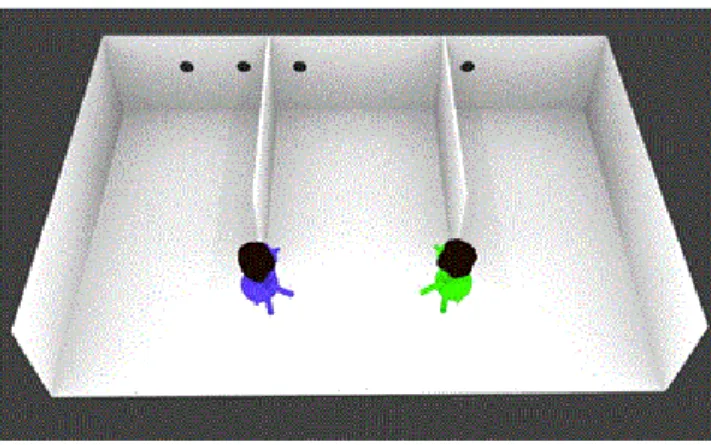
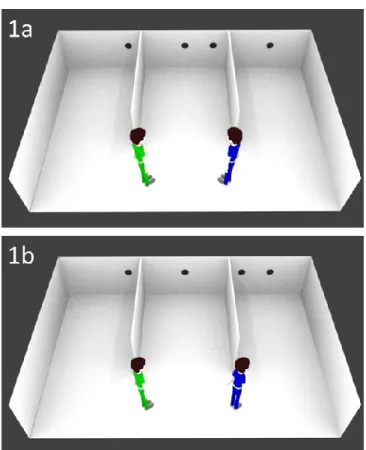
Figure 2.1. Trial examples from the original 3PP-3PP task used in Experiment 1. In the Congruent Trial (top), both avatars are facing inward and see the same number of dots. In the Incongruent Trial (bottom), one avatar (e.g., green) faces to the outside, such that each avatar has a different perspective. The target avatar always views more dots than the non-target.
identity). Second, when the self- and other-avatar perspectives were conflicting (i.e.,
incongruent trials), we anticipated that the Self avatar would produce greater interference than the other avatar. In other words, we predicted a Target Identity × Perspective Congruence interaction, with a greater congruence effect for the other avatar compared to the Self avatar. Such a differential in interference would constitute an implicit perspective-taking bias for the Self avatar.
2.2.2. Method
Participants. Thirty-six students (26 female; Mage = 21.9 years, SDage = 5.60) from the University of Birmingham were recruited through an online research participation scheme and received either cash or course credit for their participation. The sample composition was 72.2% White British/Other, 22.3% Asian, and 5.6% Other. In accordance with ethical
approval, participants received information on the experimental procedure and gave informed consent prior to participating. Following the completion of all tasks, participants were
administered a brief demographic survey, debriefed, and compensated accordingly.
Avatar identity-matching task. Three avatarswere created using Blender version 2.64.0 (Blender Foundation, Amsterdam, The Netherlands), an open-source 3D creation software. The avatars were identical in shape, distinguishable only by colour: green, red, or blue. Avatar height was 3 cm (view angle = 2.9°). Each avatar was rendered to create the appearance of facing away from the viewer, with the body angled slightly to the left or to the right, with each rendering having equal representation. The same avatars used in this
matching task were later used in the perspective-taking task.
Procedure. The matching task was adapted from a previous perceptual-matching paradigm (Sui et al., 2012). Participants were asked the first name of a close friend, which the experimenter entered into the program. The avatar-identity associations were introduced by
simultaneously presenting all three avatar images on the screen, with the appropriate label under each one (e.g., ‘YOU’, ‘OTHER’, [friend’s name]). Self and Other colours were counterbalanced between green and blue across participants. The friend avatar was always assigned the red colour and was used only to make the matching task more challenging. In the matching task, on each trial, participants viewed one avatar image (e.g., blue) above one label (e.g., “YOU”) at the centre of the screen with the instruction to indicate whether the label correctly matched the avatar image. All avatar–label combinations were equally likely to appear.
Each trial started with a fixation cross at the centre of the screen for 500 ms. Then, an avatar image and label was presented for 100 ms followed by a blank screen that remained for 1000 ms, or until response. Participants responded by key press: J for a match and K for a mismatch. Responses longer than 1 s were treated as incorrect. Each trial concluded with a feedback screen that was presented for 500 ms, providing the response state (e.g., correct, incorrect, or no response) with cumulative response time and accuracy statistics. There were altogether 192 trials that were divided into 2 blocks.
Perspective-taking task. The avatars used in the identity-matching task were also used in the perspective-taking task. A virtual room was created using Blender version 2.64.0 (Blender Foundation, Amsterdam, The Netherlands) and GIMP version 2.8.2 (Free Software Foundation, Inc., Boston, MA). Figure 2.1 gives an example of the virtual room display used. This room included three external walls and one or two internal dividing walls parallel to the side walls. The size of the room was 12 cm wide at the far wall (view angle = 11.3°) by 13 cm long from the fore to the far wall (view angle = 12.2°). The internal walls partially divided the room into two or three sections, the size of each peripheral area was 2.9° wide by 12.2° long, and the central area was 6.7° wide by 12.2° long. The avatars were placed facing
the far wall of the room in line with the dividing walls, at the bottom of the screen. The room was viewed from above with an angle of 45 degrees, aligned with the overall orientation of the avatars’ views; hence the participants saw the avatars from behind. Thus the participant and the avatars faced roughly the same direction but, as opposed to the participant’s 1PP, the avatar’s view was restricted by the dividing walls and by their head orientation.
Black dots (view angle = 0.5°) were placed on the wall opposite the avatars. There were five possible dot locations at equal distance from one another (distance between
potential dots locations 1.9° view angle): one on each peripheral area and three in the central area. On any given trial, 1–4 dots were presented with equal probability. To ensure an incongruent view with the participant’s own (first-person) perspective, a dot was always presented in one of the peripheral areas that were partly occluded by a dividing wall. For further information on trial design, see Appendix 2.1.
Participants’ task was to indicate whether a preceding prompt predicted the number of dots (e.g., 1, 2, or 3) seen by the target avatar (e.g., Self or Other). The target avatar could see between 0 and 3 dots. Participants were instructed to press the J key with their right index finger for match trials and the K key with their right middle finger for mismatch trials, with each trial type of equal frequency. Importantly, the contents of the Self and Other avatars’ perspectives were either congruent or incongruent. Note that in the congruent trials both avatars faced the shared central space, whereas in the incongruent trials the relevant space could be the shared central section or one of the peripheral sections. This means that the congruency manipulation reflected the difference between shared and non-shared views and not simply that the two avatars see the same number of dots.
Procedure. Each trial began with a text prompt revealed gradually in two parts to ease comprehension. In the first 1000 ms, participants were shown two lines of centred text
revealing the target avatar (“Your avatar / will see” or “Other’s avatar / will see”) followed by a third line below revealing the prompt number (e.g., “three dots”). To further ensure prompt comprehension, participants were given unlimited time to read the full prompt and proceed by pressing the spacebar. Next, to ensure fixation location, a 900-ms fixation sequence was used in which two fixation crosses converged toward the centre of the screen at a rate of one character per 300 ms, merging in the centre for the final 300 ms. Then, the visual scene was displayed for 650 ms, after which it was replaced by a blank screen for 2000 ms or until the participant responded. If no response was recorded within 2000 ms of the blank screen onset, participants immediately received the message “Please respond faster!” in centred red type for 1500 ms and proceeded to the next trial prompt. Failures to respond were recorded as errors. For a graphical representation of the full trial time course and details, see Figure 2.2.
The perspectives task began with a set of written and visual instructions on how to take the perspective of a given avatar followed by 12 practice trials representing at least one of each possible condition. The subsequent experimental block included 192 trials, of which 96 were match trials. After every 10 trials, a four-trial procedure was implemented to remind participants of the avatars’ identities. In each trial, the two avatars were presented together randomly on the left and right side of the screen. Centred text above the two avatars asked participants to select the avatar that matches a given target identity (e.g., “YOU”) by pressing the J key for the left avatar and the K key for the right avatar.
Analysis protocol. A 3-standard-deviation guideline was used to exclude outliers from analysis in both the perceptual-matching task and the perspective-taking task. This was done at the participant level for response time data and at the group level for accuracy rate data. Based on the LATER model (Reddi, Asrress, & Carpenter, 2003), we assumed that variability in accuracy and RT responses arise from the same decision mechanism. Therefore,
to guard against speed-accuracy trade off effects and condense reported results, accuracy and RT measures were combined to obtain the psychological efficiency index: The mean RTs of correct responses were divided by the proportion of accurate response for each condition and each participant (Townsend & Ashby, 1983). Statistical analyses were performed on these combined efficiency scores only, although similar patterns of results were obtained for the separate accuracy and RT indices (see Tables 2.1 and 2.2 for RT, accuracy, and efficiency statistics for the perceptual-matching and perspective-taking tasks, respectively).
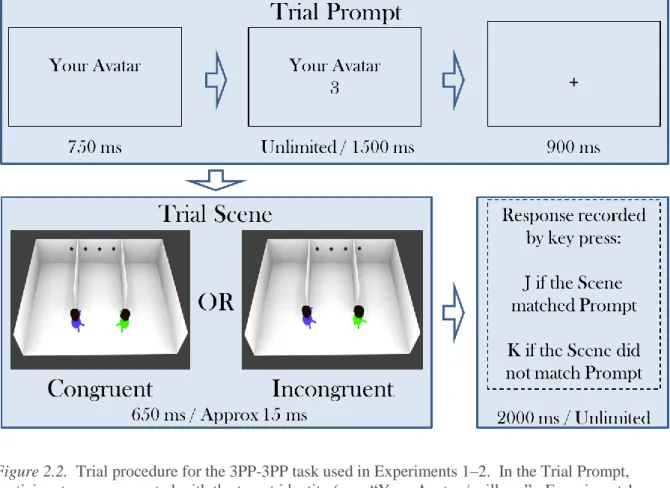
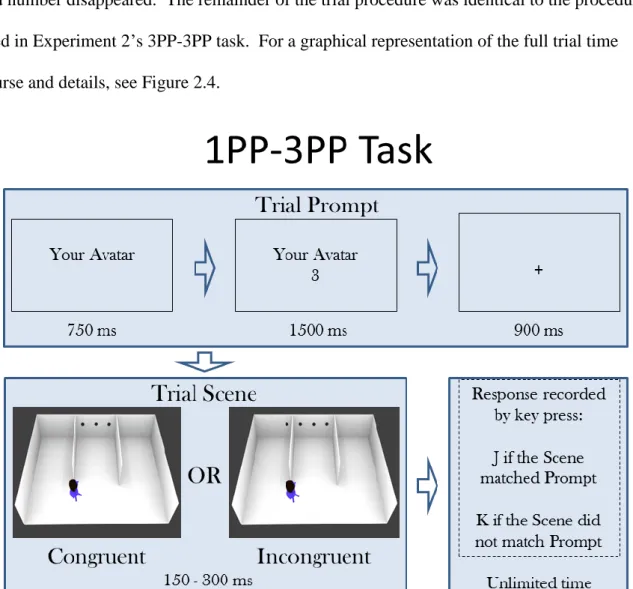
Figure 2.2. Trial procedure for the 3PP-3PP task used in Experiments 1–2. In the Trial Prompt, participants were presented with the target identity (e.g., “Your Avatar / will see” - Experiment 1; “Your Avatar” - Experiment 2) for 750 ms after which the expected number of dots for the target identity was added to the display. In Experiment 1, participants had unlimited time (or an additional 750 ms in Experiment 2) after the second frame to proceed to the fixation. Participants then viewed a 900 ms centered fixation sequence that consisted of two fixation crosses initially separated by a 3-character gap; each cross moved one 3-character closer at 300 ms, and at 600 ms the two crosses converged to form one cross in the center character position. Following fixation, participants viewed the Trial Scene (650 ms, Experiment 1; approximately 15 ms, Experiment 2). Responses were subsequently recorded by key press. Note that the trial scene images are from Experiment 2.
For the perspective-taking task, analyses focused on match trials only. Due to the design of mismatch trials, the prompt always matched only the contents of the 1PP, which was always greater than the contents of either avatar’s perspective. As a result, mismatch trials were likely confounded by deductive strategies. A similar analytical approach has been applied in previous VPT studies in which mismatch trials were subject to systematic
variations (see Qureshi et al., 2010; Samson et al., 2010; Surtees & Apperly, 2012). Nonetheless, we also report the results of the mismatch trials for completeness. 2.2.3. Results
Avatar identity-matching task. Incorrect responses (29.5% of trials) and correct responses with latencies exceeding 3 standard deviations from the individual’s overall mean (0.3%) were trimmed prior to analysis. One participant was excluded from analysis due to an outlier in accuracy rate, with a mean response accuracy of 39.6%. This participant was also excluded from the analysis of the perspective-taking experiment as it was assumed that she failed to form reliable associations with the avatars. For completeness, RT, accuracy, and efficiency results are provided in Table 2.1.
Efficiency scores were submitted to a 2 (Avatar Identity: self, other) × 2 (Label Match: match, mismatch) repeated-measures ANOVA. Results revealed a significant main effect of avatar identity, F(1,34) = 29.1, MSE = 43186, p < .001, ηp² = .461, such that the Self
avatar resulted in more efficient judgements relative to the Other avatar. A significant Avatar Identity × Label Match interaction, F(1,34) = 47.8, MSE = 30031, p < .001, ηp² = .584,
suggests that the main effect of Avatar Identity was driven by a significant self-advantage on match trials, t(34) = 6.84, d = 1.15, p < .001, but not on mismatch trials, p = .66. These results replicate previous findings on self-tagging in a perceptual-matching paradigm (Sui et
al., 2012, 2013), thus showing that participants formed reliable self-associations with the avatar.
Table 2.1
Descriptive Statistics for the Avatar Identity-Matching Task, Experiment 1
Response Index Avatar Image Matched Label Mismatched Label Average
RT (ms) Self 505 (12.7) 596 (12.1) 551 a Other 584 (15.8) 598 (11.0) 591a Accuracy Self .850 (.021) .779 (.022) .814 b Other .629 (.027) .791 (.022) .710b Efficiency Self 614 (30.7) 790 (29.6) 702 c Other 1006 (60.5) 777 (26.4) 892c
Note. Standard errors are provided in parentheses. a,b,c Pairwise t-test, p < .001.
Perspective-taking task. In addition to the participant excluded from the matching task, two additional participants were excluded for outliers in response time or accuracy exceeding the group mean by 3 standard deviations. For completeness, means and standard error for the RT, accuracy, and efficiency data are found in Table 2.2.
Incorrect responses (14.2% of match trials) and correctly-answered trials with
response latencies exceeding 3 standard deviations from the individual’s overall mean (3.65% of match trials) were trimmed prior to analysis. Importantly, mean accuracy for each
condition was reliably above chance (all p < .001). This suggests that all participants were able to easily complete the task within the required time window, despite the seemingly complex display.
Table 2.2
Descriptive Statistics for 3PP-3PP Task, Experiment 1 Trial Type Response
Index
Target
Identity Congruent Incongruent
Interference Difference Average Match trials RT (ms) Self 688 (30.4) 700 (30.2) 12 694 Other 705 (28.3) 725 (32.5) 20 715 Accuracy Self .907 (.015) .884 (.022) .023 .896 Other .838 (.023) .861 (.024) -.023 .850 Efficiency Self 764 (35.5) 810 (40.3) 46 787a Other 857 (35.9) 879 (58.2) 22 868a Mismatch trials RT (ms) Self 710 (34.2) 704 (33.3) -6 707 Other 724 (33.6) 728 (38.9) 4 726 Accuracy Self .934 (.013) .939 (.012) -.005 .937 Other .947 (.012) .912 (.020) .035 .929 Efficiency Self 767 (41.6) 754 (38.3) -13 760 Other 771 (40.9) 831 (68.4) 60 801
Note. Standard errors are provided in parentheses. a Pairwise t-test, p < .05.
Efficiency scores for the match trials were analysed using a 2 (Target Identity: self, other) × 2 (Perspective Congruence: congruent, incongruent) ANOVA. This revealed a reliable main effect for target identity, F(1,32) = 13.1, MSE = 16346, p = .001, ηp² = .291,
such that participants were more efficient for Self than Other trials. Although the effect of congruence trended in the expected direction, it was non-significant, F(1,32) = 2.52, p = .12.
The interaction of target identity and perspective congruence was non-significant, F(1,32) = 0.221, p = .64. Analysis of mismatch trials revealed no reliable effects3.
2.2.4. Discussion
Results from Experiment 1 showed that participants were more efficient on trials when the Self avatar was the target identity. This third-person self-advantage suggests that
previously observed self-tagging effects (Sui et al., 2012, 2013) can have downstream consequences in visual-spatial processing and judgements (Sui, Liu, Wang, & Han, 2009), particularly when they are task-relevant. Interestingly, this effect was observed in spite of the fact that attending to the target avatar’s view was not necessary. Because the target avatar always faced the shared central space and never toward the periphery (see Appendix 2.1), it was possible for participants to develop a strategy in which they ignore the avatars and their gaze directions and attend only to the shared space. At debriefing none of the participant reported that they used such a strategy. We discuss this issue in more detail below.
The lack of any effect or interaction from perspective congruence is surprising given that previous research has demonstrated a robust tendency to process unattended perspectives (Qureshi et al., 2010; Samson et al., 2010; Surtees & Apperly, 2012), even when the
unattended perspective is never prompted as the target perspective (e.g., Samson et al., 2010). One explanation is that the added complexity of computing a second avatar’s perspective attenuated the social-attentional cuing from avatar orientation. It is worth noting that the steps of perspective computation are effectively doubled in the 3PP: Perceivers first need to
3
The same 2 × 2 ANOVA for mismatch trials revealed a marginal effect of effect for target identity, F(1,32) = 3.208, MSE = 17394, p = .083, ηp² = .091, with greater efficiency for Self
than Other trials. As in the match-trial analysis, the effect of perspective congruence was non-significant, F(1,32) = 1.63, p = .21. The Target Identity × Perspective Congruence interaction was also non-significant, F(1,32) = 2.799, p = .10.
apprehend each avatar’s gaze direction and then view the appropriate wall segments (left, centre, or right) to confirm the number of dots in each view. Thus, due to the relatively high level of computation required, participants may have selectively encoded only the perspective needed for a given trial.
Although tempting to attribute the current findings to task complexity, the paradigm design merits further consideration. As the task was designed, the target perspective always faced the central shared space between the two barrier locations and never toward the lateral section of the wall (Figure 2.2). This was done to avoid systematic association between the target avatar’s orientation and the number of dots in its view line (see 2.2.2 and Appendix 2.1, for details). As mentioned above, one consequence of this was that the participants could solve the task by counting the dots on the shared central space, ignoring the avatars’
orientations. Importantly, no participant indicated any use of this strategy during debriefing. However, some participants did spontaneously report that avatar gaze was not always readily apparent due to the unified colour of the avatar body and head. Finally, the fixation cross may also have attenuated attentional cuing as it focused participants on the centre of the screen instead of at the bottom, where both avatars were located. In Experiment 2, these
2.3. Experiment 2: 3PP-3PP Task Replication
2.3.1. IntroductionThe second experiment used a modified version of Experiment 1 and aimed to test the same hypotheses. The following changes were included: First, the virtual room was slightly modified to create a trial set in which it was equally likely that the target avatar faced the central space or the periphery. This ensured that encoding the target avatar’s orientation was essential to correctly complete the task. Second, we added hair to both avatars to make their head/face orientation more salient. (See Figure 2.3 for examples of the modified visual scene and avatars used in Experiment 2.) Third, we ensured that participants’ attention was initially focused on the two avatars by presenting the fixation sequence on the same horizontal plane as the avatars. Finally, to minimise variability in accuracy across participants, we varied the duration of the display of the virtual room keeping each participant’s accuracy at
approximately 75–80%. Participants failing to reach at least 70% accuracy on both tasks were excluded from analysis. (See Appendix 2.2 for more details on 3PP-3PP task design
modifications for Experiment 2.)
As in Experiment 1, we expected that participants would perform more efficiently when instructed to take the Self perspective (i.e., a main effect of target perspective). We further expected the classic congruency effect (e.g., Samson et al., 2010) and that this would interact with target avatar identity such that the Self avatar would produce more interference than the Other avatar.
2.3.2. Method
Participants. Forty-seven students (39 female; Mage = 19.7 years, SDage = 2.83) from the University of Birmingham were recruited through an online research participation scheme and received either cash or course credit for their participation. The sample composition was 87.2% White British/Other, 8.5% Asian, and 4.3% Black. In accordance with ethical
approval, participants received information on the experimental procedure and gave informed consent prior to participating. Following the completion of all tasks, participants were
administered a brief demographic survey, debriefed, and compensated accordingly.
Figure 2.3. Trial examples from Experiment 2. In the Congruent Trial (top), both avatars are facing inward and see the same number of dots. In the Incongruent Trial (bottom), one avatar (e.g., blue) faces to the outside, such that each avatar has a different perspective. The target avatar always views more dots than the non-target.
Avatar identity-matching task. The same three avatars used in Experiment 1 were used in this experiment (see 2.2.2). However, in this experiment, the backs of avatar heads were manually coloured a dark brown (C = 0, M = 63, Y = 93, K = 89) using GIMP version 2.8.2 (Free Software Foundation, Inc., Boston, MA) to simulate hair and facilitate the detection of avatar orientation. The same blue and green avatars used in this matching task were later used in the perspective-taking task.
Procedure. The avatar identity-matching task procedure was similar to that reported in Experiment 1 (see 2.2.2). Key changes included (1) a modified training procedure, leading to an optimised stimulus display time for each participant (detailed below), (2) an unlimited amount of time for participants to respond (limited to 1 s in Experiment 1), (3) fewer
experimental trials (96 vs. 192 trials), and (4) less frequent feedback (after every 10 trials rather than every trial).
After a brief introduction to the task, participants completed a series of practice runs to determine the minimum stimulus duration at which they could reach 75% accuracy. This threshold was chosen to equate for overall task difficulty and to ensure variability in accuracy while minimising contamination from guessing. The practice runs consisted of at least five blocks of 12 trials, each pulled randomly from the experimental trial set. The initial stimulus duration was set at 1000 ms and decreased incrementally depending on the performance of the participant (e.g., 500 ms, 100 ms, 50 ms, 15 ms). If a participant failed to reach the requisite 75% accuracy on a given block, the stimulus duration time was raised slightly or kept the same for the next practice block. The final stimulus duration time was determined once a participant maintained approximately 75% accuracy for two consecutive practice blocks or reached the minimum display time of 15 ms.