Informing Protocol Design through
Crowdsourcing Measurements
A N N A M A R I A M A N DA L A R I
E N C U M P L I M I E N TO PA R C I A L D E L O S R E Q U I S I TO S PA R A E L G R A D O D E D O C TO R E N I N G E N I E R Í A T E L E M ÁT I C AU N I V E R S I DA D C A R L O S I I I D E M A D R I D
D I R E C TO R: M A R C E L O B A G N U L OMayo de
2019
p u b l i s h e d b y u n i v e r s i da d c a r l o s i i i d e m a d r i d
Licensed under the Creative Commons License version3.0under the terms of Attribution, Non-Commercial and No-Derivatives (the “License”); you may not use this file except in compliance with the License. You may obtain a copy of the License athttp://creativecommons.org/licenses/by-nc-nd/3.0. Unless re-quired by applicable law or agreed to in writing, software distributed under the License is distributed on an “a s i s”b a s i s,w i t h o u t wa r r a n t i e s o r c o n d i t i o n s o f a n y k i n d, either express or implied. See the License for the specific language governing permissions and limitations under the License.
“The noblest pleasure is the joy of understanding.”
Acknowledgements
Iw o u l d l i k e t o b e g i n b y t h a n k i n gmy advisor, Marcelo. Thanks for being so patient and gave me the possibility to develop my re-search skills. Thanks for hearing me out and supported me in any situations, included the most difficult ones (at work and not). I would never be where I am if you had not believed on my abilities. Thanks also to a great woman, an example for all women in computer sci-ence, Andra.
Thanks to David Clark, our conversation in2015was really inspir-ing and made me understand what I want to become in future.
Grazie alle mie amiche, sorelle da tutta una vita (letteralmente) Francesca e Valentina. Grazie per esserci sempre!
Un immenso grazie alla mia famiglia, senza il vostro supporto non so davvero come avrei fatto. Avete girato con me il mondo e ancora ne abbiamo di posti da vedere (madre non uccidermi!!). Grazie ai miei due fratelloni, alle mie cognate e a Melania, Dalila e Domi per essere così estremamente genuini e farmi ridere ogni volta che ne ho bisogno. Grazie a nonna Santella e Anna Maria per essere così profondamente "nonne" del Sud.
Gracias a todas las personas que he tenido el placer de conocer en estos4largos años en Madrizzz, desde peluquero hasta la chica del pan, pero un mas profundo gracias a: Miguel, eres extremamente sensible y bueno, un amigo como pocos; Juan, gracias para creer en mi y ayudarme siempre: Sofia, un ejemplo de mujer activa y insuper-able; Olga, increíble las cosas que tenemos en común, gracias para no aburrirte nunca de escucharme; Alberto, solo tu, yo, los35grados de Madrid en Julio y dos raquetas; Angie, desde el instituto hasta Madrid , como si10años no hubieran pasado; Anibal, gracias para hacerme reír siempre; Domenico, il destino a volte ti fa incontrare persone come te, condividiamo la stessa città due volte; Rafael, gra-cias para creer en mis sueños y ayudarme a convertirlo en realidad. Grazie ai miei amici di Reggio, sempre lì, sempre con me: Achille, Rosario e Giacomo.
Thanks to all those amazing people that I met during my intern-ships in Barcelona and Norway: Ilias, Ozgu, Eleonora, Simone, Isa, Teodora, Matteo, Sasan, Johannes, Vangelis. Thanks for made me feel like at home, for the hiking, the drinks and the happiness.
Gracias a mis compañeros de la UC3M, por las cervezas, las noches en la Uni, las comidas y las risas. Gracias a las personas de la UC3M/IMDEA and other institutes con la cual he tenido el honor de trabajar: Paco, Alberto, Ruben, Narseo, Bob Briscoe y todos los staff técnico, especialmente Goyo, Rafa y Jose Antonio.
Gracias a Fernando para no perder las esperanzas conmigo y mi tenis.
Gracias a mi compañeros de METRICS, especialmente Roberto, Ines y Costas.
Gracias a mi fantastico team de Gustami italia en Madrid: David, Elisabetta, Alvaro, Francesco, Josef y Jorge.
Finally, thanks to the people from my new Lab in London: Hamed, Roman, Minos, Vincent, Yuting, Rania and Mohamed.
Grazie ad Anna, la mia amica "pazza" londinese and Andrew the most British man I’ve ever met.
Grazie mille al mio aragostino for believing in me.
PS. During my PhD I visited17different countries, took hundreds of flights, not slept for innumerable number of nights. I broke a fin-ger and a leg, I run a half marathon, I changed3tennis rackets , went to3different horses centres, learnt how to snowboard, swam thou-sands of meters, fell in love hundreds of times and this is just the beginning (hopefully not for the bones ;) )!
—Anna Maria Mandalari
Published and Submitted Content
In c o m p l i a n c e w i t h t h e p r i n c i p l e sreffering to plagiarism in Law14/2011and in the code of good practices of the UC3M Doctoral School, in this Chapter a list the papers that are included in this thesis and have been published are included. The role of the author of the thesis for each of the contribution is also specified.
Chapter4 • A. M. Mandalari, M. Bagnulo, and A. Lutu. Informing Protocol
Design Through Crowdsourcing: The Case of Pervasive Encryp-tion. ACM SIGCOMM Computer Communication Review,45(4): 105–123,2015b. d o i:10.1145/2787394.2787397.Mandalari et al. [2015b].
– The contribution is fully included in the thesis.
– The role of the author of this thesis is on developing the idea included in the paper for using crowdsourcing platform for TLS and HTTP/2measurements. The author design the ex-perimental setup, run the experiment and process the data for evaluation.
– The material from this paper included in this thesis is not sin-gled out with typographic means and references.
Chapter5 • A. M. Mandalari, M. Bagnulo, and A. Lutu. TCP Fast Open: Initial
Measurements. ACM CoNEXT Student Workshop, Dec2015, Heidel-berg, Germany.,2015a. d o i:10.1145/2842665.2843561.Mandalari et al.[2015a].
– The contribution is fully included in the thesis.
– The role of the author of this thesis is on developing the idea included in the paper for using crowdsourcing platform for TCP Fast Open measurements. The author design the experimental setup, run the experiment and process the data for evaluation.
– The material from this paper included in this thesis is not sin-gled out with typographic means and references.
Chapter6 • A. M. Mandalari, A. Lutu, B. Briscoe, M. Bagnulo, and O. Alay.
Measuring ECN++: Good News for ++, Bad News for ECN over Mobile. IEEE Communications Magazine,56(3):180–186, March 2018a. ISSN0163-6804. d o i:10.1109/MCOM.2018.1700739. Man-dalari et al.[2018a].
– The contribution is fully included in the thesis.
– The role of the author of this thesis is on designing the exper-iments for evaluating ECN and ECN++ in fixed and mobile networks. The author run the experiments in different measure-ments platforms, process the data and evaluate the results.
– The material from this paper included in this thesis is not sin-gled out with typographic means and references.
Chapter7 • A. M. Mandalari, M. A. D. Bautista, F. Valera, and M. Bagnulo.
NATwatcher: Profiling NATs in the Wild. IEEE Communications Magazine,55(3):178–185, March2017a. ISSN0163-6804. d o i: 10.1109/MCOM.2017.1600776CM.Mandalari et al.[2017a].
– The contribution is fully included in the thesis.
– The role of the author of this thesis is on building the tool for characterizing NATs in fixed lines. The author leverage a crowd-sourcing platform for running the experiments, process the data and evaluate NATs characteristics.
– The material from this paper included in this thesis is not sin-gled out with typographic means and references.
Chapter8 • A. M. Mandalari, A. Lutu, A. Dhamdhere, M. Bagnulo, and
K. Claffy. Tracking the Big NAT across Europe and the U.S. abs/1207.0016,2017b. URLhttps://arxiv.org/abs/1704.01296. Mandalari et al.[2017b].
– The contribution is fully included in the thesis.
– The role of the author of this thesis is on leveraging the Revelio tool for tracking CGNs in fixed lines. The author improve the tool, run the experiments in two crowdsourcing large scale measurement platforms and process the data.
– The material from this paper included in this thesis is not sin-gled out with typographic means and references.
Chapter10 • A. M. Mandalari, A. Lutu, A. Custura, A. Safari Khatouni,
O. Alay, M. Bagnulo, V. Bajpai, A. Brunstrom, J. Ott, M. Mellia, and G. Fairhurst. Experience: Implications of Roaming in Eu-rope. InProceedings of the24th Annual International Conference on
ix
Mobile Computing and Networking, MobiCom ’18, pages179–189, New York, NY, USA,2018b. ACM. ISBN978-1-4503-5903-0. d o i: 10.1145/3241539.3241577.Mandalari et al.[2018b].
– The contribution is fully included in the thesis.
– The role of the author of this thesis is on contributing on build-ing a measurement platform for evaluatbuild-ing roambuild-ing in Europe. The author plays a key role on investigate the roaming config-uration and its implication in terms of delay, DNS and HTTP performance.
– The material from this paper included in this thesis is not sin-gled out with typographic means and references.
Mi d d l e b ox e s,s u c h a s p rox i e s,f i r e wa l l s a n dNATsplay an important role in the modern Internet ecosystem. On one hand, they perform advanced functions, e.g. traffic shaping, security or enhancing ap-plication performance. On the other hand, they turn the Internet into a hostile ecosystem for innovation, as they limit the deviation from deployed protocols. It is therefore essential, when designing a new proto-col, to first understand its interaction with the elements of the path. The emerging area of crowdsourcing solutions can help to shed light on this issue. Such approach allows us to reach large and different sets of users and also different types of devices and networks to perform Internet measurements. In this thesis, we show how to make informed protocol design choices by expanding the traditional crowdsourcing focus from the human element and using crowdsourcing large scale measurement platforms.
We consider specific use cases, namely the case of pervasive encryption in the modern Internet, TCP Fast Open and ECN++. We consider such use cases to advance the global understanding on whether wide adoption of encryption is possible in today’s Internet or the adoption of encryption is necessary to guar-antee the proper functioning of HTTP/2. We target ECN and particularly ECN++, given its succession of deployment problems. We then measured ECN deployment over mobile as well as fixed networks. In the process, we discovered some bad news for the base ECN protocol—more than half the mobile carriers we tested wipe the ECN field at the first upstream hop. This thesis also reports the good news that, wherever ECN gets through, we found no deployment problems for the ECN++ enhancement. The thesis includes the results of other more in-depth tests to check whether servers that claim to support ECN, actually re-spond correctly to explicit congestion feedback, including some surprising congestion behaviour unrelated to ECN.
This thesis also explores the possible causes that ossify the modern Internet and make difficult the advancement of the innovation. Network Address Translators (NATs) are a commonplace in the Inter-net nowadays. It is fair to say that most of the residential and mobile users are connected to the InterInter-net through one or more NATs. As any other technology, NAT presents upsides and downsides. Probably the most acknowledged downside of the NAT technology is that it introduces additional difficulties for some applications such as peer-to-peer applications, gaming and others to function properly. This is partially due to the nature of the NAT technology but also due to the diversity of behaviors of the different NAT im-plementations deployed in the Internet. Understanding the properties of the currently deployed NAT base provides useful input for application and protocol developers regarding what to expect when deploying new application in the Internet. We develop NATwatcher, a tool to test NAT boxes using a crowdsourcing-based measurement methodology.
We also perform large scale active measurement campaigns to detect CGNs in fixed broadband net-works using NAT Revelio, a tool we have developed and validated. Revelio enables us to actively
deter-xi
mine from within residential networks the type of upstream network address translation, namely NAT at the home gateway (customer-grade NAT) or NAT in the ISP (Carrier Grade NAT). We deploy Revelio in the FCC Measuring Broadband America testbed operated by SamKnows and also in the RIPE Atlas testbed.
A part of this thesis focuses on characterizing CGNs in Mobile Network Operators (MNOs). We develop a measuring tool, called CGNWatcher that executes a number of active tests to fully characterize CGN deployments in MNOs. The CGNWatcher tool systematically tests more than30behavioural requirements of NATs defined by the Internet Engineering Task Force (IETF) and also multiple CGN behavioural metrics. We deploy CGNWatcher in MONROE and performed large measurement campaigns to characterize the real CGN deployments of the MNOs serving the MONROE nodes.
We perform a large measurement campaign using the tools described above, recruiting over6,000users, from65different countries and over280ISPs. We validate our results with the ISPs at the IP level and, reported to the ground truth we collected. To the best of our knowledge, this represents the largest active measurement study of (confirmed) NAT or CGN deployments at the IP level in fixed and mobile networks to date.
As part of the thesis, we characterize roaming across Europe. The goal of the experiment was to try to understand if the MNO changes CGN while roaming, for this reason, we run a series of measurements that enable us to identify the roaming setup, infer the network configuration for the16MNOs that we measure and quantify the end-user performance for the roaming configurations which we detect. We build a unique roaming measurement platform deployed in six countries across Europe. Using this platform, we measure different aspects of international roaming in3G and4G networks, including mobile network configuration, performance characteristics, and content discrimination. We find that operators adopt common approaches to implementing roaming, resulting in additional latency penalties of∼60ms or more, depending on ge-ographical distance. Considering content accessibility, roaming poses additional constraints that leads to only minimal deviations when accessing content in the original country. However, geographical restrictions in the visited country make the picture more complicated and less intuitive.
Results included in this thesis would provide useful input for application, protocol designers, ISPs and researchers that aim to make their applications and protocols to work across the modern Internet.
Contents
Preface v
Preface vii
List of Figures xvii
1 Introduction 1
2 State of the art 11
2.1 Existing Crowdsourcing Large Scale Measurement
Plat-forms 15
P A R T I F E A S I B I L I T Y O F N E W P R O T O C O L S E X -T E N S I O N S
3 Leveraging Crowdsourcing Platforms for Network Measurements
19
3.1 Microworkers Crowdsourcing Platform 19
3.2 Informing Protocol Design through Crowdsourcing 20
3.3 Experiences and lessons learned measuring the Internet with
crowdsourcing 21
4 The Feasibility of Pervasive Encryption 23
4.1 The Feasibility of Pervasive Encryption in the Internet
Ecosys-tem 23
4.2 HTTP/2: Operations and Characteristics 24
4.3 The Case of the Pervasive Encryption: Experimental Setup
26
4.4 The Case of the Pervasive Encryption: Results 31
5 TCP Fast Open: Initial Measurements 45
5.1 TFO Operation 45
5.2 TCP Fast Open: Experimental Setup 46
5.3 TFO: Initial Results 48
6 ECN++ 51
6.1 ECN Background 52
6.2 ECN++: Experiments 55
6.3 ECN++: Good News for ++, Bad News for ECN over
Mo-bile 59
P A R T I I M E A S U R I N G N A T S I N T H E W I L D
7 Not all NATs are Equal: NATWatcher 65
7.1 NATs in Fixed Line 65
7.2 NATwatcher: Profiling NATs in the Wild 70
7.3 NATwatcher: Results and Dataset 75
8 Tracking and Characterizing CGNs in Fixed Lines Europe and
U.S. 81
8.1 CGNs in Fixed Line 81
8.2 Tracking the Big NAT across Europe and the U.S:
Reve-lio 82
8.3 Revelio Deployments and Data 90
9 Tracking and Characterizing Carrier Grade NATs in Mobile
Broad-band Networks in Europe 97
9.1 CGNs in Mobile Broadband Networks 97
9.2 Design, Development and Implementation of CGNwatcher
103
9.3 CGNwatcher: Results and Dataset 105
9.4 Lessons Learned 110
P A R T I I I I M P L I C A T I O N O F R O A M I N G I N E U -R O P E
10 Implication of Roaming in Europe 113
xv
10.2MONROE-Roaming Platform 115
10.3Roaming Setup and Performance 118
10.4VoIP 126
10.5Content Discrimination 129
10.6Discussion 132
11 Conclusions and Future Work 135
List of Figures
2.1 RIPE Atlas network map. 15
2.2 RIPE Atlas network. 15
2.3 SamKnows growth. 15
2.4 The MONROE platform. 16
3.1 Some examples of middleboxes. 20
3.2 Microworkers crowdsourcing platform. 21
3.3 Crowdsourcing Platform Guidelines. 21
4.1 HTTP/2frame layout. 25
4.2 HTTP/2ALPN extension. 26
4.3 Server Endpoints. 29
4.4 Browser App. 30
4.5 Android App. 30
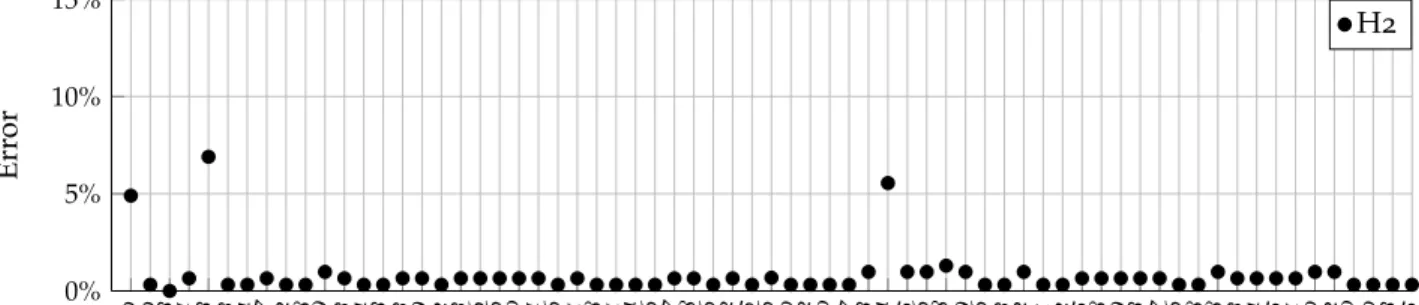
4.6 Error rate vs. port number, aggregated results. 32
4.7 Error rate vs. port number. 33
4.8 Average percentage of errors for each category in the fixed line use
case for all ports. 33
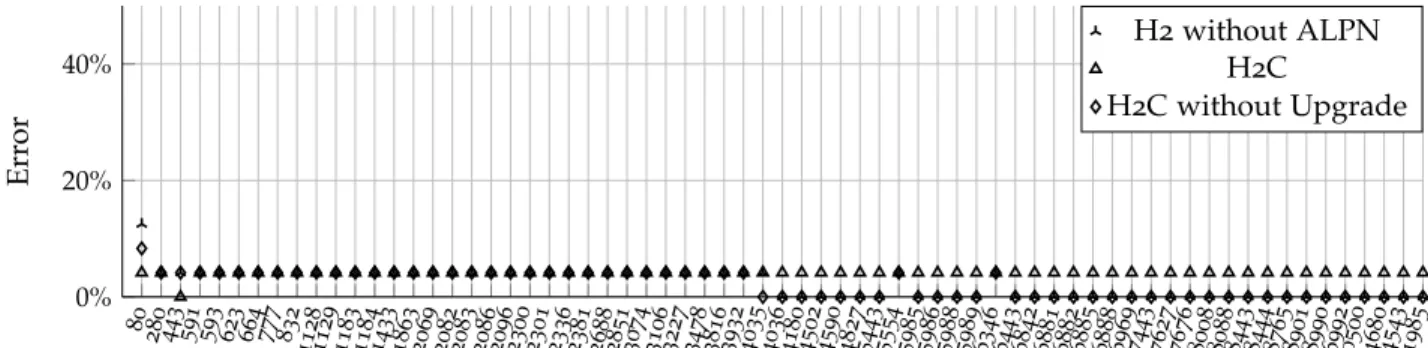
4.9 Error rate vs. port number. 34
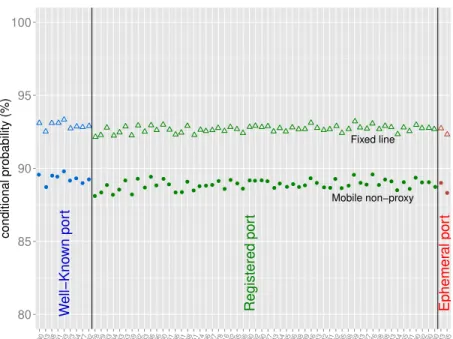
4.10Conditional probability vs. port number. 36
4.11Distributed vantage points map. 38
4.12Error rate vs. port number. 40
4.13Error rate vs. port number. 41
5.1 TFO cookie request. 46
5.2 TFO cookie request. 46
7.1 NAT operation. 65
7.2 NATwatcher operational setup. 71
7.3 Worldwide Distribution of Vantage Points. 75
8.1 Revelio experimental setup for a DSL access network (the DSLAM, BRAS
and CR are standard elements in the DSL architecture). The Revelio client runs on a device connected to the home network, whose exact topology we do not know. In the case of (a) standard DSL network access, the CPE per-forms the translation to the GRA, thus it is the GRA-NAT. In the case of
(b) standard DSL network configuration with NAT444deployment, the CGN
is the one performing the translation to the GRA, thus it is the GRA-NAT.
83
8.2 We observed that some home gateways reply to traceroute as if they are two
hosts, generating spurious links. When running pathchar to an external server, Revelio shows that the access link is the spurious link (Figure (a)). We run pathchar to the GRA (Figure (b)) and compare the results with the previous output from pathchar to the external server to correct these
Rev-elio false positives. 87
8.3 We observed that propagation delay of the different links within the home
network differs in one order of magnitude. When applying the original Rev-elio methodology, we erroneously conclude that the GRA-NAT is in access network of the ISP (Figure (a)). When factoring the expected propagation delay corresponding to the access technology we correct the Revelio false
pos-itive (Figure (b)). 88
8.4 Scatter plot of the access link delays we identified using the original
Rev-elio methodology. The horizontal lines represent the range od expected ac-cess link propagation delay per acac-cess technology. The points that lie out-side the expected range are potential false positives in the Revelio results.
89
9.1 CGNWatcher Operational Setup. 103
9.2 Port exhaustion results. 107
9.3 TCP mapping lifetime per MNO. 108
9.4 UDP mapping lifetime per MNO. 109
9.5 Yoigo port mapping. 109
10.1Roam like Home. 113
10.2Internet access options for a mobile node at home (left) and when
roaming (right). 114
10.3MONROE-Roaming platform and experimental setup. We exemplify
our setup for Vodafone DE. We have five Vodafone DE SIMs in in-ternational roaming nodes and another SIM in the home country nodes. For each roaming Vodafone DE SIM, we insert the SIM correspond-ing to the local roamcorrespond-ing partner for the MNO. For example, in Swe-den we use the Telenor SE SIM which corresponds to the network on which the Vodafone DE SIM is camping. 116
xix
10.4The distribution (left) of the MONROE-Roaming nodes in six
coun-tries and (right) SIMs for16MNO we measure across Europe. Each
country deploys two MONROE-Roaming nodes and one measure-ment server. 116
10.5ECDF of the RTT from mobile nodes to target servers. 122
10.6RTT difference from the visited country to all servers for Vodafone
DE. 124
10.7RTT difference per operator. 125
10.8DNS Query time to all FQDNs for TIM IT. 125
10.9Bitrate for operator O2DE. 127
10.10Inter-Packet Gap (IPG) for operator O2DE. 128
1
Introduction
Th e i n d i s p u ta b l e s u c c e s sof the Internet and, consequently, the increasing demand from end-users for more secure and faster ac-cess to the online services drives the need for continuous innovation. Meeting these performance, security, and policy compliance require-ments by designing new protocols or even optimizing existing ones is, however, challenging in today’s Internet. Modern networks often rely on dedicated hardware components generically dubbed middle-boxesto perform advanced processing functions like, for example, enhancing application performance (e.g., traffic accelerators, caches, proxies), traffic shaping (e.g., load balancers), optimizing the usage of IPv4address space (e.g., NATs) or security (e.g., firewalls).
One major criticism of middleboxes is that they might filter traf-fic that does not conform to expected behaviors, thus ossifying the
Internet and rendering it as a hostile environment for innovation.1 1
M. Handley. Why the internet only just works.BT Technology Journal,2006
Handley [2006] It demonstrably becomes problematic to extend core Internet
proto-cols, limiting the opportunities for optimization. For example, recent studies show that for IPv6some intermediate nodes may inspect the contents of extension headers and discard packets based on the
presence of unknown IPv6options. 2 Moreover, it is widely acknowl- 2
F. Gont et al. Transmission and processing of IPv6options. Technical report, IETF draft-gont-6man-ipv6 -opt-transmit-01,2015
Gont et al. [2015] edged by the community that several of the protocols standardized
by the IETF over the last few years including DCCP, UDP-lite, SCTP and several extensions to TCP, e.g. ECN and LEDBAT, face
deploy-ment challenges blamed on interference by middleboxes.3 3
https://www.ietf.org/mailman/listinfo/hops.
IRTF,2015
hop [2015] This does not mean that it is impossible to deploy new protocols,
but that in order to ensure success it is imperative to first understand the interaction of the proposed solutions with the middleboxes active along the path or how middelboxes behave. Recent studies4
,5
on 4
M. Honda, Y. Nishida, C. Raiciu, A. Greenhalgh, M. Handley, and H. Tokuda. Is it still possible to ex-tend TCP? InProceedings of the2011 ACM SIGCOMM conference on Internet measurement conference, pages181–194.
ACM,2011
Honda et al. [2011]
5
B. Hesmans et al. Are TCP extensions middlebox-proof? InWorkshop on Hot topics in middleboxes and network function virtualization. ACM,2013
Hesmans et al. [2013] middleboxes behavior attempt to provide such information.
How-ever, the existing measurements use only a very small number of vantage points, e.g., only142measurement points are used. In order to perform representative Internet measurements and test realistic scenarios and different Autonomous Systems (ASes), what is missing is access to a high number of diverse vantage points. Also, more
evi-dences of the nature of the problems and the portions of the network in which they manifest are needed.
The emerging sea of crowdsourcing can be an efficient and quick solution to solve the problem. Until recently, large-scale Internet mea-surement infrastructures necessary to perform this type of analysis were available only to large Internet players, such as Google, Aka-mai and large ISPs. Consequently, the lack of public access to such resources makes it hard to repeat or verify their results. In an attempt to adjust the balance, several crowdsourcing large-scale measurement platforms became available to the research and operational commu-nity in the past years, e.g., RIPE Atlas6
, BISmark7
, SamKnows8
, 6
V. Bajpai, S. J. Eravuchira, and J. Schönwälder. Lessons learned from using the ripe atlas platform for
measurement research. SIGCOMM
Comput. Commun. Rev.,45(3):35–42, July 2015. ISSN0146-4833
Bajpai et al. [2015]
7
F. Krueger and S. R. Andrews. Bis-mark: a flexible aligner and methylation caller for Bisulfite-Seq applications.
Bioinformatics,27(11):1571–1572,04 2011. ISSN1367-4803
Krueger and Andrews [2011]
8 Samknows platform. https://www. samknows.com/. Accessed on2019-02-03 sam PlanetLab9 , MONROE.10 9
B. Chun, D. Culler, T. Roscoe, A. Bavier, L. Peterson, M. Wawrzoniak, and M. Bowman. Planetlab: An overlay testbed for broad-coverage services.
SIGCOMM Comput. Commun. Rev.,33 (3):3–12, July2003b. ISSN0146-4833
Chun et al. [2003b]
10
O. Alay, A. Lutu, M. Peón-Quirós, V. Mancuso, T. Hirsch, K. Evensen, A. Hansen, S. Alfredsson, J. Karlsson, A. Brunstrom, A. Safari Khatouni, M. Mellia, and M. A. Marsan. Expe-rience: An open platform for exper-imentation with commercial mobile broadband networks. InProceedings of the23rd Annual International Conference on Mobile Computing and Networking, MobiCom ’17, pages70–78, New York, NY, USA,2017a. ACM. ISBN978-1
-4503-4916-1
Alay et al. [2017a] Using crowdsourcing, group of people, institution and
organiza-tions can be engaged via a flexible open call for voluntarily complet-ing a task. Crowdsourccomplet-ing platforms can be large-scale measurement platforms such as the ones cited above, where some hardware is installed on people’s home or institutions and no actions from the person owned the hardware is required or platform such as Mi-croworkers11
or Amazon’s Mechanical Turk12
, where actions from
11
M. Hirth, T. Hoßfeld, and P. Tran-Gia. Anatomy of a crowdsourcing platform - using the example of microwork-ers.com. In2011Fifth International Conference on Innovative Mobile and Internet Services in Ubiquitous Comput-ing, pages322–329, June2011. d o i:
10.1109/IMIS.2011.89
Hirth et al. [2011]
12
M. Buhrmester, T. Kwang, and S. D. Gosling. Amazon’s mechanical turk: A new source of inexpensive, yet high-quality, data? Perspectives on Psychological Science,6(1):3–5,2011
Buhrmester et al. [2011] people owned phones or personal computers are required.
By expanding the traditional crowdsourcing focus from the hu-man element to use a diverse and numerous group of end-user de-vices as measurement vantage points13
, in this work, we leverage
13
A. Doan et al. Crowdsourcing systems on the world-wide web.ACM,2011
Doan et al. [2011] on crowdsourcing platforms to run Internet wide measurements.
We demonstrated how to make informed protocol design choices by using a novel methodology for performing large scale Internet measurements, using crowdsourcing solutions approach.
While both crowdsourcing methodologies rely on Internet users performing a specific task (be that hosting custom equipment or per-forming custom tasks which require human intelligence), they are somewhat complementary. If in crowdsourcing large scale measure-ment platforms we have better control of the measuremeasure-ment agents, we are aware of the full specifications of the equipment being used and (in some cases) have more information about the environment where it is located, we are still limited by the number of vantage points and the types of tests that can be performed. In the case of crowdsourcing platforms (e.g, microworkers or amazon mechanical turks), we can leverage the access to a very high number of active users and their equipment. Though we lose in terms of control over the measure-ment agent, we gain in terms of number of available vantage points and the freedom of deploying our own custom-designed tests.
We exemplify next the efficiency of our methodology considering7 case studies.
i n t ro du c t i o n 3
• The feasibility of pervasive encryption in the Internet ecosystem. • TCP Fast Open (TFO).
• Measuring ECN++.
• Tracking and characterizing the Big NAT across Europe and the U.S.
• Profiling NATs in the wild.
• Characterizing Carrier Grade NATs in Mobile Broadband Net-works.
• Measuring roaming in Europe.
Lessons learned from our work can help in designing robust pro-tocol extensions. The first part of our work is devoted to test the extensions of new protocols in the Internet.
Through our methodology we tested the operation and function-alities against middleboxes of used protocols such as TLS (against different ports) and new protocols such as HTTP/2.
The public disclosure of the NSA global surveillance operations of U.S. citizens and foreign nationals generated a media frenzy, drawing a lot of attention towards the individual right for the confidential-ity of communications in the digital era. The latest revelations on this topic acted as a catalyst for the urgency of increased privacy in the Internet. As a reaction from the operational Internet commu-nity, we now observe a stronger tendency to encrypt traffic over the Internet. 14
We have witnessed recently that many popular applica- 14
S. Farrell et al. Pervasive monitoring is an attack. Technical report, RFC7258,
May,2014
Farrell et al. [2014] tions (e.g., web, Youtube video streaming) have migrated from HTTP
to the HTTPS protocol.15
The long-term objective of the research
15
D. Naylor et al. The cost of the "S" in
HTTPS. InACM, CoNEXT,2014b
Naylor et al. [2014b] community is to provide encryption by default for all Internet
com-munications.
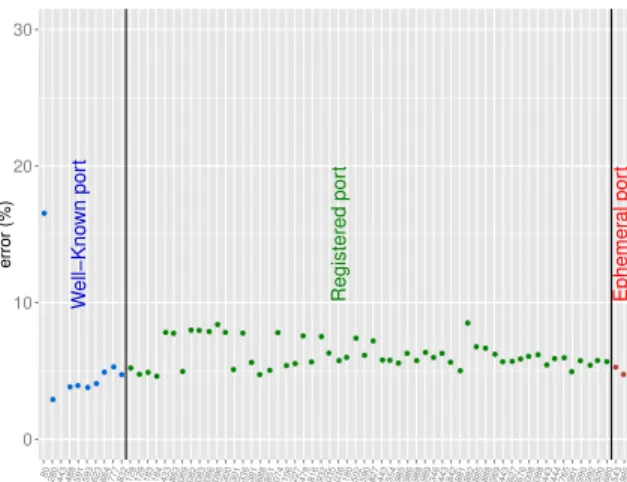
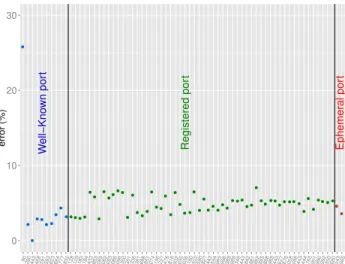
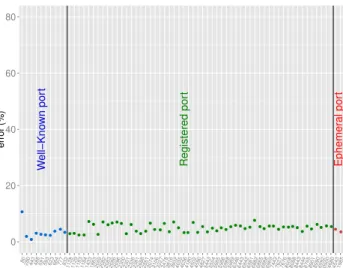
However, before designing any solution, it is first essential to un-derstand the feasibility of pervasive encryption in the Internet ecosys-tem by measuring the interaction of middleboxes with the TLS across the different TCP ports that currently use plain text protocols. In other words, we need to establish at this point whether using encryp-tion in tradiencryp-tionally unsecured ports is even possible in today’s Inter-net. With this goal in mind, we attempt to initiate TLS connections in68different ports that normally do not use any form of encryption and analyze the success of the connection. This is a first necessary step towards a full comprehension of the behavior of middleboxes relative to pervasive encryption.
On the other hand, in May2015, version2of the Hypertext
Trans-fer Protocol (HTTP/2) was standardized as RFC7540.16 HTTP/2 16
M. Belshe, R. Peon, and M. Thomson. Hypertext Transfer Protocol Version2 (HTTP/2). Technical report, RFC7540,
May,2015
is an effort to reduce the gap between how modern websites are designed, and how their content is delivered. To do such, HTTP/2 in-troduces several novel features like header compression, full request and response multiplexing, and support for request prioritization and server push.
The IETF longly discussed about whether HTTP/2should be en-crypted by default using Transport Layer Security (TLS). Specifically, the standard defines that H2C should be negotiated by mean of an Upgrade header field in a classic HTTP/1request.
Using crowdsourcing platform, over a period of one week we recruit more than600users distributed across38countries;355users perform measurements from fixed networks, while322users were only available on mobile. We build a complex dataset for a total of 140,432connections. Results, from TLS and HTTP/2campaigns, show that middleboxes affect H2C deployment, especially on port80. H2C Upgrade requests are affected by proxies, failing to upgrade to HTTP/2.
Our methodology allows us to make an extensive study on how middleboxes behave in front of TCP new extensions, namely TCP Fast Open(TFO) and Expicit Congestion Notification++ (ECN++).
We measure in the wild whether TFO is supported by the Internet paths. To this end we recruit TFO users from Microworkers crowd-sourcing platform. We create a tool called ExploreTFO that allows users to connect to our TFO server. Leveraging the access to these ac-tive users and their equipment we find that the41,3% of the paths we test allowed for a successful TFO communication. We present a first step analysis of the deployability of TFO and we demonstrate that early results are not promising, reducing the possibility to decrease the latency due the TCP handshake.
Expicit Congestion Notification (ECN) is a way to mark packets to indicate that the capacity of a link is approaching exhaustion. ECN was standardized as a straight replacement for loss signals, but
increasingly ECN is also being recognized as critical for low delay.17 17
M. Welzl and G. Fairhurst. The Benefits of using Explicit Congestion Notification (ECN). Internet Draft draft-ietf-aqm-ecn-benefits-08, Internet Engineering Task Force, Nov.2015. URLhttps://tools.ietf.org/html/ draft-ietf-ecn-benefits. (Work in Progress)
Welzl and Fairhurst [2015] A new proposal called ECN++18
proposes safe ways to remove all
18
M. Bagnulo and B. Briscoe. ECN++: Adding Explicit Congestion Notifi-cation (ECN) to TCP Control Pack-ets. Internet Draft draft-bagnulo-tcpm-generalized-ecn-04, Internet Engineering Task Force, May2017. URLhttps://tools.ietf.org/html/ draft-bagnulo-tcpm-generalized-ecn. (Work in Progress)
Bagnulo and Briscoe [2017] the original prohibitions on using ECN on each type of TCP packet.
As with any new protocol, ECN++ can experience deployment prob-lems, either because existing networks and servers protect themselves against out-of-the-ordinary behavior, or because optimizations have been built around a narrow and unchanging interpretation of the way protocols work.19
19
M. Honda, Y. Nishida, C. Raiciu, A. Greenhalgh, M. Handley, and H. Tokuda. Is it still possible to ex-tend TCP? InProceedings of the2011 ACM SIGCOMM conference on Internet measurement conference, pages181–194.
ACM,2011
Honda et al. [2011] Therefore, this study sets out to measure how much existing
net-works and servers would mangle or block the ECN++ updates to TCP/IP. Using a crowdsourcing large scale measurement platform called MONROE, we test ECN and ECN++ support in both fixed and
i n t ro du c t i o n 5
mobile networks. In particular, we test18mobile carriers, making it, to the best of our knowledge, the largest measurement study of ECN in mobile networks so far, even Apple had only tested three mobile carriers.20
Although we only set out to measure ECN++ sup- 20
S. Cheshire. Networking for the
Modern Internet. URL:https://
developer.apple.com/videos/play/ wwdc2016/714/, June2016. (Presentation video: requires Safari browser)
Cheshire [2016] port, our measurements from mobile vantage points challenge the
accepted belief that path traversal of ECN itself is free of problems. The study does not just check for correct transitions of protocol fields; it also checks behavior. That is, it checks whether ECN-capable servers correctly reduce their rate in response to ECN feedback.
We discover that:
• More than half of the mobile carriers we tested bleach (clear) the ECN field at the first upstream IP hop. This contradicts the im-pression of hardly any ECN traversal problems that has been re-inforced by all recent studies. Nonetheless, our testing with fixed connectivity is consistent with these previous studies.
• Bleaching ECN is benign21
, the connection continues, but without 21
Nonetheless, if other links precede the cellular hop (e.g. a home router or bus/train connected over cellular), any CE-marking introduced in the home or vehicle network would be wiped, which would fool ECN sources into overrunning their local network.
the benefits of ECN. We find no evidence of the ECN capability being blocked.
• Wherever ECN gets through, we find no problems for ECN++. We also find no problems with how servers respond to ECN-marking, but we do find some interesting congestion behaviors unrelated to ECN.
The second part of our work focuses on studying the characteris-tics and the behavior of such middleboxes. We centred our vision on Network Address Translation(NATs) with a deep analysis on Carrier Grade NATs (CGNs).
NATs were introduced back in the early90s as a mean to cope with the incipient address depletion crisis. Together with Classless Interdomain Routing (CIDR), they successfully extended the lifetime of IPv4from imminent depletion until very recently, when the In-ternet Assigned Numbers Authority (IANA) pool of IPv4addresses finally ran out.22
NATs are now a commonplace in the Internet and 22
Potaroo Network Tool. http://www.
potaroo.net/tools/ipv4/. Accessed on
2019-02-02
hus they are included by default in the Internet Access offerings for both
residential and mobile customers.
NATs successfully extended the lifetime of the IPv4indeed, but at a high cost: they hardcoded the client-server paradigm in the architecture of the Internet. The basic operation of a NAT relies on the creation of a mapping state between a private address and port pair and a public address and port pair. This state is created when a client using a private address initiates a communication with a server in the public Internet. Deploying applications that have an alternative paradigm, such as peer-to-peer applications, gaming or
Voice-over-IP to name a few, that require hosts in the public Internet to initiate communications towards hosts behind a NAT is challenging and requires the use of the so-called NAT traversal techniques. These techniques are usually cumbersome and increase the latency, the traffic and the energy consumed by the endpoint.
While the aforementioned problem of supporting alternative appli-cation paradigms is fundamental to the nature of the NAT operation, it is exacerbated by the myriad of behaviors of the different NAT implementations deployed in the Internet. Different NATs use dif-ferent criteria to create, preserve and remove their internal mapping state and have different filtering and forwarding rules. This severely complicates the job of applications willing to manage the NAT state in order to enable alternative communication models other than the client server one as they need to cope with all possible NAT flavours.
Another approach towards prolonging the life of current IPv4 ad-dress allocations is to deploy Carrier Grade NATs (CGNs), where Internet Service Providers (ISPs) share the same public IPv4address across multiple end users. CGNs may introduce a number of issues for end users, service providers, content providers and government authorities.23
There is some evidence that CGNs can cause dropped 23
M. Ford, M. Boucadair, A. Durand, P. Levis, and P. Roberts. Issues with IP Address Sharing. RFC6269, June2011
Ford et al. [2011] services in peer-to-peer applications, and lead to low performance of
file transfer and video streaming sessions.24
CGNs also introduce
24
C. Donley, L. Howard, V. Kuarsingh, J. Berg, and J. Doshi. Assessing the Impact of Carrier-Grade NAT on Network Applications. RFC7021,
September2013
Donley et al. [2013] security challenges including traceability of IP addresses and
anti-spoofing. Despite these challenges, CGNs offer an immediate relief to the IPv4address scarcity problem, so it is likely that their popularity will increase over time. The use case for CGN differs in wireline vs. mobile networks. Given the rapid boost in the number of operational Internet-enabled mobile devices, and the scarcity of available IPv4 address space, mobile operators usually assign the same public IP ad-dress to multiple end users. Hence, some form of carrier-grade NAT
technology has always been the norm, rather than the exception.25 25
Z. Wang, Z. Qian, Q. Xu, Z. Mao, and M. Zhang. An Untold Story of Middleboxes in Cellular Networks. InProceedings of the ACM SIGCOMM 2011Conference, SIGCOMM ’11, pages 374–385,2011. ISBN978-1-4503-0797-0; and S. Triukose, S. Ardon, A. Mahanti, and A. Seth. Geolocating IP Addresses in Cellular Data Networks. InPassive and Active Measurement, pages158–167. Springer,2012
Wang et al. [2011], Triukose et al. [2012] In wireline networks, however, end users are typically assigned
pub-lic IPv4addresses. While this situation may change as IPv4addresses become increasingly scarce and ISP customer bases continue to grow, there is no source of systematic measurements of the prevalence or evolution of CGN deployments in ISPs.
While CGNs enable mobile operators to provide Internet-access to millions of devices with a limited amount of IPv4addresses, their adoption imposes functional and potentially also performance penal-ties to the end-users that may affect their perceived quality of experi-ence.
However, it is far from clear to what extent the currently deployed CGN base complies with the aforementioned NATs requirements. There is also the concern that CGNs utilization may result in
perfor-i n t ro du c t perfor-i o n 7
mance penalties. It is a common operational practice that a single CGN serves a very large number of mobile nodes (up to millions of devices per CGN). Because of this, the CGN itself may become a bottleneck and impose performance penalties to the communica-tion. This is especially so for the case of the first packet that creates the NAT mapping, but it may also affect traffic forwarding once the mapping has been established. Measuring and understanding the performance penalties resulting from the use of CGNs is important for application designers, for end users and for mobile operators adopting the CGN technology. (e.g. for application designers, this information should affect the maximum number of communications open in parallel). This input is very relevant for a measurement plat-form such as MONROE, since the perplat-formance penalties if exist can affect and bias the measurement results.
In order to achieve a more deterministic behavior from the NAT boxes, the Internet Engineering Task Force (IETF) produced a number of specifications defining the requirements that NATs should follow when creating, preserving and removing their internal state as well as some recommendations in terms of the different filtering and for-warding policies that NAT should implement. In particular, the IETF released NAT behavioral requirements for handling TCP traffic26
, 26
S. Guha, K. Biswas, B. Ford, S. Sivaku-mar, and P. Srisuresh. NAT Behavioral Requirements for TCP. IETF, RFC5382, October2008
Guha et al. [2008] UDP traffic27
and ICMP packets. 28
However, since these IETF
stan-27
F. Audet and C. Jennings. Network Address Translation (NAT) Behavioral Requirements for Unicast UDP. IETF, RFC4787, January2007
Audet and Jennings [2007]
28
P. Srisuresh, B. Ford, S. Sivakumar, and S. Guha. NAT Behavioral Require-ments for ICMP. IETF, RFC5508, April 2009
Srisuresh et al. [2009] dards specify the internal behavior for a NAT, it is far from trivial to
assess whether NATs are following the recommendations and to the best of our knowledge there is no information about the prevalence of NAT boxes that honor the IETF specifications.
The contribution of this part is therefore three-fold:
• First, we design and develop NATwatcher, a tool to measure key aspects of the behavior of the deployed NAT base, along with a measurement methodology based on crowdsourcing that allows us to perform large scale measurement using NATwatcher. We per-form a large measurement campaign and we deploy NATwatcher in over700measurement points, building a large data set describ-ing the behavior of over700NAT boxes from65different countries and280ISPs, testing over120different NAT vendors. We find that a large majority (80%) of the NAT boxes we tested follow the IETF recommendations for11out the17of the considered features. We also observed that about half of the NAT devices we tested exhibit the exact same behavior for all the features we tested. While the other half of the devices use a variety of configurations.
• Second, we perform a large scale active measurement campaign to detect CGNs in fixed broadband networks using NAT Revelio.
29
Revelio enables us to actively determine from within residen- 29
A. Lutu, M. Bagnulo, A. Dhamdhere, and K. Claffy. NAT Revelio: Detecting NAT444in the ISP. InInternational
Conference on Passive and Active Network Measurement, pages149–161. Springer, 2016
tial networks the type of upstream network address translation, namely NAT at the home gateway (customer-grade NAT) or NAT in the ISP (Carrier Grade NAT). We deployed Revelio on two large-scale hardware-based measurement platforms – RIPE Atlas in Europe and the FCC “Measuring Broadband America” (FCC-MBA) in the U.S. – with a total of5,121vantage points in over60 ISPs. The FCC-MBA deployment consisted of2,477home routers operated by SamKnows in21large residential broadband Internet access service providers in the U.S. We also adapted the Revelio methodology to run on the RIPE Atlas infrastructure (using their available user tests), and executed the tests from2,644Atlas probes in43ISPs mainly active in Europe. We thus demonstrate the flex-ibility of Revelio and exemplify the use of two fundamentally different large-scale measurement testbeds.
Our results show that10% (6out of64) of the ISPs we tested have some form of CGN deployment. In particular, one ISP has a large-scale deployment where Revelio detected upstream CGN deploy-ment from all76vantage points in that ISP. In the other5ISPs we observed evidence of a localized deployment limited to a sub-set of customers. We verified our results with representatives of the ISPs to validate our positive and negative inferences at the IP level. We confirmed the results for4of the6positive ISPs by personal communications with ISP representatives. The combina-tion of the FCC-MBA and RIPE Atlas study represents (to the best of our knowledge) the largest active measurement study to date with confirmed CGN deployments in broadband networks at the IP-level granularity.
• Finally, we create and test CGNwatcher. The goal of CGNwatcher is to design, develop, implement, deploy an extensive set of met-rics to characterize CGN behaviour, to provide useful insight about the current CGN base deployed in the Internet.
As part of the thesis, we characterize roaming across Europe for16 different MNOs deployed in six countries. The goal of the experiment is to try to understand if the MNO changes CGN while roaming, for this reason, we run a series of measurements that enable us to identify the roaming setup, infer the network configuration for the16 MNOs that we measure and quantify the end-user performance for the roaming configurations which we detect.
International roaming allows mobile users to use their voice and data services when they are abroad. The European Commission (EC), in an effort to create a single digital market across the European Union (EU), has recently (as of June2017) introduced a set of regu-latory decisions30
as part of the “Roam like Home” initiative. This 30
European Commission: New Rules on Roaming Charges and Open Internet. https://ec.europa.eu/ digital-single-market/en/news/
new-rules-roaming-charges-and-open-internet. [Online; accessed06-March-2018]
ec-i n t ro du c t ec-i o n 9
initiative abolishes additional charges for users when they use voice and data services while roaming in EU.
In this setting, Mobile Network Operator (MNO) are expected to deliver services with Quality of Service (QoS) properties similar to the ones a user experiences when at home.
Several topology architectures can be used for roaming in a mobile network, namely, home-routed roaming (HR), local breakout (LBO) and IPX hub breakout (IHBO).
The topology can have a potential impact on the communication performance. For instance, when the node accesses services inside thevisited network, the performance is likely to be worse in the HR case, because all packets travel twice between the visited and the home country; less so when the communication peer is in a third country and is minimal when accessing services in the home country.
In the last part of this work, we perform an extensive large-scale measurement study to understand the roaming ecosystem in Europe after the “Roam like Home” initiative. More specifically, we investi-gate:
• Which technical solutions are actually being deployed and used today?
• What are the implications of roaming on the service experienced by the roaming user?
To address these questions, we built a unique measurement plat-form,MONROE-Roaming, to assess roaming and its performance im-plications. The platform integrates dedicated measurement hardware that we deployed in six different countries across Europe, covering a total of16MNOs. We purchased Subscriber Identity Modules (SIMs) that support roaming for these MNOs and distribute them across the six countries. We characterize roaming operation and network perfor-mance and evaluate the impact on VoIP and web applications while roaming. We find that all observed MNOs use HR, which yields no-ticeable latency increases. We do not observe traffic differentiation policies for VoIP or web, but we do find evidence of content discrimi-nation for roaming users.
2
State of the art
Ab roa d r e s e a rc h c o r p u sis available when studying the deploy-ment of a new protocol in the Internet. Here we select a subset of works that share some similarities with our workHonda et al.[2011], Hirth et al.[2015]. Honda et al.Honda et al.[2011] shed some light on the feasibility of extending TCP due to its (bad) interaction with middleboxes. Authors demonstrate that middleboxes are almost om-nipresent and that they can arbitrarily change packets header (e.g., dropping both known and unknown TCP options) or payloads, par-ticularly over port80.
The extent to which the Internet deploys and supports ECN has been a topic visited repeatedly over the past15years Medina et al. [2005],Langley[2008],Bauer et al.[2011],Trammell et al.[2015], Bhooma[2017]. Previous work focused on three main aspects of ECN-readiness, namely, server-side support, end-to-end path support and, finally, client-side support.
Measurements of server-side support usually focus on the pop-ulation of web servers as ranked by Alexa. While quantifying ECN server-side support in2004, Medina et al Medina et al.[2005] found that as little as2.1% of the servers tested supported ECN. Ten years later, Trammell et al Trammell et al.[2015] report an acceleration in the deployment of ECN-capable servers, finding56.17% of ECN-capable servers.
In this work, we corroborate the acceleration of ECN deployment for wired networks and Alexa servers, and we extend the study to mobile networks and ECN++.
Regarding support of ECN by the network elements on the end-to-end path, in2013, Kühlewind et al Kühlewind et al.[2013] tested 22,487hosts and reported that in0.9% of cases ECN was not usable due to middleboxes along the path. Later, in2015, Trammell et al Trammell et al.[2015] finds that when testing326,743hosts capable of negotiating ECN, for0.02% of them (107hosts) a device on the path mangles the TCP/ECN flags. We note that all these above-mentioned efforts report on measurements performed mostly in fixed networks.
Only recently, in March2017, Apple Bhooma[2017] reported100% positive results after testing from vantage points connected to ‘a few’ mobile carriers, which on further investigation meant three carriers Cheshire[2016].
As mobile broadband networks accommodate more traffic, there is a pressing need for similar analysis of mobile carriers, which are known to represent a middlebox-rich environment. Because of the difficulty of instrumenting mobile devices to perform ECN measure-ments, there is little prior work Kühlewind et al.[2013],Bhooma [2017]. For example inHonda et al.[2011,0pt] the authors only have access to a low number of vantage points. To overcome the latter is-sue, Hirth et al. Hirth et al.[2015] demonstrate that crowdsourcing platforms can become a powerful tool to achieve a realistic view of the network from an end-user perspective.
In this work, we present the largest measurement study of ECN support in mobile networks to date, using vantage points connected to18mobile operators. The results we find in this work contrast with the prior work, providing a different picture of the current support of ECN (in particular in mobile networks) and unraveling significant challenges yet to overcome towards global ECN adoption.
As we described earlier, we also propose to design and implement a set of tests that measure a number of functional and performance metrics to characterize NATs and particularly CGNs. Due to the diffi-culties that are inherent to perform large-scale measurements in real residential environments, to date, the few studies that are available have performed testing of different NAT devices in a lab environ-ment. In Hätönen et al.[2010] authors study the configurations of 34different home gateway models, analyzing the processing of vari-ous TCP and IP options and measuring the success of some network protocols when traversing NATs (i.e., STUN Rosenberg et al.[2008a], TURN Mahy et al.[2010] and ICERosenberg[2010]). In Jennings [2007] authors perform a lab study of the support of a number of features such as mapping, filtering, hairpinning, on42NAT device models. While these studies provide some information about the capabilities of the different NAT boxes, they provide limited infor-mation about the actual behavior of the deployed NAT devices in the Internet. This is so because the behavior of the deployed NAT base also largely depends on the configuration of the NAT boxes and in the popularity of the different NAT products.
The usage and impact of CGN-based solutions Skoberne et al. [2014] has lately drawn much attention from the community Donley et al.[2013],Ford et al.[2011]. Consequently, we have seen several approaches for quantifying and confirming the degree in which op-erators are actively deploying operational CGNs Müller et al.[2013],
s tat e o f t h e a r t 13
Richter et al.[2016].
Richter et al. Richter et al.[2016] use passive measurements to quantify CGN deployment rate in the Internet, after observing that some nodes in the BitTorrent DHT mistake addresses internal to a CGN for external addresses and therefore propagate these IP ad-dresses to other nodes. The authors report the average CGN penetra-tion rate to be17-18% of all Eyeball ASes. In this work, however, we focus on active CGN detection in fixed-line broadband providers at the IP level. NAT Revelio empowers end-users to test whether their upstream provider connects them behind a CGN solution active in the access network. Similar to our efforts, the Netalyzr Kreibich et al. [2010] tool, initially meant as a networking debugging tool, has been repurposed to detect CGN solutions in mobile networks. The authors present the measurements results in Richter et al.[2016], which cor-roborate the conclusion of prior work Triukose et al.[2012],Wang et al.[2011] that for mobile providers CGN deployments are com-monplace. For wireline networks, however, it is non-trivial to detect and confirm CGN deployment on a per-IP basis.
Another notable effort towards passively quantifying the degree of CGN deployment is Livadariu et al.[2017]. The authors look at CGN deployment with a /24IP prefix granularity. For the92lines Revelio identified as being behind a CGN, we identified52covering /24prefixes and cross-compared our results with Livadariu et al. [2017]. We find that38prefixes appear as CGN-positive in Livadariu et al.[2017], while13prefixes were classified as not being used in CGN deployments and one was unaccounted. Given that we were able to validate at the IP level89of these IPs, we thus highlight the benefits of an active measurements approach, while acknowledging the advantage of the passive approach to easily scale.
Finally, using an earlier version of NAT Revelio, the authors pre-sented in Lutu et al.[2016] a smaller study on CGN deployment in the United Kingdom showing a very low penetration degree. This work presents an evolution of the Revelio methodology that includes additional tests designed to support the myriad of technologies and devices deployed in real operational environments, as described in Section8.2.
In terms of measuring the performance of CGNs, there is very little work available. In particular in Bocchi et al.[2016] authors mea-sure the RTT, the time required for the TCP3-way handshake, the time to start the data transfer and the goodput rate. While, in Ohara et al.[2014] authors analyze the impact of network delays when a CGN is used. We believe that there are other relevant metrics that are useful to understand the potential limitations introduced by the CGN. For instance, the performance of the CGN when creating new
mappings (e.g. maximum rate at which mappings are created, and whether this affects the forwarding of packets for which a mapping already exists) or metrics regarding the performance of the CGN when the number of ports allocated to a given end user increases.
International roaming has received little coverage in terms of large measurement studies, potentially because of the high costs and coor-dination efforts associated with running such a campaign. Vallinaet al. Vallina-Rodriguez et al.[2015b] has leveraged crowdsourced measurements and focused only on national roaming agreements between MNOs in France. The study does not provide any further evaluation in terms of performance or content implications. Using controlled measurements in the dedicated platform MONROE Alay et al.[2017b] enabled Michelinakiset al. Michelinakis et al.[2018] to analyze the impact of international roaming, but only for two oper-ators in Europe. They find that the home-routed configuration does impact the performance of cloud service providers, such as Akamai or CloudFront. Our work complements this work and presents an ex-tensive measurement study to understand the international roaming ecosystem in Europe since the “Roam like Home” initiative.
There have been myriad recent studies focusing on mobile net-work characterization and performance. For instance, while Huanget al. Huang et al.[2013] study LTE network characteristics in a cellular operator in the US, Safariet al. Khatouni et al.[2017] show perfor-mance measurement in mobile networks are much more complex than wired networks, due to the different network configurations such as the presence of Network Address Translation (NAT) or Per-formance Enhancing Proxies (PEP), which do vary over time. Kaup et al. Kaup et al.[2016] run a crowdsourcing campaign to measure RTT and throughput towards popular websites in Germany. They used the dataset to show that the association of a mobile endpoint to the Point of Presence (PoP) within the operator network has influ-ence on network performance. The authors of Molavi Kakhki et al. [2015] present a mobile app and a mechanism for identifying traf-fic differentiation for arbitrary applications in the mobile networks. Ververiset al. Ververis et al.[2015] surveys content filtering for a mixture of broadband and cellular ISPs and finds a lack of trans-parency around the policies they implement as well as outdated and poorly implemented blacklists. In our work, we not only focus on network performance of roaming infrastructure, but also identify possible traffic differentiation for particular applications and content discrimination and geo-restriction for users in international roaming.
s tat e o f t h e a r t 15
2
.
1
Existing Crowdsourcing Large Scale Measurement Platforms
In this Section we describe in details the existing large scale measure-ment platforms. in the next Chapters we use those platforms to make informed protocol design choices.
2
.
1
.
1
RIPE Atlas
Figure2.1: RIPE Atlas network map.
RIPE Atlas1
is an active Internet measurement network from the
1
https://atlas.ripe.net/
RIPE NCC. It consists of thousands of measurement probes dis-tributed around the globe (see Figure2.1).
A probe (figure2.2) is a small hardware, located in people’s home,
that runs measurements in the RIPE Atlas system and reports these results to the data collection components. A host is someone who hosts a probe for RIPE Atlas. A RIPE Atlas host earns credits for the time that his probe is connected. It is possible to use these credits to conduct user-defined measurements, such as Ping, Traceroute, DNS, SSL and HTTP, using the entire RIPE Atlas network.
Figure2.2: RIPE Atlas network.
2
.
1
.
2
SamKnows
SamKnows2
is a measurement platform with installed whiteboxes 2
http://www.samknows.com
in over28,507,000homes, across many different ISPs. The platform was born for measuring performance of access networks in UK and in few year it expanded around the world (Figure2.3). The gateway
is a Netgear WNR3500L RangeMax Wireless-N Gigabit router with a 480MHz MIPS processor,8MB of flash storage, and64MB of RAM.
Samknows can be used by regulators, ISPs and manufactures.
Figure2.3: SamKnows growth.
2
.
1
.
3
MONROE
MONROE Alay et al.[2017a] is the first open and flexible platform to run experiments on operational3G/4G Mobile Broadband net-works. It is composed by450MONROE nodes, distributed across Norway, Sweden, Italy, Spain, Greece and UK.150MONROE nodes are devoted to mobility and installed on trains and buses. MON-ROE provided also a scheduler web interface, making easy to access the system and deploy experiments on all or a selected subset of the nodes. The platform provides also metadata, context informa-tion about the node useful during the process of the results from the experiment.
Figure2.4shows the system design of MONROE. The nodes are
located in bus, trains or people’s home and each connect to two or three MNOs. The scheduler allows the access to external users, as-signing a given slot of time. The experiments results are pulled to
external repositories, accessible later by the users.
3
Leveraging Crowdsourcing Platforms for Network
Measurements
By e x pa n d i n g t h e t r a d i t i o na l c ro w d s o u rc i n gfocus from the human element to use a diverse and numerous group of end-user devices as measurement vantage points, we show how to leverage on crowdsourcing platforms and how to exploit measurements plat-forms to run Internet wide measurements.
3
.
1
Microworkers Crowdsourcing Platform
The Internet is nowadays the main venue for crowdsourcing, since anyone with an Internet connection can become involved. Crowd-sourcing platforms connectemployersandworkersfrom around the world.
The employer is the one who creates the task (or the"micro-job") for workers and specifies the parameters of its campaign, e.g., the size of the set of users performing the task or their geographical location at country level. Each worker meeting the required criteria can carry out the task only once, thus validating the uniqueness of the results for which the employers pays. The platform then acts as a referee, guaranteeing to the employer that the campaign funded is successfully completed within the required parameters, while also making sure that the workers involved get paid for their contribution.
Microworkers offers world-wide access to employers, unlike sim-ilar more popular crowdsourcing platforms1
. Furthermore, it offers 1
For example, Amazon Mechanical Turks is only available to employers based in the U.S., thus restricting our particular access.
an automatic payment method based on a unique verification code, called VCODE. The latter provides the worker a proof (payment code) for each task performed on the external page, so that the pay-ment can be handled via the Microworkers platform. The platform presents a simple interface and it is very reliable, allowing an em-ployer to refuse pay for work which does not meet the required qual-ity. Another important advantage of using Microworkers for Internet measurements is the possibility to select the vantage points based
on certain criteria, such as the geographical location at the country level, the type of Internet access (fixed or mobile) or even the type of measurement equipment used to perform the tasks (i.e., Android or iOS mobile operating system).
3
.
2
Informing Protocol Design through Crowdsourcing
Modern networks often rely on dedicated hardware components generically dubbed middleboxes to perform advanced processing functions like, for example, enhancing application performance (e.g., traffic accelerators, caches, proxies), traffic shaping (e.g., load bal-ancers), optimizing the usage of IPv4address space (e.g., NATs) or security (e.g., firewalls).
One major criticism of middleboxes is that they might filter traf-fic that does not conform to expected behaviors, thus ossifying the
Internet and rendering it as a hostile environment for innovation.2 2
M. Handley. Why the internet only just works.BT Technology Journal,2006
Handley [2006] Middleboxes for example can alter HTTP requests and responses,
es-pecially headers, to provide their functionalities.3
The unpredictable 3
N. Vallina-Rodriguez, S. Sundaresan, C. Kreibich, and V. Paxson. Header En-richment or ISP EnEn-richment?: Emerging Privacy Threats in Mobile Networks. In
Proceedings of the2015ACM SIGCOMM Workshop on Hot Topics in Middleboxes and Network Function Virtualization, pages25–30. ACM,2015a
Vallina-Rodriguez et al. [2015a] and diverse behaviors of such middleboxes can be problematic when
adopting new protocols. This is a well know problem, and an IRTF research group is setup4
to quantify its extent and propose solutions.
4
https://www.ietf.org/mailman/listinfo/hops.
IRTF,2015
hop [2015]
Figure3.1: Some examples of middle-boxes.
This does not mean that it is impossible to deploy new protocols, but that in order to ensure success it is imperative to first understand the interaction of the proposed solutions with the middleboxes active along the path. Recent studies on middleboxes behaviour attempt to provide such information. In order to perform representative Internet measurements and test realistic scenarios and different Autonomous Systems (ASes), what is missing is access to a high number of diverse vantage points. In addition, more evidences of the nature of the problems and the portions of the network in which they manifest are needed.
Crowdsourcing platforms present a simple interface and they are very reliable. Another important advantage of using crowdsourcing platforms for Internet measurements is the possibility to select the vantage points based on certain criteria, such as the geographical location at the country level, the type of Internet access (fixed or mo-bile) or even the type of measurement equipment used to perform the tasks (i.e., Android or iOS mobile operating system). However, some information cannot be extract directly from the platform, so that the interaction with the users appears essential to obtain some relevant data to perform a realistic analysis. To overcome this issue, we create a survey in which we ask to the users what kind of con-nection they are using and other information that help us to have a complete view of the Internet scenario. We combine the
crowd-l e v e r ag i n g c ro w d s o u rc i n g p crowd-l at f o r m s f o r n e t w o r k m e a s u r e m e n t s 21
sourcing solution approach with the access to one of the available crowdsourcing large-scale measurements platforms, like for example the RIPE Atlas platform, SamKnows, PlanetLab and MONROE.
Figure3.2: Microworkers crowdsourc-ing platform.
The MONROE platform is also ideal for our purposes due to its flexibility allowing the deployment of all kind of sophisticated tests that include the crafting of specific packet sequences, thing quite difficult on crowdsourcing platform, since the user does not own a rooted device. MONROE provides a somehow controlled environ-ment, as the hardware running the tests is under control of the MON-ROE consortium. Being part of the external user, MONMON-ROE allows us to complement the main advantage of crowdsourcing techniques that is scalability with repeatability and control of the measurement process. Mostly due to privacy reasons, crowdsourcing platforms measurements do not always provide important context information like location, kind of equipment, and connection status. Moreover, MONROE supports the deployment of different applications and protocols, and enables benchmarking tools and methodologies.
3
.
3
Experiences and lessons learned measuring the Internet with
crowdsourcing
Figure3.3: Crowdsourcing Platform Guidelines.
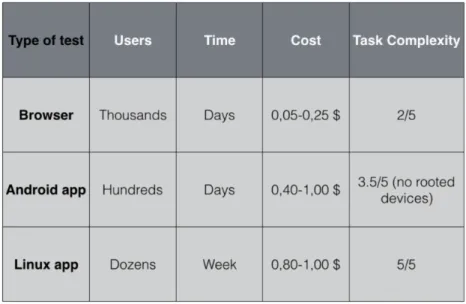
The experience on studying the seven case studies described be-fore gave us the opportunity to understand the functionalities of crowdsourcing platforms for network measurements. Figure3.3
shows the type of tests we offer to the crowdsourcing platform users. The browser test is the simpler and the most common and cheap.
Since what users need is only a standard browser in few days is pos-sible to get thousands of vantage points. It is pospos-sible to deploy an Android or Apple app and serve through the crowdsourcing plat-form. In this case the users need to own a smartphone and in few days it is still possible to have hundreds of users, but with a higher cost.
Finally, the linux app is an application that users need to down-load and run on a linux computer. Since Windows OS is more com-mon between users, it is hard to recruit users with such equipment and the cost can increase. Despite this, we could recruit dozens of users in few weeks.
Testing crowdsourcing platform for network measurements, we understood that the best period for launching a campaign is during weekend. We recruited more users than during the week.
Creating survey for understanding users network context can be hard and users can lie. We deploy some methodologies for under-standing users behavior and the fairness of their answers. Like for example changing the order of the questions. We discovered that60% of the users lie. We did not use that context information in that case.
4
The Feasibility of Pervasive Encryption
In t h i s c h a p t e r, we show how to make informed protocol design choices by using a novel methodology for performing large scale Internet measurements, using a crowdsourcing solution approach. We exemplify next the efficiency of our methodology in the case of evaluating the feasibility of pervasive encryption in the modern Internet ecosystem.
4
.
1
The Feasibility of Pervasive Encryption in the Internet
Ecosys-tem
The long-term objective of the research community is to provide encryption by default for all Internet communications. In order to achieve that, the use of TLS as a substratum for all communications is being considered. In par