A hybrid stock trading framework integrating technical analysis with
machine learning techniques
Rajashree Dash
a,*
,1, Pradipta Kishore Dash
b,2 aComputer Science&Engineering Department, ITER, Siksha ‘O’Anusandhan University, Bhubaneswar, Odisha, 751030, India
b
Siksha ‘O’Anusandhan University, Bhubaneswar, Odisha, 751030, India
Received 30 December 2015; revised 3 March 2016; accepted 8 March 2016 Available online 22 March 2016
Abstract
In this paper, a novel decision support system using a computational efficient functional link artificial neural network (CEFLANN) and a set of rules is proposed to generate the trading decisions more effectively. Here the problem of stock trading decision prediction is articulated as a classification problem with three class values representing the buy, hold and sell signals. The CEFLANN network used in the decision support system produces a set of continuous trading signals within the range 0e1 by analyzing the nonlinear relationship exists between few popular technical indicators. Further the output trading signals are used to track the trend and to produce the trading decision based on that trend using some trading rules. The novelty of the approach is to engender the profitable stock trading decision points through integration of the learning ability of CEFLANN neural network with the technical analysis rules. For assessing the potential use of the proposed method, the model performance is also compared with some other machine learning techniques such as Support Vector Machine (SVM), Naive Bayesian model, K nearest neighbor model (KNN) and Decision Tree (DT) model.
©2016, China Science Publishing&Media Ltd. Production and hosting by Elsevier on behalf of KeAi Communications Co. Ltd. This is an open access article under the CC BY-NC-ND license (http://creativecommons.org/licenses/by-nc-nd/4.0/).
Keywords:Stock trading; Stock trend analysis; Technical indicators; CEFLANN
*Corresponding author.
E-mail addresses:[email protected](R. Dash),[email protected](P.K. Dash). Peer review under responsibility of China Science Publishing&Media Ltd.
1Rajashree Dash is working as an Asst. Professor in ITER, Siksha ‘O’Anusandhan University. She has completed her M.Tech in Computer Science and Engineering. Now she is pursuing her P.H.D. Her research topics include data mining, time series prediction, evolutionary computation etc.
2Professor P.K.Dash holds D.SC.,Ph.D. degrees in Electrical Engineering and currently is the director of research at the Siksha O Anusandhan University, Bhubaneswar, India. He had several visiting appointments at the Universities in USA, Canada, Singapore, and Malaysia. He has published more than 450 papers in reputed International journals and conferences. His research interests include Power Engineering, Renewable Energy, Signal Processing, Computational intelligence, Evolutionary Computing, and Information Technology.
http://dx.doi.org/10.1016/j.jfds.2016.03.002
2405-9188/©2016, China Science Publishing&Media Ltd. Production and hosting by Elsevier on behalf of KeAi Communications Co. Ltd. This is an open access article under the CC BY-NC-ND license (http://creativecommons.org/licenses/by-nc-nd/4.0/).
ScienceDirect
The Journal of Finance and Data Science 2 (2016) 42e57
1. Introduction
With the era of economic globalization and the facility of digital technology, generation and accumulation of financial data has reached at an unprecedented rate. The rapidly growing volume of data has far exceeded the ability of a human being to analyze them manually. Again financial time series data are more complicated than other statistical data due to the long term trends, cyclical variations, seasonal variations and irregular movements. These are highly affected by many external factors, such as many highly interrelated economic, political, social and even if the psychological behavior of the investor. The continuous growth of such highly fluctuating and irregular data has put forth the critical need for developing more automated approaches for efficient analysis of such massive financial data to extract meaningful statistics from that. Being a process of exploring useful hidden knowledge, Data mining has carved its own niche in financial time series analysis. It provides pathways for investors to take proactive and knowledge-driven decisions in order to achieve successful gain with less in-vestment risk.
Gaining high profit is the ultimate goal of an investor participating in financial market. There are so many investment opportunities like trading (i.e. buying and selling) bonds, shares, foreign exchanges and precious metals etc. present in a financial market. Trading in stock market is one of the popular channels of financial investment. Investors in the stock Market can maximize their profit by buying or selling their investment at proper time. The key to realize high profits in stock trading is to find out the suitable trading time with the minimum risk of trading. But it is always hard to decide the best time to buy or sell due to the highly fluctuating and dynamic behavior of stock market. Technical indicators are the primary interest for most of the researchers to monitor the stock prices and to assist investors in setting up trading rules for buyesellehold decisions. Technical indicators are produced based on historical stock data. So trading decision taken based on particular technical indicators may not always be more profitable. In literature various data mining and artificial intelli-gence tools has been applied to analyze technical indicators in an attempt to find the best trading signals.1e4 Gaining profit or loss from stock trading ultimately depends on analysis of future movement of highly fluctu-ating and irregular stock price values. Successful classification of up and down movements in stock price index values may not only helpful for the investors to make effective trading strategies, but also for policy maker to monitor stock market. Keeping track of upswings and downswings over the history of individual stocks will reduce the uncertainty associated to investment decision making. Investors can choose the best times to buy and sell the stock through proper analysis of the stock trends. In literature a number of models combining technical analysis with computational intelligent techniques are available for prediction of stock price index move-ments5e7; Patra, Thanh, &Meher, 2009).
In this study, the problem of stock trading decision prediction is articulated as a classification problem with three class values representing the buy, hold and sell signals. The foremost objective of this study is to develop a novel decision support system using a computational efficient functional link artificial neural network (CEFLANN) and a set of rules based on technical analysis, to generate the trading decisions more effectively. Instead of training the CEFLANN network using traditional back propagation algorithm, the ELM learning is proposed for the network. Six popular technical indicators calculated from the historical stock index price values are used as the input features for the proposed model. The CEFLANN network is applied to capture the nonlinear relationship exists between the technical indicators and trading signals. Instead of using discrete class values during training of the network, a continuous trading signal within range 0e1 are fed to the network. The new trading signals in the range 0e1 can provide more detailed information regarding stock trading related to the original price variations. Further the outputs from the CEFLANN model is transformed in to a simple trading strategy with buy, hold and sell signals using suitable rules. The model performance is evaluated based on profit percentage obtained during test period. The CEFLANN model is also compared with some other known machine learning techniques like support vector machine (SVM),5,6,8,9Naive Bayesian model, K nearest neighbor model (KNN)2,9 and decision tree (DT)10 model.
The remainder of the paper is organized in to following sections; Section2highlights relevant reviews on different machine learning techniques used in stock trading. Section3specifies the details of CEFLANN network followed by the details of ELM Learning in Section4. Section5describes the detailed steps of the decision support system for generating stock trading decision points. Section6shows experimental results obtained from the comparative anal-ysis. Finally Section7contains the concluding remarks.
2. Literature survey
Though most of the financial time series analysis involve prediction of stock price or it fluctuation, but trading the stock market is another popular research area. Gaining profit or loss from stock trading ultimately depends on analysis of future movement of highly fluctuating and irregular stock price values. In literature a number of models combining technical analysis with computational intelligent techniques are available for prediction of stock price index move-ments and for stock trading. In Ref. [11] a new trading framework enhancing the performance of reinforcement learning based trading systems is proposed to make buy and sell suggestions for investors in their daily stock trading so as to maximize their profit in the dynamic stock market. In Ref. [12] a new model using Piecewise Linear Repre-sentations (PLR) and Artificial Neural Networks (ANNs) is proposed to analyze the nonlinear relationships between the stock closed price and various technical indexes, and to capture the knowledge of trading signals that are hidden in historical data. The learned ANN model is used to predict the future trading signals on a daily basis. Secondly, a trading decision is triggered by developing a dynamic threshold decision system. Another forecasting model inte-grating the case based dynamic window (CBDW) and the neural network is applied by13to predict the right turning points in stock trading, so as to maximize the investing revenue. In Ref. [2] a method using together the well known k-NN classifier and some common tools of technical analysis, like technical indicators, stop loss, stop gain and RSI filters is proposed with the purpose of investigating the feasibility of using an intelligent trading system in real market conditions, considering real companies of S~ao Paulo Stock Exchange and transaction costs. An effective trading signal detection system using Piecewise Linear Representations (PLR) and Artificial Neural Networks (ANNs) is proposed in14to capture the knowledge of trading signals hidden in historical prices by analyzing the nonlinear relationships between the stock closed price and various technical indexes. The trading decision in the model is further triggered by a dynamic threshold bound which helps to gain significant profit amount during trading. In Ref. [3] a trading system based on fundamental or chartist analysis is designed to improve the investment techniques. The main idea of the system is to generate trading points based on a financial indicator namely, relative strength index which is further calculated by a feed forward neural network. Another intelligent trading system using technical analysis, the Artificial Bee Colony Algorithm (ABC), a selection of past values, nearest neighbor classification (k-NN) and its variation, the Adaptive Classification and Nearest Neighbor is discussed in.4In Ref [15] a high-order fuzzy time series model based on entropy-based partitioning and adaptive expectation model has shown its superiority compared to other conven-tional fuzzy time series models in generating decision rules as investment references for stock investors.
3. Computational efficient functional link artificial neural network (CEFLANN)
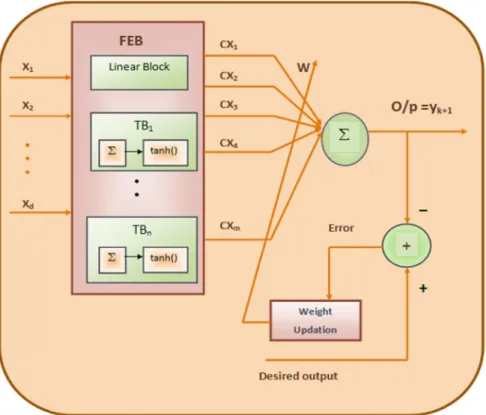
Computationally efficient FLANN is a single layer ANN having two components such as Functional expansion component and Learning component. In this network a set of highly nonlinear trigonometric basis functions are used in functional expansion block (FEB) that helps to capture the nonlinearity involves in the input space and to produce corresponding output space. The underlying betterment of the network lies in the fact of using an efficient FEB for input output mapping instead of using several hidden layers like traditional Multi Layer Perceptron network. Due to the single FEB, it possesses higher rate of convergence and lesser computational cost than those of a MLP structure. Unlike earlier FLANNS, where each input in the input pattern is expanded through a set of nonlinear functions, here all the inputs of the input pattern passes through a few set of nonlinear functions to produce the expanded input pattern.16e18 Fig. 1depicts the single layer computationally efficient FLANN architecture. With the order n any d dimensional input pattern X ¼ [x1, x2… xd] Tis expanded to a m dimensional pattern CX by Trigonometric
functional expansion as CX¼[cx1,cx2…cxd, cxdþ1,cxdþ2,…cxm]T¼[x1, x2…xd, cxdþ1,cxdþ2,…cxm]Twhere
m¼dþn. For each order n, a trigonometric block (TB) containing a summation and tanh ( ) function is present in the FEB. Along with n number of TBs, a linear block is also present in the FEB which simply transfers the input features to the first d components of the expanded pattern. For each order n, the weighted sum of the components of the original input pattern is passed through the hyperbolic tangent (tanh ( )) function to produce an output o which is stored in cxl
(with dþ1lm). Each oiis obtained using the following formula.
oi¼tanh ai0þ X i¼n;j¼d i¼1;j¼1 aijxj ! ð1Þ
Where aijis the associated parameter.
After expansion, weight is initialized for each expanded unit and then the weighted sum of the components of the enhanced input pattern produces the output y using the following equation.
yk¼
Xm j¼1
wjkcxj ð2Þ
Where wjkis the connection weight between jth expanded input and kth output layer node. The error obtained by
comparing the output with desired output is used to update the weights of the FLANN structure by a weight updating algorithm.
4. Extreme learning machine
Extreme learning machine is a recently introduced learning algorithm for single-hidden layer feed-forward neural networks (SLFNs) which randomly chooses the weights of connections between the input variables and neurons in the hidden layer and the bias of neurons in the hidden layer and analytically determines the output weights instead of iterative tuning.19ELM not only has the capability of extremely fast learning and testing speed but also tends to achieve better generalization performance. The main advantage of ELM is that the hidden layer of SLFNs need not be tuned and it can work with a wide range of activation functions including piecewise continuous functions.20e23With a given a set of N training dataset D¼(xi, yi), i¼1 to N where each xiis a d dimensional input pattern and yiis the
desired output, activation function for hidden layer nodes, H number of hidden layer nodes and a linear activation function in the output neuron, the output function of ELM for SLFN can be represented as:
yi¼
XH j¼0
wjhjðxiÞ ð3Þ
Where hj(x) is the activation function of hidden layer and W is the weight vector connecting the hidden layer neurons to output layer neuron. Equation(1)can be written as
Y¼MW ð4Þ
Where M is aN X (Hþ1)hidden layer feature mapping matrix in which ith row specifies the hidden layer's output vector for an instance xi. Equation(2)being a linear system can be solved by
W¼MJY¼ ðMTMþaIÞ1MTY ð5Þ
WhereMJ is the Moore-Penrose generalized inverse of matrix M,a>0 is the regularization parameter and I is the MM identity matrix.
The proposed approach uses the same concept of the ELM where the output weights are obtained analytically using a robust least squares solution including a regularization parameter. The use of least squares method with regulari-zation parameter will help in improving the performance of ELM in presence of noisy data.
5. Detailed steps of stock trading
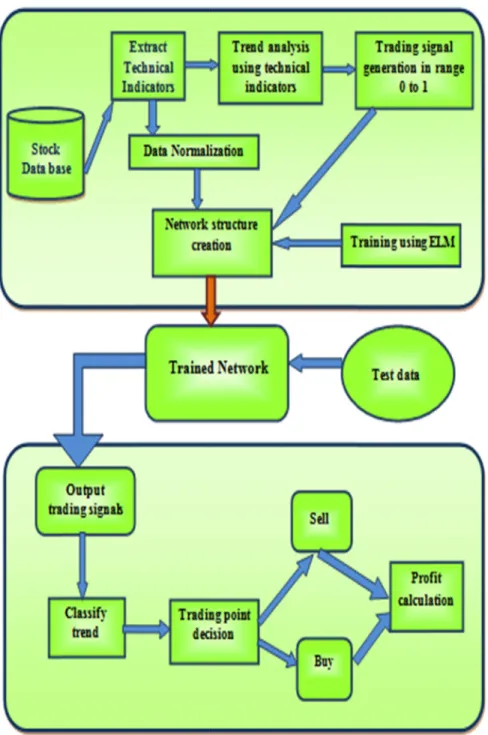
In this section, a novel decision support system using a computational efficient functional link artificial neural network (CEFLANN) and a set of rules based on technical analysis is proposed to generate the trading decisions more effectively. Instead of training the CEFLANN network using traditional back propagation algorithm, the ELM learning is proposed for the network. Six popular technical indicators calculated from the historical stock index price values are used as the input features for the proposed model. Here predicting trading decisions is cast as a classification problem with three class values representing the buy, hold and sell signals. Instead of using discrete class values during training of the network, a continuous trading signal within range 0e1 are fed to the network. The new trading signals in the range 0e1 helps to provide more detailed information regarding stock trading related to the original price variations. Further the outputs from the CEFLANN model is transformed in to a simple trading strategy with buy, hold and sell signals using suitable rules. The framework figure of the proposed model is shown inFig. 2.
The detailed steps of stock trading using CEFLANN model trained with ELM are as follows:
5.1. Step 1: extract technical indicators
In literature, researchers have used different types of technical indicators to monitor the future movement of stock prices and in setting up trading rules for buyesellehold decisions. In this study, six popular technical indicators i.e. MA15, MACD26, K14, D3, RSI14, WR14are chosen as input to the proposed model.
The technical indicators are calculated from historical prices as follows:
Simple Moving Average (MA):
It is the simple statistical mean of previous n day closing price, that normally smoothies out the price values. In this study value of t is set to 25.
MAt¼ 1 t Xt i¼1 cpðiÞ ð6Þ
Where cp(i) is the closing price.
Moving Average Convergence and Divergence (MACD):
MACD¼EMA12EMA26
EMAðiÞ ¼ ðCPðiÞ EMAði1ÞÞ MultiplierþEMAði1Þ
where Multiplier¼2=ðno of days to be consideredþ1Þ
ð7Þ
Stochastic KD:
Stochastic provides a mean of measuring price movement velocity. K% measures the relative position of current closing price in a certain time range, whereas D% specifies the three day moving average of K%.
K%ðiÞ ¼cpðiÞ Lt
HtLt
100
D%ðiÞ ¼ ðK%ði2Þ þK%ði1Þ þK%ðiÞÞ=3
ð8Þ Where cp(i) is the closing price, Ltis the lowest price of last t days, Htis the highest price of last t days.
Relative Strength Index (RSI):
RSI is a momentum indicator calculated as follows:
RSI¼100 100
1þRS
where RS¼ Average of t day's up closes
Average of t day's down closes
ð9Þ
Larry William's R%:
William's R% is a stochastic oscillator, calculated as follows:
R%ðiÞ ¼HtcpðiÞ
HtLt
100 ð10Þ
Where cp(i) is the closing price, Ltis the lowest price of last t days, Htis the highest price of last t days.
5.2. Step 2: trend analysis using technical indicators
Gaining profit or loss from stock trading ultimately depends on analysis of future movement of stock price values. In literature different technical indicators are used for successful classification of up and down movements in stock price index values. In this study rules using MA are used for classifying the stock market movement as upward (Uptrend) or downward (downtrend) as follows:
If closing price value leads its MA15and MA15is rising for last 5 days then trend is Uptrend i.e. trend signal is 1.
If closing price value lags its MA15and MA15is falling for last 5 days then trend is Downtrend i.e. trend signal is
0.
However, if none of these rules are satisfied then stock market is said to have no trend.
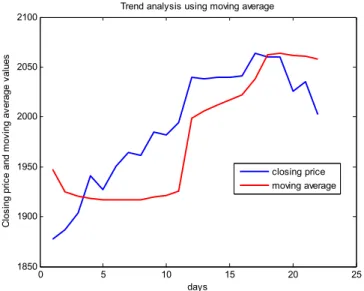
To illustrate the use of the above rules, Table 1 represents a sample time series data set representing the closing price and calculated moving average values. Using the specified rules the trend analyzed are specified in the third column of the table. The trend analysis of the sample dataset using moving average is also given in
Fig. 3.
5.3. Step 3: trading signal generation from trend analysis
Neural network models are supervised models, which need to be trained on existing input and output pattern. In our study the six technical indicators are taken as input and the model will produce trading decision of buy, sell or hold from the trend analysis. As buy, sell and hold are the discrete values and normally output of neural network is continuous values within range 0e1, so instead of using the discrete signal in training of network, trading signals in range 0e1 are generated using momentum of the stock prices. With reference to12e14a new trading signal is generated in range 0e1 reflecting the price variation. It also provides more detailed information to make precise stock trading decision. It provides more insightful information related to the movement of the stock price. The continuous trading signals Triare generated using following rules:
For up trend: Tri¼ ½cpimincp ½maxcpmincp0:5þ0:5 mincp¼minðcpi;cpiþ1;cpiþ2Þ maxcp¼maxðcpi;cpiþ1;cpiþ2Þ ð11Þ Table 1
Example of trend analysis on sample data set.
Time series Closing price MA Trend
1 1877.7 1947.537 down 2 1886.76 1925.195 down 3 1904.01 1920.275 down 4 1941.28 1918.208 no 5 1927.11 1916.938 no 6 1950.82 1917.248 no 7 1964.58 1917.027 no 8 1961.63 1916.814 no 9 1985.05 1920.144 up 10 1982.3 1921.038 up 11 1994.65 1925.467 up 12 2039.68 1998.583 up 13 2038.25 2005.992 up 14 2039.33 2011.893 up 15 2039.82 2016.909 up 16 2041.32 2022.221 up 17 2063.5 2038.003 up 18 2060.31 2062.456 no 19 2059.82 2063.689 no 20 2026.14 2061.979 down 21 2035.33 2061.086 down 22 2002.33 2057.725 down 0 5 10 15 20 25 1850 1900 1950 2000 2050 2100 days C los in g pr ic e and m ov ing av er age va lu es
Trend analysis using moving average
closing price moving average
For down trend:
Tri¼
½cpimincp
½maxcpmincp0:5 ð12Þ
Where cpi, cpiþ1, cpiþ2, are the closing price of the ith, (iþ1)th, (iþ2)th trading days respectively.
Table 2represents the trading signal generated from the trend analysis for the sample data set using the equations
(11) and (12).
5.4. Step 4: data normalization
Originally the six technical indicator values represent continuous values in different ranges. So the input data is scaled in the range 0e1 using the min max normalization as follows:
y¼ xxmin
xmaxxmin
ð13Þ Where y¼normalized value.
x¼value to be normalized
xmin¼minimum value of the series to be normalized
xmax¼maximum value of the series to be normalized
Scaling the input data ensures that larger value input attributes does not overwhelm smaller value inputs.
5.5. Step 5: network structure creation and training using ELM
CEFLANN is a single layer neural network with only an output layer. In this study we have used a network with six inputs representing the normalized six technical indicator values and one output neuron for producing the trading signals. The network performance varies based on the selected expansion order and learning technique used. So
Table 2
Example of trading signal generation from trend analysis for the sample data set.
Time series Closing price MA Trend Trading signal
1 1877.7 1947.537 down 0 2 1886.76 1925.195 down 0 3 1904.01 1920.275 down 0 4 1941.28 1918.208 no 0.2988 5 1927.11 1916.938 no 0 6 1950.82 1917.248 no 0 7 1964.58 1917.027 no 0.0629 8 1961.63 1916.814 no 0 9 1985.05 1920.144 up 0.6113 10 1982.3 1921.038 up 0.5 11 1994.65 1925.467 up 0.5 12 2039.68 1998.583 up 1 13 2038.25 2005.992 up 0.5 14 2039.33 2011.893 up 0.5 15 2039.82 2016.909 up 0.5 16 2041.32 2022.221 up 0.5 17 2063.5 2038.003 up 1 18 2060.31 2062.456 no 1 19 2059.82 2063.689 no 1 20 2026.14 2061.979 down 0.3607 21 2035.33 2061.086 down 0.5 22 2002.33 2057.725 down 0.5
initially with a suitable expansion order and random values of associated parameters used in expansion, the network is created. Further with the ELM learning, the output weights of the network is obtained analytically using a robust least squares solution including a regularization parameter. The regularization parameter value is set through a parameter selection process.
The working principle of the Computationally Efficient Functional Link Artificial Neural Network trained using ELM is detailed as follows:
Step 1: Choose a suitable expansion order n for functional expansion of CEFLANN.
Step 2: For each order n, randomly initialize the associated parameters and find a corresponding output component
oiby passing the weighted sum of the components of the original input pattern through a tanh( ) usingequation (1).
Step 3: Obtain the expanded input pattern by joining the s dimensional input vector with n number of oicomponents
as the output of the functional expansion block (FEB) and represent it as matrix M specified inequation (4).
Step 4: Find the output weight matrix W using robust least square solution as specified inequation (5).
Step 5: Finally generate the output of the network as the weighted sum of the components of the enhanced input
pattern CX using theequation (2).
5.6. Step 6: trend determination from output trading signal
After the training process, a new set of test data is applied to the trained network to produce a set of outputs. Output value of the network is the trading signal (OTr), i.e., the continuous value in range 0e1. To make trading decision, it is first required to track the trend and decide when to trade. The uptrend and down trend are classified from the output trading signals (OTri) using the following rules:
If OTri>meanðTrÞpredicted trend is upð1Þ
else predicted trend is downð0Þ ð14Þ
Table 3represents the output trading signal obtained from the network and the determined trend using equation(14)
for the sample data set. Here the mean (Tr) is considered as 0.5.
Table 3
Example of trend determination from output trading signal over the sample data set.
Time series OTr Trend Trading decision
1 0.1394 Down 2 0.0828 Down 3 0.0756 Down 4 0.3178 Down 5 0.0601 Down 6 0.153 Down 7 0.0445 Down 8 0.6975 Up buy 9 0.8558 Up 10 0.7318 Up 11 0.6696 Up 12 0.9103 Up 13 0.7158 Up 14 0.8436 Up 15 0.5323 Up 16 0.7417 Up 17 0.86442 Up 18 0.8907 Up 19 0.8433 Up 20 0.2254 Down sell 21 0.3474 Down 22 0.4195 Down
5.7. Step 7: trading point decision from predicted trend
After obtaining the stock movement direction, trading points are obtained using straightforward trading rules as follows:
If the next day trend¼Uptrend then decision is BUY If Buy decision exists then HOLD
If the next day trend¼Downtrend then decision is SELL If SELL decision exists then HOLD
ð15Þ
The fourth column ofTable 3represents the trading decision taken from the predicted trend using rules given in equation(15)for the sample data set.
5.8. Step 8: Profit Calculation
The main parameter adopted for performance evaluation is the profit percentage obtained during the test period. The profit percentage is generated from a combination of buy and sells transactions as follows:
Profit %¼P k i¼1 cpsicpbi cpbi100
Where k¼number of transactions
cpsi¼selling price of i th transaction cpbi¼buying price of i th transaction ð16Þ 6. Empirical study
In this section the performance of the proposed model is validated for stock trading problem by applying it on two benchmark stock index data sets. The model performance is also compared with some other known classifiers like support vector machine (SVM), Naive Bayesian model, K nearest neighbor model (KNN) and decision tree (DT) model.
6.1. Dataset description
Five years of historical stock index price values of two stock indices (BSE SENSEX and S&P 500) are used in this study. Initially both the data sets are divided into training and testing sets. For BSE data set the training set consists of 1000 patterns and remaining 208 patterns are used for testing and for S&P dataset the training set consists of 1000 patterns leaving the 221 patterns for testing.
The detail of the data set is given inTable 4. Initially the six technical indicators are extracted from the historical prices and normalized using min max normalization to be fed as input to the network.Table 5summarizes the sta-tistical analysis of the selected technical indicators for both the stock indices. As the aim of the study is to derive short term trading points from trend analysis, so MA15has used for finding initial up down movements of the stock prices.
Instead of using discrete value as output during training of the network, continuous trading signals are generated from the trend and used during training process.
Table 4
Data set Description.
Data set Period
BSE SENSEX 4- Jan- 2010 to 31-Dec-2014
6.2. Parameter setup
For CEFLANN with order n, input size s, the number of associated parameters used in functional expansion is n(sþ1) and number of weights between expanded pattern and output neuron is (n þs). Hence total number of unknown parameters need to be tuned by a learning algorithm is (nþs)þn(sþ1). Using ELM the n(sþ1) number of associated parameters are chosen randomly, and the remaining (nþs) number of parameters are obtained using the equation(5). The performance of the proposed model depends on different factors like the order of expansion, value of regularization parameter, input space size and so on. So initially through a number of simulations the controlling parameters of the model are derived.
6.3. Experimental result analysis
The generalization ability of the network is measured through a 5 fold cross validation approach applied on the initial 1000 samples taken as training dataset. The training dataset is divided into 5 groups, where first 4 randomly
Table 5
Summary statistics of selected technical indicators.
Data set Technical Indicators Min Max Mean Std
BSE SENSEX SMA 1.5782eþ004 2.8200eþ004 1.9515eþ004 2.9019eþ003
MACD 562.6344 597.0689 59.0154 218.5564
K% 1.6954 99.3916 56.2792 32.1840
D% 4.4787 97.3337 56.2341 29.2545
RSI 5.0617 95.4554 53.9376 18.0426
LW R% 98.3046 0.6084 43.7208 32.1840
S&P 500 SMA 1.0739eþ003 2.0565eþ003 1.4705eþ003 286.2986
MACD 42.4684 25.6214 5.1836 12.0395
K% 0 100 64.7144 31.4893
D% 1.5690 99.1513 64.6599 28.1762
RSI 9.3436 99.2987 57.1475 16.5881
LW R% 100 0 35.2856 31.4893
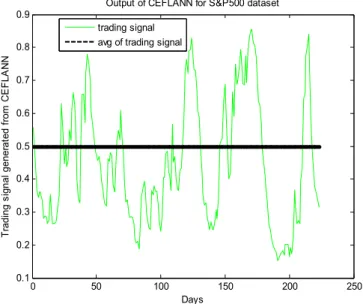
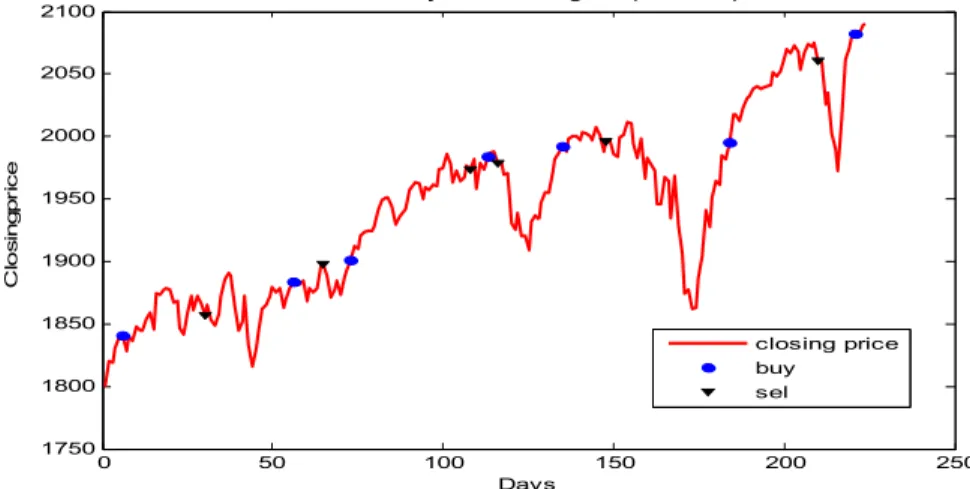
chosen groups are used for training and remaining one is used for validation. The average performance out of the 20 independent runs is considered for both the dataset. Finally the trained network is applied on the test pattern i.e., the out of sample data, which has not been used during training and validation.Figs. 4 and 5show the trading signals generated from the CEFLANN model for both the dataset. The black line represents the average value of the trading signals obtained from the network, which is used as the threshold value for finding up trend and down trend. Further using the rules of equation(15), the trading points are generated.
Figs. 6 and 7represents the initial trading points generated using the technical indicator MA15. Trading points
predicted by using the proposed model for both the data set are shown inFigs. 8 and 9. The overall performance of the model compared to other soft computing techniques like SVM, Naïve Bayesian, KNN and decision tree (DT) for the two dataset are shown inTables 6 and 7respectively. Through a series of experimental tests, the proposed model consistently generates highest profit among others.
Fig. 5. Output trading signal obtained from CEFLANN model for S&P500 data set.
Fig. 8. Trading points from CEFLANN model for BSE SENSEX data set.
Fig. 9. Trading points from CEFLANN model for S&P500 data set. Fig. 7. Initial Trading points generated using MA15for S&P500 data set.
7. Conclusion
This study has proposed a novel decision support system for developing efficient stock trading strategies, which may provide attractive benefits for investors. The model has integrated technical analysis with machine learning techniques for efficient generation of stock trading decisions. In this study the problem of stock trading decision generation is cast as a classification task. A classification model using the computational efficient functional link artificial neural network (CEFLANN) with ELM learning approach is proposed for generating the stock trading decisions. The outputs from the CEFLANN model is transformed in to a simple trading strategy with buy, hold and sell signals using suitable rules. From the experimental result analysis it is clearly apparent that the proposed model provides superior profit percentage compared to some other known classifiers such as support vector machine (SVM), Naive Bayesian model, K nearest neighbor model (KNN) and decision tree (DT) model. Hence instead of taking trading decision based on particular technical indicators, it is more profitable to take trading decision using combi-nation of technical indicators with computational intelligence tools.
Further the work can be extended by validating the proposed model over more real world datasets. More work will be done on structure optimization of the model by using efficient optimization algorithms such as differential evo-lution, harmony search, shuffled frog leaping algorithm and soon. More technical analysis will also be explored in future.
References
1. Kablan A. Adaptive neuro-fuzzy inference system for financial trading using intraday seasonality observation model.World Acad Sci Eng Technol. 2009;58:479e488.
2. Teixeira LA, De Oliveira ALI. A method for automatic stock trading combining technical analysis and nearest neighbor classification.Expert Syst Appl. 2010;37:6885e6890.
3. Rodríguez-Gonzalez A, García-CrespoA, Colomo-Palacios R, Iglesias FG, G omez-Berbís JM. CAST: using neural networks to improve trading systems based on technical analysis by means of the RSI financial indicator.Expert Syst Appl. 2011;38:11489e11500.
4. Brasileiro RC, Souza VL, Fernandes BJ, Oliveira AL. Automatic method for stock trading combining technical analysis and the artificial bee colony algorithm.IEEE Congr Evol Comput (CEC). 2013, June:1810e1817 [IEEE].
5. Kara Y, Boyacioglu MA, BaykanOK. Predicting direction of stock price index movement using artificial neural networks and support vector€ machines: the sample of the Istanbul stock exchange.Expert Syst Appl. 2011;38:5311e5319.
6. Patel J, Shah S, Thakkar P, Kotecha K. Predicting stock and stock price index movement using trend deterministic data preparation and machine learning techniques.Expert Syst Appl. 2015;42:259e268.
7. Wysocki A, Lawrynczuk M. An investment strategy for the stock exchange using neural networks. In:Federated Conference on Computer Science and Information Systems (FedCSIS). 2013, September:183e190 [IEEE].
Table 6
Performance comparison of stock trading models on BSE SENSEX data set. Performance metrics Actual
(Using MA15)
CEFLANN SVM Naïve Bayesian KNN DT
No. of Buy signals 7 11 6 8 13 9
No. of hold signals 194 186 196 192 182 190
No. of sell signals 7 11 6 8 13 9
Profit % 25.8282 47.2007 35.8099 42.3267 30.8015 33.4523
Table 7
Performance comparison of stock trading models on S&P500 data set. Performance metrics Actual
(Using MA15)
CEFLANN SVM Naïve Bayesian KNN DT
No. of Buy signals 6 9 9 10 16 13
No. of hold signals 209 203 203 201 189 195
No. of sell signals 6 9 9 10 16 13
8. Wen Q, Yang Z, Song Y, Jia P. Automatic stock decision support system based on box theory and SVM algorithm. Expert Syst Appl. 2010;37:1015e1022.
9. Ballings M, Van den Poel D, Hespeels N, Gryp R. Evaluating multiple classifiers for stock price direction prediction.Expert Syst Appl. 2015;42:7046e7056.
10. Wu MC, Lin SY, Lin CH. An effective application of decision tree to stock trading.Expert Syst Appl. 2006;31:270e274.
11. Lee JW, Park J, Lee J, Hong E. A multiagent approach to Q-learning for daily stock trading.IEEE Trans Syst Man Cybern Part A Syst Humans. 2007;37:864e877.
12. Chang PC, Fan CY, Liu CH. Integrating a piecewise linear representation method and a neural network model for stock trading points prediction.IEEE Trans Syst Man Cybern Part C Appl Rev. 2009;39:80e92.
13. Chang PC, Liu CH, Lin JL, Fan CY, Ng CS. A neural network with a case based dynamic window for stock trading prediction.Expert Syst Appl. 2009;36:6889e6898.
14. Chang PC, Liao TW, Lin JJ, Fan CY. A dynamic threshold decision system for stock trading signal detection. Appl Soft Comput. 2011;11:3998e4010.
15. Chen MY. A high-order fuzzy time series forecasting model for internet stock trading.Future Gener Comput Syst. 2014;37:461e467. 16. Bebarta DK, Biswal B, Dash PK. Comparative study of stock market forecasting using different functional link artificial neural networks.Int
J Data Analysis Tech Strategies. 2012;4:398e427.
17. Dash R, Dash PK, Bisoi R. A self adaptive differential harmony search based optimized extreme learning machine for financial time series prediction.Swarm Evol Comput. 2014;19:25e42.
18. Rout AK, Dash PK, Dash R, Bisoi R. Forecasting financial time series using a low complexity recurrent neural network and evolutionary learning approach.J King Saud Univ Comput Inf Sci. 2015.
19. Huang GB, Zhu QY, Siew CK. Extreme learning machine: theory and applications.Neurocomputing. 2006;70:489e501. 20. Huang GB, Wang DH, Lan Y. Extreme learning machines: a survey.Int J Mach Learn Cybern. 2011;2:107e122.
21. Huang GB, Zhou H, Ding X, Zhang R. Extreme learning machine for regression and multiclass classification.IEEE Trans Syst Man Cybern Part B Cybern. 2012;42:513e529.
22. Bueno-Crespo A, García-Laencina PJ, Sancho-Gomez JL. Neural architecture design based on extreme learning machine.Neural Netw. 2013;48:19e24.
23. Luo M, Zhang K. A hybrid approach combining extreme learning machine and sparse representation for image classification.Eng Appl Artif Intell. 2014;27:228e235.